Feeds:
Posts
Comments

Archive for the ‘David Foster Wallace’ Category

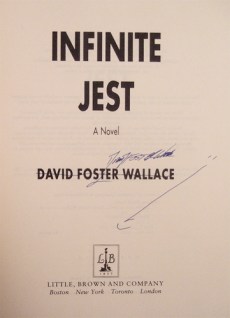
dfw-title-pageSOUNDTRACK: GARBAGE-Garbage (1995).

garbageI was thinking about how IJ reminds me so specifically of a place and time (I instantly think of the apartment I was in when I started reading it).  And there are also some discs that I was crazy about at the time too.

I very distinctly remember when the first Garbage single “Vow” came out.  I remember seeing it in Newbury Comics [the absolute best record store chain, ever] on Newbury Street and it was plastered with stickers about how it was the new band from Butch Vig and he had produced every popular alt record in the 90s and blah blah blah.  But so I basically got Vigged out and didn’t bother listening to it.

Strangely, I don’t remember what changed my mind about them.  I assume I heard the first proper single “Queer” and instantly fell in love with the band.

It makes me laugh that the band was initially marketed as Butch Vig and two other high-profile producers got together and made this great music and they found this unknown Scottish woman to from the band.  And then, shortly there after the band was Shirley Manson and three unknown guys.  Heh, prettiness wins out.

Garbage was at a record store in downtown Boston that year.  I went down, but went to the wrong location (Doh!) and by the time I got to the right one, the line was too long and I was told I wouldn’t get in.  Alas. (Hey, I’ve still got my autographed poster from The Verve before they released “Bittersweet Symphony.”)

This album was in very heavy rotation at my house at the time.  I must’ve listened to it 1000 times.  But this is the first time I’ve listened to it in awhile.  It’s hard for me to be critical of it since I know every nook and cranny.  But listening to it today I think it is still pretty damned awesome.  The vocals are tight and creepy/sexy.  The songs are all solid rocking/catchy.  And the production is superb (obviously).

Not a bum track on the whole release, even 14 years later.

[READ: Week of August 24] Infinite Jest (to page 729)

There has been much discussion here on the forums and here between me and Infinite Tasks about the IJ timeline.  There is the pretty glaring observation that M.P. tried to kill herself  on November 7th, was in the hospital for five days and then appears in Ennet House on November 8th.

In last week’s reading, the WYYY engineer is musing about M.P.  He was told that she was hospitalized, and I considered that maybe that five day gap came BEFORE she tried to kill herself (for otherwise, how to explain that Mario missed her radio show sometime in late October?).  And yet that doesn’t seem to jibe with the fact that she’s apparently in there for an overdose.

A new timeline issue may be cropping up in this week’s reading.  A green Nunhagen-sponsored car appeared during the Escahton match.  We learn this week that Steeply is driving a Nunhagen-sponsored car.  But she arrives during the Hal/Stice tennis match, three days after Eschaton.  Has she been trying to get into E.T.A. for three days?  But, also, note that she left AZ, and Orin met the Swiss hand model (and Orin is having his second go -round with her during the match), early on the 11th (I think).  So I don’t think Helen could have been at ETA during the Escahton match.  Is there a second gunman green car?

This timeline stuff bugs me mostly because I feel like IJ is really fantastic.  And I assume that DFW spent a lot of time on it. (Certainly more time that I am spending reading it!). I imagine him with charts and graphs and circles and arrows explaining where everyone is at any given time.  Now, there are a number of conceivable explanations for the mistaken timeline:

  • Most of the stories about Madame Psychosis are second-hand, so they could be wrong.
  • There is ample evidence that people in this book are crazy and therefore not to be trusted.
  • And of course, there’s always the possibility that DFW just screwed up.

If this final option is the reality, I won’t be devastated.  I don’t think the book hinges on a few minor timeliness issues.  But I will be a bit surprised.  DFW seems like such a meticulous guy (I mean, geez, look at the detail he puts into his scenes) so it would be really surprising if he got timeline issues messed up.

There is always the possibility that these issues will be cleared up, after all, he ties up so many loose threads, but I suspect they won’t.  And that’s okay.  I won’t turn into Steeply’s father poring over every page and keeping a journal in little notebooks (that’s what the blog is for!)

ijdot1It is incredible serendipity that I did the JOI filmography during this week as this week’s readings actually count on knowing a bit about it.  And since I had just reevaluated it, I was aware of a thing or two during Hal’s viewing scene.

ijdot1Week 10 starts off seeming like a lot of nothing is happening.  There’s a few post-Event scenarios.  Until we get to November 14th, and a whole lot goes on.  A whole lot! (more…)

Read Full Post »

ny[READ: August 27, 2009] “Perfect Match”

This is my second un-“regular” Infinite Jest-related post this week (it’s getting a little out of hand).

I would normally not read a 6 page article about doubles tennis.  But, since we’re in the midst of a heated tennis battle between Hal and Stice, it seemed like mandatory reading.

First off, Burkhart Bilger (wonderfully near-fictional name notwithstanding) is no David Foster Wallace.  While his writing style is much more streamlined, I feel that his passion for tennis is not quite as strong.

Nevertheless, the article was really fascinating.  It’s not available online, but the abstract is here.  I was particularly struck by the explanation that a good doubles game can only help your singles game.  Singles has become very baseline dominated, while in doubles there is a lot more running to the net, giving for broader skills.

Of course, the more IJ-related stuff concerns a) eating.  Bob Bryan says that if he eats just three meals he will lose 3-5 pounds in a day (!) and b) the synchronicity of twins during doubles. (more…)

Read Full Post »

blackSOUNDTRACK: SONIC YOUTH-SYR 4: Goodbye 20th Century (1999).

syr4This SYR recording consists of Sonic Youth’s interpretations of 20th century composers’ works.  Some of the composers are obscure, but a few are more or less household names: John Cage, Yoko Ono, maybe Steve Reich.  I knew a few of these composers from Kronos Quartet, but for the most part the pieces are all new to me.  Since I don’t know the original pieces I have no idea how faithful they are.

The most fascinating thing about the disc is the CD-ROM video of “Piano Piece #13 (Carpenter’s Piece)” which shows the band performing.  The “song” is literally the band nailing the keys of a piano down.

There are a number of guests on the CD, including the first (I think) performance by Coco Haley Gordon Moore (on the 17 second “Voice Piece for Soprano”).  And, the liner notes are all in English.

This is the longest SYR disc (at over an hour and a half) and it is a fascinating mix of noises and sounds and screams and spoken bits (okay okay okay okay okay okay okay).

This is not for everyone, not even the average Sonic Youth fan.  There’s absolutely nothing in the way of “songs” here.  The abstractness of the disc is palpable.  And, clearly, just knowing that one of the pieces is a bunch of people nailing keys of a piano, you get a fair idea of the breadth of “music” that the disc covers.

[RE-READ August 19th] J.O.I. Filmography

Before reading this week’s section, I had noticed that many people on Infinite Summer (and elsewhere) have discussed James’ films and how they relate to incidents in the overall story.  So, I decided to go back and re-read his filmography Endnote, just to see what else I could learn.

In general, with more background, the Endnote is much more interesting. The first batch of films are more amusing to read about just to see the emphasis on pain and disfigurement.  We also see that he had been using students and teachers from E.T.A. in his films for a while.

We have had an in-depth look at some of these earlier films: The Medusa v. The Odalisque; Homo Duplex, The Joke, The ONANtiad (which the endnote describes as unfunny).  But the ones we haven’t seen show distinct commentary about the state of the country since the Reconfiguration (it’s clear that J.O.I. was against it).  The American Century As Seen Through a Brick deals with anti-O.N.A.N. riots; The Universe Lashes Out is about the evacuation of New Hampshire during the Reconfiguration; Poultry in Motion concerns the toxification of Thanksgiving Turkeys; and No Troy is about miscalibrated Waste Displacement Units that crashed into Troy, NY (which was mentioned in the scene about people looking for entertainment outside of their living rooms).

[Unrelated to the story, on page 990 of my paperback IJ (with forward by Dave Eggers) every italicized word contains a superscript 1 after it (indicating, what? more footnotes?) It is an astonishingly weird glitch/typo and I can’t believe that it wasn’t spotted before going to print as it makes the titles actually harder to read.] (more…)

Read Full Post »

ny1It took me going to Seattle to learn about The New Yorker magazine.  I was visiting my friend Rob and he was really surprised that I didn’t read the magazine all the time (my reading always seems to surprise people, see The Believer.)

Upon my first read of the magazine, I was surprised to see that the first twenty pages or so are taken up with upcoming shows: films, concerts, sports, everything.  I actually wondered how much content would be left after all that small print.

Since then I have learned that Sasha Frere-Jones writes columns in here quite ofuiten.  For reasons known only to my head, I was convinced that Sasha was a black woman.  Little did I realize that he is not.  And that he was in a band that I have a CD of called Ui.  He is an excellent resource for all things music, whether I like the artist he’s talking about or not.  Some entries are here.  This audio entry about Auto-Tune is simply fantastic.

But of course, there’s a lot of content.  And the first thing you get are letters.  I don’t think I have EVER looked at the letters section. (more…)

Read Full Post »

ij8SOUNDTRACK: SONIC YOUTH-Experimental Jet Set, Trash & No Star (1994).

ejstns“Bull in the Heather” is one of my favorite Sonic Youth songs.  I love everything about it (even if I haven’t got a clue what it’s about): the simple opening, the switch to harmonics, and, my favorite part, the drum break that leads to the chorus (who ever heard of getting a drum break stuck in your head?).

There’s a lot to speak for this disc even though it seems to be overlooked (as the empty spot between Dirty and Washing Machine).  Take the absolute variety of textures, and the almost surreal mixtures of styles within (short) songs (like “Bone” which opens with super fast paced drumming and howls from Kim and then breaks into a very mellow (and catchy) chorus).

For sheer variety: the disc opens with an acoustic guitar strummer by Thurston (“Winner’s Blues”), and then, after the single “Bull in the Heather,” there’s the 2 minute noise-fest “Starfield Road.”  This is followed by the cool and catchy “Skink,” which is like Kim’s version of the slinky and cool “Self-Obsessed and Sexxee.”  This is definitely Kim’s disc, she sings about half of the songs, and shows a great variety of styles here.

“Androgynous Mind” is one of those weird songs that has a wonderfully catchy vocal line but where the music is pretty much abstract nonsense.  And speaking of catchy, this disc continues with SY’s notion of sing along choruses (even if what you’re singing doesn’t make a lot of sense (“Screaming Skull” fits that bill perfectly)).  And then “Quest for the Cup” does a 90 degree turn after the intro.  All of these shifts and changes occur in less than half an hour.

The last 20 minutes or so settle the disc down somewhat (except for the brief “In the Mind of the Bourgeois Reader,” but the 7 minute closer “Sweet Shine” ends the disc on a mellow note.

This is also the last SY disc produced by Butch Vig.  Vig’s production is often described as clean. But Vig doesn’t clean up the noise that SY makes, he just makes it, I guess, crisper would be a better word.  Compare the way that Garbage’s “Vow” opens with a big grand noise and then stops dead after a few seconds.  Vig seems to be a master of controlling noise to make it stand out more.  And in that respect, his technique really shines through on this disc…it feels almost mechanical in its precision.

From this point forward, Sonic Youth would break away from this style of music into a freer and looser almost jazz feel, so even if the album title doesn’t make literal sense, it describes the disc quite well.

[READ: Week of August 10] Infinite Jest (to page 589)

Last week, showed Gately’s car speeding through Cambridge.  He runs over a discarded cup which we follow as it sails down the street and hits the Antitoi’s door.  It was very cinematic.  Discussions abound about whether IJ could (or should) be filmed.  I’m not going to add to that discussion but I did want to mention what I see as the filmic way the book written.

In many movies you are introduced almost casually to many of the protagonists, seeing them in their most typical place of employment or hang-out spot or some such thing.  And in films, it doesn’t seem that weird to get a two minute or even 30 second establishing shot of character A before jump cutting to character B.

And that’s how IJ starts, with all of these jump cuts, establishing shots, of characters.  Clenette’s scene is hard to read, but if you saw it in a movie, you’d say, okay that’s her character.  And, for the most part you would expect her to reappear later in the movie. I’m not sure what anyone expects to happen in IJ, so who knows what we think the Clenette scene is about, but realistically, the character has to come back, even if what she said didn’t make any sense at the time.

And as movies go, so does the book, cutting back and forth between scenes building the stories along as they inevitably intertwine.

It’s also not unheard of to have what seems like it may be the end of the chronological story appear first (we haven’t seen any return to the Year of Glad yet).

And so, yes I will say a thing about the filmic possibilities of  this book.  Sure the book is long, and yet so much of the book is description, stuff that in a movie can be done with an establishing shot, even a slow one.  The whole Joelle/overdose scene which covers so many pages could be filmed rather quickly.  So could Eschaton. The question of course is how much would be lost in translation.  And that I can’t answer (although I expect quite a lot).

Be a hell of a film, though.

ijdot

So, in a few places, especially on Infinite Tasks, people have been mentioning some crucial information that happens on Page 17.   I felt bad that I didn’t recall anything that happened on page 17, so I went back and re-read this section (and how weird is it to re-read parts of a book that you haven’t even finished yet?)

And so Page 17 feels like a major spoiler!  It feels like so much is given away!  It feels like such an essential part of the story that it’s amazing how it’s sort of tossed off in a hallucinatory sequence.

I think of John N.R. Wayne who would have won this year’s WhataBurger, standing watch in a mask as Donald Gately and I dig up my father’s head.  There’s very little doubt that Wayne would have won.

Wow.  So much packed into those two sentences!  Holy cow.

And, the end of that sequence has an orderly ask Hal, “so, yo, then man what’s your story?”

Is that the device that sets up that Hal is telling this whole book?  I just blew my mind.

ijdot

This week’s reading begins with the aftermath of The Escahton debacle.  Or the precursor to the aftermath, anyway.  And it features the color blue. A lot.

It also gets to a question I’ve been puzzling about for sometime: why isclouds every IJ book jacket/promotional material designed in a sort of cloud motif. Well, in the section we lean that Uncle Charles’ office is decked out in an unsettling cloud wallpaper (which is coincidentally the same wallpaper as Hal’s dentist).  It has only appeared briefly so far, so it seems odd that it would take on such an iconic feel.  But we’ll see if it comes back.

(more…)

Read Full Post »

ij7SOUNDTRACK: VOIVOD-Nothingface (1989).

nothingfaceIn light of Marathe and the Antitois, and Quebec separatists everywhere, I figured I’d mention my favorite CD by a rocking Quebecker band.  When Voivod started they were a rumbling thrash band.  They put out an album with the wonderful title of RRRÖÖÖAAARRR.  They were very fast, very loud, and their singer had a really peculiar delivery style.  I later learned that this was because he’s a Quebecker and French is his first language.  Since he sings in English, his stresses and emphases are off-kilter, (and the guitarist seems to play to this particular feature, so the music is off-kilter as well) making for a very surreal experience.

They were probably my first inroduction to really cool French names.  Because even though they had stage names (Piggy, Blacky, Snake, and my personal favorite: Away) their real names were foreign and cool like Denis D’Amour and Jean-Yves Theriault.

Nothingface is the pinnacle of their prog-creative energies.  It is a fantastic progressive-rock/heavy metal hybrid.  There are fascinating time-changes, with cool atmospheric aspects that counterpoint the heavy sections.  And the overall theme of the album is technology gone awry.

On their previous records, melody was not really evident.  And it’ hard to believe that a disc that is so full of time changes could still be melodious.  Yet the bridge of “Nothingface” is quite pretty, which, again, counterbalances the weird chord structures of the solo section.  There’s even an awesome cover of Pink Floyd’s “Astronomy Domine” that adds some cool metal guitars to an already trippy song  The Floyd version is spacey and psychedelic.  Voivod add an element of menace to the song.  Very cool.

And then there’s a song like “Missing Sequences” which has 4 different sections in the span of less than two minutes.  An opening that is slow and spacey, interrupted by a loud “Now!” which brings to a weirdly chorused verse that morphs into a rough staccato bridge followed by a speedy guitar break and then yet another verse style.  By the time we hit the 2:30 mark, the song breaks down into a bass-only sequence.  And then it mostly repeats itself. That is, until the ending minute which is something new entirely.  It sounds impossible on paper and yet it is done seamlessly and is one of my favorite tracks on the disc.

There’s also the weirdly propelling and compelling “ground and rock and sand come crumble tumble down” sequence of “Pre-Ignition” that throws a cool catchy riff in the midst of a fast charging song.  And “Into My Hypercube” has some fantastic riffs, including another really cool bass-only section.

And the whole album works great with headphones.

In the 1990s, metal bands experimented with lots of different genres and effects, but it was this 1989 release that really highlighted what kind of fantastic music you could make within the strictures of heavy metal.  Voivod makes some pretty unusual sounds with their instruments (guitar most of all), and the album can be a challenge, especially if you like you music light and easy), but for me, this is one of the best discs around.

[READ: Week of August 2] Infinite Jest (to page 508)

50% through.
Halfway House, er, I mean Half Way Home.
Thoughts:

The rewards are coming quickly now.  There seems to be a payoff every few pages.  I am totally loving this book and the environment it has created.

Since the Boston Marathon is mentioned in the book, I’ll say that we are currently at the 14 or so mile point (downtown Wellesley).  Congratulations, you have just made it through “Screech Tunnel.”  [See the Boston Marathon route here.]

ij

I’ve been going on and on about chronological years and when exactly Subsidized years started.  I even quoted other people who had calculated the actual year that Subsidized time was set up.

And, of course, all this time, all we had to do was to look at the NAME of the Year of Yushityu 2007 Mimetic-Resolution-Cartridge….  As this clever thread shows, others figured out pretty early in the reading that the 2007 in the year was a pretty big clue as to what year Subsidized Time began.

(Presumably non O.N.A.N. countries do not follow Subsidized Time?  And the, again, presumably Japanese made Yushitsu is on numerical-year-time.  Or is that a thread that has already been discussed already?).

I am pretty embarrassed to have realized this at this late a date, and I’m delighted that everyone let me figure it out for myself (and that no one was cruel enough to rub it in.)

Now if you wanted to argue against the Yushityu 2007 as a dead giveaway to the year, you could say that, for instance, Microsoft Products don’t always indicate the year that they came out.  But for confirmation of Yushityu, we can use a perpetual calendar.

We learned that November 7th is the the day of the exam that Schacht is taking.  This is a Saturday class.  The perpetual calendar show that Nov 7th falls on a  Saturday in 2009.  Therefore YDAU=2007.   I’ve been trying to use all this logic to puzzle this information out, and here the author basically just TELLS us it from–well, not the get go exactly–but from a pretty early point.

All of this self-flagellation is also because of my own lack of clock-watching in the book.  I have somewhat obtusely not been following the chronological dates very carefully.  It was only when I consciously realized that Marathe and Steeply are having their mountainside chat in April/May of the YDAU when all of the events at E.T.A. and Ennet House are taking place in November that it dawned on me that the time line was not only present, it was pretty important.

So, I spent some time crafting a general timeline of events–something I haven’t seen anywhere else, (but then I haven’t actively been looking for it because I don’t want to get Spoiled).   So at the end of this post I’m going to put my timeline of events thus far. I’ll see how important it is to update it in future posts.

But now on to the book:

This week’s reading jumped back and forth between topics a bit more frequently. (more…)

Read Full Post »

ij4SOUNDTRACK: The Best Albums of the Year

morningAndrew Womack, fellow Infinite Summer player and founder of The Morning News has begun retroactively listing The Best Albums of the Year for each year since 1978.  This is a project that I have often thought about doing myself, yet never had the time to sift through all the music I have.

I was delighted to see how much I not only knew, but also agreed with his decisions.  Although if I’m honest, my list would have more metal and less new wave in it.  But the overall tenor is pretty on par with my feelings.

But, imagine my surprise to see that on the 2004 list I barely knew any of the discs at all!  I wonder what happened to make us diverge so much in that one year.

Anyhow, it’s a noble, well, not noble so much as worthwhile pursuit.  One that we can all enjoy.

[READ: Week of July 27] Infinite Jest (to page 434)

In the August 2009 issue of Wired, they have a little scroll across the bottom of one of the pages that lists  “Word Counts”.  King James Bible: 784,806; Where the Wild Things Are: 338; Infinite Jest: 483,994.  So, at almost halfway done we’ve read over 240,000 words!

Also, I haven’t sufficiently acknowledged some of my fellow Infinite Summer bloggers.  So I want to send a shout out to Infinite Tasks.  I especially enjoyed this post which takes a decidedly more philosophical approach than I did about a section that I found really enjoyable.  And Chris Forster, who gives a lovely discussion about Eschaton.  And I would be remiss if I did not mention Infinite Zombies, just because he may have written a letter here but his posts always get sucked up into spam, so I’ll never know.  (And because the posts are really thoughtful and worth reading too).

But enough back patting, onto the book.

solIt was a fun place to pick up reading.  At the small paragraph where I left off, we learn that the Statue of Liberty’s book now advertises that year’s Subsidizer.
On a couple of occasions there is the suggestion that the year 2000 is the first year of Subsidization, as they talk about things being different in the new millennium.  Although Matthew Baldwin’s argument here is very convincing which would make Subsidization begin in 2002.

And then we return to A.A.

(more…)

Read Full Post »

this-is-waterSOUNDTRACK: SONIC YOUTH in concert from NPR (July 7, 2009 at Washington DC’s 9:30 Club).

syI’m not sure how I learned that this show was online.  But I was pretty delighted to see NPR hosting a live Sonic Youth show (this is actually the 2nd Sonic Youth show they’ve hosted and the older one is still online.  Sorry, the previous concert is removed, but there’s a three song set from WXPN (with interview) available here).

The coolest aspect of this is that it is downloadable.  The uncool aspect is that it is one long stream, so it’s not easy to split.  Although they do give a track listing, which is nice.

This is a good, if somewhat mellow show.  It features all of their new album, The Eternal, as well as a few choice oldies: “Hey Joni,” “Shadow of a Doubt,” and the opener, “Tom Violence.”  There’s not a lot of crazy noise, and most of the songs don’t last more than 4 or 5 minutes.  In fact, the photos show pretty standard guitar setup (no drum sticks in guitar strings or anything).

I was only able to listen on really crappy headphones, which I ‘m sure do nothing to the layers of noise that the band produces, but as soon as I can get it switched over for car playing, I’m sure it’ll bust out the speakers.

The whole set is about 90 minutes.

And if anyone knows just what is going on at the 59 minute mark (just before “White Cross”), and possibly even what song that is, let me know!”

[READ: July 26, 2009] “This is Water” [sort of]

I hadn’t been planning to read any other DFW pieces before I finished Infinite Jest (why, I figured, confuse the issue?).  But when I was looking around Amazon for something or other, I saw this “new” book and was obviously intrigued.  Then I read the reviews, and almost every review (both 1 and 5 star) said that it is a speech from 2005 commencement at Kenyan College and that it’s available online.

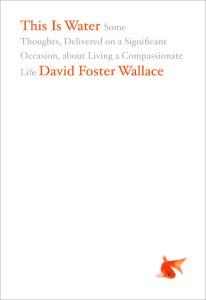
But now, with the publication of the book, it pretty much isn’t available online anymore.  [I found my copy though the Internet Archive, and marginalia.org.]  The copy that I have isn’t exactly the same as the book (in the only part I compared, the word “uniquely” appears in the book where it didn’t in the transcript, while at the same time, in the transcript there’s a preface that is funny and endearing which isn’t in the book).  But for all intents and purposes, let’s say that I have read the book.  (Plus it was easier to put the cover image than to find an image from the speech). (more…)

Read Full Post »

in hereSOUNDTRACK: THE TRAGICALLY HIP-We Are the Same (2009).

Itragically hip first heard of The Hip when I saw their video for “Nautical Disaster.” This is back in the day when I first got Canada’s MuchMusic on my Brighton, MA cable system, and when I actually watched Music channels. Anyhow, the song was intense and very cool and it built to a great climax, and I was totally hooked.

I got their back catalog and continued to get their new releases.  Since then they’ve released some really good songs, and some pretty good discs.  It almost feels like since their live disc they decided to switch from intense songwriting to more simple, straightforward rock. This is a little disappointing to fans of their intense stuff, and yet if you accept the change in style, the music is quite solid.

So this disc seems to be shooting for an even broader, more commercial appeal.  And, in the first half, at least, they emphasize a more folksy/country feel.  All of this should make me flee from the disc, and I think longtime fans are pretty disappointed by it.  And yet, I can’t get over how much I like it. There’s something slightly off about the Tragically Hip that keeps them from being overtly commercial.  So that even when they release a disc like this, which is quite mellow in places, it still sounds alternative.  Maybe it’s Gord Downie’s voice, maybe it’s something in the melodies; whatever it is, it keeps this disc from being blah.

The final track, Country Day” seems to sum up the overall feel of the disc: meandering country roads.  And “Queen of the Furrows” is about farming.  The opening few songs have a Neil Young folkish feel, since “Morning Moon” and “Honey Please” have big catchy choruses with folky verses

“Coffee Girl” actually reminds me of a serious Barenaked Ladies type song, which is disconcerting coming from the Hip, but could possibly become a hit (it’s probably their most overtly commercial song I can think of since “My Music at Work”).  Actually, I take that back, one of the final tracks on the disc, “Love is  a Curse” sounds like it’s their last ditch attempt to have a big hit in the States.  And if they were a more well known (or on a bigger label) it would be a huge hit.  It rocks pretty hard and screams radio friendly.

The Hip of old do surface on two songs though: “Now the Struggle Has a Name” is one of those great sounding Hip songs:  as you’re singing along to the swelling chorus you wonder why they aren’t huge down here, and then you realize the song is 6 minutes long and will never get on the radio.   There’s also a 9 minute song, and the good news is that it doesn’t get boring (no mean feat).

The second half of the disc has more loud guitars.  The cool riff of “The Exact Feeling” is pretty great.  While “Frozen in My Tracks” is probably the weirdest track on the disc, with a very cool, off-sounding chorus.

So yeah, the disc has horns and strings and is maybe a little too polished and produced.  But the songwriting is still stellar.  I’m sure that if I had heard these songs now without knowing the Hip, I wouldn’t be all that impressed.  Maybe as I get older I’m less critical, or maybe I’m just happy to mellow out a bit more.

[READ: Week of July 20] Infinite Jest (to page 367)

Even though last week I said I would keep to the Spoiler Line Page, I am breaking the promise already.  I just couldn’t stand the thought of leaving a passage unfinished, so I just continued to the section break of Gately’s A.A. meeting.

When I first read IJ way back in 1996 I, like most Americans, didn’t really think too much about Canada.  I liked a lot of Canadian music and The Kids in the Hall were awesome, but beyond that I was pretty oblivious to our neighbors to the north.  Since then, I have become something of a Canuckophile.  I did Curling for two years and have visited up North a number of times.  We even had a Canadian satellite dish where we watched most of our TV (like Corner Gas and The Rick Mercer Report) until that moderately legal company was sued out of business.  Now I subscribe to The Walrus which keeps me well informed. Anyhow, this is all to say that I have a greater understanding of Quebec separatists and the state of US border relations.  This makes this whole Marathe-Steeply section more interesting to me this time around.  I sort of went from Hal (apolitical) to a quarter of the way to Avril in my understanding.

But before we get to that, lets get into the book and learn about Orin. (more…)

Read Full Post »

ij autographedSOUNDTRACK: SONIC YOUTH-Daydream Nation (1988).

daydreamNormally I like to review a band’s albums chronologically.  But because in this post [which I just stumbled upon] on Infinite Summer, Colin Meloy mentions that he bought a copy of Daydream Nation at the same time as Infinite Jest, and since I was talking about Sonic Youth anyway, well, it seemed like an easy fit.

So Daydream Nation is generally rated as Sonic Youth’s best album, with most people calling it a masterpiece.  I actually came to Daydream Nation pretty late in my SY appreciation.  I had gotten EVOL but really got into them with Goo. And as I worked my way around their catalog, Daydream Nation was always the big double album that I put off getting.  All of this is to say that I’ve never loved Daydream Nation as much as every one else.

But I’ve been listening to it a lot recently, and my opinion is definitely changing about it.  The thing that always got me about Daydream Nation was that the first two songs are fantastic, in fact, “Teen Age Riot” has always been one of my favorite songs.  And even “The Sprawl,” Kim’s cool, nasty song is great.  But somewhere in the middle of the noisy instrumental section of that song, I always sort of faded out, and couldn’t really get into it.

What I have since learned is that if you actually focus on the disc, you know, not just as an interesting listen but as something to really get into, it’s quite intense.  Like “Providence,” a song that I never really listened to before is a very interesting piece.  (I also didn’t know that that Mike Watt was the voice on the answering machine).  And “‘Cross the Breeze” is a noisy ramshackle song that when you really listen is pretty darn amazing.

One of the things that I didn’t really like about the disc was that the songs themselves were very pretty, and the noisy instrumental sections of the songs always felt sort of tacked on, like they need to keep the songs from being commercially viable. It was never like an organic fit.

Indeed, the main sections of many of the songs are commercial and catchy.  The general image of Sonic Youth is of guys with screwdrivers wrenched into their broken guitars, strangling every last note out of them.   And yet, the opening guitar riff of “Teen Age Riot” is beautiful. And, of Course, “Eric’s Trip” is supremely catchy.  Once again, the guitar riff for “Total Trash” could easily be a pop song were it not 7 minutes long.  And the opening of “Candle” is quite pretty as well.  “Kissability” is another song that could be a pop single, if it were ever so slightly less twisted (of course it wouldn’t be as good, but that’s not the point).

But with each subsequent listen, I’m appreciating more and more of it.   I still feel that Goo has a more organic use of noise, with the crazy feedback sections seeming to stem from the songs quite naturally.  Nevertheless, since Daydream Nation came first, it certainly gets  kudos for originating the style.

[READ: Week of July 13] Infinite Jest (to page 283)

That’s not my copy of IJ autographed, it comes from this flickr stream.  I do have an autographed copy of A Supposedly Fun Thing… which has a similar smiley face.

I feel the need to apologize to Infinite Summer readers in that somehow I missed the page with the Spoiler Line Pages listed.  Okay, this is ingenuous, I didn’t read all of the website, and so I just never saw that listing.  I was more or less going on a 75 +/- page count, so I may not have been right on time with the Spoiler Line.  Now that I actually printed a copy, I’ll be keeping to a more proper schedule.  So, apologies if I messed up anyone’s read!

Also, I feel I have erred egregiously in my first three posts by referring to the Endnotes as Footnotes, which they clearly are not.  And I will be going back and amending that in the previous posts.  I also get  a swift rap on the knuckles for such a grade-school error.

I recently saw on InfiniteTasks, this hilarious link to a DFW/NASCAR article on the Onion, and while it is of course, very funny, I found this Onion link to be far more Infinite Summer appropriate:

Girlfriend Stops Reading David Foster Wallace Breakup Letter at Page 20

The whole piece is very funny, and there’s an “excerpted photo” which I’m attaching at the bottom of this post.

But on to the book.

This week’s reading was much more focused in terms of who we’re talking about: lengthy sections regarding select groups, rather than a few pages of random or unknown characters. (more…)

Read Full Post »

« Newer Posts - Older Posts »