Feeds:
Posts
Comments

Archive for the ‘#10yearsof01’ Category

secretSOUNDTRACK: CLUES-Endless Forever 7″ [CST064] (2009).

  cluesClues was a band who played rock songs that fused a lot of different styles–often within one song.  They released one album which was fantastic and then basically went on hiatus (that was six years ago).  This 7″ was a tour artifact that Constellation has made available.

It has two songs–a band-made remix of one song from the album and a demo of another album track..

“Ledmonton (Endless Forever Version)” is an unusual but fun song with lots of different sections.  All of them sound unrelated to each other and yet each part is quite catchy and it works wonderfully as a whole.  This remix doesn’t change the song all that much.  It makes it a little softer and fuzzier.  “You Have My Eyes Now (Demonstration Version)” feels like a demo compared to the final version, but it’s really full sounding–just not as full as the album.

This release is more for completists of the band or, since they put out one album and disbanded, any fan of their recorded output might just enjoy this.

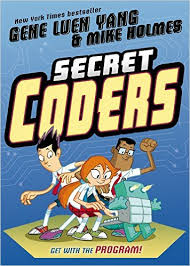
[READ: October 1, 2016] Secret Coders

Beloved artist/author Gene Luen Yang came back in 2015 with a new series called Secret Coders.

There is a kind of introductory section that implies the whole story is a lot more meta than it might at first seem–but it is not resolved yet so it’s hard to be sure of that.

The story opens on middle-schooler Hopper.  She is very unhappy to have moved to this new town and a new school.  In addition to missing everyone back home, the sh cool is decidedly weirdo.  There are birds with four eyes, the groundskeeper’s doors are locked and the custodian Mr Bee is really mean.   Plus the whole place looks haunted and there are huge numbers painted all over the buildings (but not in any actual order).

Hopper is pretty abrasive. In fact I’d say she’s downright unlikable–I find her rather offputting, myself.  Of course, she’s also unhappy and the first people that she meets make fun of her (and throw pudding at her), so she is quite snippy with people.  But she’s also not afraid to stand up for herself, which is cool.  When she learns who threw the pudding at her, she fights back–not realizing that the guy is a huge basketball player.  But he doesn’t fight her.  Rather, he chooses to walk away. (more…)

Read Full Post »

black-daimons SOUNDTRACK: LAST EX-Last Ex [CST107] (2014).

last-exOne of the things I love about Constellation Records is that you often never know what you’re getting.  They used to very specifically release a certain kind of music, but they’re now just releasing interesting and exciting music.  But also, a band name can’t really tell you what to expect from this label.

So who knows what a band like Last Ex will sound like.  And how cool that their first few songs on this are so good.

The disc’s sides are split into Side X and Side XX.

“Hotel Blues” opens with some scattered drums and chords.  It has  vaguely early-Pink Floyd feel to it.  But around a minute in, the synths pick up a repetitive melody and the bass and drums kick in to give it a very Can or Kraftwerk vibe.  The song is fairly straightforward, but there are sprinklings of notes—sometimes slightly off and vibrated that add some very cool textures to this pulsing track. It’s really groovy and fun.  But it’s “Girl Seizure” that I find so strangely compelling.  Again, over simple repetitive drum and bass, the guitar (or keyboards) play warbling notes that are unsettling and yet enticing.  The song quiets to almost nothing and then resumes in much the same way—and you welcome that weird warble and its of Moog feeling.  At just under 3 minutes its just the right length.

“Flûte magique” slows things down with some simple arpeggios.  There’s not a lot to the song, but it is wonderfully soothing as the bass notes tick away and then the guitar notes rise higher and higher.  The song picks up speed as it goes along and leads to a middle section that’s almost stiffly funky, if that’s possible.  The ending gets a little louder as it thuds to a conclusion.

“It’s Not Chris” opens with some static and strange noises and some soaring keyboards.  About a minute and a half in a strange staccato organ melody comes in with a violin sound doing a kind of solo over the top.  It’s all a little strange but it drops out in the middle to a kind of sinister pulsing, and when the melody resumes, it seems strangely comfortable again.  The end of the song has some high-pitched violin notes that sound almost like a theremin.

“Resurrection Drive” is mostly drums and echoed surf guitar chords. After a minute or so some strings are added to the mix.  It’s only 2 minutes long but it introduces some interesting tension.

Side XX has a quieter feel overall.  “Nell’s Theme” opens with acoustic guitars playing a simple, pretty four-note melody.  The song slowly grows more complex as a violin is added to the song. With about 30 seconds remaining, everything drops away save for a mournful violin.

Thudding bass and picked notes echo through “Trop tard.”  It has a slow, spacey feel (like mid-period Pink Floyd).  A guitar is added and it speeds up some but still sounds of the era and then settles back down to a languid pace.  “Cape Fear” is less than 2 minutes of swirling outer space sounding synths—a creepy, lonely feeling.

“Cité d’or” has more slow pulsing rhythms and more echoing surf guitars and the whole thing feels rather tension filled.  Some squealing  feedback intersperses the surf guitar.   “Hotel Blues Returns” for 1:43.  It’s primarily the drumming pattern of “Hotel Blues” with some swirling synth noises (it’s good for headphones).  “Hotel Kiss” ends the disc with sirens and then a slow thudding drum and more noir guitars.  This could be used in a Twin Peaks scene.

So this album is an interesting mix of rocking songs with unsettling noises and mellower songs with cool synth effects.  It’s a great find.

[READ: September 24, 2016] The Black Diamond Detective Agency

I read this book a while ago, but I never posted about it.  And that gave me the opportunity to re-read it and, frankly, to enjoy it more.

This is the third book by Eddie Campbell that I have read.  I have found his stories to be complicated and hard to follow on first read.  They really demand a second and even a third read.  Part of it is that he writes complicated and somewhat intentionally convoluted narratives.  And part is because of his drawing style.

I love the cover of this book, how it is set up to look like an Old West placard: ORPHANS! MAYHEM! TERROR!  “In This the most recent offering from The First Second Quality line of Books.  An epic take of a newly industrialized America as revealed in words and pictures by the inimitable Mr Eddie Campbell.  Based upon  the manuscript of a Kinematographic play by Mr C. Gaby Mitchell.”

And its this last part that I missed when I first read it–that it was based on a screenplay.  And this book does resemble a screenplay.  However, I noted that in my other posts about Campbell that I’ve said of this book: I liked and didn’t like this book.  Well, which is it?

The story is incredibly complicated–with double and triple crosses.  And the visuals call for mistaken identity and hidden identity as well as new characters who all look vaguely the same–like pale photographs of turn of the century urban gangsters. But the story is really interesting. So I liked it, although I think I’d like to see it more as a film. (more…)

Read Full Post »

orcsSOUNDTRACK: AVEC LE SOLEIL DE SA BOUCHE-Zubberdust! [CST106] (2014).

cst106cover_258x242Avec le soleil sortant de sa bouche (With the sun out of his mouth–no translation for Zubberdust) is the creation of former Fly Pan Am bassist Jean-Sebastien Truchy.  With this album he has created a fascinating hybrid of near Krautrock repetitions with some King Crimson guitar lines and time signatures.  And interesting sung almost operatic male vocals.  Technically the disc has four songs, but songs 1 and 3 are extended suites broken into chapters.

“Face à l’instant” (Face Now parts I-IV) is the first suite.  This disc opens like Ministry–with an aggressive, fast, pounding guitar riff for 8 bars, a sharp pause and continuation of same.  After four measures of that, a quirky quiet instrumental takes over and at about a minute the heavy guitars return. Part 2 of the song starts with a funky, slightly off-kilter sounding guitar line and whistling.   About a minute into this secretion the song shifts to a quiet sequence of overlapping riffs and sounds.  About 5 minutes in, the voices start singing in wordless chants–it’s strangely catchy and slightly militaristic at the same time.  The song builds with voices until it climaxes with a stop.  Then a complex drumming pattern begins Part 3. The guitars lines resume and there are several vocals sections (I assume singing in French) that add a lot of tension to the song.  Midway through this part the song stops and that aggressive introductory guitar pummeling resumes, this time changing keys and not letting up.  New sounds and super heavy drumming are added as this brings part three to a climax.  Part 4 returns to quieter playing (and sounds a bit like Fly Pan Am in the way the guitar line as intersect.  The final section continues with the vocals and rhythms of the other three and then ends with some dramatic keyboard chords playing us out.

“Super pastiche fantastique” (Super fantastic pastiche) is the other suite.  It opens with some complex drumming and then several sequences of notes–guitar and synth that meld nicely.  Part 1 is just 3 minutes and by the end some electronic noises start overtaking the melodies.   Part 2 opens with the same melody but the electronics have been replaced by a wah-wahed guitar and more synth lines.  The song is complex and repetitive, with the only non-repeating part being the singer’s voice (no idea what he’s even saying).  The second half of part 2 (which is 7 minutes in total) ends with some sung vocals (not unlike David Byrne).  Part 3 is a 90 second interlude of very quick tinkling strings that are overwhelmed by noise and static and thudding drums.  The end of the track seems to be building up to part 4 which picks up the momentum into a great instrumental motif–intertwining guitars and electronics all with a cool bass line underneath.  After 2 and a half minutes the  song drops to drums and a funky guitar line with all kind of noises and static and voices working as transition to the cool bass line that comes in around 3 minutes.  As the song careens towards the end, the pace picks up and you can hear some intense screaming of vocals way in the distance.  The song cleans up and plays that great fast riff right up until the end when it abruptly ceases.

Tracks 2 and 4 are weird pastiches of sound. “Déja hier…” (Already yesterday…) is a four-minute song.  Interesting music plays very quietly in the background before it gets overwritten by conversation and static.  You can occasionally hear the song being played behind the noise, but it’s mostly just a weird kind of muffled noise.  “À partir de dorénavant” (From now) is similar.  You can hear a distant muddy drum and what sounds like la dinner party–tons of conversations going on at once.  It seems like the disc is going to end with 3 minutes of this, but a keyboard melody begins to slowly overtake the din.

The last minute or so is this interesting sci-f sounding synth line with warbling effects and an interesting, mellow bass.  Although it’s nowhere near as complicated as the rest of the album, it’s a cool way to end and almost feels like a segue into something else.

This album has a whole lot of styles and genres blended together into a (mostly) very cool mix of sounds.  I like it a lot, although I’ll probably skips tracks 2 and 4 most of the time.

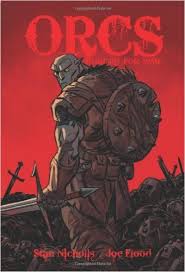
[READ: June 15, 2016] Orcs: Forged for War

This book was a little hard to learn about because Stan Nicholls has written several novels in the Orcs series.  So when you look up his books you get a confusing list of the series and other things.  This book is not part of the series, but it is part of the overall Orcs arc. It comes just before the First Blood Trilogy.

In the intro, Nicholls tells us lot more about his whole Orcs oeuvre.  He points out that unlike Tolkien (whom he loved) his Orcs are not mindless brutes. In fact, in his books, the orcs are the heroes and the humans are the ones who have along and messed things up.  He says that anyone unfamiliar with his orcs books should have no trouble following this book.

And that is true to a degree.  One thing that it behooves an author/artist to do is to make sure that everyone understands who all of the characters/races are in his/her book.  He does give a brief summary in the intro, but that doesn’t really help because there’s no visual guide.

Humans are divided into two camps.  The Manifold (Manis) pursue ancient pagan ways.  The Unity (Unis) are monotheistic.  They are both fanatics but the Unis have more bigotry and demagoguery.

This book opens with the Unis fighting the Manis.  And then the Orcs enter the fray but it’s not always clear whose side the Orcs on, if any. Regardless of which side they are on, they are willing to fight and kill whomever (there is much much bloodhsed and a shocking amount of vulgarity in the book). (more…)

Read Full Post »

coin2 hiddenSOUNDTRACK: MATANA ROBERTS-Coin Coin: Chapter 2 Mississippi Moonchile [CST098] (2013).

The first chapter of this series was a sprawling disc of free-form jazz and spoken word.  It was interesting and strange with a powerful message (not always elegantly delivered).  It felt too long, but I think it was done live which would make it more understandable as a long presentation.

Chapter 2 is quite different.  It is much shorter, but it has 18 tracks that flow seamlessly (and often without apparent logic) into each other.  Most of the songs are quite short as well.

“invocation” is a sultry jazz number (Matana Roberts plays saxophone).  There’s also piano, trumpet, double bass and drums.  One thing that I didn’t like about the first chapter was Robert’s “poetry slam” deliver of her spoken words.  This album more or less erases that all together with the inclusion of Jeremiah Abiah on “operatic tenor vocals.”  I don’t know what he’s saying (if anything) most of the time, but his voice soars above the jazzy din.

“humility draws down blue” starts in the middle of a trumpet solo and lasts for a minute and a half.  “all nations” is only 8 seconds long and seems to coincide with a vocal line from Abiah.  “twelve sighed” settles things down some.

The first real change comes with “river ruby dues,” which opens with a gentle piano motif, and Abiah’s vocals.  Roberts’ sax solo plays throughout.  There are somewhat recognizable motifs played throughout the album.  I was sure I heard parts of “Pop Goes the Weasel.”

“amma jerusalem school” also opens with a new melody–a four note sax line–without a doubt the prettiest melody of the disc.  About mid-way through the song, Roberts begins speaking/reciting.  There’s a lot going on in her saga.  When that ends, more instrumentals continue and “responsory” has a lovely falsetto singing section.

This half of the album has been fairly conventional jazz: rather pretty with some nice melodies—far more conventional than Chapter 1.

Although by “the labor of their lips,” things have become a bit more avant-garde.  But even that doesn’t last too long and by “was the sacred day,” a pretty melody has resumed and more spoken word comes in, this time in stream of consciousness.  It’s a story of childhood with some happy and some sad details including: “they didn’t like black people at the hospital. you could use a room but no nurses would attend to you.” and the story of a woman getting whipped for not saying ‘sir.’   Interspersed through this tale is a sung line “I sing because I’m happy I sing because I’m free.”

‘woman red racked’ features Robert’s singing voice—pretty and pained—with some nice, deep backing voices accompanying.  Interestingly, this vocal part ends with them singing “Amen,” but the song is not over… a sax solo emerges from this and plays a kind of wild section with Abiah’s vocals until the end.

“thanks be you” is a spoken piece, a story told to a child about the past “there are some things I just can’t tell you about” which references a lot of childhood songs.  It ends with the repeated refrain “Mississippi is a beautiful place.”

This disc is only 48 minutes and it feels just about the right length,  “benediction” ends the disc with a quietly sung song with another singer accompanying her: their voices sound great together.

As with the first one, the narrative is a little unclear.  The main thrust of the story is obvious and effective, but it would be hard to diagram the story.  Nonetheless, her use of jazz and traditional sources (“red ruby dues,” “woman red racked” and “benediction” are based on traditional American folk songs), make for an evocative look into slavery from the point of view of one family.

[READ: March 20. 2016] Hidden

Having recently read the Resistance trilogy I am much more aware of France’s role in WWII.  But that could never have prepared me for this children’s book about the Holocaust.  (written by Loïc Dauvillier, translated from the French by Alexis Siegel with illustrations by Marc Lizano and Greg Salsedo).

The book opens on a little girl.  She wakes up in bed and hears her grandmother crying.  When she asks what’s wrong her grandmother tells her about the “nightmare she was having.”

And that nightmare is her story as a young Jewish girl in occupied France and how her life was brutally upended.  This is all told with fairly cute little characters with oversized heads.

I’ve never heard this story from the point of view of a child before.  Her grandmother was a little girl going to school.  She and her friends did everything that you’d expect little kids to do and the story starts out very sweetly.  Then one day she comes home and her father says that they must all be sheriffs–wear the yellow star on their lapel.  Once they stray doing that, she is effectively shunned.  But she has no idea why–why does everyone hate the sheriff? (more…)

Read Full Post »
goblinSOUNDTRACK: AURORA-Tiny Desk Concert #486 (November 9, 2015).

auroraAurora is a Norwegian singer (I was sure her accent was Irish, so I was pretty surprised).  She was just 19 when she recorded this.

Aurora is a beguiling performer to watch because her sincerity comes through with everything she does–from her hand gestures, to the power of her voice, to the intensity of her face, which only relaxes when the song is truly over.

All three songs are just her accompanied by an acoustic guitarist (who sings backing vocals).

“Runaway” is a beautiful song of despair: “I can’t take it anymore…but I kept running for a soft place to fall.”

Between songs she seems completely moved by her words.  Once she composes herself, she has a nice chat with everyone.  Then she says she’s going to scream a bit high, “is that fine?”  Interestingly, her loud is not as loud as many other singers who don’t ask permission.

aurora2“Murder Song (5,4,3,2,1)” begins with her beautifully singing “5,4,3,2,1.”  And then the song gets pretty dark and a little disturbing. For she is killed in the first line of the song, and she is so passionate about it she sways and moves her hands in time with the “Oh oh ohs.”  I think things somehow work out though–it’s a little hard to parse.

“Running with the Wolves” has a pretty spooky chorus of the two of them singing the title in falsetto.  She’s pretty intense as she sings this song, making varied emotional faces.  And the fact that she looks to be about 12 makes them seem even more intense.

I found watching her to be a bit disconcerting, and I’d love to know more about her.  There were many parts of her songs that I liked a lot.  And I’m curious to hear what she’d sound like with full instrumentation.

[READ: September 9, 2016] Nobody Likes a Goblin

I wrote this about Hatke’s previous picture book (which I loved), Julia’s House for Lost Creatures:

I don’t normally write about kids’ picture books (if I did my whole blog would be about them as we read so many).  But this one gets a special mention because a) it was published by First Second and b) I love Ben Hatke’s drawing style so much.

Hatke has drawn books for slightly older kids, but he also does sweet (and slightly weird) books like this for littler kids.

This book really shows that nobody likes a goblin (even if he is creepy cute). (more…)

Read Full Post »

robotSOUNDTRACK: PAOLO ANGELI-Tiny Desk Concert #480 (October 20, 2015).

paoloPaolo Angeli is kind of a one-man band.  But not in a novelty sense.  Rather, he is an accomplished guitarist who decided to modify his guitar.  First a little and then a lot.

Angeli plays a Sardinian guitar which is several steps lower (and bigger) than a traditional guitar (and is bigger accordingly).  And he has added a whole bunch of strange gadgets and toys to alter and enhance the sound.

Notable additions: a set of electronic foot pedals that allow him to play little piano pads which hit the bass strings–he can play lead guitar notes and play complex bass patterns with his feet on the same strings.  He is somehow able to make the guitar sound like an electric and an acoustic at the same time.  There are propellers in the body which make a continuous buzzing sound on the strings.  There’ even a mobile phone for a drone.  I don’t think he uses it in this show, but he jokes that in concert he takes away peoples’ phones when they don’t turn them off and he uses them in his guitar.  He also plays the strings with a bow.

Anything else?  Yes.  Crossing the center of the guitar perpendicularly are another set of “strings.”  He seems to bang on these a few times for more dissonance, and maybe they are what the propeller is playing?  There’s also a set of strings that extend from the guitar head to the base about three inches above where one normally plucks the strings.  These extra strings are primary there for bowing, but they are quite loose and make some interesting scratching sounds on the final song.  There’s also a big spring attached to the bottom for percussion.

Not all of the effects are necessarily pleasant. The buzzing of the propellers is kind of harsh and the giant spring makes some crazy noises.  But his guitar playing is rally very pretty.

Oh and he sings too.

Well, not on the first song, the 12 minute “Mascaratu.”  Although he does whistle (it’s unclear if the deep breaths that he takes are meant to be a part of the song or not).  It opens with beautiful acoustic (fairly traditional) soloing, including some nice harmonics.  And then he flicks a switch and suddenly it sounds electronic.  And you can see and hear the foot pedals at work.  And then he turns on the propeller and starts using the bow.  About 4 minutes in he starts playing chords and the song comes fully alive.  By 7 minutes, he is playing the foot pedals and a lovely acoustic melody which he then trades off for a fast bowing solo.  The song proceeds in different directions and then ends with a lovely bowed solo.

He jokes that “Corsicana” is “Tom Waits vacationing in Sardinia, singing a traditional song in his own way.”  He places a damper/washer type thing under the strings which makes all of the notes sound flat and dead and metallic–yes like Tom Waits.  The bass line is even a bit like Les Claypool.  After an interesting certainly Waitsian solo, he sings what I assume are traditional lyrics (in a traditionally high tenor).  It’s about 7 minutes long.

He asks if there is time for a short song, which proves to be the 8 minute “Brida.”  For this song he uses many items to create a “prepared guitar.” He says that a “prepared guitar comes from the prepared piano which comes from John Cage.”  He wedges all kinds of little things (like binder clips) into the strings.  The song begins as a kind of noisy, chaotic solo.  In the middle of the song he plays some really fast acoustic chords.  Then it’s back to the bow–it’s cool to watch him bowing while the bass pedals are tapping away.  Then he added the buzzing propeller sound and starts hitting the piece of wood at the bottom for percussion.  This includes hitting the big spring for that weird sound and slowly slowly bowing those top strings making a creepy sound.

Angeli is a pretty ingenious player and he is a lot of fun to watch up close–he flips switches, and turns pedals and plays barefoot.  But not everything he does sounds pretty.  And some of the sections seemed to go on a bit long.   I thought I would be fascinated by everything he did but there were times when I couldn’t tell if he was playing something or just showing off the things his guitar could do.

But he is personable and funny and certainly a likable guy.

[READ: March 11, 2016] Little Robot

I love Ben Hatke.  His drawing style is wonderfully cartoonish and cute but with the ability to go a little dark and mildly scary on a dime. He also loves to draw strange-looking aliens and creatures.  Or in this case, robots.

One thing that I thought was especially cool about this book was that there are hardly any words in it.  And there doesn’t need to be.  I kind of wish it was all done without words, but that might turn it into a different kind of story, so I think it was  good choice to include dialogue, but to keep it minimal.

The story opens on a dark night as a truck drives across a bridge.  It hits a bump and a box falls out.  The box bounces over the bridge and lands in the river.

The next morning a little girls wakes up in a trailer park.  She climbs out the window and runs off.  There’s a moment when she seems to be afraid of the kids by the school bus (and the neighbor–there’s clearly a back story here that I wonder what it’s all about–I love that about his stories–there’s stories behind them).  And then she runs down to the water. (more…)

Read Full Post »

jerusalemSOUNDTRACK: JERUSALEM IN MY HEART-If He Dies, If If If If If If [CST114] (2015).

ififif Since 2005, Jerusalem In My Heart has been Radwan Ghazi Moumneh (all music) and Charles-Andre Coderre (all visuals).  This is only their second album, however, because they were always more of a live band.

Obviously there’s no real visual component to the record.

Since I don’t know all that much about this band, I rely on the Constellation records website for my information.  Thus:

Moumneh expands his compositional palette on If He Dies, If If If If If If, exploring new deconstructions and juxtapositions of both traditional and popular Arab musical currents, with an album that oscillates between powerfully emotive vocal tunes and instrumental works that primarily make use of Radwan’s expressive acoustic playing on buzuk as a point of departure.

The album’s first song “Al Affaq, Lau Mat, Lau Lau Lau Lau Lau Lau (The Hypocrite, If He Dies, If If If If If If)” opens the disc with a short piece of processed vocals.  The Arabic traditional voice is mildly auto-tuned which sounds kind of cool.  [FROM CST: One of Moumneh’s finest melismatic a cappella vocal performances].

Track 2, “A Granular Buzuk” is a 7-minute instrumental piece of Moumneh on buzuk with pulsing electronic background music.  [CST: the buzuk is processed, re-sampled and otherwise disrupted through Radwan’s real-time custom signal patches]. As with a lot of this record, pretty instrumental passages are interrupted and taken over by noise—this time a kind of mechanical scratching.  It ends with some quietly ringing percussion as the electronics all slowly drift away.

“7ebr El 3oyoun (Ink From The Eyes)” is a vocal track with an electronic drone.  It sounds traditional and mournful, but about 3 minutes in, a drum and buzuk keeps time and the song grows a bit more upbeat.  [CST: languidly plaintive vocals set against a gradually accelerating riff underpinned by hand percussion].

“Qala Li Kafa Kafa Kafa Kafa Kafa Kafa (To Me He Said Enough Enough Enough Enough Enough Enough)” has incredibly loud static with a buzuk playing in the background.   After a minute and a half the static drops away and the background is filled with a quiet pulsing kind of static.  You can finally hear the instrument being played in all its glory.  [CST: a scabrous white noise intervention wherein the entire audio mix is fed through a contact mic placed in Radwan’s mouth].

“Lau Ridyou Bil Hijaz (What If The Hijaz Was Enough?)” is mostly synth–again an old sound with metronymic electronic percussion and quiet vocals. It’s all kind of muffled and very retro.  [CST: Moumneh continues to channel his love for Arabic pop and Casio/cassette culture with this silky lo-fi dance].

“Ta3mani; Ta3meitu (He Fed Me; I Fed Him)” is a faster piece.  Echoed vocals and drones rest behind a fast buzuk melody.  [CST: he pays homage to the until-recently-exiled Kurdish poet and singer Sivan Perwer on this traditional-minded, unadorned folk tune].

“Ah Ya Mal El Sham (Oh The Money of Syria)” opens with a loud vocal and a flute mirroring the voice.  It runs for seven-minutes and ends quietly.  [CST: a tour-de-force drone piece built from Bansuri flute (performed by guest player Dave Gossage)].

The disc ends with “2asmar Sa7ar (The Brown One Cast A Spell),” a fast buzuk solo played over the relaxing sounds of oceans waves.  It has a cool melody and runs quickly and then calmly for some five-minutes before the disc ends with more waves lapping against the shore.  [CST delicate acoustic number set against the sound of waves recorded on a beach in Lebanon].

As with the previous record, song titles employ the transliterative characters used in Arabic phone texting, which I think is pretty cool.

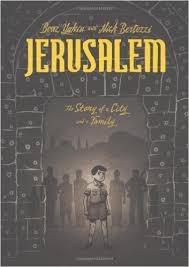
[READ: March 30, 2016] Jerusalem

With a title and subtitle like that you know this isn’t going to be a fun and lighthearted story.  And it is not.  The introduction explains how this is the story of a family, but it is more about the land and the strife that has been there for generations.

A lengthy history of Jerusalem is given, but for the purposes of this story the most recent action is the 1929 dispute over prayer rights which led to riots.  And then the British imposed the White Paper of 1939 which blocked Jewish immigration and was in place as the Nazis were riding to power. This led many Palestinian Jews to regard the British as hostile. And yet many Palestinian Jews joined the British army to fight the Nazis in Italy and the Middle East.  At the same time there were underground forces of Palestinian Jews who were attacking the British.

The action of this story takes place in 1945.

There is also a history of the Halaby family about whom this story is concerned.  Yakov Halaby was born after a series of girls were born in his family.  His father vowed that if they had another son they would move to Jerusalem.  After Izak was born they did so.  But Yakov was jealous from the start.  And he made Izak’s life miserable.  Eventually Izak left and married an Egyptian woman and they both moved back to Jerusalem. (more…)

Read Full Post »

rjSOUNDTRACK: YUSUF/CAT STEVENS-Tiny Desk Concert #411 December 9, 2014).

catAs this Tiny Desk Concert opens, Bob Boilen tells his story of being 17 years old and saving up money to buy a guitar so he could learn Cat Steven’s “Father and Son.”  He says he’s now old and has a son and the song still means a lot.  And that introduction makes the song even that more emotional when he plays it later.

It’s a shame that he is so known for the controversy about the fatwa back in the 1980s, but his conversion to Islam is pretty interesting: “In 1976, Cat Stevens almost drowned off the coast of Malibu. In his panic, he says, he shouted, “Oh, God! If you save me, I will work for you” — at which point he recalls a wave that came and carried him ashore. He converted to Islam, changed his name and left the pop world after one last album in 1978.”

He released his first non-spiritual album in decades in 20o6.  He released another one in 2014, which was a record of some originals mixed with standards and blues covers.  He plays two songs from this album here (which is a bit of a disappointment, as I could have easily listened to him play the entire Greatest Hits album).  But these two songs are quite nice.  “I was Raised in Babylon” is a bit dark, although his voice sounds great.  “Doors” was originally written for the musical Moonshadow.  It’s a delicate ballad.  And it also as a religious impact with the final line being “God made everything just right.”

In between these two he says he doesn’t know what to play next, but he has some kind of gadget that he scrolls through.  And he chooses “The First Cut is the Deepest.”  He comments maybe some people know I wrote this one, it wasn’t Rod Stewart.  I really like this song a lot.  It sounds different from the record because it’s just him and his guitar, but his voice is unmistakable. and he sounds great.  And if it makes him feel better, I’ve never even heard the Rod Stewart version.

He dedicates “Father and Son” to Bob and it’s just as beautiful as the original.  And yes, it should make you tear up, especially if you have a child.

After listening to this Tiny Desk I really wanted to see him play live.  I know that he is currently on tour and will actually be in Philly on this very night.  There are still tickets available, but since the cheapest seats cost nearly $200, I’ll be skipping this one.

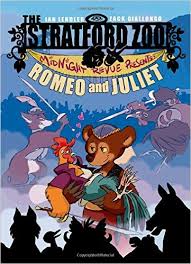
[READ: April 4, 2016] The Stratford Zoo Midnight Revue Presents Romeo and Juliet

I really enjoyed the first book in this series, in which the zoo animals put on a play of Macbeth.  Well, the zoo is ready again for their next performance.  I enjoyed that the audience is aware of the previous play–the kids are even wondering why it’s another tale of woe instead of something happy.  Later when the lion (who was in Macbeth) comes out, someone addresses him as the character from that play.

What I thought was interesting about the way this play was done was that they made the story kid friendly.  I liked this and that it allowed me to share this story with my kids.  Rather than being lovers, Romeo and Juliet want to have a play date, and rather than killing themselves at the end, they wind up hibernating. (more…)

Read Full Post »

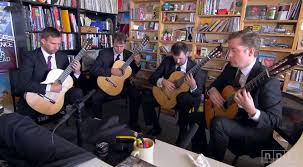
town-boy SOUNDTRACK: DUBLIN GUITAR QUARTET-Tiny Desk Concert #409 (May 15, 2015).

dgqWhen I first listened to this brief concert for some reason I didn’t realize that the quartet were playing Philip Glass.  Of course, once he stated that that’s who they were playing, it became quite obvious–but having Glass played on acoustic guitars instead of synths or violins, is quite an unusual experience.

The music is still rigidly repetitive, but there is a great deal of warmth added with the guitars (and the human element as well).

The Dublin Guitar Quarter has been around since 2002 and they play pretty much only contemporary and new pieces (despite being dressed in suits and playing on “classical” guitars).

They play two pieces, with two and three movements of each piece respectively.  They were originally recorded for strings, so these guitar transcriptions change things quite a lot (especially in Mishima).

The first piece is called “Company.”  They play Movements 2 and 3. What’s most impressive about the first piece is that you can hear all of the musical lines.  Glass often interweaves line up line of music ad you can see each guitarist playing these lines on high guitar notes and low notes while the other play accompaniment–transcribing these must have been a real challenge.

The loud chords are practically heavy metal chords on the guitar as opposed to what the strings might sound like.  And for all of the repetition, these two movements of clock in at less than four-minutes total.

It’s interesting to listen to the original after this and hear how it’s clearly the same piece but it sounds so very different.  From tone to drama, everything is changed.

The final pieces are three movements from Mishima.  In Mvt 3 there is some fast picking while the other three play chords.  It’s also fun to watch them all doing similar but distinct things through the middle of the movement.  This doesn’t have the fast lines that Glass is known for but it has a lot of loud repetitive notes.

What’s so interesting is that original is full of drums–and parts of only drums.  Obviously these aren’t present here, but the music resonates in a similar (but again, distinct) way.

Mt 2 is a slow meditative piece, and is far shorter than the original (which is also full of drums).

The final piece opens with some chords and then grows very beautiful as the Glass riff takes on an almost prog rock feel because of the guitar and the way the bass notes contrast so wonderfully with it.  It is short in this and the original and is great excerpt to listen to.

  • Glass: String Quartet No. 2, “Company,” Mvts. II & III
  • Glass: String Quartet No. 3, “Mishima,” Mvt. III, “1934: Grandmother & Kimitake”
  • Glass: String Quartet No. 3, “Mishima,” Mvt. II, “November 25: Ichigaya”
  • Glass: String Quartet No. 3, “Mishima,” Mvt. XI, “1962: Body Building”

[READ: March 24, 2015] Town Boy

This book was written (and drawn) in 1980.  First Second books had it translated and published in 2007.

I found Lat’s first book, Kampung Boy to be quite charming.  It was about a boy growing up in a small village in Malaysia in the 1950s.  This is the sequel and it is about moving from the village into the town and being a teenager.

This book is a little less episodic than the first.  Most of the story is laid out as text on one page and a drawing on the next.  But the drawings also have speech bubbles, so there’s a lot of different things going on. (more…)

Read Full Post »

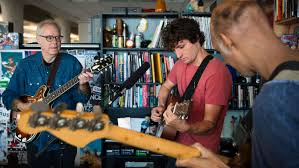
west SOUNDTRACK: SAM AMIDON & BILL FRISELL-Tiny Desk Concert #408 (December 1, 2014).

amidonThe first time I listened to this Tiny Desk Concert, I didn’t like Sam Amidon’s voice at all–he sings with a strangely flat delivery–almost monotone–but never actually off pitch.  It’s rather unusual sounding.

But the second time I listened I found it kind of interesting–compelling in an unexpected way.  I was also able to really hear what Bill Frisell was adding to the songs.

“Blue Mountains” is a folk story-song.  It is played with a very simple acoustic guitar piece and then, of course, Frisell’s interesting leads and chords that dd more and more texture as the song progresses.  The whole things is grounded by Shahzad Ismaily’s delicate drumming.

After the song, Amidon says, “Good morning, welcome to Washington DC.”  For “Pat Do This, Pat Do That,” a song about he banjo, Amidon switches to banjo.  This was my favorite of the three songs.  He plays the banjo very high on his chest (without a strap) and he plays quite fast.  It’s hard to decide to listen to Frisell’s interesting chords or to Amidon’s great banjo playing  For this song Ismaily switches to bass, which gives it lovely low end.

For the final song, Amidon gives a very long introduction about falling asleep on a pillow but dreaming that it is a little fuzzy donkey.  It’s a very strange introduction that doesn’t really end satisfactorily.  The final song is him on guitar, Frissell on electric and Ismaily on bass for a time and the switching over to drums.  Midway through Amidon switches to violin and plays a wild solo that he accentuates with a screeching voice.

It’s a most unusual and somewhat unsettling Tiny Desk Concert.  And I know I won’t be seeking out any more music by Amidon.

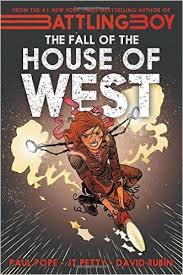
[READ: March 26, 2015] The Fall of  the House of West

This book follows The Rise of Aurora West with that cast involved.  I really enjoyed the resolution of the mystery of Aurora’s mom’s death, but otherwise I was kind of unimpressed by this book.

As with the previous book, I hate the way Rubin draws faces, especially Aurora’s–there’s too much face and not enough expression (conversely, his profiles are lovely).

Much of this story is fairly simple.  Aurora believes that she knows who killed her mother and she intends to get revenge.  But her father, the superhero Haggard West doesn’t want her to investigate on her own.  And her bodyguard/teacher is not going to let her do the work on her own, either. (more…)

Read Full Post »

« Newer Posts - Older Posts »