Feeds:
Posts
Comments

Archive for January, 2021

SOUNDTRACKSOFIA REI-GlobalFEST Tiny Desk (Home) Concert #133/140 (January 11, 2021).

Sofia ReiGlobalFEST is an annual event, held in New York City, in which bands from all over the world have an opportunity to showcase their music to an American audience.  I’ve never been, and it sounds a little exhausting, but it also sounds really fun.

The Tiny Desk is teaming up with globalFEST this year for a thrilling virtual music festival: Tiny Desk Meets globalFEST. The online fest includes four nights of concerts featuring 16 bands from all over the world. 

Given the pandemic’s challenges and the hardening of international borders, NPR Music and globalFEST is moving from the nightclub to your screen of choice and sharing this festival with the world. Each night, we’ll present four artists in intimate settings (often behind desks donning globes), and it’s all hosted by African superstar Angélique Kidjo, who performed at the inaugural edition of globalFEST in 2004.

The third band on the first night is Sofia Rei.  Rei is

an award-winning Argentine vocalist and songwriter [who] blends South American folk traditions with experimental pop and electronic music. That mix of tradition and modernity extends to her surroundings, which features traditional iconography, exuberant plants and looping pedals.

Rei plays three songs.  “Un Mismo Cielo” (The Same Sky) opens with her looping her voice.  Big electronic drums are added and then JC Maillard is messing around with their electronics to create interesting sounds and textures.   After a quiet introduction, Jorge Glem adds lovely cuatro and Leo Genovese plays a trippy electronic flute-sounding keyboard solo.  I enjoy watching Maillard playing the electronic melodies on the keys and then the quick switch to bass guitar for a funky riff.

“Negro Sobre Blanco” (Black On White) is about putting things into perspective.  Rei picks up the charango as the drums echo in.  The charango plays a delightful echoing melody.  Ana Carmela Rodriguez Contramaestre sings backing vocals and platys percussion.  The middle jam with some wild electronics then Maillard picks up guitar a plays kind of spaghetti western melody.  Then the song returns to the original melody with an even fuller sound.

Saving the best for last, Jorge Glem takes an amazing solo on the cuatro.  His hands move so fast and he simultaneously plays high chords along with percussive strumming.  At the end of the solo he does so fascinating strumming with his fingernails to make a trippy psychedelic sound.  It’s phenomenal.

The set ends with “Escarabajo Digital” (Digital Beetle), a fun dancing song.  The juxtaposition of the fast cuatro with the grooving bassline is fantastic.

I enjoyed this set a lot and want to hear more from her (and Glem who has several of his own albums out).

[READ: January 11, 2021] Okay, Okay, Okay

This story is set around Adamastor University in South Africa.  The focus is on Simon, a former teacher (now an administrator) and his family.  Also his assistant Viwe (and his family).  There’s also Vida, a sound technician for live theater.  She is unrelated to them but she gets pulled into their drama.

The story initially seems to be about how Simon (the “Head of Effective Communication”) is desperately hoping to get promoted into a more plum position. He is currently in a very good position financially, although his former colleagues feel like he threw his soul away when he became an admin.  But the story grows bigger–tackling University policies as well as racism and sexism in South Africa.

But the book opens on Vida. Vida is a sound engineer.  She is familiar with University politics because she has been to a few of Professor Bruno Viljoen’s academic parties.  Viljoen is head of the drama department and invited Vida along because she has done sound work for them.

The one thing I didn’t care for in this book was some of the younger characters occasional throwing in text speak (WTF, LOL).  While those are certainly things people of that age might say (although Vida is in her 40s), it was jarring to see text speak in a character’s thought process:

A dinner party full of academics: WTF, she’d had more fun driving her car around with nowhere to go.

Why not write it out?  It just seemed odd.

Aside from that, Vida is a wonderful character–no nonsense, takes no crap from anyone.  She loves sound and is great at her job.  She also has two dogs and two cats and she is crazy about them.  There’s at least five times when she speaks her mind and it’s terrific.

Cecily is Simon’s daughter.  She is currently taking a class with Boris. He is, everyone agrees, a silver fox.  Even younger girls swoon for him.  But Cecily has known him since she was little and she’s not impressed.

As this class opens, Boris is encouraging them to dig into their past to present a monologue.

Half the people in this class probably have slave ancestry.  That blood flows in your veins.  You are slaves.

Immediately a student raises her hand:

I just want to say that it gives me offense when you, a settler, say that I, whose ancestors are buried here, am a slave.  “Slave” implies that a person is not a person–not a mother, a lover, a human being.

After class Bruno asks Cecily what that was all about.  She says that students are very sensitive these days so just mind what he says.  He then offers to set her up with his nephew–a rather handsome fellow who looks like “a Puerto Rican Ken doll.” (more…)

Read Full Post »

SOUNDTRACK: LABESS-GlobalFEST Tiny Desk (Home) Concert #133/139 (January 11, 2021).
LabessGlobalFEST is an annual even, held in New York City, in which bands from all over the world have an opportunity to showcase their music to an American audience.  I’ve never been, and it sounds a little exhausting, but it also sounds really fun.  

The Tiny Desk is teaming up with globalFEST this year for a thrilling virtual music festival: Tiny Desk Meets globalFEST. The online fest includes four nights of concerts featuring 16 bands from all over the world. 

Given the pandemic’s challenges and the hardening of international borders, NPR Music and globalFEST is moving from the nightclub to your screen of choice and sharing this festival with the world. Each night, we’ll present four artists in intimate settings (often behind desks donning globes), and it’s all hosted by African superstar Angélique Kidjo, who performed at the inaugural edition of globalFEST in 2004.

The second band on the first night is Labess.

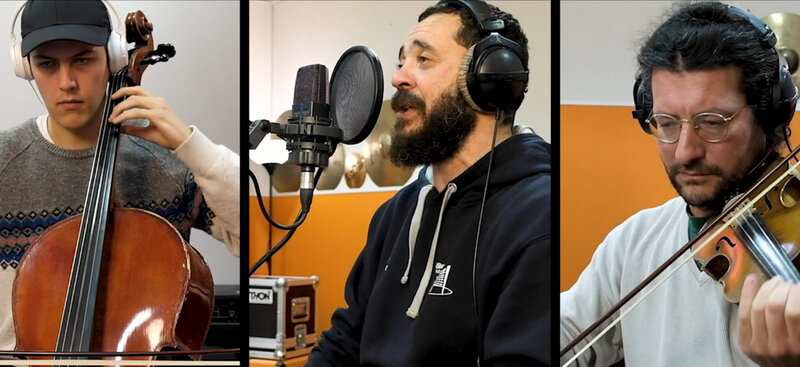
This Algerian and Canadian band proves that music has no boundaries even in times of isolation. Recording its set from France and Colombia, Labess blends flamenco and Gypsy jazz-influenced North African chaabi into energetic soul music with a nonstop beat. Singing in Arabic, French and Spanish, lead vocalist Nedjim Bouizzoul mixes realism and hope, gentleness and fury, in stories about exile that illustrate the joys and the distress that pave the road from the native countries to new homes and back again. Through his poetry, he proposes we reflect on cultural diversity and the necessity to unite, no matter our differences.

“Yal Maknin” opens with Rabah Khalfa playing the derbouka hand drum and a great riff on the banjo from Simon Demouveaux.  Nedjim Bouizzoul sings lead.  As the song move on, Demouveaux plays a solo along with strings from Simon Lannoy (cello) and Loran Bozic (violin).  It’s a lot of different sounds that work well together.

“Yemma” is a much quieter ballad.  Bouizzoul plays acoustic guitar and sings.  Khalfa plays the derbouka and Demouveauz plays a grougious melody on the oud.

They end with “La Vida Es Un Carnaval.” Mike Rajamahendra opens with drums accompanied by François Taillefer and Julio Frias on percussion.  Pierre Bonnet played some excellent bass in the first song. It sounds even better in this song.  Bouizzol sings in Spanish on this one.  The middle of the sing shifts gears and sounds very Spanish, with great horns from Javier Villa (trombone), Rafael “Pachalo” Gavilan (trumpet) and Moises Marquez Leyva (saxophone).  Then comes a drum and percussion section (including Bouizzoul playing percussive guitar.   Finally, along comes the star of the song–Miche Molina plays a wonderful button accordion solo.

[READ: January 2, 2021] A Poor Season for Whales

After having not had much exposure to South African writers (or really much of anything South African), I’m now on my second book.  This one is fiction.

My ignorance of South Africa is pretty vast, so I had to do a bunch of looking things up while I was reading.  Race plays a pretty big role in this book, so i wante dto look up some information about that.

About 80% of South Africans are of Black African ancestry, divided among a variety of ethnic groups speaking different African languages. The remaining population consists of communities of European, Asian, and multiracial ancestry.

According to the 2011 census, the two most spoken first languages are Zulu (22.7%) and Xhosa (16.0%).  The two next ones are of European origin: Afrikaans (13.5%) developed from Dutch and serves as the first language of most coloured and white South Africans; English (9.6%) reflects the legacy of British colonialism, and is commonly used in public and commercial life.

The vast majority of black South Africans were not enfranchised until 1994.

So South Africa has a pretty intense history.  This story addresses that history in some ways–it seems almost unavoidable frankly–but it’s more about an older white woman and the relationship she forms with a younger colored man.

The book starts on November 20, 2018 and runs through the new year.

Margaret Crowley a white fifty-something woman.  She is an architect, is clever and rich and has just moved into a home she designed for herself in Hermanus.  She used to live in Cape Town but left all of her friends and family to find some space in the more bucolic suburbs. The only living creature she brings with her to Hermanus is her dog Benjy, a fun and loyal Doberman.  

There’s some more fascinating things I learned about South Africa.  This story is set at Christmas time and in South Africa, Christmas is warm.  There are also whales who come to calve outside of Hermanus, making it a very popular tourist destination.  The title “a poor season for whales” refers to the fact that not many whales came to calve this year.

Margaret has recently had more upheaval than just a new house.  After twenty-six years of marriage, her husband has left her for a younger man.  She is not angry about it–she’s coping rather well, but she is still disappointed in the way things turned out.

The back of the book draws you in with this

After nearly fifty six years in the world with very little to stress or vex her, it was therefore hardly to be foreseen that in her fifty-sixth year she would kill a man with a kitchen knife.

Things get exciting at the very start of the book.  Margaret is walking Benjy along the sea front when he spots some dassies and charges after them.

Okay, so what the hell are dassies?  That was the first thing I had to look up (they are an African rodent found among rocky outcroppings.)  They were several meters down the cliff.  Benjy went after them he had no way to get back up.  And if he went further over the cliff he would clearly plummet to his death.

As she is freaking out a young man calms her down.  He says he will help.  He rappels down the side of the cliff an helps poor Benjy up and back to safety.  Benjy has made a new friend for life.   The man is a twenty four year old named Jimmy Prinslii-Mazibuko. 

He is very handsome with gray green eyes and caramel skin.  Jimmy is what is known as “colored” in Africa–

In early 20th-century South Africa, the word “Coloured” was a social category rather than a legal designation and typically indicated a status intermediate between those who were identified as “white” and those who were identified as “black.” The classification was largely arbitrary, based on family background and cultural practices as well as physical features. Most South Africans who identified themselves as Coloured spoke Afrikaans and English, were Christians, lived in a European manner, and affiliated with whites

Margaret is obviously very grateful to Jimmy for saving Benjy.  She asks how she can repay him and Jimmy basically asks if he can stop by her house for coffee and maybe a clean up (he’s cut in a few places).  Margaret is hesitant obviously–she doesnt know this man at all–but Jimmy is persuasive and seems sincere enough.  She agrees.

As she puts the ointment on his leg (at his insistence), she finds the whole scene erotcialy charged–but what could a 24 year old want with a fifty-six year old woman?   

Jimmy stays for a time and is completely irritating to her.  He loves to argue and enjoys giving her grief about pedantic issues.  Their conversations are wonderful–funny and very believable.  Jimmy is clearly smart and knows how to turn convention on its head to get what he wants.

Jimmy has really left an impression on her, but she assumes she’ll never see him again.  But the next morning when she goes to the grocery store, she sees him hitchhiking.  He flags her down and she takes him in to town.  She assumes that’s the end of it but he’s waiting at the car when she is dione shopping. She gives him a ride back home and he helps unload the groceries and then offers to make a meal for her.  (She is a terrible cook and he studied to be a chef).

She really doesn’t know what to make of this young man.

One of the most wonderful things (and timely for today–ITMFA) about this book is how much their discussion revolves around eviscerating donald trump.

The ANC was off the wall, Brexit had been a colossal blunder and donald trump was a buffoon, albeit an extremely dangerous buffon.

Even better is Jimmy assessment of how trump won

“I know I’m not saying anything original, said Margaret, but it remains a mystery how a developed, prosperous country like America could have elected a vulgar huckster as its president”
He laughed, “What is democracy but vulgar hucksterism dressed up as the will of the people?
“But democracy is the will of the people,” she objected.  “At least of a majority of the people.”
“Okay fair enough, yea but what determines the will of the people?”  Most people wouldn’t know what to have for breakfast if their TV didn’t tell them.  It’s all showbiz, reality TV, and Trump wasn’t on reality TV for chicken shit. His deal is selling himself to people who like to believe hey too can live in gold-plated skyscraper and screw supermodels”
“But he’s so unappetising.”
… “Sure he’s unappetising but that’s part of his appeal.  Most of the people who vote for him aren’t that appetising either–you’ve seen them on TV, men with paunches, brassy blonde women with too many teeth.  It’s the Revenge of the Uncool, the people left behind in Gun-and-God Gulch, who at the snobbery of the cool, with their trigger warnings and their safe spaces and their gay marriages and their abortions, the people who fly over what they call flyover country and cannot understand how anybody can actually live there…and electing Donald fucking Trump doesn’t make them any more cool, but it sure makes the cool eat a lot of shit. Because the last revenge of the uncool is to annoy the cool.

The story also deals with race issues in an unexpected way.

Jimmy introduces margaret to his friend Thuthukile.

She says to Margaret, “as a black person, I feel unsafe in Sea Point, I feel my identity threatened by the rising tide of whiteness.”
“Excuse me,” Margaret could not help but saying, “but did you say ‘as a black person?'”
“Yes, sure I did, I mean just because I was born with a white skin that doesn’t mean I’m white, Right?”
“Oh, I thought that was exactly what it did mean.”
“No, that’s the old essentialist argument.  I have a while skin but I self-identify as black. I mean, you have people born with penises who self-identify as women, and people born with vaginas who self-identify as men, right?”

When she talks to her friends and family back home about Jimmy, they have amusing reactions. Her best friend Frieda is scandalized (but fascinated) by this young man and wants all of the salacious details.  Her daughter Celia is actually too interested in her own life to care all that much, but her son Carl is concerned.  He is the same age (almost) as Jimmy and goes to the same school that Jimmy did.  He finds out some things about Jimmy that Margaret is not too pleased about.

As Christmas approaches, Margaret get st the unwelcome news that her former cleaning lady Rebecca needs to move in with her.  When Margaret moved to this smaller place, she no longer needed Rebecca who went to live with her own daughter.  But now the cleaning lady finds her living situation unbearable and insists that Margaret allow her to live with her.  Margaret can’t say no largely out of guilt.

There was an earlier comment from Jimmy that I found interesting.  When Margaret told him that she no longer employed a cleaning lady he was offended that she had money and wouldn’t give a needy person a job.  She had felt a little guilty about employing someone to clean for her, but he says it’s better that she an income, right? 

Rebecca lives in a sketchy area and Margaret is nervous to go there, but Jimmy offers to drive. He also speaks isiXhosa which impresses Rebecca and her neighbors very much.

Another wonderful subplot comes when Maraget goes to her daughter’s engagement party.  No one is looking forward to it because no one really likes her fiancee.  But everyone has a pretty good time.  Margaret also runs into her ex-husband’s sister Felicity.  Felicity is a large brash woman–the exact opposite of her brother.  She is flirtatious (even with her nephew) and tells some wonderfully scandalous stories (she believes that her father killed her mother).

This all leads to a big event on Christmas Eve at Margaret’s house.  She invites Miriam, her children and Felicity.  Jimmy agrees to cook and serve.

The party is a disaster with Felicity getting drunk and offending everyone: “when did young people get so humourless.”  At the talk of politics, Felicity grew animated

with trump the troll in the white house, Timid Theresa in Number 10 and Balls-over-Brains Vlad in the Kremlin, we’re fucked.  America is fucked, of course, it goes without saying, but where America goes the planet goes, so the planet is fucked.  And you know why?  Because fifty-two percent of white American women want their pussies grabbed.  That’s the percentage of white America women who voted for trump, right?  In the full knowledge of his pussy-grabbing propensities.
Aunt Felicity are you saying women want to be sexually assaulted?
No love I’m saying that a politically significant number of white women, fifty two wpercent,to be exact don’t regard pussy grabbing as sexual assault otherwise they wouldn’t vote for that tangerine troll, would they?
They may think that trump’s other virtues cancel ot his less admirable propensities
What other virtues love?  His humility?  His honesty?

At this point Celia stormed off.  Felicity was too drunk to drive home. Her son was too drunk to drive home. Carl and Jimmy hit it off and Jimmy wound up spending the night, with Carl.  Margaret is not sure what to think of this.

Things get very intense after this.  Margaret finds out that Jimmy’s secretive past is quite bad–he is mixed up with some very bad people  She can’t decide if she wants him gone for ever or wants him around all the time.  Two big unexpected events happen–one with Jimmy and one with Jimmy’s associates.

And yes, she does stab someone with a kitchen knife. 

I really enjoyed this story a lot and it has led me to other South african authors who I have also liked a lot.  

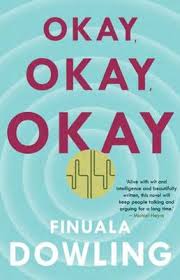
Incidentally, this book has a blurb: “Pitch Perfect. Aclever, bitingly funny novel.  It had me riveted,” from Finuala Dowling and I just happen to have a book by her with a blurb from Heyns: “Alive with wit and intelligence and beautifully written, this novel will keep people talking and arguing for a long time.”

Read Full Post »
SOUNDTRACK: ACTIVE CHILD-Tiny Desk (Home) Concert #131 (January 6, 2021).

Active Child has been around a long time, although I was completely unfamiliar with him.

Active Child is the music of Patrick Grossi. … He layers his choral-styled voice on top of melodic harp and piano. Electronic beats propel selections from his latest album, In Another Life, as well as one of his earliest and well-known songs, “Hanging On.”

He opens with “Hanging On.”  A drumbeat begins along with his high soaring voice.  As the camera fades in, he is playing the harp.  As he samples and loops himself, he switches to piano to play the main verse.  Then the loop starts and the room fills with music.  It’s pretty neat to watch him jump from piano to harp and again for a solo.

From a stunning room overlooking the San Gabriel Mountains in Pasadena, Calif., we hear the ethereal sounds of Active Child. “I chose this space, as this is where I’ve written nearly every piece of music for my active child project. my music and this house / this view are completely intertwined.”

As he’s talking, the drm for “In Another Life” begins.  I couldn’t see how he triggered it at all.  Over a drum beat and harp, he sings an ethereal melody.  When he switches to the piano his voice loops in a nice harmony.

There’s a very slow fade from one scene to the other as he begins “Cruel World.”  He starts looping and harmonizing with himself.  This is the catchiest of the three mostly from all of the looping.

[READ: January 6, 2021] Days of Our Lockdown Lives

In addition to the Zapiro book of editorial cartoons, we also got a comic strip collection from Stephen Francis and Rico (Schacherl).  This was a book in the Madam & Eve comic strip series.  There are thirty plus collections and this is the most recent.

Madam & Eve is a daily comic strip syndicated in many South African newspapers.  It started in 1992 and went daily in 1993. The premise is based around a middle-class white woman, Gwen Anderson (“Madam”), and her black maid, Eve Sisulu and how they manage in the new South Africa as the Apartheid era drew to a close.

Theirs is a relationship of affectionate squabbling.  Perhaps in the spirit of equality, neither character is portrayed as particularly sympathetic. Madam is always coming up with silly ideas in order to fit in more with the new way of life. Eve meanwhile keeps coming up with ways of obtaining extra cash out of Madam and others.

There is also a lot of political humor with strips mentioning topical incidents and also featuring some of the political figures in the news–so the Zapiro book is a nice companion. (more…)

Read Full Post »

SOUNDTRACKSEVDALIZA-Tiny Desk (Home) Concert #130 January 5, 2021).

Sevdaliza is the first Tiny desk Home Concert to be published in 2021.  Let’s hope she signals a great new year.

Sevdaliza is Iranian born although this concert is filmed in a culturally significant bookstore and publishing house in Amsterdam called MENDO.

Her collection of music is a wonderful mix of the organic and the electronic all centered around her gorgeous voice.

The set opens with “an old reel-to-reel tape machine spinning some Brazilian bossa nova.”  Then it stops and she starts singing “Human,” a song which

casts away the notion of artists — particularly female artists — as products.

It’s a moody Portishead-like track.

It opens with synths and drums as she sings achingly.  Her voice sounds a bit like Beth Gibbons as well.  Then in the middle of the song, the electronics drop off and she recites

I am flesh, bones / I am skin, soul / I am human /Nothing more than human.
I am sweat, flaws / I am veins, scars / I am human / Nothing more than human.

While she speaks, the strings of Jonas Pap (cello) and Mihai Puscoiu (violin) play an eerie backdrop.  When the strings stop a very cool electronic section takes over.  Leon den Engelsen manipulates sounds, making voices sound mechanical and machines sounds human–it’s really cool watching him do this.  Meanwhile, drummer Anthony Amirkhan adds some complex electronic and analog drums.

Then den Engelsen resumes the bossanova tape as Sendaliza announces:

“Good afternoon humans, my name is Sevdaliza, you’re very welcome on flight 808; our destination is Shabrang.”

I feel like “Dormant: sounds even more Portishead-like.  Her voice carries Gibbons’ ache as she sings “I need a different type pf caring, a different type of sharing.”  The percussion is minimal but interesting.  Meanwhile the electronics are buzzing around while the strings ground the song in melody.

As the song fades out she sings notes and words which I believe the keys are manipulating in real time.

“All Rivers at Once” opens with a pre-recorded guitar melody.  The song is just full of samples and interesting melodies and then the middle falls into place with a lovely violin solo.  It ends with a deep resonating cello note

“Gole Bi Goldoon” is sung in Iranian (I assume).  It sounds much more like an old folk song–strings and piano.

I really enjoyed this set and want to check out more of her album.

[READ: January 9, 2021] Do the Macorona

I’m not exactly sure why we have been getting so many books from South Africa at work lately, but it’s fantastic.

This book is a collection of editorial cartoons from South Africa’s Daily Maverick newspaper.  Zapiro (Jonathan Shapiro) has been making editorial cartoons and caricatures since the early 1990s and has 25 books of cartoons published.

Although I have been reading some novels from South Africa, I really don’t know very much about the country.  I have learned, however, that reading about a year’s worth of editorial cartoons is a pretty great way to learn about a country.  I don’t understand all of the jokes in here, but I do feel like I have a vague grasp on the country now. However, it’s when Zapiro turns his pen abroad–especially against trump, that I can see how good of a satirist he is.

It feels especially timely to include this post now as we prepare to get the corrupt traitor out of office for good.  He has, in fact, made a cartoon out of the insurrection. (more…)

Read Full Post »

SOUNDTRACKJAN VOGLER AND ALESSIO BAX-Tiny Desk (Home) Concert #128 (December 16, 2020).

This is the third of three Tiny Desk Home Concerts to honor Beethoven’s 250th birth anniversary. This was my favorite. The first was just piano the second was a quartet of strings.  But this one, a combination of the two, was the most exciting.  I love the way the cello (Vogler) played off of the piano (Bax).

For this Tiny Desk (home) concert, we pay a visit to the doctor’s office. Actually, the venue is called Rare Violins of New York and it’s something of a second home to cellist Jan Vogler, who pops in frequently to have the experts give his 1708 Stradivarius cello a thorough checkup. If your multi-million-dollar fiddle has a cough or the sniffles, or even needs a full-blown restoration, Rare Violins, which sits just a block away from Carnegie Hall, can help. The firm also has a lovely music room, kitted out with a fine piano – something Vogler lacks at his place.  With help from the fine pianist Alessio Bax, Vogler makes a convincing case for Beethoven as one of the great heroes of the cello. Beethoven, whose 250th birthday falls this week, wrote five cello sonatas, plus other works for the instrument, which, before his time, was primarily relegated to beefing up the bass line in various chamber music situations.

Beethoven, in essence, liberated the cello. Listen to how it dances and struts in the opening scherzo from the Sonata in A, Op. 69.

“Cello Sonata in A, Op. 69: II. Scherzo” starts with a piano and the cello quickly jumps back in.  The song builds and swells and then quiets down to a pretty piano and cello melody.

Like Jonathan Biss, these two are very chatty. They are mostly chatty with each other, but they do direct their answers to the camera sometimes too.

Up next is a short piece from the beginning of his career “12 Variations on a Theme from Handel’s Judas Maccabaeus: Variation XI: Adagio.”   In this piece the cello “sings sweetly.”  Vogler says that Beethoven was friendly with a fantastic cellist and he may have inspired the composer to write more pieces for the cello.

Although the piece starts with a lovely piano intro and has several moments of just piano, the cello adds so much to it.

Before the final song the two talk about how the pandemic has changed them and what they are looking forward to doing when it is over.

And finally there’s the opening to Beethoven’s last cello sonata, which Bax — whose role is far more than just an accompanist here — says is compact with emotion, yet “stretches the boundaries” for the instrument.

“Cello Sonata in D, Op. 102: I. Allegro con brio” feels like a call and response–two instruments in conversation.  And they had a lot to say.

[READ: December 20, 2020] The Disaster Tourist

In continuing with my around-the-world reading, I picked up this novel that was originally written in Korean (translated by Lizzie Buehler).

This story sounded really weird and interesting.

Yona works for a company called Jungle which specializes in offering vacations in areas that have suffered a disaster.

On a disaster trip, travellers reactions usually went through these stages

shock; sympathy and compassion, maybe discomfortable gratefulness at their own lives; a sense of responsibility that they’d learned a lesson and maybe a feeling of superiority for having survived where others didn’t.

For instance, a tsunami had hit Jinhae–in an instant everything was underwater.  Yona travelled there because Jungle currently didn’t offer any tours there.  But they would soon.  Yona would give donations and offer condolences to the community.  Then she would create a vacation package that involved viewing the aftermath along with volunteer work.

Yona had worked at Jungle for over ten years.  She was something of a star.  But apparently, her star was starting to fade because she had all of sudden been asked to handle some customer service phone calls–never a good sign.

Things got even worse when a supervisor named Kim got on the elevator with her.  He said:

Johnson is asking me to send my greetings to you.
Who?
Johnson.  My Johnson. Kim pointed to his crotch.

At this point I had to wonder.  Is this level of harassment something that happens in Korea?  Is this  shocking incident for any reader?  Is this a hyper real fiction in which everything is just a bit beyond reality?  I don’t know.

Then Kim grabs her bottom and put his hand in her blouse.  The gesture suggested that Kim didn’t care if he was caught.

Yona was upset, but not because of the sexual assault. Because Kim was known to only target has-beens. (more…)

Read Full Post »

SOUNDTRACK: BORROMEO STRING QUARTET-Tiny Desk (Home) Concert #127 (December 15, 2020).

This is the second of three Tiny Desk Home Concerts to honor Beethoven’s 250th birth anniversary. 

The Borromeo String Quartet consists of Nicholas Kitchen: (first) violin, Kristopher Tong: violin, Mai Motobuchi: viola and Yeesun Kim: cello (who is Kitchen’s wife).

Beethoven doesn’t score high when it comes to positive personality traits. Paranoid, litigious and a micromanager, Beethoven didn’t suffer fools and often fought with friends. Still, he possessed a well-developed funny bone, which Nicholas Kitchen and company put on display here, along with their own whimsical tiny “desks.” Because of the virus, and the confined space, the players wear masks.

The humorous side of Beethoven’s personality seeps into his music, such as the false stops and musical giggles that fuel his two-minute-long Presto from the Quartet Op. 130, which opens this performance.

“String Quartet in B-flat, Op. 130, II. Presto” has many fast moments and interesting parts where the first violin pays fast melodies but the rest of the quartet plays slow triplets over and over.  This is one of Beethoven’s shortest movements and is full of variety and energy.

For contrast, the Borromeos follow with a serious movement from later on in the same piece, the prayerful Cavatina, which Beethoven said even got him choked up.

This movement is full of serenity and tranquil beauty.  This is called the beklemmt section meaning trouble breathing. 

Kitchen can barely contain himself about the humor in the next piece, “String Quartet in F, Op. 135, II. Presto.”  He says this has a playful melody and “berserk” middle with instruments going all over the place.

More hijinks ensue in the Vivace from the Quartet in F, Op. 135, where Kitchen says the music becomes “completely berserk.”

And finally, in the last movement of the same quartet, Beethoven inserts a musical inside joke, the brunt of which falls on a wealthy music lover who displeased the great composer by not showing up at an important concert.

Kitchen says that Beethoven never met an occasion when he did not have a pun.  And he enjoyed injection his own brand of humor into his pieces.  In “String Quartet in F, Op. 135, IV. Der schwer gefasste Entschluss” there is an inscription: question must it be?  answer: It must be it must be!  Kitchen explains there was a patron who did not attend the premiere of opus 130.  The next day the patron  asked Beethoven to send him the music so his court musicians could play it. Beethoven said he’d send it but “you not only have to pay the price of admission for the concert you missed but for everyone in your family.”  The man looked at him and said “Must It be?”  Beethoven wrote a canon for four men to sing “it must be it must be.”  Then he made that joke the basis of the last movement of Op. 135.

[READ: January 3, 2021] Dinner

The Linden Tree was an interesting trip down memory lane for Aira.  

Dinner, by contrast is a wild violent fantasy (translated by Nick Caistor).  But its starts in the mundane–with a man and his mother going to dinner.

The two of them went to his friend’s house.  The friend was a terrible storyteller.  But he and the narrator’s mother had one thing in common–they were great at remembering the names of everyone in Pringles.  They knew the genealogies and configurations of nearly all the families.

But the narrator was terrible at remembering names–he had no facility for it at all.  He had plenty of memories from the town, but could never put a name to an event.

Evernatully the friend brought out a precious toy that he had.  It wa an old and rather sophisticated wind-up toy.  Two separate gears would go at the same time.  As it began to run, the door to a bedroom opened an a fat man came out and started to sing (as well as an old 19th century toy could sing). An old woman was in bed and she began to move back and forth “as a blind person does.” Then the second mechanism kicked in an the bedspread began to move and it looks like flocks of birds were flying out from underneath it. (more…)

Read Full Post »

SOUNDTRACK: JONATHAN BISS-Tiny Desk (Home) Concert #126 (December 14, 2020).

This is the first of three Tiny Desk Home Concerts to honor Beethoven’s 250th birth anniversary. 

Biss is uniquely qualified for the task at hand. The 40-year-old pianist has recorded all 32 of Beethoven’s freewheeling sonatas, performed them worldwide and has taught an online course in the music.hat’s impressive. Still, what’s more astounding is the personal story behind Biss’ obsession with Beethoven. The recording project alone took nearly 10 years and the things Biss says he gave up – relationships, even his sense of self – in order to live the dream is heartbreaking. The pandemic has shut down the life and livelihoods of many musicians, and for Biss the down time offered space to confront his relationship to Beethoven and his own demons. He tells his story in a raw and insightful audio memoir called Unquiet: My Life with Beethoven.

You can hear some of Beethoven’s own struggle in these perceptive performances. The bittersweetness of the Bagatelle Op. 126, No. 1, the moments of fragility in the Sonata, Op. 90, and the interior perspective that reaches outward from the Sonata Op. 109, all prove that Beethoven’s music is as meaningful today as ever.

Jonathan Biss is a chatty pianist.  After playing the lovely if brief “Bagatelle in G, Op. 126, No. 1” (it’s under 3 minutes), he explains that the six bagatelles were the last thing Beethoven ever wrote for the piano. 

He also jokes that he had the overwhelming urge to introduce himself via the “invent your NPR name” by inserting your middle initial somewhere in your first name and your last name is the most exotic place you’ve ever traveled.

He says that didn’t expect to be drawn back to Beethoven during the pandemic because hos music is so intense and so much.  He thought he’d rather be drawn to comfort food.  But he can’t get away from Beethoven.

The pandemic has sidelined many big Beethoven birthday plans. Jonathan Biss was slated to play concerts around the globe in celebration of the 250th anniversary of the composer’s birth. Instead, he’s home in Philadelphia. So it’s no surprise that for this all-Beethoven Tiny Desk concert, Biss chose music that explores the composer’s own isolation, brought on by deafness and an uncompromising personality.

He talks about cancelling his tour in March.  He came home  and decided to read more–do he randomly picked out How to Be Alone as if the fates were telling him something.  Biss feels that beethoven provided a guide to being alone.  He was alone for most of his life–his personality was rather off putting, but he was also functionally deaf–the most profound form of isolation.  He retreated into his imagination to create these songs.

“Piano Sonata in E minor, Op. 90: I. Mit Lebhaftigkeit und durchaus mit Empfindung und Ausdruck” is a piece that shows his vulnerability–a rare things for Beethoven.

He plays the first two movements of “Piano Sonata in E, Op. 109: I. Vivace, ma non troppo — Adagio espressivo, II. Prestissimo.”  You can hear him humming an grunting along.

He signs off with his “NPR name” which I can’t quite make out.  Then he concludes with the final bagatelle, “Bagatelle in E-flat, Op. 126, No. 3” which ends by drifting into the ether.

[READ: January 1, 2021] The Linden Tree

I’ve had a few César Aira books sitting around that I wanted to finish and the beginning of a new year seemed like a great opportunity.

It’s not always clear if his stories are fiction, non-fiction or some combination of the two.  The back of this book calls it a “fictional memoir,” as if that clears things up.  Chris Andrews translated this fictional memoir.

The book opens with the narrator explaining that his father used to go into the town square to take leaves and flowers from the linden trees (in particularly one unusually large tree) and make a tea out of them.  This had some kind of regenerative properties for him–they cured his insomnia at any rate.

From there, as happens with Aira stories–it goes everywhere.

About a different Aira story Patti Smith once wrote:

I get so absorbed that upon finishing I don’t remember anything, like a complex cinematic dream that dissipates upon awakening.

And THAT is exactly the way Aira books work for me too.  I have to go back through them just to try to remember the details.

So, in this story the narrator’s father is black (mixed race marriages were unusual in Pringles at the time of their marriage).  His mother, who he praised for marrying a black man, was also flawed in many ways, including being very short and very bossy.

But the main thing about this story is the rise and fall of Peronism. (more…)

Read Full Post »

SOUNDTRACK: HAYLEY WILLIAMS-Tiny Desk (Home) Concert #124 (December 9, 2020).

I basically missed Paramore entirely.  I’ve heard a few songs not realizing it was them and really liked them.  I listened to a bit more recently and really like the pop punk energy.

So this Tiny Desk (Home) Concert came as a real surprise. The music is stripped down and really spare.  There’s a real dancey element (funky bass and drums) and the guitars are really quiet.

The second big surprise came when Hayley introduced her band.  Becca Mancari on keys and backing vocals!  And Julien Baker on guitar!

This change in musicians and sound is intentional.

Petals for Armor is a soul-cleansing exhale from years of holding her breath. Originally released in a series of EPs, her solo debut sings through heartache in a tangle of triumph and hard-earned wisdom. It’s a pop album that knows sadness can simmer, but also shout over an ever-shifting sonic palette.

She plays three songs in ten minutes.

During the pandemic and protests, Williams has played these songs from her couch with muted restraint, and self-serenaded with acoustic covers — sad songs really can be sympathetic companions during dark days. But in her home, surrounded by blank canvases, Williams and friends splash a bottled-up energy.

The joy is infectious, as “Pure Love” bursts from first bloom

Aaron Steele counts off on the drums, while Williams gives a Huh! and Joey Howard introduces a funky bass line.  Her voice is powerful and soars throughout.

I’m disconcerted by the high fiving after the song–I hope they’ve been safe.

“Taken” shows off Baker’s jazzy-funk licks.

It opens with an outstanding bass from Joey Howard line that repeats throughout.  The song feels quintessentially dancey and a very different sound from Paramore.  Baker plays quietly wah-wah’d guitar as Mancari sings the backing bah bah bahs.  Williams plays a keyboard on a very tiny stand (I feel for her back).  The best moment comes with the five seconds of silence while Williams looks around and then jumps back into the danciness.

For the final song, Williams leans into the “Dead Horse” kiss-off with gleeful abandon.

The foundation of this song is the funky drum and bass once more. Williams picks up the guitar, but it’s Baker who plays the slightly askew riff that opens the song.  Baker plays lead licks throughout while Williams adds grace notes.  The best of which comes at 10:08 when both Williams and Baker plays a single note in harmony to make it really stand out.

And that kiss off?

When I say goodbye, I hope you cry.

[READ: January 5, 2021] “A Philadelphia Local is Unamused by the Fuss”

Today seemed like an ideal day to post about this election-related essay from Dave Eggers.

Today, a bunch if seditious Senators are going to pretend like our election was unfair.  They are going to make a spectacle of themselves and question the integrity of our very democracy.  They should be removed from office immediately.

This essay shows, in a small aside, how this phony scandal, this manufactured outrage, was created by the trump team long before the election happened.

On November 5th, while the election results were being tabulated, Eggers was in Philadelphia talking with Anna Palagruto.

Palagruto is the quintessential Philadelphian:

Palagruto has an accent so acute–“gonna” was “go-won-a” and an attitude so Philly-specific, that, if the city ever wanted a no B-S tourism spokesperson, no one but her would suffice. Come to Philly, she’d say. Or don’t.  No one cares.

Palagruto is fed up with the protesters on both sides. (more…)

Read Full Post »

SOUNDTRACK: ASHLEY RAY-Tiny Desk (Home) Concert #125 (December 11, 2020).

Ashley Ray is a singer from Kansas.

Her voice is raw and harshly accented–purely from Kansas.  But her voice goes beyond country into what sounds like ancient folk music.

In this Tiny Desk (home) concert, Ray is

sitting on a screened-in porch with producer, songwriter and longtime friend Sean McConnell (and a distant chorus of crickets chirping in the early evening light).

I don’t know what her music normally sounds like, although this blurb says the songs 

all from Ashley Ray’s latest album, Pauline feel like a breakout release for this Kansas native, but she’s been putting in the hard work for close to 20 years now, spending much of her time waiting tables while writing songs for better-known artists.

All three songs feature Ray singing.  She plays guitar on the first one.  She is accompanied by McConnell.  He plays guitar as well, but it’s when he adds his harmony vocals that the songs really flesh out.  The second song, “Dirty work” almost feels like an X song (or many a Knitters song) with Exene singing lead and John Doe adding the harmonies (and playing the only guitar).

It’s interesting that Ray’s speaking voice is almost unaccented, when a song like “Pauline” is so clearly Southern.

“Just A House” feels more country than the other two–the melody of the chorus, I’m sure.  But I like the understatedness of it.

I do not like country music (duh), bit I really enjoyed this.  It was devoid of production and twang and felt real.

[READ: January 5, 2021] “Delaware Voters Await Joe Biden: ‘We Just Need Him'”

Today Georgia voters get to decide if Joe Biden will be roadblocked by The Worst Man in America, Mitch McConnell (he may have actually done more damage than trump).  

They get to decide if two trump supporters, who have already proven that their role in government is exclusively to get rich and screw the rest of us, should be thrown to the curb (preferably from a moving car).  

This election shouldn’t be happening.  These two horrible people should in no way be close to winning an election for anything.  And yet here we are. (more…)

Read Full Post »

SOUNDTRACK: CHLOE X HALLE-Tiny Desk (Home) Concert #123 (December 8, 2020).

Chloe x Halle’s album, with its arresting album cover, has been on all the top album lists this year.  I hadn’t heard anything off of it, so this is my introduction to this “powerful sister duo.”

Flanked by personal memorabilia supplied by their mother, the Bailey sisters did their best to make this studio performance really feel like a home concert.

I don’t know what he album sounds like, but this recording (complete with a full band, horns and strings) sounds pretty amazing.  Almost as amazing as Chloe and Halle’s voices.

As they volley off each other, swapping lead and harmonies, it’s amazing to watch how years of practice and innate genetic chemistry have them synced tight.

After introducing themselves, the sister play “Don’t Make It Harder on Me.”  There’s a clean bass opening from Elin Sandberg and quiet guitar chords (it’s fun to watch Lexii Lynn Frazier play as she is smiling a lot and really into it).  The addition of the trumpets (Arnetta Johnson and Crystal Torres) adding soft and then loud accents is a really nice touch.  But nothing can distract from the voices.

Halle takes the higher notes and wow does her voice soar.  But the two of them together, whether singer counterpoint or their gorgeous wordless harmonies are really amazing.

“Baby Girl,” the second song here, starts with notes reminiscent of Crystal Waters’ “Gypsy Woman (She’s Homeless),” and is preceded with Chloe sharing “I know this year 2020 has been absolutely bonkers for all of us. For those moments where you kinda feel less than and you’re not good enough … that’s why we wrote this song. … Whatever happens, we’ll be OK. And this is our world.”

The song is softer with keyboard splashes from Elise Solberg and soaring strings from Stephanie Yu (violin), Chelsea Stevens (cello) and Marta Honer (viola).

Halle sings the first verse with Chloe adding punctuation on this cool refrain

step up to the patio
listen to the radio
try to play it on my Casio

more great punctuation from the horns nicely flesh out this song.  The song ends with a short drum breakdown from Brandi Singleton with some ripping bass work as it segues into “Do It.”  “Do It” is a great moment to see the sisters play of of each other.  It’s fun watching them smile at each other as they bounce and bop and back and forth with the “do it”s and the “woo”s.

“Ungodly Hour” is upbeat but “Wonder What She Thinks of Me” is a very different song.  Chloe says it’s a song telling the perspective of the other woman and what does that feel like?  What would we do in that situation.  Chloe sings the first verses accompanied by gorgeous strings.  It’s a beautiful torch song and their voices are simply fantastic.  Their harmonies in the third chorus are, frankly, jaw dropping.

I don’t tend to like R&B albums, (and it’s possible the album doesn’t sound like this), but this set was really impressive.

[READ: January 3, 2021] “Preparing to Spin the Wheel of Fortune”

I like when an author I enjoy has a Personal History in the New Yorker.

This one was especially fun because David Gilbert relates his experience appearing on Wheel of Fortune.

The studio is cold.  There are contestant handlers who are mystically upbeat.  They tell them to clap without clapping (so they dont mess up the sound recording).

He rather enjoyed the make up because she makes him look very good (he’s very critical of himself).  Before talking about the whole process though, he gives some background on the show. (more…)

Read Full Post »

« Newer Posts - Older Posts »