Feeds:
Posts
Comments

Archive for December, 2013

holoSOUNDTRACK: SIGUR RÓS-() (2003).
rosAfter a staggeringly successful tour, Sigur Rós took some time off. They returned about four years after their successful album with ().  I like to think they were trying to make it easier for English speakers to not have to pronounce their Icelandic words, but perhaps they were just being more difficult.  For they have made an album title that is hard to search for and hard to say.  To make it worse, there are no song titles on the record either.  (Although the band did have I guess unofficial titles for them):

  • 1.”-” (“Vaka”) 6:38
  • 2.”-” (“Fyrsta”) 7:33
  • 3.”-” (“Samskeyti”) 6:33
  • 4.”-” (“Njósnavélin”) 6:57
  • 5. “-” (“Álafoss”) 9:57
  • 6. “-” (“E-Bow”) 8:48
  • 7. “-” (“Dauðalagið”) 12:52
  • 8. “-” (“Popplagið”) 11:43

While looking for these song tracks, I learned that a lot of people think this album is mopey and depressing.  And I couldn’t disagree more.  I find the songs to be wonderful builders of drama.  Track 1 opens with lovely piano and vocals.  It’s a pretty melody that is punctuated with odd, squeaky voices.   Track 2 is slower, with a nice guitar melody instead of pianos. Track 3 opens with organs and more lovely pianos.  The pianos are slow which I usually don’t like, but there’s something about the simplicity and solitariness of their pianos that I find really captivating.  I love that it is repetitive and building, edging towards a dramatic conclusion.  Track 4 has low drumming that propels the echoing song.

Each of these 4 songs is around 7 minutes long.  And while they are not vastly different from Ágætis byrjun, they show the band experimenting within the form.  Also, Ágætis byrjun contained several different styles mixed between their epics, whereas this album is all epic.

After the 4th song there is 30 seconds of silence.  Which signifies something of a change for the second half of the album.

Track 5 is the slowest, saddest music on the album.  But it builds slowly, growing out of that sadness with a cathartic explosion at the end.  Track 6 opens with very loud drums (the percussion is spectacular on this album) and drones.  It builds and builds with more catharsis at the end.  Track 7 is the 12 minute epic that opens with organs and washes of guitars.  The opening is slow but you get the sense that it is building towards something–there is tension in the music, especially when it shifts to a minor key around 3:30.  It takes over 4 minutes to get to the chorus.  And then the song repeats and builds again.  The end is an unholy racket until Jonsi is left singing by himself.  It’s incredibly satisfying.  The final track is 11 minutes long and opens with an upbeat guitar sound.  It’s a good song and then the drums kick in around 6:20 and the song gets even better.

So yes, this is a long album full of long songs.  And none of it is in English.  Not exactly a pop seller, and yet there is something magical about the music on it.

[READ: October 10, 2013] A Hologram for the King

I had been putting off reading this book because I didn’t really like or get the title.  Sarah laughed at me when I said this, because the title is very explicit, but I honestly didn’t know what it was supposed to mean.  My mind reeled with the metaphorical possibilities.  So imagine my surprise when the title is indeed very literal.

The book is about a man named Alan Clay who is an IT sales person.  He will be doing a presentation–which will include an interactive hologram–to Saudi Arabia’s King Abdullah.  So, a hologram for the king.  Simple.

And indeed, the story is quite simple.  I had read an excerpt from it in McSweeney’s 38 and enjoyed it quite a bit–not realizing that it was from this book, of course.  The excerpt has been changed since then but most of the elements have been incorporated.  About the excerpt I said:

a man named Alan is on a flight to Saudi Arabia for business.  We learn through the course of the chapter that he has very little money left, that he is divorced and that his daughter is now fighting with her mother (his ex-wife).  He composes letters in his head to her trying to figure out the best way to placate the scenario.  But he also knows how important this deal is, both for him and for his daughter who needs money for school.  So he tries to put everything out of his mind so he can sleep.  There’s a lot of wonderful details in this chapter.

None of those details have changed, except we don’t really see as much of the flight.

Alan has landed in Saudi Arabia after not sleeping for 60 hours.  He misses the shuttle bust to KAEC (pronounce cake) the King Abdullah Economic Center.  So he calls for a taxi.  Instead, he gets a young man name Yousef who drives him the 60 or so miles to KAEC.  Along the way, Alan and Yousef talk a lot and they hit it off. Yousef has been to America (he studied for a year there) so he understands Americans.  He also has no hope for the future of the KAEC.  Alan likes Yousef and is dismayed by his attitude about KAEC, but finds him to be enjoyable company (Yousef enjoys jokes and, as a salesman, Alan is full of them). (more…)

Read Full Post »

479,076

Back on March 7, I hit 400,000 views.  back then I extrapolated based on the number of daily views and a little optimism that i would hit 500,000 views on December 10.  Well, the 10th has come and gone and optimism got the better of me as I maxed out at 479,076.

To say you’re 21,000 short of a 500,000 prediction doesn’t sound so bad.  But 21,000 short of a 100,000 prediction is a bit worse.  Not terrible, but not really close either.


Read Full Post »

goSOUNDTRACK: SIGUR RÓS-untitled #1 (Vaka) (single) (2003).

19Sigur Rós lay dormant for a while after their successful tour and then they came out with the album ().  The album tracks were also untitled (although the band did have names for them).  This single was released as a 3″ disc and then as the version I have which has the same four songs and a DVD.

It was called variously “Untitled 1/9” or “Vaka” and it contains 2 or 4 songs.   The first song is “Vaka.”  Song 2 or 2 through 4 are called “Smáskífa” (or (untitled #9)).  It was originally listed as a 12 minute song but has been broken up on both releases as 3 shorter songs:

The first one is a slow mournful section, with Jonsi’s voice manipulated somewhat to make it sound a little creepier than it normally does.   The second part opens with the voice presumably sped up making it even higher pitched than normal.  Then comes the beautiful slow piano. The third part consists of slow, repeated synth notes and ends with what sounds like more of Jonsi’s singing, but slowed down.  It’s not the most inspired song by the band, but it shows them playing around with sounds a bit more.

The official track listing is

  • Untitled (Vaka) 6:43
  • Untitled (Smáskífa 1) 4:38
  • Untitled (Smáskífa 2) 2:47
  • Untitled (Smáskífa 3) 4:22

[READ: December 2, 2013] Go

This is an excellent book for learning about graphic design, whether you are a kid or an adult.  Even though I feel like I know a lot about graphic design, I learned some fundamentals.  Kidd explains not only how but why things work as they do.  And he begins but upending conventions (just look at the cover which should give you pause).

If you don’t know who Chip Kidd is, he is an amazing book jacket designer.  Some of the most beautiful jackets were created by him.  And, even though I’ve been a fan for a while, I didn’t know that he designed the cover for Jurassic Park (and made all of the iconography for the subsequent movies).

He talks about the history of design (from nature to man-made), showing how we learn things from nature and then proceed to produce beautiful things (I enjoyed his quick trip through the highlights of man-made design from the Book of Kells to the Obama logo).

He talks about simple tricks for making designs stand out like using very small or very large pictures, inverting images, using vertical or horizontal lines, and emphasizing light and dark.  [On a purely fun bit of coincidence, he designed the cover for Zbigniew Herbert’s Mr. Cogito.  I just read a review about the book by David Foster Wallace last week].  I also really enjoyed the way he plays with images and dpi. (more…)

Read Full Post »

dec2006SOUNDTRACK: HILMAR ÖRN HILMARSSON & SIGUR RÒS-Angels in the Universe (2000).

angelsThis disc often gets placed in the Sigur Rós discography even though it really isn’t one of their records. It is a soundtrack to the film Angels in the Universe, and it is primarily music composed and conducted by Hilmarsson.  There are 17 tracks on the disc and he is responsible for 15 of them.  The remaining 2 are indeed by Sigur Rós, but if you have the “Ny batteri” single, you’ve already got the two songs.

The Hilmarsson tracks are large airy string pieces (I don’t know the film or anything about it, but it makes it seem rather sad). There are some tracks in the middle that deviate somewhat–some drums and occasional bass, but for the most part the music sounds like a string score to a film.  Pretty, but not exceptional.  At no time does Sigur Rós play with the other performers.

It’s the last two track s that are by Sigur Rós.  “Bíum bíum bambaló” is a slow piece that begins with mostly percussion.  Apparently it is an Icelandic lullaby and their version is quite different from a lullaby.  By the end of the song, when the whole band kicks in it rocks really hard and proves to be a great song.  The final track, “Dánarfregnir og jarðarfarir” was a theme used for death announcements on Icelandic radio (whatever that means).  I love the way it builds from a simple melody into a full rock band version and then back again.  It’s very dramatic.  These songs are both really enjoyable.  I like them a lot.  But I’d just stick with the single.

[READ: November 9, 2013] “The Secret Mainstream”

This article was in Bissell’s book Magic Hours, which I read a while ago.  I recognized some of the material in the article, but not all of it, which I find disconcerting that I forgot so much.

This article is (as the subtitle states) all about Werner Herzog, a filmmaker whose films I have never seen.  Herzog is notorious both for his films (he has made over 50) and for his behavior (some rumors of which are true, others are not).

Bissell wonders what historians would make of our civilization if they based their understanding on Herzog’s work.

He also goes through many of Herzog’s film, starting with Fata Morgana, Herzog’s first overt confounding of the feature film/documentary boundary.  It is neither narrative not strictly factual.  In truth, what Herzog does is make a hyperrealized truth.  For instance, in a film about a blind woman he created images and had her say they were images she remembered).  David Lynch is a fan of Herzog and you can see elements of Herzog in Lynch’s filams (so maybe the adjective Lynchian could be Herzogian.

What Bissell is saying (and Herzog confirms) is that Herzog is an artist, not a journalist.  He is also quite funny.  The story about the 32 pound rooster and the two foot horse is very very funny.

And while Herzog takes his films seriously he doesn’t really plan them.  He says he doesn’t anticipate what his next project will be and he also doesn’t spend a lot of time working on his films.  Woyzeck (1979) was shot in 18 days and edited in four.  He also took less than a month to make Grizzly Man (probably his best known recent film).

And yet for a film like Aguirre: The Wrath of God (1972), a film about Spaniards searching for El Dorado and slowly going mad, Herzog’s crew and cast nearly went mad themselves.  Klaus Kinski, the lead actor has this to say in his autobiography: “I absolutely despise this murderous Herzog… Huge red ants should piss into his lying eyes, gobble up his balls, penetrate his asshole and eat his guts.”  Herzog himself says that he helped Kinski write that and many other anti-Herzog sections of that autobiography.

Bissell cites The White Diamond (2004) as one of Herzog’s best films (it is a documentary about Dr Graham Dorrington a researcher who wants to film Guyana from an experimental blimp.  Or The Great Ecstasy of the Woodcarver Steiner (1974) which is about competitive ski jumpers and shows jump after jump after jump landing badly. Little Dieter Needs to Fly (1997) is about the escape of a pilot from a prison camp in 1966.  He has Dieter open and close his door three times before entering because “most people don’t realize how important it is to have the privilege that we have to be able to open and close the door.  That is the habit I got into and so be it.”  Which is moving and impressive and totally false.  Dieter doesn’t do that in real life.  But Dieter understood what Herzog was going for and believed in the truth of it even is it’s not strictly true.  Herzog calls it the ecstatic truth.

I don’t recall how I felt about Herzog after reading this the first time, but I am certainly thinking about watching a bunch of his films.

Some recommendations from the article:

  • Fata Morgana (1970)
  • Land of Silence and Darkness (1971)
  • Aguirre:  The Wrath of God (1972)
  • The Great Ecstasy of the Woodcarver Steiner (1974)
  • The Enigma of Kasper Hauser (1974)
  • Strozek (1976)
  • Woyzeck (1979)
  • Fitzcarraldo (1982)
  • Lessons of Darkness (1992)
  • Little Dieter Needs to Fly (1997)
  • Grizzly Man (2004)
  • The White Diamond (2004)
  • Wild Blue Yonder (2005)
  • Rescue Dawn (2006)—which Herzog was working at the time of the article and which had a fairly large budget (for Herzog) of $10 million.  He even has name stars in it (Christian Bale, for one).  Bissell makes it sound very interesting, and certainly fascinating to watch being filmed.

Read Full Post »

[ATTENDED: December 7, 2013] Danú

danuI received an email that RVCC was having a special concert with Danú.  I didn’t know who Danú were exactly, but the promo material said they were internationally acclaimed.  Since that could mean anything I contacted my friend Ailish who, while not being familiar with them, assured me of their bona fides.  And so, we set out for an early Irish Christmas.

And Danú did not disappoint.  There were six members on stage:

  • Benny McCarthy–button accordion/melodeon.
  • Dónal Clancy–guitar and storyteller (he’s the son of Liam Clancy of the Clancy Brothers and was in the band Solas).
  • Oisín McAuley–fiddle
  • Muireann Nic Amhlaoibh–vocals, flute and whistle.
  • Éamon Doorley–bouzouki
  • Martin O’Neill–bodhran and piano (more…)

Read Full Post »

goof5SOUNDTRACK: THE HIPWADERS-Dewey Decimal System (2007).

hipwadersA bouncy bass line introduces this song about the Bookmobile crashing into your house.  The librarian gives him a card and teaches him how to use the library.  The bridge is very sweet, especially compared to the silly, bouncy “Dewey Dewey Dewey Dewey Dewey decimal system” part.

Then the clever song teaches you the basic categories of the Dewey Decimal System.    That section musically reminds me of School House Rock.  It’s kind of a harsh switch from the School House Rock section to the Dewey Dewey section, but that Dewey part is so catchy that it’s a fun change.

It’s an enjoyable song (and informative too).  This song appears on the WXPN Kids Corner CD.

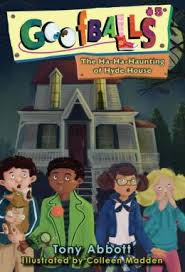
[READ: October 23, 2013] Goofballs #5: The Ha-Ha-Haunting of Hyde House

Goofballs #5 continues this enjoyable series.  This one seemed to be even funnier than the others (more jokes per page!).  I enjoyed this joke which was if not laugh out loud funny is certainly smile-worthy: “The official Goofball definition of toddler is someone too short to reach a doorknob but not too short to reach a cupcake.”

What was also funny, but strange funny, was that lead Goofball Jeff Bunter started finding clues without evening having a case.  Jeff is heading to the library for Fun Day for the toddlers.  But when he sees a woman walking out of store with pink balloons, he deems it  a clue. How can that possibly be?  Well, he is the detective, after all.

It’s also nearly Halloween.  And of course the other Goofballs are there.  Brian is there in a tuxedo (which he imagines he can wear for Halloween.  He also has a top hat that is way too big for him (although he assumed that since he brain is so big it should have fit).  And the other Goofballs and Goofdog are there to help out, of course. (more…)

Read Full Post »

tj amalSOUNDTRACK: SIGUR RÓS-Ágætis Byrjun (1999).

AgætisByrjunCoverIn this book, Amal is listening to Sigur Rós and TJ says “Sounds like nature vomiting.”  This is not a totally inaccurate description of the band, but I mean it in a good way.  Weaver says one of her friends described the band this way and while she disagrees, she thought the quote was too good not to include.  This was Sigur Rós’s first well-distributed album (and the one that shot them into the stratosphere.)

The disc opens with “Intro” (it’s funny to think of a 9 minute symphonic track as needing an intro, but there ya go).  I believe the song is backwards music.  The vocals may be backwards, but it’s so hard to tell.  It morphs into “Svefn-g-englar” which is just stunning (and reviewed a few days ago).  “Starálfur” opens with a beautiful string section over some washes of keyboards.  It’s a pretty melody.  Then the middle of the song switches to what sounds like an unplugged electric guitar strumming. The “solo” is a big string section, and the song ends abruptly with more of the unplugged guitar.  It’s an amazingly different kind of song.

“Flugufrelsarinn”  opens with noisy guitars that don’t sound like guitars.  Although overall this is the most conventional songs.  It’s got a steady beat and Jonsi’s vocals are mixed pretty loud and (relatively) deep.  “Ný batterí” opens with quiet horns for 90 seconds.  Then a bass line emerges.  At 2:30 the vocals kick in and the song builds gentle swells until the really loud drums kick in–its a great use of drums for drama.  “Hjartað hamast (bamm bamm bamm)” opens with a harmonica and a Hammond organ!  It’s got drums and loud guitars with lots of bass and, again, Jonsi’s more growly vocals—there’s unexpected diversity in sound for this track. Especially when the guitars roar into distorted crackling.

“Viðrar vel til loftárása” was also reviewed with the above single.  “Olsen Olsen” opens with distant vocals and drums then some very loud bass guitar.  “Ágætis byrjun” is a mellow ballad, with acoustic piano and guitars.  There’s nothing over the top or dramatic about the song, it’s a pretty standard ballad (except that it’s 7 minutes long).  And it works as a perfect ending to the disc.  There is actually a final track called “Avalon.”  It is electronics and other noises—a clear denouement for the record.

This is an amazing statement of what the band is all about.  It’s over 71 minutes, and the shortest song is 6:46, except for Avalon and Intro (4:01 and 1:36 respectively).  And they would perfect this palate over their next several albums.

[READ: September 24, 2013] The Less Than Epic Adventures of TJ and Amal Volume 1

This book came across my desk the other day and I was instantly attracted to the style of drawing.  And then I read the summary: “In one night Amal calls off his arranged marriage, comes out to his parents, goes on a bender and wakes up next to a dreadlocked guy named TJ. Who says they’ve agreed to travels across the country together.”  Who could pass that up?

And man, is it an enjoyable story.

I was right about the art, E.K. Weaver is a masterful artist, conveying a great range of emotion with her characters.  She also has an excellent rendering skill for places and locations.  The streets and highways are recognizable and the occasional scenes of nature are very pretty as well.

But I was also won over by the story.  It opens with Amal storming out of the house, heading to a bar in Berkeley and blacking out.  When he wakes up, a white, dreadlocked, hippie dude is making eggs in his kitchen and smoking.  Amal is confused about the guy, pleased about the eggs and pissed about the smoking.  But he has too much else going on for him to worry too much about this guy who seems nice enough, and obviously didn’t kill him or steal from him (although Amal has to confirm that they didn’t have sex).

And then TJ, for that is the dreadlocked man’s name, explains that they are both heading east (Amal’s sister is graduating from Brown and TJ keeps mentioning Graceland, but that doesn’t seem to be where he is going) and last night Amal agreed to drive him if TJ paid for everything.  TJ proves to be very cool about it—allowing Amal to back out if he wants to, but Amal says he’ll do it.  He gets some stuff together and off they go.

On the road trip we learn a bit about Amal—how his parents arranged his marriage and have now disowned him because he is gay.  We don’t learn very much about TJ though.  And while he seems to be on the up and up—he indeed pays for everything and is very generous, there are some shifty-eyed moments where we know something is unusual with the guy. (more…)

Read Full Post »

bothfleshSOUNDTRACK: SIGUR RÓS-Von brigði [Recycle Bin] (1998).

recycleAfter releasing their first album, Sigur Rós was approached by Icelandic musicians to remix the album. And thus came Recycle Bin.  I realized too late that I really just don’t like remix albums all that much–they’re mostly just faster drums plopped on top of existing songs.  And such is the case here.  Despite the interesting musical pedigrees of the remixers, there’s nothing anywhere near as interesting as on Von itself.  There are ten tracks, but only 5 songs.

”Syndir Guðs” gets two remixes:

Biogen keeps the bass but adds some more drumlike sounds.

Múm removes the bass, adds some wild drums and trippy textures and reduces the 7 minutes to 5.  It is quite pretty but very far from the original.

“Leit að lífi” gets three remixes

Plasmic takes a spacey 3 minute wordless noodle and turns it into a heavy fast dance song with speedy drums, big bass notes and with spacey sounds.

Thor brings in some fast skittery drums and keeps the spacey sounds (which sound sped up).  And of course bigger bass noises.

Sigur Rós recycle their own song into a dance song by adding funky bass and drums.

“Myrkur” gets two remixes.  the original is a fast-paced groovy track.

Ilo begins it as a spacey non-musical sounding piece.  After two minutes they add a beat of very mechanical-sounding drums.  It’s probably the most interesting remix here.

Dirty-Bix adds big, slow drums.  It keeps the same melody and vocals as the original but totally changes the rhythm and texture of the song, (removing the guitar completely).

The remaining three songs get one remix each.

The original “18 Sekúndur Fyrir Sólarupprás” is 18 seconds of silence.  Curver turns it into “180 Sekúndur Fyrir Sólarupprás” and makes a muffled drum beat and some other samples from the album, I think.  It constantly sounds like it is glitching apart until the end where it practically disintegrates–an interesting remix of silence.

“Hún Jörð” 7 min Hassbræður increases the drums and adds a more buzzsaw guitar sound and makes the vocals stand out a bit more.

“Von” has delicate strings and Jónsi voice.  The remix by Gusgus adds low end bass and drums making it a thumping rather than soaring track.

I prefer the original, but I much prefer their next album to the first one.

[READ: end of October to early November 2013]  original articles that comprise Both Flesh and Not

As I mentioned last week, I decided to compare the articles in Both Flesh and Not with the original publications to see what the differences were.  I had done this before with A Supposedly Fun Thing… and that was interesting and enlightening (about the editing process).

This time around the book has a lot more information than the original articles did.  Although as I come to understand it, the original DFW submitted article is likely what is being printed in the book with all of the editing done by the magazine (presumably with DFW’s approval).  So basically, if you had read the original articles and figured you didn’t need the book, this is what you’re missing.

Quite a lot of the changes are word choice changes (this seems to belie the idea that DFW approved the changes as they are often one word changes).  Most of the changes are dropped footnotes (at least in one article) or whole sections chopped out (in others).

For the most part the changes were that the book version added things that were left out or more likely removed from the article.  If the addition in the book is more than a sentence, I only include the first few words as I assume most readers have the book and can find it for themselves.  The way to read the construct below is that most of the time the first quote is from the original article.  The second quote is how it appears in Both Flesh and Not.  At the end of each bullet, I have put in parentheses the page in BFAN where you’ll find it.  I don’t include the page number of the article.  And when I specifically mention a footnote (FN 1, for example), I am referring to the book as many times the articles drop footnotes and they are not always in sync.

Note: I tried most of the time to put quotes around the text, but man is that labor intensive, so if I forgot, it’s not meant to be anything significant. (more…)

Read Full Post »

bomarsSOUNDTRACK: SIGUR RÓS-“Ný batterí” (2000).

nyThe single opens with “Rafmagnið búið” a kind of brass introductory piece.  There’s lots of horns building slowly, growing louder but not really playing a melody.  By the end of five minutes, it segues into “Ný batterí” which opens with horns as well.  Then the bass comes in, a slow, deep rumble of simple melody.  After 4 and a  half minutes, the drums are a powerful counterpoint to the sweet melody.

“Bíum bíum bambaló” is a slow piece (aren’t they all) that is mostly percussion.  Apparently it is an Icelandic lullaby.  The final track, “Dánarfregnir og jarðarfarir” was a theme used for death announcements on Icelandic radio.  I love the way it builds from a simple melody into a full rock band version and then back again.  It’s very dramatic.

Both tracks were used in the film Angels of the Universe (and appear on the soundtrack).

That certainly makes this single less interesting than the first one (although I’m not sure that the soundtrack was readily available at the time).

[READ: December 1, 2013] Breakfast on Mars

This is a collection of 38 essays (and an introduction by Margaret Cho).  It also includes an introduction geared toward teachers–an appeal that essays do not need to be dull or, worse yet, scary.  The editors encourage teachers to share these essays with students so they get a feel for what it’s like to write compelling personal nonfiction.  The introduction proper gives a brief history of the essay and then talks about the kind of fun and funny (and serious) essays that are included here.

This was a largely fun and largely interesting collection of essays.  When I grabbed it from the library I didn’t realize it was essays (I was intrigued by the title and then looked at the author list and immediately brought it home).  I know it says essays on the cover, but I chose to ignore that apparently.  When Sarah saw the authors (she knows more of them than I do) she had to read it first.  This proved to be a great counterpoint to the very large novel that I was reading at the same time.

The essays each take on different topics.  And what I liked was that before each essay, they include the question that inspired the essay.  I have included the questions here. (more…)

Read Full Post »

givingtuesToday is #GivingTuesday.  Giving Tuesday is a campaign to create a national day of giving at the start of the annual holiday season.  It encourages a national day of giving to kick off the giving season added to the calendar on the Tuesday following Thanksgiving, Black Friday and Cyber Monday.

In honor of GivingTuesday I wanted to post about two young people whom I have encountered recently (in print, not in real life).  Each one of them has blown me away with his and her selflessness and resourcefulness.

freethechild

The first was in the book Breakfast on Mars and Other Essays (which will get a post tomorrow) from Craig Kielburger, a Canadian man who was just 12 when he made a difference.

Craig Kielburger wrote an essay called “A Single Story Can Change Many Lives.”  In it he recounts his own personal experience of outrage at reading a horrible news story.  In 1995, when he was 12 years old, Craig saw a headline in the Toronto Star newspaper that read “Battled child labour, boy, 12, murdered.” The accompanying story was about a young Pakistani boy named Iqbal Masih who was forced into bonded labour in a carpet factory at the age of four.  Masih eventually snuck out and began telling people about what had happened.  When he was 12 he was shot dead.

Kielburger, at age 12, immediately wanted to do something about this.  He took the article to school, gathered friends founded a group called the “Twelve-Twelve-Year-Olds.”  In December 1995 before he started eighth grade, he took two months off of school and backpacked through Asia, Kielburger traveled to Asia with Alam Rahman, a 25-year-old family friend from Bangladesh, to see the conditions for himself.  His group evolved into the Free The Children fund, and international organization.  And his foundation has to date built over 650 schools and school rooms and implemented projects in 45 developing countries through its approach of “children helping children”. The majority of the organization’s annual funding comes from funds raised by young people.

marys

The second story is in the most recent Lucky Peach Issue (#9).  In an insert entitled “Guts,” there is a story about Martha Payne, a Scottish ten year old girl who has made a huge difference.

Martha was nine years old and was asked for a class to write like a journalist.  She thought it would be fun to make a blog about her school meals (this would allow her to include pictures).  So she created NeverSeconds. In one of her posts she wrote “I need to concentrate all afternoon and I can’t do it on 1 croquette. Do any of you think you could?”  Her dad tweeted it and soon it was a sensation.  People really responded to the size of her meal.

And then someone posted that she was lucky to get a meal at all.  She had been helping to raise money for Mary’s Meals for years–in her words, “they provide free school dinners in a place of education in sixteen of the poorest countries in the world.  Children can go to school instead of working or looking for food.”

never secondsBecause of the attention, she set up a JustGiving page that sends money to Mary’s Meals.  She raised £2,000 in a short time.

Back at home, her school began improving their meals and she began rating them (one even got a 10 out of 10).  And she started gaining fame in the region, making the paper and meeting chefs who were curious about her.  And then her school told her she had to shut down her blog.  She wrote about it here.

Of course, that made her blog explode.  She received thousands of messages and emails and began raising more and more money.  She had hoped to raise £7,000, as I write this she has raised £131,219 (that’s 1874% of her goal)–remember, she’s only 10.

Martha notes that $20 will feed a child for a year.  Here’s that link again JustGiving.

It’s amazing what determination can do.  Happy holidays.

Read Full Post »

« Newer Posts - Older Posts »