Feeds:
Posts
Comments

Archive for November, 2013

nov 2013SOUNDTRACK: SERA CAHOONE-Tiny Desk Concert #4 (July 10, 2008).

seraI had never heard of Sera Cahoone before this show.  NPR dude Stephen Thompson is the one who brought her to the Tiny Desk.

Sera used to be a drummer (for Band of Horses and Carissa’s Wierd) but then she picked up a guitar and started writing songs for her 2006 debut album.  Cahoone plays five songs (in about 21 minutes) for this set.  She plays acoustic guitar (and harmonica).

The songs are pretty, folky songs.  Thompson describes them as “hammock music” in that it simulates the sensation of lying in a hammock and sipping an iced tea, possibly while being fanned.  And that’s pretty accurate.  The songs are soothing and gentle, simple chords played in the right order (F/C/G/C).  Her voice is slightly husky, but she still manages high notes. easily.

“Runnin’ Your Way” is a very standard, pretty folk song.  “Couch Song” introduces some mild picking which changes the tone but retains the hammock atmosphere.  “Only As The Day Is Long” is probably my favorite of the five–I like the way she sings the verses and adds an interesting chord progression to the verse.  I’m not thrilled with the harmonica part but it’s fine.  “The Colder the Air” is a minor chord song that adds some tension to the proceedings–it’s really quite good.  “Last Time” is from her first record.  Its a little faster, and I like the change it introduces.

Although Cahoone’s music is similar throughout there’s enough variety for it to be interesting and very enjoyable. This was yet another great Tiny Desk set.

[READ: November 20, 2013] “A Summer Sunday”

This story is an interesting concept–an attempt at the narrator to not tell us something.

I admit that I found the beginning confusing.  I’m not sure when it was written but while before 2001 “two towers” may have referenced Tolkien, in 2013 it can only reference one event.  But after a few paragraphs we learn that the story is not even set in the United States (although the exact location remains a mystery).

In addition to the towers, there is a cemetery.  Near the cemetery is a house which the narrator has visited.  While they were there shells started falling near the General’s Residence, which was not too far away.  It had been a very bad day–lots of people were killed in the gunfire, but for the narrator and his family it was a pleasant Sunday.  Indeed, the whole weekend was nice, even if when he was sitting in a cafe on Saturday a piece of shrapnel landed near him.  He gleefully ran to collect it.  Later that evening he and friends were drinking in a garden when “rockets came screaming overhead.”  Several people dove for cover or huddled in a ball. The next line?  “It was very funny and we laughed a lot.”

Interesting reaction, but that appears to be all because of “that other thing I shouldn’t talk about.” (more…)

Read Full Post »

CV1_TNY_09_16_13Tomine.inddSOUNDTRACK: SAM PHILLIPS-Tiny Desk Concert #3 (June 25, 2008). 

Isamt took a month and a half to get the second Tiny Desk player in, but it took only 20 days to get Sam Phillips to come in after Vic Chesnutt.  Sam Phillips plays four songs (in what is sauna-like conditions apparently) all from her then new album Don’t Do Anything.

Phillips has had a couple of incarnations as a performer (first as “Leslie Phillips” Christian singer).  This incarnation sees her as a kind of folky troubadour with dramatic flair.  She played a lot of the music on the Gilmore Girls (she does the la las), so of course I’m a fan.

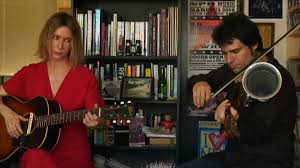
Sam is a funny performer, introducing herself (and then asking is she is allowed to talk) and later playing Bob Boilen’s cow in the can (and even questioning the way to say This is NPR).  She is accompanied by Erik Gorfain, who plays a Stroh violin which you can sort of see in this picture (there’s a better one below) and which Phillips suggests is plenty loud enough thank you.

Her first song, “Sister Rosetta Goes Before Us” opens with big strumming guitars and a bouncy melody.  It’s a great song that is a lot of fun–that violin brings great counterpoint.  “No Explanations” is a bit more rocking (with Gorfain on electric guitar).  It has a catchy chorus.  “Signal” returns to that kind of bouncy tin pan alley style which she does very well.  “Little Plastic Life” ends the set with… a screw up, which she handles wonderfully, and which makes the song seem all the better when she plays it again.

I really enjoyed this Tiny Desk and am going to have to listen to more of her work.

Check out what a Stroh violin looks like:

stroh

[READ: September 25, 2013] “By Fire”

Here’s another story about unemployment.  I had intended to post this back in September, so when I originally typed that this story is more dramatic than “yesterday’s,” I meant Lisa Moore’s story from September which was also about unemployment.

I wasn’t sure where this story took place (it was originally written in French).  The story is about Mohammed.  He graduated from University a few years ago with a degree in history.  It has been useless thus far.  When his father dies, and he is once again incapable of getting a teaching job, he gives up and burns all of his paperwork.

Then he sets out with his father’s fruit cart, determined to make some money selling fruit so he can move out of his house and in with his girlfriend.

There is ample back story in this piece.  We learn about Mohammed’s family—his mother has crippling diabetes, his brothers work but not very hard (one is downright lazy).  And we learn that the person who Mohammed’s father bought his fruit from was a crook who demands more and more money from Mohammed.

But the bulk of the story shows the daily life of Mohammed.  He is routinely harassed by the police for not having the proper paperwork or for being in the wrong place or just for being.  They start with simple harassment, but soon they turn to beatings.  Mohammed refuses to bribe anyone, even when the police give him the opportunity to turn in his former students. (more…)

Read Full Post »

nov 2013SOUNDTRACK: VIC CHESNUTT-Tiny Desk Concert #2 (June 5, 2008).

chesnuttVic Chesnutt seems to have come into my life at random times. I bought the charity record/tribute album (Sweet Relief II) only because I liked a lot of the artists on it–I’d never heard of him at the time.  More recently his records were released on Constellation, a label I trust wholeheartedly.  And then just as I was really starting to appreciate him, he died in 2009 from an overdose of muscle relaxants.

He was a fascinating person.  A 1983 car accident left him partially paralyzed; he used a wheelchair and had limited use of his hands (which you can see in the video).   He struggled with drugs and alcohol and depression.  Despite all of this, he released his first album in 1990.

Robin Hilton, music dude at NPR, introduces him here and talks about how much he loves his music.  But even Hilton’s association with Chesnutt is checkered.  He writes that when he was younger and went to see him in concert, “[Chesnutt] was often drunk and sometimes belligerent. I walked out of at least one performance,” and “all of this probably made it easy to dismiss Vic Chesnutt’s music. He was a challenging guy, and his unpolished, idiosyncratic songs weren’t easily digested.”

And yet for all of that Chesnutt seems rather shy and unsettled in this Tiny Desk setting.  He seems unsure about what he wants to play and often asks if he should play this or that song.

He plays 5 songs (for 26 minutes total).  The opener is “When the Bottom Fell Out.”  A lot of Chesnutt’s songs, especially in this setting sound similar.  His voice is incredibly distinctive, as is his playing.  But since most of his songs are just him strumming and singing, they sound quite similar.  The second song, “Very Friendly Lighthouses” sounds a little different because he plays a “horn” solo using his mouth as a trumpet. It is a web request which he says he’ll “try” to do (and that he needs a cheat sheet).  I don’t know the song but it sounds fine to me.  He also emphatically states that the song is not about Kristin Hersh (something she has claimed).

“Panic Pure” also has a Kristin Hersh connection (she recorded it on Sweet Relief).  He says he stole the melody from “Two Sleepy People” by Hoagy Carmichael.  He turned it to a minor key and wrote his song.

For the next track, he asks if he should try a new song that he just wrote–more or less asking permission to do this unreleased track.  “You really want me to try out a new song that might suuuck?” (resounding yes). “We Were Strolling Hand in Hand” proves to be a very good song indeed.

The final track “Glossolalia” comes from North Star Deserter, the album I own.  It’s about being an atheist songwriter in a Christian country.  It’s funny that he says he hasn’t played it in a long time (it’s from his then new album…).

Chesnutt was not for everyone, clearly.  But his music is haunting and beautiful in its own way, and this is a very engaging setting to see him perform.

[READ: November 8, 2013] “Lovely, Dark, Deep”

Karen told me to check out this story and while I was planning to, she got me to move it up higher on my pile.  And I’m really glad she did because there is so much going on in this story that I was glad to be prepared for it.

The story seems simple enough, a young girl goes to interview famed poet Robert Frost at a writer’s workshop.  She is an unknown writer writing for a small college journal (Poetry Parnassus) and really has no business interviewing the Poet Himself.  She is shy and literally virginal.  When she walks up on Frost, he is sound asleep on a porch.  She dares to take a few pictures of the man (which later sold for a lot of money…although presumably not for her).

When Frost wakes up he is surprised and a little disconcerted by the young girl.  And then he gets cocky with her, suggesting she sit on the bench with him.  She demurs and begins trying to be as professional as possible.

Frost proves to be an obnoxious interviewee, full of ego for himself and nothing but disdain for all other poets.  She is intimidated by him, fearing that all of her questions are silly.  Then she tries to ask him some insightful questions but he tends to dismiss them as obvious or simply ignore them.  Eventually she asks one personal question too many and he becomes blatantly offensive.  He asks about her panties and if they are now wet (the cushion she is sitting on is damp from rain).  And he bullies her terribly.  She is offended but remains strong and continues to ask him questions. (more…)

Read Full Post »

[LISTENED TO: November 8, 2013] Daniel Alarcón reads “Gomez Palacio”

alarcon The New Yorker has a Fiction podcast of current authors reading a story from the New Yorker archives.  I was unaware of this podcast until I recently stumbled upon this Alarcón reading.  I am trying to find out the breadth and depth of this podcast, but I find the navigation really unclear.  It seems like there are a lot of stories in this series.  (You can see the archives list here, although I wish it was a little easier to navigate).

The podcast is 30 minutes long.  What you get is a brief interview with Alarcón, in which he talks primarily about his exposure to Bolaño and his interpretation of this story.  And then he reads the story itself.

The interview was very interesting.  He talks about reading Bolaño when 2666 had come out in Chile.  What I enjoyed hearing him talk about was the Bolaño universe and him “sampling himself.”  And also how the shorter works reference each other and different characters appear and reappear–that Bolaño has created an entire world in which all of his stories are set.  These are things that I noticed, of course, but it is always comforting to hear others confirm your ideas. (more…)

Read Full Post »

[ATTENDED: November 14, 2013] Much Ado About Nothing

much adoDespite all of my reading, I am fairly ignorant of Shakespeare. I’ve read or seen most of the big ones, but I don’t know a lot of his works first hand.  As a young reader I realized that reading Shakespeare was hard—as, really, any play with dozens of characters tends to be.  It’s not easy to keep character straight when there are no descriptors about them.  So I more or less gave up on reading Shakespeare and decided I would watch him when I could.

When the Princeton University theater offered us tickets to see Much Ado About Nothing, it seemed a great opportunity to brush up.

This was a student production, and I have to complement all of the students on their wonderful performances.  They never broke characters, and their Shakespearean dialogue was flawless (as far as I know).  What I found interesting was that it took about fifteen minutes before I was absorbed in the dialogue and understood, well, about 45% of it.  Well, maybe 60%.  They did speak a little fast sometimes.

What was incredibly helpful about the dialogue was…the actors.  Duh.  But really, the language comes to life when you see people actually performing the lines (making Shakespeare’s bawdy jokes that much more bawdy).  And while some of the performances seemed almost over the top, I have little doubt that that is how it was performed back in the day—why would they go for subtle when there’s jokes about sex? (more…)

Read Full Post »

feb2003SOUNDTRACK: LAURA GIBSON-Tiny Desk Concert #1 (April 22, 2008).

gibsonI have enjoyed many of NPR’s Tiny Desk Concerts over the years.  And while I was listening to an All Songs Considered show, it was mentioned that there have been over 200 shows (I believe it is now over 300).  And I realized that I had missed dozens of good ones.  So, being the kind of person I am, I decided to start watching/listening to them all.  I don’t typically watch most of them as they’re usually not very visually interesting–they’re fun to watch for a minute or so, but most of the artists are there to sing, not to do visual entertainment.  So usually I just listen while doing something else.

I toyed with the idea of writing about one a day until I was done.  But the logistics of that made my head hurt.  So instead, I will write about them all over the course of however long it takes.  (And since they don’t post one every day, I will catch up eventually).

Laura Gibson had the first ever Tiny Desk show, and there’s some notable things about the show itself.  First, look how empty Bob’s shelves are!   And the camera work is a little wonky, I think.  I also enjoy how they introduce this performance without a clue as to whether there would be more of them!

I had never heard of Laura Gibson before listening to this.  She plays simple but beautiful guitar (I enjoyed watching how confidently she played the chords and individual strings).  But the big selling point is her voice.  Her voice is very quiet (this was the impetus for the Tiny Desk concept–they saw her in a club and the crowd was too loud for them to enjoy her so they invited her up to their office).  But her voice is also slightly peculiar (in a very engaging way), which you can especially hear on “A Good Word, An Honest Man,” where she is practically a capella.

She sings four songs: “Hands in Pockets,” “A Good Word, An Honest Man,” “Come by Storm,” “Night Watch.”  The sing-along at the end of the last song is really pretty–shame the audience wasn’t mic’d.  All four songs are beautiful and slightly haunting–her delivery is so spare you kind of lean in to hear more.  She currently has three albums out, and I’d like to investigate her music further.

[READ: October 31, 2013] “A Comet’s Tale”

Despite the fact that this article talks about and more or less guarantees the end of the world by asteroid or comet it was incredibly enjoyable and staggeringly informative.

Bissell begins by talking about the Biblical Apocalypse and how in 1862 Premillennial Dispensationalism (premillennialism is the belief that Christ will return before setting up his millennial kingdom and dispensationalism divides up the Bible and human history into various eras or dispensations, based on how God deals with humanity) was smuggled into the Americas and it has never left.  Fully 59% of Americans now believe that Revelations will come to pass (although what that could possibly literally mean is another question).  [Incidentally the book is not called Revelations, it is Revelation or more specifically Revelation to John.  And all of that numerology (666) must mean something right?  Well, yes, it means that the Ancient world was obsessed with numerology. The bible makes great use of the trick of predicting the future by describing the past.

Bissell pulls back from the bible to look at planet Earth “the most ambitious mass murderer in the galaxy.”  He then lists all the atrocities that have happened from natural causes to all species in the history of the planet.  But even recent tragedies (which seem to only happen to people in far off countries says the westerner) are only by happenstance happening there.  Between overpopulation and global warming we are preparing for our own apocalypse.  Although we also mustn’t look too crazy like in The Late Great Planet Earth (which still sells around 10,00 copies a year).  In that book Hal Lindsey predicted the end of the world but also the rise of a single world religion, a Soviet Ethiopian invasion of Israel and the obliteration of Tokyo, London and New York.  But astonishingly, Lindsey also worked for the Reagan administration, much like Tim LeHaye (famed “author” of the Left Behind series) was co-chairman of Jack Kemp’s 1988 presidential campaign.  Apocalyptos have way too much power in this country.

But even if we weren’t preparing for our own doom, there would still be space items to do it for us. Like 1950DA an asteroid that has near-missed the earth fifteen times and may just not miss us in the future. (more…)

Read Full Post »

witmisSOUNDTRACK: NEIL HALSTED-“Wittgenstein’s Arm” (2012).

neil-halstead-palindrome-hunches-450Halsted was a founder of the band Slowdive, who I knew somewhat.  I don’t know anything of his solo work, although his name rang a little familiar.

This is a very pretty, slow acoustic ballad.  Halsted’s voice is whispery and with proper folk inflections. The chorus has a very catchy melody.  And yet the lyrics are really dark and sad.

And while there is a mention of an arm in the song, there’s no mention of Wittgenstein.

You can check out the video here:

[READ: November 3, 2013] Wittgenstein’s Mistress p. 181-end

This peculiar book draws to a close in much the same way that it started. There are a few interesting revelations or, if not revelations, then perhaps ponderables as to the nature of just what our narrator (who is apparently named Helen) is doing.

As this last section opens, she is revisiting some more of the things that have been on her mind for the book—the waterlogged atlas that lies flat on the shelf and that blasted arthritic should/ankle  .

I have been wondering about her constant references to her period.  In addition to simply being something that happens to her which she is recording, I have to wonder if it is a nod to her fertility and the fact that since she is the last person alive she will never bear children.  On a slightly related note, I also have to wonder if her focus on rape means she was once raped.  It’s not necessarily the case of course, but there is a lot of it in the book, like this next mention: (more…)

Read Full Post »

mccarthySOUNDTRACK: PHISH-Undermind (2004).

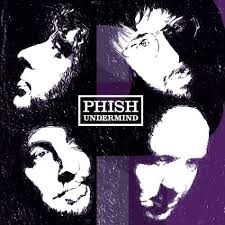
undermindAs I understand it, Phish fans didn’t like Undermind that much and yet I really liked it and still do.  Indeed, “Undermind” is one of my favorite new Phish songs, it’s clever and boppy and just really catchy.  The album has very Beatles vibe to it—a kind of echoey feel on all the songs.  And I have recently read that people interpret the cover design to be a nod to Let It Be (there are other connections made but I’m not going to go too deeply into that).

“Scents and Subtle Sounds” opens the album.  This is a brief intro–the full songs, which sounds different appears later on the disc (it’s 97 second here)).  It leads into “Undermind” which has a loose, slightly funky sound—one of their more fun songs on recent albums.  The album version has some big fat organ sounds on it which make it even cooler.

“The Connection” is another great poppy song—gorgeous harmonies and wonderful melody, and indeed it was their first real hit.  “A Song I Heard the Ocean Sing” is another great song, great backing vocals, an excellent melody and great alternating verse vocals from Mike.  It also has a great middle guitar section—it’s long and wild and reminiscent of Jimi Hendrix’ solos.  “Army of One” is sung by Page.  It is a big soaring song and it’s got a very upbeat sound.  “Crowd Control” is a very Beatleseque song.

“Maggie’s Revenge” is a noisy instrumental, with Trey’s guitars making all kind of squealing noise.  It’s weird and quite refreshing from Phish’s more recent fair.  “Nothing” picks up with the open and poppy sounds of earlier records and has more great harmonies.  It seems to fade out in the middle though—a song that could have been longer!  “Two Versions of Me” is another mid tempo song with great harmonies and  great chorus.  “Access Me” is a brief poppy song that feels a bit like filler, although it has a cool and interesting coda.  “Scents and Subtle Sounds” resumes

“Tomorrow’s Song” has a very African feel to it.  It is a simple repetitive rhythm that lasts for about 3 minutes before it fades out just like it faded in.  “Secret Smile” is a very pretty piano ballad.  It’s a little heavy handed with the strings, and at nearly 7 minutes it’s too long (especially the long coda), but the melody is certainly nice.  The album ends with “Grind,” a barbershop quartet track which shows just what kind of great harmonies they cool do.

Although it’s a mature sound, there’s enough weird stuff to let them show their funky side too.  The CD comes with a DVD called “Specimens of Beauty.”

[READ: October 8, 2013] C

I received a prepub version of this book back in 2010.  The cover and title were weird and I thought I’d like to read it.  And it sat on my shelf for two years.

And then Borders closed (bummer, their chai tea was the best!) and I saw a hardcover copy of the book for $1 so I bought it (I’m enough of a geek to want to see how prepubs and final copies are different.  In this case, the books appear identical except that in the last two dozen or so pages, there’s a section with ellipses.  In the prepub, they are single spaced but in the final book they are double spaced which throws off the line spacing.  So by the end of the book, the lines are about three lines different.  Fascinating huh?).

Anyhow, what on earth is a book called C about?

Well, it is a Bildungsroman or coming-of-age story.  By definition these stories focus on the psychological and moral growth of the protagonist from youth to adulthood.  Our protagonist is Serge Carrefax, even though he is not the first person we meet.  That would be a doctor delivering materials to Serge’s father, Mr. Simeon Carrefax.  Mr Carrefax runs a school for the deaf in which he tells children to stop using sign language and to start speaking properly.  And he has had considerable success with the children, each of whom acting in a play every year.  (The book, by the way, is set in the late 1800s).  His mother is a silkworm farmer, and much of their money comes from this job.

But the main person in Serge’s life is his sister Sophie.  Sophie is a deviously clever girl who is alternately mean to Serge (as only older sisters can be) and then encouraging him to play with her.  She is mad for science and is constantly experimenting with her chemistry set (leading to more than one explosion in the house).  The early sections of the book show Sophie and Serge’s education.  And when Sophie goes off to school, Serge is lost, especially when she returns from school but keeps telling him to leave her alone.  And then one day, Serge discovers her dead in her “lab” and experiment in progress. (more…)

Read Full Post »

wallsSOUNDTRACK: PHISH-Round Room (2002).

round After Farmhouse, Phish went on a hiatus.  No one knew it would be quite so brief, but there was really a feeling that they were done.

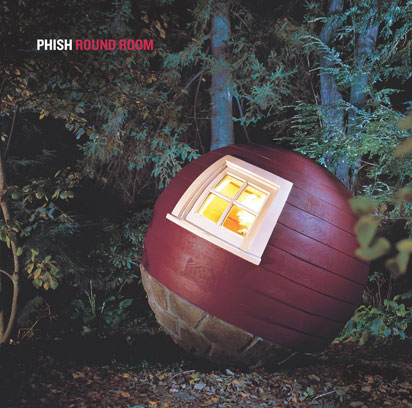
And then they quietly released Round Room in 2002.  And it bursts forth with an 11 minute song.

“Pebbles and Marbles” has an interesting riff—complex and pretty.  And when I listened to it again recently I didn’t really quite recognize it.  But that’s because it’s nearly 12 minutes long and the really catchy part comes later in the song.  At around 5 minutes, the catchy chorus of “pebbles and marbles and things on my mind” announces itself.  And it is a good one.

“Anything but Me” is a pretty, mature song that is slow and piano heavy.  “Round Room” is a boppy little ditty (clearly a song written by Mike).  It is sweet and a little weird.  “Mexican Cousin” sounds a lot like a cover (maybe an old song by The Band) except for the solo which is very Trey.  It’s a funny, silly ode to Tequila.  “Friday” is a slow six minute song with two sections.  The verses are spaced out a bit, delicate riffs that are mostly piano once again.  The middle section is sung by Mike (which makes it more mellow somehow).

“Seven Below” is an 8 minute song.  It has another great riff (and the intro music is cool and bouncey).  When the vocals come in, it’s got gentle harmonies as they croon the sweet song).  Most of the 8 minutes are taking up with a guitar solo.  “Mock Song” is another of Mike’s songs.  This one seems to be a random selection of items sung to a nice melody.  Then when the chorus comes it’s quite nice, how this is a “just a mock song.”  The first verse is sung by Mike, then Trey does a kind of fugue vocal with different words in verse two.

“46 Days” opens with funky cowbells and turns into what seems like a classic rocking folk song—few words but a great classic rock melody (complete with 70s era keyboards).  “All of These Dreams” is a mellow piano piece, another mature song.  “Walls of the Cave” has an interesting piano melody that opens the song. The song is nearly ten minutes long and the middle part has a nice flowing feel to it.  There’s also a few sections that are separated be drum breaks—something that doesn’t often happen in Phish songs.  When the third part opens (to almost exclusively percussion, their vocals all work in a very nice harmony.  It’s a long song but with so many parts it always stays interesting.  “Thunderhead” is another piano-based song with some guitar riffs thrown on top. But it is largely a slow, mellow piece.

“Waves” is an 11 minute song with long instrumental passages.  It also begins with a kind of Santana feel to it, but it is a largely meandering song, with a simple melody that they stretch out for much of the song.  So this album proves to be an interesting mix of long jams and mellow ballady type songs.  It seems like Phish had a big mix of things to let loose.

[READ: November 1, 2013] If Walls Could Talk

This book reminds me of the work of Mary Roach—exploring a topic in great detail and including lots of amusing insights.  The two big differences here are that Worsley is British and that she goes back very far in British history to give us this fascinating information about the development of certain rooms of the house.

Worsley begins with the bedroom.  She looks at the furniture—the history of the bed from lumps with straw to fantastically ornate full poster beds that were made for kings who might never actually use them.

Then she moves on to more personal matters—sex (including deviant sex and venereal disease); breast feeding (for centuries mothers felt they were not equipped to take care of and nurse their own children, hence wet-nurses) and knickers (royalty had an entourage designed specifically to assist with underthings).  Indeed, privacy was an unknown thing in olden times.  Even royalty was expected to receive people in all of the rooms in the house.  Initially the bed chamber was for their most intimate friends, not just for sleeping.

The section on old medicine was also fascinating, they believed that it was vaporous miasma that did you more harm than say, excrement-filled water.

The section on Sleep discusses what was also in a recent article by Gideon Lewis-Kraus—that there were two sleep times at night.  With no electricity there was no artificial light to keep people up late so they would go to sleep early, wake up in the middle of the night (the best time for conception of children) and then sleep again. (more…)

Read Full Post »

slippageSOUNDTRACK: PHISH-Farmhouse (2000).

farmhouseThis album has a very acoustic feel to it and I really enjoy this disc.  It is one of their most “mature” records and I feel a lot of fans don’t enjoy it as much, but I think the songs are really pretty.

“Farmhouse” is another one of my favorite Phish songs.  I love the harmonies and the melody is beautiful.  The end of the song with the two singers doing different lines of vocals is just beautiful.  “Twist” is a live favorite although here it opens with percussion only before Trey starts singing.  But then the song proper starts and it is just a riot of fun. Woo!

“Bug” is a mellow contemplative song about God.  It a little long and I must admit, a little dull.  “Back on the Train” is usually much faster live—it sounds like a slow train here.  “Heavy Things” returns the album to excellence, it’s a wonderful uptempo song that is fun to sing along to.  “Gotta Jibboo” is a silly dancey song with horns.  It’s a long jam about 5 minutes most of which is instrumental.  “Dirt” is a piano ballad.

“Piper” is a wonderful round with a melody that circles around the song, I really enjoy this song live and it’s fun to hear how fast they do it here.  I love the way the “words and words I say” gets cycled through.  “Sleep” is a 2 minute gentle ballad.  And “The Inlaw Josie Wales” is a pretty acoustic guitar/piano instrumental.  “Sand” is a funkier number that brings up the tempo.  Of all the songs on the album, I don’t know this one all that well, but it is very Phish like.  “First Tube” ends the disc with a staccato guitar riff that sounds very much like Santana to me.  It’s got a great beat and is very cool.

Perhaps I’m showing my age but I so is Phish, and I think this is a really solid album.

[READ: November 4, 2013] The Slippage

I knew Ben Gereenman from Superbad, a McSweeney’s book.  I liked it a little—but it was more trickery than story telling.  I had gotten it in my head that The Slippage was a good novel (I’m not sure why), and when I saw it at work on Friday, I grabbed it in hopes of reading it before I got back to work on Monday.  And I am pleased to say that I polished off this 288 book in a weekend (and suffered for my lack of sleep).  But I didn’t only finish it because of a self-imposed challenge, I really got into the story.

For this book Greenman’s style is simple and straightforward (a far cry from his earlier, more deliberately challenging work) and the story itself is also rather simple.  But it is engaging, funny and emotionally exhausting.  So the simple story is one of suburban discontent.  The blurb that stayed with me was “If Emma Bovary had lived in the ‘burbs, she would have left a novel like this in her wake.”

The main characters in the story are William Day, his wife Louisa and her brother Tom.  Indeed, the book is really about William and how he handles suburban discontent.  We meet all of the Day’s friends.  In addition to these people there is Emma, the woman who William has an affair with. (more…)

Read Full Post »

« Newer Posts - Older Posts »