Feeds:
Posts
Comments

Archive for October, 2009

walrus1I found out about The Walrus while watching an interview with Noah Richler on Book Television (back when I had Canadian satellite).  During the interview, they mentioned that the first issue of this cool new magazine, The Walrus, had just come out.  I was very intrigued; amazingly, the local Barnes & Noble had a copy!  I was delighted.  And since then The Walrus has become one of my favorite magazines.

In fact, in comparison to similar magazines (Harper’s, maybe The New Yorker) it is the only magazine that I read cover to cover.  I’m not sure why I insist on this (it’s probably got to do with it being an import from Canada, but really it’s just so well written that I enjoy everything), but I never regret reading every piece.

The magazine has recently had a face lift, a new cover design and, what seems to me to be a little more white space…it feels like each issue is a little less text-heavy.  Which is obviously a little disappointing, and yet when you have a lack of free time, as I do, it makes it a bit easier. (more…)

Read Full Post »

sinclairSOUNDTRACK: JARVIS COCKER-Further Complications (2009).

cockerI really enjoyed Pulp’s Different Class album when it came out.  In fact, I liked it so much I made sure to get This is Hardcore and even the one before the got big, His n Hers.  I felt like the earlier stuff was just okay.  So either they hit their stride or they got lucky just before they broke up.

Going back now, I don’t like those discs as much as I did then (maybe it was burnout), but I retained a fondness for Jarvis Cocker and his zany exploits. And yet, I wasn’t really all that interested in his solo output.

But there were several excellent reviews of this disc and I figured I’d check it out.  And it was totally worth it.  This disc is a fascinating collection of seemingly every musical style that Cocker has ever heard.  Each song is laden with his (often caustic) wit and clever word play.  And it rocks really hard.  It was produced by Steve Albini (!).

Musically, there’s not a terrible amount of originality, but that almost seems the point.  Cocker is trying on differnt styles, writing archetypical or over-the-top verses for these songs.  “”Further Complications.”” opens the disc in what could be described as a Pulp-style rocker (But, and this is consistent throughout the disc, with much harder guitars).  “Angela” is a dopey hard rocker ala the Stooges, while “Pilchard” is a fantastic near-instrumental with great breaks and stops.

The disc slows down on “Leftovers” which reminds me of a Nick Cave type ballad (although it is much funnier).  “I Never Said I Was Deep” is, as the title suggests, a wonderfully self deprecating ballad.  Funny and catchy with the delightful chorus, “I never said I was deep, but I am profoundly shallow.”

“Homewrecker!” is another great rocker (this one horn-filled).  And “Fuckingsong” is a noise-filled, riff-fired rocker that seems totally out of character for Jarvis and yet works perfectly.

The last two songs take up a lot of time on the disc.  “Slush” is another delicate ballad that kind of overstays its welcome at 6 and a half minutes (lop off a minute or so and it would be very tidy).  But despite being too long, the song itself is really great.

And the final song “You’re in My Eyes (Discosong)” is, indeed a very disco-y tune.  It fits in thematically with the rest of the disc somehow (probably because of how seedy it sounds).  And it works very well as a disc track.  But it also suffers from disco excess, in that at nearly 9 minutes it is too long by half.  Especially since the last three minutes are (my personal pet peeve) just a repeat and fade/final note to the end.  It ‘s the kind of thing that makes me not want to hit play immediately again because it really bugs me when a great album like this slowly fades away for three minutes.  But then I remember that the rest of the disc is pretty fantastic, and I give it another whirl.

Good for you Jarvis, welcome back.

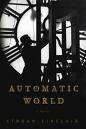
[READ: October 3, 2009] Automatic World

This is one of the first books I’ve read in a long time really just didn’t click for me.  I picked up this book because of this fantastic review at The Walrus.  The book wasn’t (and still isn’t) available in the States (although you can get a used copy from Amazon for $10), so I ordered in from amazon.ca.  And the fact that I actually ordered it from Canada (and paid the shipping) is the major reason why I read through to the end.

But here’s the thing.  Sections of the book are fantastic and totally gripping.  But other sections are nebulous and confounding.  And you get the real sense that the four (or more) stories are related, they really aren’t (as far as I can see).  Now, I am fully willing to admit that I simply didn’t get this book.  I’ve just come off reading (and putting a ton of effort into) Infinite Jest.  I deliberately didn’t read Automatic World at the same time as IJ because I knew it was supposed to be a difficult read.  So, it’s entirely possible that I was simply burnt out to really appreciate what was going on here.

When I just re-read the review at the Walrus, it once again really made me want to read the book (the review suggests that the book lets you know that the four stories are not connected, but I don’t think it does).

But let’s see what the book is about. (more…)

Read Full Post »

tinI’m popping this updated review into its own post because it’s quite different from my original review and it seems like it should be by itself.

The first time I read this story, I was too conscious of DFW’s own fight with depression and his suicide.  And since this piece is about someone with depression (and it’s in the first person) it really seemed a little too nonfictiony to be actual fiction.

As I thought about it more, though, I realized that this was not a nonfiction piece.  There were obviously things that didn’t happen to DFW; even if they seemed thinly veiled, this narrator was obviously not him.  So I decided to re-read the story with this new attitude. (more…)

Read Full Post »

coprseSOUNDTRACK: ERIC CHENAUX-Sloppy Ground [CST052] (2008).

sloppy

It took several listens before I fully enjoyed this disc.  There’s something about Chenaux’s voice that is very calming, almost soporific.  And, since his general songwriting style is kind of ambient and almost formless–with no real choruses or even rhythms, the disc tends to get lost in the ether.  There’s also some unusual instrumentation (electric harp & guitarjo (!)) too, which continues the otherworldly feel of the disc.

What really hooked me into the disc though was the three “funk marches” that distinguish themselves from the rest of the disc.  “Have I Lost My Eyes” comes in like a raging gust of fresh air after the first three drifting tracks.  It’s got a strong melody and raw drums that propel this fantastic track.  “Boon Harp” & “Old Peculiar” have a similar strong vibe.  And they are really the anchors of this disc.

The rest of the album isn’t bad, I just find it hard to listen to in one lengthy sitting.  The opening three songs tend to drift a round a little too much.  But one at a time, these songs are pretty cool.

[READ: Last Week of September 2009] The Fifth Column & The Flexicon

These two pieces were part of the list of uncollected David Foster Wallace publications.  The difference with thee two pieces is that he plays a small role along with several other authors.  Both of these pieces are sort of a exquisite corpse idea. Although unlike a true exquisite corpse, (in which the author sees only a little of the end of the previous author’s work) it’s pretty clear that the authors had access to the entire work.  The quotes in bold are from The Howling Fantods.

For a delightful exquisite corpse piece that I authored see the untitled comic strip on my website.  About ten years ago I started an exquisite corpse comic strip and sent it to a number of people who all had a lot of fun continuing the story.  I have finally put it online at paulswalls.com/comic.  (See, artists, I told you I’d do something with the cartoons some day!) (more…)

Read Full Post »

rapperSOUNDTRACK: SCHOOLLY D-Smoke Some Kill (1988).

schoolySince this disc is featured so prominently in Signifying Rappers (and the book is named after the best track on this disc) I thought I’d dust it off and listen to it again.  I got this disc probably in 1989 at the suggestion of my friend Al.  He recommended “No More Rock N’ Roll,” I think.

I haven’t listened to the disc in years, probably a decade.  The last time I listened, I think I wasn’t all that impressed by it, which is why it’s funny to me how much significance the book gives this disc/track.  In listening again, I felt more or less the way I did last time, although interestingly, after reading the book, I agreed that some of the tracks are pretty good.

“Signifying Rapper” in particular, seemed better after DFW’s analysis of it (he discusses it in the tradition of the trickster narrator, and I agree it’s a good one).  Although, at one point in the book DFW decries the misogyny in a lot of rap, but he doesn’t mention the homophobia.  And, despite the trickster style in this song, the homophobia is pretty outrageous (even if, in a surprising twist, the “faggot” kicks the “pimp’s” ass).  But really, the thing that upsets the pimp so much, that he went off to fight the faggot about is this rather absurdly childish set of insults:  your dad’s a faggot, your mom’s a whore, your granny’s a dyke and your brother’s a faggot too.  Now, homophobia aside, would these insults really get anyone so angry?   Hard to say.   But regardless of the whole thing, the song is set to the riff from Led Zeppelin’s “Kashmir” so, that’s pretty fun.

The rest of the disc is a mix of kind of lame tracks and a few good ones.  “Here We Go Again” has some great scratching on it (in fact the scratching throughout the disc is quite good), and there’s some really good background samples on “Gangster Boogie II.”  Although I think the best tracks come near the end: “Treacherous” (which samples or reinterprets Gil Scot-Heron’s “The Revolution Will Not Televised”) and “Black Man” which features the cool shout-out “What’s the Word?  Johannesburg!).

A few tracks are kind of flat.  “Mr Big Dick,” is, at best, silly and even the title track “Smoke Some Kill” is sort of uninspired.  What’s interesting about somewhat flat style is that this disc has come out after Public Enemy’s wall of sound changed the face of rap.  But Schoolly is sticking with the very sparse Run D.M.C. style.  The difference is that with Run, you had two vocalists, but Schoolly is by himself.  It’s just not quite as exciting.

And, then there’s the aforementioned “No More Rock N’ Roll” which is a companion to “We Don’t Rock, We Rap”.  The whole anti-rock trope rings hollow especially since he samples from it so freely.

It was still early days, but rap has progressed pretty far from this CD.  It also turns out that this disc is really hard to find.  It’s discontinued and lists on Amazon for $50.  How lucky for me!

[READ: October 2, 2009] Signifying Rappers

I wasn’t planning on reading this book this soon.  (I’m  not turning into a DFW addict, I swear).  But this showed up all because of the whims of the interlibrary loan system.  I put holds on books for people all the time, and usually it’s for new, popular books, so it’s often several weeks, sometimes months before the books come in.  I tend to forget that a 19 year old book that nobody is clamoring to read will show up in about 3 days.

So, those of you thinking about reading this book because you want to complete the DFW ouvre were probably wondering if this co-authored book should really count.  And, like, how would you know what he wrote?  Well, I didn’t immediately figure out the patently obvious system that they used in the book: When Mark Costello writes a section it is introduced with a large M.  When DFW gets a section it starts with a large D (see, obvious).   You can also tell because DFW’s section are laden with footnotes and very large words (no, really?)

I think for all readers, the main question is what are these two white, educated, twentysomethings doing writing about rap.  And, they both answer in their own way that, well, they like rap.  A lot.  In fact, DFW goes on to say that rap circa 1989 is the only musical genre that is interesting after some five years of commercial pap (and he’s pretty accurate with that, actually).  He also notes that as of their writing of the book there had been no real in-depth treatises written on rap.  Oh, and lastly, in the spirit of rap itself, they did it because they wanted to do it. (more…)

Read Full Post »

928

SOUNDTRACK: CLUES-Clues [CST057] (2009).

cluesThis is another of my favorite recent Constellation Records CDs.  Clues remind me of Mercury Rev, if they had remained a more indie/underpolished band instead of their more recent orchestrated pop.  The lead singer sounds a but like Jonathan Donahue (and sometimes Wayne Coyne from the Flaming Lips) and the band in general plays the sort of unusual pop that these bands have made common.

Every song on this disc is a winner.  It’s even hard for me to pick a favorite, although track number 8 “Cave Mouth” (I have no idea what the songs are about lyrically) is just fantastic: great musical riffs, great breaks, infectiously catchy melody, and yet the whole thing feels just a hair off balance.  It’s sublime.  And the rest of the disc works in a similar way: things are a little off kilter, but that make you listen even harder to find out what’s going on.

The best example of this is the last song: “Let’s Get Strong.”  The song is a pretty, simple piano ballad.  It’s very catchy and quite pretty.  But a few measures into the song, you become convinced that the piano is out of tune.  And as you listen attentively, you can’t decide what’s going on that makes the song sound off.  And by the end, you’re hooked.

Clues is definitely a quirky band.  And yet they are not offputting.  They’re just following their own muses.  And we’re all the better for it.

[READ: September 28, 2009] “Temporary”

This story concerns two women living in Los Angeles. They met when they were both applying for a temp position.  Shelly, the more outgoing of the two invited Vivian to live with her in her new place. The rent is cheap.  The only problem is that it’s a room in a factory, and technically it’s illegal, so if the police ever come they will be evicted on the spot.

And so, the title really conveys the lives that these women lead.

While Shelly’s back story is not really divulged, we learn a bit about Vivian and her upbringing.  When she was young her mother became very ill. They assumed she wouldn’t make it, but, amazingly she pulled through. This incident of more or less self sufficiency led Vivian to lead a rather sensible life, growing up faster than she probably should have.   As such, she is constantly surprised by Shelly’s behavior and lifestyle.

When Vivian landed the temp job, Shelly gave up her job hunt.  And yet Shelly always seems to be able to make the rent with no trouble.  She also has a habit of giving Vivian anything that Vivian complemented her on (which makes Vivian uncomfortable).  Shelly also walks around the apartment in loose robes, and tends to leave her “boyfriends” lying around the same way she leaves her extra cash lying around.

It’s Vivian’s temp job that provides the emotional heart of the story.  She works at an adoption agency transcibing the interviews of prospective adoptees.  One couple in particular grabs her attention.  The man seems like a bully and the wife seem too deferential to be healthy.  Since she listens to their tapes over and over for transcription purposes, she gets the man’s voice ingrained into her head.  It is inevitible that she will encounter these voices in real life, but the where and how are too good to spoil.

The main plot ends before the story ends.  The ending is a coda that ties the whole story together.  It feels extraneous at first and yet upon reflection it works very nicely to wrap up the story.

This was the first story I’ve read by Marisa Silver, and I enjoyed it quite a bit.

Read Full Post »

federeerSOUNDTRACK: SONIC YOUTH-The Destroyed Room: B-Sides and Rarities (2006).

destroyedIt’s hard to imagine what gets relegated to a Sonic Youth B-side.  Not that they are indiscriminate in their selections, but unlike many bands, their discs (as of late) haven’t been all that long, so it’s not like they couldn’t squeeze the extra track on there). Of course, I rather prefer when they don’t force extra tracks onto a disc, and so, a collection like this is a good place for these songs.

Fortunately, the liner notes give a context and explanation for all of the songs, which really helps to locate them in time (and in what SY were doing at the time).  The disc opens with the 11 minute jam “Fire Engine Dream.”  It’s loud and raucous and yet also beautiful.  And the liner note comment:  “Let’s see who’s here and who’s not” is just fantastic.

The surprising track for me is “Razor Blade” a folky singalong by Kim (she’s done a few of these, so I’m not sure why I’m surprised).  The next piece is also one of Kim’s.  “Blink” is one of her more ambient/talking pieces.

There’s a couple of interesting noise experiments “Loop Cat” and “Campfire,” and they are followed by the beautiful “Kim’s Chords,” an amazing, amazing instrumental.

The last few tracks are all furniture themed (as evidenced by the cover of the disc).  According to the liner notes, the furniture was essential in that they played them and sat on them.  The titles don’t actually reflect the furniture involved, however.   The instrumentals are surprisingly melodic and, for a first or second take, sound very complete.

The disc ends with a 25 minute version of “The Diamond Sea” (as if the 20 minute version on Washing Machine weren’t long enough!).  It’s not too revelatory, but it is a great song nonetheless, so why not add a few extra minutes to it!

As with most B-side collections, this is mostly for SY fans.  Although anyone interested in esoteric pieces (nothing too outlandish like on the SYR series) would find plenty to enjoy on this disc.  Since the pieces all come from 1994 and later, if you like this period SY, it’s a worthy addition.

[READ: September 27, 2009] Federer as Religious Experience

The anal retentive part of me wishes that I had written about this article in the same post as “Democracy and Commerce at the U.S. Open,” because they would serve as a very interesting contrast in styles from an early essay to a later one. However, this piece is so marvelous that it really does stand on its own.

In the years since DFW was last paid to go to a tennis match (at least I assume that a) he was paid to go to this one and b) that he was actually at this match,) his persona has evolved from the golly-gee, so-much-to-see naif of the first piece to the I’m-here-to-watch-this-phenomenal-guy of this piece. And I have to say, his enthusiasm is infectious. (more…)

Read Full Post »

sierraThis is another periodical that’s not really a “real” magazine.  Sierra comes free when you join the Sierra Club.  I originally didn’t really look at this magazine much either.  Then one day the cover caught my eye, and I discovered there’s a lot of cool stuff in it.  Not the least of which is that there are some gorgeous photos of landscapes and animals (which the kids love) and there’s a ton of good information for living greener.

The early pages of the magazine have lots of interesting short articles, especially about things (that I suppose you could cynically comment about consumption and the planet) that you can buy.  (Things like cereal or trail bars, or, a personal favorite, straws made out of (virtually) unbreakable glass that you don’t discard).  This is followed by “Hey Mr. Green” a column where you can find out how to live a more green and earth-healthy lifestyle. (more…)

Read Full Post »

adidasSOUNDTRACK: TV ON THE RADIO-Dear Science, (2008).

sciencThe problem with TV on the Radio for me is that their first EP is so damned good that anything else they do pales in comparison.  Having said that, Dear Science, comes really close to topping that EP.  I liked Cookie Mountain (their previous disc) but I felt like they put so many elements into the mix that it detracted from the best part of the band: Tunde Adepimbe & Kyp Malone’s vocals.

And so, on Dear Science, the vocals are back up front where they belong.  This disc is a lot less busy, which may seem a little like selling out, but instead, it just heightens the complexity and originality of the band’s work.  The disc rocks hard but it also heightens some really cool jazz and dance elements.    But it all comes back to the melodies and vocals for me.  And on Dear Science, they pretty much outdo themselves.

And you can dance to it!

[READ: September 30, 2009] Shiny Adidas Tracksuits and the Death of Camp and Other Essays

After reading David Foster Wallace’s essay in this book, I looked at the other articles here and decided to read the whole thing.  And I’m really glad I did.  It’s an interesting book full of, funny and often thought-provoking pop culture articles circa 1996.  As with some of the other pop culture/political books that I’ve read several years after they were relevant, it’s often weird to look back and see what things fully occupied the popular landscape at the time.  And, when a piece is completed dated, it’s pretty obvious, and sometimes unintentionally funny.  But there are many pieces here that are timeless (or at least hold up for a decade), and those are still really good reads.

This book also does a good job of summarizing the tenor of the defunct Might magazine.  A dose of irony, a splash of humor and a lot of criticism of what’s trendy.

The strange thing to me about this book, though is the targets that they chose to go after sometimes.  Rather than critiquing right-wing attitudes or corporate shenanigans (which they do touch on), they really seem to be after pop and rock celebrity.  For instance, there are two separate articles which take a potshot at Eddie Vedder (this was around the time of the Ticketmaster fiasco which didn’t put him in the best light but which could hardly be seen as only self-serving).  This seems rather unfair, unless his sincerity could really be called into question by a bunch of ironic jokesters.  Magazines like Radar and Spy used to do snarky articles like this. I’d always thought that Might was a little better than that.  But indeed, there’s one or two pieces here that have a holier- (or perhaps indier)-than-thou attitude.   Which may have been fine in the 90s but which seem petulant now.

But aside from those, the irony-free pieces are very enjoyable.  (more…)

Read Full Post »

« Newer Posts