Feeds:
Posts
Comments

SOUNDTRACK: THE FEELIES-Crazy Rhythms (1980).

Not too many albums start out with clicking blocks and quiet guitars that build for a minute before the actual song kicks in.  Not too many albums sound like early Cure sung by Lou Reed and not too many albums are called Crazy Rhythms when the thing that’s crazy about them is their vocals and guitars.  But that’s what you get with The Feelies debut.

In addition to the blocks, the opening song also features some sh sh sh sounds as a rhythm (techniques used by The Cure on Seventeen Seconds, also 1980).  There’s two guitar solos, each one vying for top spot in different speakers and, yes, the rhythms are a little crazy.

The album feels like it is experimenting with tension–there’s two vocalists often singing at the same time, but not in harmony.  There are oftentimes two guitars solos at the same time, also not in harmony.  The snare drum is very sharp and there’s all manner of weird percussion (all four members are credited with playing percussion).

That early-Cure sound reigns on “Loveless Love” as well, a slow builder with that trebly guitar.  There’s a lot of tension, especially with the interesting percussion that plays in the background.  And there’s that whole Lou Reed vibe in some of the vocals.

But not every song sounds like that, “Fa Cé-La” is a punky upbeat song with two singers trying to out sing the other.  “Original Love” is another short song, it’s fast and frenetic and fairly simple. It’s as if they couldn’t decide if they were going to be The Velvet Underground or New Wave punks.

The next surprise comes from their choice of covers: “Everybody’s Got Something to Hide (Except for Me and My Monkey”).  It goes at breakneck speed with some surprising pace changes after the chorus.  And a wonderful ringing percussion that makes the song sound even more tense than it is.  “Moscow Nights” is a more traditional song (although the backing vocals seem very spartan.

“Raised Eyebrows” is almost an instrumental, until the last-minute when the seemingly random vocals kick in.  And the final track, “Crazy Rhythms” seems to combine the speed of the faster tracks with the insanity of the other tracks.  It’s a pretty amazing debut, really heralding an age of music.

  It’s a shame it took them 6 years to make another (very different sounding) record.

[READ: February 8, 2012] “To Reach Japan”

I love Alice Munro’s stories, but I found this one a bit confusing.  Now, I admit that i read this under poor circumstances (while I was supposed to be attending a company-wide presentation), so that may have led to my confusion. But it felt like there was some questionable juxtapositions of the timeline in this story.

It opens simply enough with Greta and her daughter Katy waving goodbye to Peter (the husband and father) as they pull away from the train station.

The story immediately jumps back to Peter’s mother and how she fled on foot from Soviet Czechoslovakia into Western Europe with baby Peter in tow.  Peter’s mother eventually landed in British Columbia,where she got a job teaching.

The second time jump comes a few paragraphs later.  It seems like we’re back in the present, but the section opens, “It’s hard to explain it to anybody now–the life of women at that time.”  This describes how it was easier for a woman if she was a “poetess” rather than a “poet.”  But I’m not exactly sure when that was.  Presumably when Greta (who is the poet) was younger, but how long ago was that?  In Toronto, even?

The story jumps back to the present to say why Greta and Katy are on the train and Peter isn’t.  They are going to housesit for a month in Toronto while Peter goes to Lund for a summer job.

Then it jumps back to when Greta was a poetess and actually had poems published.  The journal was based in Toronto, but there was a party in Vancouver for the editor.  So she went.  And she had a lousy  time among the local literati.  She gets drunk and sits in a room by herself, but soon enough a man approaches her and offers to take her home. There is the potential for something more to come of it but it never materializes.  But she never forgot the man’s name: Harris Bennett, journalist. Continue Reading »

SOUNDTRACK: LOS CAMPESINOS!-Romance is Boring (2009).

Even though I had heard good things about Los Campesinos! before I got this album, this was the first one I bought.  I see that it gets less high marks than previous discs but I think it is fantastic.  It is frantic and catchy, it is intense and mellow, it is loud and soft and most of the time that’s in the same song.  And, as you’ll see below, lyrically I think it’s fantastic.

The disc begins slowly.  Then the vocals come in and you can tell that Gareth Campesinos!’ voice is somewhat abrasive, but well enunciated. When at the 2 minute mark the song more or less stops and turns into little twinkling bells you’re not prepared for the next bit–the guitars are noisy and the drums are loud and the lyrics are even stranger (sung in a slightly off-key style): “I’m leaving my body to science, not medical but physics.”  By the end, the song has mellowed almost completely and we have an almost a capella ending, “Would this interest you at all?”  But before you have a chance to answer that, the next song, “There are Listed Building” ratchets forth in both speakers with loud and quiet sections, group vocals and the lead singer’s more shouting style.

“Romance is Boring” has some super catchy shouted vocals as well as the first real exposure to the co-vocalist Aleksandra Campesinos!’ beautiful gentle female voice. “We’ve Got Your Back” is primarily sung by the female vocalist until the male voice come back with “and so fucking on and so fucking forth” and my favorite shouted chorus: “What would you do?  I do not know.”  “(PLAN A)” is a screaming punk blast of discord.  Until, of course, the much more palatable group sung chorus kicks in.

One of the best songs they do is “Straight in at 101” a wonderful song about breakups that is catchy and funny. It opens with, “I think we need more post-coital and less post rock.”  And then after some great alt rock, the song comes to an end with an a capella section that is quietly sung:

I phone my friends and family to gather round the television;
The talking heads count down the most heart-wrenching break ups of all time
Imagine the great sense of waste, the indignity, the embarrassment
When not a single one of that whole century was… mine

“I Warned You: Do Not Make an Enemy of Me”  has frenetic guitar and the wonderful line, “if this changed your life, did you have one before?”  And the wonderfully titled “A Heat Rash in the Shape of the Show-Me State” opens with this lyrical stanza:

She’d a bruise so black they watched it fade through the full spectrum of colours.
They kept it like a pet; a private joke they told no others.
And how the tissue repaired, and how it turned to yellow
And she found it disgusting, ’cause it didn’t match her clothing.
He said “that’s not yellow, it’s golden”.

Also lyrically interesting is “The Sea Is A Good Place To Think Of The Future,” because how can you make this couplet work in a rhythmic way.  But he does! “At fourteen her mother died in a routine operation from allergic reaction to a general anesthetic.”

There are fast songs and slow songs and pretty sections and harsh sections.  I think they meld it all together wonderfully.

[READ: February 6, 2012] “Los Gigantes”

I think I begin every T. Coraghessan Boyle story with some trepidation.  I liked Boyle because of The Road to Wellville, but I find that most of his other stories are very Southwestern, a region I really don’t know very well.  And yet for all my trepidation, I find I do enjoy his stories.

This one has a very simple premise.  All of the largest men in the area have been offered jobs by the President (I’m not sure where this is set but I assume, if it’s not entirely fictional, that it’s meant to be in Central America).  Although the men have some freedom during the day, at night they are locked into cages.  But their job is a simple one–eat, sleep and have sex with very large women.  That’s all.  It’s kind of boring, but  they are provided entertainments.  And it could certainly be worse (wait until you see what conditions the women love in!).

Discontentment begins to settle in as they realize that they are little more than stud animals (the President is breeding them for their size for a secret army in several generations).  And so one night two of los gigantes escape (it’s fairly easy, they are very strong men).  But they basically get as far as town where the pleasures of the  town’s bar keep them from returning home.  They are caught and punished, but the punishment is not that bad because the President really wants their offspring.

The men issue demands–a nicer living situation mostly–which are met, and they are contented once more. Continue Reading »

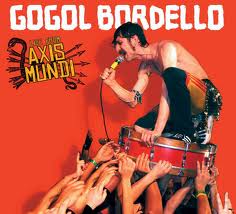
SOUNDTRACK: GOGOL BORDELLO-Live from Axis Mundi (2009).

This is a strangely-named disc collection.  The CD is actually live shows from the BBC as well as a few demos and other sessions.  The DVD that comes with it is actually a 2007 show live from Axis Mundi (Irving Plaza NYC).  For this review I’m only talking about the CD.

The BBC Sessions, as always, sound great.  The band is wild and spirited although a little less than in a typical concert setting.  They plays “Ultimate,” “Wanderlust King,” “Mishto”, “Alcohol,” “American Wedding,” and “You Gave Up (Roumania)” (all of which come from Super Taranta except “Mishto!” (from Gypsy Punks Underdog World Strike) and “You Gave Up (Roumania)” which I believe is exclusive to this disc.

The band is clearly having a lot of fun with the songs (the nine minute “You Gave Up” is a great jam) and they are perfectly in sync with each other.  At the end they even do a couple of promos shout outs for Radio One.

“Stivali E Colbacco” comes from something called the “Super Taranta Sessions” and was recorded by Steve Albini (his presence isn’t really evident, except maybe when the aggro guitar kicks in, but the song sounds great).

“Troubled Friends” comes from the “Gypsy Punk Sessions” and was recorded by Victor Van Vugt (who did the Super Taranta album).  It’s the first thing that slows the album down and feels like a B-side or a tack-on.  Mostly because the music is too minimal and meandering (and at 6 minutes is too long).

“60 Revolutions” makes up for the previous song with some solid songcraft.  At 6 minutes this is also a bit too long.  But it’s good exploration of Gogol Bordello’s flirtation with Spanish lyrics.

The last two tracks are a demo of “Immigrant Punk” which sounds different but not radically so (the lyrics seem clearer) and probably the least essential track of all, an instrumental version of “Immigrant Punk.”

The BBC stuff certainly makes this worth tracking down.  The rest is filler; but it’s pretty good filler.

[READ: December 31, 2011] “Blog This”

This is the final blog post from Max Barry’s website that I’ll be talking about (yaaay)–there’s two short stories left after this.

Like all good blog posts, this one is about the creator of the blog.  Barry was searching the web when he found a post called “Writers Who Blog.”  Barry posted a link to the article but the link is now dead and a very cursory websearch came up empty, so alas, there will be no confirmation of sources here.

So Barry says that this article about Writers who Blog totally trashes him.  He was going to let it go until he saw that a) the author was the same guy who wrote the worst review ever of his book Jennifer Government (this link is also down…I guess Barry really got to him!) and b) the critic was going by a lame pseudonym for the review but now he has revealed himself.

This post revealed to me that Barry created something called NationStates, a nation simulation game (which I would love to explore but don’t have time, which appears to be thriving).

Anyhow, the critic, Todd Bunker criticizes Barry’s blog posts, claims barry lies about his number of visitors and calls his readers sycophants.  Harsh cries indeed.  I think some of the many comments for this post include deliberately sycophantic comments.

Bunker also looked at Neal Pollack and Wil Wheaton’s blogs.  I happen to like Pollack, although I’ve never seen his blog.  But I have to say I have been following Wil Wheaton on G+ for a while now and he is a delight. I’ve never seen his blog, but I am never not amused by him (little shout out to the guy who inspired Wesley Crusher.die.die.die).  Continue Reading »

SOUNDTRACK: ISOBEL CAMPBELL & MARK LANEGAN-Sunday at Devil Dirt (2010).

Sarah bought this disc for me for my birthday a few years ago.  I had a hard time getting into it even thought it was supposed to be amazing.  It turns out that it is amazing, but only when I’m in the right mood.

The is a disc of slow, moody songs.  The closest comparison I can think of is Leonard Cohen (even though all of the songs are actually written by Isolbel Campbell)–this disc is at times more and at times less ponderous than Cohen.

The main reason I couldn’t get into it is because the first two songs are really really slow.  “The Seafaring Song” is almost comically slow–as slow as Lanegan’s voice is deep.  And yet there is a very nice melody (and beautiful accompaniment from Campbell).  “The Raven” sounds like an old Western movie.  Indeed, a lot of the disc sounds like an old Western.

“Salvation” introduces the first real up-front melody. “Back Burner” has a very old school chanting chorus which is quite a change for this album (although at 7 minutes, it does drag a bit).

“Who Built the Road” is very much like a Leonard Cohen duet (especially the La la part) while “Come On Over (Turn Me On)” is like a sexy Serge Gainsbourg duet (the album really picks up around here).  “Shotgun Blues” is a big sexy blues (surprising for Campbell who sings lead) while “Keep Me in Mind, Sweetheart” is a country-style ballad.

By the time that “Sally, Don’t You Cry” comes on, I find that I have more or less had enough of the disc.  But that is the last official song.  My copy has five bonus tracks after two minutes of silence. But the bonus songs mix things up a bit more.  “Fight Fire with Fire” is a jaunty piano based song (although it’s still pretty slow-paced).  It’s funny to hear them talking about AC/DC albums in this slow piano song.

“Violin Tango” is just what the title says while “Rambling Rose, Clinging Vine” is probably the most upbeat song on the disc. Finally “Hang On” feels the most like a song from her old band Belle and Sebastian (by way of The Velvet Underground).  It’s also the only one she sings solo.

So yes, I do like this album quite a lot. Lanegan is a perfect foil for Campbell’s sweet voice and songwriting. They made another disc together, maybe I’ll get that in another couple of years, too.

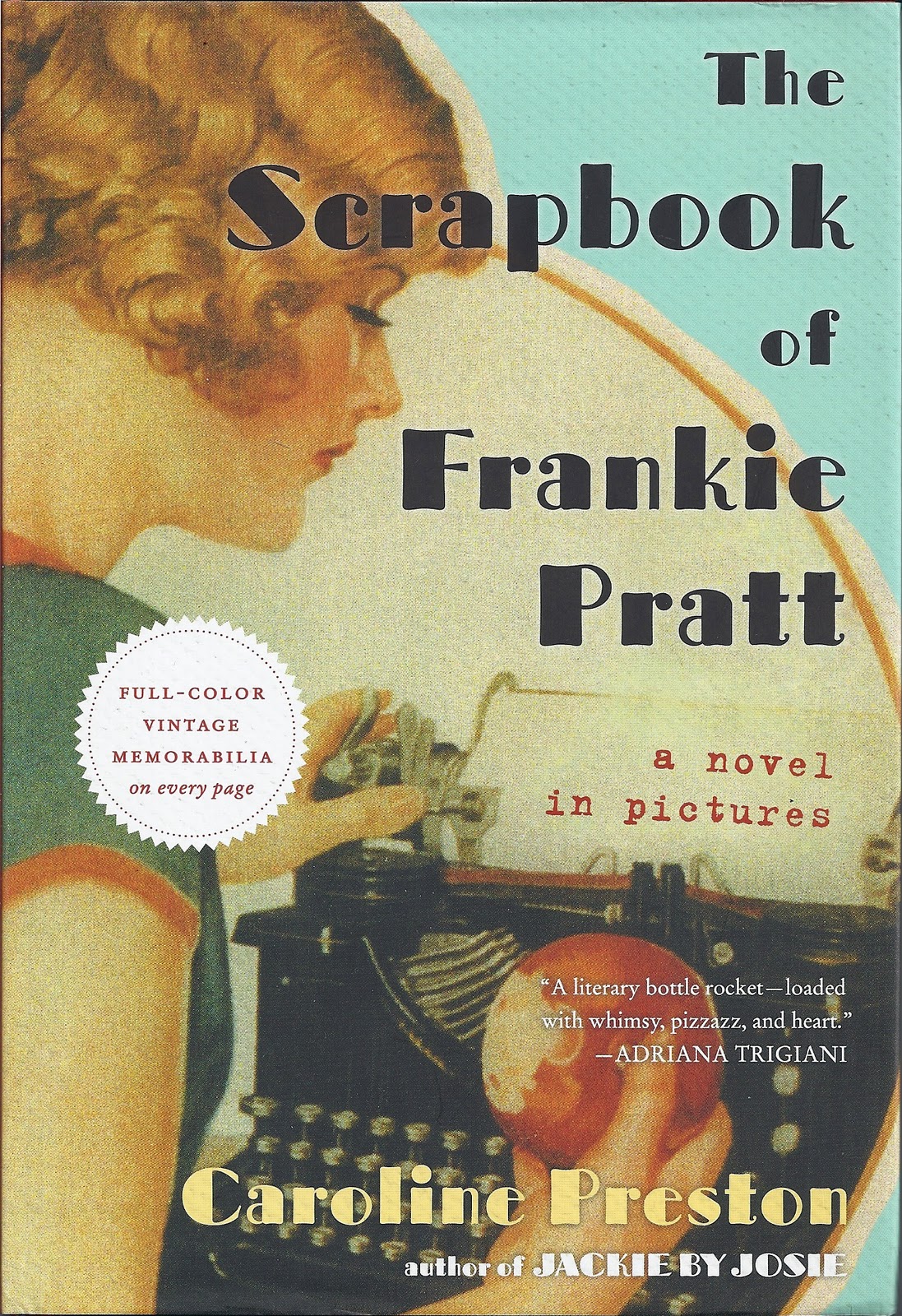
[READ: February 5, 2012] The Scrapbook of Frankie Pratt

This was a wonderful book that Sarah brought home and told me I had to read.  And I’m so glad I did.

The Scrapbook is a very simple story–it’s a biography of a lady named Frankie Pratt from the ten or so years after she gets out of high school.  She went to high school in Cornish, New Hampshire in the early 1920s; that’s when this scrapbook starts.  Over the decade, Frankie goes to college, gets a job in New York City, travels to Paris and then returns home.  That is the basic plot, but that simple summary does a grave, grave injustice to this book.

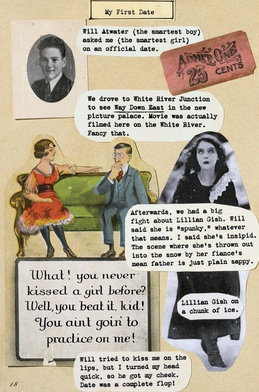
For Preston has created a wondrous scrapbook.  Each page has several images of vintage cutouts which not only accentuate the scene, they often move the action along.  It feels like a genuine scrapbook of a young romantic girl in the 1920s.

Check out the picture on the right.  Every page is like that–full of old photographs or ticket stubs, candy wrappers or advertisements.  And a few words here and there that Frankie has typed to move the story along.  It is a wondrous trip down vintage lane.

Now, as I said, the story is pretty simple (but it is befitting a scrapbook).  It showcases the highlights of Frankie Pratt’s life.  How she meets a man who wines her and dines her and treats her fine, until he reveals a shocking secret.  How she got out of Cornish, New Hampshire and went to Vassar (I admit I found this first section a little slow, but I was so absorbed in the look of the book that I didn’t really mind).

Once she gets to Vassar though, things are much more interesting because Frankie, small town girl with no money, is introduced to the rich sophisticates who attend Vassar–New York and Boston socialites.  She even rooms with one woman (who sends her down a path of debauchery and potential loss of scholarship).

Frankie longs  to be a writer, and she heads to New York to work on a magazine.  There she meets a man who wines her and dines her and treats her fine, until he reveals a shocking secret. Continue Reading »

SOUNDTRACKTV ON THE RADIO-New Health Rock (2004).

I was not aware that this EP existed (I guess technically it’s a single).  It came out after their original EP but before their first full-length.

The title track is a rocking number with all kinds of cool keyboard noises strewn about.  This is clearly early template TV on the Radio.  “The Wrong Way” will appear on Desperate Youth, Blood Thirsty Babes and it shows a new noisy sound for the band–lots of horns and a reluctance to allow silence appear, there’s sound filling up every space.  The final song, “Modern Romance” feels like a B-side.  It is kind of slow and meandering.  There are a few interesting sonic bits but mostly they are overshadowed by a kind of monotony.

Not essential listening for the TV on the Radio fan.

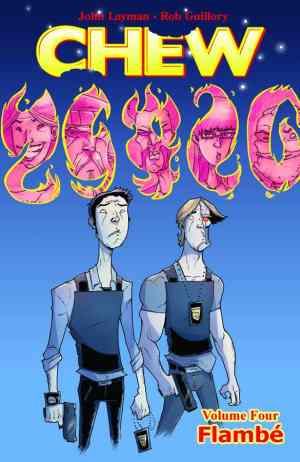
[READ: December 29, 2011] Chew: Volume Four

It was delightful to get volume four of this series so quickly after finishing volume three!

As with previous issues, this one starts out with a quirky opening.  A series of shots of a chicken restaurant (Mother Clucker’s) thirty-five years ago, then twenty-five, then fifteen and then five (nice clientele drawings over the years).  And then finally we see it today, after the ban on chicken–a wasteland.

But this story introduces an entirely new element (which goes through the arc of the book.  Lights from (presumably) an alien life form fill the skies.  They spell out words in a language that absolutely no one can understand.  And it is so vexing that money is taken away from the FDA (the people who are fighting the chicken war) and put into NASA.

This first chapter also introduces a new kind of character: a man who is voresophic–if he is eating he is unbelievably intelligent. Of course, if this was your gift, how long would you be able to stay slim?

Chapter Two jumps us right into a NASA space station.  Just as it explodes.  A quick cut to a school (where Tony Chu’s estranged daughter goes) reveals a more down to earth problem.  Since the letters have appeared in the sky people have been acting weird.  And one technologically savvy boy, who has been picked on most of his school life is looking for revenge.  But is he responsible for the space station explosion as well?

Chapter three is wonderful for a couple of reasons.  First, Chu and John Colby are getting assigned increasingly dangerous missions (because their boss wants them dead).  It culminates in a hilarious scene at the USDA (a furious female army). Chu and Colby are the last resort.  If everyone else fails, they have a fall back so dangerous that it is classified.

Chapter four is amazing for opening with a series of scenes that are gruesome and awful and, as the narrator boxes keep repeating, never actually happen.  And that is because Tony Chu has been assigned to work with his twin sister Toni Chu–NASA bigwig and (unknown to anyone else, fellow Cibopath–she doesn’t tell anyone so she’s not treated like a freak like her brother).  It’s great to see the two of them work their magic.  And while I wouldn’t want it to replace the Chu/Colby team, it would be fun to see future pairings of these two.

Chapter five (this is the first book with five chapters!) opens with a wonderfully long sequence of Agent Mason Savoy (he never went away, he’s always in the background) sampling something amazing.  And we get several wordless pages of him processing what he has just ingested.

But the more amazing thing is that suddenly the letters in the sky simply disappear.  And there seems to be a cult leader who predicted this, right down to the minute.  The cult leader ingested scads and scads of gallsaberries when she was adrift at sea and it led her to the Truth.  And she has lots of followers who are willing to drink her Kool-Aid.

The book ends with two wonderful cliffhangers.  The first one is (mild spoiler, but not really since it will be dealt with in the next book) that their actions lead Chu and Colby to get fired.  The second one is that Mason Savoy has learned a special secret about one of Tony Chu’s relatives (remember we saw them all in that cool scene from the last book?).  And he takes advantage of that knowledge.

The series isn’t over by a long shot.  Awesome.

A couple other things, first off–welcome back Poyo!  I loved the faux story they created about his background and then the negation of said story.  Also, this books reintroduces the vampires that were mentioned early in the story and then kind of hidden.  I love when stories pick up threads like this.  And a final quick nod to all of the excellent little jokes in the margins of the pictures.  I read them all and I love them…keep them up!

For ease of searching I include: flambe

SOUNDTRACK: TV ON THE RADIO-Nine Types of Light (2011).

I loved most of TV on the Radio’s releases.  On this one they scaled back some of their sound and they really highlight their assets, namely the vocals of Tunde Adebimpe and Kyp Malone.  This album feels like something of a continuation of the style from Dear Science.

Indeed, some of the songs are downright simple. “Second Song” is completely straightforward; I really enjoy the falsetto vocals on it.  “Keep Your Heart” is so straightforward it has almost no music in the verses.  It’s very much back to basics. “Killer Crane” is also very simple, with a gorgeous melody.

But don’t count uberdude Dave Sitek out of the game, he throws in some very interesting sounds and textures on a number of tracks.  “No Future Shock”  introduces all kinds of wonderful sounds and repeated lyrics which work as a mantra.  One of my favorite songs is the weird and wonderful “New Cannonball Blues” great synth sounds, cool harmonies  (that falsetto is on fire here!) and a nice staccato chorus.  “Repetition” has some cool repetitions (it’s in the title after all) that really becomes a mantra, with some great musical accompaniment.  And the drums sound amazing.  And “Caffeinated Consciousness” has some more cool sounds: orchestral hits and the like followed by a very mellow bridge.

And then there’s “Will Do” a perfect blend of the two styles–rich melodies, cool effects and great vocals (which is why it was the single).

The simple songs are a good introduction to the kind of stuff TV on the Radio is capable of, but it’s clear they have a love for the unexpected and that’s why I enjoy them so much.

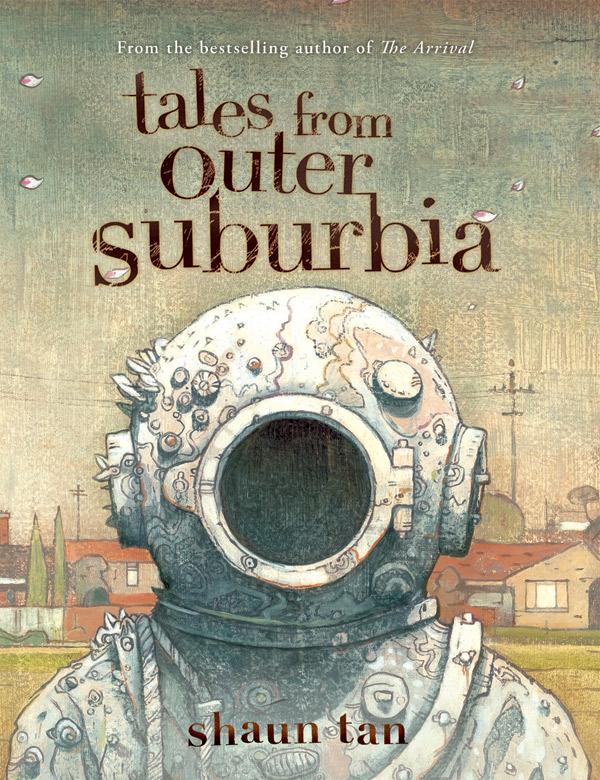
[READ: February 5, 2012] Tales from Outer Suburbia

Shaun Tan is an Australian author/artist who drew the amazing wordless The Arrival (it is stunning!).

This book is a collection of fifteen (very) short stories that come chock full of drawings.  Some drawings add to the story, some drawings tell the story and some drawings tell a kind of parallel story.  As with The Arrival, his artwork is weird and wonderful.

The library filed this book under YA Graphic Novels.  I’m not sure it’s either of those (The Arrival was filed under kids picture books).  While there are pictures, it is certainly not a conventional graphic novel.  And while the themes and idea aren’t risqué or anything, I feel like the ideas are more adult than teen oriented.  Of course, having said that, most of the protagonists are young, so maybe teens do enjoy stories about existential confusion! Continue Reading »

SOUNDTRACK: SIGUR RÓS-Inni (2011).

I’ve said before that Sigur Rós was one of my favorite live shows ever.  They created an amazing atmosphere that went beyond the music and the visuals.  It set the bar very very high.

So here is their first official live album and it does not disappoint.  It clearly cannot live up to the live experience (there is so much to see after all), but it really conveys just how amazing these guys can sound live.

Sigur Rós feels like they should only be a studio band–they are so atmospheric, so ethereal, that it doesn’t seem like it should translate live.  But they do, in fact , it brings a new energy to the music.  And the fact that Jonsi can easily hit those unearthly notes just blows my mind.

I’m not sure whether to say that Sigur Rós have hits or not, but this is like a best of playlist from all of their albums.  From their “debut” Ágætis Byrjun, we get the ten minute opener “Svefn-G-Englar.”  Although the songs all feel long, they run the gamut from two to three minutes through eight and nine up to fifteen.  They also play the awesome “Ný batterí” a few songs later.

There’s a number of songs from Takk… “Glósóli,” “Hoppípolla,” “Með Blóðnasir,” and “Sæglópur.”  There’s a couple of songs from () as well (of course, since they were untitled it takes a bit of work to know that . “E-bow” ends disc one and the concert ends with the glorious 15 minute “Popplagið”

From Með suð í eyrum við spilum endalaust, we don’t get “Gobbeldygook,” their sort of hit, but we do get “Inní Mér Syngur Vitleysingur,” “Fljótavík,” “Festival,” “Við spilum endalaust” and “All Alright”

The set also includes “Hafsól,” a B-side of “Hoppípolla” (which was a remake of a song of their real debut Von).  The best example of how Sigur Rós is not just wispy music comes in “Hafsól.”  After a few minutes of their atmospheric stuff, the drums kick in and the song becomes incredibly loud and chaotic with crashing cymbals and grinding guitars and feedback.  It’s amazing.  That it ends with a tin whistle solo just highlights the what the band is willing to put into just one song.

“Popplagið” closes out the concert with more of that dynamic.  At 15 minutes, it takes a while to get there, but somehow the drums feel more grounded.  And at the 6 and a half-minute mark when the drums really kick in and guitars get noisy and raw, it’s an unbelievable moment.  The song turns tense and intense and doesn’t let up for the rest of the track.

The encore is an unreleased track called “Lúppulagid.”  It is a slow, relaxing kind of track (it plays over the credits of the DVD).  Yes, there’s a DVD that comes with the two disc set.  I have not yet watched the DVD, but I’m pretty psyched to check it out.

This disc can’t convey the magic that is Sigur Rós live, but it really shows what they are capable of.

[READ: February 2, 2102] The Apothecary

Maile Meloy has written some of my favorite books (novels and short stories).  She is an excellent writer with a wonderful sense of reality–I’ve described her as unsentimental: her characters are typically downtrodden and not likely to follow flights of fancy.

And that’s just one reason why this book is so surprising–it is about magic!  It’s also surprising because its written as a YA book (the protagonists are fourteen).  And finally, it’s surprising because it is set in England, and previously, Meloy had been a small town America kind of writer (as far as I remember, anyhow).

Although I found the opening a little slow going (more on that in a minute), by about the third or fourth chapter I was totally hooked on this fantastic story.

The book is set just after WWII.  The main character (and narrator) Janie and her family live in Hollywood.  Her mom and dad are both television writers who are being hunted as Communists.  They tell her that they must flee for London.  (This was told briskly, and I wonder if teens know about the Communist trials in the 50s).

They move to London (where they have jobs set up as BBC writers) and learn to cope with the move from warm, sunny, prosperous Hollywood to cold, gray and still-under-rationing London.

One problem I had with the beginning (in addition to the Communist part) was that Janie talks a lot about Katherine Hepburn–walking like her, being strong like her.  Both of these things seemed like they maybe weren’t explained enough for the intended audience.  Perhaps I’m not giving young readers enough credit, but I was very distracted thinking, would a teenager want to read this?  I mean I barely know Katherine Hepburn as a young beauty.  The other problem I had was that the kids felt too modern to me.  Or maybe not modern so much as out of time.  It doesn’t really feel like the 50s.  It’s not really a problem, but every once in a while I had to remind myself that it was set in the 50 at the height of the nuclear scare.

Of course, once Janie gets to school, those concerns evaporate.  Janie goes to a fancy London school–they wear uniforms and learn Latin)–I guess it is timeless.  She is immediately introduced to Sarah Pennington, a very very rich girl (she has a butler).  What I liked is that even though Janie is different and from California and Meloy shows that they are different, she doesn’t exploit these differences.  She doesn’t make it a clique story between Janie and Sarah.

Things are dire in post-war London.  It is cold all the time and you need to put pennies in the wall to get the heat to come on–this is why people from England like hot water bottles so much!  So Janie and her dad go down to the apothecary to get hot water bottles and pennies.  When the apothecary hears that they are American, he offers Janie some homesickness medicine.  Janie and her dad don’t believe it will work but she takes some anyhow.  And she seems to feel a bit better.

Soon after this, Janie learns that the apothecary’s son is a boy in her class named Benjamin.  In school, Benjamin stood up to the lunch lady when she insisted that everyone “duck and cover” when the air raid siren went off.  He’s nobody’s fool, he knows how dangerous the Bomb can be.

Janie is surprised that Benjamin and the apothecary are related.  The apothecary is nice and mild-mannered whereas Benjamin is strong-willed.  And, it turns out that Benjamin wants nothing to do with his father’s business–even though the Society of Apothecaries has paid for his education.  He wants to be a spy. Continue Reading »

SOUNDTRACK: HELLBENDER-Footprint of the American Chicken (1996).

This disc opens with a funny quote from a movie I have never heard of called Highway 61 (thank you, internet, back in 1996, know one would have known where “Lady, you can’t cheat at bingo. If you could, I would, but you can’t. I won because I was lucky – lucky to wind up in a town full of losers!” came from).

This disc fees like a progression from Hellbender’s debut–mostly in production values, but also in song textures and vocals.  The band is still angry, still aggressive, playing choppy punk (although with most songs clocking in at over 3 minutes it’s a different kind of punk).   Al Burian, the lead vocalist is still angry–and still hard to understand, he sounds very much like California punk circa the mid 80s.

But the thing that impressed me is that on some songs there’s another singer (I assume Wells Tower, or maybe it’s Burian’s “other singing voice?”).  He is more melodic, less screamy and he really lets you hear the lyrics.

So the first song (shouty singer) has a great title “Unsolicited Anthem for the Portand Hipsters,” but I have no idea what the words are except the chorus of “It’s raining again.”  But “Tourist Trap” has some great lyrics (as well as more melodic sound):

“The quiet Americans who are my friends/ laugh at the loud ones on the other end/ of the room/ and watch them spend and spend/ acting rude/ being defeated by foreign food/ being defeated by waiters who pretend/ not to speak/ a word of their language.  We draw the line between us and them as best we can

It goes on like this with some more great imagery and then it ends with a cool detuned chord.  This song is a major highlight on the album.

The disc continues with a mix of faster, harder songs and slightly more melodic ones.  As on their debut, they throw in some nice drums breaks and great dynamics to keep the songs from becoming predictable.

“New Wounds” is more melodic, almost, but not quite, poppy with a cool guitar riff and interesting lyrics “Stay up all night counting cancers as if the counting could cut them out”

“Until It Peaks” sounds like yet another singer (man I wish I had liner notes…or could find anything about this album online anywhere…come on people!).  “Half Driven” has some interesting backing vocals and some cool “ticking” sounds instead of drums. “Pissant’s Retrospective” has a new sound for the disc: scratchy guitars.  That “third” vocalist is also singing again.   And at 5 minutes long, it stands out for having a slow instrumental section for the last minute or so.

I also really like the lyrics to “Dumb Waiter.”  It opens with a false intro (I love that) and more cool lyrics:  “cross the street which separates losers from jocks…this is just like high school again.”  I also like the chorus “I’m not lighting candles. I curse their darkness.”

The final song “I Thermostat” features three vocals at once–a harmony vocal and another voice singing a third line.  Very cool.  This album shows some major progress for the band.  They released one more disc before breaking up.

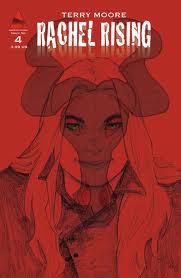
[READ: January 31, 2012] Rachel Rising

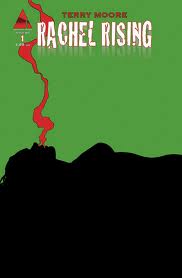
My subscription to Terry Moore’s Echo ran out with issue 27 and I never got around to renewing it.  So I totally missed the ending.  I ordered the last issues from him but, gah, 28 is sold out, so I need to wait to finish it.  But when I was on the site I saw that he has a totally new series cooking called Rachel Rising.

There were very dark tones in Moore’s most famous work, Strangers in Paradise.  And Echo is all about nuclear annihilation, so he’s clearly no stranger to darkness.  But wow, Rachel Rising a dark, dark work.

The opening sequence (a stunning words-free nine pages) shows a woman rising from the earth.  She’s beautiful and not at all zombie-like, although the whites of her eyes are dark and she has clearly been strangled.  She stumbles home (actually she gets a ride from a concerned guy whom she totally ignores) and tries to figure out what the hell happened.

We see a brief flashback of her visiting her friend Jet at the garage where she works.  But when she goes to visit Jet’s house, her housemates (or whatever they are) not only say that Jet isn’t home, they say that Jet is out playing a gig like she does every Thursday.  But Rachel thinks it’s Tuesday.  So what the hell happened to her?

In Issue two she visits her Aunt Johnny who works at a mortuary. Terry doesn’t hold back with some of these scenes.  Johnny thinks that Rachel is a figment–she gets visited by lots of ghosts in her line of work.  Rachel convinces her to go look at the site where she was buried.

In the meantime, we get another storyline.  A young girl in pigtails is visited by a woman in white.  I have to say that this is a confusing development.  The woman in white looks a lot like Rachel and I can’t decide if I’m suffering from “a lot of Terry’s characters look alike” syndrome or if this is supposed to be Rachel in another incarnation, or what.  Anyway, we don’t see what the woman tells the girl, but several pages later when that storyline resumes, we see that the woman has had a powerful impact on the girl’s behavior.

In Issue 3, Rachel visits Jet at her gig.  While they are all in the bar, Rachel and the woman who looks like Rachel but is in white both interact with a couple who are getting married soon.  Both women say things that are not very nice about the institution of marriage.  Although Rachel’s seems unintentional, the woman in white’s seems deliberate (and we notice smoke coming off of her finger).

A little later when there is an accident, Rachel is involved and the woman in white is a witness.

In Issue #4 the storylines collide somewhat.  Rachel is at the hospital after her fatal accident.  But she soon wakes up–to the astonishment of Johnny and Jet who saw that she was dead.  Doctors said she was pronounced dead at the scene.  But Rachel has a pulse, a very faint one, and Jet and Johnny are simply at a loss.

Meanwhile, the young girl (who we find out is named Zoe) is finishing up the act that she started in Issue #2 (which includes stealing her sister’s car even though she is waaay too young to drive).  She drives out to the field where Rachel was buried.  There she runs into the man who was supposed to get married.  As we’re starting to get into the plot here, I’m not going to say anymore, except that violence abounds and it’s fairly clear now that Zoe and the woman in white know each other from some kind of past experience.

Issue #4 came out in December.  I have no idea how long the series is expected to run, but it seems like it’s got a long way to go.

This is a very dark series…Terry seems to be exorcising some demons here.  But man is it good.  Terry’s art is (as always) beautiful.  And (as always) he creates real women and gives them good roles.  And as with everything that Terry has done, I cannot wait to see where he goes with this series.

My only word to Terry is that for as long as I have been reading him, he uses “it’s” instead of “its” I hope someone will correct him someday.

[RANTED: January 29, 2012] What is it with Busses?

I don’t often post things that are just me blathering, but now that I’ve started swimming every day I have a lot of time to mull.

I’m more or less opposed to the Reality TV. It bothers me that writers and creative people have been given the shaft for ephemeral “stars” who are memorable only because of how annoying they are.  But hey, the genre is here to stay (I’m already like 20 years too late to complain about it, I know).  And, in fairness, there are a number of shows that I do enjoy (I still wish they were relegated to cable to get real shows back on the networks, but I guess cable is where all the real shows are now anyhow.

The shows that I like are the ones that celebrate creativity.  Even though a friend pointed out, the participants are forced into being creative, and it’s more like art school than real art, these shows are as close to art on TV as you get most of the time.  How likely are we to see craftsmen and craftswomen at the peak of their game on prime time TV (or even not prime time TV)?

So, the four reality shows that I watch are America’s Next Top Model, Project Runway, Work of Art and (newly added) Face Off.   I don’t watch Top Chef because I don’t really believe in a show that I can’t experience the final product.  If I can’t taste it, so I don’t trust who thinks it’s the best.  Having said that I loved the Japanese Iron Chef (not so much the American one) because it was crazy and theatrical and wonderfully Japanese.

I realize that these shows are more like game shows than genuine reality TV.  The real difference between these shows and game shows of old is that these shows take the Real-World approach and try to drive up drama by having them live together, or, more specifically, interact with each other in ways that are not normal.  (Face Off doesn’t seem to do this and, as far as I can tell, Work of Art seems less inclined to focus on this aspect).  But most “reality” shows seem to focus on the “drama” rather than the product, and I think that’s a real shame–leave that nonsense to Big Brother and The Real World. Continue Reading »
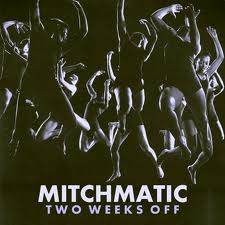
SOUNDTRACK: MITCHMATIC-“Ella MPC” and “Joplin MPC” (2010).

I haven’t quite figured out what the MPC stands for, but I really like these two short songs.

In “Ella MPC” Mitchmatic takes some Ella Fitzgerald scatting (I don’t know the source) and makes a new song out of it.  After 30 seconds or so, he throws a simple drumbeat over the whole thing and off it goes. I love that he even makes different “parts” of the song with different scatting sections.  It’s very clever.

In “Joplin MPC” he takes a Scott Joplin rag (I can’t tell which one, but there’s a plunger-trumpet on it) and loops it around on itself.  It creates an entirely new song that sounds nothing like a Joplin rag.  Indeed, if it weren’t  titled that way, it may not even be obvious that that’s where  the music is originally from.  It’s also very clever.  Especially when the drumbeats turn it into a much faster dance song in the middle.

Both of these songs come from the Two Weeks Off album, and frankly I should have just reviewed the whole thing by now, but these two songs really stand out as a cool experiment.

[UPDATE: Mitchmatic just left a comment on my About me page (cool!) and he gives me the answer to the mysterious MPC question–it’s the name of an AKAI sampler.  I’m including this video where you can watch him play “Joplin MPC” live.  It blew my mind]

[READ: December 31, 2011] “We’re not in Redmond Any More, Toto”

This post is all about Barry’s switch from Microsoft Windows to Gentoo Linux.  He explains that it was “a lot like moving to another country, both in the sense that I didn’t know where anything was or understand the local language.”  But Barry is not looking back.

He makes eight statements contrasting Linux and Microsoft.  I’ve never used Linux so I can’t really chime in, but I will say that this blog post had the most comments of any one of his by a huge margin.  (34!–Computer geeks are passionate, man).

1. Linux is a religion.
And practitioners have a born-again look in their eyes.

2. Windows thinks you’re an idiot; Linux thinks you’re a genius.
I agree with the first half, although I do like that you just hit ENTER to install stuff.  While I like to do my own tech repair, letting the machine do the obvious stuff is nice. Continue Reading »