I know Reggie Watts from Comedy Bang Bang, but his name sounds familiar, like he’s been around for a long time. And he has, although not in ways that I am familiar. He’s been in a million bands (none of which I’ve heard of) and done a number of short films and concerts (prominently as of 2004). Interestingly he was born in Germany to French and American parents. And, yes, he lived his early life in Montana.
In his early bands, Reggie sang (he has a beautiful voice). In recent years he has become sillier, doing improv and a lot of looped vocals. he also has a lot of funny comedic lyrics. But not all of them. In this Tiny Desk concert, Reggie does three songs (with funny intros). The first one “Song #4” is a “proper” song.
The other two are improved. The middle one, about NPR is very funny (if you know your NPR). In all of the songs he samples his voice creating bass lines and whatnot (he does amazing beat box work). The set is really impressive that one guy can make so much beautiful music.
Although normally I enjoy just listening to the Tiny Desk shows, this is one that demands watching, just to see how he does it all.
[READ: September 6, 2013] “Motherhood”
Manguso writes about being a mother and how sleep deprivation as a new mom is actually somewhat enjoyable (I suppose she means in retrospect). She doesn’t say anything all that new about being a mom and the experiences of waking up at the slightest sound (or lack of sound) from your children. Although of course it’s original to everyone when it is their child.
And she does make some interesting observations about how when the baby is first-born you rush to help him or her at the first cry but as they get older you feel even more protective of them. I also enjoyed the idea that maternal love is in no way a softening or weakening force but is actually a courageous act–sacrificing yourself for someone else. Continue Reading »
SOUNDTRACK: THE FRONT BOTTOMS-Tiny Desk Concert #297 (August 19, 2013).
I really enjoyed The Front Bottoms’ “Au Revoir” and was pretty excited to see they had a Tiny Desk Concert. After watching this, I’m very curious to see what they do in a full band setting because their sound works very well in this stripped down fashion–with acoustic guitars, penny whistle and muted trumpet (!).
Lead singer, Brian Sella, reminds me a lot of Mike Doughty in his speaky/singing way (especially on “Swear To God The Devil Made Me Do It”–although less speaky than Doughty or Cake–there’s just something about his delivery that puts me in mind of them.
He’s also always got a smirk on his face, which makes me like them more.
I’m torn between wondering if they’re a novelty band that I wouldn’t listen to more than a few times or a cool alternative band whose idiosyncrasies only get better with each listen. I love the way “Twin Size Mattress” has little elements (like the tambourine moment–and the “no fucking way moment) which elevate it above some of the seemingly sillier songs. Not to mention the lyrics are really good in the song. Indeed, even though the lyrics are funny, they are often very clever, too.
I really enjoyed all four songs in this set and I have listened to it many times now. “Au Revoir (Adios)” sounds great. All four songs comes from their new album Talonof the Hawk. And the more I listen the more I’m convincing myself to jut get the damned album.
[READ: September 6, 2013] “Gaboxadol”
This essay was actually hard for me to read. That’s because the first half was all scientific chemistry talk and I really got lost–I don’t really know what GABA receptors are or do and I didn’t even really understand what he was talking about what Stepan Krasheninnikov did in 1755. And I worried that I wasn’t going to enjoy this at all.
But soon Morris brought it back to an area that dummies like me can enjoy He talks about the history of Gaboxadol a drug created by Dutch chemist Povl Krogsgaard-Larsen in 1977. The first time Povl took it (self-experiment was very common until recently) he said it made him feel like he had just had three beers–a very comfortable feeling.
But Gaboxadol never found its niche. Povl knew it had relaxing qualities but he couldn’t specifically diagnose who would best benefit from it. It was tried on the mentally ill. The desired effects did not really arrive–but the side effects made people feel sleepy. Then it was tried as an analgesic for cancer patients. It relieved some pain but it made everyone sleepy (you see where this is gong, right?). It was then tested on patients with anxiety disorder, but the side effects were more powerful that the anti-anxiety effects.
So then the drug was just shelved (were people just less experimental back then?) It wasn’t until 1996 that Marike Lancel a somnologist in Munich read the research and decided to try it as a sleeping aid. She realized that Gaboxadol assisted sleep and also had none of the side effects that Ambien had (apparently terrible insomnia once you stop taking it–so I’ll not be taking that, thank you very much). Merck bought the rights to Gaboxadol for $270 million. Continue Reading »
By my count there are fourteen people in Mother Falcon (the notes say 17 but I couldn’t see them all)–that’s a lot of people in a Tiny Desk concert. And they all play an instrument. I count trumpet, bassoon, three saxophones, three violins, two cellos, an upright bass, accordion, guitar and mandolin (the mandolin player is the lead singer (and a cello player too).
Despite the orchestral set up, the songs are short pop songs but with a lot of, well, orchestration. The songs have gorgeous instrumental sections, especially in “Marigold” where the riff is powerful and made all the more dynamic by the woodwinds.
“Marfa” has vocals by the female lead (who plays guitar–I don’t see any band member names on the NPR site). The strings really dominate here and remind me of the way The Dambuilders used strings–even though there is no heavy guitar. The strings feel like they are playing rock songs rather than being used as background for a rock song. “Dirty Summer” is a sing-along track with no real words–lots of oh ohs.
Watching one of the members climb on the desk to sing louder was pretty fun. It was also cool hearing how excited they were to be on the Tiny Desk. Check it out.
They sound really great and, although I have to suspect that they must be more dynamic live than on record–how could they not be?
[READ: September 6, 2013] “Herbal Remedies”
Curtis is a holistic nutritionist. I was a little concerned that this whole essay was going to be about prescribing alternative medicines to people to help them sleep (that’s only part of the article–and sadly there’s no quick suggestions either). Actually, I’m normally all for herbals, but I’ve been watching Doc Martin lately and, man, he really rails into the herbalist on that show. I’m generally torn about herbal remedies–I absolutely believe in science, but I have no faith in corporations. So I believe scientists find cures for things and then corporations mess with them and make us need more than we do. And I also feel like old herbal remedies probably work to an extent and yet they have also not been scientifically proven. What’s a skeptic to do?
Anyhow, the switch comes when Curtis admits that while her patients can’t sleep, she has no problems with it. Except that she doesn’t want to sleep, she hates it. She even slept with the light on (until her business associate warned that it ruins your “kidney jing.)”
She talks about what it’s like to sleep in different men’s beds. I liked the descriptions–the way each bed and each man makes her feel a different way in the bed–like a princess, or someone who wakes up several times a night so she can cuddle again or, like a safe and secure person who can sleep uninterrupted all night long. Continue Reading »
If you have the hard copy of the three Green Day CDs, you’ll notice the back cover lists a fourth disc, ¡Quatro!. I wasn’t really sure what¡Quatro! was supposed to be, but I have recently found out that it is a documentary DVD/CD. For those keeping track, Jason White who was a touring guitarist with the band for years and who has recently become a full-fledged member of the band, is on the cover.
According to press releases and such, ¡Quatro! will give a behind-the-scenes look at the creative process that resulted in the trilogy and their various live shows across the U.S.
It seems as though the release date is up in the air (no doubt because of the state of the band), although some of the material premiered as early as last November. And their official site only says “in 2013.” I probably won’t watch it as I find this kind of thing self-indulgent and pointless; however, some of these videos can be entertaining. Indeed, if it had come as a bonus disc to one of the other three discs I probably would have watched it.
At any rate, the official trailer for ¡Quatro! is available on YouTube
And there’s a few other snippets (which were probably shown on VH1.
[READ: September 6, 2013] “Bed-Wetting”
Bed-wetting is fairly common, especially for those who are potty training. Smallwood talks about all of the ways throughout history that people have tried to deal with it. She gives this list (which I have abbreviated here):
Plugging the urethra
Constriction of the penis with bandages, strings, adhesives, or vises, one of which was described as a “formidable rat-rap looking instrument”
Eliminating sugar
Removing the child from school
Injecting the bladder with gaseous carbonic acid
(and I have left out a few of the more crazy ones).
By the late nineteenth century, naturally, Westerners began connecting bed wedding with masturbation (other symptoms of masturbation: flushed cheeks, paleness and paralysis). At this time, victims were subjected to cold baths, hard beds and even whipping (which may have caused sexual fantasies but certainly didn’t help with bed wetting).
A fascinating piece of information—boys are more prone to night time wetting while girls are more prone to day time. Continue Reading »
The third and final album of the trilogy is called ¡Tre! (and yes I enjoyed that they named this one ¡Tre! as opposed to ¡Tre! and put Tre Cool on the cover—not exactly the most clever thing around, but it made me smile and makes me think that they only did three albums so they could have this title/cover combo). And, yes, this is my least favorite of the three discs. It feels like a bonus disc—songs that don’t really belong anywhere else. It’s kind of an album full of ballads (but that would suck) so they made it mostly ballads with other things too.
Like “Brutal Love” a slow ballad (complete with horns) that builds into a standard rocker (it’s got a very “rock and roll” vibe). Many punk songs are really just rock and roll played fast and this is certainly one of those songs. (I don’t care for that kind of punk so much). “Missing You” is a another mid-tempo rocker–the kind they do very well.
“8th Avenue Serenade” has another cool sound (as in different from the rest of the album). “Drama Queen” is an acoustic guitar ballad with creepy creepy lyrics. It’s probably my least favorite Green Day song ever. “X-Kid”seems even more simple than other Green Day songs (does Billie Joe throw anything away?) It sounds like a classic rock song form the mid 80s. “Sex, Drugs & Violence” brings the disc back some with a fun poppy rocker. “A Little Boy Named Train” sounds a lot like “Carpe Diem” from ¡UnoI (same chords, just played slower—although the verses do change it a bit.
“Amanda” a mid tempo rocker and “Walk Away” is another slow song that sounds like classic rock. “Dirty Rotten Bastards” clocks in at over 6 minutes! It’s got several short sections in it though (which makes it more fun). The first part is the melody of The Marines Song. “99 Revolutions” is so catchy it even has a chorus with only drums (that lowest common denominator of songs that is guaranteed to get the crowd to sing along).
So yes, there are a few good songs in this collection, but they could have easily scraped out the good ones and dumped them on the first two discs and just put Tre’s picture on the back of both of them.
[READ: September 6, 2013] “Neighbors”
Unferth, like Julavits, writes a kind of narrative piece about sleeplessness. It’s hard to imagine her living the way she does, but if you’ve read her memoir, she has certainly slept in worse places than a Chicago slum. It turns out that her downstairs neighbor, Maximilian, would turn on his TV late at night and leave it on all night. The odd thing was that he had no electricity in his apartment—he ran an extension cord to the light in the foyer. When Unferth would get fed up with the noise, she would go downstairs and unplug the cord.
But then Maximilian’s girlfriend Dorothy moved back in. The two of them fought nightly—loud screaming fights that were worse than the TV noise (when Unferth unplugged the TV, Dorothy found an electricity source elsewhere, although Unferth couldn’t figure out where).
She makes a very interesting distinction about the type of noise that might wake you up as compared to visceral fighting of your neighbors. From things like jets and trains (or a fire engine, like at my house): “You may lose sleep over them, but you won’t lose sleep over them.” Whereas hearing your neighbors screaming at each other is far more disturbing. Continue Reading »
While I was writing about these songs the words “stupid” and “dopey” came up a lot and I realized that of this trilogy of albums, this may be the dopiest (I mean, look at the cover). I assume that’s on purpose. We know that Green day was taking a break from their serious albums and operas to make dopey punk rock. But between the lyrics and the riffs, this one is really quite dopey. Charmingly so.
¡Dos! opens with “See You Tonight” a tinny guitar sound that makes me think they’re goin to bust into The Allman Brother’s “Jessica,” but no, it remains a folky song that lasts for 90 seconds before it bleeds into “Fuck Time” a knuckleheaded, big drummed bluesy riff that reminds me of Soundgarden’s “Big Dumb Sex” except that it might actually be serious. And it may be the least sexy song about sex I’ve ever head. “Stop When the Red Lights Flash” ups the speed even further (although they manage to have catchy verses that seem to recall The Who again). “Lazy Bones” changes the tone somewhat, bringing in some nice ringing guitars (sounding more like The Strokes than punk) and a prettier feel (in the verses anyhow). It’s probably my favorite on this disc.
“Wild One” is one of their rockier ballads. It could probably do with being about a minute shorter, but the backing vocals are pretty cool. “Makeout Party” is stupid fun (with some wild solos, and even a bass solo section). “Stray Heart” is a fun boppy song with, yes, a big arena-friendly chorus). “Ashley” is a fast punky song (that plays high guitar notes rather than big chords).
“Baby Eyes” has good harsh sound in the riff (a rare minor chord)–although again those verses are bright and happy. “Nightlife” is the one glaringly odd song. It has a silky bass line and a really interesting sound. But it also feature an extensive rap by Lady Cobra (who I’ve never heard of). The rap is just as silly as Armstrong;s lyrics, but somehow since she is speaking them so clearly (rather than hurriedly singing them) they seem even dumber.
“Wow! That’s Loud” is a wonderful title for a fast spirited song, with a dopey riff and some fun soloing sections (unusual for Green Day). The disc ends like it began with an acoustic type ballad. This one is called “Amy” and it is pretty much the quintessential sweet Green day ballad.
Although I liked this one, I preferred the first disc overall.
[READ: September 6, 2013] “Segmented Sleep”
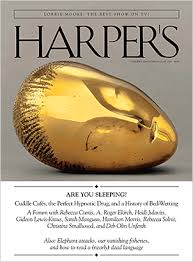
I’m repeating this intro because of the content of this essay. The timing of this Folio, entitled “Are You Sleeping? In search of a good night’s rest” is quite spooky. I myself have been having middle of the night insomnia. I seem to battle this occasionally. This recent bout seems to be accompanied by a stomach upset. So I have this really unfair cycle. My stomach is bothered by caffeine, so it keeps me up at night and when I wake up groggy and with a headache, I need the caffeine to get me somewhat stabilized (and I’m not a big caffeine drinker—a cup of tea, maybe two a day). But that seems to upset me during the night. I am also really strangely accurate with my insomnia. It is almost always between 2 and 2:30 AM. So, yea, here’s other people interested in sleep deprivation.
[begin new content] Although Julavits’ piece read like a story, Ekirch’s has a much more academic style. Turns out that he wrote about a history of sleep for his dissertation and for part of his book At Day’s Close: Night in Times Past. This short essay focuses on “segmented sleep.” It turns out that in pre-industrial nights, sleep was segmented: a first and second sleep bridged after midnight “by an hour or more of wakefulness in which people did practically everything imaginable.” This second sleep is mentioned in Odyssey and Aeneid.
In the 1990s a sleep study was done. Males were deprived of artificial light at night for a few weeks. They began sleeping in segments as well. This seems to be a natural circadian rhythm to our lives. Indeed, It was in the 1800s that segmented sleep gave way to one longer sleep—when lighting and industry came to dominate our lives. And we felt compelled to be awake when it was light out so we could be more productive. Continue Reading »
Last year Green Day announced that they were going to release three back to basics albums (a sort of antidote to their operas and concept albums). And lo, there they came: one, two and three. Oh and in the meantime, Billy Joe Armstrong had a kind of mental breakdown or something.
I’ve enjoyed Green Day’s releases since Dookie–they write simple pop/punk songs that are fun to sing along to. Not all of them are winners, but many are. Billy Joe has a knack for a pop hook. So when I say I liked all three of these records, it is with the understanding that these aren’t genius records, they are fun, kind of silly records. Or, as I like to sum them up: simple three chord pop punk with supremely catchy choruses.
¡Uno!, the first one, is comprised of a lot of these simple, catchy rockers. There are super fast rockers like “Nuclear Family” “Let Yourself Go” “Loss of Control” (with the fairly lame bridge of “we’re so crazy, oh so crazy now”–even by Green Day standards, that’s pretty lame) and “Angel Blue.”
There’s also slower rockers (which last longer) like “Stay the Night” “Carpe Diem” (with pretty harmonies and falsetto) “Troublemaker” and “Fell for You” (which if it was slower and sung by a girl group would be a perfect girl group song from the 1950s–except for the “pissed the bed line” of course).
Then there’s the jittry “Kill the DJ”, a song I instinctively dislike, (because of the stupid chorus) but which is undeniably catchy. Even the Green Day songs I don’t really like I find myself singing along two after a couple of listens.
The last three songs change the tempo of the album a bit and each song stands out in its own way. “Sweet 16” is a big ol’ ballad (with really falsettoed vocals). It’s a pretty standard ballad from them, not quite as lighter-raising as their huge ballads, but this could have been huge if marketed right. Along similar lines is “Rusty James” their more uptempo radio hit—big choruses, backing vocals a wonderful bridge—three chords and a major hit. You have to be really jaded not to tap your foot to this one. And the final track, “Oh Love” feels like a big 70s rocker (reminiscent of the Who).
There’ a lot of cursing on this album (mostly of the “we don’t give a fuck” or “you’re a stupid motherfucker” variety). And while I don’t object to that in principle, it comes across as really lazy songwriting. Of course, this is a 40 minute album of pop punk and three chords, so it’s not exactly an unlazy album to begin with.
Of the three this is my favorite.
[READ: September 6, 2013] “Restlessness”
The timing of this Folio, entitled “Are You Sleeping? In search of a good night’s rest” is quite spooky. I myself have been having middle of the night insomnia. I seem to battle this occasionally. This recent bout seems to be accompanied by a stomach upset. So I have this really unfair cycle. My stomach is bothered by caffeine, so it keeps me up at night and when I wake up groggy and with a headache, I need the caffeine to get me somewhat stabilized (and I’m not a big caffeine drinker—a cup of tea, maybe two a day). But that seems to upset me during the night. I am also really strangely accurate with my insomnia. It is almost always between 2 and 2:30 AM. So, yea, here’s other people interested in sleep deprivation.
Julavits writes about her vacation home in Maine. Her family spends a few months there each year and it often happens that she is simply hunting the house for sleep while her family snores on. Beginning at 12:20, she leaves Husband bed and heads off to the other options: Child One, an uncomfortable futon; Child Two: a single air mattress (“basically [a] pool toy for houses”). Continue Reading »
So if you’re Voivod and you have just released a prog rock metal masterpiece, what’s your next step? Hire Terry Brown, famed producer of the early Rush catalog! And then try to go somewhat more commercial. And name your new, commercial album… Angel Rat?
Oh but then—never a good sign—after recording the album, original bassist Blacky left the band. It’s hard to find out exactly why (personal reasons) but he then went on to form The Holy Body Tattoo Dance Society and to create electroacoustic music.
When this album came out I was very disappointed in it—it is so far from the angular prog rock of Nothingface that I assumed the band had utterly sold out. I mean, there’s ballad moments on it, there’s hardly any dissonant chords, and most of the songs are simply verse bridge chorus. The band sounds a lot more commercial (sadly for them, the album tanked). Listening to it now with fresh ears it actually reminds me a lot of Blue Öyster Cult, especially with Snake’s vocals and the chord structures that Piggy presents. And since they used Terry Brown there’s a Rush element as well. Once I divorce the album from what came before I actually like the album quite a bit. The songs are remarkably simple (I feel like Piggy could have been playing all the parts himself at the same time), but there’s still enough interesting weirdness that the songs don’t sound boring. And once you get used to the overproduction and the fact that Snake can sing, there’s some really good stuff here. Conventional but good.
It starts out pretty heavy with a chugging guitar but soon you notice that Snake is actually singing…nicely. His voice sounds polished and good. And then you notice that the guitars are fairly conventional—there’s almost no dissonance. True it is still heavy metal and there’s some slightly obscure chords, but for the most part it’s not all that weird. Even the guitar solo is a fairly conventional speedy solo. And when the chorus comes in it’s actually quite pretty. Speaking of pretty, the band photo is one of the more glammed up moments in Voivod’s career and, without being unfair, they are not a terribly pretty band, so this is kind of a funny picture.
“Clouds in My House” is also quite a pretty song, although admittedly the verses are a little dark (with that squeaking guitar solo sound that was popular around that time in heavy metal). But the chorus is downright upbeat. There’s a cool section in the middle with a noisy (but very simple) bass popping and a guitar solo over the top of it—it reminds me a lot of Rush in sound). “The Prow” is the catchiest thing that Voivod has ever done—great sing-along verses and a big chorus. “Best Regards” has more BÖC simiarlies—the chorus in particular has a very BÖC structure. There’s also a some great bass on it. Again, not the complicated bass of previous album, but a great rumbling sound that works very well as a riff while Piggy solos. “Twin Dummy” is another fast song. This one features some of the stranger lyrics on the album. Away says that he backed off on some of the concepts for this album and let Snake so his own thing. So this song seems to be about ventriloquist dummies with the strange opening lyric “Dummy says…” But the music is fast and furious here—some weird chords and really fast bass. There’s also some keyboards on this track (pipe organ type sounds) that reminds me of Rush from around this period.
Title track “Angel Rat” sees Snake crooning over a very simple guitar ballad intro. It’s almost unthinkable. And yet the band keeps it interesting—especially Blacky’s bass. Again, I don’t know why he left, but his bass is featured nicely on this album anyhow. Blacky opens “Golem” with a powerful (but again simple) bass. There’s an occasional funky note, but it’s a very staccato song. The drums have a strangely pop quality (the way he fills in the gaps). It’s a little unsettling how obvious and catchy it is. And even more unsettling is the solo—which has a very jazz feel. I can’t even really tell what’s going on—is that Piggy or a keyboard? “The Outcast” has probably the most conventional early 90s metal sound (except…is that a harmonica?) Snake even does a falsetto at the end of a verse! Probably the biggest surprise is that the final lines are “everything’s gonna work out.”
“Nuage Fractal” at least has a very Voivod title. And the chorus sounds a lot like recent Voivod (except for the solo section). The biggest surprise has to be “Freedoom” which opens with a very pretty guitar ballad sequence. Something that early Voivod would have stomped all over. Snake is whisper-singing and Piggy is playing gently for two whole minutes. Interestingly, once the full band kicks in for the last two minutes, it is one of the heaviest sections on the album. So even when they’re being conventional, they can’t do it for too long. The bass in particular sounds very Geddy Lee to me on this track. The final song “None of the Above” Is another political song—this one about global destruction. The music is surprisingly upbeat for such a topic, but Blacky’s bass is wonderfully deep and rumbling here.
So yes, ever the chameleons, Voivod have made an album that could have sold a lot of copies–except that they’re a little too weird to do so. But it was a good experiment and resulted in some great songs.
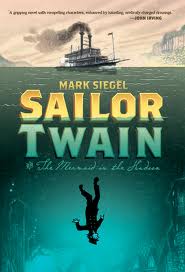
[READ: August 15, 2013] Sailor Twain
Sarah got me this book for Christmas. I didn’t read it until right now because it’s fun to stretch out Christmas gifts as long as possible.
This book is a lengthy graphic novel from our friends at First Second. It is complicated and a little confusing (the whole story is a flashback that is sort of explained in the very beginning). It’s also very beautiful.
Except, I might say, for the main character. The background images and the interstitial pages are really beautiful and detailed. But the main character is very cartoony–very two-dimensional with a triangle nose and big circular cartoon eyes. I found this very disconcerting for about a third of the book. Siegel does manage to make him very expressive and uses the big circle eyes to a good drawing benefit through, but the character just looks so–surprised?–all the time that it was hard to not notice him. Of course later on his big eyes come in handy during the darker sequences, but I still found it an odd choice. So too were the really cartoony choices of some of the other main characters–very big, comical noses or fat round faces. It certainly made the characters distinctive, but as I said, I was unsettled by it.
As the story opens, Captain Twain sits in a bar and is approached by Miss Camomille. She asks to speak to him but he says he wants nothing to do with her or his past. She holds out a necklace and says he can have it if he tells her the story. He is shocked to see it and reluctantly agrees. Continue Reading »
I had seen the cover of this book in the library almost every time I went in. I loved it but I wasn’t sure if the book was too old for the kids (it’s rated 8 and up, but it turns out there’s nothing too intense that my 5 year old didn’t love it too (she didn’t get it all, but she liked it). Angleberger is best known for the Origami Yoda series–I haven’t read it and frankly without knowing anything about it, the entire concept of the series baffles me. But I enjoyed this book so much that I may have to dive into the folded paper series too.
This audio book was read by Jonathan Todd Ross and Jessica Almasy. And while I liked Almasy, I really enjoyed Ross’s two sections–there was something about is style that really appealed to me.
This is the simple (albeit complicated) story of a boy whose friend buys a fake mustache. In the town of Hairsprinkle, young Caspar lives with his parents who believe in wholesomeness—in other words, they don’t have a TV. Nor do they believe in an allowance—material goods are not so good. But every year Caspar’s aunt gives him a couple hundred dollars to by something frivolous. And this year, Caspar has his sites set on a man-about-town suit. Not just any cheap suit, but a very nice tailored, man-about-town suit (this phrase, repeated throughout the beginning of the book cracked me up. I’m sure my kids didn’t know what it meant but it made me laugh every time it was used). After buying the suit, he went to the Heidelberg Novelty Store to buy the Heidelberg Handlebar #7—a glorious fake mustache which is made from real human mustache hair (ew). With suit and mustache, Caspar looked like a short man-about-town. And the citizens of Hairsprinkle were impressed
The main character and narrator of the story is Lenny Flemm, Jr. Lenny is something of a loser and his only real friend is Caspar. Turns out that he himself is responsible for giving Caspar the extra ten dollars that he needed to get that mustache (they had raised the price). When Lenny goes shopping with Caspar, he is excited not to buy a suit or a mustache but to buy a sticky grabber hand (for $1). The lady at the desk, Sven, is hilarious (and Ross’ voice for her is dynamite).
That night a bank is robbed—by a short man in a man-about-town suit. And the next day Caspar gives Lenny his money back, with a lot of interest. Then another bank is robbed. And then another. The next time Lenny visits Caspar’s room, there are stacks of gold bars against the wall. Lenny decides to call the police, but they don’t believe him—Caspar is a boy, they are looking for a man. But now that Caspar knows that Lenny is onto him, he tries to make trouble for Lenny.
But before Lenny can prepare for this, there is a new player in town—Fako Mustacho—a man who plans to save the town, the country, the world, from itself. Fako Musatcho is a short man with a glorious mustache and a suit—not a man-about-town suit, mind you, but a different kind of suit. And it seems that whenever Fako speaks, people automatically listen–including the mayor who agrees to step down because she can’t catch the bank robber. Except for Lenny who seems to be the only one who can see that Fako is really Caspar. So, what is a kid with no friends supposed to do?
Call for help from Jodie O’Rodeo, of course. Jodie is the star of the now cancelled kids show The Jodie O’Rodeo Showdeo. On the show she sang and did trick riding stunts. Turns out that she can really do them (the stunts, not the singing) and she also knows that Fako Mustacho is a kid wearing a mustache. By the middle of the book, when Part 2 opens, we hear Jodie’s side of things (in the audio book this is where Jessica Almasy takes over). Interestingly Jodie and Lenny meet because Lenny is dressed like Jodie O’Rodeo (long story). Lenny always thought she was cute (and was embarrassed to say so) but the show has been off the air for a few years and Jodie is really cute now. And she still has her horse, Soymilk. And she wants to help Lenny save the world! (And she thinks Lenny is cute, even though it’s weird because he is dressed like her).
Once the two begin working together, hijinx ensue and the story gets very exciting indeed. Whereas Lenny is a man of words, Jodie is all about action, and there is a ton of it (most of it very funny indeed). By the time they free themselves from Fako Mustacho’s henchmen, Fako has the whole world hypnotized and, since it is an election year, he has them all hypnotized to vote for him as the President of the Unites States. It’s going to take nerves of steel, great horsemanship and perhaps a sticky grabber hand to stop the plans that are afoot (including the other plan to assassinate Fako should he become president—don’t forget, he is only Caspar in a fake mustache).
This story was so funny. It is riddled with absurdities and hilarious asides. The situations are preposterously simple and yet also dangerous. All throughout there were wonderful jokes, hilariously silly set ups (they fall into a vat of oozing slime) and preposterously funny foolishness—who doesn’t love when no one can see the bad guy but one kid?
I enjoyed this book so much I insisted that the kids only listen to it when I was in the car. And it did not disappoint.
As I said earlier I loved Ross’ reading. He was very very funny (and reminded me at times of John Hodgman’s deadpan delivery–absurdity always works best in deadpan). And his pronunciation of Fako Mustacho made me laugh every single time. Jessica Almasy’s reading was also really good (I don’t want to give the wrong impression). It’s just very different—Jodie’s story is more exciting than Lenny’s while it is still funny, it’s not as absurdly funny as Lenny’s (although Almasy does a great job with the different character voices as well).
Here’s trailer for the book (ha). I feel compelled to point out that the “its” in the trailer should have an apostrophe, but at least they didn’t put one in where it didn’t belong, which is so much more common. I also didn’t realize the book had illustrations (that’s the trouble with audio books).
.
I am sold on Angleberger and am not only preparing to read the Origami Yoda books, but I can’t wait to get the audio for Horton Halfpott: Or, The Fiendish Mystery of Smugwick Manor; or, The Loosening of M’Lady Luggertuck’s Corset. The fact that it also has a crazy subtitle means I like it already.
Incidentally, Angleberger has also written under the pseudonym Sam Riddleberger and I hear that his The Qwikpick Adventure Society is quite enjoyable too.
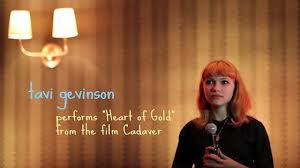
SOUNDTRACK: TAVI GEVINSON-“Heart of Gold” and “Heart” (2013).
Both of these songs were recorded for the release of the film Cadaver (see below). Neither song appears in the film, although Gevinson herself is the main character. I admit to being awed and repulsed by Gevinson [insert standard issue comments about fashion, young fame and blogging here]. But I am glad she’s using her fame to write feminist theory instead of fashion anymore. And I enjoyed her article in The Believer recently.
As for the film, she does a very good job as the voice in the movie. But let’s hope she doesn’t pursue her singing career any further.
She has the kind of flat delivery that Zooey Deschanel does, but Deschaenl’s voice has a gravitas that Gevinson doesn’t (sure, you can say she’s only 16 or whatever, but there are tons of teenagers who can sing amazingly). Her take on “Heart of Gold” is fine. She enunciates very clearly, but there’s very little passion in the song. Her take on Pet Shop Boys’ “Heart” (a song I know very well, but didn’t know that was the title) is a little better. Primarily because she takes the very discoy song and turns it into a slow acoustic number. The instrumentation is a little bland (not her fault) but she puts moments of excitement into the singing. In both cases I’d much rather hear the original, and in fact I am going to listen to the Pet Shop Boys version right now.
And before you yell at me for picking on a teenager, she is far more successful than I will ever be, so just assume this is all sour grapes.
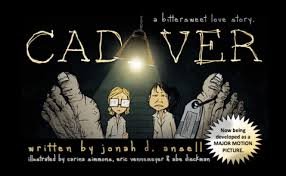
[READ: August 31, 2013] Cadaver
This book came across my desk and I was intrigued because it was a comic book about cadavers. It’s shaped like a comic strip book (reminding me of early Far Side books) and it turns out to be a comic book adaptation of a short film which was originally a poem. In the introduction, Jonah Ansell explains that his (baby) sister was going off to medical school so he wrote her a (funny) poem. Eventually, the poem was turned into an animated short film. And after being made into a short film it was made into this book.
The story is told in rhyme and is quite funny, until it gets rather touching. In the introduction, Ansell also explains that there was more to the story than medial school–it’s about love and loss and cynicism vs romanticism. Not bad for a 7 minute film.
An unnamed med student is handed a scalpel by the scary professor. She is told to make the first incision into the cadaver. She does so, but as she removes the heart (nicely shaped like a cartoon heart), the cadaver sits up and says that he needs it back. The student’s partner passes out. The man says he’s not read to die, he has a heart to give someone. Continue Reading »
 SOUNDTRACK: REGGIE WATTS-Tiny Desk Concert #227 (July 12, 2012).
 I know Reggie Watts from Comedy Bang Bang, but his name sounds familiar, like he’s been around for a long time. And he has, although not in ways that I am familiar. He’s been in a million bands (none of which I’ve heard of) and done a number of short films and concerts (prominently as of 2004). Interestingly he was born in Germany to French and American parents. And, yes, he lived his early life in Montana.