Feeds:
Posts
Comments

greatestSOUNDTRACK: PINK FLOYD-“The Hard Way” and “Wine Glasses” (1974).
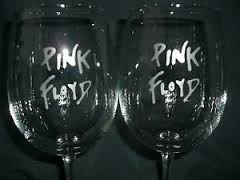
glassThis book informed me about these two unreleased Pink Floyd songs (there’s a Wikipedia site that lists some fifty more !).  While the were unreleased in 1974 (from the abandoned Household Objects album), they were eventually released in 2011 on expanded versions of albums.

“The Hard Way” features some “percussion” that sounds like someone taking steps.  There’s a bass riff which I gather is from rubber bands (but very well tuned).  There’s clocks ticking and chiming and tape being unspooled.  It’s a neat idea and while it is absurd to think you could make a whole album with this kind of stuff (in 1974), it’s a surprisingly good sounding track.

“Wine Glasses” was apparently made with wine glasses.  It is all of 2 minutes long.  It was designed to be a full song but was eventually used in the introduction to “Shine on You Crazy Diamond.”  I never really considered that there were wine glasses making the sounds (and clearly there are synths added on top), but yeah, so that ‘s kinda neat.

[READ: November 25, 2014] The Greatest Albums You’ll Never Hear

I found this book at work and knew I had to read it.  I was actually surprised at how long it took me to read (there’s a lot of entries).

The title and subtitle pretty much say everything you need to know about this book (and if you need to read it or not).  This book collects a series of writers who give a brief history of some of the more famous (and some not so famous) albums that were never released.  It explains (as best they can) why the albums weren’t released and even gives a percentage chance of likelihood of the album ever seeing the light of day (interestingly, most seem to be a 3/10–they may have been able to use a 5 point scale).

I knew some of the records they talked about (The Beach Boys’ Smile, Neil Young’s Chrome Dreams), but was ignorant of quite a lot of them. And while big fans of the artists may know all of the details about their favorite lost album already (these are sketches, not exhaustive research), there will certainly be some new information.  For instance, I’m a huge Pink Floyd fan but had no idea about the two shelved works mentioned here.

I liked the way the book was done chronologically and grouped by decade.  It was also interesting to see how the “reasons” for the non-release morphed over the decades from “the record label didn’t like it” to “it was leaked online.”

The one major gripe I have with the book is that it is chock full of “imagined” album covers.  This in itself is okay, but it is not made explicitly clear that they are all imagined (credits are given at the bottom of each image, but it took me a few entries to realize these were just people’s ideas of what the covers could look like).  And most of them are gawdawful.  Just really lame and dull (as if they had 20 minutes to come up with an idea).  They mar an otherwise cool collection,especially since some of the unreleased records actually do have proposed covers (even if they were never released).  I see that there is in fact a paragraph about the covers in the front pages of the book, but it is almost hidden away.

In addition to the albums I’ve listed below, I learned some fascinating things.  That Bruce Springsteen has hundreds of songs that he wrote but never released for various reasons.  That Pink Floyd did try to make an album out of household objects (with no instruments).  That the Sex Pistols’ Never Mind the Bollocks was almost simultaneously released illicitly as Spunk.  And that Danger Mouse’s The Grey Album was recently remastered.

The end of the book includes two small sections: other favorites that were never released.  Not sure why they earned only a small column instead of a full entry, but that’s okay.  The second was albums that we eventually did see, like My Bloody Valentine’s MBV and Guns N’ Roses’ Chinese Democracy.

So if you ever wondered what happened to that long lost album, this may be the book for you.

A sampling of the unreleased records include:

  • The Beach Boys-Smile
  • Buffalo Springfield-Stampede
  • The Kinks-Four Respected Gentlemen
  • The Beatles-Get Back
  • Jeff Beck-The Motown Album
  • Jimi Hendrix-Black Gold
  • The Who-Lifehouse
  • Wicked Lester
  • Rolling Stones-American Tour ’72
  • CSN&Y-Human Highway
  • Pink Floyd-Household Objects (1974), Spare Brick 1982
  • Dusty Springfield-Longing
  • David Bowie-The Gouster (1975), Toy (2001)
  • Sex Pistols-Spunk
  • Neil Young -Homegrown (1975), Chrome Dreams (1976)
  • Frank Zappa-Läther
  • Beastie Boys-Country Mike’s Greatest Hits
  • Weezer-Songs from the Black Hole
  • Jeff Buckley-My Sweeetheart the Drunk
  • Van Halen-IV
  • Foo Fighters-The Million Dollar Demos
  • Green Day-Cigarettes and Valentines (the author doesn’t believe it was actually stolen)
  • Tapeworm (Trent Reznor and Maynard James Keenan among others)
  • Deftones-Eros
  • U2-Songs of Ascent
  • Beck-The Song Reader


harpjuneSOUNDTRACK: FATHER JOHN MISTY-“Bored in the U.S.A.” (2014).

 boredNot a cover of the Clash song (“I’m So Bored with the U.S.A”) this is a piano dirge about the materialism of American culture.

I loved Father John Misty’s debut, and the way it addressed serious topics but with beautiful songs and Misty’s wonderful voice.  But this song is a dark and dreary tale of life in contemporary America.  Father John laments about, well, just about everything:

I’ve got all morning to obsessively accrue
A small nation of meaningful objects
And they’ve got to represent me too

or

Now I’ve got a lifetime to consider all the ways
I’ve grown more disappointing to you
As my beauty warps and fades

with the staggering next line

I suspect you feel the same

Te melody is pretty, but solemn (there’s no ironic poppy chord structure for this lament).  Rather, it’s a slow minor key piano melody with Misty’s beautiful aching voice drifting over the chords: “Save me white Jesus.”

By the next verse, while the melody and singing stay at the same pace, he adds a laugh track to his life: “They gave me a useless education / A subprime loan, Craftsman home / Keep my prescriptions filled / Now I can’t get off, but I can kind of deal / Oh, with being Bored in the USA.”

If this is the single, what can the album have in store?

 Save me President Jesus.

[READ: November 17, 2014] “Long in the Tooth”

This is a Czech story (translated by Stacey Knecht) written by Hrabal (who died in 1997).  I don’t know anything about him except that he wrote “many novels.”

But this story I find quite puzzling.  It’s not hard or complicated, indeed, it is quite a straightforward piece.  I’m just puzzled by why he wrote it (unless the conceit of false teeth was so novel that it needed to be written down).

In this story, the main character (who is a woman although that isn’t revealed until quite late in the story) is marveling at how she (and her husband) have aged without them realizing it.  She says that suddenly she was sixty and then sixty-five when she contracted paradentosis (which can cause massive tooth loss). Continue Reading »

harpjuneSOUNDTRACK: みっちりねこマーチ – MitchiriNeko March (2013).

mitchiBecause Lewis-Kraus mentions “the most important internet cat band of our day” in this article, I did a search for such a thing and came across this.  This is an adorable cartoon of cats marching (and playing along to the music).

I didn’t look into this too hard, and I don’t really know MitchiriNeko, although the video says that “MitchiriNeko” is a cat-like cartoon character who is always in a group to hang out so closely with each other wherever they go.

I’ve listed below more stuff about MitchiriNeko, but really I just enjoyed watching the video.

Evidently there is a web comic for this fella:
Manga Box! English editions are coming soon.
https://www.mangabox.me/
https://www.mangabox.me/reader/247/

There are apps for this character:
iPhone
https://itunes.apple.com/jp/app/mitch…
Android
https://play.google.com/store/apps/de…

And this song “MitchiriNeko March” is now on sale.
https://itunes.apple.com/jp/album/mit…

[READ: November 17, 2014] “Story A”

I enjoyed Gideon Lewis-Kraus’ previous Harper’s essay about Japan: “Sleeping Together.”  I thought it would be fun to tie it to this one which is also about Japan.

He says that for a time, he was drawn to “particular breeds of the Japanese trivial” like “the “most important internet cat band of our day” and the cafe that he describes in “Sleeping Around.”  Thus he was immediately drawn to the Japanese hole-digging contest.  He decided to go see it, which would also allow him to visit his brother Micah in Japan.

The title of the article, “Story A” refers to a journalistic practice in which “essays purport to be about one thing but reveal themselves to be about some other, profounder thing.  Story A might be about the game of Monopoly but its real role is to give cover to Story B which is about the decline of the American city.”  He imagined that the nonsense of hole digging could lead to something incredibly profound. Continue Reading »

harpjuneSOUNDTRACK: KING TUFF-“Black Moon Spell” and “Eyes of the Muse” (2014).

tuffI first heard King Tuff on WXPN.  A few weeks later I heard two of his songs on NPR Music.  I’m including both of these because they’re from the same album and yet they are so very different.

“Black Moon Spell” has a stupid, great, heavy riff–it’s all distortion and garage rock.  And when the first verse starts, Tuff’s voice sounds very 60’s–whispered and trippy.  It’s a great contrast to the rocking riff that repeats in the chorus.  The second verse and the chorus sound pretty much the same, but they are so catchy it’s hard not to rock out to it all.  There’s a cool guitar solo and, perhaps most unexpected, female backing vocals as the chorus repeats in the outro.

It has a real classic rock sensibility but with modern elements.

“Eyes of the Muse” is also full of classic rock sensibilities but in a very different way.  This song is anything but heavy–it has jangly chords, and a pretty guitar riff.  The vocals are also higher pitched with a very sixties folky style.  And when the Boston-style guitars burst forth about half way through, you’d swear you’d heard it all before, and yet it is still different enough to be really enjoyable.

Ty Segall plays drums of “Black Moon Spell” and I can compare this record to him or to Mikal Cronin–simple familiar elements done in a novel and exciting way.  I’d definitely like to hear more from this record.

[READ: November 17, 2014] “The Second Doctor Service”

I didn’t think I’d read anything by Mason before, but I had.  I didn’t really like his previous story in Harper’s,(which was sort of a parody of Herodotus).  This one was written in an old style as well (although not a parody this time–if indeed the first one was supposed to be one).

Anyhow, this one opens like an old story (with county names given in this format: K— and S—).  At first I thought we didn’t really need a story pretending to be old like this, but Mason really mastered the style.  Not to mention a story with this content works much better as an old one (before “modern” science).

Essentially, the author is writing a letter to the Journal, in response to Dr Slayer’s study “On the So-called Cumberland Were-wolf.”  He has not encountered a were-wolf but he hopes that anyone reading the Journal might be familiar with his own unusual plight.  Continue Reading »

withoutSOUNDTRACK: GOJIRA-L’Enfant Sauvage (2012).

gojiraGojira is a French heavy heavy metal band, and this album was highly recommended back in 2012 (I didn’t realize it wasn’t their debut–they have quite a few records out already).  This album is quite heavy, but it has a lot of diverse elements to keep it interesting.

At the same time, they do rely on a couple of guitar effects which make the album weirdly samey (no idea if they do it on other albums too).  The two biggest offenders in this “repeated” scenario are the seeming over-reliance on the open high e string to add contrast to the heavy chugging chords.  It’s a cool effect once or twice but they do it a lot (especially in the song “The Axe” where it happens way too much and which is then followed by “Liquid Fire” where they do it again).  The other thing they do is this weird scraping sound.  It happens in the first few notes as the disc opens (in “Explosia”).  It’s a really cool sound and quite distinctive.  When you do a weird sound like that a lot in one song, it feels like maybe too much, but then to do it in several other songs, it feels like a crutch.

Which is a shame because the rest of the album is really interesting–the vocals are growly but audible and there’s occasionally really cool backing harmony vocals (“Liquid Fire”) and some really unusual different parts to songs.

So “Explosia” opens really heavy with a crazy riff and pounding drums (and that weird scraping sound).  I love that at 2:30 it switches from bludgeoning to slower (but still heavy) and that as the song fades out with another heavy section there are slow guitar notes that remind me of a Western.  It’s really cool. “L’Enfant Sauvage” uses that open high E string in an interesting riff (by doing more than just letting the string ring out).  (The scraping sound appears here too, but in limited quantity). I like the way the song’s volume just drops for the last thirty seconds or so.

“The Axe” opens with a pummeling drum and guitar sound.  “Liquid Fire” alternates between heavy guitars and that open high E sound.  “The Wild Healer” is a simple, pretty instrumental.  It is 2 minutes long and the main riff is simple one (again all on one string).  There’s an interesting solo that plays along behind the main riff which is quite pretty–but it all ends very abruptly.

“Planned Obsolescence” jumps right in with some pummeling guitars (an a scrape sound).  It slows down a bit, but towards the end the pummeling double bass drums resume until the really slow sweet guitar section that comes in around 3:45.  “Mouth of Kala” has a heavy riff which is a cool change (even if the riff is fairly simple).  But there’s some nice melodies that alternate with the heavy stuff.  I also really like the way the song ends with a very different riff and sound than the beginning.  (And the backing vocals are really cool too).

“The Gift of Guilt” has an interesting open E string riff (which is similar to Iron Maiden’s “The Trooper,” although they do something very different with it.  This song is just littered with odd effects, like a big heavy “bowh” sound and some high-pitched guitar pyrotechnics.  But I love the way it alternates parts (the growly vocals work really well here, too) and then ends so melodically.

“Pain is a Master” opens with a slow guitar riff and whispered voices, it’s a great change of pace for the disc.  Once the slow part ends, the guitars and drums pound furiously and we get some more odd effects–a siren sound (from the guitar) alternating with the ubiquitous scrape.  But the middle parts are really quite different, slower, slightly more menacing.  “Born in Winter” opens and closes with a slow and atmospheric section (delicate vocals even).  In the middle it gets heavier (and has some really fast drumming).

“The Fall” has an Alice in Chains vibe in one section and then a more cookie monster type vocal on another.  The scraping sound returns for a final showing. I really like the way the album just sort of disintegrated into random sounds as it ends.

So overall I really enjoyed this album. It’s probably nitpicky to complain about the overuse of certain sounds, especially since they are cool.  But they have so much creativity on the disc, that to hear the same things a few times just seems redundant.  Nevertheless the album rocks and is a really enjoyable metal album.  I was supposed to see them open for Mastadon earlier in the month but something came up and I had to eat the tickets (who knew you couldn’t even give away Mastadon/Gojira tickets, come on!).

[READ: November 21, 2014] Without Blood

I’ve been enjoying Baricco so much that I decided to grab this book while I was in the library too. I had already read this book a couple of years ago, or actually, I had read the version that appeared in the New Yorker.  The Wikipedia entry says that the New Yorker version is a”revised form” of the novel.  I didn’t know what that meant exactly.  But basically I gather it means that Ann Goldstein (who translated the New Yorker version) has re-translated the story (or that they edited it for the magazine the first time).

The New Yorker version is really long for a New Yorker story (it is practically the whole novel), so it’s understandable why things were a little shorter for the magazine.  But she hasn’t changed very much for the book.  There’s a lot of little modifications–tenses of verbs (in flashback situations), word phrases are altered, additional details seems to have been added and there is at least one small section in this novel that was not in the New Yorker version.

This “new” section is about a woman who is sitting in the cafe with them.  She asks the waiter about the two main characters and we learn a little about her past as well (it’s not relevant to the story and I can see why it was omitted, but it does flesh out the scene).  I am not willing to do a page by page comparison of the two (even though that is something I tend to do). But suffice it to say that the stories are virtually identical, although I found it more satisfying reading the novel version.

Since my original recap is basically how I would summarize it this time as well, I am including it here almost verbatim.  But in the spirit of the updated version of the novel, I am modifying this post from the original in small details–see if you can spot the differences. Continue Reading »

internetSOUNDTRACK王蓉Rollin-小雞小雞(Chick Chick) [RONG “ROLLIN” WANG-“Chick Chick”]. (2014)

chickchickDon’t call it a novelty! You must watch it.

Is it a kid’s song?  I have no idea.  But it is mesmerizing.  I have now watched it about a half a dozen times and somehow it gets better each time.  Not as awesome as Babymetal (who are Japanese), but awesome in a wholly different (Chinese) way.

So far it only has 8 million views, the number must be increased!

[READ: November 15, 2014] The Best of McSweeney’s Internet Tendency

Although I have been a fan of McSweeney’s from the very beginning, I have never faithfully read their online Internet Tendency.  Of course I have read the often circulated ones, and a few years ago I said I would read the old posts from the beginning (I didn’t).  Now I discover that in the years since I said that, the Internet Tendency has 283 pages of archives (with something like 30 entries per page).  Get moving on that.

Having these best pieces in a book form is nice, as is anything with “It’s Decorative Gourd Season, Motherfuckers” printed on the cover.  Since I haven’t read all 8,000 entries, I can’t say what qualifies as the best.  Although I have to wonder if some of these were picked more for their contributors than their actually bestness.  (Take a look at some of the heavy hitters represented below).  Regardless of how these were chosen, it is an excellent collection of funny stuff.

When I finish reading all of the online pieces (in about two years), I will have more authority to say if these 50 are the best, but in the meantime, I’m just going to enjoy this very funny selection. Continue Reading »

silkSOUNDTRACK: STARS-Heart (2003).

stars I found out about Stars with their second album but I like their debut quite a lot too.  There’s a few songs that i don’t love, but overall the album is really solid.

The opening synths belie the beautiful guitar (and nice bass work) of “What the Snowman Learned About Love.”  Singer Torq’s voice is low and muted while other singer Amy Milan has gorgeous  harmony vocals.  “Elevator Love Later” features’ Milan on lead (for some verses)–the album really comes to life with this song.  It’s got a great chorus and a cool bass line that elevates the song above typical pop fare.

“Heart” has a melancholy piano riff (something Stars excel at) and some wonderfully poignant lyrics: “Sometimes the TV is like a lover, singing softly as you fall asleep.”  And yet it, once again, has a really catchy chorus (with lots of “All rights”).  “Woods” is mildly orchestral and has a plaintive vocal line and a sampled spoken word section (which I can’t identify).

“Death to Death” is one of my favorite Stars songs.  A slinky discoey song with Torq’s cool verses and Milan’s sultry “I am destroyer I am lover” chorus.  I love the sound of the next song (synthy flutes and the very clear guitar) that play throughout “The Vanishing” even though I don’t love the song.

“Romantic Comedy” surprises with its baritone guitar sound (instead of the sprightly synths), but the chorus is once again super catchy.  There’s some great lyrics in this song as well: “You’re not bad, but you were just badly raised,” and the chorus “don’t walk away then turn and say I love you anyway.”  “Time Can Never Kill the True Heart” is a beautiful song with a lovely sentiment.  “Look Up” is a pretty Amy Milan sung song.  I love the way the chorus’ words don’t pause for breath even though the song itself is not very fast.  “Life Effect” is pretty song sung by Torq (I really like when the guitars come to the fore even though I think of Stars primarily as a synth band).

stars other“Don’t Be Afraid to Sing” is the final song on the album,.  It’s a simple ballad, and once again the bass line is great–nothing fancy but it’s a great melody behind the guitars and vocals.  It’s got a great ending of an album sentiment: “We all come to an end / And we all end together.”

There’s a “bonus” track on my version of the album (cleverly hidden about 20 seconds after the previous song).  It has a with a great hidden bonus track title–“The Comeback.”  It actually sounds perfect with the album–an instance where a bonus doesn’t really feel tacked on.  It’s a nice addition if you can’t get enough of the band.

Incidentally, the American version has the reddish cover above, while the original cover is this black and white one down here.

[READ: November 17, 2014] Silk

I enjoyed Mr Gwyn so much that I wanted to read more by Baricco.  And when I saw that many of his books are so short, it  was easy to grab them and devour them.

I didn’t know anything about Silk–somehow I missed it when it came out.  It was even made into a movie, so it must have been a big important book (and it was a huge best seller).  So imagine my surprise to see that the book is 91 pages and that each chapter is basically one page (sometimes half a page).   And Baricco creates this beautiful, taut story that is really compelling, in what is really only about 70 pages of text.

I’ve admired Baricco’s ability to write gorgeous novellas, and this must be where it all started (his earlier books are somewhat longer than this).  The fact that none of his stories are about similar things is also pretty amazing.

This story is about a Frenchman who makes his fortune buying silkworm eggs and the lengths and distances he is willing to travel for them.  But it is also about something much more poignant. Continue Reading »

dk SOUNDTRACK: DEAD KENNEDYS-Demos (1978).

demosI didn’t know these demos existed until I saw them mentioned in this book.  They are obviously not meant for public consumption (Jello sounds like he’s straining on a few songs, like “Kill the Poor). But it’s impressive just how good the band sounds and how fully formed the ideas are.

I also enjoy how some of the songs are played a wee bit slower which changes the vibe of the lyrics somewhat (especially “California Uber Alles” and “Holiday in Cambodia”).

“Kepone Kid”s is a slightly different version of “Kepone Factory” (same basic music but different lyrics.)  “Forward to Death” is pretty much the same.  “California Uber Alles” is much slower and perhaps a a bt more menacing.  “Your Emotions” is pretty similar to the version I’m familiar with.  “Kill the Poor” is also pretty much the same

“Holiday in Cambodia” is the most drastically different.  In addition to being slower, Jello sings the first verses in a flat monotone.  At first I thought that perhaps he wasn’t giving his all, but then it seemed like a deliberate choice–which makes it seems somewhat more sinister a the end–where he goes nuts in the Pol Pot section (even crooning it at one point).

“Kidnap” is new to me–a kind of football chant about kidnapping someone (hard to get the actual lyrics from this demo).  “The Man with the Dogs” has that great creepy echoed guitar opening and sounds a lot like the final product (with Ray having some awesome fun with feedback and noise at the end).  “I Kill Children” is even more disturbing without the “God” quote at the beginning.

“Dreadlocks in the Suburbs” is a reggae song (!).  I can’t really make out the lyrics, but I’ll bet it’s funny.  “Rawhide” is a little sloppier than I’m used to, but it really gets to what they are trying to do with the cover.  “Mutations of Today” has a very strange guitar set up–intertwining guitar riffs (I assume the second is by 6025) and a very long intro before Jello sings (really oddly even for him) about Mexican monster babies.  It’s not a favorite and seems more improvised than anything.  “Cold Fish” is simple punk song.  I’m not quite sure what its’ about although it seems to be about killing someone (and seems more like a goof than a song).

“Forward to Death” appears again.  This later version is a bit more loud and full sounding.   And “Viva Las Vegas” ends this set with a fun romp of a cover–it sounds great and raw in this demo.

So it’s interesting to hear these early versions of their songs.  There’s a few insights (and I understand that the drummer Ted likes the slower versions of those two big hits) and a few surprises.

[READ: November 16, 2014] Dead Kennedys

When I was a young punk I loved the Dead Kennedys. Jello Biafra was THE MAN! And he still is, although I am less politically motivated as I used to be. I have a bunch of his spoken word albums and all of the DK’s output. I distinctly remember buying Frankenchrist on vinyl at the Flea Market in Elmwood Park and feeling nervous as he slowly put the album in a bag while my parents waited for me to be done.

I haven’t really thought about the DKs that much for a few years. I knew there was some kind of litigation about something, but I didn’t care all that much. Then I saw this book and I thought it would be a fun read. And it was.

I have no idea who Alex Ogg is, although he seems to have some kind of insider information about the band. And this book is comprised of quotes from the band members, recollections from others who were there and all kinds of photos.

As the subtitle says, this is the early years. So it really only covers the band’s formation to the recording and release of Fresh Fruit for Rotting Vegetables.

Because Jello was the frontman and was very very outspoken, he was always the main focus of the band for me.  Although I knew the names of the other guys, I never really thought about East Bay Ray or Klaus Flouride or Ted or 6025 or D.H. Peligro.  And honestly I never really thought about the DKs as musicians—I knew I liked the music and that some of it was pretty weird, but I never really thought about it like I did with other bands that I wanted to play. Continue Reading »

ladySOUNDTRACK: NEKO CASE-The Worse Things Get, the Harder I Fight, the Harder I Fight, the More I Love You (2013).

nekoSarah got this disc for me for Christmas last year.  Amusingly, she wrapped it and then we couldn’t find it  So I got to listen to the auto download on amazon and to wonder who threw it out.  When we took down the tree several weeks later, we found it on one of the branches.  Belated Christmas gift!

I have enjoyed most of Case’s output since I first heard he several years ago withe New Pornographers.  And this album is no exception.  There are 12 songs and most of them are quite short (no guitar solos for Case–well, okay a couple). And I love how great her voice sounds.  Although, perhaps surprisingly I do not like her voice in the few a capella moments she does.

“Wild Creatures” showcases her great songwriting.  “Night Still Comes” has some amazing harmonies in the chorus (I didn’t realize this but vocals are by Jim James).  I love the way the song builds and retracts as she criticizes “you” for not holding a falling star “at the right angle.”

“Man” is one of my favorite songs ever.  It’s so punchy and rocking.  And lyrically it is both subversive and really funny.  In addition to the whole premise “I’m a man, that’s what you raised me to be/ I’m not your identity crisis” it features the great verse: “and if I’m dipshit drunk on pink perfume, then I am the man on the fucking moon, coz you didn’t know what a man was until I showed you.”  There’s also a great simple guitar riff from M. Ward.  And at 3 and a half minutes I could listen to it over and over.

But Case plays with all differs style soft music on this record, so “I’m from Nowhere” is just her and an acoustic guitar (and her voice is gorgeous in this stripped down setting).  “Bracing for Sunday” is just over 2 minutes, but it’s not a fast punk song it’s just a speedy shuffling rocker (with horns!).

Then comes “Nearly Midnight, Honolulu.”  I don’t think I have hated a song as much as I hate this one.  It is more emotionally fraught that “Suzanne Vega’s “Luka” (which I like) with none of the subtlety.  I’ve only listened to it once or twice and don’t even want to listen to it again to say what else I hate about it.  Maybe if it was spoken instead of sung it would be more palatable, but ugh it is awful, and really seems to ruin the mood of the record for a couple of songs (even if I skip it).

“Calling Cards” is a countryish song, mellow and pretty, but after the bad taste of “Honolulu” I feel lit just kind of falls flat.  “City Swans” brings back the thumping drums and rocking guitars.  “Afraid” is a more successful a capella ish song (with vibes and autoharp accents).

Of course, I prefer when the album perks up again.  “Local Girl” has a simple but cool bassline and great backing vocals.  After a slow weird intro, “Where did I Leave that Fire” turns into a cool jazzy number.”  Although I don’t have a clue what she’s singing about at the end.  The final song, “Ragtime” has a kind of dreamy “Blue Moon” quality until the big horns kick in at the and it really swings and makes me want to listen to the album again

Despite how much I like Case’s voice I just don’t like the slow a capella moments on the album.  There’s so much I do, but I feel like those moments really mar the disc for me.  And yet after the final song, I’m always game to listen again (especially when “Man” comes on).

[READ: November 16, 2014] Lady Cycling

I saw this book at work and thought that with that title and that cover that it would be a very funny tome about how women shouldn’t really ride bikes (I mean “what to wear” comes first, right?). But to my surprise and delight, this book is actually very pro women riding (Miss Erskine herself is a rider) and while she does warn women not to overdo it (no more than 40 miles a day!), it is actually quite a practical and, dare I say still, useful book for female and male riders.

The funny, out-of-date parts are mostly about dress—she encourages all women to wear wool all the time because cotton chafes and wool keeps you warm when you get wet (and you will sweat a lot).  Now I’m not going to overstate the practicality of it in modern society, really, but there are some things in it which are terribly useful and which many contemporary riders do not observe.

But from the get go, Erskine is adamant that women do and should ride bikes.  She says it is much cheaper than owning a pony (true) and is more than just recreation it can also be a means to an end.  She addresses the then controversy by saying that if women “ride fifty miles when ten ought to be their limit—in short, if in cycling they cast reason and common-sense to the four winds of heaven—then, beyond all doubt, cycling is harmful.” (2). The one really out of date aspect here is that she says women ought not to race (it is bound to end in disaster), although I’m unclear if she disapproves of women racing or of racing in general.

In chapter three she answers the question about what kind of bike women should buy. And while she doesn’t exactly name brands she does sensibly say that a cheap bike will wear out and be less well constructed, so it is worth spending more up front.  More practically, she also talks about the location and adjustment of the seat and handlebars. She even talks about the proper way to pedal (using rat-trap pedals—which are apparently the ones we still use today with the metal grippers). Continue Reading »

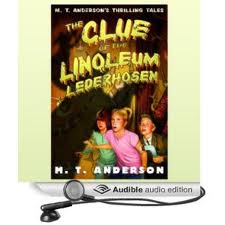
[LISTENED TO: November 16, 2014] The Clue of the Linoleum Lederhosen

linoWe enjoyed Whales on Stilts so much that we were really excited to listen to this second book in the series.  However, this book, while featuring the same main trio, was actually quite different.

The gang has decided that they are going on vacation.  They’re a little bored (Katie’s mom has been doing things like cutting off her own hand just to freak out Jasper), so they take Jasper’s latest gadget and head up to the mountains for a little r n r (and a free dinner with the coupon that Jasper received).

When they get to the hotel (the Moose Tongue Lodge and Resort), they realize that they can’t afford a room, so Jasper’s gadget attaches to the side of the hotel and looks just like it is supposed to be a part of it (apparently).  Of course, when they leave their invasive bubble, they have to go out through someone else’s bathroom and he is terrified by the calamitous sound that Jasper’s gadget made while attaching to the building).  They also learn that the coupon for a free dinner was fake.

When Jasper reveals to the hotel clerk that he is indeed Jasper Dash, boy technonaut, the clerk reveals that he is but one of many literary super sleuths in residence that night.  The Manley Boys and the Hooper Quints are there, and so is Eddie Wax and the Cutesy Dell Twins.

Who?  Continue Reading »