April 19, 2017 by Paul Debraski
 SOUNDTRACK: LAURA MVULA-Tiny Desk Concert #284 (July 1, 2013).
 I don’t know Mvula’s music (I know her because her name is unmistakable and I feel surprised that her debut came out only 4 years ago). The blurb talks about her big powerhouse soulful pop. But that is not in evidence here at all. As they say:
with the help of a small string section, she forgoes some of her flashier songs (“Like the Morning Dew,” “Green Garden”) in favor of Sing to the Moon‘s most brooding ballads.
“Father, Father” is almost entirely her singing and playing a very spare keyboard–with just a few seconds of string help near the end. Her voice is quite lovely in what is practically an a cappella setting.
She introduces the second song by saying: “If we had the bigger band we’d do the more upbeat things. I usually write in six-part harmony. But it’s just the three of us so I’m going to do another more intimate one called ‘Diamonds.'” There’s more strings on this song, which add to the song (the keyboard is quite thin, I fear).
The set ends with “She,” a song with a bit more complex keyboard parts which I rather like. This song is my favorite, probably because it sounds the fullest.
The whole set is a little too mellow for my tastes, but I am curious to hear what her big poppy six-part-harmony songs sound like!
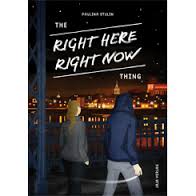
[READ: April 21, 2016] The Right Here Right Now Thing
I found this graphic novel at work. What was so funny about it is that the title is in English but the publisher is German. I flipped through the book and saw the English dialogue so I decided to read it. Imagine my surprise then that the first few and the last few pages are in German!
Google Translate is a good thing. Unfortunately, it doesn’t do as well with idiom and vulgar phrases, and there are a few in this book. But I got the gist.
Plus, quite a lot of it is wordless, too.
The story begins with hands putting drugs (I assume cocaine and pot from later sections) into a condom. And then we see our heroine on the toilet…doing something. Her plane ticket says Frankfurt-Krakau. She says goodbye to the guy lying in bed and she heads to the airport. Continue Reading »
Posted in Airlines, Decadence, Drinking, Drugs, Foreign Books, Funny (ha ha), Graphic Novel, Laura Mvula, Paulina Stulin, Sex, Tiny Desk Concert, Toilets, Translation, Travel | Leave a Comment »
April 18, 2017 by Paul Debraski
 SOUNDTRACK: NICK HAKIM-“The Want” NPR’S SOUTH X LULLABY (March 24, 2017).
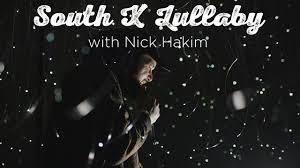 It’s always interesting to hear someone with a big hairy beard sing in high falsetto, and that’s just what Hakim does here.
This song is very simple with twinkling synths and programmed beasts all underneath Hakim’s delicate voice. The blurb introduces Hakim to those of us who don’t know him:
Nick Hakim begins with a bit of a fake-out — languorous strings like something out of a Stars Of The Lid record rumble from a sampler, somber and hesitant. But as he begins to sing in a heartbroken falsetto, surrounded by optical fibers hanging from the ceiling of SXSW’s Optic Obscura installation by Raum Industries, the ambient intro morphs into a quiet, psychedelic croon.
“The Want” will appear on Hakim’s full-length debut, Green Twins, but for now, this solo version is only backed by Mellotron and the reverb’d rhythms of what sounds like a Casio preset. It’s soul music for outer-space, performed in a room that looks like outer-space.
This blurb makes this song sound a lot more trippy than it actually is. To me, the only psychedelic bit is one harp line. Otherwise it sounds like a very spare, echoing, simple song. The end does add some interesting layers of sound, but maybe the recorded version is more trippy.
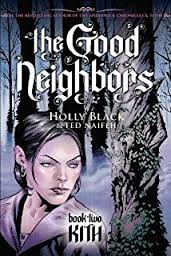
[READ: June 1, 2016] The Good Neighbors: Kith
I didn’t really love book one in this series. I enjoyed the premise, but found the execution flawed–both in the “script” and to an extent in the drawings–there a bunch of characters who all look vaguely similar. But I did like it enough to want to read Book 2.
There’s a handy recap that catches us up.
Then we see Rue sad because of her sullen boyfriend who might be breaking up with her. But he’s a dick anyhow as are most of the characters, frankly.
About 30 pages in something interesting happens when they discover a knife in a tree. Continue Reading »
Posted in All Songs Considered, Alternate Reality, Death, Fears, Goblins, Goths, Graphic Novel, Huh?, Humiliation, Marriage Trouble, Oddities, Regrets, Romance, Sex, South X Lullaby, Supernatural, SXSW, Violence, YA Books, Yuck! | Leave a Comment »
April 17, 2017 by Paul Debraski
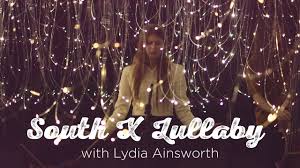
 SOUNDTRACK: LYDIA AINSWORTH-“Afterglow” NPR’S SOUTH X LULLABY (March 23, 2017).
 I was unfamiliar with Lydia Ainsworth, but I was instantly struck by the setting of her lullaby.
We asked Lydia Ainsworth to perform in Raum Industries’ Optic Obscura installation. Surrounded by dim, long-hanging optical fibers that look like an infinity room of cat’s whiskers, she sings a stripped-down version of the slow-burning “Afterglow,” accompanied only by an upright bass and light percussion.
I’m not sure what the original song sounds like, but this version is moody and intense. The upright bass opens the song as Lydia’s whispered, sensual vocals come forth. She has a beautiful voice and it is especially haunting in this setting. It reminds me a bit of someone else although I can’t decide who.
The starkness of the silence when she stops singing is intense. And I really like the way the song ends, not abruptly exactly, but rather unexpectedly.
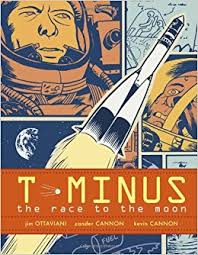
[READ: March 21, 2016] T-Minus
Jim Ottaviani did the amazing graphic novel Feynman, and in the blurb about him in that book, it said that he also wrote T-Minus. Coincidentally I had just brought T-Minus home for Clark and I to read. He read it quickly and said it was very good. It took me a little longer to read (I’m sure he didn’t read all the details) because Ottaviani jam packs this book with interesting facts.
As the title says, this is about the race to get a man to the moon. It begins 12 years before the actual date occurred. And it toggles back and forth between the United States and the Soviet Union.
On the margins of many pages there are drawings of all of the various attempts each country had to get a rocket into the air. The drawings show the design and then at the bottom it states the duration of the flight, the date and some other details. The USSR’s first rocket (1957) lasted all of 20 seconds before exploding. The U.S’s first rocket lasted about 7 seconds.
We meet a handful of people who were instrumental in the design and origination of these rockets. (Ottaviani explains that many of these people are composites of real people involved–if he wanted to include everyone, there would be 400 people in every panel). Continue Reading »
Posted in Adventure, Alexei Leonov, All Songs Considered, Astronauts, Charles A. Murray, Children's Books, Communists, Cosmonauts, Graphic Novel, History, Jim Ottaviani, John F. Kennedy, John Glenn, Lydia Ainsworth, NASA, Optic Obscura, Raum Industries, Russia, Scientists, Sergei Korolev, South X Lullaby, SXSW, Valentina Tereshkova, YA Books, Yuri Gagarin | Leave a Comment »
April 16, 2017 by Paul Debraski
 SOUNDTRACK: PHOEBE BRIDGERS-“Smoke Signals” NPR’S SOUTH X LULLABY (March 22, 2017).
 Bridgers’ “Smoke Signals” is a beautiful haunting song that reminds me a little of Liz Phair in her delivery. I had heard this song before and really liked it–I especially loved the arrangement, which had echoing guitars that reminded me of Twin Peaks.
“For this Tiny Desk, Bridgers and percussionist Marshall Vore came to Bob Boilen’s hotel room just before midnight to play the striking ‘Smoke Signals.'” The music is great with Bridgers’ open chords, and Vore’s suitcase percussion, children’s toy bells and vocal harmony. The cho and vibe are removed in this version which means you must really listen to the words–which are pretty intense.
I like how she talks about musicians in such an interesting way:
Singing ‘Ace of Spades’ when Lemmy died / nothing’s changed LA’s alright
and then later
Its been on my mind since Bowie died/ just checking out to hide from life
The toy bells and harmonies are a really nice touch, but again, it’s those lyrics:
I went with you up to
The place you grew up in
We spent a week in the cold
Just long enough to
“Walden” it with you
Any longer, it would have got old
This song is a little too slow for my preferences, but it’s very beautiful. I’d like to hear more from her.
[READ: February 5, 2016] The Good Neighbors: Kin
This book was on the new shelf at my library. And since I like Black and Naifeh I was grabbed it. Then I saw that it actually came out in 2008. Whatever.
It also turns out that my library has book two of this trilogy but neither had book 3 (which came out in 2010). What gives?
Holly Black is best known (by me anyway) as having written The Spiderwick Chronicles.
This story is actually a YA graphic novel and it definitely skews older. But like Spiderwick, it deals with a normally unseen world coming into contact with out own. Continue Reading »
Posted in All Songs Considered, Alternate Reality, David Bowie, Death, Fears, Goblins, Goths, Graphic Novel, Holly Black, Humiliation, Lemmy, Liz Phair, Marriage Trouble, Motorhead, Oddities, Phoebe Bridgers, Regrets, Romance, Sex, South X Lullaby, Supernatural, SXSW, Ted Naifeh, Violence, YA Books, Yuck! | Leave a Comment »
April 15, 2017 by Paul Debraski
 SOUNDTRACK: DAKHABRAKHA-“Kolyskova” NPR’S SOUTH X LULLABY (March 21, 2017).
 I loved DakhaBrakha’s Tiny Desk Concert. It was mesmerizing and beautiful. And so the performers came to SXSW and did a lullaby. And as the blurb says, they brought their “cello, keyboard, accordion – and tall, wool hats! — to the balcony of the Hilton Austin hotel.”
This lullaby of “Kolyskova” quiets things down a bit. The song opens with simple keyboard notes. One of the women sings, and when they reach the end of the verse, the male accordionist sings a falsetto that matches the women’s tone. The woman on drums makes a strange sound–like a baby crying or animal yelping.
Then he winds up singing lead on the second verse in that falsetto with the women singing backing vocals. Then the cello and drums kick in to build the sound. The third verse is sung by the cellist as the keys play a pretty melody.
The song is upbeat with lots of bouncy vocals, even though the lyrics seem rather dark. ‘The band only ever calls it “Lullaby.” It’s a quiet, contemplative song that the band says is a “connecting of several lullabies” with “philosophical lyrics that [say] we have time for everything — time to laugh and cry, time to live and die.’
I love at the very end as the song slows down to just the keyboardist singing because the drummer adds a very cool breathing as a kind of percussion accompaniment. And then as the camera pulls back the two attack the keyboard making a cacophony of fun notes. I bet they’re a lot of fun live.
[READ: June 2 2016] Explorer: The Hidden Doors
This is the third (and I assume final) in a series of graphic novel short stories edited by Kazu Kibuishi, the creator of Amulet.
I really enjoyed the first one a lot and was pretty excited to read the rest. As with the other two I was delighted by the authors involved and the quality of these stories.
The three books are not related to each other (aside from thematic) so it doesn’t matter what order you read them in.
This book revolves around the theme of “hidden doors.” I like the way each author takes a concept that seems like it would be pretty standard and turns their stories into things that are very different indeed. Continue Reading »
Posted in Adventure, Aliens, All Songs Considered, Alternate Reality, Cats, Children's Books, Culture Shock, Cute, DakhaBrakha, Douglas Holgate, Dragons, Faith Erin Hicks, Fears, Fish, Graphic Novel, Jason Caffoe, Jen Breach, Jen Wang, Johane Matte, Kazu Kibuishi, Mystery, Outer Space, Sci-fi, Short Story, South X Lullaby, Spirited Away, Steve Hamaker, Supernatural, Surreal, SXSW, Threats | Leave a Comment »
April 14, 2017 by Paul Debraski
[ATTENDED: April 14, 2017] The Decemberists
 Two years ago Sarah and I went to The Decemberists concert at the Academy of Music in Philadelphia. It was spectacular. A great venue, a dignified crowd and a great set deign. The only complaint we had at all was that we couldn’t stand up and dance (well, we could, but we try to be considerate of those around us).
We knew we’d want to see them again, so when they announced another show in Philly–this time at the Fillmore, we were super psyched. We love the venue, the sound is great and best of all, you can dance.
I was telling Sarah that I have become spoiled by smaller venues like Union Transfer, which holds about 1,000 fewer people than the Fillmore, because I can get up really close. Well, this show was sold out big time (we were packed in a little too tightly for my liking). I wanted to try to get there as early as possible, but a few things led us to getting there about ten minutes later than I had hoped. And as such we were just a little too far out for my liking–the tall people seemed to have a wall set up about five rows of people ahead of us and we just couldn’t break through it.
So that meant a lot of leaning side to side depending on who you wanted to watch and, of course, terrible pictures. But wow did they sound great. This tour was a little less elaborate than the previous one. There was no real “set,” just lights. And that’s fine because the focus was on the music! Continue Reading »
Posted in Chris Funk, Colin Meloy, Jenny Conlee, John Moen, Kelly Hogan, Nate Query, Philadelphia, PA, The Academy of Music, The Decemberists, The Fillmore Philadelphia | Leave a Comment »
April 14, 2017 by Paul Debraski
[ATTENDED: April 14, 2017] Julien Baker
 I first heard Julien Baker from All Songs Considered. Her song “Sprained Ankle” is simply beautiful. She plays a very delicate guitar and on that song you can barely hear her voice–everything is very gentle.
I was intrigued when I saw that she was opening for The Decemberists, but I wasn’t entirely sure how much I’d like a whole set of such mellow music. But Bob Boilen has said on many occasions that you need to see her live.
And that proved to be true.
Her set started quietly with a new song, “Funeral Pyre” and then the incredibly pretty harmonics (looped) of “Funeral Pyre.” But she wasn’t all about delicate folksiness. Because on a few of these songs she belted out powerful notes–signing loud and hard and letting those notes linger for a long time. Her voice was absolutely amazing. And for just a “girl with a guitar,” she won the audience over pretty easily. Continue Reading »
Posted in Julien Baker, Philadelphia, PA, The Decemberists, The Fillmore Philadelphia | Leave a Comment »
April 14, 2017 by Paul Debraski
 SOUNDTRACK: NINA DIAZ & Y LA BAMBA’s LUZ ELENA MENDOZA-“January 9th” & “Living Room” NPR’S SOUTH X LULLABY (March 20, 2017).
 I was intrigued by this pairing because Luz Elena Mendoza has a shirt buttoned up to her neck and, from the angle of the first song, it appears that she has her long sleeves down, while Nina Diaz (originally from Girlfriend in a Coma) is wearing a sleeveless T-shirt with tattoos showing up and down her arms. They seem somewhat mismatched. Until they sing. (And also during the second song when it becomes obvious that Luz Elena’s arms are covered in tattoos as well).
The two have never played together, but after NPR Music paired them in the courtyard of St. David’s Episcopal Church for a late evening performance, we’re beginning to wonder why not. They’ve both played the Tiny Desk (Diaz twice, once with Girl In A Coma) and both navigate complex emotions and notions of identity in their music. Also, they just sing beautifully together, Mendoza’s yodel swirling in Diaz’s gritty croon.
Luz Elena’s song “Living Room” is first. She plays guitar and sings. It’s a short song with Nina’s nice high harmonies over Luz Elena’s deeper voice. The blurb also notes: Mendoza shares a brand-new song here, “Living Room.” When the two harmonize its confession — “I feel like I’ve been undressing all my thoughts in front of you” — it is, in tandem, starkly intimate and separate.
Nina Diaz’ song “January 9th” is a bit more fun (partially because I know it from her Tiny Desk Concert, but also because it’s a bit more upbeat). I like Diaz’ singing quite a bit. Mendoza’s backing vocals add nicely to the “bad one/sad one” part of the chorus. The blurb adds: “It’s a bluesy ballad with a through line of ’60s pop, a tribute to her late grandmother, cooed and howled into a warm Austin evening.”
Future collaborations should be called for.
[READ: June 27, 2016] Explorer: The Lost Islands
This is the second in series of graphic novel short stories edited by Kazu Kibuishi, the creator of Amulet.
The three books are not related to each other (aside from thematic) so it doesn’t matter what order you read them in.
This first one is all about “lost islands.” What was neat about this book was that since the premise of an island is so broad, the stories were all very different. Continue Reading »
Posted in Adventure, Aliens, All Songs Considered, Alternate Reality, Children's Books, Chrystin Garland, Culture Shock, Cute, Dave Roman, Fears, Fish, Girlfriend in a Coma, Graphic Novel, Greed, Huh?, Jake Parker, Jason Caffoe, Katie Shanahan, Kazu Kibuishi, Luz Elena Mendoza, Michael Gagne, Mystery, Nina Diaz, Outer Space, Raina Telgemeier, Sci-fi, Short Story, South X Lullaby, Steven Shanahan, Supernatural, Surreal, SXSW, Threats, Y La Bamba | Leave a Comment »
April 13, 2017 by Paul Debraski
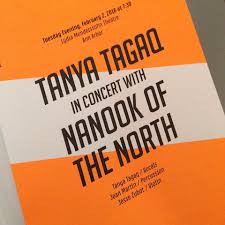
[ATTENDED: April 13, 2017] Tanya Tagaq performs Nanook of the North
 No use burying the lead: I just witnessed something singular. Something unique and unforgettable. Tanya Tagaq is a magical performer and I consider myself lucky to have seen her (even if I wasn’t always looking at her). And to have heard her incredible band live.
Tagaq is an Upik performer who incorporates throat singing into her music. And when she performs, her entire body is possessed by the music. She becomes animalistic, both low and growling as well as high and soaring.
Nanook of the North is considered the first documentary film. Filmed in 1920 by Robert J. Flaherty, it depicts Nanook, a “happy Eskimo,” and his family as they go about their lives. For many people it was their first and only exposure to Native culture. This film has been praised for its documentary techniques, but ridiculed for its patronizing attitude and for fudging reality.
I learned last night that part of the reason some of it was fudged was because his original film was destroyed in a fire and he returned to get more footage–often recreating what happened the first time. [Some Wikipedia details shed some light on his good intentions and controversies–see bottom of the post for a few details].
I first watched Nanook of the North about 20 years ago in a college film class. It was fine–less boring than I imagined, with some interesting moments, but not exactly gripping after 80 years of filmmaking. But with Tagaq’s new soundtrack, the film took on an amazing and powerful component which added intensity, drama and tension to this film. Continue Reading »
Posted in Canadian Content, Canadian Music, First Nations, Kimmel Center for the Performing Arts, Nanook of the North, Philadelphia, PA, Robert J. Flaherty, Tanya Tagaq, Verizon Hall | Leave a Comment »
April 13, 2017 by Paul Debraski
 SOUNDTRACK: L.A. SALAMI-“Day To Day (For 6 Days A Week)” NPR’S SOUTH X LULLABY (March 17, 2017).
 L.A. Salami’s full name is Lookman Adekunle Salami. I really enjoyed Salami’s song “Going Mad As The Street Bins.” His delivery is great and there were some rather unexpected chords.
For this performance of “Day to Day,” he is standing on the balcony of the Hilton Austin hotel overlooking the downtown skyline.
I usually try to pair kid-friendly songs with books, but there’s some curses in this song).
The music is basically the same for 7 minutes (although it does build by the end), which means you must focus on the lyrics. And they are pretty dark. It talks about boredom on public transportation as well as gruesome deaths on the news. There’s talk of mental health, like this section:
Went to work for the NHS –
Mental health, people depressed.
Met Joanne – Scared of living,
Afraid of dying, terrified of being.
Then met Paul, a schizophrenic,
Shaking limbs, paranoid fanatic –
Unwashed 10 days in a row –
So afraid almost paralytic.
I tell them that I do the same –
In certain moods, on certain days…
But despite the sane ways I can think
I could not do much to convince them…
But mostly I enjoy his delivery which has his slightly accented voice and charming mannerisms. The first time I heard this I wasn’t as drawn to it as I was his other song, but each listen unveils something more to like about it.
[READ: June 1, 2016] Explorer: The Mystery Boxes
This is the first in a series of short graphic novel short stories edited by Kazu Kibuishi the creator of Amulet.
Sarah brought these home for the kids to read and they were sitting around our house for a while so I picked one up. When I flipped through it and saw all the great authors in it I knew I had to read them.
The three books are not related to each other (aside from thematic) so it doesn’t matter what order you read them in.
This first one is all about “mystery boxes.” Continue Reading »
Posted in Adventure, Aliens, All Songs Considered, Alternate Reality, Children's Books, Culture Shock, Cute, Dave Roman, Emily Carroll, Fears, Graphic Novel, Greed, Huh?, Jason Caffoe, Johane Matte, Kazu Kibuishi, L.A. Salami, Mystery, Outer Space, Rad Sechrist, Raina Telgemeier, Sci-fi, Short Story, South X Lullaby, Stuart Livingston, Supernatural, Surreal, SXSW, Threats | Leave a Comment »
« Newer Posts - Older Posts »
 SOUNDTRACK: LAURA MVULA-Tiny Desk Concert #284 (July 1, 2013).
 I don’t know Mvula’s music (I know her because her name is unmistakable and I feel surprised that her debut came out only 4 years ago). The blurb talks about her big powerhouse soulful pop. But that is not in evidence here at all. As they say: