Feeds:
Posts
Comments

SOUNDTRACK: RHEOSTATICS-Starlight Club Waterloo, ON (March 25, 2007).
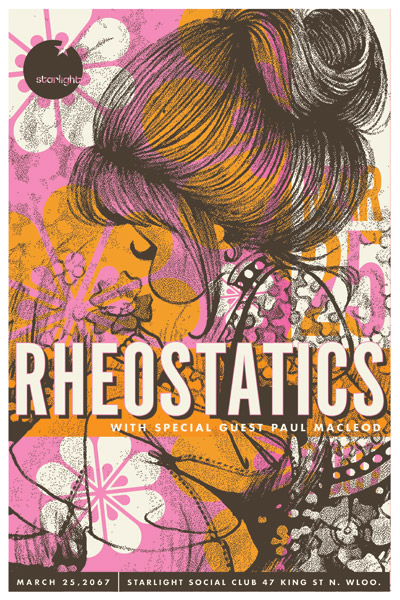
Rheostatics ended the first (or second, or third or whatever it was) phase of their career on March 30, 2007, presuming never to play again.  Before that final show at Massey Hall, the band played a few warm up gigs.

This first one was in Waterloo, perhaps a little over a year since their last live gig together.  It was hampered by the fact that Martin Tielli had laryngitis (just a few days before their final ever gig!).  Martin sounds like a caricature of a mobster whenever he talks–deep voiced and strangely Brooklyn-y.  And, obviously they don’t play many of the songs that he sings lead vocals on.  So, it’s a practice show of a sort.

Martin’s guitar is also too loud in the mix for some reason.  This means you can really hear the great sounds he’s making but it’s really distracting when it’s all you can hear.

“Fat” opens the show with all kinds of crazy sounds that Martin is making.  It sounds really cool and it goes on for quite a while, but it totally overwhelms Dave’s guitar and you can barely hear the bass.  The first time Martin sings backing vocals, he sounds completely sinister.

Next up is “Marginalized.”  There’s a long intro with some cool guitar sounds.  Tim’s voice is so quiet and Martin’s guitar so loud that the song sounds bizarre.  It also feels strangely subdued for such an angry song, but that may just be the mix.

“Me and Stupid” sounds good, although Dave forgets some words: “hang on, I got it, I got it.”

Dave tells a story of their first ever trip away from their home town.  Thanks to doc who brought us in to our first show in Waterloo in 1981.  We were ate the Kent hotel opening for L’Étranger, an old heroic Toronto punk/new wave band with Andy Cash, Chuck Angus and Bruce “Bruce P.M.” Meikle.  [Interestingly as of 2011, Angus and Cash were both in politics, sitting in the Canadian House of Commons as members of the New Democratic Party caucus].   We had on our dad’s blazers–our dads dressed cool at one time.  We did our set and were preparing to get high when L’Étranger showed up.  They had ripped jeans and leather jackets and they were shaking.  They had opened for the Dead Kennedys at the Concert Hall where they had been driven from the stage by spit and blood.  We thought they were a real band.

Tim picks up the story: they decided t o drive around and went to a park to get high.  Then the police came by.  Maybe they’d never smelled marijuana in Kitchener/Waterloo, but they let us go. Then we couldn’t find our way out of the twin cities.  We always got lost and ended up at the Alexanian Carpet Factory.

Paul Macleod fronts us for the next song, “Soul Glue,” another Northern Ontario tragedy.  Although it is sung by Tim.

“Four Little Songs” runs to 12 minutes long.  It has a fun cheesy keyboard sound and a silly long introduction.  Martin sings his and sounds insane.  Ford would you like to sing us a song?  Ford recites a quote from Valley of the Dolls, and the band poo poos that it was a song.  Martin sounding like a movie wise guy asks, “Ford was that really a song?”  So Ford sings a new song about Martin having laryngitis and he gets half of the room to sing “laryn” and the other have “gitis.”  Dave: “That bit’s gonna be great at Massey Hall.”

They do a really nice harmony at he end of the song “now they’re gone.”

Paul is back to the stage for “Little Bird, Little Bird,” although I’m not sure doing what.

Tim sings “Here comes the Image.”  I guess Martin is not on this song at all because everyone sounds the same level.  The keyboard solo is all back and forth in the headphones.

Guitar tech Tim Mech plays the terrific solo on “Legal Age Life.”  Then Martin says, “we’re gonna do ‘Take Me In Your Hand.'”  He gets cranky (or it’s just his voice–“oh Jesus, I’ll play it on electric.”  They either don;t play it or it didn’t get taped.  They move on to “Ozzy,” instead.  Martin, “we’re skipping tunes… things are changing…  We’re doing “Feed Yourself.”  This version is really intense with a lengthy guitar solo.   It runs about nine minutes.

Selina Martin comes out to sing “Dope Fiends and Booze Hounds.”  She says, “Poor Martin broke his voice.”  He makes up for it with a wild loud solo.  Then the go for a break.

Tim comes back out for the encore. He says some nice things, explains Martin’s voice and says somebody asked “Row” which he hasn’t done in a long time.  It sounds pretty good.

Andrew Roark the world’s tallest guitar tech and Paul will help us sing “Claire.”  Then they start “Horses” and Dave asks, “who has it in them to sing ‘Horses’ for us?”  The unnamed fan comes up and does a pretty decent job.  Martin’s solo is also really loud.

Finally Paul Macleod comes back to sing “Record Body Count.”  He says can you believe I get to to do this?  This is fucking crazy?  He sings an angry sounding version (not all that well).  Then he starts singing the praises of the band–really lays it on thick.  “This is the best band of all time.  Nobody is as good as this.  He gives a nod to Rush (Martin plays the Tom Sawyer riff).  He ends with I cannot believe that I have been alive during the time of this band (Dave: Holy shit!)

Martin recites (incorrectly) the end of the lyrics in that scary voice.

Someone (Paul, Michael?) starts the “whoo hoo hoo” intro to “Aliens.”  It’s pretty poor singing (he can’t get even close to the high notes), but it’s all in fun.

Michael: “give me more of Martin’s guitar in the monitor.”  Tim: “give me more of Martin’s voice, I can’t hear him.” (ha)

They play a really solid version of “When Winter Comes” (all 8 minutes of it), with Dave correcting one mistaken lyric “It’s ‘coal men’ not ‘snow men.'”

The show ends with a wild, scorching rendition of “R.D.A” with lots and lots of screaming from everyone except for Martin.  We hope that he will be ready in five days.

[READ: September 10, 2017] “Synchronicity”

I don’t know if it’s because I’m a city slicker or cosmopolitan or whatever stupid word people use for us East Coasters, but I don’t get stories like this.  And I don’t like them, either.

I can never tell if there’s supposed to be something beyond the obvious–some down home wisdom that I’m missing, maybe?

As far as I can tell, this story is about a guy visiting his friend Ward.  Ward likes to fix things, so when the narrator has a problem–like with his John Deere, he asks Ward for help. Continue Reading »

CV1_TNY_06_08_15_09.inddSOUNDTRACK: LUCY DACUS-“Historians” NPR’S SOUTH X LULLABY (March 21, 2018).

I’m looking forward to seeing Lucy Dacus live in a few weeks.  Her music is often spare but grows very intense.  For this particular song it is just her and her guitarist who is creating textures and sounds as Lucy sings clearly and starkly.  She plays the (almost) title track from her new album Historian.

The idea behind our South X Lullaby series was to offer intimate moments with musicians as an antidote to the commotion and deluge that is the SXSW music festival. When we met Lucy Dacus for her Lullaby and found out she’d perform “Historians,” a most somber song from her deeply personal and triumphant album Historian, it felt just right. It’s a song of reflection, the story of two intertwined partners and the way they document one another’s lives and preserve each other’s memories.

With simple but compelling swirls of sound, Dacus begins singing clearly with a bit of softness on the edges of her words.  It’s fascinating to watch her face illuminated by the video around her (the same video that Stella Donnelly performed in front of).

The song is warm despite the sadness inherent in it.

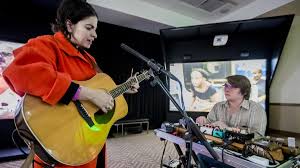
The setting for this performance, by Lucy Dacus and guitarist Jacob Blizard, is an interactive art installation by the multidisciplinary Israeli artist Ronen Sharabani that’s part of the SXSW Art Program. This work, titled “Conductors and Resistance,” explores human-machine interaction in our ever-evolving technological world. The images projected behind Lucy and Jacob are two coffee cups, one empty and one that’s been almost drained, both tangled in and tugged at by a complex series of wires, representing what I think is human communication and miscommunication.  This is just one of three walls onto which images are projected in this installation — you can see another wall behind Stella Donnelly in her South X Lullaby video.

[READ: April 13, 2016] “The Magic Mountain”

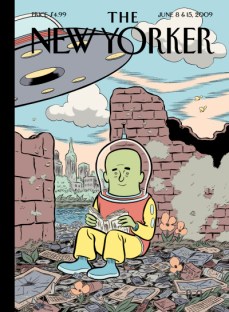
Back in June of 2009, The New Yorker had their annual summer fiction issue.  Included in that issue were three short essays under the heading of “Summer Reading.”  I knew all three authors, so I decided to include them here.

This essay was about Aleksander Hemon’s childhood in Sarajevo.

He says that (not unlike Angell) his family had a cabin on the mountain called Jahorina.  His family would spend winter breaks there skiing and partying.  His parents thought it was heaven up there.  But he and his sister hated to go there in the summer. Continue Reading »

CV1_TNY_06_08_15_09.inddSOUNDTRACK: KEVIN MORBY & KATIE CRUTCHFIELD-“Downtown’s Lights” NPR’S SOUTH X LULLABY (March 20, 2018).

I don’t know if Bob Boilen ever explained how he starte dto get people doing South X Lullabies, but here he explains why he started doing them:

In the midst of all the chaos that is Austin, Texas during the SXSW Music Festival, we seek moments of calm. And so one night, as the week was nearing its end, we made our way to the courtyard of St. David’s Episcopal Church, just a few blocks from the thousands of festival participants and onlookers. There we found a trickling garden-side waterfall, where Katie Crutchfield and Kevin Morby performed “Downtown’s Lights,” from Kevin Morby’s recent album, City Music.

I don’t know Kevin Morby.  I’ve heard of him, but aside from a Tiny Desk Concert, I’ve never explored his music.

“Downtown’s Lights” is a simple folk song.  He’s got a bit of a Bob Dylan delivery in what feels like a very deliberate folk song.  Katie Crutchfield is Waxahatchee who I’m excited to see in a few weeks.  Waxahatchee has been really rocking out the last few albums, so this folk song (and her Southern accent) stand out somewhat.

Their voices work nicely together, and that moment when you hear someone yelling, it almost sounds like a wolf howling.

“Downtown’s Lights” is a song of comfort and prayer for someone who is down and out in the city, and this version, with Katie singing — and the sounds of the city echoing in the background — is wistful and peacefully perfect.

[READ: April 13, 2016] “Two Emmas”

Back in June of 2009, The New Yorker had their annual summer fiction issue.  Included in that issue were three short essays under the heading of “Summer Reading.”  I knew all three authors, so I decided to include them here.

This essay was about Roger Angell’s summer home in Maine.

He says that on late February nights his mind often returns to his family’s cottage in Maine and the books that are on its shelves.

Those books have been there for as long as he can remember, and have been read and re-read every summer.  The list is interesting:

Good Behaviour [Molly Keane], Endurance [Alfred Lansing], Framley Parsonage [Anthony Trollope], Get Shorty [Elmore Leonard], Daisy Miller [Henry James], Dracula [Bram Stoker], Butterfield 8 [John O’Hara], Goodbye to All That [Robert Graves], Why Did I Ever [Mary Robison], Oblomov [Ivan Goncharov], The Heart of the Matter [Graham Greene], Sailing Days on the Penobscot [George Savary Wasson], The Moonstone [Wilkie Collins], Possession [A. S. Byatt], Morte d’Urban [J. F. Powers], Quartet [Jean Rhys], Emma [Jane Austen] and dozens more. [I have to chime in and say that this sounds heavenly].

He says that fat books like Martin Chuzzlewit [Charles Dickens], Orley Farm [Anthony Trollope] and the Forsythe Saga [John Galsworthy] were saved for a tedious week of Down East fog. Continue Reading »

CV1_TNY_06_08_15_09.inddSOUNDTRACK: SOUNDTRACK: STELLA DONNELLY-“Talking” NPR’S SOUTH X LULLABY (March 19, 2018).

The South X Lullaby is a really fun way to get to know a new (or familiar, but mostly new) artist in an intimate live setting.  I had heard one of Stella Donnelly’s songs before, but this Lullaby presented her by herself (with a very cool backdrop) with an amazingly clear recording of her voice and guitar.

Stella Donnelly has only one EP to her name, but that’s been enough to make her sharp wit come through in sweet, quiet songs that rage loudly. The Australian singer-songwriter’s Thrush Metal EP was recently reissued in the U.S. with a bonus track, “Talking,” which she performs here surrounded by video of wires, a weaving machine and woolen yarns.

Her voice is clear with big open vowels (you can kind of hear the Australian accent, but it’s somewhat indeterminate).  Despite it being just her electric guitar, she plays a in a couple of slightly different styles throughout the song which adds a lot of texture to the piece.

For the end of the song she really unleashes her voice even as the guitar doesn’t alter all that much.  It’s pretty intense.

I wish you could see the art installation a bit more (I realize this is a video for her, but the installation is pretty neat).  At least they hold the pull-back screen at the end a little long so you can see what’s going on.

Donnelly played “Talking” in Conductors and Resistance, an art installation by the Israeli artist Ronen Sharabani that’s on display as part of the SXSW Art Program. Like Donnelly’s direct and feminist folk songs, Sharabani confronts the viewer to increase action in areas of high resistance, the only way to ensure a strong reaction.

[READ: April 13, 2016] “A Soldier Home”

Back in June of 2009, The New Yorker had their annual summer fiction issue.  Included in that issue were three short essays under the heading of “Summer Reading.”  I knew all three authors, so I decided to include them here.

This essay was about Yiyun Li’s growing up in China.

And I was astonished by the first line: “The summer after my year of involuntary service in the Chinese army….”  I didn’t know that women were made to be in it.  She says that after that summer, she read Hemingway compulsively. Continue Reading »

CV1_TNY_06_08_15_09.indd

SOUNDTRACK: MAX RICHTER-“Dream 3 (In The Midst Of My Life)” from Sleep– NPR’S SOUTH X LULLABY (March 17, 2018).

This piece is remarkable.  And the except provided here (all 8 minutes of it) is but a teeny fraction of the entire 8 hour work.

I had heard about this piece on Echoes a few months ago and was very interested in it, but figured there was no way I’d hear it.  I never imagined anyone would hear it quite like this:

Right at the start of the 2018 SXSW Music Festival, Max Richter’s eight-hour composition Sleep was performed overnight to an audience tucked into 150 beds. They — the audience, not the tireless group of musicians who performed the piece — slept, dreamed and sometimes snored through this trance-inducing experience.

Richter has described this piece: “Really, what I wanted to do is provide a landscape or a musical place where people could fall asleep.”

In the video here, you’ll see Richter himself on keyboards and electronics, along with the ACME string ensemble and soprano vocalist Grace Davidson.

What I loved about the story of this piece is not that it is a piece to sleep to exactly but that it is based around the neuroscience of sleep.  He says, “Sleep is an attempt to see how that space when your conscious mind is on holiday can be a place for music to live.”

It’s wonderful and I would love to sleep to it some night.

[READ: April 13, 2016] “Old Wounds”

I thought that I had read more by Edna O’Brien but it appears that I’ve read hardly anything by her.

This story was an interesting look at Irish stubborness and the way families can hate each other over small things (or even big things).

The narrator explains that her family had a falling out and for several years there was no communication at all between them.  Even when they attended funerals they did not acknowledge each other.

Finally all of the older people had died off and it was just her and her cousin Edward (both past middle age) they met and put aside the hostilities. They even visited the family graveyard together.  The graveyard was on an island a short boat ride from Edward’s house. Continue Reading »

[ATTENDED: March 20, 2018] Judas Priest

Judas Priest was one of my favorite bands when I was a kid.  I remember being very excited when Screaming for Vengeance came out.  I even liked Turbo (“Turbo Lover” may be a terrible song but it is sure catchy).  But then by 1988 I had stopped listening to them, thinking that they’d gone all synth.  I moved on from JP to more heavy music, but I returned to JP’s earlier more progressive-sounding rock quite a lot.  Which means I missed the outstanding “Painkiller” and the whole “Ripper” Owens period.

I even saw Rob Halford live with his band Halford in 200o (opening for Queensryche and Iron Maiden).  I decided I wanted to see this essential childhood band especially since they had a new album out that had gotten decent buzz.  I knew it wasn’t all the original members.  Bassist Ian Hill was still there with Halford.

The drummer Dave Holland was replaced by current drummed Scott Travis in 1989, so he’s a veteran of the band.

Original guitar maniac K.K. Downing left in 2011 and his replacement Richie Faulkner has been accepted into the Priest fold.

And then there was Glenn Tipton, the other original member and part of the twin guitar attack.

So 3/5 original members is pretty good for a band that started in the mid 1970s.  Then Tipton revealed that he had Parkinson’s and would not be touring with the band.  Ouch.  I wondered if it was still worth gong, and I was soundly criticized for doubting the Beast which is Priest.  He was replaced by their engineer Andy Sneap. Continue Reading »

[ATTENDED: March 20, 2018] Saxon

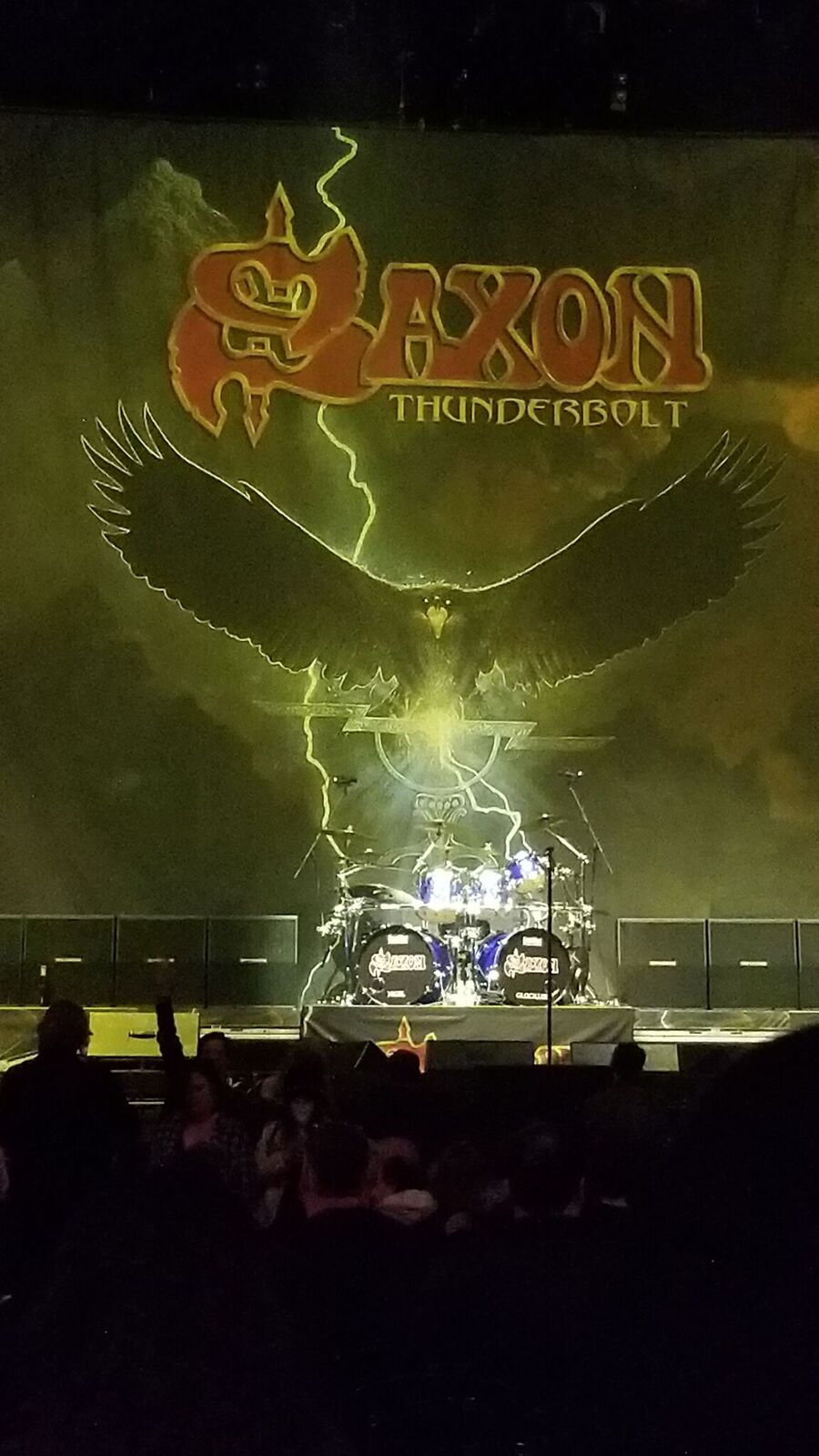
Back in high school, I loved Saxon.  I may have loved them more for their logo than their music (that battle-axe S is still awesome). But I know I listened to their records enough that their songs were often familiar (and cool).

“Denim and Leather” was my introduction and favorite song, although hearing it now, it’s not as good as many of their other classics.

I bought their first eight albums on vinyl. And then I kind of forgot about them. Or at least assumed they had broken up or something.

But, unlike most bands that started in the 70s, Saxon appears to have never stopped.

Indeed, since that last album I bought in 1988, they have put out fourteen (!) more (not including ten live albums and countless compilations). Continue Reading »
[ATTENDED: March 20, 2018] Black Star Riders

I had not heard of Black Star riders before this show.  My friend Nick told me that they were involved with Thin Lizzy in some capacity.  I really like Thin Lizzy, so I was intrigued by that aspect.  Although I didn’t quite understand  the connection, I assumed it was the original members plus a new singer.  I have just looked at the timeline of Thin Lizzy members and trying to figure out what an original member would be is a futile gesture.

Scott Gorham who is in Black Star Riders joined Thin Lizzy in 1974 (after the band had released three albums) and has been with them ever since.  Thin Lizzy broke up in 1983 (Phil Lynott, singer, bass player and primary songwriter died in 1986–I always assumed they broke up because he died).  Continue Reading »

SOUNDTRACK: BECCA MANCARI-“Dirty Dishes” NPR’S SOUTH X LULLABY (March 15, 2018).

Becca Mancari plays a pretty acosutic guitar melody while Blake’s effects-laden pedal steel guitar soars and echoes around her.

I don’t know the original, but according to the blurb, “Mancari removes the clicking pulse of the studio version to underline the song’s lonely atmospherics.”

The song is simple–one that speaks to a relationship: “‘I can’t face myself,’ Mancari repeats the line like a broken admission spoken through a pinhole camera, a whispered truth so potent it can’t be looked right in the eye. “

At 2:41, the guitarist hits a great effect that turns the soaring pedal steel guitar into a buzzy rocking guitar solo while Becca strums on.  It’s a great interlude that really sells this song.

I also love that the final 30 seconds is just the sound of the guitar(s) fading out.

There are moments in this video where the Nashville-based singer-songwriter turns away from the many faces of the Life Underground installation by Hervé Cohen, which is part of the SXSW Art Program and supported by the Cultural Services of the French Embassy in the United States. What’s being projected onto the screens in the room are interviews with subway passengers from around the world who share their stories and dreams. The installation’s notion is that empathy often comes by just asking a few questions, which, maybe for “Dirty Dishes,” is just too damn hard right now.

[READ: April 12, 2016] “The Tiger’s Wife”

Téa Obreht took the literary world by storm with her debut novel The Tiger’s Wife.  I’ve had a copy of it on my bedside I guess now for 8 years.  I’ve been meaning to read it but other things always jump in first.

So finally I got around to reading this excerpt from the novel.

The excerpt is, I assume, the first few sections of the novel since they are numbered and begin with 1.

The first part is called The Tiger and it talks all about the titular tiger.  The tiger was in a zoo (or a circus) in 1941 when the Germans began bombing the city for three straight days.

The tiger should have died in the concussion and rubble, but he managed to escape and wandered to the village. Continue Reading »

SOUNDTRACK: NATALIE PRASS-“Short Court Style” NPR’S SOUTH X LULLABY (March 14, 2018).

I did not enjoy this Lullaby at all.  Prass’ voice is very conventionally poppy and the synth sounds were really cheesy.  I would without question turn this off it was on the radio.

Evidently the original has “a laid-back disco cool and bouncing bassline groove” but then Prass

shows up to her South X Lullaby session with keyboardist Jacob Ungerleider, slows down the tempo just a mood lighting dimmer and turns the song’s breezy funk into the soft murmurs of late-night devotion.

Still doesn’t make me like it.

This version of “Short Court Style” was filmed in an interactive art installation by Caitlin Pickall called FEAST, which is part of the SXSW Art Program and was created as part of the Laboratory Artist Residency program in Spokane, Wash. Prass and Ungerlieder sit at a dinner table set with plates and towers of wine glasses, onto which images and patterns are projected. The projections are triggered by the movements of guests at the table, so the experience changes every time someone sits down.

[READ: March 15, 2018] “No More Maybe”

This story looks at immigrants in the land of trump’s america.  But it also looks at how in-laws can drive us crazy.

The narrator’s in-laws have come to visit them because she is pregnant.

Her mother-in-law has been very busy taking advantage of all that America has to offer (cheaply): blueberries, the clean air, the stars, and English-language classes (which are expensive in China).

She is puzzled by them being free: “America is a capitalist country….  What about so-called ‘invisible hand’s” (She learned about that phrase two days earlier).  The woman is confident (she is a volleyball coach) and is not shy about expressing herself. Continue Reading »