Feeds:
Posts
Comments

Archive for the ‘Yuck!’ Category

preludeSOUNDTRACK: BEAUTY PILL-Tiny Desk Concert #481 (October 23, 2015).

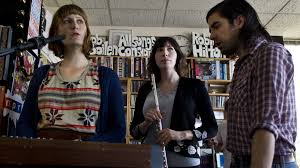
beauty-pill Beauty Pill is an unusual band.  They seem fairly conventional–guitars, baas and drums.  But they also feature a strange light up computer device (which is called a Monome) that is a sort of looping sampler trigger.  The samples are weird and unexpected and the music plays off of that–at times lurching and bouncing, at times playing smooth and conventional.

I love the crazy funky vibes as the first song “Afrikaner Barista” begins.  There’s interesting samples and a cool riff.  The song feels “assembled.”  And I was really excited to see where it would go.  But I really didn’t like the singer/speaker’s voice in his delivery of the verses.  It’s a little too unemphatic–it’s neither loud nor weird not even excessively deadpan.  It’s just kind of bland.  The chorus is cool though, and his delivery works because there are harmony vocals to accompany him.

I also like his sort of distorted guitar solo.  Mostly though, it’s fascinating watching Jean Cook play her Monome, watching her push buttons that light up and produce diverse sounds.  The drums are also great–complex and dynamic.

In all of the songs, there’ a lot of repeating of lyrics–almost like a mantra.  This song repeats, “I want to be the one you like.”  I’m not even clear if the words mean anything.  Even the title “Afrikaner Barista” is fun to say but I don’t know if its meaningful.

“Drapetomania!” is introduced as a dark song although the singer, Chad Clark, thinks it resembles the Fat Albert theme song.  He says it’s about the suburbs.  When the song begins, it has a kind a of creepy circus quality to it and it opens with the dramatic line, “I want more life, fucker!”  There’s some fun lyrics in this song like “Morning Ralph, Morning Sam” (referencing the Bugs Bunny cartoons).  Or “The neighbor’s wifi’s called “magic negro” now / I am gonna burn his house down, if I may.”  And this great line: “deep in the heart of wildest Caucasia.”

The middle has a breakdown that’s lot of fun as the samples continue to play with all sorts of things, including, I believe, Clark’s voice.

The final song is called “Exit Without Saving” which he says is “either a Microsoft Word document or a situation where you feel trapped,”  I like the riff of this one and the samples too. There’s more great lyrics like “a five ton mastodon frozen in mid-snarl in a ten ton cube of ice, says I don’t know how I got in here but if I get out it ain’t gonna happen twice.”  There’s a repeated refrain of “you recognize that this is noise, right?”

It’s not always clear what he’s on about, but it’s fun to listen to them.

There’s so much about this band that I like but I feel like there’s just something missing–either in the voice or maybe that the samples and sounds need to be a little more prominent?  I’m curious to see what these guys do next though.

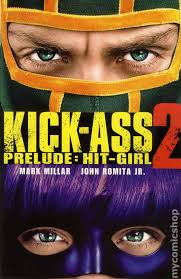
[READ: February 14, 2016] Kick-Ass 2: Prelude

This book is a sequel to Kick-Ass and a prequel to Kick-Ass 2.  It focuses on Hit Girl, but not her childhood (which we saw in Kick Ass).  Rather, it follows her in the days following the events of the first book.

We see that Hit Girl, Mindy McCready, is at home with her mom and her stepfather.  Her mom has calmed down (she has been quite hysterical lately) and her stepdad, Marcus, is a policeman trying to keep things orderly.  He knows about Mindy’s secret identity (he knows all about what kind of upbringing she had as well) and he wants her to stop the superheroing.  But overall, he is pretty cool.

We see Mindy at School (Kick Ass if there too, of course).  No matter how tough Mindy is when she has her costume on, she is still a little girl and she is crushed by the mean girls in school.  And so Mindy makes a deal–she’ll teach Kick Ass to actually fight and be a real superhero (as much as she is) if he’ll teach her to be normal. (more…)

Read Full Post »

2016-12-05-21-06-09SOUNDTRACK: LAURA GIBSON-Tiny Desk Concert #200 (March 5, 2012).

I’d published these posts without Soundtracks while I was reading the calendars.  But I decided to add Tiny Desk Concerts to them when I realized that I’d love to post about all of the remaining 100 or shows and this was a good way to knock out 25 of them.

gibsonLaura Gibson performed the first Tiny Desk Concert in 2008.  The whole enterprise was started because of her.  Bob had seen her in a club and her quiet music was overpowered by the audience.  So he invited her to play in his quiet office.  And now, here it was 200 shows later and Gibson is back–the first person to headline twice.

Things have certainly changed since then.  There was one camera on her face and another on her guitar.  There was minimal editing and the sound was fine.

Since then they have stepped up the game–multiple cameras, professional lighting and, as Stephen Thomspon writes: Bob’s desk “permanently houses a microphone that’s worth more than my car. (Three hundred dollars!).”

2006 was the release year of her debut album.  She had put out her third album in 2012.  She was quite back in 2006 and is still quiet in 2012.  But for this show she has brought along some help:  Brian Perez – Vocals, Percussion; Matthew Berger – Drums; Johanna Kunin – Vocals, Piano, Flute; and Jill Coykendall – Clarinet.

The songs are very quiet.  “Feather Lungs” begins with some lovely harmony vocals and then Gibson on keyboard.  The flute and clarinet add layers of music which really fleshes out this quiet song. The thumping drum that opens “La Grande” really sets the tone of a much heavier song.  This proves to be a romping song with Gibson on guitar and a lot of intensity behind her.

“Milk-Heavy, Pollen-Eyed” slows things down again, with quiet percussion and Gibson’s delicate guitar and vocals.  She says that the last time she was there it was a Monday morning and there was not much enthusiasm to sing along with her.  But since it’s a Friday afternoon, she invites eveyone to hum a long to “The Rushing Dark.”  Of course, she has backing vocalists so it’s unclear if anyone else joins in, but this a capaella song sounds lovely.

[READ: December 6, 2016] “Bestiary”

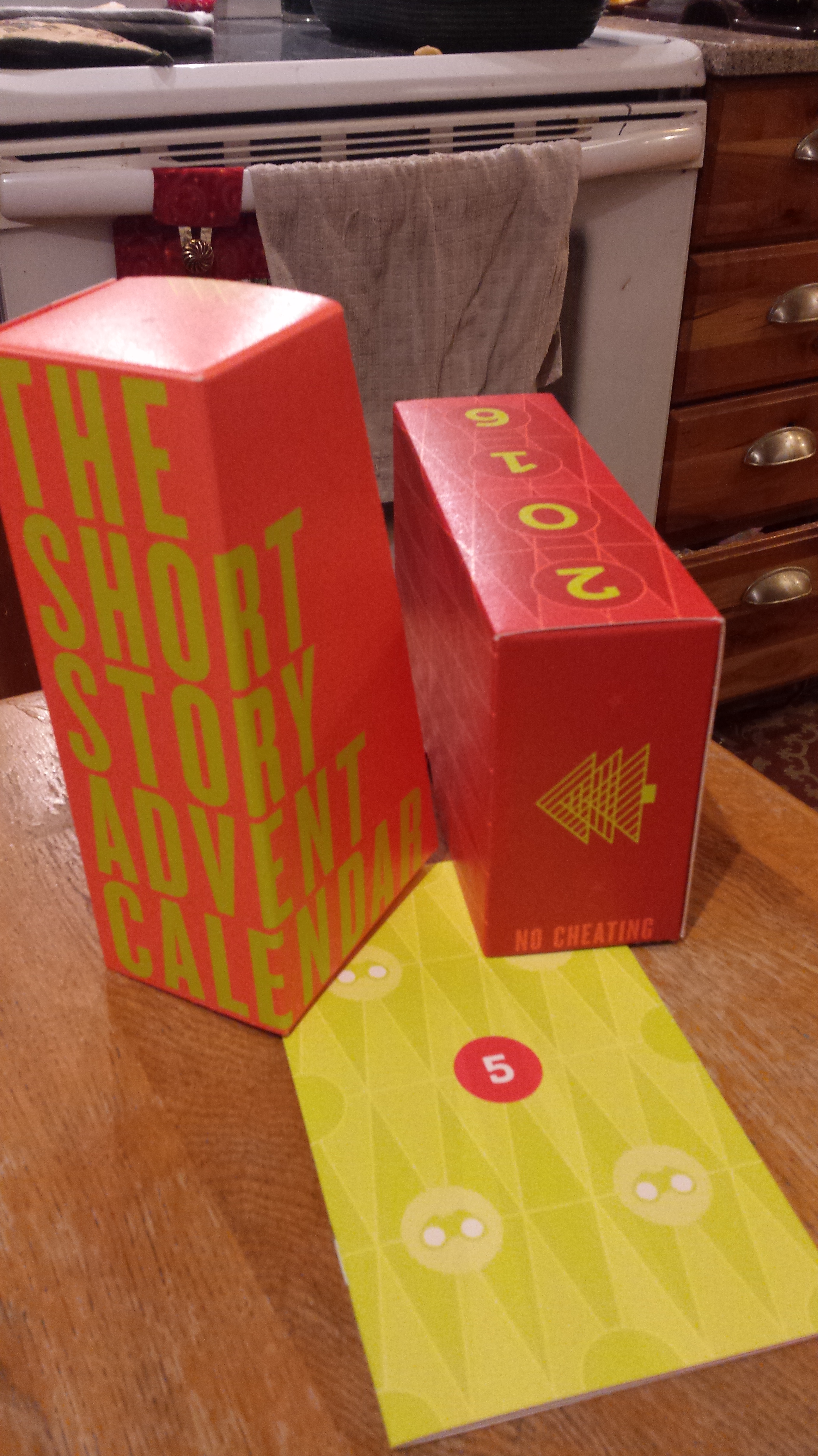
Near the end of November, I found out about The Short Story Advent Calendar.  Which is what exactly?  Well…

The Short Story Advent Calendar returns, not a moment too soon, to spice up your holidays with another collection of 24 stories that readers open one by one on the mornings leading up to Christmas.  This year’s stories once again come from some of your favourite writers across the continent—plus a couple of new crushes you haven’t met yet. Most of the stories have never appeared in a book before. Some have never been published, period.

I already had plans for what to post about in December, but since this arrived (a few days late for advent, but that was my fault for ordering so late) I’ve decided to post about every story on each day.

“Bestiary” is an interesting “short story” because it is not exactly a short story.  It’s not even exactly fiction.  Rather, after an excellent epigram from Robert Kroetsch “We are the animals who talk the fables in which the animals talk.  We are talking animals, claiming that animal’s don’t talk.”  The piece consists mostly of factual stories about animal behavior.

Each one opens with a title that ties into the piece beneath it. (more…)

Read Full Post »

dfwreadSOUNDTRACK: CHRISTIAN SCOTT aTUNDE ADJUAH-Tiny Desk Concert #477 (October 9, 2015).

aacsChristian Scott aTunde Adjuah and his septet play what he calls stretch music: “the particular type of jazz fusion he’s up to: something more seamless than a simple collision of genre signifiers.”

They note that even his appearance stretches traditional jazz: “You may note that he showed up in a Joy Division sleeveless T-shirt and gold chain.” It’s sleek and clearly modern, awash in guitar riffs, but also bold and emotionally naked.

Christian Scott aTunde Adjuah (not sure how to abbreviate that) is a trumpeter and he can hit some loud powerful and long –held notes.   It’s funny that when he bends over the trumpet grows quieter—those ic really are direction-based.

For the first song “TWIN” he does some impressive soloing over a simple and cool beat—piano and delicate guitar riffs (there’s also an upright bass and drummer).   After his lengthy solo there’s a flute solo that also works perfectly (if less dramatically) with the background music.  (Christian plays tambourine during her solo).  He says that this song is about being a twin.  His brother, Kyle Scott is a film director and for whom Christians scores the music.  Christian also explains that he comes from an African-American and Native-American background and that this song has rhythms as a sort of history of his family that touches on Mali, Senegal Gambia and The Ivory Coast and makes its way to the Caribbean, Cuba and into New Orleans.

He’s pleased to play the Tiny Desk Concert for an audience that appreciates “Music that has nutritional value.”

For the second song, “West of the West” he brings on a young alto-saxophonist who plays with his drummer in a different band. The song opens with a rocking electric guitar solo and then the jazzy band kicks in behind it.  The instrumental features a couple of solos by the saxophonist, the pianist and the bassist.

“K.K.P.D.” is a dramatic song for which he gives a lengthy back story.  Many years ago in his home of New Orleans, he was stopped by New Orleans police late at night for no reason other than to harass and intimidate him.  he was coming back from a gig.  He resisted and was in a serious situation and was seriously threatened—the story is long and very affecting, especially given how articulate (I know, terrible word, but true) and calm he is about retelling this horrifying story.  His pride almost made him do something ill-advised, but instead he channeled that pent-up frustration into a piece of music whose long-form title is “Ku Klux Police Department.”

He adds that we see things on TV about inner cities or the ninth ward and we believe them to be true.  Like that the neighborhood is happy that the police are clearing out the youth there.  We begin to think that the narrative is true, although the people who live there can tell you otherwise.  Despite the title and the origin, the is song is designed to reach a consensus to move forward –not to build derision or hate.  He says that we have to start working on that now, because if it doesn’t start now then our children will continue to inherit this situation.

It opens with a noisy guitar wash and fast drums.  It’s quite noisy and chaotic although it resolves very nicely into an almost sweet piano-based song with slow horns.  The middle of the song ramps up with some intense soloing from Christian.  I love how that segues into a very different section with an electronic drum and delicate piano.  Chritsian’s next solo is much more optimistic.  The final section is just wonderfully catchy.

When he introduces the band, he points out just how young some of his newest members are: Drummer Corey Fonville (another new member) used a djembe as a bass drum, and also brought a MIDI pad so he could emulate the sound of a drum machine; Lawrence Fields, piano; Kris Funn, bass; Dominic Minix , guitar (21 years old); Braxton Cook, saxophone (24 years-old) and Elena Pinderhughes, flute: 20 years old!

I don’t listen to a ton of jazz, but I really liked this Tiny Desk Concert a lot.

[READ: July-October 2016] The David Foster Wallace Reader

I’ve had this book since Sarah bought it for me for Christmas in 2014.  I haven’t been in a huge hurry to read it because I have read almost everything in it already.  And some of that I have even read recently.  But this summer I decided to read some of my bigger books, so this was a good time as any.

One of the fascinating things about reading this book is the excerpting in the fiction section.  I have never really read excerpts from DFWs longer books before.  And once you decontextualize the parts, you can really appreciate them for themselves rather than as a means to the end of the story.  This is especially true of the excerpts from Broom of the System and Infinite Jest.  But also just reading some of these sections as a short story makes for an interesting experience.

It was also very interesting to read the non-fiction all together like that.  These pieces come from difference anthologies, but they have thematic similarities  So, placing them together like that allows for really comparing the stories.

And of course, the selling point for most DFW fans is the teaching materials in the center of the book–an opportunity to look into the man’s mind at work shaping younger minds.

I have written about virtually everything in this book already (title links refer back to previous posts), so mostly these are thoughts about the pieces themselves and not a part of a whole. (more…)

Read Full Post »

mustcahe SOUNDTRACK: SUN RA ARKESTRA-Tiny Desk Concert #402 (October 31, 2014).

sunraSun Ra was a big band innovator who claimed to be from Saturn.  He died 20 years ago, but he would have turned 100 in 2014. And the Arkestra that bears his name keeps his spaced out spirit alive.

The band plays jazz, but most often that jazz is noisy and abrasive and seems to make no sense at all.  Sometimes it seems like it would just hurt to listen to it.  But when they gel, the music is trippy and cool.

The first song, “Along Came Ra”/”Zoom” opens with the group singing “When the world was in darkness and darkness was ignorance, along came Ra.”  And after a few times through this the chaos begins (that would be “Zoom.”  All of the horn players just start wailing on whatever.  The violin plays something, the keyboard is all over the place.  It is noise and chaos and probably hurt people’s ears there.

And then it stops and a proper jazzy song “Queer Notion” begins.   It has a catchy piano melody.  When the horns come back in, they feel slightly off somehow, as if deliberately not quite playing what you’d expect–but very close.  There’s even an electronic keyboard solo (set to a nice spacey sound).  The band leader (Marshall Allen, who is 91 and has been with the Arkestra since the early 1950s) play a “melodica” that has some kind of spacey processor on it.  And yet for all the craziness there is some real fundamental jazz beneath it.

“Angels and Demons at Play” has a trippy underlying riff with horns over the top.  The biggest surprise comes after a few minutes when the violinist sings the title slowly and dramatically.  The song builds and repeats over and over and then ends with chaos and drama.

The set ends and there is much applause and the band wishes everyone a Happy Halloween–the band came dressed complete with costumes inspired by Egyptian symbolism and science fiction.  And just when it seems like it’s over (and this surprises Bob) they start another song.

“Interplanetary Music” is a big fun sing along  with lots of clapping and it seems like the kind of thing they might end every show with.  So even though some of the music is crazy, there’s good fun at the heart of it all.

[READ: June 1, 2016] The Glorkian Warrior and the Mustache of Destiny

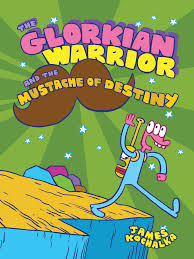
This Glorkian Warrior story was probably my least favorite of the three.  It felt really long, possibly because many of the jokes were repeated a lot.  I did get a kick out of how the mustache appears in the very first pages and then almost never makes a return appearance.

The best part of the story is that the Glorkian Warrior continues to be incredibly stupid.  When he says good morning to his coffee, super backpack says “good morning” and warrior thinks it is the coffee that talks back.  So he thinks, “I just invented talking coffee.”  He and the backpack argue for a few pages (my favorite parts are their fights because the backpack is smart and the Warrior…isn’t).

And then in cones a bunch of little kids (crazy Kochalkan characters, of course).  There’s Crazy Face, Doonky and Bronk (who only says Bronk).  The kids want to go on a mission with him but he says no. (more…)

Read Full Post »

orcsSOUNDTRACK: AVEC LE SOLEIL DE SA BOUCHE-Zubberdust! [CST106] (2014).

cst106cover_258x242Avec le soleil sortant de sa bouche (With the sun out of his mouth–no translation for Zubberdust) is the creation of former Fly Pan Am bassist Jean-Sebastien Truchy.  With this album he has created a fascinating hybrid of near Krautrock repetitions with some King Crimson guitar lines and time signatures.  And interesting sung almost operatic male vocals.  Technically the disc has four songs, but songs 1 and 3 are extended suites broken into chapters.

“Face à l’instant” (Face Now parts I-IV) is the first suite.  This disc opens like Ministry–with an aggressive, fast, pounding guitar riff for 8 bars, a sharp pause and continuation of same.  After four measures of that, a quirky quiet instrumental takes over and at about a minute the heavy guitars return. Part 2 of the song starts with a funky, slightly off-kilter sounding guitar line and whistling.   About a minute into this secretion the song shifts to a quiet sequence of overlapping riffs and sounds.  About 5 minutes in, the voices start singing in wordless chants–it’s strangely catchy and slightly militaristic at the same time.  The song builds with voices until it climaxes with a stop.  Then a complex drumming pattern begins Part 3. The guitars lines resume and there are several vocals sections (I assume singing in French) that add a lot of tension to the song.  Midway through this part the song stops and that aggressive introductory guitar pummeling resumes, this time changing keys and not letting up.  New sounds and super heavy drumming are added as this brings part three to a climax.  Part 4 returns to quieter playing (and sounds a bit like Fly Pan Am in the way the guitar line as intersect.  The final section continues with the vocals and rhythms of the other three and then ends with some dramatic keyboard chords playing us out.

“Super pastiche fantastique” (Super fantastic pastiche) is the other suite.  It opens with some complex drumming and then several sequences of notes–guitar and synth that meld nicely.  Part 1 is just 3 minutes and by the end some electronic noises start overtaking the melodies.   Part 2 opens with the same melody but the electronics have been replaced by a wah-wahed guitar and more synth lines.  The song is complex and repetitive, with the only non-repeating part being the singer’s voice (no idea what he’s even saying).  The second half of part 2 (which is 7 minutes in total) ends with some sung vocals (not unlike David Byrne).  Part 3 is a 90 second interlude of very quick tinkling strings that are overwhelmed by noise and static and thudding drums.  The end of the track seems to be building up to part 4 which picks up the momentum into a great instrumental motif–intertwining guitars and electronics all with a cool bass line underneath.  After 2 and a half minutes the  song drops to drums and a funky guitar line with all kind of noises and static and voices working as transition to the cool bass line that comes in around 3 minutes.  As the song careens towards the end, the pace picks up and you can hear some intense screaming of vocals way in the distance.  The song cleans up and plays that great fast riff right up until the end when it abruptly ceases.

Tracks 2 and 4 are weird pastiches of sound. “Déja hier…” (Already yesterday…) is a four-minute song.  Interesting music plays very quietly in the background before it gets overwritten by conversation and static.  You can occasionally hear the song being played behind the noise, but it’s mostly just a weird kind of muffled noise.  “À partir de dorénavant” (From now) is similar.  You can hear a distant muddy drum and what sounds like la dinner party–tons of conversations going on at once.  It seems like the disc is going to end with 3 minutes of this, but a keyboard melody begins to slowly overtake the din.

The last minute or so is this interesting sci-f sounding synth line with warbling effects and an interesting, mellow bass.  Although it’s nowhere near as complicated as the rest of the album, it’s a cool way to end and almost feels like a segue into something else.

This album has a whole lot of styles and genres blended together into a (mostly) very cool mix of sounds.  I like it a lot, although I’ll probably skips tracks 2 and 4 most of the time.

[READ: June 15, 2016] Orcs: Forged for War

This book was a little hard to learn about because Stan Nicholls has written several novels in the Orcs series.  So when you look up his books you get a confusing list of the series and other things.  This book is not part of the series, but it is part of the overall Orcs arc. It comes just before the First Blood Trilogy.

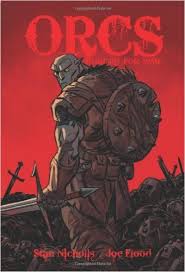
In the intro, Nicholls tells us lot more about his whole Orcs oeuvre.  He points out that unlike Tolkien (whom he loved) his Orcs are not mindless brutes. In fact, in his books, the orcs are the heroes and the humans are the ones who have along and messed things up.  He says that anyone unfamiliar with his orcs books should have no trouble following this book.

And that is true to a degree.  One thing that it behooves an author/artist to do is to make sure that everyone understands who all of the characters/races are in his/her book.  He does give a brief summary in the intro, but that doesn’t really help because there’s no visual guide.

Humans are divided into two camps.  The Manifold (Manis) pursue ancient pagan ways.  The Unity (Unis) are monotheistic.  They are both fanatics but the Unis have more bigotry and demagoguery.

This book opens with the Unis fighting the Manis.  And then the Orcs enter the fray but it’s not always clear whose side the Orcs on, if any. Regardless of which side they are on, they are willing to fight and kill whomever (there is much much bloodhsed and a shocking amount of vulgarity in the book). (more…)

Read Full Post »

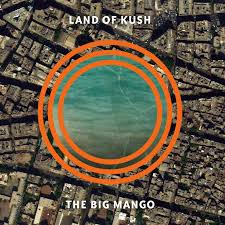
harpaugSOUNDTRACK: LAND OF KUSH-The Big Mango [CST097] (2013).

mangoOsama Shalibi is how Sam Shaibi is credited on this album.  He is the composer and creator of The Big Mango, although he does not appear on it.

Some background that may or may not be useful.  This comes from Popmatters:

“Big Mango” is the nickname for Cairo and The Big Mango is a love letter from composer Osama (Sam) Shalabi to his new home, Cairo, and all of its tumults and contradictions…. Reveling in free-jazz noise, rock rhythms, and the radical propulsion that Shalabi encountered on trips to Dakar, Senegal, the album weaves the divine spirit unleashed through fury and joy and dance into an utterly fascinating whole…  This pinging between controlled pandemonium and something beautiful, strident, transcendent, is not accidental. Shalabi is tackling the nature of change and the place of women in Arab culture on Big Mango, and by so clearly blurring the strange and the celebratory, he suggests that even sweeping, radical change need not be a revolution, but perhaps a way of life, movement as vital force in the universe.

With an introduction like that it’s hard not to want to love this record.  But a with everything Shalibi does, he is always trying to push boundaries and attitudes.  And so, this album has some songs that are really fun ad/or pretty and some songs that feel like (but apparently are not) wild improvisations that test the limit of your patience for experimentation.

As I mentioned, Shalibi doesn’t play on this –I would have loved to hear his oud, but instead we hear all kinds of interesting Western and Eastern instruments: setar (is a Persian version of the sitar), flutes, saxophones, piano, balafon (a wooden xylophone), hand drums: riqq (a type of tambourine), darbuka (goblet drum), and tablas (like bongos) and of course, guitars and bass.

“Faint Praise” opens the disc with 3 and a half minutes of Middle Eastern music quietly played with a rather free form vocal over the top.  The vocals are a series of wails and cries (and almost animalistic yips).  It sounds like an orchestra warming up, and indeed, the Constellation blurb says:

These opening six minutes are an inimitable destabilizing strategy of Shalabi’s – his lysergic take on an orchestra ‘warming up’ – that serves to introduce most of the instrumental voices and the montage of genres that will form the rest of the work

It comes abruptly to a halt with “Second Skin,”  a much more formal piano piece—structured notes that end after a few minutes only to be joined by a saxophone solo that turns noisy and skronking and nearly earsplitting.

After some dramatic keyboard sounds, “The Pit (Part 1)” becomes the first song with vocals (and the first song that is really catchy).  It begins with a jolly sax line which is accompanied by another sax and a flute before the whole band kicks in with a refreshingly catchy melody.  For all that Shalibi likes exploration, he has a real gift for melody as well.  The lovely lead vocals on this track are by Ariel Engle.  It’s very catchy, with a somewhat middle eastern setar riff and those voices.  When the song stops and it’s just voices, it’s really beautiful.  The song is 7 minutes long and I love the way the last 30 seconds shift gears entirely to a more dramatic, slower section.  This section is so great, I wish it lasted longer.

“The Pit (Part 2)” is only two minutes long.  It’s a quiet coda of piano and flute.  After about a minute, a low saxophone melody kicks in, it is slowly joined by other instruments and Engle’s voice.  Unfortunately I can’t really tell what she’s singing, but it sounds very nice.

“Sharm El Bango” is a jazzy song with hand drums and all kinds of space age samples spinning around the song.  I really like when the flute melody takes over and the song become quite trippy.

“Mobil Ni” is the second song with vocals.  It begins with some strings instruments and hand drums over a slow bass line.  Then Katie  Moore;s voice come s in with a gentle lovely vibrato.  Her voice is a little smoother than Engle’s.  The song ends with a mellow section.  And then there’s a trumpet blast that signals the beginning of “St. Stefano.”  The trumpet gives way to brief explorations off free-jazz type before turning giving way to a bowed section with resonating bass notes.

“Drift Beguine” returns to catchy territory with a full Middle Eastern musical phrase and Elizabeth Anka Vajagic’s lovely voice raging from high to scratchy and breathy.  Around 4 minutes when the pace picks up, it’s really quite fun.

The final track is the only one that really rocks.  “The Big Mango” has a big catchy guitar riff and hand drums filled in by Molly Sweeney’s rock vocals.  The song ends the disc as a kind of fun celebration.

As with most of Shalibi’s releases, it’s not for everyone.  But there’s a lot of great stuff hear, if you’re willing to experiment.

[READ: August 25, 2016] “Don the Realtor”

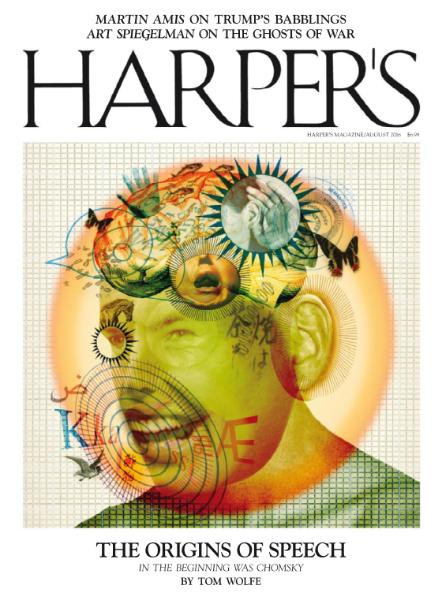
I hate to contribute anymore attention to Trump.  But it’s hard to pass up a chance to read Martin Amis, especially when he eviscerate his targets so eloquently.  Hopefully Trump’s voice will soon disappear from the airways and we can go back to forgetting about him.

Ostensibly this is a review of “two books by Donald Trump,” The Art of the Deal (1987) and Crippled America (2015).

Amis begins, as he usually does, by getting to the point: “Not many facets of the Trump apparition have so far gone unexamined, but I can think of a significant loose end.  I mean his sanity: What is the prognosis for his mental healthy given the challenges that lie ahead?”

Some basic questions come up about Trump: “Is his lying merely compulsive, or is he an outright mythomaniac, constitutionally unable to distinguish non-truth from truth.  Amis adds that “Politifact has ascertained that Donald’s mendacity rate is just over 90 percent, so the man who is forever saying he ‘tells it lie it is’ turns out to be nearly always telling it like it isn’t.”

But the Trump lying machine has grown from the rubble of the G.O.P. which “has more or less adopted the quasi slogan ‘there is no downside to lying.'” (more…)

Read Full Post »

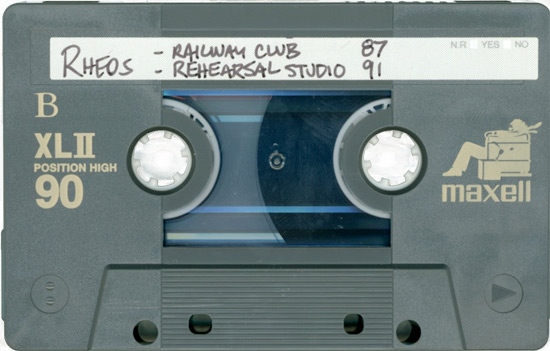
liofriends SOUNDTRACK: RHEOSTATICS-Railway Club, Vancouver, BC (November 1987).

RailwayClub87-PROD91It’s pretty impressive that this show (ostensibly from the same month as the previous show) has such a different setlist.  Between the two shows they play 22 songs and only four are repeated.  And this time five of the songs come from their debut album, Greatest Hits.

This tape begins with a recording of “Indian Arrow” by the 13 Engines.  It sounds very different from the other songs on the tape–the audience is very loud and you can hear a woman say “I wanna sing this one” (!).  I know this song from a Martin Tielli solo tour (and indeed, he sounds pretty much solo here–although there is a piano, too).

The rest of the tape all has the same audio quality but sounds different from the first song.  “Crescent Moon” begins mid-song (as if it was recorded over by “Indian Arrow”).   “Sad Sad World” is more upbeat than the title suggests with a “vocal solo” introduced with Dave and Tim chanting M-R-T-I-N in time with the music.  An upbeat “Ditch Pigs” leads to some silly banter during the guitar solo.  “Churches and Schools” sounds a lot like Talking Heads.  “Bridge Came Tumbling Down” is a Stompin’ Tom Connors song–they really had been playing him since forever.  Then they play a good version of “Higher and Higher” (from Greatest Hits).

It’s their last night in Vancouver, apparently which leads to a lengthy talk about he next song–a funky version of “Good on the Uptake” with lots of screaming at the end (from Tim).

The band plays the full version of “The Ballad of Wendell Clark” (with a some jokes about “Joel” whoever that is).  It’s rollicking and stomping and Martin starts playing “O Canada” as part of the solo.  Bidini stops the song and asks him to play it again, so Martin plays it on a good echoed effect (and Dave Clark shouts “alright Joel!”)  There’s some inappropriate jokes before Martin launches into a delicate version of The Beatles’ “Across the Universe-“-not the best version I’ve heard but still nice.

The final song is a romping stompin “PROD”–the only song The Rheostatics play in G#.  It has a fun shambolic end and it ends the set with them saying they’ll be back to play some Menudo tunes after a short break (which we never do hear).

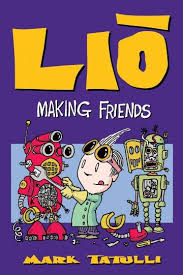
[READ: January 15, 2016] Making Friends

It’s unsettling to me that the Liō books come in different shapes.  This one is even hardcover!  The contents of these stories are not unsettling to me though, even if they are to some readers (looking online, you can find gripes).

Liō continues to be a strange kid who loves zombies and squids and spiders and playing pranks.  This is his latest book (and I just confirmed to see that he is still publishing daily, so a new book must be coming soon, right?).

Tatulli still has some great gags.  And this format book has some of the strips in color. (more…)

Read Full Post »

zabimeSOUNDTRACK: ST. PAUL AND THE BROKEN BONES-Tiny Desk Concert #410 (December 6, 2014).

stpaulPaul Janeway stands on Bob Boilen’s desk wearing gold shoes  and singing his heart out.  Janeway is the lead singer of St. Paul and the Broken Bones, a seven-piece soul band based out of Alabama.

Janway has a powerful voice and sings in a very old-school soul style.  The Broken Bones consist of two guitarist, a keyboardist, a trombone, a trumpet and drums.

They play three songs, “Half the City,” and “Call Me” (in which he does some great shuffle dances on the desktop and seems to almost fall off the desk) are full throttle dancing soul music.  The final song is kind of a sad song, a story about how the band got together called “Broken Bones and Pocket Change.”

There’s a funny moment when Bob asks if he’s hot way up there and he Janeway replies, “Is it hot?  Naw man, we’re from Alabama.”

The band was fairly new back in 2014, but I see that as of this week, they have a  new album coming out. So good for them.

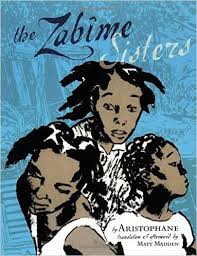
[READ: March 1, 2016] The Zabîme Sisters

When I read this book, back in March, I had been reading a lot of First Second graphic novels (I’m very close to having read them all!).  And reading this publishers entire catalog has led me to read amazingly detailed and interesting stories about real events.  And that’s pretty awesome.

This story is set in Guadeloupe, but unlike some of the other real-life stories of horror and degradation that I’ve read, this one is a simple story of childhood in a Caribbean island.

Not a lot happens, and yet the story is charming and enjoyable.

The story is told in 3 parts.  It is about three sisters, I’m not sure if they are triplets or just close on age.  I like how they have similar features but distinctive hair. (more…)

Read Full Post »

lioSOUNDTRACK: RHEOSTATICS-El Mocambo, Toronto ON (November 1987).

ElMo-Nov1987After re-listening to some of the Rheostatics most recent shows, I checked the Rheostatics Live site and found out that he has added some really old shows.  This show is the oldest show on the site, dating back to 1987.  A brief Rheos history shows that in the earlier incarnation, it was Dave Bidini, Tim Vesely and Dave Clark.  They were joined by the Trans Canada Soul Patrol and played mostly R&B and funk.  Around 1985 the Soul Patrol left and Martin Tielli joined.  Around the time of this show, they had released Greatest Hits.  And then they broke up (circa 1988).  Then they reformed in 1991 with an entirely different sound.

So this is from what I guess you’d call he Mach II era: no Soul Patrol but before the breakup.  Interestingly, only two songs from this how appeared on their debut album, although many appeared on earlier demos.

They play 11 songs, including what I assume is an improvised rap from Dave Clark (the really silly one of the band).  And the songs are dominated by a smooth guitar sound and often times a funky bass.  Perhaps the most amazing thing about this set is the prominence of Tim.  He sings many of the songs and Dave includes him in many jokes.  Martin is almost non-existent.

“National Pride” dates back to 1983 and starts as a kind of goofy rap song but then turns into the funky version from the demo.  Martin Tielli also released a solo song called “National Pride” which is nothing like this.  They follow this with the “Greensprouts Theme Song” (which they played at the AGO almost 30 years after this show).  Dave Clark calls it the “silliest song ever written,” although in the years hence they have made a few challenges to that claim.

“Good on the Uptake” is a song I’ve heard in a few places before.  Tim sings lead and there’s a kind of funky bass line with lots of guitar harmonics.  I think Martin is singing backup (and probably playing the harmonics).

Tim breaks a string and Dave Clark shouts, “This song is called Rheostatics learn how to string their guitar.”  With a broken string they play an impromptu version of “Red Dog Ray” taught to them by Reverend Ken and the Lost Followers “about the beer strike in 1983.  We were all pissed off because we had to drink Old Milwaukee and Rolling Rock and all that shit.”  This song has come up in their sets in the early 2000s.

It segues right into “Ditch Pigs” from Greatest Hits and sung by Martin.  The middle section devolves into a chant of “I want an egg salad sandwich and a glass of Coke.”

For “Four Upright Walls” Bidini introduces David Clark as the Poet Laureate of Etobicoke.  This is a rap of sorts in which the band does response to Dave’s rap (with all kinds of crazy sound effects and even some beatboxing (!)).

“Crystal Soup” is very much a Tim song–it sounds a lot like a song he would write now–there’s a surprise guitar riff in the middle of the verses that sounds a bit like Rush.  At the end of the song Dave introduces “Mr. Nigel Tufnel,” although I’m not sure to whom he is referring.  “Sue’s Mining Song” (also sung by Tim) has a kind Rush feel although the lyrics are very un-Rush (“woman,” “girl” and a line about “buzzards on your Steely Dan”).  It also features Tim screaming a high note!  It’s a pretty heavy song (especially at the end).

It’s funny that they follow-up with “a nice song,” Martin’s sung “Crescent Moon” a very, very new wavey song that Bidini wrote, and which leads of Greatest Hits.  They follow with a fun and fast rocking “People’s Republic of Dave” in which Dave encourages Tim to make silly faces.  And Tim growls that he wishes his name was Dave.  This seems like a great show ender, but they’ve got one more song.

“Chemical World,” has a kind of discoey guitar opening and lots of slap bass.

[READ: January 5, 2016] Zombies Need Love Too

I prefer to read series like this in order, but sometimes you can only get the books that you can get (and you don’t get upset).  For reasons I don’t understand, my library only had the first two books (which were also collected in Liō’s Astonishing Tales which they also have) and the two most recent books.  There’s maybe two books in between, as far as I can tell.

The good thing is that there’s not a lot of forward narrative in these stories–except perhaps for the new pets that Liō acquires.

So after four years what is Tatulli writing about?  Well, largely the same stuff, which is fine with me. (more…)

Read Full Post »

solomonSOUNDTRACK: RYAN KEBERLE & CATHARSIS-Tiny Desk Concert #393 (October 4, 2014).

keberleWhen Trombone Shorty played the Tiny Desk I said that I was surprised to see that the leader of the band was a trombone player.  Well, perhaps it’s not that unusual as Ryan Keberle is a trombonist as well.  But unlike many recent jazz performers, Keberle & Catharsis aren’t showing off. As the blurb puts it, “he’s not after any high-concept framing. He’s just targeting the sweet spot where a nifty arrangement meets a solid groove.”

This band plays pretty traditional jazz (complete with upright bass solos and everything). Although, interestingly, their first song is a cover of  Sufjan Stevens song (turns out that Keberle toured with Stevens).  “Sister” is my favorite of their three songs.  I really enjoyed when the full band kicked in after the intro riff from Keberle.  The band has a vocalist, Camila Meza, who mainly does wordless vocal sounds.  As the song nears its end she does sing lead vocals, and it’s quite pleasant.

Her vocals work pretty well for this song, but I didn’t like it is much later.  That could be because “Sister” is a catchy pop song, where the other songs are jazzy.  And I find her singing style to be a little lite-Fm for my tastes.

“Gallop” is a bit faster than the first song.  It moves along at a nice clip and then stops for a bass and drum solo–very very jazzy.  There’s a trumpet solo in the middle of song too (no trombone solos which is interesting, I guess).  The other guys in the band are Michael Rodriguez on trumpet, Jorge Roeder on bass and Eric Doob on drums.

“Zone” opens with two contradicting three note riffs on both trombone and trumpet which is pretty cool.  Then the song settles down to just bass drums and voice and Keberle playing the melodica (beloved instrument of Tiny Desk Concerts) which works but sounds odd in the mix.  It seems like the song is going to end as the music fades to just bass, but it soon picks up again with anew trumpet solo.

I don’t love mellow jazz like this, but these players are excellent.

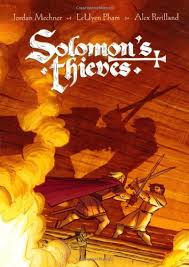
[READ: April 13, 2016] Solomon’s Thieves

I had this book on hold for quite some time.  When it finally came in, I thought, hey this art looks familiar.  And then hey, this book is about the Templar knights, what a strange thing that First Second would have two book about the Templar Knights.   And then as I flipped through it I realized the author and artists were the same.  And for a split second I though, they wrote two books about the Templar Knights?

And then it came to me that the first part of Templar was called “Solomon’s Thieves.”  And that this is indeed the First Part published long before Templar actually came out in full.

So even thought I had read the whole of Templar not too long ago, I decided to read this as well   As far as I can tell it is exactly the same as the first part of Templar.  Although it’s possible that there are some minor changes, I wasn’t sure if things that I didn’t remember were just because I can’t remember everything, you know?

Perhaps because I had read the full book not too long ago, I really enjoyed this run though again.  Since everything looked familiar, it was fun to pick up on things I missed the first time, and to see how things made a little more sense once I could tell who everyone was and what their roles were (there is something to be said for re-reading).

I’m including what I wrote about the first part of Templar here because it’s the same, but if you want more about the whole book or background about the Templar Knights check out the full post.

As the story opens we see Martin, a Knight, looking longingly at a woman, Isabelle.  We learn that he had been “dating” her (or whatever they called it back then) and then one day he found out that she left to be married to the brother of King Philip.  So he joined the Knights.  As they march through the city, we see that they are drunkards and carousers.  They get in all manner of trouble.  And one evening they were heading back to Paris when suddenly the above dictum was established–all Knights were to be arrested.  And Martin is one of them.

But through some excellent machinations (and good fighting) he escapes.  And he soon joins together with a very unlikely band of merry men, including Brother Dominic (a real priest with the tonsure and everything) and Brother Bernard, a loutish drunken man who is not above thieving from people.  Martin is offended at the thought of working with him, and they wind up at odds with each other from the start.  Before the end of the first book, we see that they have a letter revealing where all of the Templar gold and jewels are hidden.

There’s a great bit of accounting work done in which the bookkeeper shows on his ledger that rooms were empty when in fact it appears that the gold was taken out on hay carts.  The bookkeeper, even under torture, swears he knows nothing of the fortune’s whereabouts.

Mechner tells a really exciting story with humor and sadness.  The fact that it’s linked to history is just a bonus.  Another winner for First Second and their #1oyearsof01 anniversary.

Read Full Post »

« Newer Posts - Older Posts »