Feeds:
Posts
Comments

Archive for the ‘Work’ Category

CV1_TNY_10_14_13McCall.inddSOUNDTRACK: TOM JONES-Tiny Desk Concert #13 (March 2, 2009).

tomjI never gave a thought about Tom Jones until I worked a warehouse job in Cambridge, MA. My boss used to play Tom Jones all the time and all of us young’uns (I was 22) would get into it.  And soon I was singing Tom Jones songs to myself.  I have his Greatest Hits and it certainly scratches an unexpected itch.

It’s also funny to think of Tom Jones at at Tiny Desk Concert since his voice is so big.  And also because I think of shows as being spectacles.  But here he is, with just a guy on guitar and no microphone to hold on to or anything else.  He stands there sweating and just belting out these songs.

His voice sounds incredible—he can hold those notes like nobody else I know. Although I have to wonder if he has a bit of a cold (he still sounds amazing, but he’s coughing a bit).  The first and third songs, “If He Should Ever Leave You,” and “We Got Love” are from his then new album 24 Hours, so I didn’t know them.  But with the simple electric guitar accompaniment the songs sound clean and energetic (I imagine that with a  full band they’re much bigger, and there must be a horn section, right?).

“Green Green Grass of Home” is wonderful older song that I know from his Greatest Hits.  It sounds wonderful here–it’s all about his voice.  And the final song is a Jerry Lee Lewis song called “The End of the Road.”  I didn’t imagine him fitting this style but he jumps in perfectly and totally manhandles the song.  It’s great.

It never occurred to me to want to see him live (women throwing their underpants and all) but I’ll bet he puts on a great show.  It’s also amazing to see how crowded the offices are for him (they even turned down the lights for extra ambiance).

[READ: January 7, 2014] “Piano Man”

This New Yorker has several small essays about work.  They are primarily from people who I wasn’t familiar with–only Amy Poehler saved the five from being unread.  When after reading all of them I enjoyed them enough to include them all here.

The pieces are labelled under “Work for Hire” and each talks about a humiliating job.

Jeremy Denk is a well-regarded pianist (he won a McArthur Genius Grant).  He talks about his initial success very casually.  He says he had about $4,500 of debt when he won a piano contest in London.  I admit I didn’t know who he was when I read this and I wondered how it was that some guy randomly won a piano contest–are there many piano contests in London?  That cleared away his debt (and apparently must have covered the cost to fly to London, since he is from the Midwest). (more…)

Read Full Post »

harper juneSOUNDTRACK: PHISH-A Picture of Nectar (1992).

nectarA Picture of Nectar plays with expectations of Phish somewhat (as many as could be formed after two albums).  This album has sixteen songs, with half of them at 3 minutes or less.  These include the pretty jazz instrumental “Eliza,”  “Poor Heart” which is a slide guitar filled short country-ish romp, “Manteca” thirty seconds of nonsense.  “Magila” is a jazz instrumental which has solos by both piano and guitar.  “The Landlady” is another instrumental, but one that is a rocking guitar workout. “Faht” is a pretty, simple guitar piece with birds playing in the background

After somewhat anemic recordings, A Picture of Nectar feels a lot more full.  “Llama” bursts out of the gate sounding very complete with all of the instruments at the same power and breadth.  “Cavern” has a pretty ridiculous drum sound—very big and echoey and the pace is a little slower than is typical live, but it sounds very good. “Stash” clocks in at 7 minutes and it sounds very similar to the albums (although there are a still a bunch of silly voices like the one who says “Please don’t do that.”  “Guelah Papyrus” (no idea what that name is about) sounds fine here—very much like the live versions, full and fun.

“Glide” features the “glad glad glad” chorus in multipart harmony that makes this song seem like a barbershop number and sounds wonderful.  The longest song on the album is perennial favorite “Tweezer.”  The song is very much like the live versions except that the middle section has a crazy noisy breakdown which is a little disconcerting.  The solo then moves into a typical jam for Phish which really shows what they would do with this song live.  “The Mango Song” is a fun piano based jaunty number that highlights the band’s harmonies.  It sounds really good too.  “Chalk Dust Torture” sounds different because the voice is very different.  It sounds like Trey through a processor of some sort, or possibly somebody else singing.

The album ends with “Tweezer Reprise” because the song is so good it needs a proper ending.  This is another successful album from Phish.

[READ: September 20, 2013] “East Texas Lumber”

I wasn’t sure I would like this story about an unsuccessful guy in East Texas.  But I really did.

The narrator is Brian, a guy who has not been very successful since he got out of school.  He’s trying to save up to be a locksmith, but in the meantime he’s working at East Texas lumber.  And he’s thankful to divine providence for sending a tornado which helped him get the job.

A tornado ripped through their town and because of all of the rebuilding, the lumber store needed extra help, and that’s where Brian came in.  Even though on his first day he crushed some drywall and put a nail in his foot, they kept him on.  He was paired with Jimmy, a goof who had been working there for a long time.  Jimmy liked to smoke pot and go to parties, but he was the only one willing to partner up with potential liability Brian.

On this day their boss has given them a cushy job.  Deliver two loads of shingles to two different locations.  This was easy work—a lot of driving and no lumber to stack.  And it should get them back around 4, which is just enough time to goof off for the last hour, and get to The Hangout by 5 PM. (more…)

Read Full Post »

2013-10SOUNDTRACK: VOIVOD-“In League with Satan” (1998).

venomI wasn’t aware of this tribute to Venom, the much reviled/much beloved black metal band.  It is titled In the name of Satan. Voivod has done some covers of Venom songs throughout their career, so it seems natural that they would do one for an official tribute album.

The music is fine.  As anyone who knows Venom knows their music isn’t terribly complicated.  So it’s nothing for Voivod to do.  I’m actually wondering if Piggy wanted to spruce it up a bit.  But no, he plays it straight, as does everyone else.

But man are the vocals awful. They are a kind of high-pitched growl–very strangely affected and sounding really weird both for Venom and for Voivod.  I’m not sure who is singing on this track (I assume E-Force given the date).  It doesn’t really sound like either E-Force or Snake, but I’m siding with E-Force because there’s none of the odd pronunciations that Snake is prone to do.

I didn’t listen to anything else on the album, but even for a Voivod diehard, this one is not worth owning.

[READ: September 19, 2013] “The Challenges and Rewards of Re-entering the Workforce”

Lisa Moore doesn’t deserve to be associated with Satan or a less than stellar cover song.  So apologies to her for pairing this together, but it worked nicely in my Voivod timeline.

I was really intrigued by the title of this short story and I wasn’t really sure what to expect.  What I got was a very interesting and very interestingly structured story.  The first thing of note is the pronoun choice:  “Everybody had a target on his back.  His or her back.”  This specification continues throughout the story.  But before we learn why exactly, we learn about the devastation at this job (which is never specified).  People are let go in waves, then in clumps, and just when it seems safe, one at a time.  Some people are moved around to fill those empty spots.  In other words, resentment is breeding wildly.  Rumors spread—they wouldn’t fire people if you stand up for yourselves—but no one wanted to stand up.  And just when we think Moore can’t give any more examples of the anonymous firing, we get into specifics.

The Downeys (who both worked there) were fired on the same day.  The had just purchased a new house as well.  Of course, that was before the summer when the dump started to stink.  So we can anticipate how much they will get when they try to sell. (more…)

Read Full Post »

I had intended to post my final recap of William Gaddis’ JR today.  But my family had been on vacation and I was feeling lazy.  Then September 3 proved to be Labor Day, a perfect day to write thoughts about JR.  The irony was not lost on me.  But then I figured I’d fudge a bit, leave my Monday post until Tuesday and back date it (a good technique for checks too!).

Well, it turned out that my position was terminated at my job.  Which means I got laid off.  Right after Labor Day, and right when I was about to post some thoughts on JR.

That’s a pretty big helping of irony right there.

So here it is two days later, Sept 5 and I’m backdating this post (because I’m anal retentive and like to have a post per day).  I’m happy that I had written a bunch of posts for this week already as I don’t have much gumption for writing about books right now (even though I read several good ones over the vacation).

So enjoy my ironic life and I’ll say a few words about JR next Monday, if I still think it’s funny.

Perhaps I’ll apply for a new job as Mister Ten-forty.

Read Full Post »

SOUNDTRACK: THE GREAT GAMBLE-Book One (2012).

My friend Matt has worked at a school in Pennsylvania for years. He wrote to tell me that a few kids who graduated from his school had formed a band and have released a CD.  It’s streaming (and downloadable) on bandcamp at their site.

I have lots of friends in bands, and I’ve listened to lots of demos, so I wasn’t expecting very much.  But the first thing I noticed when I listened was how good this sounds–professional and, yes, like a “real” album.  This isn’t just a bunch of guys jamming in their garage.  What makes this even more striking is that the music is heavy progressive metal–not something you just whip out in a quick take.  This is complicated, interesting music.  I’m hearing a kind of Dream Theater meets King’s X vibe going on.  And man, it’s really good.

This is multi-step heavy rock (complete with a synth player/violinist!). The only song that is less than 9 minutes is the 90 second introduction called “The Marketplace.”  Otherwise, we’ve got three songs over ten minutes and one over 16!  Who even knew young bands did stuff like this anymore?

Al Joseph plays lead guitar and sings lead vocals.  His guitar speed is very impressive and his vocals sound not unlike Dug Pinnick from King’s X (noticeable on the opening track, especially) .  Matt Weaver plays violin and keyboards.  The keyboards offer more than just a fuller sound.  On “Release the Kraken” they provide some cool sci-fi sound effects.  At about five minutes in, “Release the Kraken” slows down to a quiet middle section that really showcases Steve Michael’s drums.  And then comes the blistering guitar solo.  It’s followed quickly but a slight diversion and then a wholly different style of solo.  It’s really something.

If “Release the Kraken” wasn’t a good enough prog rock title, how bout “Legends of the Symmetria.”  This one has a very Dream Theater feel for the opening.  But the vocals sound very different–dual vocals with great low harmony.  There’s a cool pre-chorus (I guess) at about 3 minutes.  This song is definitely a heavy one.  At about 4 minutes, the song slows down into a pretty classical guitar section,where Chris Joseph on plays bass gets to show off a bit (although he seems to be the most understated of the 4 players).  There’s some great drumming at the end of the song, too.

“The Ghost of Three Reflections” is a slow builder of a song.  There’s some quiet parts (with beautiful harmonies) and a guitar solo that sounds clear and perfect (I’m hyping the production so much because it sounds so good).  The guitar solo section in this one strikes me as something that might suit two guitarists better–maybe two more different styles of soloing, but he pulls it off well, especially when by the end, he has shifted to a very different style, and the music changes along with it).  I love the bass section at the 8 minute mark, which reminds me of something Rush might have done back in the mid 70s.  The song kind of merges into “Breach At Fort Mycenae” which opens with the same kind of staggered sound as the end of the previous song.  The violin gets an airing in the middle of this song and it’s a cool treat.  I could definitely use more violin in these songs, although maybe little bits are a treat.  There’s a few times when I don’t like the production choices–maybe there needs to be a bit more music behind some of these solos so it doesn’t just sound like two players soloing against each other.

The disc ends with the big one, the sixteen minute, “The Sleepwalker Pt. 1 – Tears of Dagon” [I love that it’s a Part One and it’s 16 minutes long].  When the vocals kick in at about 3 minutes, the harmonies are gorgeous.  I love the bass guitar break at 5 minutes.  Although there’s something about the keyboard sound that I don’t like–maybe they’re not big enough?  But I love the crazy guitar solo at the 9 minute mark of this track (I’m a sucker for dissonant scales).

This is an amazing debut CD and I hope these guys go far (they’re going from Scranton to Boston for school, but I hope they can go further than that).  They are tight as a drum, stopping and starting perfectly, keeping all of the rhythms and time changes perfectly.  They really have done their prog rock homework.  The only gripe is as I’ve said, some sections don’t feel “big” enough.  If you’re going to write a 16 minute song, you don’t want sections that sound small–you want your backing guitars or bass guitars to be a little louder so it sounds like the song is still going.  But other than that, there’s not much room for improvement.

I downloaded their CD, (and yes, I paid for it…that will help with college, eh?).  But my real complaint is that on the computer, the album cover is awesome–if you look at it from an angle, there’s a whole scene behind the large logo (try it, it works here too).  But when you print it out, you lose all of that.  The images are there, but the effect is gone.  This is a band that calls out for full color packaging and maybe even a gatefold sleeve!  (The bottom of the cover says Ο υπνoβάτης which means The Sleepwalker).

Good jobs guys!  You’ve done NEPA proud!

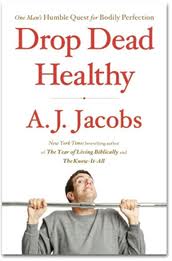
[READ: May 15, 2012] Drop Dead Healthy

Sarah got me this latest A.J. Jacobs book for my birthday.  At first I didn’t think I wanted to read it because I feared what a book all about being in good shape would be—nagging, obnoxious, making me feel bad about my vices. But I should have leaned from all of my A.J. Jacobs experience that he is completely NOT about that.

Jacobs occasionally enters into preposterous forays of Self-Improvement.  In the first book of his I read, The  Guinea Pig Diaries, he tried various weird experiments to see what it was like to be a woman, radically honest, a unitasker, etc.  His other books have been about self-improvement.  He read the encyclopedia from A-Z, he did a year trying to live like out of the bible (I will get to these eventually).  In this book, he is on a quest to be the healthiest person in the world.

It’s an impossible task.  And, frankly, a foolish one.  But he decides he will take two years and focus on individual parts of his body one month at a time.  I’m going say right up front I feared that this book would make me feel bad about all the things I don’t do for myself.   But well, a) Jacobs is a funny writer, so at least you’re laughing.  b) Jacobs is either in bad shape or plays up his badshapedness so that the average person doesn’t feel too bad off.  c) He is so over the top in his quest that no one would ever think about doing all of the things, but we can take what he learned and apply little bits to ourselves.  What is nice is that he tries to get two if not balanced opinions then perhaps fringe opinions to balance out–trying one extreme then another to see which work.

He Breaks His Categories Down thusly: stomach (eating right, the perfect food), the heart, the ears (the quest for quiet), the butt (avoiding sitting too much), the immune system (germs), genitals, nervous system, lower intestine (better bowels), adrenal gland (lowering stress), brain, endocrine system (removing toxins), teeth, feet, lungs, skin, inside of the eyelid (sleep), bladder, gonads, nose, hands, back, eyes, and skull.  Each category is designed to be a month-long workout of that organ/item–some things he keeps doing after the month is over making his workout regime something like 5 hours a day.  And at the beginning of each month he lists the stats for what he accomplished.

I’m not going to talk about all of his body parts, but I will mention a few that i enjoyed the most. (more…)

Read Full Post »

 SOUNDTRACK: FIONA APPLE—Live at SXSW (sampler), April 11, 2012 (2012).

Fiona Apple hasn’t been in the public eye much lately.  Her new album comes out any day.  And she gave a preview of her tour at SXSW this Spring.  NPR has access to four songs from that show (streaming).  I wish there was video—she’s an intriguing performer—but if audio is all what we get, so be it.

“Fast As You Can” starts this sampler, and she sounds great.  It’s not a challenging song vocally, but she sounds strong and like she hasn’t been away for very long.  Musically, the song isn’t as dense as on the record—I’m sure that’s the nature of her touring band.  “A Mistake” has a strangely long “jam” session, which strikes me as odd for her.  I wonder what she did during that time (or is she playing piano?).  “Extraordinary Machine” sounds good, but again, it seems so spare (the album was so full of music).  She hits the high notes quite well, though.  The final song of is “Every Single Night,” the new song from her new album.  It sounds great live.  And it was a good introduction to the song.

It’s hard to critique the music live because who knows what could have happened that did not transfer well.  But he voice sounds excellent.

I’m looking forward to her new album, with the preposterously long title.

[READ: May 17, 2012] “Atlas”

This story opened up in a very confusing way.  It begins with a day listed in all caps (The Day the Fat Man Almost Fell) and then proceeds to talk about Danny (who is not the fat man).  It is set in the fairly insular world of a hospital and those first few paragraphs have lots of jargon.  So much so that when I finally figured out that Danny was an employee not a patient, I had to reread it to get my bearings.

The first section ends with the Day mentioned above as the story then switches to flashback and context.

Danny has been at the hospital for three years.  He had a lot of medical problems, so his doctor inquired about his getting in on the ALP—Assisted Living Program.  The doctor explains it’s not disability or Goodwill, it a holistic treatment model.  There was a long list of applicants but since the doctor knew Danny, he could offer him this opportunity.  Danny would work for the hospital, live in subsidized housing provided by the hospital and get all kinds of in-house benefits (discounts on meds and the cafeteria.  He could even join study teams).  Eventually they even hoped to have tunnels that connected the housing to the hospital.  (I wonder what the hospital would get in return?  Underpaid workers?  It never says if he makes very much).

We jump back to the earlier scene and how Danny helps with the Fat Man (he helped to support him before he fell off the operating table).  The scene is darkly comic (“are we going to operate on his ass?”).   And it results in Danny earning some respect (one of the nurses winks at him and calls him “Atlas”). (more…)

Read Full Post »

SOUNDTRACK: RED BUDDHA-Raindance (2007).

My Aunt Marg gave me this disc for Christmas a few years ago.  She said that she knew it from a spa that she went to.  And I can totally tell. I don’t know anything else about the artist, and it’s even hard to find stuff about him online.

The disc has an Indian (Eastern) vibe (which surprises me given the name of the artist and the African-looking person on the cover).  It also has a real world music feel.

Sarod

Overall, I like the music quite a lot.  It’s certainly new agey, but not treacly new age or anything.  It showcases some cool world music without resorting to clichés.  However, I admit to not caring much for the spoken lyrics of the opening track,  “Sometimes.”  His voice is deep and distracting, especially over such mellow music.  Despite the very Indian feel of “Sometimes,” the rest of the disc explores other sounds as well.  “Kokou” has a 70s kind of organ and bongos (with more appropriately world musicy chanted vocals).  “Raindance” has a cool flute over some bongo beats (all very soothing…with crickets).

Veena

I really like “Girl from Orissa” with its cool Eastern instrumentation.  There’s a sarod, a veena and a sitar on the disc.  (Orissa is located on the eastern side of India).  “Khali Gandaki” also features this cool instrumentation. (The Khali Gandaki valley is in Nepal).

“Mswati” opens with some percussion. But this track differs because of the interesting riff that plays throughout the song (whether guitar or keyboard, I can’t tell).  “Touba” has a nice bassline, which really stands out on a disc with minimal bass. It also has some neat wah-wahed guitars.  And “Preaching of Buddha” has a kind of Dead Can Dance feel to the vocals (they’re my go-to band for world music).

Sitar

“Katarajama” (a pilgrimage site for Sri Lankans and South Indians) has a great riff to it, and it’s even better when the other instruments play along.  “Patan Part 1” also has a cool sitar riff.  Although if Part 1 is 8 minutes, how long is  the whole song?

The final song, “Sufi Kalaam” has a somewhat more sinister or perhaps just movie soundtracky sound (low bass chords underpin the beginning of the track).  There are chanted vocals and lead vocals in another language.  I rather like the song, but it doesn’t really fit on the disc.

The whole disc is definitely a background/new agey kind of deal.  I can hear it all (except the first and last songs) working well for a relaxing evening of massage.  Just don’t listen to it while driving!

[READ: February, 17 2012] “Lorry Raja”

“Lorry Raja” won Narrative magazine’s “30 Below” contest for 2011.  After the wonderful stories that came in second and third place I expected something pretty amazing to win.  And I was maybe a little disappointed by this story because of it.  And I think I have to blame a cultural disconnect for that.

This story is set in Karnataka, India, a poor state in the south of the country.  People there are so poor that they live in tents and work in the mines–smashing up rocks to get at the iron ore inside.  The children can’t afford to go to school, there’s no electricity and everyone is covered in a red dust from all of the dirt in the mines.

Madhuri Vijay is able to create a compelling story out of this harsh environment.   The story concerns one family as they struggle to survive under these conditions.  The father (I had a really hard time keeping the names straight, so I’m not going to include them here) had an accident and cannot work to his full capacity, so he is stuck working less lucrative jobs. The mother works smashing up iron ore.  The middle son, 12, works and plays around the mine (collecting a few rupees each day).  They put some money aside for his eventual education.  The older brother has just gotten a job as a lorry driver for the mines–he takes the ore out to the port cities.  He is only 14, and, being 14, he takes especial care of his lorry–cleaning it from all the red dust and driving it in a very proud manner.  So much so, that everyone starts calling him Lorry Raja.  There’s also a baby brother who doesn’t play much of a part except (in the way I read it) to show off how hopeless things are (the boy is playing in the dirt and when it is time to feed him, his mother just takes her breast out in front of everyone).

The story is narrated by the middle son.  And we watch as he grows jealous of his brother–the Lorry Raja.  We see the narrator break up rocks, spy on his mother, spy on his father (who is lowered by a rope in to a deep mine (!)).  And we see him talk to the owner of the mine (who has a car, a generator and drinks Pepsi).  And finally we see him spend some time with his brother’s ex-girlfriend (they broke up more or less once he started driving his lorry).

When the girl casually remarks that the narrator should get his lorry license and then he could drive her to China, that sets a new part of his life in motion.  (They are thinking about China because the “Lympic Games” (“Whatever they are” he says) are being played there this year). (more…)

Read Full Post »

SOUNDTRACK: DINOSAUR JR.-Live at the 9:30 Club, Washington D.C. October 8, 2009 (2009).

This was one of the first shows I downloaded from NPR.  I’ve been a fan of Dinosaur Jr. since my friend Al turned me on to Green Mind back in college.

This is an amazing show created by the original Dino Jr. members.  This tour is in support of their second album since reuniting, Farm. This set-list is an outstanding mix of old songs, new songs, Barlow-sung songs and even some songs from when Barlow and Murph weren’t in the band.  (Green Mind is still my favorite album by them).

When the band reunited there was much joy, and I’ve said in reviews of the newer albums, I’m not entirely sure why.  I mean, Dino Jr has always been about Mascis, and it’s not like Barlow is such an unusual bassist (although Murph’s drumming is always solid).  I’ve nothing against Barlow (I love Sebadoh and Folk Implosion) or Murph, it just seems odd to get excited about having them back in the band aside from nostalgic reasons.

Having said that, the band sounds amazing (and yes, Barlow does get to sing on “Imagination Blind”).  What never really came across to me until hearing all of these great songs live was that Mascis has always been a great pop song writer.  These songs are catchy as hell. But Mascis buries them under loud squalling guitars and a voice that is almost whiny, almost off-key, a total slacker voice.  (But you’ll notice it is never actually off-key.  He must work very hard at that.)

By the nd of the show Mascis chastises the audience for not moving (we obviously can’t see what they’re doing), saying he forgets that people don’t move in Washington, D.C.  But during the encore break, NPR host, Bob Boilen, points out that Mascis himself doesn’t move either–he just stands in front of that wall of Marshall stacks (Boilen wonders how he can hear anything anymore).  And looking at the pictures it’s comical the way he looks, surrounded by amps.  The picture above doesn’t fully do it justice, but check out the extra photos at the NPR page.  And while you’re there, listen to this show. It is amazing.  For a total slacker, Mascis can rock a guitar solo like nobody’s business.

[READ: July 20, 2011] The Best American Non Required Reading

I’d been meaning to read this series for years (yup, Eggers fan), But I have a hard time starting “collections” because I feel like I’d rather be reading a novel.  Nevertheless, I have most of these Nonrequired books, so it seemed like I should dive into one and see what it was like (I don’t think the year really matters all that much–some of the articles are topical but most are not exactly).  Then Sarah said this would be a great book to read on vacation because it’s all short essays, and she was right.  It was perfect for late nights when I wanted something to read but didn’t feel like getting involved in the novel I was reading.

DAVE EGGERS-Introduction
Eggers’ introduction is actually a partial short story about kids who go swimming in pools around town. It reminded me of the opening of Life After God by Douglas Coupland, but of course, lots of kids did that so I’m not saying it was “lifted” from DC.  The story “ends” (it doesn’t really end so much as stop) with an interesting scene between two unlikely kids who get caught.

After this story Eggers includes these three notes about the collection: It’s not scientific, It’s alphabetical, and We had a lot of help with this.  Of the three, it’s the middle one that’s most useful because Eggers says that you shouldn’t necessarily read them in order just because they are printed this way: “In the first half of this collection, you get a good deal of hard journalism, primarily about war and refugees, from Afghanistan to the Sudan, followed immediately by a number of less serious pieces, about malls and Marilyn Manson.  We didn’t group anything by theme , and won’t be offended if you skip around.”  This was good to know (not that we needed the permission of course), but yes, the beginning of the book is pretty heavy. (more…)

Read Full Post »

SOUNDTRACK: RA RA RIOT-Live at the Black Cat, Washington DC,  October 12, 2008 (2008).

I really like Ra Ra Riot’s album The Rhumb Line, and this concert is basically a showcase for that album.  There’ s an interview at the end of the show (all downloadable from NPR), in which the  band says that critics raved about their live show as much as their album.

I don’t really hear that the show is more energetic than the album (maybe visually they are wild), but it did sound fantastic.  It’s amazing to hear a rock band that is dominated by strings–the cello and violin are often louder than the guitar (but not in a competing/drown you out kind of way,  more of a strings do the melodies and the guitar adds bulk to the sound).

I always enjoy hearing a band that is grateful to their audience for showing up (this is most evident in young bands, who seem so much more genuine about their love of the audience) and Ra Ra Riot are certainly that .  They seem genuinely surprised at the turn out, and they play a great set accordingly.

There are two songs that aren’t on the album here “A Manner to Act” and the encore “Everest.”  They both feel like they came off the album, which bodes well for their second album, Orchard, which just came out in May.  Ra Ra Riot also do a great cover of the obscure Kate Bush song “Suspended in Gaffa.”  At the end of the show they tack on a cover of “Hounds of Love.”  Lead singer Wesley Miles has a wonderfully strong voice and he can reach some pretty high notes–not soprano or anything like that, just strong enough to be able to pull off a Kate Bush cover.

This is a great show.  And when you read about the tragedy they suffered just as they were starting to take off, their obsession with death may not be so surprising.  I’m looking forward to Orchard.

[READ: 1995 and August 18, 2011] Microserfs

After reading Life After God and thinking about Microserfs, I looked up Coupland’s bibliography and saw that indeed Microserfs came next.  And I was really excited to read it.  I have recently watched the JPod TV show and I knew that JPod was a kind of follow-up to Microserfs, so I wanted to see how much of it rang true.  And I’ve got to say that I really rather enjoyed this book.

While I was reading this, I started taking notes about what was happening in the book.  Not the plot, which is fairly straightforward, but about the zeitgeisty elements in the book.  And, since I’m a big fan of David Foster Wallace, I was also noting how many zeitgeisty things this book had in common with Infinite Jest.  I’m thinking of tying it all together in a separate post, maybe next week.  But I’ll mention a few things here.

My son also loved the cover of this book because it has a Lego dude on it and he has been really getting into Lego lately.

So Microserfs is the story of a bunch of underpaid, overworked coders who work for Microsoft.  The book is written as the journal of Daniel Underwood (Coupland still hadn’t really branched out of the first person narrative style, but the journal does allow for some interesting insights).  The story begins in Fall 1993.  I felt compelled to look up some ancient history to see what was happening in the computer world circa 1993 just for context.  In 1991, Apple released System 7.   In 1993, Windows introduced Windows NT, Intel released the first Pentium chip, Myst was released and Wired magazine launched.  In 1994, Al Gore coined the term Information Superhighway.  Yahoo is created.  The Netscape browser is introduced.  So we’re still in computer infancy here.  It’s pretty far-seeing of DC to write about this.

Daniel works at Microsoft with several friends.  Daniel is a bug tester, Michael (who has an office, not a cube) is a coder, Todd (a bodybuilder) is a bug tester.  There’s also Susan (smart and independent), Abe (secret millionaire) and Bug Barbecue (an old man–he’s like 35).  The five of them live in a house on “campus.”  There’s also Karla (a type A bossyboots who doesn’t like seeing time wasted) who works with them but lives up the street.

As the story opens, Michael has just received a flame email from Bill Gates himself and has locked himself in his office.  This leads to a very funny scene and ongoing joke in which the office mates feed slide two-dimensional food under his door and he vows to eat only things that are flat. (more…)

Read Full Post »

SOUNDTRACK: WAVVES-Live at Sasquatch, May 28, 2011 (2011).

I learned about Wavves from NPR–in fact I listened to their other NPR concert before even getting their album.  So this marks my second concert from them.  What makes me laugh about Wavves is that the songs are really short and Nathan Williams is a total chatterbox. When I burn these concerts onto CD, I use Audacity and I make tracks for songs and band chatter.  Which means that this Wavves show, which is just under 40 minutes has 20 tracks.  (Whereas S. Carey, at about the same length, has only 11).

This show has 14 songs.  Four of the songs are from their second album, called Wavves (which is also their second album called Wavves).  The rest come from King of the Beach (except “Wavves” from their first album and a couple of newer tracks).

The band blasts through these songs (I’m not even sure who is in the band, since the Wavves albums are a solo endeavor), and they all sound very good.  The album has kind of a tinny sound (on purpose, I suspect), whereas live the songs sound a bit fuller.

Lead Wavves guy Nathan Williams wasn’t that friendly in the previous show; he seems to be having a bit more fun here.  But really it doesn’t seem like you don’t go to a Wavves show to hear him talk, you go for what is undoubtedly the pogofest that is Wavves’ punk.  It’s a good set.

[READ: July 2, 2011] “Friendly Fire

Pam runs a small but successful cleaning business–but her workers are pretty unreliable.  So her friend Shelley, the real protagonist of the story, helps out once in a while.  Shelley enjoys the work once in a while (she has a real job after all)–she can use the extra cash.

This job was cleaning a warehouse–not the warehouse section itself, but the bathrooms, kitchens and offices.  They arrive early, but the workers come in while they are working and Shelley enjoys teasing/flirting with the men when they come in to use the bathroom and find her bent over, ass waving in their face. (more…)

Read Full Post »

« Newer Posts - Older Posts »