Feeds:
Posts
Comments

Archive for the ‘Virginity (Loss of)’ Category

misswyomingSOUNDTRACK: THE TALLEST MAN ON EARTH-Live at KEXP (September 8, 2012).

tmoeThe Tallest Man on Earth is Kristian Matsson a Swedish singer songwriter.  His albums have a very full sound, but when he plays live, it’s just him and his guitar.  And man, is he a compelling performer.  His guitar playing (primarily classical-sounding but often heavy and mostly rocking) is gorgeous–fast and pretty.  And his voice is gravelly and powerful.  I’ve enjoyed the studio songs I’ve heard, but he is transcendent live.

This set opens with a buzzy guitar that sounds like the show is not recorded well.  But that quickly goes away and the songs shine.  Matsson is a charming and self depreciating performer and when he has a malfunction as in “Love is All”and at the end he says “that was kind of embarrassing.”  But he not bothered by it and plays on with a great, short set.

The set includes some (then) new songs and a few older ones as well: “A Field of Birds,” “King of Spain”, “Tangle in This Trampled Wheat,” “Thrown Right at Me,” “The Gardener” and “Like a Wheel.”  It’s a great introduction to the guy and his amazing voice. which you can enjoy at KEXP.

 [READ: August 20, 2013] Miss Wyoming

I first read the book during my trip to Vancouver on the eve of Y2K (the best flight I’ve ever had—mostly empty and we were given champagne).  I started reading it on the plane and then in the second chapter the heroine is in a plane crash.  So I stopped reading.  I’m sure I finished it later, although I didn’t remember much of anything about it.

I read it again now and I was a little disappointed when I started reading it.  The first few chapters are so full of similes it is insane.  The word “like” is tossed around at an incredulous pace.  Like:

  • John’s teeth were big and white, like pearls of baby corn
  • …his skin like brown leather.
  • His eyes looked like those of somebody who’s lost big.
  • They crossed San Vicente Blvd, passing buildings and roads that once held stories for each of them, but which now seemed transient and disconnected from their lives, like window displays.
  • Susan was wrapped in a pale light fabric, cool and comfortable, like a pageant winner’s sash.
  • John was sweating like a lemonade pitcher,
  • …his jeans, gingham shirt and black hair soaking up heat like desert stones.
  • John felt as close to Susan as paint is to a wall.
  • Staring at the pavement, like Prince William behind his mother’s coffin.
  • This man with sad pale yes, like snowy TV sets

That’s all in the first chapter!

Now, I have come to see that the story is cyclical and it’s about people looking for their real selves.  So it’s possible that the simile heavy beginning is meant to reflect the fact that the protagonists are looking for themselves—they have no substance so they can only be compared to other things.  But man, it is hard going with that many comparisons.

The other major problem I had with the story was the really aggressive use of coincidence.  Susan and John both end up eating out of fast food dumpsters; just as Susan’s mother wants to sell their house, a pile of garbage from an airplane falls on it.  Right after we learn of a guy hoarding gasoline, the house explodes.  Again there are arguments for why these things might happen in this story (numerology is an important aspect of the book), but it seems too…easy.

But once the story starts moving the actual plot is really interesting and compelling. (more…)

Read Full Post »

CV1_TNY_04_08_13Ulriksen.inddSOUNDTRACK: THE POSTAL SERVICE-“A Tattered Line of String” (2013).

postalI enjoyed The Postal Service record but I wasn’t as big of a Death Cab for Cutie fan at the time.  Now, having enjoyed DCFC so much in the last couple of years, this song sounds much more like a DCFC song but with keyboards (Ben’s voice is so distinctive).

This song has been released with the reissue of the Postal Service album.  It’s not on the original but it also sounds like it might be a remix (the skittery backing vocals make me think remix).

Either way this is a supremely catchy song (Gibbard knows from melody) and when you throw the keyboards and dancey beats on it, it’s even more poppy than DCFC’s stuff.  I wonder why the album wasn’t bigger when it came out.

[READ: April 21, 2013] “Valentine”

Tessa Hadley has written another story that I enjoyed–with that same quaint feeling of love in 1970s England.

The story opens with the narrator Stella and her friend Madeleine waiting at the bus stop.  They are fifteen, have never kissed boys, and think about nothing else (especially since they go to an all girls school).   Madeleine is willowy with long curls a “kitten face” and “luscious breasts” while Stella is small, plump and shapeless.

As they wait for the bus, Valentine approaches (yes I though the title was about the day not a person).  He is in school as well but he is new to them.  Valentine has just moved to the area from Malaya.  And, as he sizes them up, offering them each a smoke, when it comes down to it, amazingly, he chooses Stella.

She likes him because he is different as she is different–they are clearly soulmates.  While her parents (well, Gerry is her stepdad) don’t ‘t approve of him (his hair, his dress, his attitude).  He barely talks to her parents when they interrogate him and then he imitates their voices when they are alone.  Regardless of what others thought or really, because if it, they are soon hanging out all the time.  And soon he is her boyfriend.  And soon enough she had lost weight (because all they did was talk and smoke), they died their hair black (a proto-goth in the hippie 70s) and they basically began to look alike. (more…)

Read Full Post »

CV1_TNY_05_06_13Schossow.inddSOUNDTRACK: BOY-“Little Numbers” (Live at The Current, April 6, 2013) (2013).

boyI am totally hooked by this single–a song which sounds like the next huge Feist hit.  It’s got a great piano melody that just grabs on and won’t let go.

So how does the song hold up on acoustic guitars?  In a recent interview the two Swiss/German band members, Valeska Steiner and Sonja Glass, say that the song was originally written in this slower more acoustic vein.  On first listen this version is not very appealing–there’s something so bubbly and bouncy and joyous about the single version.

The immediacy of the song is gone and the “woah-o” section seems more mournful than joyous.  I suppose it is actually more true to the original intent of the song (I read your name on every wall, is there  cure for me at all).  Although this version features Boy’s beautiful harmonies, especially the concluding moments, I still prefer the more upbeat single version.

[READ: May 21, 2013] “The Gray Goose”

When this story started, I was a little concerned that it was going to be another story about a repressed childhood under the thumb of an oppressive Jewish mother.  It begins by telling us that Miraim’s father left in 1948, when she was little.  One of the only presents she had been given was an album by Burl Ives.  And that album could be played on her family’s hi-fi/radio housed in a rosewood cabinet—“the most fantastical item of furniture in their lives.” Her father hated that they gave into consumerism to buy such a thing, but it was revered.  And all vinyl was held very delicately, as if a breath of air might warp it.

“The Gray Goose” was her favorite song and she listened to it often, trying to scrutinize the songs—just what was this gray goose that could not be killed, Lord, Lord, Lord.  (The traditional meaning of the gray goose that could not be killed appears to have something to do that with the hunter went hunting on the Sabbath, so the goose could not be killed). Although in the story, Miriam’s mother, Rose, says that the goose represents the heart of the working class.  For Rose and her husband, Albert were fiercely Communist.  We learn about Rose and Albert’s marriage—they were passionate about their beliefs, and this passion seemed to transmit to each other.  And then Rose got pregnant, so they married.  And then Rose had a miscarriage, but now they were stuck with each other so they decided to have a child—Miriam.  (His parents didn’t approve of any of it, especially Rose).

Then Albert was offered a job back in Germany—the only Jew to return to Germany so soon, and Rose and Miriam were on their own.  Well, Miriam was on her own, Rose had many many suitors, although none could stay the night.

That’s all back story for the evening of the action—the evening that Miriam and some friends have gone to Greenwich Village to a jazz club.  Miriam is precocious, having finished school a year early and started college (and apparently already dropped out).  She is out with some friends, the wonderfully named Rye Gogan, the horn-rimmed glasses-wearing Porter, assorted girlfriends and Miriam’s boyfriend who is referred to hilariously as Forgettable.  As in “of course Forgettable weighed in with, ‘What?’” (more…)

Read Full Post »

mystrugglSOUNDTRACK: TRICKY-“Christiansands” (1996).

christiansandsThis book is set in Kristiansands, and so naturally this song was ringing through my head the whole while I was reading it.  I’ve known this song for ages, but had no idea that Chirstiansands was an actual place in Norway.

This song is dark and tense.  Over a slinky beat, a spare guitar riff introduces Tricky’s voice as he rasps (his voice is slightly modified to give him a weird echo).  And while he’s reciting his verses, the gorgeous voice of Martina Topley-Bird, repeats what he’s saying in a whispered voice until she sings out the chorus “I met a Christian in Christiansands.”

The verses repeat with Tricky emphasizing, “master your language and in the meantime I create my own.  It means we’ll manage.”

I honestly don’t know what the song is about, and it feels like it never properly ends–that riff, at once menacing and gripping never seems to conclude.  It’s a masterful track and hard to forget once you’ve heard it.

[READ: May 11, 2013] My Struggle Book One

I read an excerpt of Book Two from this series in Harper’s.  And despite the fact that nothing really happened in it, I was drawn in by the writing style.  This first novel is very similar in that not a lot happens but the voice is very captivating.  The translation is by Don Bartlett and it is fantastic–I can only assume the original Norwegian is just as compelling.  So, despite the fact that this autobiographical series contain six books (six!) and totals over 4,000 pages (how could this be if Book one is a mere 400?  Books 4-6 are over 1,000 pages each), I decided to give it a try.  (Incidentally, Book Two has just been translated into English this month).

This series has caused some controversy because it is given the same title as Hitler’s Mein Kampf (Min Kamp in Norwegian), and also because he says some pretty means stuff about people who are still alive (like his ex-wife).  Although there isn’t much of that in Book One.

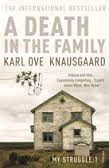
death in the familyIndeed, Book One basically talks about two things–a New Year’s Eve party when Karl Ove was youngish and, as the bracketed title indicates, the death of his father.  (The title A Death in the Family is the same book as My Struggle Book One–from a different publisher.  It has a totally different cover but is the same translation.  I don’t quite get that).  But indeed, these two events take 430 pages to write about.

How is this possible?  Because Karl Ove writes about every single detail.  (I assume this why the books are considered novels, because there is no way he could remember so much detail about every event).  I’m going to quote a lengthy section from a New Yorker review (by James Wood) because he really captures the feeling of reading the book:

There is a flatness and a prolixity to the prose; the long sentences have about them an almost careless avant-gardism, with their conversational additions and splayed run-ons. The writer seems not to be selecting or shaping anything, or even pausing to draw breath….  There is something ceaselessly compelling about Knausgaard’s book: even when I was bored, I was interested. This striking readability has something to do with the unconventionality of “My Struggle.” It looks, at first sight, familiar enough: one of those highly personal modern or postmodern works, narrated by a writer, usually having the form if not the veracity of memoir and thus plotted somewhat accidentally, concerned with the writing of a book that turns out to be the text we are reading.  But there is also a simplicity, an openness, and an innocence in his relation to life, and thus in his relation to the reader. Where many contemporary writers would reflexively turn to irony, Knausgaard is intense and utterly honest, unafraid to voice universal anxieties, unafraid to appear naïve or awkward. Although his sentences are long and loose, they are not cutely or aimlessly digressive: truth is repeatedly being struck at, not chatted up.

That idea of being bored but interested is really right on–and it may sound like a bad thing, but it’s not.  You can read along thinking that there’s no way he is going to give so much unimportant detail.  But you get this description of drinking a cup of tea: (more…)

Read Full Post »

thisoneSOUNDTRACK: JAPANDROIDS-Post Nothing (2009).

japan1Japndroids are two guys from Vancouver.  And man, they make a racket fit for a group double its size.  There’s a lo-fi quality to the recording but that’s mostly because the guitar is buzzy and noisy and distorted and the drums are miked very loud (and there’s cymbal splashes everywhere).  The vocals (which are mostly screamed/sung) are also pretty relentless (especially when the backing vocals come in).  And yet for their simple punk aesthetic  their songs aren’t short. “Young Hearts Spark Fire” which opens with some slower guitar (before crashing into a huge verse) runs over 5 minutes.  That’s five minutes of thumping drums and super fast guitars.  Well, they do take small breathers in the song, but they don’t last long.

But for the most part, the songs are simple, fast rockers and while there is a sameness to the album, there is diversity within their sound.  “Rockers East Vancouver” has a bit more treble in the guitar and a slow middle section.  It also has what sounds like a bass guitar break–but remember there’s no bass.  The thudding guitar and drums that open “Heart Sweats” also sound very different, as do the groovy Ooooohs that punctuates the verses–making it a very distinctive song.

“Crazy/Forever” opens with a nearly 2 minute instrumental before turning into a slow rocker that last for 6 minutes of catchiness.  The album closer, “I Quit Girls” has a cool feedbacky sound on the guitar that makes it sound rather different as well.  And the song itself is a slow almost ballad (bit not really a ballad, don’t worry) that really stands out on the disc.  So this debut is 8 songs in 36 minutes–a great length for a fun rocking album.

[READ:  February 19, 2013] This One is Mine

If you named a book Unlikable People Who Do Foolish Things it probably wouldn’t sell. Or maybe it would.  Regardless, it’s an apt subtitle for this novel.  Semple is extremely daring to write a story in which nobody is likable at all.  Luckily for her, though, is that she writes really well and the book itself is very likable, so much so that I stayed up way too late several nights in a row to finish it.

So this book is about a small group of people who run somewhat parallel lives.  David Parry is married to Violet.  His sister Sally is single.  Although David is the sort of fulcrum between the two women, the story is about the women far more than David.  But it’s important to start with David to set things up.  David Parry is a multimillionaire.   He works in the music industry–he’s the asshole that all the bands need on their side.  So, he has autographs with everyone (working on getting his daughter a photo op with Paul McCartney, had Def Leppard play his wedding, etc).  But he’s cold and distant to his wife.

Or at least he seems to be from Violet’s point of view.  Violet is a writer.  She wrote a very successful TV show but wanted out of that life.  When she met David, they had an amazing first date (and David still swoons when she looks at him that way, but it seems like she hasn’t been looking at him that way very much lately).  And when they settled in, she realized she didn’t have to work anymore.  But then she felt odd realizing that she wasn’t making any money herself.  So she threw her creativity into a new house.  Which took forever.  Then they finally managed to have a child (Dot), but Violet found being a mother overwhelming as well, so the nanny (called LadyGo) takes Dot much of the time (and yes, David is resentful of this too).

Violet is at loose ends with her life.  And then she meets Teddy.  Teddy is a loser–a former addict with Hepatitis C, he plays double bass in a Rolling Stones cover band.  When she first sees him, he is playing in the park for some kind of function (not as the Stones cover band, but in some other kind of band) and she is entranced by the music they make.  Teddy has a double bass and, when Violet runs into him after the show, because she parked near him, he is trying to fit it into his crappy car that breaks down all the time.  Indeed, it won’t start now.  He can;t afford to fix it which means he wont be able to get to gigs, which means he won’t have money for rent, etc.  He’s about as far from Violet’s one can get.  Yet, despite the fact that he is an asshole: verbally abusive, cocky and prone to make very bad choices, she falls for him.  She offers to pay to have his car fixed.  And then imagines when they can meet again. (more…)

Read Full Post »

McSweeney’s #13 (2006)

13SOUNDTRACKPARTS & LABOR-Stay Afraid (2006).

partslaborParts & Labor have changed t heir style over the years going from noisemakers who have a melody to being melodious noisemakers.  This album is one of their earlier releases when noise dominated.  Right from the opening you know the album is going to be a challenge.  The first song has pounding drums (electronics that sound like bagpipes) and heavy distorted shouty vocals.  By the end of the songs there is squealing feedback, punk speed drums and screaming distorted vocals (complete with space sound effects).  It’s an aggressive opening for sure.  Song two opens with a long low rumbling and then “Drastic Measures” proves to be another fast-paced song.

“A Pleasant Stay” is 5 minutes long (most of the rest of the album’s songs are about 3 minutes).  It continues in this fast framework, although it has a bit more open moments of just drums or just vocals.  The way the band plays with feedback in the last minute or so of the song  very cool.

“New Buildings” has a hardcore beat with a guitar part that sounds sped up.  “Death” is a thumping song (the drums are very loud on this disc), while “Timeline” is two minutes of squealing guitars.  “Stay Afraid” has a false start (although who knows why–how do these guys know if the feedback sounds are what  they wanted anyhow?).  The song ends with 30 seconds of sheer noise).  The album ends with the 5 minute “Changing of the Guard” a song not unlike the rest of the album–noisy with loud drumming and more noise.

The album is certainly challenging, it’s abrasive and off putting, but there;s surprising pleasures and melodies amidst the chaos.   Indeed, after a listen or two you start to really look forward to the hooks.  If you like this sort of thing, this album s a joy.  It’s also quite brief, so it never overstays its welcome.

[READ: April 15, 2011] McSweeney’s #13

I have been looking forward to reading this issue for quite some time.  Indeed, as soon as I received it I wanted to put aside time for it.  It only took eight years.  For this is the fabled comics issue.  Or as the cover puts it: Included with this paper: a free 264 page hardcover.  Because the cover is a fold-out poster–a gorgeous broadside done by Chris Ware called “God.”  And as with all Chris Ware stories, this is about life, the universe and everything.  On the flip side of the (seriously, really beautiful with gold foil and everything) Ware comic are the contributors’ list and a large drawing that is credited to LHOOQ which is the name of Marcel Duchamp’s art piece in which he put a mustache on the Mona Lisa.  It’s a kind of composite of the history of famous faces in art all done in a series of concentric squares.  It’s quite cool.

So, yes, this issue is all about comics.  There are a couple of essays, a couple of biographical sketches by Ware of artists that I assume many people don’t know and there’s a few unpublished pieces by famous mainstream artists.  But the bulk of the book is comprised of underground (and some who are not so underground anymore) artists showing of their goods.  It’s amazing how divergent the styles are for subject matter that is (for the most part) pretty similar: woe is me!  Angst fills these pages.  Whether it is the biographical angst of famous artists by Brunetti or the angst of not getting the girl (most of the others) or the angst of life (the remaining ones), there’s not a lot of joy here. Although there is a lot of humor.  A couple of these comics made it into the Best American Comics 2006.

There’s no letters this issue, which makes sense as the whole thing is Chris Ware’s baby.  But there are two special tiny books that fit nearly into the fold that the oversized cover makes.  There’s also two introductions.  One by Ira Glass (and yes I’d rather hear him say it but what can you do).  And the other by Ware.  Ware has advocated for underground comics forever and it’s cool that he has a forum for his ideas here.  I’m not sure I’ve ever read prose from him before. (more…)

Read Full Post »

12SOUNDTRACK: FRANK OCEAN-“Bad Religion” (2012).

frankoI didn’t know anything about Frank Ocean until I started looking at all of the  Best Albums of 2012 lists.  He was on everyone’s list and was pretty near the top of all of them.  So it was time to check him out.

It  turns out that he’s affiliated with the Odd Future collective, whom I’ve talked about in the past.  But he’s also been on a lot of big name records.  Channel Orange is his debut album (that’s not a mixtape) and the big surprise seems to be that this song (which he sang live on Jimmy Fallon) is about a male lover.  And I guess that’s progress.

So Ocean sings a slow R&B style, and I have to say his voice reminds me of Prince a lot.  Which is a good thing.  I really like this song.    It has gospelly keyboards (but in that Purple Rain kinda way).  And a really aching vocal line.  It’s really effective and it’s really simple.  And I think that’s what I liked best about this song and others that I’ve heard–he’s really understated.  Crazy, I know.

Now I do not like R&B, it’s one of the few genres that I just don;t get.  And yet there’s something about this album (the tracks I’ve listened to) that is really compelling.  It’s not awash in over the top R&B trappings, and it doesn’t try too hard.  It’s just Frank  (not his real name) and his voice over some simple beats.  A friend of mine recently said that all of a sudden she “got” this album, and  I think I may have to get it as well.

[READ: December 30, 2012] McSweeney’s #12

At the beginning of 2012, I said I’d read all of my old McSweeney’s issues this year.  I didn’t.  Indeed, I put it off for quite a while for no especial reason.  Now as the year draws to an end, I’m annoyed that I didn’t read them all, but it’s not like I read nothing.  Nevertheless, I managed to read a few in the last month and am delighted that I finished this one just under the wire.  For those keeping track, the only issues left are 13, 14, 15, 16, 20, 10, 38, (which I misplaced but have found again) and 42, which just arrived today.  My new plan in to have those first four read by Easter.  We’ll see.

So Issue #12 returns to a number of different fun ideas.  The cover:  It’s a paperback, but you can manipulate the front and back covers to make a very cool 3-D effect (by looking through two eyeholes) with a hippo.  The colophon/editor’s note is also back.  Someone had complained that he missed the small print ramble in the beginning of the book and so it is back, with the writer (Eggers? Horowitz?) sitting in Wales, in a B&B, and hating it.  It’s very funny and a welcome return.

As the title suggests, all of the stories here are from unpublished authors.  They debate about what exactly unpublished means, and come down on the side of not well known.  And so that’s what we have here, first time (for the mos part) stories.  And Roddy Doyle.

There are some other interesting things in this issue.  The pages come in four colors–each for a different section.  The Letters/Intro page [white], the main stories [pink], the Roddy Doyle piece (he’s not unpublished after all so he gets his own section) [gray] and the twenty minute stories [yellow].  There’s also photographs (with captions) of Yuri Gagarin.  And a series of drawing that introduce each story called “Dancewriting”–a stick figure on a five-lined staff.  They’re interesting but hard to fathom fully.

LETTERS (more…)

Read Full Post »

SOUNDTRACK: BAND OF HORSES-Live on KEXP , April 13, 2006 (2006).  

Band of Horses played KEXP in 2006.  They had been around since 2004 but their debut came out in 2006.  Since they are a Seattle band, they are treated as yet another Seattle band, which is kind of funny as they would be huge not long after this release (okay technically in 2007).  This show takes place about a month after the debut album came out (although the DJ says they’ve been playing them for a while).

I did not know that many of them were in a band called Carissa’s Weird (nor had I heard of that band), but thanks to the KEXP DJ for bringing that up.  I also found out that “Wicked Gil” is about baseball player Gil Meche.  The band sounds great–not quite as polished as on record, which is to be expected of course, but the vocals all sound great and the band is very tight.  They also play “Part One,” “The Great Salt Lake” and “The Funeral.”

It’s fun to hear a band before they became famous.

[READ: September 3, 2012] “Amundsen”

I read this story a day or two before I got laid off.  Unsurprisingly I didn’t feel like posting about it then.  But now it’s time.

This story is  about a young woman, Vivian Hyde, who is to be the new teacher at a rural santitorium.  She has traveled from Toronto to work at the ward where the girls have TB.  She has a B.A. and wants to work on her M.A, but she thought she’d earn some money for a time, first.  The story is set during the war, and the nurses are doing their wartime duty.

The first girl she meets, Mary, is the daughter of one of the employees who lives there.  She doesn’t have TB and does not participate in the studies that the TB girls do.  Vivian likes her but the headmaster, Dr. Fox, scolds the girls and sends her away so that Vivian can get settled in.

Munro is wonderful with details, like when the doctor asks is he knows anything about  tuberculosis:

“Well I’ve read–“

“I know, I know. You’ve read The Magic Mountain.”

[This is novel by Thomas Mann from 1924 that dealt with TB.  I love how Vivian does not respond to his comment one  way or the other]. (more…)

Read Full Post »

SOUNDTRACK: THE SMITHS-“Girlfriend in a Coma” (1987).

Big bouncy basslines open this poppy little ditty that belies its happy music by saying “I know it’s serious.”  The song is catchy and poppy and then there are some strings and martial drums and in 2 minutes it’s over.  What a strange and wonderful single from the Smith’s final album.

The single came with two B-Sides.  “Work is a Four Letter Word” which I never realized was a cover until reading about it now.  Of course it does seem very un-Smiths upon reflection.  And apparently Johnny Marr hated it.  “I Keep Mine Hidden” is the second B-Side.  I thought I had heard every Smiths song, but I don’t recognize this one at all.  It’s an okay song, not exactly a great hidden gem or anything.  If it were on the album, you;d say it should have been a B-side.  So, well done, lads.

The craziest thing about this whole single–three songs–is that it is under 7 minutes long in total.    Ah, I remember the 80s.

[READ: October 14, 2012] Girlfriend in a Coma

I’m glad I watched the short film Close Personal Friend just before reading  this because it really did put forth a lot of the ideas in this story.  The crazy thing is that I read  this book in 1998 but I didn’t remember very much of the story until the very end (which is surprising given how over the top some of the scenes are!).

And, let’s not overlook the Smiths connection.  Not only is the title a Smiths song, but there are dozens of instances where Coupland includes Smiths song titles and lyrics, sometimes in conversation.  In a short succession I saw: the queen is dead, oscillate wildly, bigmouth strikes again, hand in glove.  It’s like a scavenger hunt.

But on to the book. (more…)

Read Full Post »

SOUNDTRACK: CIRCLE TAKES THE SQUARE Live at Black Cat Washington DC, August 31, 2011 (2011).

I had never heard of Circle Takes the Square before seeing the link to this show on NPR (Thank you, Viking!).  I like the band name (Hollywood Squares reference), and couldn’t imagine what they sounded like.

Song titles like “In the Nervous Light of Sunday” and “We’re Sustained by the Corpse of a Fallen Constellation” and even “Non-Objective Portrait of Karma” lead one in many possible directions.  But it turns out that the band is sort of pigeonholed as screamo, a post-hardcore style that allows mostly for screamed vocals.  And yet these guys also incorporate intricate playing, odd time signatures and some beautiful instrumental passages.

Even though the band plays fast, they don’t play only short songs.  The shortest songs run about three minutes but they have two songs that are over 6 minutes, with several different sections.

I listened to this show a few times and I confess I never really got into it.  I liked some of it but I was never fully able to grasp what was going on.  It could have been the recording quality.  Usually NPR shows are crystal clear, but this one was a bit muddy–which may have been intentional from the band as they are pretty raw sounding.  I did like  the split male/female vocals which added a cool depth to the songs.  But mostly I was impressed by the kind and almost sweet attitude of the lead singer.  He was polite and thankful to the audience (thanking them for braving the weather–the show was during Hurricane Irene–thanking them for coming from both far and near and talking about how excited he was about Pg. 99, the headliners.  It’s funny to hear polite thankfulness and then screaming lyrics like: “Embrace the sweet sound of self-destruction.”

I’d like to hear a studio release before passing final judgment, because there was a lot to like here.

[READ: August 29, 2012] Habibi

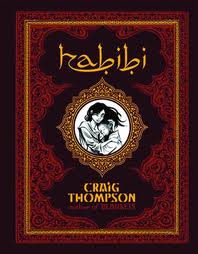
I saw this book in a review by Zadie Smith in Harper’s a while back.  I didn’t realize at the time that the author was the same person who did the wonderful Blankets.

This book is an amazing piece of art.  And the story is very good too.

So this massive book (almost 700 pages) is the story of  a woman born into a fictional Middle Eastern country called where the Qur’an is studied and women are more or less chattel.  As the story opens Dodola is sold by her father to a wealthy man who becomes her husband.  The scene of her deflowering, while not graphic at all, is very disturbing nonetheless.  She is afraid of this man and cowers in the fear until they gradually start to see each other as human beings.  And although their age difference is substantial (and yes, gross), she learns to appreciate him.

Until he his killed by the king’s men and Dodola is taken away to the king’s palace to be sold as a slave–her hair is tied to another girl’s hair so they cannot escape.

Through a series of events, she does escape, and when she is hiding out she manages to save the life of a black baby named Cham.  She calls him Zam after the Well of Zamzam (Arabic: زمزم‎) in Mecca, the holiest place in Islam.  And while she is only 12, she takes care of this 3-year-old boy and raises him as her own child. (more…)

Read Full Post »

« Newer Posts - Older Posts »