Feeds:
Posts
Comments

Archive for the ‘Violence’ Category

SOUNDTRACK: PEPPER RABBIT-“Alison” (2011).

Pepper Rabbit had NPR’s Song of the Day on September 19th.  “Alison” opens with a kind of circus organ pumping out a steady, thumping beat.  The beat continues until the quieter stated chorus: “You will know my name.”  The song is, as circuses are, light and bouncy with an air of the sinister floating all around it.  By the second chorus, we learn that “it’s all a game to get you to learn my name.”

The vocals are done in a kind of 70’s piano pop style–a bit high-pitched, a bit echoey– and they help to obscure exactly what’s going on.  But it’s the music that is so charming. 

Even if it’s unclear to me what the intention of the song is (stalker or just lost love) it’s a poppy ditty that will keep your toe tapping.  I’m looking forward to hearing more from them. 

[READ: September 14, 2011] Into the Gauntlet

And so the series ends. 

Or, actually, it doesn’t.  This isn’t really a spoiler because there are more books out in the series.  And I’m not going to say what happens at the end of this book, but for those of you wondering just what the heck is going on here with a Book Eleven coming out eight months after Book Ten, I’ll summarize (with no spoilers).  Book Ten ends the hunt for the clues–the goal is reached.  But at the end of the book, it is revealed that there’s another group, another family, who is also hunting for the Answer.  They hadn’t been hunting alongside the Cahill families, they were apparently watching alongside them waiting to see what would happen before setting their plan into action.  And thus….  Series Two.  

Book 11 is a kind of transitional book that fills in some back story on each of the families and shows Grace’s life.  I’m intrigued to read it, especially since most of the writers from the series contribute to it.

So Book Ten was written by the excellent author Margaret Peterson Haddix.  And this book comes in at 326 pages (over 100 pages longer than any other book in the series).  But Haddix earns her extra pages.  She totally breaks with the set-up of the series so far by following not just Dan and Amy but all of the branches of the family.  We actually get into the heads of all of the competitors (including Eisenhower Holt–who has feelings after all, Natalie Kabra–who is not quite as dim as she appears, and Ian Kabra–who might just be as evil as his mom).  Haddix also introduces a huge surprise in the beginning of the book–a surprise that may not have been such a surprise if I’d been reading the books close together but with this much remove from the early books, I was shocked!  And later on, when she doubles up on the surprise, it’s even more shocking! (more…)

Read Full Post »

SOUNDTRACK: DINOSAUR JR.-Live at the 9:30 Club, Washington D.C. October 8, 2009 (2009).

This was one of the first shows I downloaded from NPR.  I’ve been a fan of Dinosaur Jr. since my friend Al turned me on to Green Mind back in college.

This is an amazing show created by the original Dino Jr. members.  This tour is in support of their second album since reuniting, Farm. This set-list is an outstanding mix of old songs, new songs, Barlow-sung songs and even some songs from when Barlow and Murph weren’t in the band.  (Green Mind is still my favorite album by them).

When the band reunited there was much joy, and I’ve said in reviews of the newer albums, I’m not entirely sure why.  I mean, Dino Jr has always been about Mascis, and it’s not like Barlow is such an unusual bassist (although Murph’s drumming is always solid).  I’ve nothing against Barlow (I love Sebadoh and Folk Implosion) or Murph, it just seems odd to get excited about having them back in the band aside from nostalgic reasons.

Having said that, the band sounds amazing (and yes, Barlow does get to sing on “Imagination Blind”).  What never really came across to me until hearing all of these great songs live was that Mascis has always been a great pop song writer.  These songs are catchy as hell. But Mascis buries them under loud squalling guitars and a voice that is almost whiny, almost off-key, a total slacker voice.  (But you’ll notice it is never actually off-key.  He must work very hard at that.)

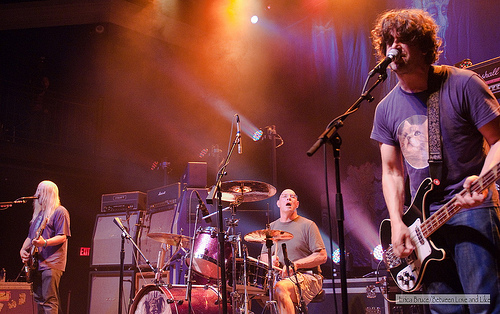
By the nd of the show Mascis chastises the audience for not moving (we obviously can’t see what they’re doing), saying he forgets that people don’t move in Washington, D.C.  But during the encore break, NPR host, Bob Boilen, points out that Mascis himself doesn’t move either–he just stands in front of that wall of Marshall stacks (Boilen wonders how he can hear anything anymore).  And looking at the pictures it’s comical the way he looks, surrounded by amps.  The picture above doesn’t fully do it justice, but check out the extra photos at the NPR page.  And while you’re there, listen to this show. It is amazing.  For a total slacker, Mascis can rock a guitar solo like nobody’s business.

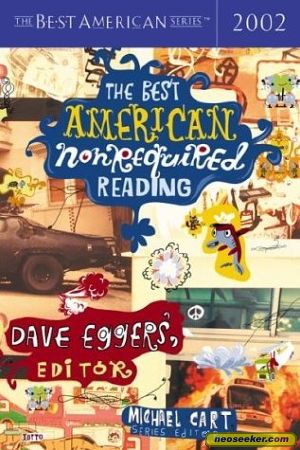
[READ: July 20, 2011] The Best American Non Required Reading

I’d been meaning to read this series for years (yup, Eggers fan), But I have a hard time starting “collections” because I feel like I’d rather be reading a novel.  Nevertheless, I have most of these Nonrequired books, so it seemed like I should dive into one and see what it was like (I don’t think the year really matters all that much–some of the articles are topical but most are not exactly).  Then Sarah said this would be a great book to read on vacation because it’s all short essays, and she was right.  It was perfect for late nights when I wanted something to read but didn’t feel like getting involved in the novel I was reading.

DAVE EGGERS-Introduction
Eggers’ introduction is actually a partial short story about kids who go swimming in pools around town. It reminded me of the opening of Life After God by Douglas Coupland, but of course, lots of kids did that so I’m not saying it was “lifted” from DC.  The story “ends” (it doesn’t really end so much as stop) with an interesting scene between two unlikely kids who get caught.

After this story Eggers includes these three notes about the collection: It’s not scientific, It’s alphabetical, and We had a lot of help with this.  Of the three, it’s the middle one that’s most useful because Eggers says that you shouldn’t necessarily read them in order just because they are printed this way: “In the first half of this collection, you get a good deal of hard journalism, primarily about war and refugees, from Afghanistan to the Sudan, followed immediately by a number of less serious pieces, about malls and Marilyn Manson.  We didn’t group anything by theme , and won’t be offended if you skip around.”  This was good to know (not that we needed the permission of course), but yes, the beginning of the book is pretty heavy. (more…)

Read Full Post »

SOUNDTRACKSUPER FURRY ANIMALS-“Let the Wolves Howl at the Moon” (From the Basement) (2007).

[DISCLAIMER: This post was published on September 6th see that post for details].

Continuing this exploration of the From the Basement series, I found this unlikely video from Super Furry Animals.  SFA have never been big here (well, that had a fluke hit but that doesn’t count).  I have no real idea how big they’ve been back home.  So maybe it’s not a surprise that they are playing here.

SFA were a bunch of crazy psychedelic indie rockers.  Their early albums are totally nuts (like the EP Llanfairpwllgwyngyllgogerychwyndrobwllantysiliogogogochynygofod (in space)).  But over the years, they have mellowed considerably. This song is the final track from Hey Venus!, an album that returned the Furries to their more rocking roots.  Despite the album’s overall rockingness, this song is the mellow ender to the album. 

This live version is very good, with Gruff Rhys sounding in fine form.  Visually, it’s more interesting than say Neil Hannon’s in that there are five of them, but they’re not exactly putting on a crazy show. What’s nice is the chance  to see just what the recording space looks like (there’s lots of wide shots) and to see just which hairy Welshmen are making which sounds. 

This is a wonderful song that could easily have been on anyone’s mellow folkie playlist.  The album version has a little bit more going on, but it’s not missed in this someowhat stripped down form. 

[READ: August 29, 2011] 3 Book Reviews

After last month’s tour de force about one title, this month returns to Zadie’s typical 3 books/month schedule.

The first book is Ian Thomson’s The Dead Yard: A Story of Modern Jamaica.  Zadie makes the amusing observation that this book, a very good and very well researched cultural study of Jamaica was written by a white Scotsman; she notes that a sense of remove from the culture was probably essential in order to create this book. 

Thomson offers historical context for the dangerous world that Jamaica occupies now (it’s not all “Jah, ganja mon” in the country.  In fact, five people are murdered every day (on this island of 3 million).  Fascinatingly, there is much racism in Jamaica—people seen as too black are often looked down upon in favor of lighter-skinned people.  Because of this, respect is very important.  Indeed, any kind of disrespect can cost you your life—just about everyone packs a gun (hence the stat above.  Of course this racism also may be why the Jewish, Indian and Chinese Jamaicans are thriving while the majority black are not.

Zadie says the only place where Thomson falls flat is in his utter dismissal of dancehall music (he likes reggae but can’t stand dancehall).  He dismisses Sean Paul and although Zadie’s not a huge fan of Sean Paul, she finds this dismissal a poor oversight possibly due more to his age (culture being a young person’s game) than anything else.  I especially enjoyed her dissection of one of Sean Paul’s videos. (more…)

Read Full Post »

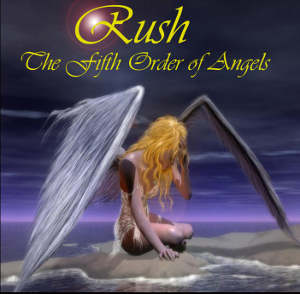
SOUNDTRACK: RUSH-The Fifth Order of Angels (bootleg from the Agora Ballroom,Cleveland, 26 August 1974) (1974).

I have mentioned this concert before, but I played it again today, and was struck by a couple of things.

1) According to the liner notes, Neil Peart had been in the band about two weeks.  How did they decide that their new drummer was going to be doing a drum solo during the show?  I mean, by now, everyone knows that the solo is its own song.  But, he’s been in the band two weeks.  It’s obvious he’s a good drummer, better than their original drummer, but a drum solo?  Is that just what rock bands did back then?

2) I’m struck by how much this show sounds like early Kiss.  I never really thought that  their first album sounded like Kiss, but in this live setting, a number of the songs, or perhaps just  the way they are recorded make me think of early Kiss.  In particular, during the crazy “one, two, three, FOUR!” of “In the End,” when the guitars kick back in, it sounds like a Kiss show from circa Alive!.

3) It’s amazing how guitar-centric the band was back then.  The mix is a little rough so it’s not entirely clear how insane Geddy is on the bass (when he gets a few solo notes, the bass sounds really tinny).  But the concert is like a showcase for Alex’s solos.  True, the whole first album really demonstrates what a great soloist he is, but it’s really evident here that Alex was the star.

4) Their earlier songs are really not very good.   I mean, every Rush fan knows that the first album is almost not even a real Rush album, but it’s shocking how pedestrian these songs are compared to even what would show up on Fly By Night.  Still, circa 1974 I’ll bet this show kicked ass.

It’s available here.

UPDATE: The missing content has been added!

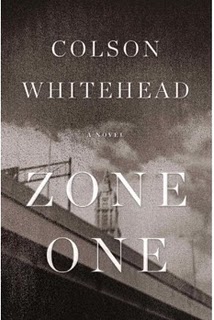
[READ: August 9, 2011] Zone One

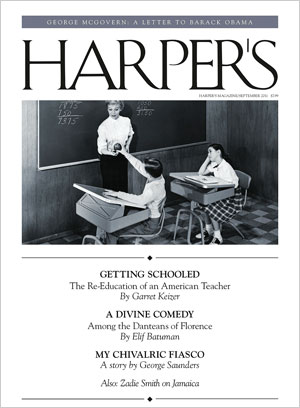
After reading the excerpt from Zone One in Harper’s I decided it was time to read the book (which is due to be published in October).

I admit I haven’t read Whitehead’s other works, but I have read excerpts, and I thought I knew the kind of things he wrote.  So it came as a huge surprise when the excerpt ended the way it did. I didn’t want to spoil anything when I wrote the review of the excerpt, but since the entire book is set in the dystopian future and since it explain what has happened right on the back, I can say that Zone One is set in the aftermath of a kind of zombie apocalyptic plague.  And I can’t help but wonder if the rousing success of McCarthy’s The Road has more or less opened up the field of literature to more post apocalyptic, dare I say, zombie fiction.  [I haven’t read The Road, so there will be no comparisons here].

Actually there will be one.  Sarah read The Road and complained that you never learned just what the hell started the end of the world.  Indeed, in this book you don’t either.  There is an event called Last Night, and after that, there’s simply the current state of affairs.  I suppose you don’t really need to know, and since the story is all about dealing with the zombies, I guess it doesn’t really matter how it all started, but I think we’d all like to know.

Now what makes this story different from the typical zombie story is that for the most part there aren’t all that many zombies (or whatever these undead people are called) in the story.  There are some of course, and they are inconvenient to the main characters, but unlike a story like Zombieland, (which was awesome) or the more obvious Night of the Living Dead, the story isn’t really about fighting zombies, it’s more about the rebuilding of the country in a post-zombie world. (more…)

Read Full Post »

SOUNDTRACK: BILLY BRAGG-Live at the Newport Folk Festival (2009).

Billy Bragg is one of the great holdouts of aggressive political liberalism in music.  For every “American Idiot” that young bands play, Billy can whip out “There is Power in a Union” or the more prescient, “No Power without Accountability.”  Lyrics:

IMF, WTO,
I hear these words just every place I go
Who are these people? Who elected them?
And how do I replace them with some of my friends?

He’s an old school American folkie, despite the fact that he is so outrageously British that his singing accent is stronger than most British folks’ speaking voices.

But he’s not all politics (well, yes he is, but sometimes he disguises it).  Like on his minor hit “Sexuality.”  With some of the first gay positive lyrics I can remember hearing on the radio: “I’ve had relations with girls from many nations/I’ve made passes at women of all classes/And just because you’re gay I won’t turn you away/If you stick around I’m sure that we can find some common ground.”

Billy’s set is pretty great.  He plays the electric guitar for most of it (with an amusing moment where he switches to the acoustic guitar and references Dylan), and really, he needs no accompaniment.  He plays several of his own songs as well as a number of Woody Guthrie songs (both ones that Guthrie recorded and ones that Bragg and friends recorded for the Mermaid Avenue project).

Bragg also talks.  A lot.  His stage banter is as funny as it is impassioned.  And he urges people not to give in to cynicism about their newly elected President (the task is too great for him to please everyone).   Sometimes he comes across as really inspirational and other times as simply idealistic.

The only part of the show that I don’t really like is the “cover” of “One Love.”  I don’t particularly like the song to begin with and this version is 6 minutes long.  True, he modifies the lyric, but the basics are  the same.  Aside from that it’s a pretty rousing set (even if the DJs interrupt him about 40 minutes in, apparently thinking he was going to be end).

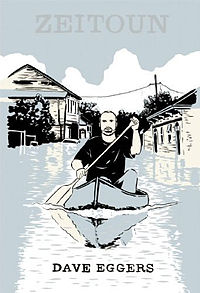
[READ: August 1, 2011] Zeitoun

I loved A Heartbreaking Work of Staggering Genius.  And I liked You Shall Know Our Velocity quite a bit too (and I just found out that YSKOV was rereleased as Sacrament with an extra 45 page section from Hand’s point of view–and that apparently there is only one copy available anywhere in the world and it costs $250!).

Anyhow, It was through Eggers that I found McSweeney’s (and its vast empire).  And yet during that time, I sort of gave up on reading Eggers’ published works.  When Zeitoun came out, I wasn’t all that interested to read it.  Mostly because I knew the book was about Hurricane Katrina, and I didn’t think I could handle a book about such a tragedy.

But recently, several people in book clubs had mentioned how good (and quick) of a read it was.  So I decided to give it a read.  And I’m really glad I did.

The book is about Abdulrahman Zeitoun, a Syrian born American.  He was living in New Orleans and was the owner of a very successful remodelling business (as well as the landlord of several properties around New Orleans).  Zeitoun is a hard-working, exceptionally conscientious man (the flashback to him running to work, carrying his broken bicycle on his back is as inspirational as it is amusing).  He rarely takes a vacation (much to his family’s chagrin) and oftentimes his wife has taken their kids on a vacation without him.  (One time they dragged into the car with his bags already in it without telling him they were going away for a weeklong vacation). (more…)

Read Full Post »

SOUNDTRACKSUPERCHUNK-Superchunk (1990).

Some time ago, I reviewed all of the Superchunk EPs.  After progresing to their most current music, returning to their first album is a bit of a shock.  Superchunk’s first full length album is incredibly raw, with lots of screaming (two vocalists at once, even) and a very grungy attitude.  It has a DIY aestethic, in keeping with the undeground scene at the time.

The first four songs fly past in a pretty quick blur of adrenaline (the longest is just over 3 minutes).  The fifth song, the aptly named “Slow” slows things down and strecthes things out with a five minute track of slow distorted chords and a long solo.

Of course, the pinnacle comes with the next song “Slack Motherfucker” one of the best grunge anthems of all time. 

The last four tracks speed things up again with the bratty attitude that Superchunk is so good at (see especially “Down the Hall”).  But it’s not all just blistering speed.  The band has some dynamics down and there are a couple of tempo changes as well.

The album is a lot of fun to listen to, especially if you’re lookig for grunge before it became Grunge.  Although there’s very little indication that they would become the indie superstars that they eventually became you can clearly hear proto-Superchunk chunks–Mac’s voice is as it ever was and the noise is present but not overpowering.  There are even hints of melody (although nothing as catchy as later albums).  And yet for all that it sounds like a criticism, the album is really quite solid.

[READ: June 15, 2011] The Hollow Planet

Yes, THAT Scott Thompson, from The Kids in the Hall.  I found out about this comic book from my good friend Jessee Thorne at The Grid.

The backstory is that Scott Thompson had been working on this story for years and years.  He imagined it as a movie (starring him, of course).  When that didn’t pan out, he decided to sell it is a comic book.  And while he was recovering from cancer, he worked on it extensively with Kyle Morton–character likenesses and whatnot.  And now we have a cartoon rendering of Scott Thompson!

This story focuses on Scott’s character Danny Husk…

The book opens with Danny and his wife and kids at a carnival.  After a few moments, Danny’s son gets lost on the merry-go-round.  In the next scene we see just how much his wife is estranged from him (she may even be cheating on him), and how little his daughter thinks of him.  Soon after, Danny goes to work, inserts a disc into his laptop and more or less brings down his company.

So far nothing out of the oridnary for this type of  story–henpecked husband on a quest for revenge that he doesn’t know he wants yet.

Then Danny visits with his old friend Steve.  They talk, they bond over Danny’s concern about his wife.  And Danny feels better.  Until he gets home.  After a scene which I won’t spoil, the story suddenly takes off with a high speed car chase (no kidding) and with Danny entering the titular hollowness of the planet. (more…)

Read Full Post »

SOUNDTRACKTINDERSTICKS-Claire Denis Film Scores 1996-2009: White Material [CST077] (2009).

White Material is the most recent soundtrack that the Tindersticks created for Claire Denis.  It was recorded between their “reunion” album The Hungry Saw and their latest album Falling Down a Mountain.

This is a very moody soundtrack.  The guitars set a brisk but desperate-sounding pace.  There are feedback squalls that echo for even more tension.  The feedback could be any number of things as well: squeaky machines, industrial noise, or simply disconcerting sounds.

There is a repeated motif throughout the score that morphs and blends with the tone.  The overall feel of the soundtrack is unified but it never sounds like you’re listening to the same few notes repeated (which is actually what it is, the songs use a very limited palette).

For such a limited palette of music, they really manage to give a diverse picture of the movie.  The way “Andre’s Death” builds, using those same few notes and feedback is truly amazing.  The tension that has been building throughout the score really comes to a head in those 2 minutes.  Contrarily, the flute that plays over those same notes in “Children’s Theme 2” is a haunting exploration of the theme.

This soundtrack isn’t as industrial/weird as L’intrus, but it is probably more intense and spooky.  It’s amazing how evocative these guys are.

[READ: June 22, 2011] Merit Badges

Sarah brought this book home, but she didn’t read it.  It sounded pretty good (I mean it won the 2009 AWP Award for the Novel), so I decided to give it a go.

The book seemed strange to me in the way it was set up: it seemed to have a very specific structure but it didn’t always follow it exactly. So, there are four main protagonists who write chapters of the book.  But they don’t each get a turn, in fact one, Barbara doesn’t really have much to say until much later when her story becomes very compelling.  It also advanced over the years with no real explanation of pacing or even of when a new narrator has jumped ahead several years.

I assumed this was going to be a story of four people looking back on their high school years.  But indeed, it’s about four people looking back on their whole lives, as they grow together, drift apart, come back into each others lives and then disappear again.  In that way, it was also a bit hard to get my bearings.  It was also hard for me to keep all of the characters straight.  Because even though there are four narrators there are many many more kids introduced in the beginning of the story.

Each chapter opens by stating who the narrator is.  The first few narrators are Chimes Sanborn (Prologue), Quint (Woodwork), Slow Slocum (Cooking), Chimes (Drafting), Barb Carimona (Music), Quint (Mammals), Quint (Crime Prevention) etc.  So it’s not consistent.

But also, as you can see, all of the chapter titles are named after Merit badges (which I liked quite a bit).  The subtitle describes what you have to do to achieve the badge (and the chapter does indeed kind of work within that stricture).

So far so good, but we’re also introduced to ancillary characters who appear quite often: Dickie Burpee, Pooch Labrador, Smash Sarnia, and a psychopath named Tulep.  With all of the nicknames and rotating narrators, I admit to losing track of who was who, which I fear lessened the impact of some of the events.

Of course, that’s all structural.  And while I felt like I probably missed out on moments of impact, the overall storyline was not hard to follow.  And, indeed, complaints aside, the story was pretty intriguing.  It is set in the (fictional) small suburb of Minnisapa, Minnesota.  It feels very true to me (having lived in a small town, myself) as do the choices (bad and good) that the kids make. (more…)

Read Full Post »

SOUNDTRACK: WEEZER-Death to False Metal (2010).

This is a fascinating release.  I assumed it was a quick cash in of unreleased tracks.  And yet it doesn’t sound like a bunch of tracks from different eras thrown together.  A little digging reveals that it is sort of a collection of unreleased tracks.  The ten songs here were written over the band’s career but were either never finished or were finished but never released.  According to various places online, Rivers edited and manipulated the songs (and maybe re-recorded some?) to make them all sound current (and like they’re from the same time).  Thus he considers this to be the follow-up to Hurley.

The album is full of poppy songs (“Turning Up the Radio” has FIFTEEN people listed as composer on Allmusic–the true sign of a pop juggernaut).  There’s a couple of slightly heavier songs, “Blowin My Stack” has a big shouty chorus and “Autopilot” has a very electronic kind of sound.  But perhaps the most notable track is the cover of “Unbreak My Heart.”  That song came out in 1996, so one assumes that this version must be at least ten years old, because why would someone make a cover of an old pop hit from fourteen years ago?  It’s quite good, though, as Weezer covers tend to be.

If you like Weezer, this isn’t a throw away.  The songs are just as good as their other recent records (which means they’re not as good as their early ones, but are still poppy).  If you don’t like Weezer this will do nothing to change your mind.

Although I am amused by the album cover design that they chose for this title (which is a tribute to the band Manowar, obviously), I think a better cover would have been Weezer in loincloths.  Can you imagine Rivers Cuomo brandishing a giant sword?

[READ: May 21, 2011] “Medea”

Ludmilla Petrushevskaya had a story in The New Yorker recently.  The fact that she has one here as well can only mean she has a book coming out (although a quick look at Amazon does not indicate that she does).

The opening line says, “This is an awful story…”  And it’s true (not in the sense of being bad, but in the badness that it contains).  Petrushevskaya tends to write very dark stories (dark fairy tales is how they’re mostly categorized), and while this is not a fairy tale, it is certainly dark (and as with most of her stories, it’s quite short).

It’s a fairly simple story: the narrator hops in a cab and complains about how her seventy-three year old grandmother called for a cab to pick her up at a certain time but it never came–and never even called to say it wasn’t coming.  This meant she missed her plane, and the people waiting for her missed her and basically the whole day (and a lot of money) was lost because of a cab.

The cabbie didn’t have anything to do with that, but he tells her that it could be worse, and proceeds to launch into a story trying to outdo her story.  They jockey for position in terms of terrible stories (a woman whose baby dies on vacation–and that’s only the beginning of her problems) until finally he talks about himself. (more…)

Read Full Post »

SOUNDTRACK: CHARLOTTE GAINSBOURG-KEXP in studio May 11, 2010 (2010).

Charlotte Gainsbourg is a fascinating individual.  Between her acting and her singing, she’s had quite a life.  And even moreso since she had a near fatal accident.

That accident formed the nexus of her album IRM.  And this interview and performance is done in support of that disc.  IRM was made with Beck.  Beck’s not here, and the songs are more stripped down, but they sound really good in this format.

Gainsbourg sings the Beck-sung-on-IRM “Heaven Can Wait” and really makes it her own.  The other three songs here work very well in this more acoustic setting.  “Me and Jane Doe” is practically acoustic already and “Time of the Assassins” and “Trick Pony” are reworked very well.  And Charlotte is a charming interviewee as well.

It’s another excellent in-studio performance from KEXP.

[READ: March 31, 2011] “The Dead Are More Visible”

I read all of The Walrus stories when I received the magazines.  I wondered when I would completely recognize a story when re-reading them now.  Well, this was the first one that I remembered parts of vividly.  And why not–there’s a search for a missing eye on an ice hockey rink.  That’s hard to forget.  However, I didn’t remember the ending and in fact, my memory added many more details than actually occurred in the story.

The beginning of the story, which is very different from what I just described, was less memorable but perhaps more interesting.  The story opens with a woman reflecting about her graveyard shift job.  In this case the job is literally a graveyard shift, because the park she works in has a graveyard within it. However, her job is not really scary–she is there to make the ice for the upcoming skating season.  It takes several nights of very cold weather and she must go out in all her gear and fill up the rink, several tousand litres of water at a time.

While the ice settles, her time is her own–to listen to music and read. She gets a few hundred pages read a night (dream job!)  She prefers romance and horror novels.  The introduction of horror novels into the story foreshadows a bit about the scene ewith the eye later on, although for this is not a horror story. (more…)

Read Full Post »

SOUNDTRACK: JÓNSI-Go (2010).

Jónsi is the lead singer from Sigur Rós. This is his first solo album and, honestly it’s not radically different from Sigur Rós (were we expecting trip hop or something?).   However, within the confines of the type of music that Sigur Rós play (swirling orchestral songs), Jónsi’s solo disc is kind of different.  And the difference comes in tone.

For while Sigur Rós records are orchestral and swirly, the are also kind of dark and moody.  Jonsi’s songs are more upbeat.  They’re ethereal both in style and tone.

I’m also surprised to see just how short these songs are.  They feel like they are very long (epic in a good way) but in fact, only two songs go over 5 minutes–most are in the mid fours.

There’s no question that if you dislike Sigur Rós you will not like this record. Jónsi’s voice is the same after all–gorgeous sweeping, helium sounding and out of this world.  But if you doubted whether Jónsi could work without his mates in the band, you need not worry. This album is a beauty.

[READ: May 19, 2011] “The Trusty”

I didn’t think I would like this story.  It concerns a subject that I generally don’t have a lot of interest in: chain gangs in the south.  And yet, Rash’s writing was excellent and the story was quite compelling.

The Trusty of the title is named Sinkler.  Sinkler is a prisoner on the chain gang–he stole money from a business and got 5 years.  He has served 18 months with very good behavior and has been given the unofficial title of Trusty, which means he can do things like walk a mile up the road to the next farm house to see if their well has water for the men on the gang.

And this is what he does.  They are working on a road and have moved far enough past their current source of water that Sinkler offers to walk up to the next house to bring water back.  When he arrives, the door is answered by a young woman (between 18-22–Sinkler himself is in his 20s).  She is standoffish and unmoved by him.  She is also married–her (much older) husband is plowing the field.  She agrees to give Sinkler two buckets of water if, at the end of the day he agrees to leave one bucket there as payment.

Sinkler agrees and decides that he would like more than water from the young woman.  And over the next few weeks he returns every day and tries to win her over.  And Lucy begins to sweeten on Sinkler. (more…)

Read Full Post »

« Newer Posts - Older Posts »