Feeds:
Posts
Comments

Archive for the ‘Violence’ Category

SschizoOUNDTRACK: BUILT TO SPILL-There is No Enemy (2009).

330px-There_is_No_Enemy It took only three years for Built to Spill to release this, their seventh full length.  I have mentioned this disc before, and I loved it then.  And I love it now.

“Aisle 13” starts with some echoed sounds and then big echoing chords which quickly resolve into a great BtS song.  And after the lengthy songs of the previous records, it’s amazing to hear a song (or several) tha are under 4 minutes.  The album is also full of some great (if odd) lyrics like: “one day I’ll come home to find you covered with ants because you are so sweet.”

“Hindsight” has two separate great riffs in it (and the great line: “is that grass only greener because its fake”).   “Nowhere Lullaby” is a slow ballad with a great vocal line (and strings).  “Good Ol’ Boredom” is almost a dance song—a fast drums beat and echoey guitar intro (although there’s a signature BtS guitar riff over the top).   I like the slide guitar solo in the middle and the lengthy jam section which trades off guitar solos (this song lasts 6 and a half minutes). “Life’s A Dream” slows things down and even includes a section of “ahhh”s and “la la las” in beautiful harmony.  And then there’s a surprise inclusion of horns.

“Oh Yeah” opens with a slow picked guitar and slowly builds up with more instrumentation, although it never really gets any faster.  But it has some great lyrics:

And if god does exist
I am sure he will forgive
Me for doubting for he’d see
How unlikely he himself seems

“Pat” zooms out off the gates with one of the fastest, most punk songs they’ve ever done (live it was even more so). And at under 3 minutes it’s a nice blast of excitement.  “Done” is a slow song with one of my favorite end soloing sections—tons of echo (once again, this was amazing live).  It seems like it should end the disc, but “Planting Seeds” comes out of that song with a great catchy riff.  And as the bridge comes in there’ an even more catchy riff.  It also has some great lyrics:

when bullies grow up they get meaner
yeah they really get it down

they think that they get it but they always get it wrong
they’ll play your favorite song
just to sell shit to you

I’ve heard that they’ll sell anything and I think they might
I think Bill Hicks was right
about what they should do

and just because you love something doesn’t mean it’s yours to buy
been selling it so long that no one even knows the reason why
you’ve been messing with our minds
gettin’ rich wasting our time

“Things Fall Apart” slows things down and even adds a trumpet solo before unleashing a lengthy guitar solo.  “Tomorrow” ends the disc slowly with keyboards. It seems like a downer ending but this 7 minute song has a lot packed into it. After about 90 second the guitars kick in and the song builds.   At 2 and a half minutes the song takes a sharp turn into a slower, darker section with a great solo. It jumps back and forth and ends with a lengthy solo that fades just as some interesting feedback squalls start to build.

This continues the progression of great Built to Spill records.

[READ: August 30, 2015] The Eradication of Schizophrenia in Western Lapland

This play was created by a theater group called Ridiculusmus, who I know nothing about.

The premise of this play was quite interesting.

Audience members are seated on either side of a wall.  Act One and Act Three are performed simultaneously on either side of the wall.  So you can watch Act One and hear Act 3 or vice versa.  The Acts overlap and are connected, so it’s not like a nonsensical experience.

Act One is between a mum and her two sons, while Act three is is between a psychiatrist and one of the sons, set some years in the future.  That’s pretty interesting.

But what happens is that after you see Act One/Three, the audience switches sides and you listen to it all over again, this time seeing what you missed last time.  But unlike a farce like Noises Off, where what you see is all the stuff that’s going on behind the scenes, you can hear everything that is being said behind the wall, I don’t think there’s anything new visually that will change the fact that you have just heard all of this dialogue a few minutes ago. It feels terribly redundant to me.

After both of these performances, act two is staged. (more…)

Read Full Post »

tsugeSOUNDTRACK: MOPS-“White Rabbit” (1968).

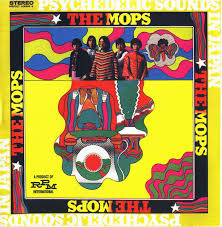
mopsAfter totally grooving on The Mops’ songs in yesterday’s post I decided I had to check out their cover of Jefferson Airplane’s “White Rabbit.”

And, boy do I love it.  It came from their debut album Psychedelic Sound in Japan which was released in 1968 (“White Rabbit” came out in 1967).   The album also includes covers of “Somebody to Love” by Jefferson Airplane, “Light My Fire” by The Doors and two songs by The Animals.  They received much press for being the “first psychedelic band” in Japan, and performed with elaborate light shows.

Lead singer Hiromitsu Suzuki really nails all the notes (even if he doesn’t quite nail all the words), but I especially enjoy the instrumentation they employ–the violin is an interesting addition.  And the way the instruments are separated in headphones (all drums in the right ear?) is really psychedelic.

It is really a trippy version (“Somebody to Love” is pretty fine too, especially when the really buzzy guitar kicks in about half way through).

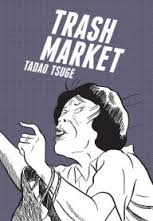
Trash Market

Tadao Tsuge is a Japanese cartoonist considered “one of alternative manga’s cult stars.”  He has been making cartoons since 1959 and has contributed to all manner of Japanese publications.

What seems to set him apart from other cartoonists (according to the interviews and such that fill out the book) is that Tadao grew up in the slums of Tokyo and is willing to write about them.  He also worked for many many years at a blood bank (one that paid people for their blood).  It was there, amid the terrible conditions, that he believes he contracted hepatitis.

The amazing thing to me while reading these six cartoons (which I assume are only a tiny fraction Tadao’s total output, but I’m not sure) is that I had no idea when they were written–they have a timelessness that is really amazing.  So when I finally flipped back to the front and saw that the first story was written in 1968, I was blown away. (more…)

Read Full Post »

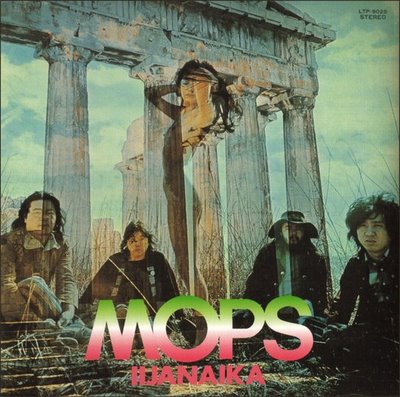
tokyoSOUNDTRACK: THE MOPS-“Goiken Muyo (Ilja Naika)” (1971)

mopsThe Mops were a Japanese psychedelic band who were inspired by American psychedelia.  They appear in one of the films below (Stray Cat Rock: Wild Jumbo from 1971) in a really weird scene in which the band is playing on the back of a flatbed truck (in the middle of another scene that has nothing to do with them).  They play their song and then drive away.  Weird.

Anyway, the song is pretty great.  There’s all kinds of interesting percussion (the film clip shows them playing stuff which most likely is not what they are playing).  But the studio version (linked to below) has great audio quality and a lot of depth in the bass and cool screaming guitars.

The band released possibly 9 albums (it’s a little hard to tell from their Wikipedia page).  With their first album being pretty psychedelic and this one (I assume their third) being much heavier and fuller sounding.

I had found a clip of the band from the movie.  Then I lost it and cannot find it anywhere.  But here’s the studio version dubbed over the movie clip

But really, check out the whole album, it’s pretty great.

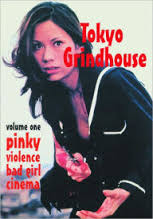
[READ: October 10, 2015] Tokyo Grindhouse

The life cycle of a book at my work is pretty straightforward.  If I see it at all, I usually catalog it or send it on its way to someone else.  But for some reason this book came back to my desk three times.

I didn’t know a thing about Tokyo Grindhouse, I’d never heard of pinky movies, but if something keeps coming back you gotta check it out.  So it turns out that this book has about ten pages of text and the rest is pictures.

And the book is about “classic” exploitation films made in Tokyo from 1960-1970 (or so).  The text by Jack Hunter explains that women and violence have been in Japanese exploitation films since the 1950s.  Evidently there were some landmark films in the mid-fifties about topless pearl divers that set off a craze for topless women in films.  This morphed into movies where women were the victims of violence with translated titles such as Nude Actress Murder Case: Five Criminals. (more…)

Read Full Post »

pablo SOUNDTRACK: BUILT TO SPILL-Live (2000).

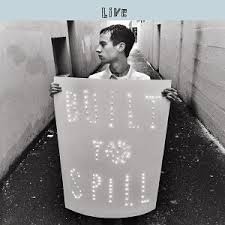
btsliveSoon after releasing “Carry the Zero,” Built to Spill released this, their first (and so far only) live disc.

This disc shows a jamming side of the band that their records up to now hadn’t really displayed (sure there was some evidence of the jam band within, but who would have guessed 2 songs on this disc would stretch to 20 minutes?).

The live set also shows a rather contrarian spirit in that there are only 9 songs in 70 some minutes and only 5 of the songs are actual Built to Spill songs.

The disc opens with “The Plan,” a great version of their most recent disc’s opener.  Then they jump right into Perfect from Now On’s  opening track “Randy Described Eternity.”  That song has a lot of parts and sections, and they do them perfectly.  They follow it with another song from Perfect, “Stop the Show” which also has multiple parts and again, they nail it.  These three songs were recorded in New York.  Brett Netson joined them for “Randy,” and “Stop” which really helps to flesh out those songs.

The next song is a cover of The Halo Benders’ “Virginia Reel Around the Fountain.”  And if it sounds very fitting for Doug, he was in The Halo Benders with Calvin Johnson before he started Built to Spill.  Then comes the centerpiece of the record–a 20 minute version of Neil Young’s “Cortez the Killer.”  And it is amazing.  He sounds enough like Neil to be totally respectful, without just being a rip off.  It’s probably the best version of this song I’ve heard (until I saw Neil do it this summer).

They switch gears to their first single, “Car,” a delightful 3 minute song.   And then, to fill out this almost all covers section, they play “Singing Sores Make Perfect Swords” a song originally done by Love as Laughter.  I don’t know the original, but it fits in with Doug’s style.  These four songs were record in Seattle.

There’s one song that was recorded in Denver, “I Would Hurt a Fly,” which is yet another song from Perfect, and is one of my favorite songs of theirs.  It does not disappoint.

The final song on the disc is a nineteen minute version of the song “Broken Chairs” (which is 8 minutes long on Secret).  They do the whistling section and a ton of solos.  Indeed, the way they stretch out the song out with guitar solos and noise (and the way the song ends with feedback) is really cool.  Netson joined them for “Fly” and “Broken Chairs” (which is why that ending solo is so intense.

It’ s a great live collection of songs and the sound is outstanding.  You’d never know it was recorded in different venues, either.

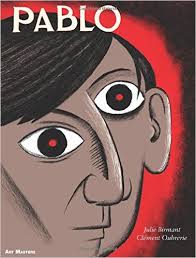
[READ: October 4, 2015] Pablo

Judging this book by its cover you would be correct in assuming that it is about Pablo Picasso.  But rather than being a simple history of the Art Master (the title of the series), this is a thorough recounting of Picasso’s life.  And what’s even more interesting is that the story is told from the point of view of Picasso’s lover and model Fernande Olivier.

And Fernande’s diary entries make up the bulk of the story and allow for a very personal look into the man and the stylistic choices that Picasso made over the years.  As the book says on the back, the authors show “how Picasso’s style developed in response to his friendships and rivalries.”  And of his rivals none was greater than Henri Matisse.  (The book also covers Picasso’s life before she met him too, of course).

The original work was published (in French) in four volumes.   This edition was translated by Edward Gauvin.

I especially like the way the book begins from the point of view of Fernande as an old woman, still alive and reminiscing about her life. (And yes, it’s amazing to realize that Picasso died in 1973…in my lifetime!).  (more…)

Read Full Post »

jup[iterSOUNDTRACK: BUILT TO SPILL-The Normal Years (1996).

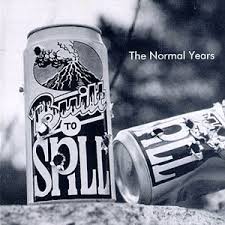
btsnormalIn 1996, Built to Spill signed with a major label.  In the meantime, K Records, released this collection of early singles and rarities (not bad for a band with two albums out).

It’s not a bad collection, but it’s also not terribly essential.”So & So So & So from Wherever Wherever” is a very good song, with a weird almost seasick guitar intro and then some big heavy guitars in the chorus.  It, like most of the songs here, is pretty lo-fi.

“Shortcut” is a fast and simple song and is only 90 seconds long.  “Car” is the original version of the song from Love.  This one has no strings and is “Some Things Last a Long Time” is a Daniel Johnston song.  It opens slow with “ah ah” backing vocals and slow guitars although at 90 seconds the guitars kick in and pick up the noise.

“Girl” is done on an acoustic guitar song.  It seems very honest and confessional with the lyric that he would like “someone I can talk to; someone I don’t have to talk to.”

“Joyride” is like the opposite of “Girl.”  It’s probably my favorite song here–sloppy and funny, with a great line: “I screwed her and she screwed me but we never once had sex.”  And the whole second verse talks about the structure of the song, including which chords are being played.  It even includes a car crash.   “Some” is a live recording that opens with slow pounding drums and a long solo to start.  It mellows out by the end.

“Sick & Wrong” is an early single with a surprisingly funky bassline.  “Still Flat” comes from the Red Hot & Bothered collection, so it sounds better recorded than the other songs.  It also has a trombone.  The final song, “”Terrible/Perfect” starts slow but builds big and ends with a long mellow instrumental section.

While there are certainly some good songs here, it’s really for the die hard fan.

[READ: September 29, 2015] Jupiter’s Legacy

Jupiter’s Legacy Book One collects books 1-5 of the Jupiter’s Legacy series.

I didn’t love the artwork of this story.  There was something about it that I found disagreeable.  And it made my initial impression of the story less than great, too.  There is a bunch happening all at once that needs to be unpacked and I was a little distracted by the art.

But the story is so good.  It takes ideas that have been bandied about recently–What do superheroes do if there are no more super villains?  What do the children of superheroes do?  And what would happen if superpowers become illegal–and adds a personal drama (and a very elliptical storytelling style).

The story opens in 1932.  A group of people are requesting transportation to an island which the ship’s captain says simply isn’t there.  The leader, Sheldon, has had a dream about it being there and everyone (including his brother William) trusts his visions completely.  And they do find the island just as Sheldon imagined.

Then we flash forward to 2013.  We see two young people who look a bit like the earlier men and women.  It turns out that they are the son and daughter of the 1932 folks.  They are celebrities living in Los Angeles, and they looks somewhat the worse for wear.  Meanwhile in Vermont actual superheroes are battling Blackstar.  And that’s when we see Sheldon is one of those superheroes.  He has gray hair but, well, he’s a superhero–in tights a cape and he is known as Utopian.  He is super string and has a cool ability of removing a person’s mind from their body and putting it in a safe place while that person’s body is getting pummeled.  This prevents them from fighting back. (more…)

Read Full Post »

kickassSOUNDTRACK: BUILT TO SPILL CAUSTIC RESIN (1995).

caustic This is one of those CDs that I used to see all the time back when I shopped at Tower Records in Boston.  Either they had a lot of copies of it or it was always at the front, or something.  But I never forgot the title of this EP, which I only purchased a few years ago.

The title is funny because it is indeed a merging of Built to Spill and Caustic Resin.  But it’s not a split single with the two bands playing.  Rather, it is Doug Martsch from Built to Spill playing with the three guys from Caustic Resin James Dillion on drums, Tom Romich on bass and Brett Netson on guitar and vocals on “Shit Brown Eyes.”  (Remember how Doug was planning to have different musicians on each album?).

The EP has four songs totaling about 25 minutes.

“When Not Being Stupid Is Not Enough” is over 9 minutes long.  It opens with a lot of instrumental stuff until about 3 and half minutes when the title lyrics come in as does the organ.  By 5 and half minutes the song doubles in speed and builds with some great soloing.

“One Thing” has loud and screamed vocals from Martsch (probably the only BtS song like that). There’s a lot of wild psychedelic keyboard work in the middle of the song which alternates with a lengthy guitar solo.  They pack a lot of jamming into five minutes.

“Shit Brown Eyes” was written by Caustic Resin.  It’s a fairly conventional sounding song.  There’s lots of guitar work and dual vocals.  It’s a little chaotic, but there’s more beautiful soloing toward the end.

The final song is a cover of Kicking Giant’s “She’s Real.” The song is also fairly conventional (I don’t know the original) but they stretch it out to 8 minutes.  It has a slow and mellow opening.  There’s a lengthy fairly quiet guitar soloing section and then the end has a rocking section repeating “be my, be my baby” (but not a cover of the original).

This is an interesting EP, and might serve as an introduction to Caustic Resin (who I don’t really know) more that Built to Spill.  It’s certainly not their best album, but “When Not Being Stupid Is Not Enough” is really fantastic.

[READ: July 20, 2015] Kick-Ass

I really enjoyed the movie of Kick-Ass.  I knew it was from a comic book but I’d never seen the book before.  And then I walked right past it in the library and had to check it out.  This book collects issues 1-8 of the first series.

The movie is changed in different ways (made more “upbeat” mostly) but the story line is pretty consistent.  Dave Lizewski is a fairly  normal kid.  He’s not a jock, but he’s not picked on either.  He likes comic books but isn’t a major geek.  He crushes on a hot girl and she won’t give him the time of day–pretty standard fare.  But he wants something more.  And he wonders why no one has ever tried to become a super hero for real.  Obviously there’s no magic or superpowers involved, just a costumed avenger helping people?  Why not?

So he decides to do it.  He puts on a scuba suit an and a mask and heads out. Now, unlike every superhero, he has no major back story.  His mother is dead, but from an aneurysm, so there’s no revenge.  And his dad is pretty cool, so there’s no struggle there.  He just wants some excitement.  And he finds it.  He runs into some kids spray painting on a wall.  He has no fighting skills, and he gets the crap beat out of him.  And as he flees, he is hit by a car.   He winds up in the hospital, barely alive. (more…)

Read Full Post »

woyzeckSOUNDTRACK: BUILT TO SPILL-There’s Nothing Wrong with Love (1994).

Theres_Nothing_Wrong_With_LoveThis is the second Built to Spill album.  They moved to a new indie label (Up Records) for this one.  For this album the line up changed to Brett Nelson, on bass and Andy Capps on drums.

For this album there aren’t too many long songs.  In fact many are 3 minutes or less.  And overall, the feel is more lo-fi, less experimental.  And yet it still sounds very much like Built to Spill.

“In the Morning” is pretty and catchy with some interesting guitar work that is downplayed in the mix. I like the rather surprising ending.  “Big Dipper” is insanely catchy with two separate styles of guitar solo at the same time.

“Car” is even catchier–one of their great early songs.  It’s got a great riff and verse.  And the strings add a lot to the song.  “Fling” opens with acoustic guitar and strings.  It’s a pretty song and only 2 and a half minutes.  “Cleo” is another slow song with some bursts of guitar greatness.

“The Source” has loud and quiet elements—big acoustic guitars and some crazy jamming moments towards the end.

“Twin Falls” is a stripped down and honest song.  It’s just him and his acoustic guitar (with some electric guitar soloing over the top) singing an honest, sweet ballad.

“Some” has slow and heavy elements as it tells a story about a guy. It’s the longest song on the dis and one of the few where Martsch just lets loose on guitar and wails (for a long time).  “Distopian Dream Girl” has a kind of sloppy feel to it (with the lead guitar being especially sloppy).  The lyrics about his stepfather looking like David’ Bowie are very funny. I love the way the mildly catchy verse turns into a big catchy chorus.

“Israel’s Song” has a groovy bass line unlike anything else on the disc.  And the disc proper ends with “Stab.”  The song opens slowly with some quiet electric guitar but it builds for 5 and a half minutes (the second longest song on the disc). By 2 minutes, the song has become a heavy guitar song getting faster and faster until it breaks into a slow guitar picked section with strings. As the song returns to that heavy fast section, it adds a long guitar solo–combing all of the elements of Built to Spill in one song.

Although this album isn’t as “experimental” as the first and doesn’t have too many weird sounds on it, they haven’t lost their sense of humor.  There is an unlisted track which is a “preview” of the next Built to Spill record.  It contains several snippets of “songs” that will appear next (a decent variety of styles, too).  Of course, none of these songs appear on the record and the date that they give for when it will come out is also false.  It’s pretty darn funny.  This album tends to get overlooked because their next full length was on a major label, but it’s still really solid.

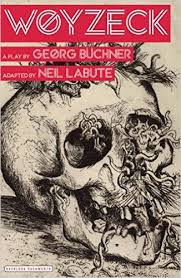
[READ: September 26, 2015] Woyzeck

Karl Georg Büchner died in 1837 at the age of 24. In his short life he wrote 4 plays and all kinds of nonfiction.  Woyzeck was unfinished and has been adapted many times for the stage and film.  And now it is LaBute’s turn.

Neil LaBute is one of the most misanthropic filmmakers I know of.  His films are super dark, (occasionally funny–but always dark) and he’s not afraid to address controversial issues.  So he seems like the perfect person to adapt (and add to) this play.

In the lengthy introduction, LaBute comments that if you didn’t spend time looking for buried treasure as a kid “your childhood may have been even worse than mine and therefore I want to spend no time imagining it.”  He says that Woyzeck is such a treasure. (more…)

Read Full Post »

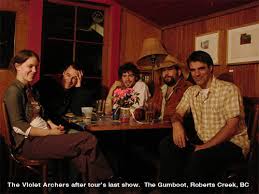
powers SOUNDTRACK: THE VIOLET ARCHERS-Victoria, BC (October 2005).

violetarcI have reviewed this show already, but with some context of other shows, it seemed worth revisiting.  The opening act was Scribbled Out Man (their bio on the CBC Music site says that they are friends of the Rheos).

I suspect this dates from 2004, as Tim says the album is coming out late spring or early summer and might be called The End of Part One (it was released in 2005).

The opening track is a soundcheck.  It sounds fine, although the “real” version later is better.  They play 12 songs at this show (compared to 8 in the previous show).  They cover all of the songs from their debut except “Outrovox” which is a short instrumental and “Fools Gold Rope” which is sung by Ida.

The opening two tracks are just Tim on guitar, singing the lovely simple song, “Simple” and the slightly darker, minor chord “All the Good.”  They sound good, but it’s more fun when the full band comes out.

Yawd on guitar and keyboard, Steve Pitkin on drums and Bass on bass.  “The End of Part One” sounds great, but Tim has some major guitar problems playing “Life and Then” a normally great song.  The rest of the set goes off without a hitch.  It’s true that the band sounds better when Ida sings with them, but in this original incarnation, they’re quite good.

For the final song “Here Comes the Feelings,” Tim asks, should we do the false start?  That’s become part of the song.  Steve counts to 5 and then we go–but we’re gonna get it wrong.  And they do.  But once they get past that, it’s a great set closer.

The band is still looking for a name, Tim suggests “The Gay Apparel.”

[READ: May 27, 2015] Powers Bureau

I hadn’t heard of Powers Bureau before (this book collects issues 7-12).  My initial thought was “do we need yet another superhero book?” But this book is different in a fun way.  Also I love the artwork–it is blocky and bold and reminds me of the Bryan Lee O’Malley style.

So this book is about Federal Agents Christian Walker and Deena Pilgrim.  They used to be homicide detectives who worked solely on (super) powers-realted cases.  But there was a disaster of some kind (presumably in book 1) and now all powers-related cases are Federal cases.

The two arrive at a crime scene in which a woman is tied up naked in the bathtub (way to open, huh?).  The boyfriend is the suspect, but he says that the woman (whom he did tie up for sex purposes) suddenly appeared next to herself, killed “herself” then fled.  It sounds preposterous, until they realize that the woman is Matzuii, who can split her self into multiple parts.  So essentially she killed herself. (more…)

Read Full Post »

cowlSOUNDTRACK: THE VIOLET ARCHERS-Fall Nationals The Horseshoe Tavern Toronto (November 17, 2003).

veselyThe Violet Archers were (are?) a band formed by Tim Vesely, bassist for Rheostatics.  They released their first album, after the release of Rheostatics’ final album, 2067.  However, given that this show was recorded in 2003 and they talk about an album, it’s clear that Tim was writing stuff all along.

The band released two albums, which I’ve mentioned before: The End of Part One and Sunshine at Night.  They are both poppy and kind of mellow (with some noisy parts). And they are both great.

This show comes not only before the first album was released, it comes before the band even has a name.  It occurs on night 8/13 of the Rheostatics Fall Nationals 2003 at the Horsehoe.  This night was called SoloStatics Night (Martin also does a show).  The band for this set is – Yawd Sylvester (guitar/keyboards), Steve Pitkin (Drums), Bass (Bass).

The show starts with “Coordinates” which “shows of Tim’s hot guitar licks.”  The heavier parts rock pretty loud.  Yawd is playing some wild notes until the song smooths out some.  It also has an ending coda which not on the album.  “Life and Then” is a more upbeat song (with backing vocals).

Tim explains that the name of “The End of Part One” was inspired by his daughter’s speaking part on Harmelodia (she says end of Part 1).  For this song, Yawd plays keyboards.  Then Tim thanks Yawd for wearing pants tonight.  And thanks Bass for having his stomach sewed up before the gig.

“First the Wheel” is a protest song about food and war.  There’s a big guitar sound that sounds a bit more aggressive than the album.

Tim says that we (the band) don’t have a name, but this song does.  “Track Display” is a slow, mellow song with the unfortunate moment that as Tim is singing “things just sound so nice” that he hits a bad chord.  There’s some nice organ sounds and overall the song sound fine.

Some jokey band names shouted out: Marshmallow Room, Jello Enema, Submissions, Beauty Call, Beauty Kong, My Three Bearded Men, The Hairy Beards

“Saved Me” with simulated horns by Tim is quite nice.  Then Tim says the record is almost done, and it’s due out early next year.

The final song is listed as “Come the Night” but later on the record it will be call “A Rising Tide.”  I love the way the chorus turns minor and dramatic (along with Tim’s falsetto vocals).  It’s a good set and a good introduction to this band.

Amazingly, there is also video footage courtesy of Mark Sloggett can be found here.

[READ: May 25, 2015] C.O.W.L.

I saw this book at work and was quite intrigued.  I love a new graphic novel series that seems different.  And one called C.O.W.L. Chicago Organized Workers League sounded promising.

But I have to say that right off the bat I really didn’t like Rod Reis’s artistic style.  The book is set in Chicago 1962 and has a decidedly noir element.  It is translated very well by Reis’ style.  But I just don’t like it–it’s very dark and shadowy and I prefer my comics brighter.  I also found that the book looked like the it was computer designed–like the characters were cut and pasted and sometimes angled by computer–I found it a bit unsettling at times.

But I can get around that if the story is good.  And this one is.  After World War II, a group was assembled to try to bring all of the superheroes together.  It was started by The Grey Raven, Blaze and Sparrow.  They were organized by the titular labor union which also impacts other city workers.  (I love that idea).

And they were very successful.  But now, in 1962, the public is not sure what to do with C.O.W.L.  They have successfully taken down all of the supervillains, so what is their purpose?  This book collects C.O.W.L. issues 1-5. (more…)

Read Full Post »

myopSOUNDTRACK: DEVO-“Satisfaction” (1977).

devoThis has to be the most audacious cover of its time.  Devo took one of The Rolling Stones’ more beloved song and turned it into a weird, angular piece of art.

The original has a simple riff, a surprisingly slow pace an a slinky, sexy groove.  Devo has sped it up and, most importantly, made it angular and complete unsexy.  I have been listening to this song over and over trying to figure out what is going on.

The drums are consistent but there’s all kinds of interesting sounds in the drums.  The guitar and bass are doing one or two repetitive riffs that don’t quite make sense individually, but work well together.  The bass line itself is just fascinating–how did anyone think of that?

Lyrically, the song is the same, but instead of sounding like a guy who is trying to score, he sounds insane.  And the babybabybabybabybabybaby section is hilarious and weird.  Then they throw in a modified “Satisfaction” riff loud on the guitar at the end with the band chanting “Satisfaction.”  Talk about deconstruction.

No Devo song would be complete without the visual element.  All five of them wearing their plastic hazmat suits, moving in stiff/jerky motions, more robot than human.  And of course, Mothersbaugh himself looks crazy with swim goggles on and mussy hair.  Then they show his modified guitar–the first item in close up.  There’s duct tape all over it, and extra knobs and some kind of square bottom section.  It seems impossible that it is making the sounds that he is shown playing on it since the strings (or is it just one string?) seem so loose.

There’s the guy doing flips (Wikipedia tells me he is dancer Craig Allen Rothwell, known as Spazz Attack, whose signature dance move was a forward flip onto his back).  And of course, there’s an appearance by Booji Boy sticking a fork in a toaster.

What on earth did Mick and the boys think of this?

This cover was done in 1977 and it is still remarkable today.

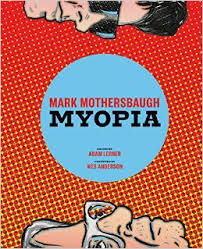
[READ: September 1, 2015] Myopia

We saw Mothersbaugh’s Myopia show at the Museum of Contemporary Art Denver.  In retrospect I would have loved to spend more time there (although the kids probably wouldn’t have).  So when I saw that there was a book for the show, it seemed like a worthwhile investment.

And this book is a fascinating and comprehensive look at Mothersbaugh’s life and output as a visual artist and a founder of Devo.

Mark was a quiet kid and he was legally blind when he was born.  It wasn’t until he was around 5 that he got a pair of glasses which totally changed his world.  He was always artistic and rebelled against convention.  His world was greatly expanded when he went to college.  But he was at Kent State when the four students were killed by the National Guard. This affected him profoundly and send him investigating the world of devolution.

Of course most people know of Mothersbaugh from Devo–who were huge in their own way in the 1980s.  I was a young lad at the time and while I liked “Whip It,” I never thought they were cool (if only I knew).  But before creating Devo, Mothersbaugh was creating all kinds of visual arts.  He was doing print making at college, he was doing postcard mailers to people. It was only when he realized how much cheaper it would be to make music than to constantly be making print items that he devote some energy to Devo instead. (more…)

Read Full Post »

« Newer Posts - Older Posts »