 SOUNDTRACK: THE MOPS-“Goiken Muyo (Ilja Naika)” (1971)
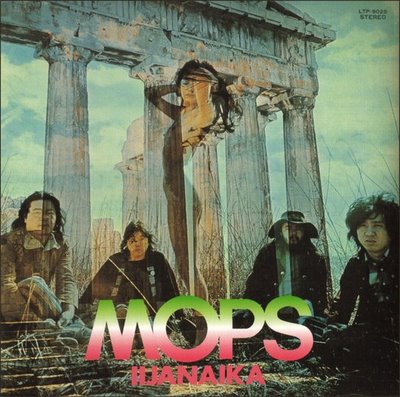 The Mops were a Japanese psychedelic band who were inspired by American psychedelia. They appear in one of the films below (Stray Cat Rock: Wild Jumbo from 1971) in a really weird scene in which the band is playing on the back of a flatbed truck (in the middle of another scene that has nothing to do with them). They play their song and then drive away. Weird.
Anyway, the song is pretty great. There’s all kinds of interesting percussion (the film clip shows them playing stuff which most likely is not what they are playing). But the studio version (linked to below) has great audio quality and a lot of depth in the bass and cool screaming guitars.
The band released possibly 9 albums (it’s a little hard to tell from their Wikipedia page). With their first album being pretty psychedelic and this one (I assume their third) being much heavier and fuller sounding.
I had found a clip of the band from the movie. Then I lost it and cannot find it anywhere. But here’s the studio version dubbed over the movie clip
But really, check out the whole album, it’s pretty great.
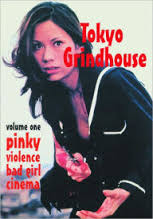
[READ: October 10, 2015] Tokyo Grindhouse
The life cycle of a book at my work is pretty straightforward. If I see it at all, I usually catalog it or send it on its way to someone else. But for some reason this book came back to my desk three times.
I didn’t know a thing about Tokyo Grindhouse, I’d never heard of pinky movies, but if something keeps coming back you gotta check it out. So it turns out that this book has about ten pages of text and the rest is pictures.
And the book is about “classic” exploitation films made in Tokyo from 1960-1970 (or so). The text by Jack Hunter explains that women and violence have been in Japanese exploitation films since the 1950s. Evidently there were some landmark films in the mid-fifties about topless pearl divers that set off a craze for topless women in films. This morphed into movies where women were the victims of violence with translated titles such as Nude Actress Murder Case: Five Criminals.
But it was in the late 1950s and early 60s that Japanese filmmakers started focusing on delinquent or violent female leads–women fighting back and fighting back hard (and probably topless). This led to yakuza series, which added elements of female criminality, prostitution, girl gangs and girls in prison. This all laid the ground work for “bad girl cinema” in Japan.
Bad Angel was one of the first, but a second wave (which was more violent) came about in the mid 1960s. It began with some gambling movies (the cleverly titled Female Gambler and sequels like Female Gambler and the Nun). Evidently this introduced a subgenre of “nunsploitation” films.
Most of these movies were made by the same production company and most of them had multiple sequels (The Red Peony series has 8).
Some went in a more soft core porn direction, but this book focuses on the pinky violence (a term which is never actually defined). And so much of the book is given to the late 6os and early 70s. He starts by looking at women in prison movies including a trio of films (which are highly regarded) Female Prison Scorpion 701, the sequel Cell 41 and the final sequel Beast Division (1972-1973), They all starred Meiko Kaji as the titular prisoner who fought back against all oppression (presumably topless). Kaji acted in more than 100 films and also became a singer (as so many Asian film stars seem to). Recently, she contributed songs to Tarantino’s Kill Bill (or actually, I gather older songs were used in the film). In fact it is Taranatino who seems to have caused the resurgence in this type of film and may be something of an indirect impetus for this book).
As the prison movies were being churned out, there was also a the girl gang series. This started with Delinquent Boss and was followed by the Stray Cat Rock series (four films all starring Kaji). The genre became known as sukeban. There’s also a trilogy of films called Girl’s Junior High School. There’s also the Delinquent Girl Boss series (four films) which starred Reiko Oshida who excelled in fight scenes (presumably nude).
This all led to the pinky violence films which, the book says, “would be filled with nudity, sex, action, cat-fights, torture, and revenge and peopled by very very bad girls.” The final movie mentioned is 1974’s Zero Woman: Red Handcuffs (also very highly regarded). The book describes it as “exploitation film-making that transcends its genre limitations to spiral into realms of pure delirium.”
After this film the pinky violence craze died down, to be picked up by a trend that I assume will be covered in volume two should it ever come out.
The rest of the book includes posters ans stills (over 140 rare images of film posters and publicity shots). Most of the photos are NSFW, by the way.
So this was my introduction to a genre of film I never knew existed but which I guess I have been somewhat aware of mostly because of Tarantino and his friends. But most importantly, it introduced me to The Mops!
Here’s The Mops singing The Doors’ “Light My Fire.”


Leave a Reply