Feeds:
Posts
Comments

Archive for the ‘Universities’ Category

#20SOUNDTRACK: SUGAR-File Under: Easy Listening (1994).

fuelI  always thought File Under: Easy Listening was a very funny title.  But it’s possible that people took it too literally as it didn’t sell all that well. And in Mould’s autobiography he says he didn’t have much time to write songs for this disc and he thinks it suffered.  Of the three Sugar discs, this is definitely the weakest, although there are some great moments on it.

The disc opens with “Gift” which has some ragged distorted guitars. It’s got some noises and grungy sounding solos showing that FU:EL was a joke.  Although, the overall sound is kind of a cleaner version of the angry songs on Beaster.  “Company Book” is kind of a pounder, until the voice comes in and you realize…it’s not Mould!  It’s got a catchy chorus, but after the kind of underwhelming opener, it’s a strange place for a song that’s also not so dynamic.  Especially when it’s followed by “Your Favorite Thing” another great pop song from Mould—not top tier but a really strong second tier (although that bright, simple guitar solo is a real winner).  “What You Want It To Be” is a another decent song (the addition of that extra guitar playing the melody line really makes the song shine.  “Gee Angel” is also a high point.  A catchy song, but which never quite reaches the heights of the previous albums.

“Panama City Hotel” has the same feel as the opening of Beaster: bright acoustic guitars and a similar riff.  But it never really goes anywhere, and the 4 minutes seem.  The “do do do do’s” that open “Can’t Help You Anymore” are certainly the brightest spot on the album, and a big pop song as well.  “Granny Cool” has a nicely abrasive riff although it seems kind of mean spirited.  It’s funny that he tucked “Believe What You’re Saying” at the end of the album.  It’s a minor song but it sounds so bright on this album after the other songs. It’s really quite pretty.

And the closer, “Explode and Make Up” is one of Mould’s great angry songs.  Unlike Beaster, this one has a happy acoustic field—bnright guitars with that raging distorted guitar underneath.  It’s a great slow burner of a song and at five minutes it ends a somewhat lackluster album in a great way.

[READ: March 31, 2013] McSweeney’s #20

McSweeney’s #20 is an issue that I have read before.  At least I think I have.  My recollection is that it was the last one I read before I started writing about them on this blog.  I was hesitant to read it soon again, which is why I waited until now.  And while I remember the issue itself (with all of the art), I didn’t remember the stories.  So who knows if I actually read it six years ago.

Anyhow, this issue comes jam-packed with art.  Every fourth page has full-color artwork on it–many of them are quite famous.  It makes for a very beautiful book.

In between these artworks are a number of stories–ranging in size from 2 pages to 30-some pages.  There are no letters, and the explanatory and copyright information is on the cover of the book–which would be fine, except that it is covered up by a kind of 3-D artwork.  I wonder if the whole text is available anywhere?

The book also comes with a separate pamphlet–an excerpt from Chris Adrian’s Children’s Hospital.  I intend to read the novel eventually so I didn’t read the excerpt–although maybe if I put off the novel for six years I should just read the excerpt now. (more…)

Read Full Post »

CV1_TNY_12_03_12Thiebaud.inddSOUNDTRACK:  PETER BJORN AND JOHN-Live at KEXP May 10, 2011 (2011).

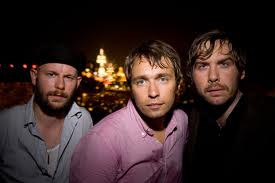
pbjkexpPeter Bjorn and John play KEXP every couple of years.  This set is promoting their most recent album Gimme Some.  I haven’t heard much of Gimme Some.  I found the last album to be kind of dark, but this one seems to have upped the poppy quotient a bit.  I was surprised when they opened the set with “Second Chance” which is the theme from 2 Broke Girls (and is the best thing about the show, I hope they get a ton of cash from that!).  If you ‘ve seen the show, you may be surprised that there are lyrics, but there are, and it works as a full length song, too.

“Dig a Little Deeper” has a kind of reggae feel and an amusingly long drum opening because “Peter dropped his guitar”.  It’s a poppy catchy singalong with lots.  “May Seem Macabre” is a funny title for a song that is as poppy and danceable as this one.  “Eyes” continues that upbeat poppy flavor.   This is a very fun set and I’m going to have to check out the album as well.  Peter Bjorn and John have proven to be a consistently great band where every album sounds different. You can listen to this show here.

[READ: December 5, 2012] “Nighthawk”

Tony Earley’s essay in the food issue differs from the others because it is not about a specific food, but about cooking.  Or, lack of cooking.  It’s a pretty funny essay about a boy of a certain age and time who was, if not spoiled exactly, simply waited on–by his mother and his grandmother.

His mother would make on demand fried bologna and onion sandwiches (wow, that sounds gross but I’ll bet it’s pretty good), and his grandmother would have waiting for him anything he desired when they visited.  Even when he went to college, he lived close by so he just went home for meals.

It wasn’t until he moved to Tuscaloosa that he realized he had no idea what to do in the kitchen (the description of the muffin tin and his inability to even conceive of its use is very funny).  And then, like other students, he subsisted on frozen meals and whatever else he could whip together with his meager skills.  His point though, is that eating alone is okay, but it really takes a toll on the taste of food–no matter how much cheap wine you drink with it to appear sophisticated.   (more…)

Read Full Post »

SOUNDTRACK:  JEFF THE BROTHERHOOD-Tiny Desk Concert #165 (October 8, 2011).

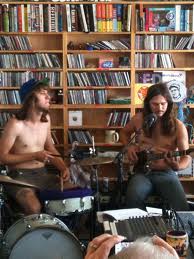
This was my first exposure to JEFF the Brotherhood, a rollicking duo who blast out the walls of the NPR studios.  The guitarist and drummer play simple, power punk (quite well) and they sound like a whole band, not just two guys.

“Diamond Way” reminds me of the Meat Puppets–echoey lazy-sounding punk.  ANd the oh oh oh oh oh is very catchy.  And then, after describing an NPR host as sounding like Ira Glass–if he were an old woman (and then apologizing if he offended anyone), they play “Bummer”–shirtless—presumably a first for the NPR offices.

“Bummer” is a mellower song and their sound doesn’t sound less full for the mellowess–especially when he kicks on the distortion pedal.  “Bone Jam” is one of my favorites–more ooh’s and the simple but wonderful lyrics “Gonna grind your bones to make my bread.”  It’ s amazing that two guys can sound this good.

[READ: August 17, 2010] “The Ruin of Amalfitano”

Natasha Wimmer has translated yet another posthumous work from Roberto Bolaño, this one called Woes of the True Policeman, due out this month.

This may already exist, but I hope someone is compiling a family tree of all of the Bolaño characters who have appeared in different locations.  For instance, the Amalfitano in this story appeared in 2666, indeed he has a whole chapter about himself.  And we know it’s the same Amalfitano because they both have a daughter named Rosa.  This story is set before 2666 and these fascinating events would shed some light on the state of Amalfitano when we do meet him in the novel.  Of course, Bolaño’s writings don’t seem to follow a conventional strategy so who knows if he intended any of this to be part of the “missing” Part 6 of 2666.

Anyhow, this story is about Amalfitano, but it opens with Padilla who decided to become an artist at the age of 13.  After dabbling in theater and film, he settled on poetry.  By 17, he was a sarcastic angry kid who could be easily provoked to violence (he claims that when fighting Nazis, anything is permitted).

At 18, he published his first book of poetry and when he was 21 he showed the poems to Amalfitano.  Amalfitano was a teacher of Latin America writers at the University.  He liked Padilla’s poetry, although he didn’t much like Padilla who didn’t come to class very much.  But once Amalfitano gave him praise for the poems, Padilla never missed another class. He even invited Amalfitanoto his house for parties.  After many such parties, the two became lovers.

Once the University learned of this, Amalfitano was fired.  (more…)

Read Full Post »

SOUNDTRACK: DEERHOOF-Live at CMJ Gibson Showroom (2008).

I don’t know much about Deerhoof (I certainly didn’t know they’d been around over a decade).  I heard them on Pitchfork TV (they had two videos on it about two years ago which I rather liked).  This set was recorded live at CMJ by KEXP.

The DJ is very familiar with the band, and the repertoire is casual and funny (although the Gibson joke falls flat).  They play four songs and each one is virtually an instrumental.  The voice is mixed so low on “Blue Cash,” I didn’t even realize she was singing until the third time I listened, so I don’t know which songs have words.  “Tears of Music and Love” is a bit wilder (with some great crazy drumming in the middle).  “Fresh Born” has a bit more of a sinister edge what with the intense riff and the scratchy feedbacky bridge.  It’s my favorite song of the set.  “Basketball Get Your Groove Back” sounds a bit like “Roadrunner” so it’s less than thrilling end to the set.

I expected the band to be a lot weirder than this, I admit, but it’s still a good set.  You can listen here.

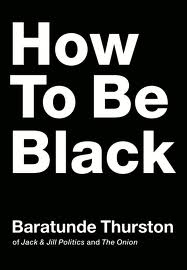
[READ: September 20, 2012] How to Be Black

Karen at A Just Recompense posted about this book a little while ago and after just a few lines, I had to stop reading her post so I could get the book.  I had no idea who Thurston was before I read the book, but it sounded so good.  And it was.  Although it wasn’t exactly what I was expecting.

This book is a combination autobiography of Thurston and “how to” book.  Thurston went to a Quaker School and a black militant program at the same time and also went to Harvard before becoming a stand up comedian; he’s co-creator of Jack & Jill Politics and director of digital at The Onion (that’s some serious cred for a geek like me).  As I said, in addition to being his autobiography, this is also something of a how-to manual for being black.  It’s funny, but not cheesy-over-the-top funny (stereotypes are played with but also deconstructed), it’s “serious” funny, and it’s very enjoyable.  And it covers topics that one might not expect, like talking about the Nigerians he has met who are offended at his name.  Baratunde is a twist on a Nigerian name, although his family is not Nigerian, his mother wanted him to have a traditional African name.  And he is quite annoyed at the Nigerians who assume he doesn’t know what his named means.  He does (and the example he gives is very funny). (more…)

Read Full Post »

SOUNDTRACK: MOGWAI-Special Moves (2010).

This is Mogwai’s first live album and it really captures the band in all of its intense glory.  This is a good year for a Mogwai live recording because they play some of their newer song which are a bit more melodic (and sometime have words) but they also revisit their older songs–which still sound intense.  It’s a great overview of their career so far and it’s a great testament to how different their music sounds over the course of so many years–even though they still sound like Mogwai

We get two songs from Their (then) latest The Hawk is Howling –“I’m Jim Morrison I’m Dead” and “I Love You I’m Going to Blow up Your School.” Two songs from Mr Beast “Friend of the Night” and the stunning set closer “Glasgow Mega Snake.” Two from Happy Music “Hunted by a Freak” and “I Know You Are But What am I.” Two from Rock Action “You Dont Know Jesus” and “2 Rights Make 1 Wrong.”  From Come On Die Young we get “Cody” and from their debut, two classics: “Like Herod” (which is amazing live) and “Mogwai Fear Satan” (also amazing)–each one over 10 minutes long and full of the emotional release that we’ve come to expect from Mogwai.

This is a great place to start if you want to hear what Mogwai is all about.

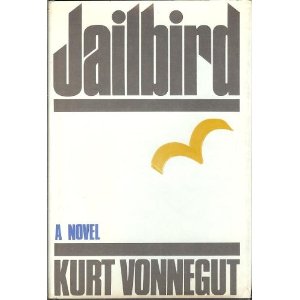
[READ: June 4, 2012] Jailbird

First off I want to say how neat it is that I took this book out of the library and that it’s from 1979.  Thirty-three years old!  Books are cool.

Anyhow, I have a stack of dozens of books I want to read, and yet somehow Vonnegut said, no, read me now.  In addition to Vonnegut books being relatively short, they are also very quick to read.  I read this in a couple of days, which is very satisfying.

My old boss at the library told me that she thought Vonnegut more or less stopped writing good books after Breakfast of Champions.  I disagree, but that has certainly colored the way I look at his later books before I read them–which one had she read that turned her off?  I kind of suspect it was this one.

In some ways this is a minor novel.  It’s fairly brief (240 pages, although there’s  30 page Prologue which I gather is from Vonnegut himself (you never know, he has so many layers going on)).  He explains some of the details that are in the book and several other interesting preface-type things.  I enjoyed the bit about the fan who wrote to Vonnegut and (Vonnegut claims) summed up all of his works in just seven words: “Love may fail, but courtesy will prevail.”  And that is the basic plot of this book. (more…)

Read Full Post »

SOUNDTRACK: MAC LETHAL-“You’re vs. Your” (2012).

Mac Lethal is a YouTube sensation (he did the pancakes video that I liked quite a bit).  And, yes, he does actually have albums for sale.  He raps really fast (so fast that I wondered if it was sped up–I don’t believe so).  I am 100% behind the sentiment of this song (possessive vs contractions, this is something you used to know).

I’m a grammar freak, so it bothers me when I see these common mistakes made.  It’s nice to hear a song about it (even if it’s not a terribly catchy song or anything).

I like his name dropping and his lecture is pretty effective.  I’m a little confused by the big dick reference/joke at the end of the song…it’s not really relevant.  But his fast tongue is really impressive.  As for his singing….mmm, stick to rapping.

I like the T-shirt!

[READ: May 15, 2012] Science News Letter

I’ve mentioned before when my company sends out links to articles that are interesting or cool.  This is the second time a link to a Science News Letter has gone out.  I swear if I had time, I would love to read all of these.  I wonder how often it was published?

This letter has only two articles in it–one from Physics and one from Archaeology.

The Archaeology one is called “Find Sacred Kitten in Bronze Cat Coffin.”  And indeed, two metallurgy experts were cleaning a bronze cat (which had “bronze disease”) and inside of it they found the bones of a fetal cat.  This was one of the first times that actual bones were discovered in one of these cat idols.  There’s even a (kind of creepy) picture of the bronze statue with the far creepier caption: Cat Coffin.

The Physics article is headlined: Fifth Dimension is New Realm Entered by Professor Einstein”  What?  How cool is that… “Professor Einstein!”  Einstein died in 1955, so it’s not weird that he’d be in a Science Letter.  But still!  Einstein talking about his current theories?!  The subtitle is “Celebrating Sixtieth Birthday, Scientist Wants New Dimension To Account for Electro-Magnetic Effects.” (more…)

Read Full Post »

SOUNDTRACK: THE COLIN McENROE SHOW-The Life & Legacy Of David Foster Wallace (December 5, 2011) (2011).

This NPR show features an interesting discussion about David Foster Wallace:  his fan base, his cronies and his archive.   The guests were Donald Brown (New Haven Review), Evan Hughes, Ryan Walsh (who created the David Foster Wallace Audio Project) and Maria Bustillos.  Evan Hughes recently wrote a piece in New York that I’ll look at tomorrow and Maria Bustillos wrote the main piece for today’s post.  The other two guys I admit I don’t know.

This show looks at some interesting aspects of DFW’s life in the wake of his suicide and the release of The Pale King.  Although really the impetus seems to be Hughes’ article (which was published in Oct).  McEnroe asks him about the state of literature today and how both Jonathan Franzen and Jeffrey Eugenides have created characters that “resemble” DFW in some way.

They talk about the cult of DFW and play some audio clips.  Brown is an older reader and so does not embrace DFW as much as others.  He is of the same age as DFW and so loves the people DFW loved more than DFW himself.  I get the feeling that he is a curmudgeon.

But they can all agree that fans of DFW feel that he was their buddy.  Super-intelligent but very human, almost speaking like they would (if they were that smart).  They conclude that the Kenyon commencement speech is something of the pinnacle of his project of earnest warmth in humanity.

At the half way point, Maria Bustillos comes in to talk about going to the archive (which you can read about below).  She explains her own interest in self-help books and how DFW was a person who needed help.

The end of the episode has them talking about DFW’s voice.  They wonder why DFW has an “audio project” but other writers do not.  They talk about DFW’s voice and his presence during interviews and how he is very warm, even when he’s being cold (it’s an odd clip they choose). I’ve mentioned the Audio Project before.  It’s wonderful.

For anyone interested in reading books that are in a similar vein to Infinite Jest, Bustillos recommends Under the Volcano (Malcolm Lowry) and wholeheartedly recommends The Last Western (Thomas Klise).

A fascinating thing about this show was finding out that McEnroe was the author of a pretty funny piece in McSweeney’s many many years ago called “I Am Michiko Kakutani.”  He offers an anecdote about originally mentioning DFW in the story but that the McSweeney’s guys asked him to change it to someone else.

But I have to say that the show seems a bit too much about Colin McEnroe (the McSweeney’s anecdote was just one of many involving McEnroe).  He talks a lot about himself and about how he’s “afraid” that the Awl will make fun of him or that Franzen (who was with McEnroe in a green room backstage at some show) will put him in his next book (because he was discussing Neti Pots).  But I’m just not sure that Colin McEnroe rates enough to warrant the concern. 

It’s an enjoyable show, although unlike other interviews by people like Charlie Rose or Michael Silverblatt, McEnroe’s questions and comments aren’t very well informed.  If you know a lot about Wallace, this show is a bit frustrating because it takes a tone that Wallace is basically a “postmodern ironist” or that he sees everything as “a big dark joke.” And even when the guests are showing that that is not the case, he seems to try to keep reverting back to this trope.

Oh well, it led to some interesting articles at least.  Like the one below.

[READ: December 7, 2011] “Inside David Foster Wallace’s Private Self-Help Library”

For no reason in particular, I’m devoting this weekend to articles that are specifically or tangentially about David Foster Wallace (it’s been awhile, and I have yet to finish my Consider the Lobster project, so, why not). 

I actually read this because of the above radio show.  I know Maria Bustillos because we’re both in a newsgroup.  “Newsgroup” is so 90s, I wonder what they’re called these days).  Anyhow, Maria has always proven to be smart, funny and very articulate.  And the only reason I didn’t read this article when it came out was because I wasn’t sure I wanted to dive into this topic. 

After listening to the above radio show, however, I felt that this would be a very interesting article. And so it was.  It’s available at The Awl.

As it opens, Bustillos lets us know that she visited the DFW Archives Ransom Center at the University of Texas at Austin and pored over all of the materials they have there (undergrad papers, drafts of fiction and non-fiction, syllabi, tests and quizzes, and juvenilia among other things). 

Wallace was a major note-taker.  And he loved to take notes in a book as he was reading.  Just look at some of these books

But what surprised Maria (and me) is that among Wallace’s collection of wonderful fiction was a collection fo self-help books which were equally annotated and marked up. 

Much of the set up of the article concerns why DFW had self-help books at all.  The answer is, of course, because he was a depressed person (obviously) and because he had been in rehab for a pretty long time.  None of this background information is new, but Maria offers insights into DFW and his life that I had never heard before (Maria and DFW had corresponded, although I don’t know if they were “friends” or not).  (more…)

Read Full Post »

SOUNDTRACK: PJ HARVEY-Let England Shake (2011).

I’ve listened to this disc several times online; I have no details about the recording.  There’s samples, but I don’t know what they are and I can’t really tell what all the lyrics are (it’s obvious she’s pretty angry, but the details are lost to me).

The first question for me on hearing this disc is what happened to PJ Harvey’s voice?  It comes as such a shock when you compare it to Dry.  But once I accepted that this is not the PJ Harvey of Rid of Me, I listened to it as a new artist and I really like it.  But it’s a weird record to be sure.

The title track is played on an autoharp (!).  In fact the autoharp is a dominant instrument here.  It’s got a cool melody and, once you accept that she sounds like the singer from Rasputina, you can really appreciate what’s going on.

The second track, “The Last Living Rose,” returns somewhat to the PJ of old (the opening “God damn” sounds like she’s about to bust out some good-ol’ invective).  And there are guitars, but the music is upbeat (as are the vocal melodies) and there’s even a horn!  “The Glorious Land” has samples from the cavalry (I can see the horses riding across the plains) and a cool, slinky guitar (or is that the autoharp?).  There’s male vocals in the middle of the song, and it makes for disconcerting harmonizing (especially when PJ,’s voice ratchets up the weirdness and sounds more like Kate Bush).  But musically this song is great, it’s got a wonderful 80’s alt-rock feel.

“The Words That Maketh Murder” also has horns and some interesting male vocals chanting the lyrics.  This has one of the least subtle lyrics I’ve heard in a long time, although the re-imagining of the “Summertime Blues” refrain is pretty genius.

“All and Everyone” opens with more autoharp, and I think I’m realizing that the autoharp is what I think of as the interesting guitar sound (this song opens like a Smiths’ ballad.)  There’s more horns on this track which adds a weird dimension of sadness to it.  “On Battleship Hill” is a fast but delicate track in which PJ pulls out an astonishing falsetto–completely unexpected.  After the first verses, the rest of the song has, again, a kind of slinky 60s vibe.  “England” brings out the Kate Bush voice in PJ again.  This is a very delicate song, the music is mixed so low in the background that it feels like acapella–I guess Harvey has grown much more confident in her voiuce.  The music builds and builds though and there’s an unexpected middle eastern sounding vocal in the background.

“In the Dark Places” brings out Harvey’s guitar (in this case the Harvey is Mick Harvey, I believe) and her lower register vocals. While “Bitter Branches” is probably the loudest song on the disc, with a bunch of screamed vocals.  It’s rather startling considering the rest of the disc, but it’s nice to know just how much fire PJ still has.

“Hanging in the Wire” is another delicate song, with quiet pianos and Harvey’s sedate voice.  “Written on the Forehead” returns to that middle eastern vibe (“people throwing dinars at the belly dancers”) and that Kate Bush vocal–the backing vocals remind me of Peter Gabriel.  The album ends with “The Colour of the Earth.”  It’s the most disconcerting song of the bunch becuase it opens with a male singer (John Parrish?) singing what sounds like an old trad song (the melody is very traditional).  Then PJ joins in and makes the song her own.

It’s obvious that the lyrics are the main aspect of this disc, and I know that I’m missing something by not having them. I’m also missing a lot by not knowing all that much about England’s history.  It sounds like she has a lot of gripes with Eng-a-lund, and I’m curious to know what she’s on about.  But more than that, I’m totally hooked by the music.  It’s a great reinvention of a great artist.

[READ: February 9, 2011] The Ask

I was planning to read nothing except books from the pile by my bed for the foreseeable future.  And then, as if calling to me, I saw this book, which I was planning to read eventually, on a display right in front of me called Booklist Editor’s Choice (a new display for our library).  I stared at it for three hours and just had to check it out.

And I’m glad I did.  For the most part I really enjoyed this book, it was quite funny and the main character, kind of a schlub, was completely relatable.  I say for the most part because I felt like it dragged a bit about 2/3 of the way through (more on that later).  But its possible that it dragged because the first half of the book was just fantastic–fast paced and clever with lots of wonderfully funny lines (more on that later too).  And a setting that I found very entertaining.

The story is about Milo Burke. He is married to Maura and they have a going-on-four-year-old boy Bernie who is nothing if not precocious.  The titular ask concerns Bernie’s job.  He works for a small arts college in New York (which he called Mediocre University).  His job is to basically ask (hence the title) rich people for money for the college. We see him in his office as the book opens and we meet the rest of the staff: the surprisingly unslacker slacker Hubert (with whom Milo shares space and ribald jokes…this section is the funniest; many paragraphs end with sentences that hilariously undermine what he just described.

We often called it, with what we considered a certain amount of panache, the Mediocre University at NewYork City.  By we, I mean Horace and I.  By often, I mean once (4).

His supervisor is Vargina.  (This name, which is obviously over the top and childish and which I absolutely laughed at and then felt was maybe too easy of a laugh, has a great origin story and is really never not funny no matter how often you see it).  Milo has obscene fantasies about Vargina, but he is a (somewhat) happily married man and would not cheat on his wife.

He’s not very good at his job, but the other askers do alright so his job is safe.  Until, that is, he insults the daughter of one of the university’s biggest donors and he is summarily let go, without severance.  And then we get to see a lot about his home life. (more…)

Read Full Post »

SOUNDTRACK: CAIFANES-El Silencio (1992).

Caifanes was another of the Rock en Español bands that I bought back in the 1990s.  I bought two of their records, El Silencio and El Nervio del Volcan.  In retrospect I’m not sure why I bought two from Caifanes and only one from Tijuana No! as I find Tijuana No! to be much more satisfying overall.  But El Silencio is a fun album as well.

As with a lot the rock en Español bands, the album starts with a really heavy track.  “Metamorfeame” is a raging, screaming punk blast.  But it’s followed by a Latin-infused mellow second song “Nubes” with a great weird guitar solo.  “Piedra” rocks, and Saul Hernández’ voice soars over the heavy bass work (he was meant for stadium rock).  It also ends with a little mariachi music as a coda.

“Nos Vamos Juntos” showcases some more great guitar work and “No Dejes Que…” practically sounds like the Alarm or some other stadium rock band.  “El Comunicador” is an interesting understated minor key song with interesting production.

The production is by Adrian Belew and you can tell as it seems very much like what I know of Adrian Belew: gleaming and bright and well polished.  And, like Belew himself, the album jumps from style to style.  Depending on your tastes, this is either great or tiring (and sometime both).

Wikipedia tells me that this album is considered one of the most influential albums from the most influential band to come out of Central Mexico.  Well how about that.

[READ: December 16, 2010] Amulet

This book is an extended version of an episode in The Savage Detectives.  InDetectives, Auxilio Lacouture has a ten-page story in which she was hiding out in the bathroom of UNAM (Universidad Nacional Autónoma de México) in 1968 during the military takeover (in real life, this is known as the Tlatelolco Masscare).  She hid in the bathroom for thirteen days, reading and writing poetry (Auxilio is the mother of Mexican poetry).

The episode in Detectives was  pretty exciting recollection.  She was in the bathroom when the soldiers broke in.  She could see the tanks outside and she could hear the gunshot.  So she hid with her feet in the air while the soldiers searched the premises.  She promised herself she would not to make a sound until she was discovered. So she read poetry and wrote poetry on the only paper available. (more…)

Read Full Post »

SOUNDTRACK: TRACY BONHAM-Live on Mountain Stage, September 29, 2010 (2010).

I loved Tracy Bonham when she first came out.  Her EP and first LP were amazing explorations of controlled anger with great bursts of violin.

As with many angry songwriters from the 90s, Bonham seems to have become, shall we say, happier.  She has a new album out this year called Masts of Manhatta.

I haven’t heard the album, so I don’t know if this Mountain Stage performance represents it well or not.  I’m guessing that the Mountain Stage setting has made it somewhat more mellow than the original (steel guitars and fiddle solos?), but that may not be the case.

Regardless of the tone of the album, the songwriting tricks that Bonham has always employed are still in evidence here.  In fact, even though I’d never heard these songs before, the chord progressions (and of course, her voice) make these songs sound distinctly hers.  And lyrically she’s still clever as anything–witness most of the lyrics to “We Moved Our City to the Country”  which also features a very conventional fiddle (no, not violin) solo.

It seems like Bonham has grown as an artist and is exploring lots of different styles. And although I really love her early rocking stuff, and I was a little concerned that she had gone soft, it’s clear she’s just channeled her hardness in a different direction.  She’s also got great stage presence.

Manhatta here I come.  The show is available here.

[READ: October 12, 2010] “The Third and Final Continent”

Jhumpa Lahiri was the final writer in the 1999 New Yorker 20 Under 4o issue.

I have heard such wonderful things about Jhumpa Lahiri, and I have been intending to read her novels and short story collections for quite some time.  I’m a bit saddened that this is the first fiction by her that I’ve read.  But it was an excellent place to start.

The story is a masterful telling of what, even the main character admits, is “quite ordinary.”  And yet it is touching and moving and a wholly realized experience.  [DIGRESSION: I have been listening to old interviews with David Foster Wallace and in most of his interviews he argues that good writing should be “real” as opposed to ironic and sarcastic.  He worries that hipster irony has eroded people’s ability to tell real stories.]  Well, this is a very real story.  It is simple and honest and wholly believable–just what the doctor ordered].

The story opens with an Indian man leaving India for London in 1964.  In 1969 he gets a job offer to work in the library at M.I.T.  Before leaving though, he confirms his arranged marriage, meets his bride and officially weds.  But days later he has left for America with the intention of her following in about six weeks.  He lands in Massachusetts on the day of the moon landing.

After staying at the YMCA, and adjusting to American life, he finds an apartment at an old woman’s house.  He tells the old woman that he is married bit she is insistent  that he has no female visitors.  The old lady is strict and a little crazy (she makes him marvel about the moon landing on a nightly basis).  And yet, despite herself, it is clear that she approves of this polite man. (I was a little surprised that she would be so approving of a foreigner, but maybe she was more progressive than I give her credit).

And the bulk of the story is made up of his life in this small apartment with this ever-present landlady who he feels somewhat indebted to, even though all he really owes her is $8 a week. (more…)

Read Full Post »

« Newer Posts - Older Posts »