Feeds:
Posts
Comments

Archive for the ‘Translators’ Category

SOUNDTRACK: OKX: A Tribute to Ok Computer (2010).

OK Computer is one of the best records of the 90s.  Every time I listen to it I hear something new and interesting.  So, why on earth would anyone want to cover the whole thing?  And how could you possibly do justice to this multi-layered masterpiece?

I can’t answer the first question, but the second question is more or less answered by this tribute which was orchestrated by Stereogum.

The answer is by stripping down the music to its bare essentials.  When I first listened to the songs I was really puzzled by how you could take a such a complex album and make Doveman’s version of “Airbag,” which is sort of drums and pianos.  Or gosh, where would you even begin to tackle “Paranoid Android?”  Well Slaraffenland create a bizarre symphonic version that excises many things–in fact half of the lyrics are missing–and yet keeps elements that touch on the original.  But it’s an interesting version of the song and shows  a bizarre sense of creativity.  And that is more or less what this tribute does–it makes new versions of these songs.

Mobius Band make a kind of Police-sounding version of “Subterranean Homesick Alien.”  Again, it radically changes the song, making it a fast and driving song (although I don’t care for the repeated “Uptights” and “Outsides” during the verses).

Vampire Weekend, one of the few bands that I actually knew in this collection (and whom I really like) do a very interesting, stripped down version of “Exit Music, for a Film.  The “film” they make is a haunted one, with eerie keyboards.  Again, it is clearly that song, but it sounds very different (and quite different from what Vampire Weekend usually sound like).

“Let Down” (by David Bazan’s Black Cloud) and “Karma Police” (by John Vanderslice) work on a similar principle: more vocals and less music.  The music is very stripped down, but the vocals harmonize interestingly.  Perhaps the only track that is more interesting than the original is “Fitter Happier” by Samson Delonga.  The original is a processed computer voice, but this version is a real person, intoning the directives in a fun, impassioned way.  There’s also good sound effects.

Cold War Kids take the riotous “Electioneering” and simplify it, with drums and vocals only to start.  It’s hard to listen to this song without the utter noise of the original.  “Climbing Up the Walls” is one of the more manic songs on this collection, with some interesting vocals from The Twilight Sad.

There are two versions of “No Surprises” in this collection.  Interestingly, they are both by women-fronted bands, and both treat the song as a very delicate ballad.  Both versions are rather successful.  Marissa Nadler’s version (the one included in sequence) is a little slower and more yearning, while Northern State’s version (which is listed as a B-Side) is a little fuller and I think better for it.  My Brightest Diamond cover “Lucky.”  They do an interesting orchestral version–very spooky.

Flash Hawk Parlor Ensemble (a side project of Chris Funk from The Decemberists) do a very weird electronic version of the song (with almost no lyrics).  It’s very processed and rather creepy (and the accompanying notes make it even more intriguing when you know what’s he doing).

The final B-side is “Polyethylene (Part 1 & 2),”  It’s a track from the Airbag single and it’s done by Chris Walla.  I don’t know this song very well (since it’s not on OK Computer), but it’s a weird one, that’s for sure.  This version is probably the most traditional sounding song of this collection: full guitars, normal sounding drums and only a slightly clipped singing voice (I don’t know what Walla normally sounds like).

So, In many ways this is a successful tribute album.  Nobody tries to duplicate the original and really no one tries to out-do it either.  These are all new versions taking aspects of the songs and running with them.  Obviously, I like the original better, but these are interesting covers.

[READ: November 5, 2011]  McSweeney’s #8

I had been reading all of the McSweeney’s issue starting from the beginning, but I had to take a breather.  I just resumed (and I have about ten left to go before I’ve read all of them).  This issue feels, retroactively like the final issue before McSweeney’s changed–one is tempted to say it has something to do with September 11th, but again, this is all retroactive speculation.  Of course, the introduction states that most of the work on this Issue was done between April and June of 2001, so  even though the publication date is 2002, it does stand as a pre 9/11 document.

But this issue is a wild creation–full of hoaxes and fakery and discussions of hoaxes and fakery but also with some seriousness thrown in–which makes for a fairly confusing issue and one that is rife with a kind of insider humor.

But there’s also a lot of non-fiction and interviews.  (The Believer’s first issue came out in March 2003, so it seems like maybe this was the last time they wanted to really inundate their books with anything other than fiction (Issue #9 has some non-fiction, but it’s by fiction writers).

This issue was also guest edited by Paul Maliszewski.  He offers a brief(ish) note to open the book, talking about his editing process and selection and about his black polydactyl cat.  Then he mentions finding a coupon in the phonebook for a painting class  which advertised “Learn to Paint Like the Old Masters” and he wonders which Old Masters people ask to be able to paint like–and there’s a fun little internal monologue about that.

The introduction then goes on to list the 100 stores that are the best places to find McSweeney’s.  There are many stores that I have heard of (I wonder what percentage still exist).  Sadly none were in New Jersey.

This issue also features lots of little cartoons from Marcel Dzama, of Canada. (more…)

Read Full Post »

SOUNDTRACK: YEASAYER-Odd Blood (2010).

Sometimes albums have a single that is nothing like the rest of the album.  So you buy the album and hate everything but that one song.  This album is almost the exact opposite.  It opens with a song that is so odd–noisy and with massively manipulated vocals, that you would never guess the rest of the album is like some of the best Depeche Mode-friendly pop in the last thirty years.

That opening song, “Children” is creepy, with lots of percussion and atmosphere.  And it gives you no expectation for what comes next: “Ambling Alp” a bouncy track with a super catchy chorus.  This track reminds me of Erasure at their heyday.

“Madder Red” seems to be comprised mostly of (rather nice) backing vocals) with lead vocals done in a mellow Depeche Mode style.  “O.N.E.” sounds pretty much exactly like a keyboard-heavy alt-radio hit from 1991 (it’s fantastic).  And “Love Me Girl” with its tremendous dual-vocals sounds like one of the best pre-guitar Depeche Mode songs ever.  It’s amazing. 

And yet for all of  this talk of sounding like mid 80s alt rock, Yeasayer adds enough new ideas–recording techniques, fullness of sound and current studio tricks that they don’t sound dated.  Or like a rip off.

The frantic keyboard lines of “Rome” propel that song, while “Strange Reunions” slows things down considerably.  Things pick up again with the chanting and the cool keyboards (and great post chorus riff) of “Mondegreen.” 

The disc ends with “Grizelda.”  It continues with this current groove.  Not the best song, but a decent ending to a great disc.  Just don’t let that first song scare you off of what’s inside.

[READ:  October 21, 2011] “Sez Ner

Sez Ner is evidently a place.  And this story is a snapshot of a day or two of that place. 

Sez Ner has a swineherd, a cowherd, some other farmhands and a priest.  This snapshot shows the men in their daily lives: accepting the fate of the dying animals, pushing the living animals to the edges of abuse and/or not really caring that much about them.  Some animals escape.  Some die.

The priest blesses everyone, takes his bounty and leaves. (more…)

Read Full Post »

SOUNDTRACK: PUBLIC ENEMY-Fear of a Black Planet (1990).

NPR recently broadcast a PE show from the All Tomorrow’s Parties Festival.  I didn’t know that PE was still touring, so that was a surprise to me.  The show was largely a celebration of Fear of a Black Planet, which meant that I had to go back and listen to the original.

Man, is this a solid album.  The lyrics pack a punch even twenty years later and what is perhaps more amazing is that the sound collages that Terminator X created, which were something of an oppressive sonic assault are now fairly mainstream-sounding (forward thinking or what?).

What I like about this (and most PE) albums, is that  they have little skits between songs, but unlike most rap skits they’re not one-not jokes that you listen to once and then skip every future time.  A wonderful skit (for lack of a better word) is “Incident at 66.6 FM” in which we hear an amazing amount of racist epithets thrown at PE apparently on the radio.  Or the rather disturbing “Meet the G That Killed Me.”  “Anti-Nigger Machine” is a great collage of samples like “Think” and James Brown and a dozen more songs.

“Can’t Do Nuttin for Ya, Man!” is a (sort of) comic song from Flav that is catchy as anything. While “Reggie Jax” is a confusingly titled song that has nothing to do with baseball, but everything to do with funk.

Of course, this disc has some of PE’s best songs as well.  From the awesome “911 is a Joke” to one of the best rap songs ever, “Welcome to the Terrordome” (my favorite story of this song is when I was wearing a  Welcome to the Terrordome shirt and my philosophy professor asked me quite pointedly, “What in the hell is a terrordome.”  That was a fun conversation).  “Terrordome” is still amazing–powerful, musically intense and for all of its lyrical acuity, it still has funny moments….boing.

And of course, “Burn Hollywood Burn” is an amazing critique of the movie industry (and it’s catchy too).  I got Black Caesar back at the crib, right Lar?

I’ve always been a little confused by “Pollywannacracker.”  Not lyrically, but vocally, as Chuck’s (is it really Chuck?) voice is treated in a surprisingly tinny way.  I liked the song more on this listen than any other, I guess in the past it just kind of snuck by me.

The album is a little front loaded with greatness.   “Power to the People” is another powerful song, but it’s not quite as memorable as the other tracks.  “Fear of a Black Planet” has some really cool sounds on it (where did they get that “black man, black woman, black baby” sample?).   “Revolutionary Generation” is a great track in which Chuck and Flav stand up for black women: “R-E-S-P-E-C-T, my sister’s not my enemy.”  Not your average rap subject.

And the last couple of proper songs, “B Side Wins Again” and “War at 33 1/3” are fast paced and furious, but they don’t really have much in the way of a hook.  Nevertheless, lyrically they are really great, and I love to hear Chuck D flow that quickly.

The biggest surprise for me is the censored version of “Fight the Power” (the song that got me into PE in the first place, thanks Spike).  It’s really surprising to me that PE allowed their music to be bleeped–unless it was just for a deliberate radio play (which I can accept).  Although they also list a title as “Leave This Off You Fu*Kin Charts” (did I buy a Columbia House version or something?)

This is an amazing album, one that still sounds fresh and sadly, is still relevant.

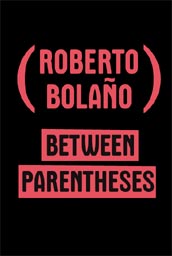
[READ: October 15, 2011] Between Parentheses

I never expected to get so addicted to Roberto Bolaño.  And despite his death, there is no shortage of works coming out in English (that is one of the advantages to reading a translated author–even death doesn’t cease the available materials).  Indeed, this year alone, New Directions is publishing Between Parentheses, and Tres and FSG is publishing The Third Reich (a collection of non fiction, a collection of poetry and a novel respectively).

When I really get into an author, I fall for his or her works, not necessarily him or her as a person (heck, some author are downright jerks).  But there are some authors that I want to know about, personally.  Bolaño is a pretty polarizing figure–he seems obnoxious, his works don’t shy away from very specific opinions, and sometimes it’s unclear what kind of views Bolaño himself has in his works (or if he’s even telling the truth about his so-called truths).  One thing in particular is the constant use of the word “faggot.”  It is used often in 2666 (and I know that is a translator’s choice, but still) and used derogatorily.  Now, clearly the context is everything for something like that.  But it seems to speak badly of Bolaño.  And yet, when reading these essays he is not homophobic in the least.  He is obviously well aware of institutionalized homophobia in Latin America, and he is obviously not supportive of it.

But that’s just one interesting thing about this book.  So let me back up. (more…)

Read Full Post »

SOUNDTRACK: COLIN STETSON: “Horn of Plenty” (interview, NPR’s All Things Considered) (2011).

I’ll be mentioning some recordings by Stetson shortly, but as an introduction to this man and his bass saxophone, this ten minute piece from NPR is absolutely essential.  I had listened to his recent album and NPR has two concerts from him that are downloadable.  I enjoyed the music, but after listening to this interview it gave me so much more appreciation for what the man is doing.

For a lot of classical and jazz, knowing what the author “meant” can help.  Knowing that The Moldau is a river makes Bedřich Smetana’s piece all the more interesting and moving.  Similarly, knowing that “Judges” is about horses… well, holy crap yes it is.

More importantly, knowing how he does what he does–circular breathing: taking air in through your nose while breathing out through your mouth (try it…it’s not possible) allows Stetson to essentially never have to stop playing.  (Tenacious D has a very funny version of this called “Inward Singing,” although it lacks the gravitas of Stetson.)

Also, the bass saxophone weighs twenty pounds nad is almost as tall as him.  The picture is preposterous.  Who even thinks of making music with such a thing.  And yet he does.  Unsettling music, sure, but music nonetheless.   Listen to this interview and be amazed.

[READ: 2010-2011 and beyond] Natasha Wimmer

Many readers don’t read anything that was written in a different language.  And those of us who do probably give little thought to the translator.  Until recently I didn’t give much thought about them either.  Often I assumed that if I didn’t like a book, it was the author not the translator.  And that could be true, but it may also not be so easy a judgment.

Natasha Wimmer has translated many of Roberto Bolaño’s English publications (she has not translated them all–see below–and, she has also translated other writers).  But she has famously translated The Savage Detectives which rocketed her to prominence, and then she managed his unwieldy 2666.  She has also recently translated Between Parentheses, the book I am currently reading.

Between Parentheses is a collection of newspaper columns, essays and pseudo-fictions.  It is a far cry from the convoluted masterwork that is 2666 and yet Wimmer has made this collection of essays utterly readable (I’ll review the book proper when I finish it).  Again, obviously the work is Bolaño’s and he deserves the credit.  But as I’m reading these newspaper articles, I am aware that they were written in Spanish.  And yet the word choices that Wimmer uses, from idioms to real seventy-five-cent words make the essays flow, give them real impact and really convey the kind of writer that Bolaño was.  Let’s take just one example picked not at random but because it uses a real seventy-five-cent word and it mentions David Foster Wallace (can I go a week without mentioning him?).  In “All Subjects with Fresán”, Bolaño states that he and Rodrigo Fresán spend much of their time talking about various subjects;  he lists 30.  Number 22 is “David Lynch and the prolixity of David Foster Wallace.”  I have no idea what word Bolaño used in Spanish (he has an amazing vocabulary, so I’m sure it was a Spanish 75 cent word) but how many translations would have used the word prolixity?  [Okay I had to look it up, he uses “palabrerío” which Collins translated as “verbiage, hot air.”  How much more outstanding is “prolixity”!–Oh, and as if Bolaño wasn’t prone to palabrerío himself]. (more…)

Read Full Post »

SOUNDTRACK: TOM WAITS- Foreign Affairs (1977).

This album is kind of a split between Waits’ bluesy songs and his “poetic rants.”  The only problem with the album per se is that he’s been doing this kind of stuff for five albums now and while he’s still good at it (great at it, actually), it’s probably time for a change (which he does on the next album).  This is not to say that the songs themselves are weaker than others, or that they are not at least slightly unexpected (the eight minute “Potter’s Field” is quite unexpected), just that when you know what he’s going to be doing,  this album feels like a pre-transition, one might even say a rut.

The disc opens with a pretty piano waltz (“Cinny’s Waltz”) that segues right into his jazzy nightclub sounding (ie. piano and sax) track “Muriel.”  The third track, “I Never Talk to Strangers” is a duet with Bette Midler (which I think makes sense given her persona, but I have simply never liked her–maybe that’s why I don’t like this album as much as I could).

“The Medley of Jack & Neal (about Kerouac and Cassidy) is a long rambling story about the two beats, it ends with a riff on “California Here I Come.”  In a similar vein–alluding to appropriate music–“A Sight for Sore Eyes” opens with the music from “Auld Lang Syne” before turning into one of Waits’ weepy ballads.

The second half of the disc is more storytelling as song.  “Potter’s Field” tells a lengthy story with occasional blasts of saxophone.  About midway through, it begins to sound like more of a musical–with the music adding dramatic effects to the lyrics–this may be a kind of foretelling of his more operatic music from Swordfishtrombones.  “Burma-Shave” is another long story (over 6 minutes).  This one is much darker (a fairly straightforward story of meeting a bad guy and going for a drive), but it’s a pretty good story for all of its noirishness.  “Barbershop” has a great bassline, but it is indeed about getting a haircut.  The album ends with the title cut, a sung ballad.

His next album, Blue Valentine, features electric guitars and keyboards and will change the sound of his songs quite a bit.

[READ: September 25, 2011] “Beatrixpark: An Illumination”

I don’t think I have read too many contemporary Italian authors (Italo Calvino is the only one who springs to mind).  Realistically, this shouldn’t make any difference to anything but this story seemed so off to me that I have to wonder if it’s something about Italian authors or if it is Voltolini is particular.  This story was translated by Anne Milano Appel.

The story begins by explaining that the main character is a man from the south.  Being very conscious of the fact that the author is Italian, not American, I worked hard to think of the bottom of the boot as opposed to Alabama.  Of course, being from Southern Italy doesn’t mean anything to me really, but I kept it in mind.   Then I find out the story is set in Amsterdam.  And then several paragraphs in, we learn that he is from Southern Europe somewhere.  Sigh.  To quote the story, “Gimme a break, provincial middle-aged man from the south!  Fuck off, why don’t you?” (more…)

Read Full Post »

SOUNDTRACK: TOM WAITS–The Heart of Saturday Night (1974).

What would be more shocking–hearing this and then going to Bone Machine, or listening to Bone Machine and then hearing this. Holy cow. Tom’s voice is so NOT Tom Waits on this record. It kept me thinking of The Eagles or something. The tone, the pacing, I kept expecting him to bust out “Desperado.”  He also has some crazy beat-inspired poetry (what the kids today call spoken-word pieces)  Indeed, these spoken pieces would stay with him in one form or another for his whole career.  But seriously, how much a man can change in thirty years!

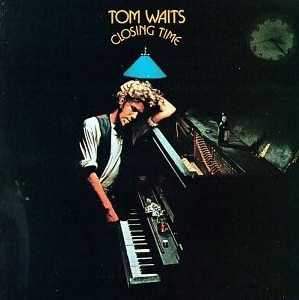
Like Closing Time, this album has several different styles.  Primarily, it has a sloppy, bar sound, the sound that Closing Time‘s cover conveyed.  And that sound is all over “New Coat of Paint.”   But there’s also piano ballads.  And those ballads, combined with Waits’ non-gravelly voice, give “San Diego Serenade” and “Shiver Me Timbers” that Eagles’ ballady sound.  And then “Semi Suite” brings back that muted trumpet. 

“Diamonds on My Windshield” is a beat poem set to a walking bass.  It’s clichéd, except that no one actually does it as well as Waits.  And although I don’t really like the blues in general, I enjoyed “Fumblin’ with Blues” quite a bit.  There’s something about Waits’ sloppy (but not) style  that makes the song interesting.  Even though this is considered a classic, this album is just not really my style and it’s one I listen to quite infrequently.

[READ: September 21, 2011] “An Anonymous Island”

This story is translated from Korean by Heinz Insu Fenkl.  

I felt like the heart of this story was completely unoriginal in content; and yet I can’t tell if it is a common story, if it is a kind of folklorish story, if it’s sort of a story from ancient writings or if it’s just something that happens.

The beginning of the story shows a woman listening to her husband.  He is watching the television,bemoaning the fact that anyone can be anonymous these days (this struck me as a funny sentiment given how much everyone in America bemoans the lack of privacy or the fact that everyone is on the internet).  You can get off at one bus stop past your own and no one knows you.  Back when he was a kid everyone knew everyone else, a village was a family.  And as the woman listens, she flashes back.

The flashback is to when she was a teacher in a small village.  A village where everyone is related.  Everyone treats each other with respect and deference.  Except for one man, Ggaecheol.  Ggaecheol is a bum–he has no job, he has no home.  The village tolerates him because he is an idiot and he is impotent.  But whenever he wants a meal, he simply walks into someone’s house and sits down and says, feed me.  Which they do.  Typically he sleeps outside, but when it’s cold, he walks into someone’s house and sits at the foot of their bed.  He says he wants to keep the woman warm, so the men, amused by his impotence, allow this.

There’s an old Monty Python skit in which the town idiot, despite being mocked by all, does great with women.  The punch line, showing the idiot with a couple of hot girls in bed with him: “I may be an idiot, but I’m no fool.”  And so it is with this story.  The bum is sleeping with everyone in town.  (more…)

Read Full Post »

SOUNDTRACK: TOM WAITS-Closing Time (1973). 

This is the first official Tom Waits release.  There’s a couple “Early Years” collections which are really fascinating for how much he doesn’t sound like the 21st century Tom Waits, but these at least show glimpses of the man to come.  There are some songs on here that I knew of from different artists, and had no idea TW had written them  (Tim Buckley covered “Martha” the same year this came out (that’s pretty amazing), The Eagles covered “Ol’ 55” on their album the following year.  However, Van Halen’s “Ice Cream Man” is not a cover of Tom’s song). The funny thing about the record is how much he sounds like a late 70s lounge singer. How can an album as stripped down as this sound of an era? I don’t know, but it does. It’s also nice to know that his opening song “Ol’ 55” has had such a long life.

My wife does not like Tom Waits, but I think I could sneak this album past her.  You can tell that it’s Tom (before years of abuse to his vocal chords).  His voice is in fine non-gravelly form, just a little bass heavy.  And he is crooning to us.  He even has one of his sweet songs (“Midnight Lullaby”).  It’s hard (but not impossible) to imagine that this man would have turned into the man from Bone Machine.

As I was saying about the mid 70’s, the style of songs here could easily have been played on the same radio station as Springsteen (this album came out the same year as Greetings from Asbury Park–and Springsteen made famous “Jersey Girl” one of Tom’s early songs).  Indeed, many of these songs were covered by other artists.  The funny thing to me about the album is that although Tom is the pianist, I feel like the album is more focused on the trumpet (that muted trumpet seems to be everywhere (giving the album more of a jazzy feel than a rock feel).  And yet, despite this overall jazziness, “I Hope That I Don’t Fall in Love with You” and “Old Shoes (& Picture Postcards)” is a pretty straight-ahead folk song.  There’s also the beautiful ballad “Martha” played only on piano–such a gorgeous melody.  Perhaps the least exciting song is the instrumental ballad “Closing Time.”  It’s a simple piano melody with more trumpet.  There’s nothing wrong with it, it’s just not that inspirational.

I find that as I get older I like this album more (which is somewhat ironic since he recorded it when he was 24).  It’s tempting to say that the album–with its many styles–is unfocused, but Waits’ albums all seem to follow in this multiple-styles vein.  He’s not afraid to try something new (see his entire output since 1983).  But this one is a surprisingly straightforward album.  I can’t wait to see if Sarah likes it.

[READ: September 21, 2011] “Town of Cats”

Murakami is (in my limited experience) a master of the surreal. And yet for his more recent short stories, he seems to be switching into more of a story within a story conceit.  And that’s fine too, because the stories and the stories within the stories are clever and creative and still a bit surreal.

This story starts out a little awkwardly: at Koenji Station, Tengo boards a train with absolutely no destination in mind.  He can get off anywhere that he wants, he decides. He imagines going to the beach and enjoying a nice day.  But then he realizes that all along he has ben heading in one specific direction: to visit his father in a nursing home.  This is especially surprising for Tengo as he has not visited his father in over two years (and Tengo is his only relative).

As Tengo thinks back to his childhood, it is full of nothing but anger.  Anger that his father took him on his work (collecting fees for Japanese TV) every Sunday and that Tengo never had any chance for fun.  In fairness to Tengo’s father, Tengo’s mother died when Tengo was just a baby and his father had to take care of him as best as he could.  But there was no love, no warmth, no emotion.  And the more he thought about his father he realizes that that’s what his father was like–no intellectual curiosity of any kind.  Just work work work.

And yet Tengo can’t shake a memory from when he was only a year and a half or so of his mother standing near hs crib with a man who wasn’t his father kissing her naked breasts.  This memory has always been with him and he can’t help but wonder if his father really isn’t his father at all.  (more…)

Read Full Post »

SOUNDTRACK: METRIC-Live at the 9:30 Club, June 18, 2009 (2009).

I love the new Metric album and this tour supported that disc, so, it’s a win-win for me!  Metric sound great live, and the notes on the NPR page where I downloaded this give a fascinating history of the band.  Evidently they burnt out in 2005 while touring for Live It Out.  So they made solo records and kind of went their separate ways.  Then:

in March 2008, Haines was on stage, in the middle of a live solo performance, when she had an epiphany: She was tired of being sad. While playing one of the standout cuts from her gloomy but beautiful album Knives Don’t Have Your Back, Haines stopped, turned to the audience and said, “I don’t want to play these songs anymore.” Instead, she spent the rest of the show performing her favorite Metric tunes.

The band reunited and made Fantasies, the poptastic album that I love so much.

This show plays pretty much all of the album (except “Collect Call” and “Blindness”) and they rock the house!  The only odd part for me is the opening track, “Satellite Mind.”  The band chose to have the first half of the song performed with just the keyboards, so it has no bottom end at all.  It sounds kind of tinny and weird.  Then when the guitars and bass kick in (for the rest of the show, thankfully), the band sounds whole again.

The other weird thing is Emily Haines’ banter.  I like chatty lead singers (–The Swell Season’s banter is great, Wayne Coyne’s banter is emotional but enjoyable), but there’s something about Haines’ musing that are just kind of…lame.  She’s very earnest, but her thoughts are kind of, well, vapid.  So, I just skip past all the chatter and enjoy the music.

It’s a really great, rocking set and the crowd is very into it.

[READ: August 25, 2011] Atlas of Remote Islands

If you need an unusual but doubtlessly cool book, my brother-in-law Ben is your man.  For my birthday and Christmases he often gets me books that I have never heard of but that are weird and interesting.

This book is no exception.  As the subtitle states, this is a book about fifty remote islands that virtually no one lives on.  True, some are inhabited, but many are not.  And a goodly amount of them are little more than icebergs (I wonder how they will survive global warming).  There’s even one that the accompanying story implies was created from bird droppings. (more…)

Read Full Post »

SOUNDTRACK: TORI AMOS-Live from the Artist’s Den (2010).

I think my relationship with Tori Amos has come to an end.  I haven’t enjoyed her more recent albums all that much lately, but I was excited to see that this live and intimate set was on PBS.  After all, it was just her with a piano and what turned out to be a really cheesy organ.

I was pretty thrilled by the setlist, which goes all the way back to her debut album (with “Girl” and “China”).  I was even more excited to hear “Bells for Her” one of my favorite songs by her and even “Concertina” one of her more mellow tracks that worked well for this show which was primarily mellow songs.

There were a lot of newer songs which I don’t know that well, and a few newer songs which I know okay.   I don’t love her newer stuff, but I was even disappointed with the presentation of her older songs.  She has definitely taken on a new technique where she reeeeeaaaaaalllllllllyyyyy streeeeeeeeeeeetches the songs out. And, as I’ve complained on other recent posts, she mis-pronounces or mis-enunciates words that she used to say perfectly fine.  I find it maddening.

It took me two days to watch this 50 minute show because I kept falling asleep.  Gadzooks.

Now I totally respect an artist’s desire to change her songs.  Indeed, there are some live versions of her songs that I have enjoyed more than the originals.  But there’s something about the way these are drawn out that it feels like the life has been sucked from them.  The melody of “Ruby Through the Looking Glass” loses its impact when it is slowed down so much.

I’m also really disappointed with the synth that she chose.  Synthesizers can make any sound in the world, so why did they program this keyboard to play utterly anemic strings?  The conclusion of “Girl” which is so dramatic on record actually sounds worse with the thin washes than it would if it were played on just piano.

And as for the way she sings words now…  “Bells for Her” to give just one example, has her mangling the word “you” so that when she sings “not even you” we get something like “not even yaow” which I don’t understand.  I mean, listen to the awesome live version on To Venus and Back–she didn’t used to do that.  So wha happa?

I used to think that I liked her solo better.  I always enjoyed the little quiet time section of the concerts when she would play a song or two by herself.  But I feel like now, when she’s by herself, she loses any sense of editing.  The band seemed to keep her on pace.  And it’s a shame to see her drift so much.

Because Tori was an important part of my music youth, I’ll give her one more chance–she has a new album due out reasonably soon, but I’m not holding out much hope for it.   I think we may just be on very different planes of existence anymore.

[READ: July 19, 2011] Five Dials Number 17

The brevity of the Christmas issue is followed up by the somewhat longer Five Dials Number 17.  (This issue also has 7 pages of photos at the end of the issue).  I admit I didn’t know where Jaipur was (it’s sort of north west-ish in India, not terribly far from New Delhi).

This is also the first issue of 2011 (I’m nearly caught up!).  So the issue opens with New Year’s Resolutions.  The letter is also from editors, plural, for a change.

CRAIG TAYLOR & SIMON PROSSER-Letter from the Editors
The letter opens with some enjoyably self-deprecating comments about resolutions (and how they made theirs now, instead of at the end of the year).  But what I enjoyed most was the collective list of resolutions that the entire staff made.  They are listed as one person, which makes for wonderfully contradictory resolutions.  I was particularly pleased by: “stop making that face when my brother makes a suggestion.” (more…)

Read Full Post »

SOUNDTRACK: FOO FIGHTERS-Wasting Light (2011).

The Foo Fighters are huge.  Duh.  But when I think of that, it amazes me that a) the Foo Fighters are the band from “the drummer from Nirvana” and that b) while Dave Grohl knows his way around a melody, he is a metal dude at heart, and some of his most popular songs are really heavy.  He can scream with the best of them.

I’ve enjoyed the Foos for many years, but I didn’t listen to their previous discs all that much (or at least I didn’t listen to the mellow disc from In Your Honor and I don’t remember anything off of Echoes…), but this new one is fantastic.  There’s not a dull song on the disc, and Grohl has hit new heights of catchiness and singalong-ness. 

I also like how noisy the disc is.  It opens with some great discord before turning in a majorly heavy rifftastic scream fest in “Bridge Burning.”  Despite the screaming and noise of the opening, the chorus is super catchy.  “Rope” was said to be inspired by Rush.  Knowing that, I can hear a lot of little Rush-isms in the track: The main riff is very Rush-like, there’s a cymbal tapping that reminds me of Neil Peart in the verses, as well as a little drum solo in the middle (with a cowbell!) and the solo is very Alex Lifeson. (It also feels longer than 4 minutes).

“Dear Rosemary” features Bob Mould on backing vocals (but you can hardly tell it’s him).  It’s got a great chorus as well.  “White Limo” is a wonderful punk song, completely incomprehensible lyrics and all.  Meanwhile “Arlandria” (whatever that means) is another totally catchy track (I find myself singing it a lot).

“These Days” should be the next single: catchy and easy on the ears.  I wonder why it hasn’t been released yet.  “Back and Forth” has another great noisy riff.  One thing that I like a lot about the Foos is that they put different things in the same song:  so “A Matter of Time” has a very simple verse and a catchy chorus, but there’s some really buzzing heavy guitars too.  “Miss the Misery” has a kind of sleazy feel which I think is new for the Foos.  And “I Should Have Known” is a kind of angry ballad (I’d like to see Richard Thompson cover it). 

The final track, “Walk” is a fast rocker that sums up the album really well.  Bravo Dave Grohl.  I can’t get enough of this disc, regardless of how popular it is.

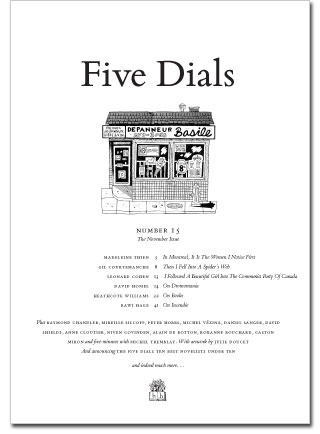
[READ: July 2, 2011] Five Dials Number 15

After the brevity of Number 14, Five Dials Number 15 comes back to a fuller size.  It’s strange to me that the issue is titled The November Issue, in part because they never tell us when the issues were published, but even more because this is actually the Québec Issue.  Most of the authors are Quécbecers and the issue release party was in Québec as well.

I’d like to point out that while I was looking something up about this issue (more later) I discovered the Five Dials News Page.  There are currently 43 pages worth of posts.  But most of them are short.  If there are any especially noteworthy ones, I’ll add them to reviews of future issues, but for the most part so far they’re just announcements of how well received their books are (I’ve already made notes to read two of them).  They also give release dates for the issues, which is how I have been able to retroactively attach dates to some of them.

There are many Québecois writers included in this issue (thoughtfully translated into English), as well as some standard features by Alain De Botton and frequent contributors David Shields and Raymond Chandler.

CRAIG TAYLOR-On Our Québec Issue, and Young Novelists
Taylor’s introduction discusses many Canadian’s attitudes about Québec and their (seemingly perennial) vote concerning separation from the country (“so, let them go”).

creepy beard

The confusing thing here is that it appears that Taylor is Canadian (or at least lived there in 1995/6).   But surely he is British, no?

There’s lots of information about Québec in here but no grand statement (except that Celine Dion’s husband’s beard is still creepy).

He also introduces a new section called “Our Town” which is all about London.  The final section of the note says that

we are releasing our second Five Dials list of Top Ten Novelists Under Ten (or ‘Ten Under Ten’,or ‘Ten-Ten’, or as some of the writers themselves call the list: ‘Tintin.’) As you know, many of the writers we chose for our first Ten Under Ten list went on to things such as high school.

This is how I discovered the Five Dials News page, because there certainly was no Ten Under Ten section in a previous issue of the magazine.  Of course, nor is there any mention in the news that I have seen.  So I can’t decide if the whole thing is just a big joke or what.  I assume it is (but I’d hate to not give credit to the waaaay precocious kids at the end of the issue). (more…)

Read Full Post »

« Newer Posts - Older Posts »