Feeds:
Posts
Comments

Archive for the ‘Natasha Wimmer’ Category

SOUNDTRACK: CAIFANES-El Silencio (1992).

Caifanes was another of the Rock en Español bands that I bought back in the 1990s.  I bought two of their records, El Silencio and El Nervio del Volcan.  In retrospect I’m not sure why I bought two from Caifanes and only one from Tijuana No! as I find Tijuana No! to be much more satisfying overall.  But El Silencio is a fun album as well.

As with a lot the rock en Español bands, the album starts with a really heavy track.  “Metamorfeame” is a raging, screaming punk blast.  But it’s followed by a Latin-infused mellow second song “Nubes” with a great weird guitar solo.  “Piedra” rocks, and Saul Hernández’ voice soars over the heavy bass work (he was meant for stadium rock).  It also ends with a little mariachi music as a coda.

“Nos Vamos Juntos” showcases some more great guitar work and “No Dejes Que…” practically sounds like the Alarm or some other stadium rock band.  “El Comunicador” is an interesting understated minor key song with interesting production.

The production is by Adrian Belew and you can tell as it seems very much like what I know of Adrian Belew: gleaming and bright and well polished.  And, like Belew himself, the album jumps from style to style.  Depending on your tastes, this is either great or tiring (and sometime both).

Wikipedia tells me that this album is considered one of the most influential albums from the most influential band to come out of Central Mexico.  Well how about that.

[READ: December 16, 2010] Amulet

This book is an extended version of an episode in The Savage Detectives.  InDetectives, Auxilio Lacouture has a ten-page story in which she was hiding out in the bathroom of UNAM (Universidad Nacional Autónoma de México) in 1968 during the military takeover (in real life, this is known as the Tlatelolco Masscare).  She hid in the bathroom for thirteen days, reading and writing poetry (Auxilio is the mother of Mexican poetry).

The episode in Detectives was  pretty exciting recollection.  She was in the bathroom when the soldiers broke in.  She could see the tanks outside and she could hear the gunshot.  So she hid with her feet in the air while the soldiers searched the premises.  She promised herself she would not to make a sound until she was discovered. So she read poetry and wrote poetry on the only paper available. (more…)

Read Full Post »

SOUNDTRACK: TIJUANA NO!-Transgresores de la Ley (1994).

In the mid 90s, when I was living in Boston, I discovered MTV Latino, and the Rock en Español resurgence.  Since I’m always interested in new music, I bought a few CDs by these Spanish-singing bands.  For most of my life I’ve thought about the rabid Japanese audiences who loved bands that sand in English.  Did they understand the lyrics?  And did it matter?  Well, here was a test for me.

Tijuana No! was the first band I bought and I really liked it (and still do).

The disc opens with a rollicking ska rocker “Goples Bajos” which features a wonderful horn filled breakdown and ends with a blistering guitar solo.  The title track, “Transgresores de la Ley” opens with a military beat and a military sounding flute before taking off with a heavy verse and, more impressively, a punk/shouty chorus.

My favorite song is “Tu y Yo,” it’s funky all over the place and has a super heavy midsection.  And “Borregos Kamikazes” has a wonderful juxtaposition of speedy, almost loco lyrics in the verses with some great group vocals in the chorus.

The first surprise (for me) comes with “La Esquina del Mundo” because suddenly there’s a female vocalist on lead.  She sounds great (her voice has a cool echo on it) and although she doesn’t quite convey the heaviness of the rest of the track, it’s an interesting juxtaposition.

The second surprise is that the track “Conscience Call” is mostly in English (I got so used to not understanding the lyrics that I was quite surprised to hear words I understood).

The final surprise comes with the penultimate track: an excellent cover of The Clash’s “Spanish Bombs.” Again sung by the female vocalist, her voice works wonderfully with the track.  The chorus, sung in Spanish, is really perfect.

So, in answer to the question, do you need to understand the lyrics to enjoy the music?, I’d say no.  Although it is nice once in a while.

[READ: November 20, 2010] The Savage Detectives

This was the Bolaño novel that I had initially wanted to read because the reviews were so glowing (amusingly enough it turns out to be virtually the last book of his that I read).  And now that I have read almost all of his books, it’s obvious how this book fits into his larger scheme of writing (I wonder what I would have thought if I hadn’t read the other books, too.  In fact, I wonder if I would have liked 2666 more at the time if I had read this one first.  As it is, I think I enjoyed this more having read 2666 first).

[DIGRESSION: When I was reading 2666 I found a fantastic review of 2666/The Savage Detectives by Daniel Zalewski, which reviews 2666 and The Savage Detectives in context of Bolaño’s life].

In a previous post I noted how Bolaño doesn’t really write conventional novels.  And this one is no exception.  Part I is the diary of Juan Garcia Madero, a 17-year-old aspiring poet.  It covers from November to December 31, 1975 .

Garcia Madero talks about his introduction to the visceral realists, a group of Mexican poets whose legacy is more or less unknown to us now (in the book–in reality there was no such group).  The two main visceral realists are Arturo Belano and Ulises Lima, and we will follow or look for these two for the rest of the book.

As with other Bolaño books, there is a massive obsession with sex.  At first Garcia Madero is a virgin and thinks about sex a lot.  Then he finally has sex with first one woman and then many women.  And he writes about them in his diary and spares no details.  (Many entries reveal him having sex with one of his girlfriends 5 or 6 times a night).  And there are of course whores and other deviant sexual individuals (including a guy who carries a large knife by which he measures his penis–we never see this, it’s all hearsay, but it’s in there).

And during this time, he is writing poetry as well–a fully welcomed member of the visceral realists.   (more…)

Read Full Post »

I’ve waited to post this, my wrap up of ideas abut 2666, until I saw what others had to say about it.  Which is kind of a cop out but also kind of understandable.  This book is a giant mess of information, and I’m not entirely sure how to process it all.  So I’ve been looking for help.  And I’ve gotten some, but it’s all kinds of contradictory.  Most people seemed to hate the book.  A few people enjoyed it somewhat, and one or two people really felt moved by it.

I think I fall squarely in that middle camp.  As anyone who has been reading here knows, I became obsessed with Bolaño’s books, and read all of his short fiction (saving Savage Detectives for a read in a few weeks).  And yet I’m not exactly sure WHY I felt compelled to read these stories.  (I’m very glad I did…there will be more on Bolaño himself in a day or two).

I’ve decided to look back over what I wrote to get a sense of what I thought of the book (I knew these posts would come in handy). (more…)

Read Full Post »

SOUNDTRACK: FUGAZI-Steady Diet of Nothing (1991).

Jangly noisy guitars open the track (and then a lengthy silence after a minute or so).  And this loud/soft dynamic is pretty dramatic on this disc.
There’s a slot of really cool sounds (within the framework of loud noisy alterna-punk).  “Reclamation” opens with some harsh guitar harmonics over a kind of spoken verse, but it bursts into a great chorus.  “Nice New Outfit” is quite catchy (even if lyrically it’s very dark).  But by the middle of the disc, it feels like some of the songs aren’t quite as interesting.

Of course, the instrumental “Steady Diet” is noisy and wonderful.  And “Runaway Return” has a catchy noisiness to it.  But the band comes back to a high point with “Polish” and the thoughtful “Justice Letter” (written about favored  Supreme Court Justice William Brennan who retired in 1990).

This record is a cool departure from the first disc.  To me it’s not quite as immeiate as Repeater, and yet it still has some really powerful songs.  I find that no matter how many times I listen to it there’s a few tracks that never grab me, but overall, this is another great release from Fugazi.

[READ: Week of April 26, 2010]  2666 [pg 831-893]

Wow.

The book is over and I am blown away.  I don’t know if it was the set up, or my utterly lowered expectations or the complete lack of connections previous to this, but I had assumed that this story would end (well, actually exactly as it did, with him going to Mexico) but the 30 pages before the end blew me away.  I can’t get over how nicely he tied so much together and in such an unexpected way.  I could not tear myself away from the end.  Wow.

I’m still not sure how I feel about the whole book.  I’ll do a final thoughts post after I digest, but the ending of the book was immensely satisfying. (more…)

Read Full Post »

SOUNDTRACK: PHISH-Joy (2009).

This is basically Phish’s reunion disc (after a 5 year hiatus).  It opens with one of their poppiest songs, “Backwards Down the Number Line” a song that picks up where their least disc left off: with a feeling of driving down a country lane with nowhere to go, windows opens, just happy to be alive.  The second track, “Stealing Time from the Faulty Plan” is a delightful rocker with a supremely catchy chorus “got a blank space where my mind should be….”
The third track, “Joy” starts as a simple piano ballad, but quickly morphs into one of the prettiest songs I’ve heard in ages, an outrageously happy upbeat tender song: “We want you to be happy, cause this is your song, too.”

“Sugar Shack” is a delightfully funky song, recognizable at once as one of Mike’s songs.  It’s a simple, pleasant enough track, but somehow Mike’s voice sounds weaker than usual.

“Ocelot” is a silly track (and one of my favorites) while “Kill Devil Falls” is a bluesy number that will easily be a lengthy jam live.  It’s my least favorite track on the disc, but it is followed by a more upbeat future-jam called “Light” which features delightful multi part harmonies.

The highlights of the disc are the final two songs: the 13 minute “Time Turns Elastic” and the five-minute “Twenty Years Later.”  “Elastic” is a wonderful non-jam, a thoughtfully constructed epic with many parts (although not an elaborate prog rock track or anything).  It’s catchy and moving with sweeping grandeur and easy to sing parts.  And it melds wonderfully into the delicate multipart gorgeous final track.

This is a really strong, mature disc from Phish. There’s not a lot of silliness or nonsense, just some great uplifting gentle rock songs.  It’s quite wonderful.

[READ: Week of April 19, 2010]  2666 [pg 766-830]

This penultimate section of 2666 (the end is nigh!) settles down into an almost pasotral recollection of Archimboldi (the man formerly known as Reiter) as a writer (yes the pronunciation of his name is not lost on me, although I assume it doesn’t have the same connotation in German).  And while it is not all happiness, there is more joy in these 60 some pages than in most of the rest of the book combined.

But before we get there, we have one final moment with a war criminal.

(more…)

Read Full Post »

SOUNDTRACK: VAMPIRE WEEKEND-Contra (2010).

I absolutely loved Vampire Weekend’s debut album (and still do).  It was my favorite record of last summer and always makes me think of summer fun and hijinx.  Critics trotted out the “world/ethno/Paul Simon” vibe when discussing the album.  But I really didn’t hear it.  I mean, yes  I suppose it was there but the album felt more like a punky ska album of fun.

On this, their follow up, it’s as if they took all those critics to heart and decided to make the album that everyone was describing. This disc emphasizes all of the ethnic music sounds,  and downplays the guitars and more rock elements.  I was a little disappointed by this on the first listen or two.  However, subsequent listens showed me that the songwriting was still there and it was just as strong.

There’s still lots of rocking elements, it’s just that they are hidden under the other divergent influences.  But for the most part, the album is still bouncey and full of fun summer tunes.  There are three songs that slow down the pace, “Taxi Cab” and “Diplomat’s Son” (at 6 minutes, it’s a little long).  And the final song “I Think Ur a Contra” is a bit too divorced of beats (it works as an end to the disc, but I’d never listen to it on purpose).

The rest of the disc however, is very enjoyable, and I find that the 7 other songs work just as well as anything off the debut. “Horchata” is a delightfully fun world music treat (I hear Paul Simon, yes, although come on, Graceland came out 24 years ago!).  “White Sky” has delightfully catchy falsetto screams.  “Holiday” is practically classic ska and “Cousins” has a delightfully tricky guitar riff.

This feels like a band who has matured and experimented and yet not lost track of who they are.  I’m really looking forward to their next release.

[READ: Week of April 12, 2010]  2666 [pg 702-765]

Last week I concluded that

It almost seems as though Bolaño is saying that even Nazi Germany is better than Santa Teresa.

Oh how wrong I was.  Despite the fact that I found the bulk of this section enjoyable and fascinating (twisted and dark certainly, but fascinating nonetheless), the ending killed me.  The opening’s entire writers among writers, within writers, with communist party members and secret diaries was completely captivating.  And then it is all shattered by the reality of WWII. (more…)

Read Full Post »

SOUNDTRACK: THE DEAD MILKMEN-Not Richard But Dick (1993).

After the mature Milkmen of Soul Rotation, they followed up with this mini disc (at 28 minutes it’s probably an EP (even the title suggests that maybe it’s an EP) but it’s not considered one).

This album is a bit more twisted that Soul Rotation, although it still offers some of this newer more mature music.

The two most twisted songs are the largely spoken-word “I Dream of Jesus.”  It’s a rant in which the singer (who now goes by the name Arr. Trad.) talks about his mother keeping Jesus in a bottle, and the ramifications that that can have.  (It also features a sung chorus of “Jesus Loves Me”).  “Let’s Get the Baby High” has vocals that are processed so who knows who is singing.  But the title is pretty much spot on for the content of the song.

And you can pretty guess who is singing “The Infant of Prague Customized My Van.”

Butterfly Fairweather once again sings the bulk of the songs.  And most of them are fast rockers. The first song, “Leggo My Ego” could have been a hit (with the cool keboard opening) and “Little Volcano” probably should have been a  hit, it’s very catchy.

He’s also on vocals for some of those mellow songs (that remind me so much of Dromedary Records’ Cuppa Joe.  In fact, “Not Crazy” could have been done by Cuppa Joe.

The final song is a wonderfully hilarious Lou Reed impersonation with simple guitar chords, and a tin whistle!  It’s a very mellow spoken word piece about “The Woman Who was Also a Mongoose”.

Not Richard But Dick is no longer in print (Hollywood Records really gave DM the shaft).  I’m not sure if it’s worth tracking down at this point, but there’s some interesting and fun stuff on this disc.

[READ: April 7, 2010] Antwerp

Continuing with Roberto Bolaño’s fascinating melange of styles, Antwerp (technically the first “novel” he wrote (circa 1980 although he didn’t have it published until 2002) is a series of numbered sections.  I’ve heard it described as a prose poem, and, given his (at the time) recent switch from poetry to prose, that makes sense.

I had read an excerpt from this some time ago, and I found it difficult to read as excerpts.  Unsurprisingly, I also found the entire thing a challenge as well.  And that’s because, wow, there is so much crammed into these 79 pages, and there are so many different points of view and so many unclear events (written in great detail, but trying to piece those events together…phew) that even after reading it twice, I’m still not entirely sure what’s going on. (more…)

Read Full Post »

SOUNDTRACK: THE DEAD MILKMEN-Beelzebubba (1988).
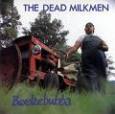
Why the hell do you think they call it a burrow owl anyway?

Beelzebubba is pretty close to the pinnacle of The Dead Milkmen’s career.  Of the 17 songs, there’s only one or two that fall flat.  But there are so many that rise to greatness.  The wholly un-PC James Brown-mocking song “RC’s Mom” which is pretty much all about beating your wife is in hugely questionable taste, but the funk is quite funky.

The brilliant “Stuart” is the culmination of all of the white trash mocking/spoken word nonsense songs.  And then there’s the outstanding single “Punk Rock Girl.”  It is simultaneously catchy as all hell and yet whiny and kind of off-key.  It’s really magnificent and was suitably lauded.

The strange thing to me is that the actual released “single” was for “Smokin’ Banana Peels” (an EP with that title was released with an absurd number of dance remixes).

“Sri Lanka Sex Hotel” is an angry rant that references The Killer Inside Me and talks about having sex with everything.  It’s pretty bizarre, but is musically fantastic.

True, the back half of the disc suffers somewhat (“Howard Beware” and “Ringo Buys a Rifle” are just okay), but the disc ends with the sublimely vulgar “Life is Shit” a gospel-tinged song that matches Monty Python’s “Always Look on the Bright Side of Life” for faux uplift.

Future DM discs would feature some good songs, but the band pretty much peaked with this one.  I’m so bored I’m drinking bleach.

[READ: Week of April 5, 2010]  2666 [pg 637-701]

What a difference a week makes.  The style and writing of Part 5 is markedly different from Part 4.  It is far more laid back and focuses primarily on one individual, Hans Reiter (who we know from Part One is Archimboldi).

The Part opens with information about his parents: his father had one leg (he lost the other in WW1) and his mother was blind in one eye.

Hans’ father, after losing his leg, was in the hospital, expounding on the greatness of smoking.  (He even gives a smoke to a man wrapped head to toe in bandages–and smoke pours out from all the cracks).  When he left the hospital, he walked home–for three weeks.  And when he arrived back home he sought the one-eyed girl in the village and asked for her hand in marriage.

Hans Reiter was born in 1920. He proved to be unreasonably tall: (At 3 he was taller than all the 5 year olds etc).  And he was most interested in the seabed.  There is much information from his childhood of his love of the sea (when his mother bathed him, he would slip under the water until rescued).  At six he stole a book, Animals and Plants of the European Coastal Region, which he more or less memorized and was the only book he read.  And then he began diving, investigating the shoreline.

His father evidently hates everyone and thinks all nations are full of swine (except the Prussians).

Hans also enjoyed walking and he would often walk to the surrounding towns: The Village of Red Men (where they sold peat), The Village of Blue Women , The Town of the Fat (animals and butcher shops); or in the other direction, he went to Egg Village or Pig Village.  Or even further along was the Town of Chattering Girls (who went to parties and dances).

He almost drowned twice.  The first time he was initially mistaken for seaweed as he was floating in the water.  (After he had discovered laminaria digitata).  He also began to draw seaweed in his book.  (The seaweed connection is pretty thorough as he was described as looking like seaweed when he was born).  The tourist who saved him was named Vogel.  He believed in the general goodness of humanity, but he felt that he was a bad person for initially mistaking Hans for seaweed.  Vogel also talked endlessly about the virtues of masturbation (citing Kant as an example). (more…)

Read Full Post »

SOUNDTRACK: RUSH-Permanent Waves (1979).

When my friend Doug and I were hanging out back in the 80s, we both were getting into Rush at the same time.  And because this album was in black and white this was the last Rush LP we bought.  Imagine our surprise when it turned out to contain “The Spirit of Radio” one of the best hard rock anthems ever.

The cover art also featured a newspaper that read Dewey Defeats Truman.  But the band got in trouble for it from the Chicago Tribune!  I’ve never actually seen an actual cover with that headline (or the proposed fix: Dewei Defeats Truman).  Huh, thanks internet, here’s a picture of it.

The disc  also contains some (more) of my favorite Rush tracks.  “Freewill,” a fantastic “smart” song features some insane guitar and bass work in the middle sections.  And side one ends with “Jacob’s Ladder,” a 7 minute mini epic with precious few words that really evokes the simple concept of the sun’s rays bursting through clouds.  It’s surprisingly moving.

Side two features two more short tracks: Entre Nous suffers from side two syndrome: it would have been a hit if it was on side one.  While “Different Strings” is probably the last mellow song the band would write until the acoustic tracks on Snakes and Arrows.

For me, the best song is “Natural Science.”  A three-part mini 9 minute mini epic that features very cool lyrics, acoustic and electric guitar, a mid-song (short) drum solo and an incredibly intense heavy metal section.  And I have been really really psyched that they play this live again.

This disc marks an interesting transition from the prog rock heyday to the poppier commercial side that would soon arrive.  It’s a great mix of truly classic classic rock, real virtuoso performances and a couple of nice pretentious epics.  You’ll but it for Spirit of Radio, but you’ll get hooked by Natural Science.  “A quantum leap forward, in time and space….”

[READ: Week of March 29, 2010]  2666 [pg 565-633]

Before I start with the final week of the Crimes, I wanted to acknowledge everyone else who has been doing a great job in the endurance-o-rama that is the winter/spring 2666 online readathon.  I have been terribly remiss in mentioning (and even reading) as many of these posts as I would have liked (oh where does the time go).  But there’s some folks who have been doing a great job bringing up issues and suffering through The Part About the Crimes with me.

Obviously our friends at Bolanobolano are hosting this event and keeping wonderful track of details that I’m too exhausted to do myself.

And of course, the cohosts in Crimes, Infinite Zombies, are keeping tabs on all manner of thoughtful aspects of this book.

Steve, who I often read on IZ, also posts at his own site: A Solipsist’s 2666.

The Daily Snowman has been offering interesting thoughts, as well as a Paragraph of the Week (often from 2666).

Naptime Writing always offers thoughtful comments as well as a quote of the week.

Bleakonomy offers brief summaries and ideas, as well as non-2666 related thoughtful ideas.

Alone with Each Other offers that rarest of birds: someone who really likes The Part About the Crimes.

I haven’t been reading these blogs as much as I would have liked (and maybe someday I’ll post a comment to one of them long after we’ve all finished reading), but what I’ve read, I’ve appreciated.  So thanks for keeping me company out here.

And on to the last (and best) section of the Part About the Crimes.

I don’t know if the slow plodding death after death was like climbing a hill, but these last 68 pages were like speeding downhill with the top down.  So much was packed into it.  I was totally rejuvenated, thrilled to meet new (!) characters and totally unsurprised when the Part ended and absolutely nothing was resolved. (more…)

Read Full Post »

SOUNDTRACK: KISS-KISSology: The Ultimate Kiss Collection, Vol. 2: 1978-1991 DVD (2007).

In addition to containing Kiss Meets the Phantom, this DVD contains concert footage, music videos and some interviews.  We see Peter Criss being interviewed on CNN (!) by a woman in a tank top (ah, the early days of 24 hour news) about leaving the band.   Of course, this doesn’t hold a candle to the actual music video for “Shandi” one of the cheesiest of cheesy Kiss videos.

This early 80s period is one of disco, operas and unmasking, and it is generally considered their low point.  I however, happen to enjoy this weird period.  While I acknowledge it’s not very “good,” I enjoy it much more than their mid-80s makeup-fee period.  (The often maligned The Elder has a weird kind of charm of the over-extended-effort).  So, I am of course sad that it is so under-represented here.  Although we do get a few clips from the long defunct show Fridays (I wish they would have shown more of the show itself, as it bought us Larry David and Michael Richards (and is mentioned in Black Flag’s “TV Party”, but that show seems to be locked away in a vault somewhere).

Disc 2 features an Australian tour during 1980, where the Aussies go crazy for them, and the band plays accordingly.  There’s also the final (or one of the final) shows they did with makeup.  And then the first show the did without makeup (1983).  And, naturally we see the highly undramatic “unmasking” on MTV, a hilarious attempt at TV news by the ever-flappable J.J. Johnson.

The concert in 1987, (The Crazy Nights Tour) is pretty bad.  This was a time when the band still played the early makeup songs, but they seemed to care so little about them, that it’s kind of embarrassing (Paul’s contempt for singing “Love Gun” in a way that even vaguely resembles the original is rather shocking).  Even Ace is phoning it in at best.  (Of course, Gene is a ham from the start so he’s always on).

After watching that last show I was not looking forward to the final Detroit show (The Hot in the Shade tour–a disc I liked more than most of the late 80s discs, even if the cover conceit of a sphinx with glasses is about as lame as you can get), but I was surprised at how great the band sounded.  They seem energized and like they were having a lot of fun.  Bruce Kulick definitely rocks hard (although I am a little disappointed that he felt compelled to change some of Ace’s signature guitar solos).  And it ends the disc on a very high note.

The collection ends with the death of drummer Eric Carr.  Which is certainly a downer, but seeing the shows that he played in are definitely a high point.  I’m fairly certain, however, that I can’t bring myself to watch Vol. 3 of this collection.

[READ: Week of March 22, 2010]  2666 [pg 513-564]

More deaths. I am starting to get worn down by all the murders (and I can see that I am. not. alone.) and by the cavalier attitude of the police (which is either a coping mechanism for them or just a case of simply not caring).  I am very much looking forward to Part 5!

However, there were some breakthroughs this week! One of the murderers was captured and found to be a member of Los Caciques [blackbird?] gang.  [UPDATE: 6/27/2012:  Thanks to Oscar in the comments for the update on what <<cacique>> means.]

Amidst the usual murders was a suicide.  Perla Beatriz Ochoterena, a teacher, wrote that should couldn’t take it anymore.  Juan de Dios Martínez talks to Elvira Campos about it, but they didn’t come to a valid explanation.  Was it because of the dying girls? Would that drive anyone to kill herself? (more…)

Read Full Post »

« Newer Posts - Older Posts »