Feeds:
Posts
Comments

Archive for the ‘Translation’ Category

little vamopSOUNDTRACK: DO MAKE SAY THINK-Winter Hymn Country Hymn Secret Hymn [CST025] (2003).

hymnThis album, at least according to the liner notes, seems to be broken into three sections, as the title suggests.  Although there is no explicit attachment of a particular hymn to the songs, there is a gap between the listings, giving each section three songs.

“Federica” is 9 minutes long and opens with a very lovely slow guitar melody.  Then the drums crash in and the song doesn’t change so much as intensify.  At around 3 minutes the song pauses before a loping bass adds to the mixture and the songs gets bigger and bigger, and even a little funkier. When the distorted guitar comes in at 5 minutes, it’s hard to believe it’s basically the same song all along.  It builds to a cacophonous explosion and then settles down again. A new style emerges—slow and plaintive with mildly distorted guitars. But they can’t stay muted for long. The distorted guitar comes back and forces the song forward with some distorted bass and other noises until it resumes a reprise of the original guitar melody.

“War on Want” is only 2 minutes long.  It is mostly strings that seemed to be looped in some way.  There haven’t been a lot of strings in DMST records so far, so this is new.  They drift slightly out of tune as they introduce the 3rd song “Auberge le Mouton Noir.”  The song opens with some crackling noises and some pretty, slow chords. which resolve into a simple riff.  The song builds, growing faster with a great propulsive beat. I like that it switches back and forth between the chords and the guitar riff.  Is that a slightly out of tune bass guitar before the ringing guitar solo takes over?

The second section begins with “Outer Inner & Secret.”  It’s ten minutes long and opens with an interesting bass line and guitar motif. It’s quiet and insistent, kind of dreamy. After exploring some quieter avenues some feedback squalls float in and out.  About 4 minutes in the song builds, but it quickly recedes only to build again and recede once more.  For the third build the drums kick in and the song launches in a louder direction for a few measures.  But just as you think it’s going to take off for a while, it settles down and then comes back to a quitter style with martial beat and keyboards.   The remainder of the song switches between loud building guitarists and quitter moments with just bass and drums.  For the last-minute or so horns burst forth and then the music drops away except for the horns, which end the song with a plaintive melody.

The 4 minute “107 Reasons Why” is a slow horn & guitar melody song.  There’s some interesting sounds that play over the top of the delicate melody, including a nice horn line.

“Ontario Plates” is 7 minutes long and opens with very jazzy drums and bass–it’s rather noir with a quiet saxophone.   Once the sax plays over the top it just increases the jazziness. DMST has always had a jazz feel but this one really pushes it about as far as the band has gone. The drums start to come to the fore and I love the way about 3 minutes in the drums morph into something else and the song almost imperceptibly switches into a new song entirely. The bass takes over and a new riff enters the piece. About 5 minutes in, the song switches to a very bright and uplifting motif–big horns, bright guitars and a catchy riff.  It’s quite lovely.

The third section opens with “Horns of a Rabbit.”  This song introduces big drums and kind of electronic bass sound.  About two minutes in the noise beaks through—bashing guitars and intense drums.  It even includes a pretty wild guitar solo. I like how the song (which is only 4 minutes (kind of disintegrates on itself before merging into the two-minute “It’s Gonna Rain,” which may indeed be simply the sound of rain on a tin roof.

The final track, the 7 minute “Hooray! Hooray! Hooray!” opens with some synths sounds—unlike anything else on the record.  And then a pretty guitar intro mixes with some lovely horns.  It’s probably the most delicate thing they have created.  After 3 minutes the occasional guitar swirls grow louder and it grinds it way to a happy and uplifting keyboard riff.   Then a bunch of surprises for DMST: A slide guitar plays a little solo and then, most surprisingly, a chorus of voices sings the melody.  The ending slide guitar sounds like it could come from Mercury Rev or The Flaming Lips.  If you listen closely, you can hear people shouting Hooray! in the background.

This album feels a bit more claustrophobic than their others, and while I like pretty much all of the songs, I really like their other albums more.

[READ: December 20, 2015] Little Vampire

Joann Sfar is responsible for the Sardine comics which I kind of liked but mostly didn’t (I think that may have been because of the uglyish drawing style).  But here Sfar has another series called Little Vampire.  (I also just learned that Joann Sfar is a man, so apologies earlier, but I think that’s an understandable mistake).

This book collects three stories into one volume, all translated by Alexis Siegel.  Each story is about 30 pages.  And they follow the “life” of little vampire.  He is a sweet boy with a bald head, big eyes and pointy ears.  He lives in a castle with call all kinds of undead people including his dog Phantomato (he is bright red and rather devious) and several other monsters.

“Little Vampire Goes to School” introduces us to the home where the monsters live.  As the undead are partying, Little Vampire comes down and says he wants to go to school.  The others are horrified, but he won’t give up the idea. He says he’s bored and wants to meet other children (most of the undead are adults).

Little Vampire’s mother (who is strangely pretty in her weird design) and the other elders allow him to go to school, but he can only go at night when it is closed.  So the undead come and all attend school with him.  The class is taught by The Captain of the Dead who is an old dead pirate. (more…)

Read Full Post »

deogrataisSOUNDTRACK: JOSH RITTER-Tiny Desk Concert #119 (April 11, 2011).

ritterNot too many performers mention the actual day that they are performing their Tiny Desk Concert.  But Ritter mentions Valentine’s Day twice during his set so I thought I’d post it on Valentine’s Day even if the actual date of the posting is much later.

I don’t really know Ritter, I’ve heard of him, but I’m not too familiar with him.  Nevertheless, I was quickly won over by him.  He is charming and polite and is certainly having a good time (he even laughs at some lines in his songs).

His first song “The Temptation Of Adam”sounds vaguely familiar.  The melody is very catchy and his voice is strong and excellent.  Lyrically the song is quite interesting.  I especially loved this section: “We passed the time with crosswords that she thought to bring inside/ ‘What five letters spell apocalypse?’ she asked me/ I won her over saying, W.W.I.I.I.’/ She smiled and we both knew that she misjudged me.”

“Lark” is a faster song, but still very folksy and clever.  I love that although the melody is fairly simple, the way he plays it (with very fast fingerpicking) makes the song sound more complicated.  “Rattling Locks” is a dark minor chord song, louder and heavier than the other two.

The site says there is an audio only track called “Pale Blue Eyes,” but I can’t find it.  For the last track, his 2003 song “Kathleen,” he introduces the song by saying, “I think Valentine’s Day is the most awkward self-imposed holiday — even worse than New Year’s — so this is an awkward song.”  It’s a louder song, with Ritter’s voice reaching great intensity.  It’s a great way to end the set.

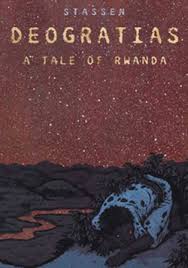
[READ: February 14, 2016] Deogratias

Here’s another story that I would never have read if it were not for First Second’s #10yearsof01 challenge.  The thought of reading a story about the genocide in Rwanda just seems to depressing to undertake.  And yet in the spirit of reading things outside of your comfort area, I decided to read this this weekend.

And I am incredibly glad that I did.

I feared that this story would be one of rampant genocide–struggle and death and mutilation and everything else that I could imagine.  But rather, what Stassen has done is created a story about how the toll of genocide can impact one person.  Yes, it affects him directly and the story is incredibly sad, but it was a very different story than I expected, and it was so personal that it made it more tragic without having the oppressive unreality of millions of dead people in the plot.

The introduction alone is worth reading, as translator Alexis Siegel gives a brief summary of the Rwandan tragedy.  I’ve always found the conflict to be really hard to grasp.  Hutus and Tutsi, a privileged minority, a brutal majority.  The back and forth was so hard to grasp, and the names of the tribes were similar as well.  It is hard for a lazy person to keep straight.

But I found Siegel’s explanation to be succinct and very effective. (more…)

Read Full Post »

june2015 SOUNDTRACK: WOLF ALICE-Tiny Desk Concert #503 (January 22, 2016).

wolfaliceI have been really enjoying Wolf Alice’s album My Love is Cool. It has many familiar elements of shoegaze and grunge but it’s played in different and unexpected combinations.  The album is moody and at times abrasive. But there are some lovely melodies underneath these songs.  (They were originally a folkie band before going electric).

So this Tiny Desk Concert plays to their origins (all of five years ago).  And they really change their songs for this set.

“Fluffy” on the original has noisy guitars and some great stop starts and big screams.  They really, really slow it down for the set.  They remove the abrasiveness, sing delicately (with the drummer providing backing vocals), and for the chorus of “sixteen, so sweet” they actually whisper it.

On record, “Turn to Dust” is pretty and soaring and very moody.  This version is quite folky.  I prefer the original but I really like this version especially the way you can really hear the interesting lyrics. Also, Ellie’s voice is quite lovely with no effects on it.  They even hit Bob’s gong at the end.

The recorded version of “Bros” is upbeat and somewhat poppy.  This acoustic version takes on a similarly upbeat feel but in a very different style.  It feels like a real folk song and works surprisingly well in this context.  I love the ending that they take onto it which make it even prettier.

I enjoyed this set a lot, even if it took me two listens to recognize two of the songs.  But I didn’t really enjoy the band members all that much.  I’m going to assume they were nervous rather than disaffected.

After the first song the bassist casually asks, “How’s everyone doin?  Good?” and when everyone chuckles, he says, “That’s the end of that banter,” which is pretty funny (and makes Bob laugh out loud), but it proves to be true.  And it takes Bob to break the silence (while the guitarist tunes).  Bob tried to barter with the drummer for his shirt, which gets them to admire the strange things around the office.  Also singer Ellie Roswell seems really strangely uncomfortable looking at he ceiling quite often, which seems very unlike the cocky persona she puts on in her videos.  But the music is great, so that’s okay.

[READ: January 10, 2016] “Lip Service”

“Lip Service” is an excerpt from Hilbig’s book I which was translated from the German by Isabel Fargo Cole.

This was a strange story which is all about perception.

It starts “Most of W’s perceptions were acquired by looking from outside into the interior of lighted dwellings.”

He would watch people talking but he could barely hear them.  And so he learned how to perceive what was going on and how unimportant the actual words that people said could be.

And he really enjoyed the non-gratification this afforded–the idea of being a voyeur who never completes his quest. (more…)

Read Full Post »

1182016SOUNDTRACK: DAMIEN JURADO–Tiny Desk Concert #114 (February 28, 2011).

damienI had always assumed that Damien Jurado was someone else entirely.  I had no idea that he was (as the blurb describes him) “a big dude playing sad songs.”

And he is.

For this Tiny Desk it’s just him and his guitar.  He keeps his eyes closed tightly as he sings these sad songs.  His guitar playing is simple–just strummed chords and his voice is simple as well–there’s no tricks.  It’s all about his songwriting.

I liked all four of these songs: “Cloudy Shoes,” “Newspaper Gown” (that was my favorite), “Arkansas,” and “Beacon Hill.”

The strangest thing about him was how uncommunicative he seemed to be–almost nervous.  He barely spoke and when he did it was hard to hear.  And as soon as the set was done he immediately stood up to leave.

Although he does say it’s “nice.”

His songs were lovely although I don’t think I’ll be seeking him out anytime soon.

[READ: January 12, 2016] “The Story of a A Painter”

This story was translated by Anna Summers and, as the title suggests, it is about a painter.

But this story delves into surreal territory pretty quickly.  It may even be a fairy tale as the opening line is “There once lived a painter….”

This painter has had some bad fortune as of late.  His landlord promised to get him a lot of money if he would sell his large apartment.  But the landlord sold the place and kept the money (a lawsuit is pending).  Then the landlord offered him a place under the stairs–no running water–which the painter accepted.  But he can’t pay the landlord, so the landlord gives him grief every day.

On another day a man asked if he would rent him his “apartment.”  The painter said yes for money up front.  The man gave him the money then moved his entire family into the tiny, below-the-stairs place and planned to never leave.  Now the painter was destitute and homeless. (more…)

Read Full Post »

karlove SOUNDTRACK: ESPERANZA SPALDING-Tiny Desk Concert #110 (February 12, 2011).

esperanzaI didn’t know who Esperanza Spalding was before this show.  But she defied my expectations by being a fairly tiny woman who sings while playing an upright bass (not a very common combination for anyone).

For the first song, “Little Fly,” she plays a kind of jazzy bass, but has a string accompaniment–violins, guitars etc.  But it’s clear that the bass is the star.   And while her playing is very good (she has some great vibrato), it’s her voice that is mesmerizing–she’s hunched over playing the bass and still manages to sound strong and powerful.  “Little Fly”‘s lyrics come from a poem by William Blake.

“Midnight Sun” is a solo performance–just her voice and bass.  I loved the beginning where she sang notes along with what she played.  Then when the lyrics come in she sings in a very jazz voice (with eyes closed the whole time).  Turns out this is a Lionel Hampton song that only appears on the Japanese release of her album which make explain her singing style.

Because on the final song she sounds very different.  “Apple Blossom” is her own composition.  It’s her singing with the string section playing along (there’s no bass).  The song is lovely, but I prefer it when she plays bass in the song, too.

I enjoyed this performance and how delightful Spalding was.

[READ: January 9, 2016] “My Saga: Part Two”

Speaking of not finishing multi part essays, I ended my post about Part One of this essay by saying I couldn’t wait for part two.  And then apparently I forgot all about it because here it is almost a year later before I read part two (which was published two weeks later).

In this second half of Karl Ove’s journey he spends most of his time realizing that he hasn’t really learned very much for his assignment.  I can’t imagine anyone else being able to write endlessly about how he has nothing to write about (and still make it strangely compelling–his stress produces good sentences).

He does make some interesting connections though. (more…)

Read Full Post »

dq25SOUNDTRACK: ARCHER PREWITT-“O, KY” (2005).

wikldernessArcher Prewitt formed The Coctails (a kitschy lounge act) in the early 90s, several years before the lounge revival.  Then he joined The Sea and Cake and has been making amazing music with them.  And he has also released several solo albums.

He has also published some comics (Sof’ Boy) with Drawn & Quarterly.

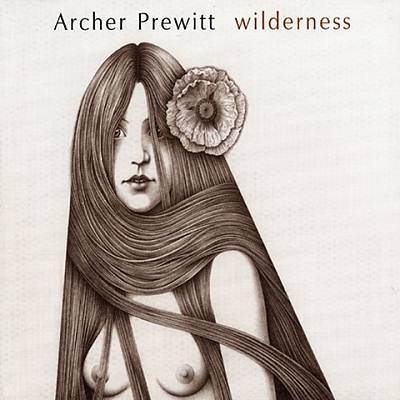
This song comes from his album Wilderness.  The title of the song is clever, too.

It’s upbeat and folky with a little psychedlia and rock thrown in.  I like Prewitt’s voice quite a bit–it’s simple but really strong.  But the selling point on this song (and others from this album that I have listened to) is the composition and arrangement of these songs.

I like the way this one goes from simple guitar to orchestration (although presumably not a real orchestra) for the chorus.  And how post chorus there are flutes and other instruments to pick up the momentum which adds a vaguely psychedelic feel to it.

At four minutes (the song is five) it changes direction entirely and turns into a nearly new song with big guitars and drums. And it rather rocks.

And just to make Archer the all around dude that he is.  He also drew the cover art.  Jeez.  He’s probably super nice and friendly, too.

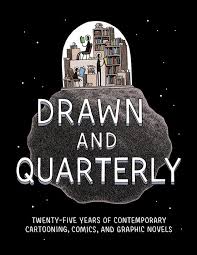
[READ: January 3, 2016] Drawn and Quarterly: Twenty Five Years 

I have liked a lot of D+Q books for a long time, although I never really considered a comprehensive look at their publishing house.  This book–about 775 pages long–is about as comprehensive as it gets.

This book contains a few previously published cartoons and excerpts as well as a whole slew of previously unpublished pieces.  There are essays and histories and reminiscences and love love love for the little Montreal graphic novel publisher.

I didn’t know much about the history of D+Q–that Chris Oliveros started the publisher in 1989 out of his house.  That he was the only employee for years.  And that he was essential in getting the term “graphic novel” used by everyone–including the library of congress!

He weathered distribution problems, he weathered the rise and fall of indie comics in the late 90s and he has come through with some of the most beautiful books published.  D+Q has also brought attention to foreign artists as well as out of print artists.

Really, if you have any respect for graphic novels (that aren’t superhero-based) you owe thanks to D+Q. (more…)

Read Full Post »

rhineSOUNDTRACK: HMSTR-Tiny Desk Concert #413 (December 24, 2014).

hmstrThe only thing I could think of to pair with a complete telling of Wagner’s Ring Cycle (aside from the entire thing itself, which… forget about it), was the smallest, most inconsequential music I could find.

Enter HMSTR.

HMSTR played the Tiny Desk Christmas show in 2014.  And really, they must be seen to be believed.  Not because they are spectacular, but because the joke isn’t really very funny if you just listen to the music.

Starting with some bizarre synth sounds, after 20 seconds the songs bursts into a lo-fi punk anthem.  It’s all buzzing guitars and a simple synth over some majorly lo fi drums.  There’s even a somewhat catchy “chorus” section.  After a minute, the guitars fade and sleigh bells signal the end of the song.

So whats the joke?  See for yourself

All in a tiny Tiny Desk setting.

[READ: May 20, 2015] Richard Wagner’s The Ring of the Nibelung

Yes, this is a massive graphic novel depicting Wagner’s “Music Dramas.”  The text was translated by Patrick Mason and then Russell adapted the whole thing to fit his story.

Everyone loves “Flight of the Valkyries,” but hardly anyone has listened to the entire Ring (it’s 4 operas and 15 hours long).  Except for the Bugs Bunny version, of course.  I have been interested in the Ring for a long time, but I wasn’t willing to devote that much time to it either.  So this book is perfect. (more…)

Read Full Post »

sing no evilSOUNDTRACK: STILE ANTICO-Tiny Desk Concert #86 (October 25, 2010).

stile I’ve said before that one of the great things about the Tiny Desk Concerts is being introduced to bands that I never would have heard of anywhere else.  And that is certainly true of Stile Antico.  I really enjoy this kind of a capella music, although I never listen to it.  And I wouldn’t even know where to start looking for it.

So, lucky for me, I now know a band that performs gorgeous 16th-century choral music.  There are twelve singers.  And it is comforting in this day of pop singers who are more hot than musical that Stile Antico is all about the voice.  They don’t dress flashy or sexy, they don’t really do anything…except sing to the heavens.

They perform four pieces in about 20 minutes.  I don’t know any of them and I honestly couldn’t really tell them apart, but I loved the whole show.

The lead speaker (unnamed in this show) says that William Byrd is the best songwriter of the era, which is why they do two of his songs.  After the first one, he says that they want to transform this office into some kind of Tudor Chapel.

The second piece, “The Lord’s Prayer” is not done in any melody that I have ever heard it (and I assume it is in Latin).

But it’s the final piece that is really the showstopper, and the one that is fun to watch (even though, as I say they’re not actually doing anything–okay not true, they are nodding to each other instead of using a conductor).  Praetorious’s piece weaves 3 choirs together with 12 independent voices.  And the speaker jokes that each of the three choirs wind up flirting outrageously with each other.  It’s breathtaking.

Their voices are simply beautiful, and it’s amazing to see them working together silently as they sing.

The only problem is that now that I know who they are, which of their 11 records do I start with?

The songs:

  • William Byrd: “Vigilate”
  • John Sheppard: “Lord’s Prayer”
  • William Byrd: “Ecce Virgo Concipiet”
  • Hieronymus Praetorious: “Tota Pulchra Es”

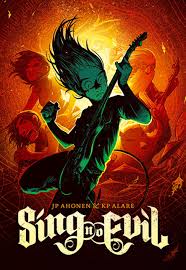
[READ: July 10, 2015] Sing No Evil

I saw this book at the library and loved the title.  As soon as I flipped through it I knew I had to read it.  This book was originally written in Finnish (cool!) and was translated by JP Ahonen into English.  It is all about Fininish death metal bands and the devil.  And it is cool and very funny.  It was originally called Perkeros (which is what the protagonist’ band is called) and which I can’t quite define, but that’s okay.

The book opens on Aksel rocking out (in his imagination).  He and his band are getting ready to go on stage and he is nervous.  Aksel is a perfectionist and his riffs and progressions are second to none (Perkeros is a progressive death metal band which I’d rather like to hear).  The problem for the band is that Aksel’s singing is poor.  But the band likes what they do.  So they keep playing.

Here’s the fun part.  The band consists of Aksel and Lily on keys (and here I have to comment that Lily and Aksel don’t look all that different in drawing style but somehow Alarea has made these simple lines create two very different looking characters, and with those simple lines you can see just how pretty Lily is).  There’s also Kervinen, a really old guy with a chest-length beard (he used to be a monk), and, well, a bear, yes, a bear, on drums (the bear’s story is never given).

The band is opening for Nelum Lucifera, a grease-painted death metal band (with names like Belphegor and Samael).  A fight ensures and the bands are banned from every playing that gig again. (more…)

Read Full Post »

tsugeSOUNDTRACK: MOPS-“White Rabbit” (1968).

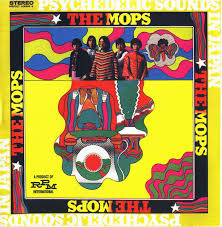
mopsAfter totally grooving on The Mops’ songs in yesterday’s post I decided I had to check out their cover of Jefferson Airplane’s “White Rabbit.”

And, boy do I love it.  It came from their debut album Psychedelic Sound in Japan which was released in 1968 (“White Rabbit” came out in 1967).   The album also includes covers of “Somebody to Love” by Jefferson Airplane, “Light My Fire” by The Doors and two songs by The Animals.  They received much press for being the “first psychedelic band” in Japan, and performed with elaborate light shows.

Lead singer Hiromitsu Suzuki really nails all the notes (even if he doesn’t quite nail all the words), but I especially enjoy the instrumentation they employ–the violin is an interesting addition.  And the way the instruments are separated in headphones (all drums in the right ear?) is really psychedelic.

It is really a trippy version (“Somebody to Love” is pretty fine too, especially when the really buzzy guitar kicks in about half way through).

Trash Market

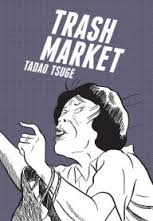
Tadao Tsuge is a Japanese cartoonist considered “one of alternative manga’s cult stars.”  He has been making cartoons since 1959 and has contributed to all manner of Japanese publications.

What seems to set him apart from other cartoonists (according to the interviews and such that fill out the book) is that Tadao grew up in the slums of Tokyo and is willing to write about them.  He also worked for many many years at a blood bank (one that paid people for their blood).  It was there, amid the terrible conditions, that he believes he contracted hepatitis.

The amazing thing to me while reading these six cartoons (which I assume are only a tiny fraction Tadao’s total output, but I’m not sure) is that I had no idea when they were written–they have a timelessness that is really amazing.  So when I finally flipped back to the front and saw that the first story was written in 1968, I was blown away. (more…)

Read Full Post »

godboutSOUNDTRACK: BUILT TO SPILL-“Carry the Zero” (1999).

zeroI loved “Carry the Zero” so much that I immediately bought the CD single (that’s what you did back in the 90s).

The Ep contains 6 songs.  There’s two tracks from Keep It Like a Secret (“Carry the Zero” & “Sidewalk” which is good in itself), 2 new songs (“Forget Remember When” and “Now & Then”) and 2 live songs “Kicked it in the Sun” and “Big Dipper.”

The two unreleased songs are good, but neither one is quite as immediate as anything on the album.  Of course, if you’re looking for extra BtS tracks, these are just waiting for you.

The real gems are the two live songs.  Both of them are solo acoustic guitar recordings recorded in a tiny setting.  They are quite different from the album.  I feel that “Big Dipper” fares a little better since the song is simpler.  There are some complex chord changes in “Kicked It in the Sun” which lose a little of their immediacy in the stripped down version.  Which is not to say that it’s bad–the first half of the song sounds great–it’s when it gets to the middle that it feels a little cumbersome.

So this is certainly a die-hards only release, but if you’re looking for some unusual BtS recordings, this is a great place to start.

[READ:October 2, 2015] Amerika

This is a graphic novel version of Franz Kafka’s Amerika.  And it is really well done.  The artwork is fantastic–clean lines, distinctive characters and wonderfully detailed background scenes.

I don’t know the original story at all, so I assume that Godbout was faithful to it (the back of the book says he was). Actually, this graphic novel was translated by Helge Dascher, so I wonder if she translated Godbout of Kafka?

Unlike so much of Kafka, this story isn’t really “Kafkaesque.”  There is some darkness to it and there are machinations of trouble for the main character, but it is not a perpetual state of nightmarish life.

Karl Rossmann is a young immigrant to America.  (Kafka had never been to America, but he gets quite a lot right).  He was sent to America because of an embarrassing sexual incident (which is rendered rather humorously).  When he arrives in New York harbor, he disembarks from the ship but forgets his umbrella.  So he races back on the ship.  But instead of finding it, he runs into the ship’s engine stoker.  The hulking man is suspicious if him, but after they talk for a few minutes Karl convinces the stoker to air his grievances about his supervisor to the ship’s captain. (more…)

Read Full Post »

« Newer Posts - Older Posts »