Feeds:
Posts
Comments

Archive for the ‘Threats’ Category

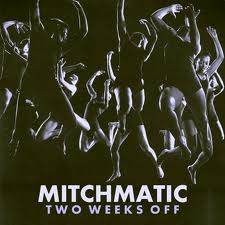
SOUNDTRACK: MITCHMATIC-“D-Bags” (2011).

On the show New Girl, my favorite joke in the pilot (which was brought back in a recent episode) is the douchebag jar.  Every time someone in the house (well, Schmitt, really) says something a douchebaggy, money goes in the jar.

This song has a crazily simple bass line–which sounds like “Another Bites the Dust,” but isn’t.  It’s unclear from the beginning exactly what the song is about.  But once the chorus comes in, the song is just perfect: “D-Baaaaaags: Hey I’m calling from a handicapped stall, dude; D-Baaaaaags:oh I’m a jerkwad? I’m a jerkwad?  D-baaags, Don’t tell me how to carb load, I know how to carb load.”

There are three rappers in the song.  Mitchmatic takes the first verses.  Mikey Maybe gets the best line: “say irregardless while trying to seem smart.”  The Joe has a really fast delivery that reminds me of Paul Barman (in lyrics and style).

I’m really enjoying Mitchmatics’s beats.  You can download Two Week Off for free.  Or you can watch the video (which seems to have the studio version of the song over a live video)

The video goes on a little long after the song, but the song is pretty great.  It might actually do to give it a proper video.


[READ: January 24, 2012] “Shore Ting”

When I signed up to receive Narrative magazine, I also signed up for their emails.  And the January 9 email contained this story (as well as many other things).  This story was chosen as their Story of the Week.

I really wanted to not like this story.  There were so many things about it that seemed like they should be red flags to me: a tourist getting entwined with a local urchin; the tourist “doing good” for the urchin when none of the locals want anything to do with him; a wife who is very Christian; and the implication of forthcoming violence throughout the story.  Not to mention a piece of foreshadowing that I assumed gave away the ending (although it doesn’t).

The story opens with an interesting scene.  The tourist, Dale, gives the urchin (named Sammy, although this was obviously a name for tourists) a cigarette and then realizes that he has personally started this boy on a lifetime of smoking. And he feels bad about that.

Sammy hits up Dale for work.  Dale doesn’t have work, but since he is looking into renting a sailboat, he more or less hires Sammy to help him on the boat.  Dale asks Sammy if he can do various things and whatever he asks, Sammy replies, “Shore Ting.” (more…)

Read Full Post »

SOUNDTRACK: DAN ZANES-“Wonderwheel” (2002).

This track comes from Zanes’ Family Dance album and from the For The Kids compilation.

Dan Zanes is a wonderful troubadour of kid’s folk rock.  The funny thing about many of his songs, like this one, is that it’s not really a kid’s song–there’s nothing about the lyrics that says “only children will like this.”  It’s just a generally happy song that is safe for all ages.

The song opens with a simple accordion melody and is about riding a wonderwheel (I’m not sure what that is actually–a ferris wheel?).  The melody is great and there’s a nice female vocal harmony.  The song reminds me of a poppier, happier version of a Richard and Linda Thompson song.  It feels olde, like a classic song that people have been singing forever, and yet it’s brand new.

Dan Zanes is going to be playing a show around here in February and I’m pretty excited to go.  He’s one’s of my favorite kid’s music makers.  His songs are clever and catchy and never pander to the lowest common denominator.

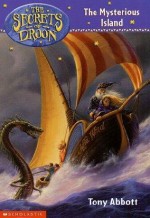
[READ: November and December 2011 and January 2012] The Secrets of Droon, Books 1-12

Every night, my wife and I read picture books to my kids before bed.  Once in a while I would read chapter books to my son (they’re usually a little too much for my daughter to focus on). Clark is 6, Tabitha is 4.

We had been reading The Magic Tree House (which both kids love) and then I hit upon The Secrets of Droon.  I knew of the series from the library, but I didn’t know a thing about it.  I thought that Clark might read it himself, but he asked me to read that first book to him (it may indeed be too much for him to be able to read and fully enjoy).  I’m glad he did, because it has begun a special evening ritual for us.

We try to read three or four chapters of a Droon book a night.  And he really follows along well.  There are times when he guesses what will happen, and he certainly remembers more about what happened than I do.  Sure there are a few things he doesn’t quite get–some of the books in the teens are, if not intense, then certainly mind-boggling: I don’t think a 6-year-old can really grasp time travel or the apparition of a character who has disappeared, but he certainly likes the good vs evil story and he thinks that Neal, the comic relief, is really funny.

We started with Book 2 (Book 1 wasn’t at the library), and continued through Book 6 before going back and reading #1.  He thought #1 would be boring because we’d gotten so far beyond that already, but even that book was good–and filled in a few questions that I had.

There are 36 books in the series (as well as 6 Special Edition books (we haven’t read any of those yet so I don’t know what that means)).

The first twelve books form a kind of arc.  I suppose it’s official as an arc (at least it seems to be in all of the official info about the series), because a problem runs through all the books and is then solved.  However, there’s no real mention of it as an arc in the books, the kids “finish” that task, but simply continue to go back for a new adventure in Book 13.

So, just what is this series about? (more…)

Read Full Post »

SOUNDTRACK: BELLE & SEBASTIAN-Write About Love (2010).

I’ve enjoyed Belle and Sebastian’s music since their debut album all those years ago.  For some reason I didn’t get into this album as much as previous releases.  In part it’s because the band has morphed quite a lot from what they used to do.  It’s true that I have really enjoyed their more rocking songs on their more recent albums, and this one is full of them.  It’s also true that a band needs to evolve, but somehow this album just never really gripped me.  I think it’s because the album takes so long to start.  The fade in is like 20 seconds!  But I’ve listened again with renewed interest recently and I’m changing my mind a bit about it.  There are plenty of great songs on this disc. 

“I Didn’t See It Coming” is a classic B&S song (after that awful delay).  It’s a wonderful duet with Sarah Martin (this is how to do a duet, guys–the ending is fantastic!).  “Come on Sister” is one of the great faster B&S songs.  The “gotta have a little FAITH” line is great and then the unexpected shift into the third part of the sing is just stunning.  I also love “Calculating Bimbo” first because who would every have thought there’d be a song with that title but also because Murdoch sings it so wonderfully.  I generally don’t like slow music, but there’s something about slow B&S song that I find myself leaning in instead of tuning out.

“I Want the World to Stop” is another wonderful “rocker.”  It’s a fast paced little ditty with great backing vocals (and it always makes me go “two, three, four” before the chorus kicks in–always the sign of a great song).

“Little Lou, Ugly Jack, Prophet John” slows things down really far.  Possibly too far for me. It’s a duet and it reminds me just a little too much of a Beautiful South duet (not a particular song, just their style).  And I have to say that The Beautiful South would have done it better.  After looking at the liner notes I realized that Norah Jones is the duettist here.  I like that Jones has been providing her services across a wide spectrum of music (Foo Fighters, OutKast etc) but I really just don’t have anything good to say about her.  The melody is nice though.  I also didn’t realize that the sing came out on Norah’s disc before the B&S disc.

The album quickly redeems itself with “Write About Love,” a great keyboard fueled rocker (with backing vocals from Carey Mulligan who I don’t know, but who nails the song “I haaate my job”).  “I’m Not Living in the Real World” has lots more keyboards and oooh vocals (it reminds me of a Who songs from Sell Out) and it’s sung by Stevie. 

From the there, the disc kind of slows down.  “The Ghost of Rockschool” is the least memorable song on the disc for me (although the horn section is nice).  “Read the Blessed Pages” is so quiet (even for B&S) that it kind of gets lost on the disc.  (The instrumental break is pretty though).  “I Can See Your Future” opens with a catchy horn blast that kind of wakes you from the slumber of the previous song.  “Sunday’s Pretty Icons” opens with a cool guitar riff, but it’s not all that memorable either.   While these last few songs are fine, they’re not as strong as the beginning of the album.  They kind of meld together. 

So I guess what I’m saying is that the first half of the disc is great and the second half is okay.  The  good songs are worth it though.  I’ll stop being so hard on the disc.

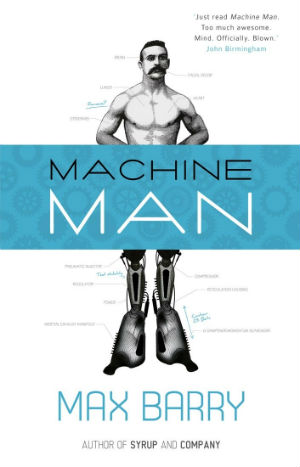
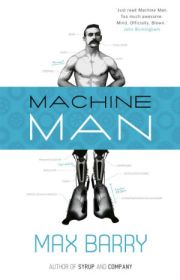
[READ: January 5, 2012] Machine Man

Don’t worry if you’re suffering from Barry blog overload, this post is about Barry’s new novel, which I just finished.

I have enjoyed Barry’s previous novels quite a lot.  They typically deal with corporate skewering and this book is no exception.  Except that the corporate skewering takes a back seat to the major sci-fi elements of the story.  Before I mention the story itself, I wanted to mention the origin of the story.  In the Acknowledgements at the end of the book, Barry explains that his fans had been nudging him to write something.  And while he had been doing projects, he hadn’t written a book in a while.  So he decided to write the book online.  He wrote a few hundred words a day and posted them online.  And then he sat back and waited for the comments to come in.

He talks about how he’s basically showing everyone his rough draft of a story and letting people tear it apart.  But he found that his fans were supportive and even offered ideas (which he then callously stole, muhahaha).  And so the story online is actually rather different from what appeared as the final draft.  (No, I’m not going to read the online version, but you can.  It’s available here).

Anyhow, as the story opens, Dr Charlie Neumann (I just got the bad pun of that name, shame on him and shame on me for not seeing it sooner) loses his phone.  He feels totally cut off without his phone.  The scene seems a little over the top (he checks his car while wearing only a towel) but it shows how technologically dependent he (and we) feel most of the time.  This kind of mild slapstick scene resolves itself in a shockingly brutal way.  When Dr Neumann gets to his office (he’s an engineer at Better Future) he finally sees where he left his phone.  Unfortunately, he has already started an industrial vice and he’s distracted by his phone long enough to have his leg crushed by said vice.

When he wakes up in the hospital, he is surrounded by people trying to help him–nurses, doctors, therapists, but he’s really just distraught about the loss of his leg.  And then he sees Lola Banks, who is bringing him a pile of artificial legs.  Lola is quite possibly the first woman who Charlie has ever spoken to who seems in any way empathetic to him (Charlie is, admittedly a pretty cold and cerebral individual). She shows him some prosthetics which he’s not too thrilled by.  But when Lola reveals that Better Future is paying for top of the line stuff for him, she shows him the highest end of the high end legs.  And Charlie falls in love (with Lola and the legs). 

Lola Banks proves to be an interesting person.  Not ony does she not recoil from Charlie and his handicap (it is her job), but she seems to almost admire Charlie for seeing the beauty in the prostheses.  Lola proves to be the kind of woman who falls for certain kinds of men, but with Charlie it’s different.  Really, it is.  Shut up, it is.

Although Charlie does see the beauty in the prostheses, he can’t help but see how they can be improved (he is an engineer after all).  And so, he sets out to make the artificial legs not just replacements but better than their human counterpart.  Better Future is on board with helping Charlie recover (which is quite nice, and somewhat unexpected coming from corporation hater Barry), but we see that Better Future knows what it has with Charlie–a single-minded, focused engineer. A man who only wants things to be more efficient.  So when Charlie starts outfitting the prosthetics with motors (and considers putting in wifi) the company is kind of impressed.  And so is Charlie.  The leg is heavy and a little unwieldy, and it’s not very pretty (it has hooves), but it sure works. 

The problem, as Charlie sees it, is that his intact leg is holding back his new invention.  How can he fully test the artificial legs if his human leg is less than the prosthetic? (more…)

Read Full Post »

SOUNDTRACK: DAVILA 666-“Eso Que Me Haces” (2011).

The Davila 666 album Tan Bajo made NPR’s Best Albums of the Year list.  And they cite this song as an example. 

This is a fuzzy, kind of tinny guitar song (that reminds me a bit of Wavves).  It’s only two minutes long and the riff is simple and catchy.  The vocals are shouted and the chorus is gang shouted.   And there’s a big “Oh Oh!” to really grab you.

So basically it’s catchy but nothing original.  The novelty of the song is that the whole thing is sung in Spanish.  If you don’t speak Spanish the vocals sound distorted enough that you may not even realize they’re in Spanish.  This band is from Puerto Rico.  And this album has been a hit both in Puerto Rico and in garage rock circles in the States. 

I’m pretty intrigued, and I’m going to have to check out the rest of their album.  NPR says it’s kind of offensive–maybe I need to re-learn Spanish.

[READ: January 4, 2012] “Chechnya”

Karen Carlson also recommended this story.  She wrote: “I didn’t think I’d like this, but it grew on me, and by the end it had me in the palm of its… well, if a story had a hand, it would’ve had me there.” 

This was a dark story.  It was a little slow to get going but once it started flowing it was really gripping.  It was as if the story picked up adrenaline as it (and the danger) progressed.  While at first the story seemed pretty obviously about Sonja, it is really about Chechnya. 

As the story opens, we meet Sonja, a nurse in war-torn Chechnya.  We learn that she works in the only hospital in the area and that even they were bombed not too long ago.  All that is left is a maternity ward and a trauma ward, and they can’t spare any electricity because their generator can’t handle anything more.  Sonja is one of the few nurses on call.  She hasn’t been home in ages and she just sleeps at the hospital. 

When Sonja wakes up, she hears that a man is waiting to talk to her.  He asks if the hospital will take in an eight-year-old girl, since both of her parents were killed.  Sonja informs the man that they are not an orphanage.  But the man, whose name is Akhmed, says that he will work at the hospital (he was in training when his wife got sick) if they will help the girl.  he immediately gets to work. 

The story then follows the parallel lives of Sonja and Akhmed as they work at the hospital.  Akhmed’s wife is delusional and dying at home.  So he can be out for 16 hours at the hospital and she doesn’t realize how long he has been gone.   Sonja forgets immediately about the girl and just stets about healing the sick.  What else can she do? (more…)

Read Full Post »

SOUNDTRACK: THE SWELL SEASON-Strict Joy (2009).

I bought this disc for Sarah after it came out.  I didn’t think that I would enjoy it that much because while I loved the movie Once, I wasn’t sure if I needed more from Glen and Marketa.  But then I found a whole slew of free concerts from NPR and I became hooked on the band.

The disc opens with “Low Rising” (what I think of as the “Van Morrison” song).  It gets better with each listen.  It’s a slow ballad which is followed by “Feeling the Pull,” a more up-tempo song that really highlights Marketa’s beautiful harmonies.  “In These Arms” is a gorgeous song.  The verses are downbeat and somber “if you stay…with that asshole…it will only lead to harm” but again the harmonies are gorgeous.  “The Rain” is a more rocking tune (within reason, of course).  It has an interesting middle section that quiets down, but it’s a solid folk rocking song.

“Fantasy Man” is Marketa’s first lead vocal song on the disc.  I like her voice but sometimes I find her lead songs to be a bit too wispy, too quiet.  I like this song, but it feels long (and at 5 minutes, it is).  “Paper Cup” is one of Glen’s quiet ballads.  It’s a pretty song.  “High Horses” is one that I didn’t know from the live sets, I guess it’s not too popular with the band, but I think it’s strong.  It runs a little long but that’s because it has a cool middle section that keeps building and building with more instruments and voices.  “The Verb” is another song that I didn’t know.  It has a cool intensity to it and while it doesn’t stand out as a hit, it’s certainly an enjoyable song.

“I Have Loved You Wrong” is another pretty Marketa song, but again it’s very slow and very long.  I don’t think I could buy her solo album because although her voice is lovely and her melodies are nice, they’re just so ephemeral I can’t really get into them.  “Love That Conquers” is an interesting song.  It sounds nothing like The Swell Season (must be the banjo).  It’s a nice addition to the album and should maybe have been placed a little earlier to break up the sound style a bit more.  “Back Broke” ends the disc very strongly.  Although I think the song works better live (with audience participation), the melody and tone of the song are somberly beautiful.

There are moments of this disc when it turns out to be what I feared the whole disc would be–bland folkiness. But overall this is an enjoyable album for a rainy day.  And Hansard really has an amazing voice.  However, I really like them better live.

[READ: December 26, 2011] Third Reich

I was pretty excited when I heard about this book, although I must admit I was a little concerned by the title.  Bolaño has a kind of weird Nazi fascination.  There is Nazi Literature in America and then a whole section of 2666 is given over to Nazi Germany.  He doesn’t like Nazis or anything but he writes about them a lot and it can be a little exhausting.  So it was with some relief that I learned that Third Reich is the name of a game that the main character plays.  It is a kind of historical reimagining kind of game (I guess like Risk but more specific and with more at stake).  It is set during the time of the Third Reich and the players represent various countries (or perhaps even powers).

I am giving up on explaining the game from here on because a) there’s a lot about the game in the book and b) I’m not sure if it wasn’t explained very thoroughly or if I just missed out on exactly what was happening.  During the book he talks about Hexes 65 through 68 and so on.  So I assume the map of the world is a hex grid.  But he never gives any context (or even a picture!–and this makes sense as it’s written as the diary of a well-regarded player who is not trying to teach us the game).  So while I understand the general tenets and play of the game (there’s a die (or dice) and tokens that reside on the board), the specifics are completely nebulous.  But that’s okay.  Because the game specifics don’t impact the book, but the game overall is at the heart of the book.  I think it’s neat that Bolaño invented a game (and several others games are named, but no details are given).  He is clearly very gifted at inventing people, games, things.

But as I said, the game is only a part of the book and in fact, the game details don’t enter into the book until about half way through. (more…)

Read Full Post »

I have been getting The Washington Spectator for years and years.  I was delighted with it in the beginning when the editor had the wonderful name of Ben Franklin.  I am delighted now that publisher’s name is Hamilton Fish.  But aside from these two fascinating details, I have always enjoyed the content.  It was thoroughly researched and detailed.  And the little 4 page leaflet always looked like a newspaper in design and style, and it gave it a kind of gravitas–no flashy colors or pictures.

Well, here it is, Vol 37, Issue No 21 and they have finally changed the format.  And not only that, they have created a website and have a Facebook presence!  Welcome to the 20th century!

I say that jokingly because despite these changes (which look great by the way), The Spectator has not abandoned its old school journalism practice.  21st century news is pretty much all flash and brash–style over substance–quick reporting with no concern for accuracy and very little attention brought to retractions (can anyone say “climategate” (I wish they wouldn’t call it that)).  But The Spectator is exactly the opposite, and I am delighted to say that although they are now a lot more accessible, they have not lost any of their tenacity or thoroughness.

The redesign is quite nice.  There’s an image on the front page and now there are pull quotes in red, which stand out nicely on the pale paper.  Although I always liked the pull quote box in the middle off the front page, this new format allows for a couple of different pull quotes as well as an opportunity to mix things up a bit.  (more…)

Read Full Post »

SOUNDTRACKСУБИТО (Subito)-“Du Hast” (2011).

Субито (pronounced Subito) is from the Ukraine.  They’re a bunch of miners and they play music.  In addition to this cover, which is generating some meme buzz on the internet, they have a few other songs (and videos) of note.

This cover is notable in that the only real difference between this song and the original is the prominence of the button accordion.  The vocals are nearly identical (he’s got his German goth down perfectly), and the rest of the band plays quiet heavily (I love the triangle instruments!).  But the accordion changes the entire texture and tone of the song.   It’s still ominous (I mean, those vocals!) but the accordion adds an air of whimsy that undermines the menace and yet also somehow makes the rest of the song seem even more menacing.

Of course the video is quite silly which leads one to assume that they’re not taking their version too seriously and yet their playing is impeccable and their backing vocals are right on.

So, yes, I rather like this song, and I like being able to include the word Субито in my post.

[READ: November 10, 2011] “The Good Samaritan”

Joyce Carol Oates has a wonderful way of turning her stories into something dark.  Even if it starts out in a rather innocent light.

This story is set in 1981 on a train coming from Utica, NY.  The narrator, Sonia, finds a woman’s wallet stuffed into the seat of the car.  The story begins with Sonia thinking about the woman, wondering what she’s like, looking at the photos of herself and her family and sort of daydreaming what it would be like to be older and married.  It’s only after a brief reverie that she, a poor college student, checks the money to see what’s there.  (About $25).  She hopes that the woman is old enough to give her a reward, but assumes she is not.

Sonia is to be heading home to help her mother with her ailing grandmother, something she’s not looking forward to.  So she decides that she will return the wallet to the woman who, after all, lives only a few blocks from the station.

What is wonderful about this story is that this innocent setup masks the real story, which is never fully explored, but is hinted at enough to keep us all guessing.  When Sonia arrives at the house, the woman’s husband is home and he seems….surprised that Sonia has brought this wallet home.  She feels sympathy for him when he begins to explain that his wife ran off and must have dropped this wallet on this train while she was fleeing.  Sonia wants to help the man in some way.  He invites her inside and she thinks of all the things she could do for him–stupid things like make dinner or maybe even look at her things to see is she can help figure out where her wife went.  She suggests this last idea and he accepts. (more…)

Read Full Post »

SOUNDTRACK: SUFJAN STEVENS-The Age of Adz (2010).

Sufjan Stevens has released a bunch of albums of beautiful orchestral rock.  It is multi-layered and complex with classical elements and all kinds of cool instruments.

And this album starts out with a beautiful acoustic guitar melody and Sufjan’s delicate vocals.  Although it is a far more stripped down song than usual, “Futile Devices” seems like it is heading in the standard direction.  But anyone who heard Sufjan’s Christmas album number VIII knows that he has been having some fun with electronics.  And they show up with a vengeance on track two, “Too Much.”

All of the multilayered noise that was once orchestral and (some might say) precious has been replaced by a cacophony of gorgeous electronic noises.  The beginning of the song reminds me of the sounds in Skinny Puppy’s “Stairs and Flowers” (how many Sufjan Stevens reviews mention Skinny Puppy?).  The song is nothing like Skinny Puppy once the vocals kick in–it’s catchy and delicate–but those electronics underpin the whole thing, bringing his pastoralia into the twenty-first century.  When I first reviewed this song I didn’t like it but once you get absorbed by Sufjan’s world, it’s an enticing place to be,

“Age of Adz” takes this electronic nonsense even further with an 8 minute brew of strange sounds and choral voices.  But he always manages to throw in some catchy parts, no matter how strange the song gets.

For me one of the highlights of the disc is “I Walked” it features one of my favorite Sufjan things–falsetto vocals in a beautiful but unexpected melody.  And this song has them in spades.  “Now That I’m Older” has a very disconcerting sound–his voice is slowly warbled and mournful.  It’s a beautiful melody that is alienating at the same time.

“Get Real Get Right” returns to his earlier style somewhat (there’s more layers of music, although the electronica is still in place).   “Vesuvius” is a beautiful song and “All for Myself” is another of those great falsetto tracks that I like so much.

“I Want to Be Well” eventually turns into a manic electronic workout in which he repeats the chorus “I’m not fucking around.”

But nothing compares  to “Impossible Soul” a twenty-five minute (!) multi-part suite of electronic chaos.  It’s a fantastic song complete with autotune (used to very cool effect), repeated swelling choruses (it’s like a Polyphonic Spree tribute), electronic freakouts, and acoustic comedowns.  All in a positive, happy message.  I can’t stop listening to it.  “It’s not so impossible!”

Sufjan continues to impress me.

[READ: November 10, 2011] McSweeney’s #9

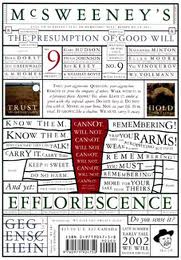
After the excesses of McSweeney’s #8, I was excited to get to the brevity (and urgency) of McSweeney’s #9.  This one is a paperback and looks like the first couple of issues.  The cover is mostly text with a hodgepodge of phrases and pleas.  You get things like: Thankful, Emboldened, The (Hot-Blooded/Life-Saving) Presumption of (Perpetual/Irrational (or More Likely, Irreducibly Rational) Good Will, Efflorescence, Our motto this time: We Give You Sweaty Hugs,” Alternative motto: ” We Are Out Looking,” GEGENSCHEIN (no more), and the promise: “We will Do Four This Year.”

This is the kind of issue that makes me love McSweeney’s.  There are some wonderful short stories, there are some nice essays and there are some dark moments all centered vaguely and tangentially around a theme.  There are some great authors here, too.

The back cover image is called Garden Variety by Scott Greene and it’s a fantastic painting.  You can see it here (navigate through the 2000-2004 paintings, but I have to say I really like the style of all of his work.

There are no letters and no nonsense in this issue.  So let’s get to it. (more…)

Read Full Post »

SOUNDTRACK: COLIN STETSON-Live at All Tomorrow’s Parties, October 4, 2011 (2011).

In addition to playing SXSW, Colin Stetson also played All Tomorrow’s Parties, and NPR was there.  Unlike with SXSW, this set appears to be full length (about 50 minutes–which is a pretty amazing amount of time for him to blow that horn).  Like SXSW (and the album) Stetston starts with “Awake on Foreign Shores” and “Judges.”  What I love about this recording is that after Stetson finishes “Judges” a guy in the audience shouts (in a voice of total amazement) “That shit was off the hook!”  And he is right.  It’s not even worth me going into how amazing Steston is once again (check previous posts for  that), but man, just look at the size of that horn he’s playing (seriously, click on the link to see it bigger).

Stetson plays a few more songs from New History Warfare, Vol. 2: Judges like “The Righteous Wrath of an Honorable Man” (which is outstanding) and “A Dream of Water” (which works without Laurie Anderson, although he does say he’s sorry she’s not there).  He also introduces two news songs “Hunted 1” and “Hunted 2” which show new levels and new styles that Stetson employs.

This is a remarkable set, and Steston is clearly in his element (and the crowd is rapt).  The only problem I have is the recording level.  It must be very difficult to maintain recording levels for Stetson’s brand of noise–his louds are really loud–but you can’t hear him talk at all.  And most of the time, the introductions to his songs are worth hearing.  I’m sure if they tried to get the speaking level a little louder the music would have sacrificed though, so I think they made the right choice–I only wish there was a transcript available.

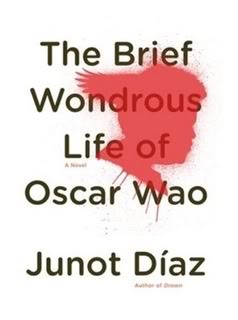
[READ: October 31, 2011] The Brief Wondrous Life of Oscar Wao

Apparently it’s pronounced, “Wow”, by the way.

Because of my new job, I don’t have a  full hour of lunch-time reading like I used to.  And so this book took considerably longer than I intended.  However, once I set aside some time to read it, I flew through the book.

I’m going to get this part out of the way because I was thinking about it throughout the book and I want to mention it without having it bog down the post.  This story reminded me a lot of Roberto Bolaño.  On the surface, sure this is because they are both writers from “Central America” (Diaz is originally from the Dominican Republic but moved to the US, while Bolaño is originally from Chile but moved to Mexico and then Spain).   But I’m not really talking about their origins so much as the style of storytelling.

Without going into a lot of Bolaño here, I’ll just say that Bolaño tends to write very detailed character studies–stories that follow one person throughout his whole life on something of a fruitless quest.  And the details of that person’s life include information about family members and distant relatives.  Further, Bolaño has written about the brutalities of both Chile and Mexico and how a person can survive in such a place.  Similarly, Díaz follows the life of Oscar and his extended family and he talks about the brutalities of the Dominican Republic.

This is in no way to suggest that there is any connection between the two writers. I mean, The Savage Detectives came out in the States in 2007 (same years as Oscar Wao) and while he certainly could have read it in Spanish, I have no evidence that he did (and as I recently found out, the first draft of the Oscar story was written in 2000).  Again, the parallels are only from my reading and have nothing to do with Díaz himself.

Okay, now that that’s out of my system…

This is the story of Oscar de Leon.  But more than that, this is the story of a fukú–a curse that befalls the de Leon family and follows them through several generations.  Oscar is the youngest member of the family and the person whom the narrator knows best.  So we see this fukú as it impacts Oscar.  And although the book is ostensibly about Oscar, it is about much more.

Oscar was born in Paterson, NJ (the town next to where I grew up!) and went to Don Bosco Tech High School (where many of my friends went).  Oscar is Dominican (his mother is from the DR, but he and his sister were born in NJ), but unlike every other Dominican male, Oscar is totally uncool, into geeky sci-fi and D&D and is clearly destined to be a virgin because he is fat with terrible hair and no social skills.

And, (no spoiler), as the title states, his life will be short. (more…)

Read Full Post »

SOUNDTRACK: TOM WAITS-Small Change (1976).

Half-naked woman on the cover and all (Wikipedia say that this might be Elvira, before she was “Elvira”), this is what people thing of when they think Tom Waits: That gravelly voice is in full form here, with poetic rants and bluesy, drunken musings.

The opening track, “Tom Traubert’s Blues (Four sheets to the wind in Copenhagen)” (I love that many of these titles have parenthetical additions) features the repeated chorus from “waltzing Matilda” which is kind of cheating, but which certainly makes this song potent and memorable.  “Step Right Up” is a skit and scat sales pitch for a miracle product.  It’s a wonderful piece of snark aimed at hucksters (this actually makes sense given that nearly 40 years later he still hates advertising (according to this interview on NPR)).

“Jitterbug Boy” is a mournful piano ballad.  It makes me think of William Kennedy’s Ironweed (of course, Waits was in the film of Ironweed, so maybe that’s got something to do with it).  “I Wish I was in New Orleans (In the Ninth Ward)” has a very Louis Armstrong feel to it (I never noticed how close this early style is to Armstrong until I started playing “What a Wonderful World” for my kids (no Tom for them yet). And of course, the Ninth Ward was really devastated by Hurricane Katrina, so maybe they should have used this as their anthem.

“The Piano’s Been Drinking” is forever etched in my mind from Mystery Science Theater 3000–Tom Servo does a wonderful Tom Waits impersonation.  Incidentally, Waits himself had been drinking, quite heavily at the time.  The track “Pasties and G String” is a scat-fueled description of the lady on the cover, more or less.  It’s accompanied by simply drums and a cymbal and is not too dissimilar from “Step Right Up.”  “Bad Liver and a Broken Heart” begins and ends with the melody of “As Time Goes By” and ends with a confession to drinking too much.

A song like “The One That Got Away” is Waits rambling around with his poetry in his gravelly, slurry followed by a sultry saxophone.  It sets a mood faster than anything I know.  Of course, if you don’t want that mood, you won’t want this album.

Of his first four albums, this one is my favorite (just ahead of Closing Time).  I’m not a huge fan of his early work, and I don’t listen to it all that often, but it’s a perfect treat when the mood strikes.  Waits also was beginning to get into something of a rut.  Despite his varied styles per album, all of the albums were beginning to blend a little.   There are still some great songs coming, but it would take until Swordfishtrombones before he went really far afield from this comfort zone.

[READ: September 21 2011] “Dog Run Moon”

This is one of those stories that seems so pointless that you can’t stop reading.  The good thing is that it was so well-written and engaging that its pointlessness is part of its charm.

As the story opens, Sid is running stark naked through a desert landscape–his feet are bleeding, he is covered in the red dust from the ground and there is a white Spaniel running alongside him.

Essentially, the entire story is that Sid has stolen this dog from Montana Bob and his friend Charlie Chaplin.  They caught him and he ran away with the dog through the desert.  As I say, it’s kind of pointless because he’s running naked and barefoot and they are chasing him on ATVs–he’s obviously not going to escape.  But what makes the story worth reading is the way the plot is irrelevant (except that it tells you a lot about Sid), because it’s really the impetus for his actions that comprises the story. (more…)

Read Full Post »

« Newer Posts - Older Posts »