Feeds:
Posts
Comments

Archive for the ‘Technology’ Category

overpoSOUNDTRACK: J. MASCIS-Tiny Desk Concert #406 (November 22, 2014).

mascisJ. Mascis is best known as a wailing guitarist who plays in front of a wall of speakers with Dinosaur Jr.  But for this Tiny Desk Concert he busts out an acoustic guitar and plays some songs from his solo album (as well as an old Dino classic).

“Stumble” is sung in Mascis’ delicate falsetto.  They zoom in on him singing and its amazing how he doesn’t seem to be straining in any way doing this really high voice.  After all the falsetto, his saying “Thanks” in a deep voice is really kind of funny.

For the second song, he busts out the classic “Little Fury Thing.”  This acoustic version sounds really good–so simple and clean.  The original is great burst of loud rocking and it’s amazing that the song can sound so good stripped down. His voice is much deeper for this song .  I love at the end how he plays the strings really really fast but continues to swing in his most languid style.

The third song is actually two songs.  He switches guitars (and is apparently using sheet music) to play “Drifter/Heal the Star.”  The first part is a lengthy, really pretty instrumental.  For all of Mascis’ noise and rocking out, he knows how to write beautiful, lovely melodies.  The main melody is played on the high strings alternating some great strumming on the low strings for the “chorus.”   I could listen to this for ages.

The song segues into “Heal the Star” which sounds very Mascis–his most Mascis voice and strumming style.  Although for the chorus he’s back to the falsetto vocals again.  The solo a the end is great as he plays chords on the lowers strings while soloing ion the high strings (there must be a different tuning to make this sound so good).

I saw Dinosaur Jr a couple of months ago and I’m going to see them in November again.  I love Mascis’ loudness, but it’s wonderful to hear him play these quiet pieces too.

[READ: April 1, 2016] Overpowered!

I loved the premise of this book right from the start.  I mean, the cover alone is great, and flipping through it, there are some wonderful images of men with great mustaches in turbans doing all manner of hypnosis to people.  What I didn’t expect (but probably should have if I’d read his bio on the back) is that Green himself is a practicing hypnotherapist (in addition to being an actor and performer who has created such characters as “US Country music star Tina C and pensioner rap star Ida Barr.”

It turns out that Green has been interested in hypnosis for a long time.  He learned how to do it and then wanted to set the record straight for what hypnosis actually is as opposed to what we believe it is.

So this proves to be a thorough (and very funny) history of hypnosis through the years.   He says the book is called “Overpowered” because “I’m fascinated by the delight human beings derive from the idea of being taken over.  Being conscious may be beneficial, but it is also hard work.” (more…)

Read Full Post »

1971 SOUNDTRACK: DAVÍD GARZA-Tiny Desk Concert #405 (November 15, 2014).

garzaI first heard of Garza back in 1998 with his minor hit “Discoball World.”  I really liked it.  And then I assumed he just went away.  But apparently he didn’t.

The first song, “Texas is My Hometown” is a slow jazzy song about how much he loves Texas.  He sounds like an old-timey crooner, except that he references all kinds of contemporary musicians.

And then he plays “Discoball World.”  It sounds quite different because it’s all acoustic guitar (although his strumming is pretty intense).  I prefer the original, but he’s really intense while singing this version.

He says he was walking around DC and he ran into his favorite singer in the whole world.  Then he invites Gaby Moreno to sing the final song, an old Spanish song their grandparents used to sing.  And indeed, with wonderful flair, he plays a beautiful Spanish guitar.  Gaby sings lead (in Spanish) on the whole song and her voice is really amazing.  She can hold a note for a really long time and then really powers through a loud note.  He does backing ooohss when needed, but Gaby is the star of this song.  Until, that is, he plays some great guitar at the end, very percussive, very powerful.

It’s a good set.

[READ: June 1, 2016] The Complete Peanuts 1971-1972

I took some time off from my Peanuts reading–I needed a break after fifteen years.  And it was fun to come back to the strip really looking forward to the 1970s.

There seem to be three big consistent ideas in these two years.  Woodstock becomes very prominent, Sally gets to complain about school a lot and Peppermint Patty comes into her own, with strips about her and Chuck, her and Franklin and her and Marcie (who is finally named!).

1971 starts off auspiciously with Charlie saying that this is going to be his year of decision–he’s going to start making changes.  But Lucy interrupts saying that she is going to spend the whole year regretting the past-“Forget the future!” (more…)

Read Full Post »

may16SOUNDTRACK: MARISA ANDERSON-Tiny Desk Concert #374 (July 19, 2014).

marisaMarisa Anderson may be the most unassuming guitar wizard I’ve ever seen.  There’s nothing flashy about her or her look, but man can she make those guitars sound great.  And she plays an old-timey bluegrass style of guitar with slides and lots of picking.

For this set she plays 5 songs (on four different guitars).  She doesn’t sing, she just lets the music do all the work.

“Hard Times Come Again No More” is done on a hollow-bodied electric guitar.  It’s noisy, and fuzzy.  She plays finger-picks the main melody in the high notes and then in the middle of the song she plays big open string chords–buzzy and noisy–while still playing the melody.  She says the song “gets stuck in my head if I’m driving through snow.”

“Sinks and Rises” is about a swimming hole in Kentucky.  She went there in a car, but she wasn’t driving and she’s never been there since but it was the best swimming day of her life.  For this song she plays a lap steel guitar that looks to be made of ivory.  It’s so much fun to watch her slowly moving that slide up and down the neck (sometimes only playing one note) while her picking hand goes like crazy.

For the third song she plays a different hollow body guitar.  “Hesitation Theme and Variation Blues” was inspired by her favorite guitar player Rev. Gary Davis.  She says this is a deconstruction of his “Hesitation Blues.”  She doesn’t sing so she took it apart and put it back together.  It begins with an almost classical theme before launching into a very cool blues.

Then she switches back to guitar #1.  She says she plays in settings didn’t allow cover songs, she didn’t want to do just originals so she played songs from public domain–like the national parks if we don’t use them we’ll lose them.  In 2013, she released an album that was all songs in the public domain.  “Canaan’s Land Medley” is a medley of three gospel songs.  She plays the melodies with her fingers and a slide on her pinky–which adds some cool textures to the song.

For the final song, “Galax,” she brings out guitar #4, a Fender Strat (or knock off). She says she went to a bluegrass festival and was overwhelmed by all of the good songs being played in the parking lot–she’s not even sure if she got to the show.  This song is about all those songs being played at once.  There’s some really fast guitar playing and slide at the same time.  It sounds great and is even more fun to watch.

Anderson is really a marvel–totally soft-spoken and seemingly shy, but main is she amazing to listen to.

[READ: July 13, 2016] “Call Me Crazy”

The May 16, 2016 issue of the New Yorker had a series called “Univent This” in which six authors imagine something that they could make go away. Since I knew many of them, I decided to write about them all.  I have to wonder how much these writers had to think about their answers, or if they’d imagined this all along.

Of the six articles, Brownstein’s was certainly the funniest.  It’s also the most contemporary and almost the most obvious thing to complain about.  But it suits her comic style very well.

She wants to uninvent the conference call.  She assumes that we all agree that the conference call is a bad idea, but in case we need convincing she offers this example. (more…)

Read Full Post »

feynman SOUNDTRACK: LARA ST. JOHN-Tiny Desk Concert #530 (May 9, 2016).

laraWhen Lara St. John released her first CD it made ripples because of the way she appeared on it (presumably topless).  But if that was a stunt to get people to listen, it was a good one because the music on it was phenomenal (and the disc sold very well).  St. John is masterful on the violin and has released a dozen or so CDs of herself playing.

I have never seen her play before and it is a marvel watching her fingers  fly (and slide) all over the neck of the violin (including some absurdly high and fast notes).

The first piece is “Czardashian Rhapsody.”  It is an amazing mashup of two songs by Martin Kennedy: Czardas, the most familiar Hungarian melody for violin and Hungarian Rhapsody No. 2, the most familiar Hungarian melody for piano.  He merged them into a real barnstormer.  It’s 6 minutes of switching back and forth between the familiar melodies and very gypsy-esque sections (and some very long held notes).

The song is 6 minutes of musical acrobatics.

Although this is billed as St. John’s show, much recognition must go to her pianist Matt Herskowitz who is also magnificent.

St. John clearly has a sense of humor since she named her new album Shiksa.  She says the album actually has ten different titles because every culture has a word for “big Canadian chicks” like herself.

The second piece is “Sari Siroun Yar” by Serouj Kradjian.  She says it was the first song she heard when she went to Armenia in the lat 1980s.  It is a bittersweet Armenian troubadour song.  While this song is much more mellow than the first, it still showcases some amazing playing on both musicians’ parts.  The opening notes she plays high on the fret board which gives the violin a very different sound–almost breathy.  And the main melody is quite lovely.

The final song is once again a wild one.  “Oltenian Hora” is one that St. John arranged herself.  It plays off a catalog of violin tricks, St. John explains, practiced by traditional Romanian gypsy fiddlers: rapid-fire whistles, bird calls and slithery harmonics, all in a variety of off-kilter rhythms.  I’ve never seen some of the things she does on the violin (those bird calls are amazing).  And by the end she is bowing so hard the bow seems about to break.  It is way intense and really awesome.

I’m not sure I’ve ever seen a violinist get out of breath from playing so hard before, but she deserves all of the applause.

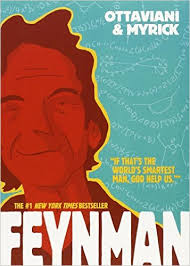
[READ: March 15, 2016] Feynman

This is a graphic novel biography of Richard Feynman.  Ottaviani worked as a nuclear engineer, programmer and reference librarian, so you can trust him.

I have respected Richard Feynman for years.  I have a few of his books, although I can’t say I have read them intensely.  I knew that he was considered an amazing professor–making really intense subjects easier for the layman to understand.  And many of his lectures are available as audiobooks.

But there was so much about him that I didn’t know.  And this biography (which runs nearly 300 pages and is jam packed with information) covers nearly all of it.  Including excerpts from his own publications and attaching a massive bibliography for more works by and about Feynman. (more…)

Read Full Post »

may2015SOUNDTRACK: GAELYNN LEA-“Someday We’ll Linger In The Sun” (TINY DESK CONTEST WINNER 2016).

gaelynnYou never know what is going to win the Tiny Desk Contest–there are so many genres represented.  Will it big a big rocking band, a scrappy bluesy band, will it be a sweet lullaby, or, unexpectedly, will it be a haunting song by a woman with a fiddle.

Gaelynn Lea plays a violin which she loops.

As the song opens, the first violin notes are slow and haunting, almost hesitating.  Then she plays harmony notes over those (the spareness here reminds me of Gavin Bryars’ “Jesus’ Blood Never Failed Me Yet.”  Then she plays some pizzicato notes over the top of these.  It’s a beautiful, haunting melody.

After a minute her voice comes in.  It is unexpected.  It sounds slightly off, and yet somehow even more hauntingly beautiful for it.  Especially when she gets to the simple “chorus” of “and I love you.”  The melody doesn’t change through the song, that constant repeating riff, those slow pulls on the bow, the intermittent pizzicato notes and Lea’s voice continue as lyrics flow over you.

And what lyrics:

Our love’s a complex vintage wine
All rotted leaves and lemon rind
I’d spit you out but now you’re mine

Don’t tell me we’ve got time
The subtle thief of life
It slips away when we pay no mind

We pulled the weeds out til the dawn
Nearly too tired to carry on
Someday we’ll linger in the sun

Man.

After a few verses, she plays a solo over the top of it all.  It is as aching as the rest of the song.  Try not to cry while listening to it.

You can watch the video here.

[READ: January 8, 2015] “From the Palo Alto Sessions”

This is an excerpt from Cohen’s Book of Numbers.  I vaguely know Cohen (his first book Witz, was 800 pages and BoN is almost 600), but I don’t really know his writing.

This excerpt (I don’t know where it comes from the book) is a bit hard to get into: “Toward the end D-Unit had been working on the touchscreen.  Do not interrupt, we do not digress.”  Turns out that D-Unit is a person and the narrator is plural (or the royal we).  The story follows as “we” investigate D-Unit’s house and computer supplies.

There’ s a ton of tech speak, as well as what appears to be slang (I never figured out what “cur” meant in this book).

The language just piles up with sentences that build and stop and resume in another way.  I enjoyed this: “This career vegan who after his wife left him for a woman stuffed his freezer with enough cuts of venison to make 1.33 deer.” (more…)

Read Full Post »

1969  SOUNDTRACK: ABIGAIL WASHBURN-Tiny Desk Concert #101 (January 3, 2011).

abigailAbigail Washburn had plans to study law at Beijing University in China.   Before she left, she bought a banjo—she wanted to take something to China that was American.  Then Washburn went on a road trip to study the banjo and to learn some tunes. She found her way to the Augusta Heritage Center in West Virginia, then to North Carolina and then Kentucky to the International Bluegrass Association. It was there that she sat down with a few women to play music, and right then and there was offered a record deal. She blew off China ans has made a career as a banjo player–typical story.

In the ten years since then, she has been to China (with her banjo) where she learned Chinese folk music.  She now mixes American bluegrass and folk with Chinese folk music.  For this Tiny Desk, she plays three songs with her band Rob Hecht on fiddle, Jared Engel on bass, Jamie Dick on drums and Kai Welch on keyboards and trumpet.  She uses two different banjos, a normal sized one and, om the final track, a great big-bottomed one.

The first song “City of Refuge” she says is done in hop high tuning (in case you were interested).  It’s fun seeing how fast her right hand is moving while her left hand is fairly still and her vocals are fairly slow.

“Taiyang Chulai” is a traditional Chinese song meaning “The Sun Has Come Out and We Are So Happy.”  She sings in Chinese (and plays no banjo).  Her Chinese sounds amazing (and it’s really funny to see her speaking/singing it).  She says that taught American folk music in China and learned that she needed to do arm gestures since all Chinese folk songs have accompanying arm movements.  She also wore armbands which her grandma made for her.

“Bring Me My Queen” is the final song.  I found it interesting that her songs are rather slower than the Chinese song, at least in tempo.  This song is even slow for a banjo song.  But it’s quite beautiful.  In addition to being a great banjo player, Washburn has a lovely voice, too.

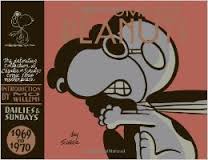
[READ: December 8, 2015] The Complete Peanuts 1969-1970

I was excited to get to this book to see which strip was published on my birthday (it’s sort of like seeing the headlines from the New York Times on your birthday).

Well, sadly, my strip was kind of boring–part of an annual be kind to animals or national dog week or something like that.  Nothing life-changing or earth-shattering.   Good grief.

I also decided that I’m taking a break from Peanuts for a time.  I have really enjoyed what I’ve read, but I need a breather.  I have read twenty some years of the strips over the last few months and, even if Schulz never rested, he didn’t condense twenty years into a few months either.  So sometime later in 2016 I’ll resume the books.

This book is notable for revealing Woodstock’s name!  I feel like that was the last big revelation that we’ll see for a while.  I am curious to see if the 70s added any new characters. (Well, there is Marcie.  I wonder when she comes along).

1969 starts out with Lucy saying that this is her year, “it’s all mine.”  Although a few days later she asks for a refund.  Lucy finally gets fed up with Schroeder and not only kicks his piano but throws it into the kite eating tree.  In March of 1970, Lucy says “I’m a new feminist.”

There’s a lot of Lucy/Snoopy rivalries.  In May 1969 we see the first an only reference so far to tether ball–Lucy is great at it (until Snoopy beats her).  There has been a somewhat recurring joke about Lucy beeping Snoopy on the nose (which he hates).  She does it in April and says it has been 384 days since she did it last (I wonder if anyone confirmed that).  In June, Charlie and his family go on vacation and Lucy is in charge of Snoopy (and she is particularly harsh).

Los of things happen to Snoopy this year.  As is per usual, Snoopy is skating in the winter time.  He is planning to win trophies (skating with Peppermint Patty–although she has to break the news that she is not interested).  He is also in preparation (in March 1969) to be the first beagle on the moon (wearing an astronaut helmet).  Surprisingly, there is no acknowledgement when the first man does land on the moon.

In April 1969, Snoopy goes on a two-week journey looking for his mom (but doesn’t find her).  In July of 1969 Snoopy takes up roller derby (for a very brief time).  In September of 1969 Snoopy finishes his first novel and submits it for publication. But he is rejected!  In Sept 1969 there are a lot of football jokes involving Snoopy and the little bird (the bird being too small to move a football of course).  March 1970 shows the return of the Easter beagle.

1969 sees a lot of talk of “Head Beagle.”  First Frieda reports Snoopy to the Head Beagle for not chasing rabbits.  Later Snoopy is appointed Head Beagle but can’t handle the workload.

In the summer of 1970, Snoopy goes to give a speech at the Daisy Hill puppy farm and a riot breaks out with tear gas!  And in September 1970 Snoopy wears a cooper bracelet to cure his arthritis.

In July 1970 Snoopy reveals a good truism “If you think about something at three o clock in the morning and then again at noon the next day you get different answers.”  Also in July is the first mention of “The Six Bunny-wunnies” fictional series of books.

For a few weeks in August of 1970 Snoopy pretends to be a grocery clerk (butter 28¢, bread 39¢, eggs 59¢, tea 79¢).

Lots of things seem to happen on the baseball field this year.

And in April 1969 Charlie Brown’s team wins two games in a row–neither team could make it so they both forfeit (Franklin is on one of those teams).  Later in June of 1969 Snoopy wins the Rookie of the year award for the baseball team.

In March of 1969 Linus make a sports drink which “replaces the body stores and prevents and diminution of vitally needed electrolytes and nutrients.”  (Gatorade was invented in 1965 and became popular with athletes in 1967).

Some great moments in this book:

In May of 1969 (on the baseball mound, of course) the team is talking about the costs of college “it can cost almost sixteen thousand dollars to go to college.”  The joke comes that Charlie is hoping for a baseball scholarship and every one busts out laughing.

In May of 1969 the school nurse is going to weigh them and Linus says he’s going to as about his hurting shoulder, “never pass up a chance to get a little free medical advice.”

In August, Linus’ gramma says she’ll donate $10 to his favorite charity, “ten dollars is a lot of money.”  (He ultimately decides not to accept).

In July of 1969 the little red-haired girl moves from Charlie’s street!  And Charlie never says anything to her.  Later in December 1969 Linus Charlie and Snoopy go skiing (on a school ski trip).   Charlie sees the little red-haired girl and falls off the ski lift.

Charlie makes a funny joke when he offers to shovel Lucy’s snow.  He asks for a quarter and she says “What if it snows tomorrow and covers up our walk again.  Do we get our quarter back?”  He replies, “No by then I will have spent it on riotous living.”

Peppermint Patty gets a lot of strips in these two years.  In Nov 1969 she talks about school: “I signed up for Folk Guitar, computer programming, stained glass art, shoemaking and a natural foods workshop.  I got spelling, history, arithmetic and two study periods.  I learned that what you sign up for and what you get are two different things.”  (I would TOTALLY sign up for those classes too).

She returns a lot in 1970–she’s a great character allowing Schulz to explore all different kinds of kids and ideas.  In the beginning of 1970 she is called to the principals’ office because she’s not allowed to wear sandals to school any more.  She cries and calls Charlie Brown for advice.  It takes Snoopy to kiss away her tear to snap her out of it.  The strip series ends with Franklin saying, “All I know is any rule that makes a little girl cry has to be a bad rule.”

Patty also says that she got an F on a test because she has a big nose–if a teacher doesn’t like your looks there’s nothing you can do.  Franklin looks at the paper and says “you turned in a blank test paper.”  She sighs, “there’s nothing you can do.”

In December 1970 Peppermint Patty invites Snoopy to a “turn about dance” (where the girls ask the boys).  They have a good time until a boy asks who her weird-looking friend is.  She punches him out and feels guilty about it until Snoopy says he had a great time and he’s the one who bit the chaperone.  Their friendship is great.

In Sept 1970 Patty has a crisis–thinking she’s not beautiful  (then Snoopy gives her a kiss).  The following week her dad gives her a dozen roses and says that the boys will be calling on her when she grows up and he wants to be the fist one in her life to give her a dozen roses.  It brought tears to my eyes.

In June of 1970, Peppermint Patty asks to borrow Charlie Brown’s glove for a kid on her team named “Thibault.”  Which leads to Charlie asking “Thibault?” at least twice.  Then Thibault (who has sideburns), refuses to give the glove back.  But Charlie Brown is happy by this because Thibault accuses him of “thinking you’re better than us.” And Charlie gleefully says “Me?  Better than someone else?”

1969 ends for Charlie when he buys a ticket to a sports awards dinner.  He gets a seat right next to Joe Shlabotnik…who never shows up.

This strip really sums up why Charlie Brown is so likable.  On October 26 in which Linus describes an amazing football game in which a team makes an amazing come from behind victory with seconds left in the game .  He describes the great plays and then Charlie’s response is “How did the other team feel?”

Sally is starting to become a more fully developed character–opinionated but often horribly wrong.  In May of 1970 she buys a fish tank saying “This is the age of aquariums.”  And she has no tolerance for school.  In Sept 1970 she asks why they have to learn all of these things in school.  Why does she have to learn the names of rivers?  “I’ve never even seen a river!  They could at least take me to see a river.”  Later she writes a theme for school, “If I had a pony:”  “If I had a pony I’d saddle up and ride so far from this school it would make your head swim.”  Then she crumples it up and says “That’ a good way to get a D-minus.”  In Nov she shows the class a document that is written by “an actual caveman.”  The punch line: “Show and Lie is my best subject.”

The best Great pumpkin joke comes in Oct 1970 when Lucy says “Santa Claus has elves to help him…what does the great pumpkin have, oranges?”

There are a couple of topical jokes.  In July 1970, when it rains during a game Lucy starts singing “Raindrops Keep Falling on My Head” (which was a hit in early 1970).  And in December 1970, the kids use a Ouija board which had been released as a game earlier that year.

And then on June 22, 1970 the little bird reveals his name to be Woodstock!  (strangely it was a year after the concert).  With a name he acts no differently.  In Nov 1970 Woodstock tries to fly south but gets lost.  So Snoopy walks with him.  After a week they get grabbed by a girl who say “Ma, I found a stray dog!”  Then Snoopy is tied up for a few days while Woodstock tries to rescue him.

The year ends with Sally doubting whether you really have to be good for Santa to bring you presents “the old rascal is bluffing…I know that [he] will bring me presents whether I am good or not.”  Then on Christmas Day, ”I was right!”

This was a great book, with some excellent strips and character developments.

Mo Willems, beloved children’s author, wrote the foreword.  Mo says he started his career by selling black market drawings of Snoopy and Charlie Brown in second grade.  He learned that even bullies liked Charlie Brown.  He says he could utterly relate to Charlie’s world, “For me, an immigrants kid, recently plopped into the middle of a small school in the insular world of uptown New Orleans, Charlie Brown was the only one who understood how confused and unhappy I felt.”

He says he aspired to Linus-ness: to be wise and kind and highly skilled at making gigantic structures of playing cards.  But he knew he was always a Charlie brown.  “Sometimes when I am in a deep funk and feel like my life if is an uphill battle…I try to stop and imagine someone reading the comic strip of my frustrated life and laughing.”

All of his characters are an homage to Schulz in some way.  And the greatest lesson her learned from Schulz, is “never let the characters know they are funny.”

He concludes by saying that Peanuts isn’t Art… it’s better.  He toured the Charles M. Schulz Museum and Research Center and held an original comic but he found it anti-climatic.  They were too precious to be enjoyed…they became Art.  The magic that you get from having them in a book or newspaper was missing.

Read Full Post »

1967 SOUNDTRACK: JULIAN LAGE TRIO-Tiny Desk Concert #140 (July 7, 2011).

lageJulian Lage is a jazz guitar prodigy.  he normally plays with a quintet but for this set he brought only a trio which includes bassist Jorge Roeder and percussionist Tupac Mantilla.

This was my first exposure to Lage and he does some really impressive lines and riffs.  He plays a hollow-bodied electric guitar that sounds an awful lot like an acoustic guitar. He does some phrasings that are really pretty or really interesting

But I was more impressed with Mantilla on percussion.  He uses thick brushes, he uses his hands on bongos and cymbals.  He uses his hands on his body–playing his lap and chest).  He even uses little dusts brooms (which must be unwieldy).  He’s also got some kind of drum (perhaps a loose snare?) with a great sound and even a bell.

They play three songs.  “Welcoming Committee” is a new song not recorded as of then.  At the end of the song, they all laugh as an office phone rings the end.  Julian is a sweet funny guy with some interesting stories about his songs.

“However” is an upbeat bouncy song (with some less noodling).  Interestingly, it was written by their saxophonist who is not playing in the trio today.

Before introducing the final song “Untitled (No. 24)” he says he started a blog for inspiration–to get people to bounce ideas off each other–healthy peer pressure with incentives for song writers.  The most recent one was a song a day for 30 days.  This was number 24.  (Hhe jokes that the first 23 sucked).  It’s a really fun piece that doesn’t feel incomplete at all.

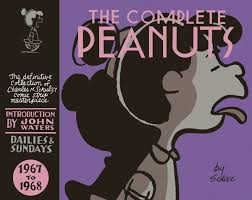
[READ: December 8, 2015] The Complete Peanuts 1967-1968

It’s 1967 and Schulz has had huge success with Snoopy’s Red Baron plots.  In December 1966 The Royal Guardsmen made a song called “Snoopy Vs the Red Baron” which made it to number 2 on the charts.  So The Red Baron plot takes over a lot of this year.  And while I enjoy seeing him like that and I get how it’s funny, I don’t really like it all that much–the jokes are too samey for me.  But despite all of the Red Baron excitement there are other things going on this year too.  Like the introduction of the Easter Beagle.  And of Franklin!

The kids get involved in many different sports this year.  In Feb 1967 Lucy begins arm wrestling (and beating) everyone.  She even takes on the Masked Marvel (Snoopy).  In Oct 1967 Snoopy plays hockey for the first time (I think).  He references Bobby Hull).  Later in Jan 1968 all the kids play hockey together.  Lucy beats everyone up and say how much she likes the game.  And at one point Snoopy smiles and is missing teeth.  In Oct 1968 Snoopy shoots and scores (on his doghouse) and says “they’re not sleeping well in Montreal tonight.”

In December 1967 Snoopy considers going to the Olympics in France for his ice skating.  He says he misses skating with Sonja Henie).  In April 1968 Snoopy is going to the Masters in Augusta.  When that doesn’t work out (we never see him there), later in April Snoopy is a wrist wrestler who is going to go to Petaluma for the world competition.  (There are many jokes about Petaluma).  Snoopy is disqualified because he has no thumbs.

In August 1968 Snoopy says “jogging is my thing.”  And in Nov 1968 we learn that Snoopy has a pool table but that Minnesota Fats won’t play him.

And of course there is baseball.

Peppermint Patty comes back in March 1967 to play against Charlie’s team.  She has a new player, Jose Peterson, who doesn’t really hang out in the strip for very long, but who is an awesome slugger.  In November of 1967, there’s a reference to the lousy New York Mets.  I didn’t realize it but at the time of this strip, the New York Mets were a recent expansion club with a terrible record.

In summer of 1967 Charlie and snoopy return to camp and they see Peppermint Patty is there.  Patty strikes out Charlie a whole bunch and says she considered letting him hit one but he wouldn’t want that, right?

In march of 1968 snoopy takes over as manager and is really mean.

And of course, Snoopy has a lot going on too.  We learn that August 10 is Snoopy’s birthday.  He also says a lot of things are gauche.

In a very funny skit, in May 1968 Snoopy watches a bird chomp a worm and then says “I’m going to be very very very very very very very very sick.”

June 1968 introduces Lila again, and how Snoopy pines for her.  Then in August she writes to Snoopy again.  And finally on Aug 24 we meet Lila for the first time.  Lila is a girl in the hospital.  But it’s not until the end of the month that we learn that Lila was Snoopy’s previous owner who lived in an apartment and had to get rid of him.  AND THAT’S ALL THAT’S SAID ABOUT IT!

On a lighter note, in March Snoopy pretends to be a piranha for a few strips.  In April 1967 there’s some Cheshire cat jokes from snoopy (who is only a smile)  April 1968 sees the first mention of the Easter Beagle (Lucy doesn’t believe Linus who is the only one to see him).

Linus and Lucy pop up a lot of course.  They revisit a lot of the same ideas with variations.  In August Linus’ grandma agrees to give up smoking to get Linus to give up his blanket.  He thinks she’ll never do it, but he goes through the real withdrawal.

In Dec 1967 Lucy ups her psychiatrist booth’s price to 7 cents (winter rates).  And then as the book ends in Dec 1968, Linus is taking shorthand notes for her.

Father’s Day this year had Peppermint Patty writing a card.  She says that her dad calls her a “rare gem,”  This phrase is used as a joke in the strip and then a few more times.

It seems like summer is a good time for new things as well.  There are two weeks of strips starring Peppermint Patty at camp!  She is a counselor of littler kids.  There is a little girl who looks like Marcie but isn’t (her name is Clara).  And then later that week another little girl, Sophie, calls her “Sir.”

And then July 31, 1968 introduces Franklin!  He and Charlie play at the beach for a few days.

Religion pops up from time in the strips, especially with quotes from the Bible.  But in March 1967, Violet asks Charlie if they go to church.  He says yes, but she says her family “used to…now they belong to a coffee house.”  And in April Schulz revisits the “here’s the church gag.”

[From the Peanuts wikia] On February 8, 1963, Sally watches while her big brother uses his hands to illustrate that old rhyme: “Here’s the church…here’s the steeple…open the door…and see all the people!” After carefully examining his closed fingers, she announces, “It looks like a rather small congregation!” Four years later, on April 8, 1967, Sally watches as Linus delivers the same rhyme…and then she provides an almost exact response: “Sort of a small congregation.”

Most of the strips are totally timeless, with me even thinking that I read some of them when I was much older than I did.  I can’t say as I remember a lot of specific strips, but I always remember the one from Dec 5, 1968 (which is from before I was born, so I obviously read it in a collection).  Peppermint Patty says that it snowed last night Her dad says that “when it snows you should always take a slice of bread out for the birds.”  She places a whole slice on the bird’s head.

I think the timelessness of the strips are what make reading these volumes so much fun.

In May 1967, Charlie asks Linus if he wants to be the first man on the moon.

In July 1967, the bird (unnamed yet) has “long hair” and Snoopy calls him a bird hippie.

Charlie writes to his pencil pal in Nov 1967 and says, “According to what I read, your country hates my country and my country hates your country.  I don’t hate you, and I don’t think you hate me.  I think about this a lot.  It makes sleeping at nigh very difficult.”

In Jan 1968, the girls are going to have a “crab-in.”

Dec 18 1968 Snoopy has a sled and Charlie looks at it and says “Rosebud?”

In June 1968, Snoopy says he thinks he is in love with Twiggy.

In August, Snoopy says that you never hear anyone sing “Chloe” anymore (although which song that is, I’m not sure.  Perhaps the Al Jolson one).

In Nov, Snoopy says he is feeling groovy (the Simon and Garfunkel song came out in 1966).

There are references to the election year with the birds holding ups signs that say ? and !!  Snoopy say he’ll vote for the one with the paw print on it.

My two favorite jokes in the book have to do with math.

Sally is trying to learn her times table and guesses answers like “Four-thousand six? elventy-twelve? fifty quillion? overly-eight?  twiddelty-two?”  Then she  asks “Am I getting close?” And Charlie responds, “Actually it’s kind of hard to say.”

In Dec 1968, Peppermint Patty says she loves numbers.  “Twos are sort of gentle, threes and fives are mean, a four is always pleasant.  I like sevens and eights too, too but nines always scare me.  Tens are great.”  When a classmate asks if she has prepared her division homework, she says “Nothing spoils number faster than a lot of arithmetic.”

~~~~

In my edition the May 1 strip is repeated instead of the May 3rd strip! (The missing strip will apparently be printed at the end of the next book).

John Waters give the best foreword yet.  He actually references strips in this book!

He says he became obsessed with peanuts when he had mono in 6th grade.  He loves the depression paranoia and delusions.   But John was all about Lucy.  He loves her politics, her manners “Get out of my way!” her narcissism and her rants.   He says he has a niece named Lucy and Schulz got the expression perfect when she yells “No” on page 61.

He also says that for the most part the strips don’ age at all (with a few exceptions).  He talks about Lucy shouting “police brutality” at Charlie as a crossing guard!  He also says that Schulz was criticized for including the minority characters (which is shocking).  Waters is also fascinated by characters like Roy who are rarely if ever heard.

Pig-Pen was an inspiration for Dingy Dave in A Dirty Shame; Divine cutting up her daughter’s jump rope in Female Trouble is inspired from a Peanuts strip.

He sums up with the attitude that Peanuts presents:

You are dealt a hand.  Deal with it.  But most importantly he teaches all ages that if you can learn to laugh at the things that cause you the most pain, you will be the strongest of all.

Read Full Post »

1965 SOUNDTRACK: TIME FOR THREE-Tiny Desk Concert #291 (July 27, 2013).

time for 3Time for Three are a string trio who play many types of music.  There are two violinists Zachary De Pue and Nick Kendall with a double bassist Ranaan Meyerand.  And over the course of their three songs (all original) they play classical, jazz, bluegrass and just about everything in between.

“Banjo Love,” features two contrary violin solos which get support from Meyer’s expressively propulsive bass.  It opens with the two guys strumming the violins before breaking into some lovely bowed playing.  Both violinists switch off solos (the blond player is a bit faster and more “showoffy” (but great)).  There’s even a bit of a bass solo after which the three guys all make a big grunt before continuing to the end of the song.

They say they are honored to be on the Tiny Desk series and compliment them on their new offices.

“Sundays” is a slow piece that features lots interesting bass parts behind the slow violin melodies.

They have funny stories about the origins of their songs.  “Don Don” is so named because the baseline goes don… don.  This has more of a bluegrass fiddle feel than a classical feel.  It’s super fast and fun with perfect slides and solos to really keep the song moving.

The notes say that they wished the guys played more, and I do too.  Interestingly I see that they have covered Daft Punk and Kanye West, so I guess they’re up for just about anything.

[READ: December 8, 2015] The Complete Peanuts 1965-1966

A whole bunch of ideas that I think of as BIG PEANUTS ideas come along in this book.  May of 1965 introduced the Daisy Hill Puppy Farm and Snoopy’s desire to meet his siblings.   In July of 1965 we get the first instance of snoopy at the typewriter writing “it was a dark and stormy night.”  We see Charlie Brown refer to the tree as a “kite eating tree” for the first time.  In July 1965 it’s the first time I can recall seeing the phrase “jelly bread.”  It’s the first appearance of Snoopy as Beau, the World War 1 flying ace (Oct 1965).  And in September 1966 we get the first appearance of Peppermint Patty!

The pop culture references seem to have dimmed somewhat too, although in January 1965, Linus cries “Annette Funicello has grown up!”

The “Happiness is” quotes are fewer, although Lucy squeezes Snoopy and says “Felicitas est parvus canis calidus,” which is Latin for “Happiness is a Warm Puppy.”   Of course later when he kisses her she freaks out “get some disinfectant, get some iodine” and he says “next time I’ll bite her on the leg.”

Linus’ blanket also takes on a mind of its own in March 1965 actually hissing at and attacking Lucy. (more…)

Read Full Post »

blueblue SOUNDTRACK: NICK BUZZ-A Quiet Evening at Home (2013).

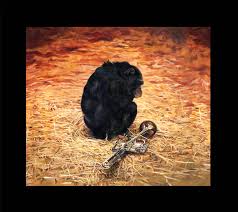
quietIt seemed like Martin Tielli was done making music after his (so far) final solo album in 2009.  He has been focusing on (gorgeous) visual arts since then.  But then in 2013, Tielli along with Jonathan Goldsmith, Hugh Marsh and Rob Piltch recorded another Nick Buzz album (cover painting by Tielli)–possibly their last as well, but who knows.

This album is almost entirely mellow, with beautiful slow pieces and delicate singing and instrumentation–with some exceptions.  The biggest exception is the first song and single (with video) “The Hens Lay Everyday.”  It is unlike anything else on the album.  It is a weird, electronic fast song with pulsing beats and funny lyrics (and a crazy video).  It’s kind of a shame that it’s on this album because I want more music like that.  But the rest of the album is also wonderful in a very different way.  This song just doesn’t fit.

Beginning with the second song, the album is a beautiful album of wonderful ballads.

“This is Not My World” is a delicate guitar song with simple keyboard washes.  Martin’s voice even sounds different on the song–I almost didn’t recognize him until the last few verses.  “Milchig” opens with a buzzy violin (that sounds almost like a fly).  Tielli did this song with The Art of Time Ensemble (it was called “Moglich”).  It has a gentle guitar and Tielli’s keening voice and spoken word–“he had given me ‘the relax.'”  There’s several sections in this song, and I especially like the slowly lurching middle section.

“Sea Monkeys” opens with some delicate chimes and underwatery sounds.  And once again, Tielli’s voice sounds different.  I love this peculiar song about ordering and “growing” sea monkeys.  He says he only wanted plankton or krill but during that evening, the sea monkeys started building their city, and after 4 and a half minutes, the song turns somewhat more sinister with a section about the Crustacean Monkey Queen.  The delicate music grows harsher and more mechanical sounding.  It’s pretty intense.  And it coincidentally relates to the book below.

“If You Go Away” has a vaguely Spanish guitar feel to it.  It’s a very delicate, slow ballad (I should have realized it was an old song written by Jacques Brel) with strummed guitar and gentle percussion.  It has a lounge feel as well (the romantic lyrics aid in that style).  It was recorded live with audience clapping at the end.

The mood picks up a little with the next song, “The Happy Matador.”  It’s played on acoustic guitar with flamenco-esque runs.  It’s a delightful song even if lyrically it’s a little dark.  “Eliza” is a darkly comic song with a kind of circusy feel.  It opens with accordion, adds a violin and basically makes fun of a woman named Eliza, with the great last line: “The only incredible thing about Eliza is the terrible terrible music she inspires.”

“A Quiet Evening at Home” opens with some strange noises like Circo did, but this is an older, more mellow album and they quickly give way to some pretty, delicate guitar chords.  About two and a half minutes of gentle chords are disrupted by a noisy saxophone and some manipulated spoken words.  This process repeats itself for about six minutes of mellow, slightly weird, but really enjoyable music.

“Uncle Bumbo’s Christmas” continues in that delicate vein, but this time with actual words.  It has gentle echoed guitar and some occasional strings.  It’s not exactly a Christmas song although the lyric “I love everything about Christmas, except Christmas” is decidedly ambiguous.  There’s beautiful overlays of vocals and guitar for the middle two minutes of the song before it resumes with a slightly more uptempo and much more catchy end section.  This song gets better with each listen.

“The House with the Laughing Windows” opens with a tinkling piano melody.  It hovers between ominous and dreamy.  I like the way the song gently, almost imperceptibly, builds over the course of its 4 and a half minutes.  And I love the way the guitars start playing louder as if the song is going to build to something bigger but it never quite does.  John Tielli plays theremin on this track.

“Aluminum Flies” is a slightly louder song which is much more meandering and ends with what I believe is the sound of windshield wipers.  The final song is the lovely “Birds of Lanark County.”  It opens with chickadees chirping and a beautiful delicate acoustic guitar melody from Martin.  Michele Williams sings lovely backing vocals.

It’s amazing how different this album is from Circo–same band members but an entirely different style, and a simply gorgeous collection of songs.

[READ: November 25, 2015] Blue on Blue

I had never heard of Quentin S. Crisp before (he’s not to be confused with Quentin Crisp, the British raconteur who died in 1999).  Except that I knew he contributed lyrics to the most recent Kodagain album.  But I received an advance copy of this book with Brendan Connell’s latest book (its publication date is December 15 (from Snuggly Books)).

This story was fantastic (in both senses of the word).

The story is told in 5 parts.  And what I loved about it was that the central part of the story is a fairly conventional story about love and loss, and yet the other four parts frame the story with an other-worldliness that is almost familiar, but not quite.

The story begins with the statement “I am a citizen of the ASAF, the Alternative State of the American Fifties.”  There’s a footnote attached which explains that the ASAF “ia an artificial history zone ‘reclaimed’ from sunken parallel time.”  This is a potentially worrisome beginning to a book to be sure, and yet the book does not go through any rabbit- or worm- hole, this is simply the set up for the story. (more…)

Read Full Post »

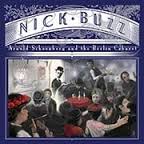
zambraSOUNDTRACK: NICK BUZZ-Arnold Schoenberg and the Berlin Cabaret (2003).

schoenIn 1901, Arnold Schoenberg wrote eight Brettl-Lieder (Cabaret Songs).  The songs were short and fun with naughty (cabaret influenced) lyrics.  Some 100 years later, inspired by the Art of Time Ensemble who commissioned Nick Buzz to play pieces for their Schoenberg show.

So the guys from Nick Buzz got together and recorded four of the eight pieces.  Then Martin Tielli released this disc as number 2 of his Subscription Series.  Some of us were a little disappointed when this came out since it was only 15 minutes of music, but the art is wonderful and I have recently rediscovered this disc and have enjoyed it immensely.

Basically the Buzz guys have interpreted the songs in their own style, but they have remained faithful to the original melodies and lyrics (which were in German but are now in English).

“Gigerlette” explores electronic manipulations (presumably by Hugh Marsh) and offers lots of fun samples (what I assume is some earlier recordings of the song in German).  It opens with sampled female singing and staccato piano as well as other unusual effects. Then Martin’s vocals come in and the effects clear out and the song becomes simple piano ballad for a brief moment.  Then the noises come back in again, playing around with this amusing song.  It’s a song of romance and love with the sweet punchline being that cupid is driving their coach and four.  At over 5 minutes this is the longest song by far, even if the basic song is just over two minutes.

“Der genugsame Liebhaber” (The Modest Lover) opens with what sounds like a distorted harp (presumably the piano) and scratchy records (from Marsh).  This song is about a man going to see his lover, but his over’s pussy loves his bald head so much that she continually climbs atop it.  It is charmingly naughty. There’s some wonderful violin from Hugh Marsh on this song

“Galathea” is the most conventional of the three songs.  A lovely piano ballad to Galatea.

“Arie aus dem Spiegel von Arcadien” (Aria from the Arcadian Mirror) is super fun. The music is weird and goofy with a very drunken feel.  And the chorus is just wonderful “my heart begins to thump and dance just like a hammer’s blow it goes boom boom boom boom boom boom boom boom boom (getting faster and faster).  I’ve listened to the original and it is very much the same, although Nick Buzz’s version is much better.

You can find some of these songs on line from a recording at Lula’s Lounge (Dec 9, 2010)

It’s cool to see how they recreate the album so faithfully in a live setting. It’s only a shame that the video isn’t a little closer so you could see just what they are doing.

Nick Buzz-December 9 2010 Lula’s Lounge

[READ: September 1, 2015] My Documents

I have enjoyed some of Zambra’s stories in other locations, so I was pretty excited that McSweeney’s released this collection (translated by Megan McDowell).  The book is pretty much all short stories, although the first items feels a bit less fictional and more memoirish.

“My Documents”
This is a brief historical account of Alejandro as a child and as a writer.  He talks about when he started working on computers and what happens when the computer dies with the information inside.  He explains that this file is in his My Documents folder and he’s going to publish it “even though it’s not finished.  Even though it’s impossible to finish it.”

“Camilo”
I read this story in the New Yorker.  It concerns the relation of a man and his godfather, whom he has not seen since his father and godfather had a falling out years ago.  See my link for a more complete synopsis.  I enjoyed it just as much the second time.

“Long Distance”
The narrator worked as a phone operator in 1998.  He liked the job–his boss was cool and would let him do anything he wanted so long as he answered the phones quickly. The job was in a travel insurance office and one day he received a call from a man named Juan Emilio. After speaking for a time about various things, the narrator realized it had been 40 minutes since they first started talking.  They were expected to call clients back 14 days later as a follow-up and this time Juan Emilio talked with him foe a while and, upon learning that the narrator studied literature, asked if they could meet and discuss books.   The narrator was already teaching classes at night, and these two situations overlapped somewhat.  I loved the way all of this information is used as backdrop to a romance he has with a student known as Pamela.  And the final line is great.

“True or False”
The titular phrase is uttered by a boy, Lucas,  who declared, based on an inscrutable internal feeling, that things were True or False.  An armchair might be true, while a lamp might be false.  Hid father Daniel had a cat, Pedra, even though pets were forbidden in his building.  Lucas loved the cat.  Then the cat had kittens.  There is a metaphor at work about the fatherless kittens and Daniel’s own behavior toward his son. I really enjoyed this story and the strangeness of the true or false brought a fascinating childlike quality to the story

“Memories of a Personal Computer”
The conceit of this story is great.  A PC remembers what it was like to observe a relationship as it begins and then ebbs–and how the PC was moved around into different rooms as things changed in the relationship.

“National Institute”
At the school where the narrator went, they were called by number.  He was 45.  The main subject of his story was 34, although he doesn’t know the boy’s real name.  34 had failed the grade and was made to repeat it, but rather than being sullen about it, he was popular and fun.  All of the students were worried about failing–the final test was very hard.  But one day 34 approached 45 and told him he had nothing to worry about.  The other students didn’t know what to make of it, but he slowly assessed everyone and told them whether they had anything to worry about.  By the end of the story, when 45 is brought to the inspector of schools, he is told a lesson he will should never forget.

“I Smoked Very Well”
A look back on smoking and how quitting smoking made him a different (though not necessarily better) person.

“Thank You”
She is Argentine, he is Chilean and they are not together (even though they sleep together).  They were in Mexico City when they were kidnapped together.  The incident has unexpected moments. It’s a weird story (with some really unexpected moments) but a really good one.

“The Most Chilean Man in the World”
A Chilean couple has decided to separate once she was accepted to school in Belgium.  After several months he is convinced that she wants him to visit, so he spends a ton of money and heads out to Belgium.  Without telling her.  And it goes very badly.  But he can’t just leave Belgium, now can he?  So he goes to a pub where he meets some new friends who call him the chilliest man in the world.  The story hinges on a joke, but the story itself is not a punchline.

“Family Life”
I read this story in Harper’s.  I thought it was fantastic–it was one of the stories that made me want to read more of his works.  This is story of a man house sitting and the false life that he constructs around him.  It was surprisingly moving.

“Artist’s Rendition”
I loved the way this story began.  It tells us that Yasna has killed her father.  But we slowly learn that Yasna is character in a detective story that an author is trying to write.  We learn how the author constructs details about this character and the things that she has experienced which make her who she is.  As this story unfolds we see how those first lines proved to be true after all.

This was a great collection fo short works and I really hope to see more from him translated into English.

Read Full Post »

« Newer Posts - Older Posts »