Feeds:
Posts
Comments

Archive for the ‘Supernatural’ Category

SOUNDTRACK: beabadoobee-Loveworm (2019).
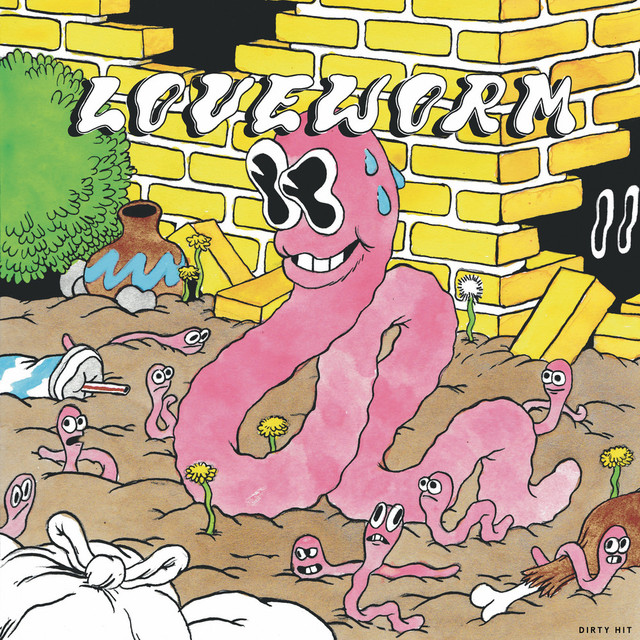
beabadoobee is Beatrice Kristi Laus, a 19 year-old singer-songwriter who was born in the Phillipines and lives in London.  She has released some six EPs since 2018 and has been played on the radio on WXPN.  I see she’s also headlining a small tour over here in the Spring.

Yesterday I listened to the bedroom version of this EP, and here is the original release in all of its glory.  Interestingly, the sound isn’t all that much bigger, but there is a lot more instrumentation.  And some of these songs definitely rock harder.

“Disappear” is played on a gentle electric guitar with swirling keys and a simple drum clicking sound.  When the bass comes in after the first verse, the song feels really full (with a sprinkling of keyboard sounds added on top, too).  The middle third has a nice little section with bells as everything else fades out for a moment.

“1999”s guitars sound a bit more downbeat, deeper.  The middle has some lovely overdubbed guitar parts. I really like the repeated guitar melody that flows all the way to the end,

“Apple Cider” is wonderfully upbeat in this version.  Bouncy guitars, more bells and her soft vocals make this sound like a perfect 90s alt-rock song.  Just as I was about to say this song was perfect, it added some “oohh la las” which don’t quite fit.  However, the crazy guitar solo(s) are very cool and more than make up for it.

“Ceilings” remains a quiet ballad with some nice falsetto vocals and trippy backing sounds that turn into a synthy solo.

“Angel” sounds different on this record too, with some staggered guitars and a fairly complex drum pattern.  There’s some noisy electric guitar on this song too.  I love the way this song rocks out at the end.  The rocking continues on “You Lie All the Time” (which still sounds a bit like Juliana Hatfield).  It rocks all the way through to the end,

The final song “Soren” is a slow ballad.  With the two guitars it does actually sound quite different from the bedroom version, which is kind of cool since they are for the most part pretty similar.

I enjoyed both versions of this EP, but I like this one more. There’s more variety and the songs rock a bit more.  I’m curious what her first full-length will sound like.

[READ: January 10, 2020] The Babysitters Coven

I don’t usually read books like this, but the cover caught my eye (I love judging a book by its cover) and I’m so glad I read it. It was fun and funny and mashed up ideas from existing stories into something all its own.

Esme Pearl is a babysitter.  She and her best (and only) friend Janis started a Babysitter’s Club back in junior high. There were of course four of them in the club and each girl paralleled one of the girls in the original series.  [I have never read those books, so I don’t know how much is taken from that series.]

I enjoyed Esme as a character for a number of reasons.  She was a believable seventeen year old, but a shy and kind of solitary one.  She uses some abbreviations, but the whole book is not littered with them.  Lines like “the number one perk of babysitting is OPP–other people’s pantries” is a good example.  Esme has a great tone of being above her school while still being unpopular (but not hugely so).  She lives in Spring River Kansas home of the Bog Lemmings (“apparently by the time they’d gotten to Spring River all the good mascots had been taken”).  About the cafeteria food: “I’d never seen a food that wasn’t brown.”  Later she grabs what she things is curry but which turns out to be gravy.

She and Janis coordinate outfits every day.  [I love the detail that Janis’ full name is Janis Jackson].  They don’t wear similar things at all, they just discuss the night before what their fashion choices will be and then show them off the next day,  They both love going thrifting, so their outfits are unique.  If I had one complaint about the book it’s that there’s no way a backwater town like Spring River would have such amazing thrift stores.  Anyway, today “Janis was ‘Denise gets a step-daughter’ and I was “Sylvia Plath goes to prom.'”

Esme loves babysitting and she takes it very seriously–she does not wan any other kind of job, like where you wear a uniform–and she has built up a reliable collection of clientele.  She and Janis really are the only game in town.

As the book opens, Esme is babysitting Kaitlyn, a demon baby.  Not literally.  She is just a wild girl who is high maintenance. But Esme thinks of her as baby Satan (Kaitlyn managed to get a Sharpie and draw all over the wall while Esme was peeing).  But usually once Kaitlyn is asleep, she’s down.  This night things are different.  Esme heard a loud thunk and went upstairs,  The door was locked–Esme would never lock the door.  She somehow got the door open an saw that the bed was empty and the window was open.  She looked out the window and saw Kaitlyn on the roof.  Esme managed to get her back to safety.  When Esme asked what happened, Kaitlyn described a guy who looked like David Bowie’s character in Labyrinth. She knew that Kaitlyn watched a lot of movies so she assumed it was a nightmare. But there was so much unexplained…. (more…)

Read Full Post »

SOUNDTRACK: FALHA COMUM-“Film Do Mundo” (2019).

Every year Lars Gotrich publishes his list of favorite music in an NPR podcast called Viking’s Choice: The Year In The Loud And The Weird.  I always listen to these songs because I’ll never hear them anywhere else (he mostly seems to scour bandcamp for unknown music.

One that he especially liked was by this band Falha Comum, a duo from Brazil.

He says:

The Brazilian post-punks scaled down to a duo, but opened a festering third eye. The psychedelic noise receptors of a previous decade (think Raccoo-oo-oon and Gowns) run throughout Rakta’s Falha Comum, but in levels below, the sinister grooves and cackled reverb inhabit a life all their own with primal incantations to spirits unknown.

The album is like a few things and nothing else that I’ve heard.  There’s elements of krautrock–but not sterile and efficient, more groovy and cool, with a warm bass and seemingly wild, improvised vocals.

This particular song is 7 minutes long and opens with a spoken word section (presumably in Portuguese).  There are synths and screams behind the speaking and then everything starts pulsing as the vocals echo and echo.   The music–a simple repetitive drum and bass (I guess) line, keep a terrific groove going while on top, the high notes (vocals and other synths) skitter and flit about.

Midway through, the song goes through a phase shift–it sounds like it’s been transported somewhere else, and that’s when the bass gets cleaner and the vocals grow a bit more intense.  But the groove remains.

Somewhere around 6 minutes, the groove changes slightly–a brief shift in notes suddenly gives the song a brief moment of extra melody.  The following keyboard frenzy keeps it from getting too comfortably melodic though.

It’s an unexpectedly interesting and cool record.

[READ: Summer 2019] The Long Utopia

This was the fourth book in the Long Earth series.  I brought it along on vacation thinking it would be a fairly slow and leisurely read like the others—something I didn’t mind putting down and picking up a few days later.  But this book changed that pattern entirely.  It was fast paced and quite exciting and my favorite book of the series so far.

The previous book about the Long Mars seemed to be more than anything else, a distraction.  Not a lot happened, although there were some cool ideas in it.  The one big thing that book 3 did that effects book 4 is the cable/elevator thing—which I still don’t understand [see yesterday’s post about book 3].

This book also introduces a new concept in Stepping.  Typically Stepping is described as moving left or right, east or west through the Earths.  But suddenly, in this one world, it seemed like a person could move…north.  Into an entirely different world—night instead of day:  “No stars exactly, it was like he could see the whole galaxy…from outside.”

This book is set in 2052.  Protagonist Joshua Valiente:

will be 50 years old. He has been stepping for 35 years and has been all over the Long Earth.  But some things are still unsettling—things that he can feel in his bones or his head.

The reason for his feelings date back to 2036 in New Springfield.  Cassie Poulson had been digging a basement for her house when she hit some kind of opening.  Not a cave or anything natural, but some kind of manufactured tunnel or the like.  When she poked her head in,  what poked back was a humanoid metal beetle.  Obviously she freaked out and covered up the hole. (more…)

Read Full Post »

SOUNDTRACK: FIRE-TOOLZ-“mailto:spasm@swamp.god?subject=Mind-Body Parallels” (2019).

Every year Lars Gotrich publishes his list of favorite music in an NPR podcast called Viking’s Choice: The Year In The Loud And The Weird.  I always listen to these songs because I’ll never hear them anywhere else (he mostly seems to scour bandcamp for unknown music.

One that he especially liked was by this band Fire-Toolz.  He says:

When I try to describe the simultaneously fantastical and obliterating sounds of Fire-Toolz to folks, I usually throw my hands up — not out of frustration, but from awe. Angel Marcloid has clashed New Age synthscapes, clubby raves, jazz fusion and metal shrieks for a few years now, but Field Whispers (Into the Crystal Palace) goes beyond the mash-up, into an idiosyncratic master’s pure creation.

The album credits indicate: Angel Marcloid: voice, drums, electric & acoustic guitar, fretless bass, virtual studio technology, field recordings, circuit-bent junk, composition, lyrics, recording, production, mixing, mastering.

The only other musician is Ian Smith: who plays what can only be described as a smooth-jazz saxophone solo.  Oh, and her cat, Breakfast, gets a vocal turn.

I have listened to some of the whole record, (a lot of tape manipulation on track 2), but nothing sums up the project like the first song, “mailto:spasm@swamp.god?subject=Mind-Body Parallels” (yes, that’s the title).  In 2 minutes and 11 seconds, she includes more genres than I can name.  And the amazing thing is that unlike other artists who squeeze many genres into one song (there are those who do this well and those who do not), these shifts feel at once hairpin but also natural. 

The song starts with a skittery electric melody that almost sounds like digital pipe organ.  It’s very new-agey, but with heavier drums than you might expect.  The quiet death metal growling is certainly unexpected, but somehow it doesn’t feel out of place (and is low enough in the mix to feel more like another sound than vocals–I have no idea what she’s saying).

After the first verse the music shifts to a kind of jazzy new age followed by a punishingly fast electronic drum and a scorching heavy metal solo and the song devolves or crescendos with inhuman growls.

Welcome to 2020!

[READ: May 2019] The Long Mars

I found the first book in this series rather compelling–almost surprisingly so given that it’s not a fast-paced book and, to be honest, not a lot happens.

But it was really well written and the things that do happen are compelling and fascinating.  And I couldn’t wait to read more.

In the first book:

A man creates an invention (The Stepper) which allows one to step into a parallel world that is next to ours.  There are a possibly infinite numbers of parallel worlds in each direction (East or West).  The worlds that are closer to ours are almost identical to our Earth (known as Datum Earth).  The further you go, the greater the differences.  But none of them have experienced humanity before Step Day (aside from earlier hominids).

The main character is Joshua Valienté.  Joshua is a natural “Stepper.”  He doesn’t need the device to Step from one word to the next, nor does he feel the nausea and other side effects that most people feel as they travel.  Most of the book follows his exploits.

The Black corporate has a ship with an entity known as Lobsang who claims that he was a human reincarnated as artificial intelligence.  Joshua is sure that Lobsang is a computer, but Lobsang’s human skills are uncanny.  This ship has managed to Step as an entity, meaning everything in the ship can go with them.  Normally you can only bring what you can carry (aside from metal).

The novel more or less is an exploratory one with Joshua and Lobsang Stepping through millions of Earths.  Not a lot happens, but the novel never grows boring.  The interactions between Joshua and Lobsang are often funny.  And the writers have infused the Earths that they stop in with just enough differences to make each stop strangely compelling (this must be Baxter’s hard science leanings).

I found the second book less compelling on a story level, but no less compelling on a conceptual level.  There was still some cool stuff going on.

Joshua Valienté has settled down in a town called Hell-Knows-Where.  He has a wife, Helen, and a child, Daniel, and lots of regrets about what happened at the end of book one.  He is embedded with the rest of the community.  They show off what a successful community can be way out in the Long Earth.  It is more or less cut off from Datum Earth, which means that everyone needs to work for the community to survive.  Since trust and companionship are key to survival, people don’t really try to take advantage of others and crime is pretty much nonexistent.

This independence is a major concern for the governments of Datum Earth.  In fact, some of the more thriving distant communities (like Valhalla) want to declare independence from Datum Earth altogether.

Another issue is human (or alien) rights.  The trolls from the first book have become a part of most communities at this point.  And yet, the way they are treated seems largely dependent on who they are with.  Some are welcomed like family members, other are treated like animals, slaves or worse.   And the mistreatment of a mother and son troll are what set a series of events in motion.   Maggie Kauffman is a new character introduced to speak on behalf of the trolls.  Before their otherwise peaceful nature gets pushed too far.

Another plot line (and there are quite a few) concerns Roberta Golding, a young genius who goes on an exploratory mission with the Chinese.  The Chinese are exploring the “East Earths” (most of the other travelers went West).  Roberta is an odd child, who anticipated jokes and therefore finds nothing funny. She is cold and emotionless.  Her story remains unresolved by the end of the book.  But her crew managed to get to Earth East 20,000,000 with the crew.

When Sally tries to get Joshua involved in an adventure once again, he is reluctant, but Helen is the one who spurs him on–as long as she and Dan go with him. This adventure is a bit of backtracking, though–an attempt to use Joshua’s name and status back on Datum Earth–where he is not welcomed by everyone.  He tries to prevent the government from harming trolls–because he knows what is at stake if the trolls grow angry.

In their adventure, they also encounter a race of beings known as Beagles.  It is a pretty dark and disturbing world, with Joshua getting tortured and Sally and Monica being the only things keeping him from a brutal death.   There’s a lot of brutality now, which is not unexpected given the reality of the situation, but it does often seem rather harsh

That’s a lot of summary to prepare for Book Three.  But book three does continue the saga, just another twenty years or so later.

(more…)

Read Full Post »

SOUNDTRACK: MEREBA-Tiny Desk Concert #916 (November 27, 2019).

Who the heck is Mereba?

Very few artists get to return to the Tiny Desk, and fewer still return twice in the same year. But after contributing background vocals behind the desk for Dreamville artist Bas in early 2019, we invited Mereba back for a solo set that puts her eclectic, major-label debut The Jungle Is The Only Way Out into sharp focus.

As with many singers I’ve never heard of, I’m not sure if these songs sound like this on the record or if they are more dancey.  I do quite like the simple, organic sounds that accompany these songs.

The stripped-down soundscape Mereba achieves live with her four-piece band is equally dreamlike here, drawing from influences as wide-ranging as the many places she’s called home (Alabama, Philly, North Carolina, Atlanta, Ethiopia). As she pulls from genres as seemingly disparate as folk, rap and spoken word, her set reflects the years she spent perfecting her craft on live stages in Atlanta cafes and clubs, where she attracted the attention of the indie creative collective Spillage Village  before joining them in 2014.

She sings three songs and recites a poem (all on the album).

When “Black Truck” started I thought she sounded exactly like Alanis Morissette.  The way she says “and I said world would you please have some mercy on me” sounds very uncannily like her.  The song is a quiet, mellow piece that starts with a simple bass line (including some harmonics) from Chris James and guitar washes that turn into a nice picked melody from Sam Hoffman.  After a minute or so, Aisha Gaillard plays a simple drum beat and the song kicks into higher gear.

Through all of this, the backing vocals from Olivia Walker were just beautiful.  The end of the song turns into a kind of rap as the guitar and bass fade out.  I say kind of a rap because Mereba is also a poet and she has more of a poet’s delivery than a rapper’s delivery.

For “Stay Tru” the guys switch instruments and the bass takes on a slightly more lead role.  But this song is also very mellow.  Mereba’s vocals sound a bit more Jamaican in his song.  Midway through, James switches to violin and Mereba plays keys which adds a whole new texture.  I didn’t like this song as much because the chorus is kinda lame with a lot of repeating of “cut the bullshit, this time” sung in a sweet voice.  It also seems to drag on for a really long time (although it is very pretty).

“Dodging The Devil” is a poem she wrote when things just didn’t seem to be going right.  After a couple of verses, a quiet guitar line fills in the background.

On the last song, “Kinfolk,” Mereba plays the main guitar line while Sam plays single soaring notes.  The song kicks into gear with a simple guitar riff and some prominent bass.

I really enjoyed this set.  I thought the music was beautifully restrained and her voice distinct enough in each song to show such a range of sounds.  It’s always nice to be surprised by a new musician.

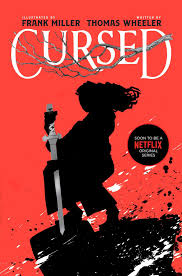
[READ: November 15, 2019] Cursed

I saw this book in the new YA section at the library.  I was attracted by the cover and fascinated by the “soon to be a Netflix Original Series” sticker.

I have known of Frank Miller for years.  I’m sure I’ve read graphic novels by him, although I don’t know if I’ve read Sin City (maybe a long time ago?).  Mostly he drew superhero comics which is not my thing.  Turns out I really don’t like his artistic style in this book (at least for the way he draws the heroine–I rather like the way the bad guys are drawn).  If the series was in any way designed to look like the art in the book I don’t think I’d watch it.

But the story itself is petty darn good.  It took me a while to read it for some reason. I guess maybe the opening was a little slow because there’s so much going on it takes awhile to really get settled in this universe.

But the description of the story is pretty intriguing: Whosoever wields the sword of power shall be the one true king.  But what if the sword has chosen a queen?

For this is a story of Arthurian legend with many many twists.  My knowledge of Arthurian legend is surprisingly minimal.  I love the story and I know the main participants, but there is a lot of information in here that I didn’t know about–or even how much Wheeler is making up. (more…)

Read Full Post »

[LISTENED TO: Summer 2019] Circus Mirandus

I checked out this book exclusively because Bronson Pinchot was reading it.  I will listen to just about anything that he reads.  So the fact that this story sounded even vaguely interesting (and age appropriate–Pinchot does tend to read a lot more adult books) meant I grabbed it right away.

This book is about Micah, a young orphan who is living with his sickly grandfather.  Taking care of Grandpa Ephraim is Ephraim’s sister Gertrudus.  Aunt Gertrudus is the meanest, most-horrible person ever.   She makes Micah drink bitter black tea, she makes him do all of the work in the house and she refuses to let him see his grandpa.

Micah loves his grandpa and he loves the stories that his grandpa tells.  It’s these stories that Gertrudus is trying to keep Micah from.

As the book opens we see the letter that Ephraim has sent to Circus Mirandus: (more…)

Read Full Post »

SOUNDTRACK: DAN TEPFER-Tiny Desk Concert #885 (August 29, 2019).

Most of the time, a Tiny Desk Concert is an opportunity to see an artist in a quiet almost unplugged setting.  Sometimes, it’s an opportunity to see a band really show off in a close space.  And sometimes a Tiny Desk Concert will blow your freaking mind.

Like this one.

I have never seen anything like this.

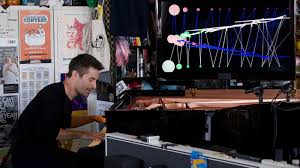
Dan Tepfer has created a program that plays the piano along with him.  It’s for a project he calls Natural Machines.

Watch the keys and you’ll see this Disklavier — a player piano — plucking notes on its own. But it’s not a prerecorded script.

Here’s how it works: Tepfer plays a note, and a computer program he authored reads those notes and tells the piano what to play in response. Tepfer can load different algorithms into the program that determine the pattern of playback, like one that returns the same note, only an octave higher. Another will play the inverted note based on the center of the piano keys. These rules create interesting restrictions that Tepfer says make room for thoughtful improvisation. In his words, he’s not writing these songs, so much as writing the way they work.

Tepfer plays free improvisation–he “makes things up and tries to be present in the moment” but the computer responds to him in real time based on rules.

He says for “Canon At The Octave” theres’ an axis of symmetry on the piano and “everything I play on one side if reflected on the other side.  Super simple, but it leads to musical problems that lead to real music.”

Since he is improvising, he is also reacting to what the computer makes.

He explains that “Tremolo” is when a note is repeated very quickly.  He gives the example of a violin player playing a note quickly.  It’s much harder on piano than a violin and it’s impossible to do more than ten notes at once.

He plays single notes that generate a series of chords playing quickly all at once–it’s really cool to watch the piano take off as if with a mind of its own.

But watching the piano isn’t the only cool thing

To better communicate what’s happening between him and the piano, Tepfer converted these audio-impulse data into visualizations on the screen behind him, displaying in real time the notes he plays followed by the piano’s feedback. [We dive even deeper into this project in a recent Jazz Night in America video piece].

He explains that these improvs are super short versions to show off how the programs work.

“TriadSculpture” is all about harmonic ratios.  Pythagoras discovered that sounds work with whole numbers.  The math behind music.  So Tepfer has mapped numbers as a 3-D object and he has been printing them–even more mind blowing.  The computer program generates these shapes–  everything he plays on his left hand creates those shaped in real time on the screen.

Perhaps the trickiest part here, unlike a human-to-human duo, is that the computer plays along with 100 percent accuracy based solely on Tepfer’s moves. He compares it to dancing with a robot that never misses a beat. Tepfer has to play in kind to keep the train on the tracks, but if he falls out of step, so does the computer.

Fortunately he never falls out of time (or at least it’s hard to tell since it’s all improvised.

The final piece is “Constant Motion” in which he plays a note and the computer responds to it by playing a note either up or down.  This creates a fun fast piece that explores the full range of the piano.  The visuals for it are very cool too.

I’m not sure if this would be fun to see live (at least any more fun than an improvising pianist is) because listening to it you don’t always really know what’s happening or that the piano is doing the work.  But seeing it up close like this is awesome.

[READ: August 21, 2019] Holy Cow

Like most people, ever since watching The X-Files, I’ve liked David Duchovny (why don’t you love me?).

I watched some of the Red Shoes Diaries just for him.  I watched some of Californication just for him (Didn’t have whatever network it was on, so never watched more than a bit of it).  But I’m always willing to give him a shot because I think he’s smart but goofy.

Enter Holy Cow.

This is Duchovny’s first novel and just what a pitch it must have been.

Hi, this is David Duchovny.  Yup, that one.  I’d like to write an adult book about a cow that wants to go to India once she finds out cows are worshiped there.  Yes, David Duchovny.

I had no idea he had written this book.  I just happened to see it on my library shelf when I was looking for something else.  The book was short and had (terrible) drawings in it and seemed like it would be absurdly funny.

So, with the caveat that if you think that a talking cow buying a plane ticket and going to Jerusalem with a pig and to Turkey with a turkey sounds stupid and juvenile.  Well, you’d be right.  But you’d be missing out on an enjoyable, silly romp if that kept you from reading it. (more…)

Read Full Post »

SOUNDTRACK: LAURA MARLING-NonCOMM (May 18, 2017).

I enjoyed listening to the sets from NonCOMM back in May, so I dug into the archives and found out that a lot of sets are still available.  I was especially happy to see this one from Laura Marling.  The end of the blurb says:

You’ll have another chance to witness this fixating performance when Laura Marling comes to the TLA tomorrow night.

And that’s the show I saw.

After a hearty introduction from Bob Boilen, Laura Marling and crew swan-dived right into debut single, “Soothing,” off of her latest album, Semper Femina.

“Wild Fire” is an amazing example of her incredible voice as she speak-sings, whispers, coos and soars all over the verses which come together in the beautiful harmony of “meeeeeee” in the chorus.  This song has a bunch of curses in it, but she kept it clean for this performance.

With a piercing yet still somehow soft gaze cutting through the crowd (I don’t know how she does the thing, but it’s true), Marling unleashed her otherworldly vocals — flawlessly ebbing and flowing with the track’s funkier rhythm.

“Always This Way” is a beautiful song off of Semper Femina.  The guitar melody is delightful and, of course, her voice is outstanding.

“Next Time” has a simple, quiet, guitar melody which allows her voice to just wend all over this song.  When the backing vocals come it it’s quiet angelic.

“Nothing, Not Nearly” has some wonderfully fast vocals that are as fun to try to figure out as they are to sing along to.  It ends Semper Femina and is my favoirte song on the record.  From the main melody to her wonderfully high notes this song is amazing.

She ended the set with “Once” from Once I Was an Eagle, the album that introduced me to her.

This song is very different from the others, but it still sounded great.  When I saw her I wished she’d played ten songs from each album.  Maybe some day I’ll see her do everything.

[READ: September 7, 2019] “The Stone”

This was an otherworldly story about an earthly object.

As a young girl, the main character’s family drove to an island in Lake Superior every summer.  She was wandering in the brush one day when she felt sure someone was looking at her.  There was no one there, but then she saw the stone.

It was smooth and black, half the size of a human skull and rain had carved what looked like two eye holes in it.

She was spooked at first but then was drawn to it.  She brought it back to the vacation home and put it where she slept.  But then she was sure one of her siblings would try to take it, so she hid it in her sleeping bag.

She brought home after the summer and put it in her room. Her mother saw it as she was getting them ready for school in September. Her mom asked if she’d found the rock the summer.  She nodded and, after dinner, hid it in her room. (more…)

Read Full Post »

SOUNDTRACK: DEATHPROD-“Disappearance / Reappearance” (2019).

Every once in a while I like to check in with Viking’s Choice on NPR’s All Songs Considered.  Lars Gottrich specializes in all of the obscure music that you won;t hear on radio.  For this month, he did a special focus on Patient Sounds. a small label based out of Illinois.

[UPDATE: At the end of 2019, Patient Sounds closed shop. I’m not sure if any of these songs are available outside of Bandcamp].

Lars had this to say about the label

Matthew Sage, who runs the label, knows that dynamic drone, jittery footwork, oddball drone-folk, hypnagogic guitar music and cosmic Americana can exist in the same space.

The first song is by Deathprod.  Lars says:

Deathprod’s first album in 15 years, Occulting Disk, smothers dank, dark drones around the void of your soul, like a frozen hug from a cyborg teddy bear.

This song is 8 minutes long.  It consists almost entirely of a single loud distorted note/chord played on a synth until it fades into distorted crackles.  The note changes, but it is a pretty ominous soundtrack, like the slowest monster approaching you.

[READ: September 2, 2019] Blackbird

This book starts out with a very realistic concern but quickly become supernatural.

Nina was 13 years old and had a vision of an earthquake coming.  Her sister just called her a crazy baby (something the whole family called her). But moments later, the Verdugo Earthquake happened.  She and her family fled, and were almost crushed by a collapsing bridge.

But then a beautiful celestial monster came down and fixed the bridge and saved them.  The creature cast a forgetting spell over everyone, but somehow Nina remembered it all.

Despite the magical creature’s help, Nina’s life went to hell from there.  Her mother and father began fighting.  He began drinking and she died in a car accident while trying to get away from him.  Nina had been a great student but high school became unbearable.  She became “the girl who talked about magic and wizards and paragons.”

Now as an adult, she has a dead end job at a bar, is living with her sister and is sneaking painkillers.

There’s a guy, Clint, who seems to be stalking her at the bar.  I mean, he’s cute, but he’s always there. (more…)

Read Full Post »

SOUNDTRACK: KIAN SOLTANI-Tiny Desk Concert #880 (August 16, 2019).

I feel like listeners are more familiar with a violin than a cello.  Violins are everywhere (they’re so portable), but cellos only seem to come out when you need a bigger string section.  I have come to realize that I much prefer the sound of a cello to a violin  The cello can reach some impressive high notes (check out about three minutes into the Hungarian Rhapsody) but its the richness of the low notes that really impresses me,  Or maybe it’s just the historical value of Kian Soltani’s cello

It’s not every day someone walks into our NPR Music offices and unpacks an instrument made in 1680. And yet Kian Soltani, the 27-year-old cellist who plays with the authority and poetry of someone twice his age, isn’t exactly fazed by his rare Giovanni Grancino cello, which produces large, luminous tones. (He also plays a Stradivarius.)

I love Liszt’s Hungarian Rhapsody, and I love this one as well. What is it about Hungary that inspires such wild songs?

The Hungarian Rhapsody, by the late 19th century cellist and composer David Popper, traces its inspiration to similarly titled pieces by Franz Liszt and Johannes Brahms, but showcases a number of hot-dogging tricks for the cello, including stratospheric high notes, flamboyant slides and a specific high-velocity bouncing of the bow called sautillé. Soltani nails all of them with nonchalant elegance, backed with companionable accompaniment by pianist Christopher Schmitt.

He says that that piece was a very extrovert, out-there piece and so from this mode we take it more inward.

To prove he can make his instrument truly sing, Soltani worked up his own arrangement of “Nacht und Träume” (Night and Dreams) by Franz Schubert, replacing the human voice with his cello’s warm, intimate vocalizing.

It’s fascinating to think that this song was musically written for the piano and voice.  But he has taken the vocal track and turned it into a moving (possibly better?) version on the cello.

His parents emigrated to Austria from Iran in the mid-1970s.  He grew up in Austria and loved it as a locus of great classical music.  But he also hold on to his Persian roots.

And in the Persian Fire Dance, Soltani’s own composition, flavors from his Iranian roots – drones and spiky dance rhythms – commingle with percussive ornaments.

This is a wonderful Concert and Soltani’s playing is really breathtaking.

[READ: September 1, 2019] Middlewest

I had heard of Skottie Young as the author of I Hate Fairyland (which sounds like a children’s book but is definitely not).

This book is also definitely not for children (although I see some people think it could be for YA readers).

Abel is a young boy who lives with his abusive father.  His father, Dale, is a real piece of work. Abel’s mother left, so Dale blames Abel and is on him all the time.

As the first chapter opens, Abel has overslept his paper route (the second time in five years).  His father is very angry even if Abel has been getting up at 4:30 every day for five years. As Abel is running late delivering the papers, his friends tell him to blow it off–it’s too late anyway, just go with them to play video games. (more…)

Read Full Post »

download - 2020-05-20T121917.708SOUNDTRACK: THE FLAMING LIPS AND HEADY FWENDS-“Is David Bowie Dying” (2012).

2012 saw the release of this very strange collaborative album.  Whether The Flaming Lips had entered the mainstream or if people who’d always liked them were now big stars or maybe they all just liked doing acid.  Whatever the case, The Lips worked with a vast array of famous (and less famous) people for this bizarre album.  Here it is 8 years later. Time to check in.

This six minute track starts with scraping and electronic sounds and a two note guitar melody that rise sand falls. Neon Indian, an electronic chillwave band, is the guest on this song

Around 2 minutes the music turns optimistic and soaring and then it  mellows out with trippy sounds. The lyrics change to

At the mountain, you scream
Now the fountain reveals
As you do want and make you whole
Goodbye, goodbye

The mellowness lasts for about a minute then the angular guitars returns.  This second half feels less harsh and more trippy, although the wild effects are still in place.  This sequence runs through to the end as they repeat

Take your legs and run
Into the death-rays of the sun

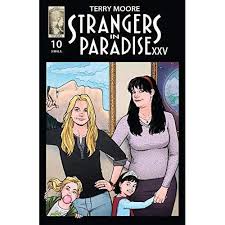
[READ: August 1, 2019] Strangers in Paradise XXV #10

This limited series ends with this issue.

Katchoo is the voice over as she worries about the five years the earth has left to exist–she will have this hanging over her head as she returns home.

Francine reports that her mother is doing fine–she has the will to be alive to watch her grandchildren grow up.  This, of course, makes Katchoo even sadder.

Back home, the girls are up in the air vent wondering why Aunt Libby is crying.  But she’s not.  It turns out that there is a heavily tattooed man with a gun telling her that he plans to kidnap the two little girls because the dykes who live there have a lot of money and he intends to get the ransom for them. (more…)

Read Full Post »

« Newer Posts - Older Posts »