Feeds:
Posts
Comments

Archive for the ‘Suicide’ Category

SOUNDTRACKNOËL, PLESZYŃSKI, MAĆKOWIAK-“Salty Air” (2011).

While looking for videos of Basia Bulat, I stumbled upon a Polish music site.  The site featured a review of this album and a free stream of this song.

The album is a collaboration of artists Ann Noël, Grzegorza Pleszyńskiego and Artura Maćkowiaka (Ann Noël, Grzegorz Pleszynski and Artur Maćkowiak).  Their website explains the collaboration (in translated English obviously):

It is for the first time that Fluxus artist Ann Noël and a visual artist Grzegorz Pleszynski engage in a music venture. For Maćkowiak, a musician from Potty Umbrella and Something Like Elvis, this project has become an unprecedented way to go beyond rock band routines known for years.

Potty Umbrella?  Love it.

Anyhow, this is experimental improv music of the most fascinating kind. Especially since, “Ann and Grzegorz have never played music or any instrument.”  The site allows you to listen to all of the tracks.  “In Emmet’s Bag” is a spoken word piece in the spirit of Laurie Anderson (the spoken part is in English).  And “Hey Man!” is a pretty conventional guitar with spoken word piece.

But it’s this track, “Salty Air” that I keep coming back to.  It opens with some guitar waves. Then a simple repeated riff entrs the mix.  And after a minute or so, distorted, echoed vocals speak underneath the music.  I think it’s in English but that’s irrelevant because the repeating and echoing makes it almost incomprehensible.

It doesn’t evoke a mood so much as a kind of helplessness.  But it’s a beautiful helplessness.  Especially when the second voice comes in, sounding almost inhuman as it moans over the top of everything else.  It’s quite a track.

 You can hear this song (and others, and download the CD for $.50) at their site.

[READ: July 10, 2011] “The Swan”

“The Swan” was a wonderfully dark and confusing story.  I loved everything about it.  It opens with the very simple scene of David coming home from work and knowing something was wrong.  His wife Suzie is acting very strange, and where the hell is the car?  Suzie tells him that she was hit by a car and that her car was totalled.  Why didn’t she call him at work?  She didn’t think it was that big of a deal.

He doesn’t know what to think so he turns his anger towards his seventeen year old son (from his first marriage).  Jamie is upstairs in his room, smoking pot and more or less ignoring everything around him (a trait he has perfected).  When David finally breaks through to Jamie, he learns the truth–Suzie was hit by a swan.

The story unfolds a little more: Suzie imagined that the swan was David’s first wife, coming to give her a message.  David is more freaked out by this than Suzie seems to be.  He can’t understand why suddenly all these years later, she is so upset about his first wife (who died, before David met Suzie, by the way).  Suzie wants to know why David never talked about her (she didn’t want to know back then).  And then finally she winds up spending most of her time with a sketchy woman across town. (more…)

Read Full Post »

SOUNDTRACK: GOGOL BORDELLO-East Infection (EP Extra) (2005).

I learned about Gogol Bordello from some live shows available on NPR.  I enjoyed their sets so much I decided to check out their albums as well.  And I love them.  The albums are full of frenetic energy (they give Sarah agita, she says).  But everything that I love about fun, spirited, gypsy music is present here.

The band is essentially a band of gypsies, headed by wonderfully-mustachioed Eugene Hutz.  And their live show (as demonstrated by the included video) is a wild circus of fun (curtains and dancers and fire buckets and bowling pins and musicians jumping out of boxes), it’s like a wild party.  The video is for “Never Young Again” which would appear in full on their next album. It’s a fun song that reverses the age-old lament of wanting to be young again.  But mostly you watch this for the live footage.

This EP is probably not the best place to start as an introduction to Gogol Bordello (but it was really cheap so I bought it first).  Although it does offer many of the different aspects of Gogol’s music.  The EP features 6 songs and the video.  The songs are intense, hyper, crazy and wonderful.  “East Infection” opens with some nonsense lyrics (“Lee lee lee lee lee, la la la la la”) and morphs into what may be more nonsense, although there’s actual lyrics here.  “Ave B.” (which is also on their following album Gypsy Punks) is a more acoustic-based song, but it still has loud parts to it.

“Mala Vida” is a cover of a song by Manu Chao.  This version is a super fast punky track sung in Spanish (despite Eugene Hutz’ origins in the Ukraine, he has lived in Brazil for years and sings many songs in Spanish).  The original is very similar in temperament, although GB version is a bit more frenetic.

“Copycat” is the odd track on the disc, it’s a kind of dub track with big fat bass and a very slinky sound.  It and “Mala” were produced by Steve Albini.

“Strange Uncles from Abroad” is to me a very typical GB song: lots of violin, lots of dah dah dahs and a great melody.  It has a total gypsy feel, and goes through some loud and quiet moments.   The final track, “Madagascar-Roumania (Tu jésty fáta)” is the longest track by far (6 minutes).  It sounds like a demo and lacks the punch of the rest of the disc, but it showcases the softer side of the band (and yes there is one).

So, maybe this EP is a good place to start after all.  It’s certainly not throwaway material.  And the EP cover alone is pretty outstanding.

[READ: June 14, 2011] Five Dials Number 10

This is the issue of Five Dials that introduced me to the publication.  It is a special issue devoted to the memory of David Foster Wallace.  The entire issue is comprised of the eulogies given at the DFW memorial.  [The details are a little sketchy here…I’m not sure if these are all of the eulogies or just the eulogies from well known people.  I’m not even sure who would have been in the audience for this memorial.  The notes say “These tributes were given on 23 October, 2008 at the Skirball Center for the Performing Arts, New York University” and yet the Jonathan Franzen entry says “here at Pomona.”  So… details are sketchy].  Nevertheless, the tributes are heartfelt, informative and very moving.

Of course, I’m not going to ‘critique’ them, I’ll just try to summarize them.  But really, they’re all worth reading if you’re a fan. (more…)

Read Full Post »

SOUNDTRACK: POKEY LaFARGE-Tiny Desk Concert #122 (April 20, 2011).

I had never heard of Pokey LaFarge before this Tiny Desk concert was sitting in my download folder.  In fact, the notes on the page say that they had never heard of him before they saw him wandering around SXSW.  And then he climbed onstage and played a great set.

LaFarge plays an old-timey style of music.  It’s a kind of Squirrel Nut Zippers retro sound.  As with the Zippers, I love their music in small doses.  And so, this Tiny Desk set is a perfect little sample of LaFarge’s music: happy, bouncy, jazzy.  There’s an upright bass solo, songs about being happy and singing “La La La” and other upbeat stuff.  It’s quite satisfying.

Especially if, as the notes say, you use it as a kind of antidote to the raucous music that you generally listen to.  A Pokey LaFarge song will perk you out of any self-inflicted gloom.  I just don’t need to hear more than three.

[READ: April 15, 2011] 2 book reviews

It looks like Zadie Smith has become a regular fixture at Harper’s.  I’m undecided if I’m going to review all of her book reviews from now on (perhaps I’ll lump some together in one post).  But in the meantime, I’m mentioning this one primarily because she reviews the story that I mentioned in yesterday’s post: Edouard Levé’s Suicide. (more…)

Read Full Post »

SOUNDTRACK: LES CLAYPOOL-5 Gallons of Diesel (DVD) (2005).

I’ve loved Primus for years.  And if you love Primus, chances are you love Les Claypool.  And Les Claypool has created and released music with all manner of bands since Primus broke up (they have since gotten back together and have planned a new release for July).  I don’t love all of his solo releases, but they all have something to commend them, and he’s made some great, unheralded music during those years.

This DVD covers the years from Sausage through to 2005.  At first I was pretty excited by the DVD.  The set opens with the off the wall video for Sausage’s “Riddles Are Abound Tonight” which is followed by a mercifully short “making of” video.

Then things started to go downhill somewhat.  The rest of the DVD is live, which is fine (Les live is a thing of beauty). It’s just that for many of the videos the quality is terrible.  The audio is also not ideal all the way through (that may have been my setup, but there were certainly songs that were much quieter than others).  Now I accept that there weren’t professional film crews out for Les Claypool’s Holy Mackerel tour, and that these videos are basically bootleg, but it  seems like they may have spruced them up a bit for the DVD.

Things change with the switch to Oysterhead.  I could have watched several songs from Oysterhead and I wonder why they chose only one.  This is a professional quality mix (although it is a little dark) and I have to say that the whole song is stolen by Trey Anastasio’s guitar thing.  It’s a guitar (called the MatterHorn) but during the verses of the song it appears to be a kind of theremin on the reverse side (with a full-sized antler sticking out of the bottom) .  He holds the thing upside down and waves at it to generate noise.  It was bewitching.

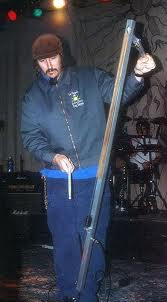
But Trey wasn’t the only one with a weird instrument. For the Frog Brigade set(s) on one of the songs, Les plays a “bass” which is just one string (called the Whamola). He hits it with a stick and changes the notes with a movable handle that he raises and lowers.  I’ve never seen anything like that, either.  Most of the Frog Brigade set is outside at a festival.  The lighting is good but the sound is awful.  In one song, the poor guy on percussion is banging away at various things and you simply cannot hear them.  Les also uses a secondary microphone (the Sandman–which has a great story behind it) but its volume is also quite low, which is a shame as you can’t hear him for quite a bit.

When Colonel Claypool’s Bucket of Bernie Brains the setting is an odd one (they appear to be on a cruise(?)).  It’s basically two lengthy jams, which is fine.  Buckethead amazes with his skills.  But the Bernie on keyboards, I can’t tell if he was screwing up or messing around during his solos.

There’s two more songs attributed to just Les Claypool, and this version of “Riddles Are Abound Tonight” is especially neat because there is a sitar playing the majority of the riff.

The DVD extras are fun.  There’s a weird set from a band called 3 Guys Name Schmo which is 2 bassists and a drummer.  The other bassist is miked very loud and it’s hard to hear Les (imagine outbassing Les Claypool!).  Then there’s the second official video on the disc for “Buzzards of Green Hill” (very low budget).  This comes with a making of the video video and a making of the audio video.  Both are interesting and brief, giving tidbits of info without overwhelming us.

The final two items come from an actual TV show called Fly Fishing the World.  I don’t fish, so I never knew this show existed.  But sure enough, there’s our Les going to two separate locations and fishing on.  The best part is that they play lots of Primus music between fishing (probably the most Primus music ever played on non-music TV), and they interview him as well (I didn’t know he had such cute kids). Despite my not knowing the show or caring about fishing, I found the whole program enjoyable and fascinating (and they catch and release as well).  It’s well worth the time.

So overall, this is a mixed bag.  There’s not a lot of video of Les’ non-Primus music out there, so in that respect this is great.  I just wish the quality was better.

[READ: March 25, 2011] “Life in Three Houses”

This is an excerpt from Suicide.  The introduction states that days after delivering the manuscript of Suicide, Levé killed himself.  I suspect that that is the main reason that this story was published here.

It opens promisingly and very interestingly in the second person.  The story tells us that you set off to play tennis with your wife, but you backtrack and go into the basement where you shoot yourself.  Your wife finds you moments later but misses the clue you set out for her (that was handled very well).

The rest of the story (and there’s quite a lot) gets confusing.  First off because it stays in the second person (even after death) but it also goes into apparent flashbacks.  Even more confusing is the addition of an I as the narrator.  An I who knows “you” but who was not present for the suicide so how could he have all these details?

The book is being published by Dalkey Archive Press.  It’s possible that the excerpts do an injustice to the full book, but I fear that I will not be reading any more by this author.

It was translated by Jan Steyn.

For ease of searching I include: Leve

Read Full Post »

SOUNDTRACK: WU MAN-Tiny Desk Concert #124 (April 27, 2011).

Wu Man is considered the master of the pipa. If that sentence was complete gibberish, the pipa is a 4 stringed lute-like instrument and Wu Man is a Chinese virtuosi of the instrument.  This Tiny Desk Concert shows Wu Man playing three songs, solo.

The songs are, if not traditional Chinese songs, then at least traditional in style.  Needless to say they are not for everyone (and really, they’re not even my cup of tea–I’m not downloading it, just watching it), but watching her fingers move on this instrument and really paying attention to the kind of things she’s doing with four strings, it’s quite an impressive feat.

She doesn’t sing, and the songs do not follow western musical structure at all.  But it’s an interesting look into Chinese musical culture.

Even if you only watch the first song, it’s worth the time.

[READ: April 29, 2011] The Pale King

[Note: this review is pretty much free from spoilers–some details are given but I don;t think they ruin anything–but it is full of speculation and imaginings of what could have been]

I finished The Pale King today.  It took about a month, but that was because I only read it at lunch hour.  And I was surprised to find that, unlike with other books, I didn’t always feel up to pushing my lunch hour a few extra minutes to get some extra pages in.  Not because I didn’t like the book, but I think it was just really dense and often quite intense.

I’ll also state that I hadn’t been making any kind of notations when I started.  Then, a bit of the way through, when I realized there were a lot of characters, I started jotting down some names and characteristics.  But then I stopped again, because it was interfering with my absorption of the story as a story (such as it is).  So, this review is based on an initial read (yes, I’ll be reading it again in the not too distant future, that’s for sure), without any real note taking.

Is note taking necessary?  Well, yes, at least to keep the characters straight.  There are many many characters and most of them do not interact (or at least not explicitly) so it’s not always easy to know who is who or which person’s weird characteristics are showing up in any given chapter.  Plus, there are dozens of chapters in which unnamed people are described.  It’s hard to know how deliberate that was or how much of it is just the fact that book was unfinished.

The other thing is the ending, of course.  DFW fiction is notorious for its “lack” of endings.  Broom of the System ends mid-sentence, Infinite Jest ends in the middle of a scene, so who can imagine what The Pale King would have ended.  As such, we have only to go by editor Michael Pietsch’s placement of chapters.

So, in many respects, this book is very much Pietsch’s project.  Sure, DFW wrote all the words, but it was Pietsch’s job to piece them together.  Who is to say that DFW would have wanted §50 to end the book?  Pietsch also includes about ten pages of notes at the end of the book all showing ideas that DFW had asked himself about the nature of the finished product.  Some of these questions are minor, but others are quite significant, and would effect not only connections in the novel, but also the overall shape of the book.  It also implies that there could have been as much as another 500 pages coming.

The book feels like a kind of culmination of all of the things that he has been putting into his work for the past few collections.  There are character sketches based on interviews (Brief Interviews), there are lengthy sections of bureaucratic minutiae, lovingly rendered (“Mr Squishy”), there are scenes of conformist office work (“The Soul is Not a Smithy”) and there is redemption in the everyday (“This is Water”).  The mind reels at what this could have been had it been finished.

So this book is obviously, radically unfinished (and yet it’s still over 500 pages long).  So, why bother reading it?

(Here’s where the review really starts).

Because what is here is amazing. (more…)

Read Full Post »

SOUNDTRACK: THURSTON MOORE-in studio at KEXP, March 11, 2008 (2008).

This interview was headlined ‘Thurston Moore: Not a “Real Guitar Player”?’ which is pretty funny.  The Sonic Youth guys have been defying conventional guitar playing for years.  And then in 2008 Thurston put out a solo album called Trees Outside the Academy, a beautiful delicate album of acoustic guitar songs.

The interview covers this very subject and concludes that maybe back when they started he wasn’t a guitar player, but now, 25 years later, he certainly is.  Moore is charming and funny and relates a very amusing story about being on the cover of Guitar Player and then embarrassing himself in front of one of his idols.

But this download is all about the songs.  Thurston (and violinist Samara Lubelski–who plays great accompaniment, but doesn’t really get any on air time to speak) play four songs from Trees: “Sliver>Blue,” “The Shape is in a Trance,” “Frozen Gtr” and “Fri/End.”  He sounds great in this setting, especially under close scrutiny.  I’d always assumed that there was a lot of improv in the SY guitar world, so to hear him play these (admittedly not difficult) songs flawlessly is pretty cool.  I actually wondered if he’d be hesitant (he admits the acoustic guitar is a fairly new thing for him), but not at all (although he says he screwed up on a chorus, but I never heard it.

It’s a great set and its fun to hear Thurston so casual.

[READ: April 14, 2011] “Farther Away”

The subtitle of this essay is “‘Robinson Crusoe,’ David Foster Wallace, and the island of solitude.”  As with Franzen’s other recent essays, this one is also about birding.

Franzen explains that he is hot off the work of a book tour (for Freedom) and is looking for some solitude.  He decides to travel by himself to the island of Alejandro Selkirk, a volcanic mass off the coast of Chile.  The island is named after Alexander Selkirk, the Scottish explorer who is considered the basis for Robinson Crusoe.  As such, Franzen decides to travel to the remote island, decompress and read Robinson Crusoe while he’s at it.  The locals call the island Masafuera.

I haven’t read Robinson Crusoe as an adult, so I don’t know the ins and outs of the story.  Franzen has a personal resonance with the story because it was the only novel that meant anything to his father (which must say something about Franzen’s father, no?).  The upshot of what it meant to Franzen’s father was that his father took him and his brother camping a lot as a way to get away from everything.

However, for Franzen, on his first experience of being away from home for a few days (at 16 with a camping group), he had terrible homesickness.  He was only able to deal with the homesickness by writing letters.

When he arrives on Masafuera, Franzen’s writing really takes off.  He has some wonderful prose about this treacherous space.  Although he comes off as something of a yutz for relying on a Google map to learn about the terrain and for bringing an old GPS which has more or less run out of battery. (more…)

Read Full Post »

[WATCHED: March 19, 2011] Until the Light Takes Us

Soon after finishing Lords of Chaos, I heard a radio interview on the Sound of Young America with the directors of this movie (which is about the same black metal scene in Norway).  I finally got around to watching the film, and I’m really glad I did.

It covers much of the same terrain as Lords of Chaos (although the book covers much more stuff), but what’s cooler about the movie is actually seeing these guys talk to you.  And seeing how “normal these guys are.”  The two “stars” of the movie are Fenriz from Darkthrone and the main man in the scene, Varg Vikerens.

In the radio interview, the directors talked about the way they structured the film. And, I’ll reveal a bit of that.  So if you don’t know this particular fact, I’ll give the next line as a spoiler alert:

SPOILER ALERT: (Highlight the blank space to read it) Varg is in jail for murder and for the burning of several churches and was sentenced to 21 years in prison.

They don’t reveal this information until very late in the film.  So when we first meet Varg, he is a clean cut, handsome man in his late 30s.  He is in jail (although not explicitly stated, it is clear he is in jail).  And he is talking about the Norwegian black metal scene.  Vikerens formed the band Burzum in 1991.  He later joined the band Mayhem.

Mayhem is at the center of the black metal controversy.  The singer of Mayhem, Dead, killed himself with a shotgun.  The guitarist Euronymous found him and took pictures of him (one of which was used as a bootleg album cover–ewww) before calling the police (and it is believed he took some “souvenirs” from the scene).

Vikerens talks about growing up in idyllic Norway, which is peaceful and beautiful–but he undermines all of that by talking about the fairly typical suburban ennui that kids face.  Of course, in Norway it surfaced in violence and death.   Later, he talks about Christianity and how when it came into Norway there was no respect for the Norwegian culture.  Christians built churches on top of ceremonial grounds.  And it seems that he and his mates became very interested in Norwegian folklore and avenging the wrongs done to it. (more…)

Read Full Post »

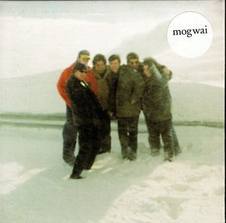
SOUNDTRACKMOGWAI-No Education = No Future (Fuck the Curfew) (1998).

This is a 3 song EP. The opener “Xmas Stripes” is one of my favorite early Mogwai songs.  The opening melody is really great, with a cool interesting bass and a nice guitar over the top.  At about 3:30 the song grows from a silent track to a menacing, growing beast until the drums start and the song and the main riff begins.  By 5 minutes it’s all out rock noise.  By 6 minutes the song is scaled back for the violin solo.  The remaining 7 (!) minutes are a denouement for the song.  Even though I love the track, I mostly love the first 8 or 9 minutes.  The ending tends to drag a bit.

But for all of their noise, Mogwai’s early releases were really quieter instrumentals, meditative songs that were really quite pretty.  “Rollerball” is a beautiful, sad three-minute track.

The last song “Small Children in the Background” continues in this quieter vein.  At nearly 7 minutes, it allows for a noisy middle section.  This noisy section is indeed mostly noise.  And yet the pretty melody of the rest of the track is just as loud throughout the mix, making for a very cool and very brief explosion mid-song.

Not all EPs are essential, but this one is pretty fantastic.  And I have Lar to thank for getting it for me.

[READ: March 10, 2011] Changing My Mind

It’s funny to me when that when I get into an author, I seem to wind up not reading the books that people most talk about until much later.  Take Zadie Smith.  Her debut, White Teeth, is something of a touchstone for many readers.  I missed it when it came out, but I loved On Beauty and figured I’d go back and read it.  That was almost a year ago.  And in that time I have read lots of little things by her and now this collection of essays.

Regardless, this collection of essays is a wonderful look in to the nonfiction world of a writer whom I admire.  And it was quite a treat.  Zadie is an intellectual, and that comes across in all of these paces.  Whether it’s the subjects she’s writing about, the footnotes she uses or just the acknowledgment that she likes art films and not blockbusters, we know where she’s speaking from.  And, of course, I’m right there with her.  The funny thing about this book then is how few of the subjects I know.

The book is broken down into five sections: Reading, Being, Seeing, Feeling and Remembering.  The Reading section is basically book reviews.  The Being section is about her experiences.  The Seeing section is about films.  The Feeling section is about her father and the Remembering section is about David Foster Wallace. (more…)

Read Full Post »

SOUNDTRACK: All Songs Considered Year End Music Roundup (2010).

Every year, I like to check various sources to see if there were any albums that I missed.  My definition of good resources: allmusic, amazon, pitchfork.  (There’s another fascinating list available here at Best Albums Ever, a site I’ve never seen before, and I have a large portion of the Top 50 albums.  I didn’t buy a lot of music this year, but evidently I chose wisely!).  I don’t necessarily agree with these lists, but if I see the same album on a few lists, I know it’s worth at least listening to.

This year, since I spent so much time on All Songs Considered, I thought I’d see their Best of Lists.  What’s awesome about the site is that you can hear not only selected songs in their entirety, you can also download the audio of the original show…where the DJs talk about their selections and play excerpts from them.   There are many different lists to investigate.

The most obvious one to star with is 50 Favorite Albums of 2010.  This shows the staff’s 50 favorite albums in all genres.  I admit that there’s going to be a lot on this list that I won’t bother exploring (I’m not really that interested in new classical or jazz and I’m not too excited by most pop music, although I was pleasantly surprised by how much I enjoyed the Kanye West songs here).

But some albums did stand out that I hadn’t heard, and I will investigate them further in 2011:

Buke And Gass, ‘Riposte’
Deerhunter, ‘Halcyon Digest’ (I know, this is on many best of lists)
The National, ‘High Violet’ (This is also on everyone’s list)

Bob Boilen, All Songs Considered’s most awesome host, picks his Top 9 of the year.  I’m on board with about 1/2 of his list (haven’t heard the other half).  Sufjan Stevens is his #1.

Robin Hilton, Boilen’s partner in crime, has a Top Ten which is remarkably similar to Boilen’s.  It has most of the same albums just appearing in a slightly different order.  Lower Dens is #1. (I’ve never heard of them).

Carrie Brownstein (of beloved Sleater-Kinney and now evidently a permanent member of the NPR team) has a Top Ten (Plus One)–funny that she liked more than ten when Boilen liked less than ten.  I’m really surprised by her selection of albums because her own music is so punk and abrasive, but her top ten features R&B and some folky bands.  Her top album is by Royal Baths, a band I’ve never heard of.

Stephen Thompson also picked his Top Ten.  He has an interesting mix of alt rock and jazz.  His number one is by Jonsi from Sigur Rós. (A great album).

Perhaps the best list comes from 5 Artists You Should Have Known in 2010.  I didn’t know any of the 5.  Sarah bought me two CDs for Christmas (and she was pleased to have gotten me good music that I hadn’t heard of!).  The Head and the Heart hasn’t arrived yet, but The Capstan Shafts is great.  I’m also really excited by Tame Impala.

Another great list is Viking’s Choice: Best Metal and Outer Sound (stay tuned for much more from this list).  It is dominated by black metal, but there are a few surprises in there as well.

Even the All Songs Considered Top 25 Listener’s List was great.  I had most of the list (except for The Black Keys who I simply cannot get into).

Although I enjoyed a lot of new music this year, it’s always nice to see that there is some new (to me) stuff to investigate.  Who knows maybe some day I’ll even have listened to enough new music in a year to make my own Top Ten.

[READ: December 31, 2010] McSweeney’s #36

With McSweeney’s #36, it’s like they made my conceptual ideal.  Its weird packaging is fantastic and the contents are simply wonderful.  But let’s start with the obvious: this issue comes in a box.  And the box is drawn to look like a head.  You open up the man’s head to get to the contents.  Brilliant.  The head is drawn by Matt Furie (with interior from Jules de Balincourt’s Power Flower.

Inside the box are eleven items.  The largest are smallish books (postcard sized) running between 32 and 144 pages.  The smaller items are a 12 page comic strip, a nineteenth century mediation (8 pages) and 4 postcards that create a whole picture.  The final item is a scroll of fortune cookie papers.   The scroll is forty inches long with cut lines for inserting them into your own fortunes (I wonder if they will sell this item separately?)

Aside from the bizarre head/box gimmick (and the fact that there is ample room in the box for more items), the contents are really top-notch.  For while many of the books included are individual titles, there is also an actual “issue” of McSweeney’s (with letter column and shorter stories) as well.  So let’s begin there

ISSUE #36: New Stories and Letters.  The resurrected letters page continues with more nonsense.  I’ve often wondered if these are really written like letters or if they are just short pieces that have no other place to reside.  (Oh, and the back of this booklet contains the bios for everyone in here as well as assorted other folks who don’t have room for a bio on their items).

LETTERS (more…)

Read Full Post »

SOUNDTRACK: THERION-Theli (1997).

I bought this disc when I was living in Boston and I immediately fell for it.  I seem to recall I was doing a lot of driving at the time, and this mix of extreme metal, orchestral accompaniment and twinned vocals was very captivating.  It was also really fun to play very loud on a dark highway.

I’d read a very good review of this disc that claimed it was a big step forward in styles of thrash/black metal (and if you Google reviews for this album they are pretty universally great).  The disc is exemplified by the track “To Mega Therion” which is almost entirely a full choir singing what I guess is the chorus.  The verses are populated by a guy screaming in a guttural voice who is answered by an almost mechanically twinned voice which sounds great but is even harder to understand.  Follow this with a beautiful piano (!) solo not unlike something Randy Rhoads put together for Blizzard of Oz, and add a pounding double bass drum all the way through (truth be told the album could be a little heavier in the bass) and you get a crazy mix of styles which is catchy and creepy at the same time.

It’s hard to match a song like that.  And, admittedly, the band doesn’t quite manage to do so, but the rest of the album keeps up this orchestral death metal throughout.

Reading about Therion has taught me that this album is something of  touchstone for a new genre of metal, called variously symphonic or operatic metal (I suppose we have this to blame for the Trans Siberian Orchestra?).

In addition to the choirs and guitars there are a lot of keyboards. They are disconcerting when you’re thinking death metal and yet really they add an even fuller sound, even if at times they are not as grand or powerful as anything else.  At times the album seems cheesey, but that may have more to do with thirteen years distance than the music itself.

Anyone who has seen The Exorcist knows that choirs can be spooky.  And when you mix it with the heavy guitars and guttural vocals, you get a really cool sinister yet catchy (and possibly uplifting) album.  There are certainly a lot heavier albums, but this one is pretty stellar.

[READ: Summer of 2010, finished December 12, 2010] Lords of Chaos

My brother-in-law gave me this book for my birthday this year.  I was familiar with it as it is fairly well-known in heavy metal circles as a fascinating read.  And so it was.

This book is basically a history of black metal in Norway and how some bands’ antics went beyond music into burning churches and even murder.  The authors present a pretty neutral account of the story.  They let the main participants (criminals) have their say and the interviews don’t comment on their answers, they just let them tell their side of the story.  The authors also know a lot about the music scene.  Of course, in the end, the authors (thankfully) disapprove of the violence.  It makes for an interesting and somewhat conflicting read. (more…)

Read Full Post »

« Newer Posts - Older Posts »