Feeds:
Posts
Comments

Archive for the ‘Sports’ Category

SOUNDTRACK: ANTONIO CORA-“The Cellar” (from The Blair Witch Project) (1999).

A lot of the music I listen to is weird and probably creepy to other people, but I don’t necessarily think of songs as appropriate for Halloween or not.  So for this year’s Ghost Box stories, I consulted an “expert”: The Esquire list of Halloween songs you’ll play all year long.  The list has 45 songs–most of which I do not like.  So I picked 11 of them to post about.

I was getting bored of the Esquire list so I found this fun little tidbit of spookiness.

The Blair Witch Project was a low budget, DIY-looking movie.  The soundtrack is a compilation with songs on it (Josh Blair’s Witch Mix), but this track is from the actual movie soundtrack.  I couldn’t exactly tell if there was a release of the actual movie soundtrack, but the last track on the disc is similar to a video I found online for the “end credits theme.”

Excluding the intro, which has 30 seconds of dialogue from the film (“Heather’s Apology”), this track is a five-minute nightmarish ambient score.

It is largely quiet with rattling, echoing sounds.  An online thread (therefore of dubious truth) says that the score was made with the sound of sticks breaking and being thrown into a culvert (or some such) and slowed down dramatically.  There’s also some kind of droning sound throughout (maybe a synth, but who knows).  It seems to slowly percolate while things scrape and bang.  There’s a few louder noises that really stand out, but there’s no momentum or narrative to the soundtrack.  It’s just a sort of endless low grade scare.

Don’t listen at bedtime.

[READ: October 27, 2019] “Last Call for the Sons of Shock”

Just in time for Halloween, from the people who brought me The Short Story Advent Calendar and The Ghost Box. and Ghost Box II. comes Ghost Box III.

This is once again a nifty little box (with a magnetic opening and a ribbon) which contains 11 stories for Halloween.  It is lovingly described thusly:

Oh god, it’s right behind me, isn’t it? There’s no use trying to run from Ghost Box III, the terrifying conclusion to our series of limited-edition horror box sets edited and introduced by Patton Oswalt.

There is no explicit “order” to these books; however, I’m going to read in the order they were stacked.

I feel foolish that I didn’t “get” this story right away.  When I see that it was originally published in The Ultimate Frankenstein, I guess the Blank Frank name would have been a bit more obviously Frankenstein’s monster.  I did figure it out before the end, but on a second read it was much clearer. (more…)

Read Full Post »

SOUNDTRACK: TAYLOR SWIFT-Tiny Desk Concert #902 (October 16, 2019).

Most Tiny Desk Concerts are from musicians that few people have heard of.

Not this one!

It’s hard to imagine exactly how it happened that Tiny Desk Concert managed to get Taylor Swift to play.  And to play with just a acoustic guitar and piano.  “It’s just me. There’s no dancers, unfortunately,” she quipped.

I have seen people already complain that Tiny Desk is supposed to be for unknown artists blah blah blah.  But I think it’s pretty awesome that a) Taylor Swift is a fan of NPR and Tiny Desk and b) that this show will bring more notoriety to Tiny Desk and potentially other bands.

Plus–I had no idea that Taylor Swift was not a studio creation–that she’s actually a real and thoughtful person who wrote her own music.

She talks confidently and casually about songwriting and she seems pretty genuinely pleased to be there.

As she settled in for her Tiny Desk, she looked out at the 300-plus NPR employees and guests. “Wow! This is a lot of people in a tiny office!” she said. “I love it!”

She delightfully says, “It’s great to be in DC.  You guys had anything exciting going on in the last couple of weeks?  Any possible changes in play?”

And, hey, she writes good songs, too.

I’ve never really listened to her music–although I love “Shake It Off.”  I haven’t actually heard anything of her new album so this was all new to me.

After introducing herself, she explained her objective: “I just decided to take this as an opportunity to show you guys how the songs sounded when I first wrote them.”

She talks a lot about each song and why she wrote them.

Opening with an acoustic rendition of “The Man,” from her 2019 album Lover, Swift delivered a critique of gender double-standards with a sense of humor (and a perfectly deployed hair toss), Leonardo DiCaprio name-check and all.

She says she has been thinking about the topic for many years and it was something she wanted to write about conceptually for a very long time because we have a bit of double standard issue in our society.  She wondered if there was a concise and catchy way to write a song about this?  So she decided to imagine what her life would be like if she said and did all the same things but if she was a man.

While not an original idea, she tackles it really well.  And I like that she’s using her platform to address the issue

I would be complex
I would be cool
They’d say I played the field before
I found someone to commit to
And that would be okay
For me to do
Every conquest I had made
Would make me more of a boss to you
I’d be a fearless leader
I’d be an alpha type
When everyone believes ya…
What’s that like?

And it’s really catchy too.

At the end of the song she gives her pick to a little one in the audience (to a room full of awws).  Then she switches instruments.

She talks about the process of writing songs–when something comes and its easy, that’s wonderful.  But most days you show up… and the idea doesn’t.  Then you have to know the craft of songwriting–you’re not always going to be inspired and that’s okay.

Turning to the piano for Lover‘s title track, with a smile, she explained the guitar-string scars of the song’s bridge.

She says that she has scars on her hands from playing guitar when she was young–when she played until her fingers bled or when a string snapped and cut her.  In your life you received all kinds of scars–emotional and physical and if someone is going to take your hand, they’d better take your hand scars and all.

It’s a pretty piano ballad and her voice is really pure.

After the song she removes her blazer to reveal a velvet top (she must have been very hot).  “You guys ever had costume changes at Tiny Desk?” She then finds three more guitar picks to give to three other kids, one of whom you can quickly see is pretty darn excited.

Picking up the guitar again for “Death by a Thousand Cuts,” Swift confronted a question that she says has haunted her career: What will you ever do if you get happy?

She receives this question over and over that “has the potential to seriously deteriorate my mental health.”  “What will you ever do if you get happy?  Will you just never be able to write a song again?    She says she used to reply that she started off when she was 12, she was writing songs about things she had no idea what she was talking about.  She wrote songs about heartbreak based on movies and books and character studies.  So she would say, “If stuff is going on in the world maybe she could hey inspiration from that.

But then she really asked herself that question.  “Would I not be able to write break up songs?  I love break up songs!  They’re so fun to write.”  She says she had friends going through breakups and she was watching movie and reading books about breakups and these ideas came to her.  She woke up with heartbreak lyrics in her head and realized “It’s still here!”

Across the song’s run-on thoughts and relentless searching, Swift offered an answer: She’ll continue to excel at crafting superb story-songs.

I rather like her songs on acoustic guitar–even if I’m not much of a fan of break up songs.

Before the final song, “All to Well,” she talks about how she never googles herself–she recommends you not do it either.  But her dad does.  He sends her links to lists that people rank her songs (she finds it very nice that people care enough to do that).  When the Red album came out, she said there’s a song and “I’m the only one who loves this song this much–because it happens to me and its personal.”  But it turns out that this song tops everyone’s favorite list.  “I’m happy that my opinion lines up with your opinion on that.”

I actually didn’t know this song at all–I guess I am really isolated from pop music.

She says, “here’s a sad song about fall.”  It’s very pretty on piano and once again her voice is really great.  I really like the way the words unfold and then reflect back on themselves.  It’s a really wonderfully crafted song.

This Tiny Desk Concert may not introduce Taylor Swift to a lot of people, but it pretty much did introduce me to her music.  And I was really impressed.

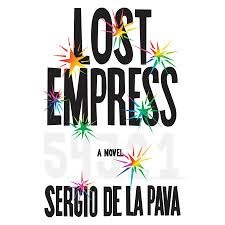
[READ: August 19, 2019] Lost Empress

I loved Sergio De la Pava’s A Naked Singularity. It was complicated and funny and clever and bizarre and thoroughly engaging.

Lost Empress is even better.

There’s a story about a woman running a football team–and being overlooked because she is a woman.

There is a storyline about 911 operators, and the guy who transcribes them.

The third story is about a tough, smart guy who is in jail.  He is his own defense for trying to get out.  And he hatches a plan that involves stealing artwork, the Paterson Falls and the Super Bowl.

I enjoyed it in part because much of it is set in Paterson, NJ.  I grew up next to Paterson and the city has for most of my life been in a state of decline.  Despite all of the great things it has to offer (like the Paterson Falls! which get a shout out in this book), Paterson gets no respect.  This book doesn’t exactly aim to correct that, but it does give the city something cool–a football team.

It also jokes about “what the hell is up with Paterson?”  The city had once tried to rebrand itself in which they staged a contest  for “an official slogan for the troubled city.”  Proposals emerged: “the verifiably untrue, the unintentionally insulting/intentionally insulating, the so vague that sense fails to be created, the rhyme or alliteration for its own sake, and the technically true but not even conceivably relevant.” (more…)

Read Full Post »

SOUNDTRACK: DEODATO-Prelude (1973).

I know this artist because of Phish.  For years I thought that they “wrote” the discoey, funky. super cool version of “Also Sprach Zarathustra” which they play at a lot of shows.

I should have realized that the “Deodato” in the credits was the actual arranger of this cool piece, but I guess I never really thought about it.  I’ve no idea where the realization came to me, but once it did I decided  to check out the album from which it comes.

It turns out that Deodato is Eumir Deodato de Almeida (Brazilian Portuguese: [ẽʊ̃ˈmiχ djoˈdatu]; born June 22, 1942) is a Brazilian pianist, composer, arranger, and record producer, primarily in jazz but who has been known for his eclectic melding of genres, such as pop, rock, disco, rhythm and blues, classical, Latin and bossa nova.  Prelude was his first album released in the U.S. (released when he was 31) and eighth overall.  In addition to making over 30 albums, he has also been a producer and arranger on everything from Kool and the Gang’s “Celebration” to Bjork’s albums PostTelegram, and Homogenic

“Also Sprach Zarathustra” begins with twinkling and guitar noises for 30 seconds before the 5-note funky keyboard comes in.  And then about a minute in the horns join to create the familiar Richard Strauss “Also Sprach Zarathustra” crescendo.  Even though that melody is barely a minute long, this version is 9 minutes long with a lengthy funky keyboard solo occasionally punctuated by horns.  It then switches to a more rocking sound with a 70s sounding guitar solo.  It really never loses the funk for the entirety of the piece.

“Spirit Of Summer” is a slow moody song that sounds like it could be the soundtrack to a noir film with slinky horn lines and jazzy bass.  I love the opening and how it then switches to an almost easy listening string section before adding a mellow keyboard solo and a surprising very fast flamenco guitar solo as well.   The song is only four minutes and ends with a flute solo and then a return to the opening horns.

“Carly & Carole” is an easy, mildly funky jazzy number.  There’s lead flute combined with the keys that push the song along.

“Baubles, Bangles, & Beads” is a jaunty five-minute romp that sounds like it would have been very popular at swinging parties in the 1970s.  There’s more flute and keys and two lengthy wild Santana-like guitar solos that run through to the end of the song.

“Prelude To The Afternoon Of A Faun” opens with a mournful flute that sounds a lot like the weird Snoopy interludes when he is the World War I Flying Ace in the old Peanuts cartoons.  The melody is quite nice and is then repeated by several instruments throughout the piece.   After 2 minutes it tuns into a swinging jazzy number with a flute solo and wah wah guitars and a bright trumpet solo.  I see now that this piece was done by Debussy and this is another arrangement.  It is not used in Peanuts although Schulz does reference the song in a strip.

“September 13” ends the disc with an upbeat funky song with groovy bass and keys and wah wah guitars.  There’s a wild mildly distorted guitar solo with fun effects put on it.  It’s a fun way to end an album that is short but really captures a moment in time.

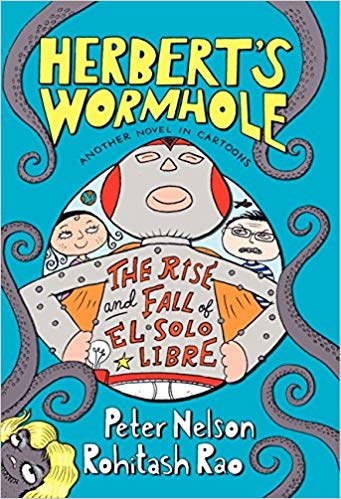
[READ: September 3, 2019] Herbert’s Wormhole Book 2

I accidentally read Book 3 before Book 2.  I am embarrassed that that happened because I am a librarian and I should know better, but I checked on Goodreads and must have read a paperback reprint pub date and though that book 3 was in fact book 2.

Having read book three I basically knew a lot of what happened in book 2.  But primarily this is because in book 3 they make offhanded comments to things they did in book 2.  Incidentally, while I was reading book 3 I thought it was a really fun, bold move on the author’s part to reference adventurers that we hadn’t read about.  That should have dawned on me but I just persisted in believing that the author was being really daring. Oh well.

Knowing what happened didn’t really spoil anything, because the book is silly and funny anyhow.

This book opens with a paneled cartoon recap of book 1.

It’s followed by a hilarious opening sequence in which Alex’s dad has become hooked on video games.  He was trying to bond with Alex over Alex’s love of video games.  But in book 1, Alex’s memory of video games is wiped out.  So now his father is playing them and Alex doesn’t really see the point.  But Alex’s father is now as addicted as Alex was. (more…)

Read Full Post »

SOUNDTRACK: A-WA-Tiny Desk Concert #8876 (September 3, 2019).

I knew of A-WA and had seen them in a South X Lullaby this year.  But  that song was performed quietly, with just a guitarist.  This session is full band with all kinds of dancey accouterments.

Liron, Tair, and Tagel Haim [left to right] are behind my desk with a full band of keyboards, bass, guitar and drums, singing more forlorn tunes in their unique three-part harmony.  Their songs mix Yemenite and Arabic traditions with splashes of reggae and hip-hop.

These songs also have the lyrics translated at the bottom of the screen.  Since Bob says the songs are sad, I haven’t been reading too much, just enjoying the melodies [I’ll let Bob talk about the song in brackets]

The first song is “Habib Galbi” (“Love of My Heart”), [a heartbreaking song that went viral for A-WA in 2016].

I don’t know much of anything in the languages they are singing, but back in 1988 Israeli singer Ofra Haza released an album that I really liked and one of the great songs was “Galbi.”  So here it is again and it means “mt heart.”

‘Habib Galbi” opens with Middle Eastern melodies played on a synth (by Noam Havkin)–it’s a cool combination of traditional and modern almost futuristic.  It even has some electronic percussion (from Tal Cohen) and some great bass from Nitzan Eisenberg.  I love that there’s an occasional “Woo!” and lots of hand claps.  It is so dancey, how can it be heartbreaking?

 A-WA have recently released a second album, Bayti Fi Rasi (in Yemenite it means My Home is in My Head). The record tells the story of their grandmother traveling from Yemen to Israel.  The final two songs come from that recent album.

The second song “Al Asad” (“The Lion”) has the reggae feel in with the staccato guitar and a cool guitar solo from Yiftach Shachaf.  It “is a metaphorical tale of facing down a lion in your path.”

Once again, their movements and tone belie the story, as they move so almost sensually to the music as they sing (in fairness, it’s hard not to).

The last song “Hana Mash Hu Al Yaman,” (“Here is Not Yemen”) features some amazing rolling of r’s as they sing–I’m thinking it’s the word for “wheat.”  Once again, despite the music, this song

paints the struggles of coming to a new land, learning the language, finding work, a place to live and making it a home.

Although this song starts out more somber, as the song moves on it picks up a more danceable beat with more interesting synthy sounds.

I couldn’t help but be interested in the lyrics for this one with the way they sang “wheat” I had to find out what the rolled r word was.  This led me to see “Land of wheat and barely, grape and olive / fig, pomegranate date and home.”

And then further on:

Where will I stake a home? (You have a tent for now)
Or at least a small shack (along with four other families)
And here I will raise a family (Don’t let them take your daughter)
I’ll find myself a job with an income (either in cleaning or working the earth)
And I will learn the language (Lose the accent)
With time I’ll feel like I belong (Here is not Yemen).

Dang, draw me in with fun music and beautiful voices and then wow me with powerful lyrics.  Well done, A-WA.

[READ: September 3, 2019] Herbert’s Wormhole

We listened to this book on our summer road trip.  When I saw that it was a novel “in cartoons,” I decided to check out the print to see if it was any different as a story.

The cartoons certainly add to it. The drawings are done in a very stylized way (by Rohitash Rao).  The cartoons are indeed very cartoony but that befits a story about squid aliens who wear fake mustaches and toupees.

I’m glad I listened to the audio first because it was fun having the experience of hearing the Australian accents in my head while reading the text.  I’m sure I could have imagined the accents myself, but since Jonathan Davis did such a good job, it was nice having them in place.

The other interesting thing is how much I evidently missed during the listening (if you’re driving you have to pay attention to the world around you as well).  So the book version filled in some details that I clearly missed and a few things made a bit more sense.

The opening is fairly simple: Alex Filby is 11 years old and loves video games.  He is just about to defeat all the aliens in Alien Slayer 2 which is pretty great,.  Except he promised his parents that when he beat the game, he would stop playing video games for the summer and start playing outside.  So when he destroys the final alien, his parents tell him that they have set up a play date with the weird kid next store: Herbert Slewg. (more…)

Read Full Post »

2002SOUNDTRACK: ANT & DEC-“We’re on the Ball” (2002).

indexEvidently, for nearly every football tournament since 1970, the English team has had a theme song.

Occasionally one of those songs will reach non-footbnall fans.  In 1990 New Order did “World in Motion” which New Order fans will know whether they like football or not.  One of the band members described the single as “the last straw for Joy Division fans.”

Who the heck are Ant &Dec?  They are TV presenters (of what I’m not sure) with really questionable haircuts.  I don’t know if they wrote this song or just sing it. I’m not even sure what the verses are on about as they seem to be irrelevant–filler until you get to the chorus.  A vibrant horn melody introduces the easily chantable:

We’re on the ball
We’re on the ball
We’re on the ball
We’re on the ball
We’re on the ball
We’re on the ball
We’re on the ball
We’re on the ball

The final verse is one that any football fan can appreciate:

Japan, Korea, here come England
It’s Neville to Cambell
Cambell to Rio
Rio to Scholesy
Scholesy Gerrard
Gerrard to Beckham
Beckham to Heskey
Heskey to Owen
To Nodd
5-1

Honestly I prefer Fat Les’ “Vindaloo,” which has a huge na na na part and this wonderful boast: “We’re gonna score one more than you.”

[READ: September 25, 2019] “We are the World”

Nick Hornby wrote his final music article for the New Yorker in 2001.  He then wrote this article about soccer and then stopped contributing to the magazine at all (until mid 2020, it turns out).

This article is all about the World Cup.  I’m sure there are many writers who can write wonderful things about the World Cup, but I feel like Hornby’s unbridled love for the game, combined with his quick wit and mild snark, make his World Cup writing excellent.

It’s always weird to read about things that happened nearly twenty years ago as if they were current. It’s even weirder to read about things that happened nearly twenty years ago that you didn’t care about, or possibly even know happened, from someone who cares very deeply about it.  “It is mostly pointless to try to convince an American readership of the joys of football (yes football) but it would be hard for anyone not to take pleasure in the rhythm of life in a football-mad country during the world cup.”

The world cup was on at 7:30 AM in England most days . England’s tabloids had to battle the World Cup for eyeballs and gave up: “On the morning of England’s game with Brazil the cover of the Daily Mirror showed only the flag of St George–England’s official flag–and the caption, ‘This page is cancelled. Nothing else matters.'” (more…)

Read Full Post »

[ATTENDED: August 27, 2019] Mac Sabbath

When I saw that Okilly Dokilly was opening for Mac Sabbath I had to check out who this band was.  They’ve been around for a few years and this was their “American Cheese Tour” (that’s a good one).

And so basically, they are a Black Sabbath cover band, but all of their lyrics are about McDonald’s and the fast food industry in general.  So that’s pretty funny.  But that’s not all.  They have taken this concept to an absurd length.   Each band member is costumed or wears makeup.  And the costumes are phenomenal–not cheap little handmade things, but remarkably detailed and well constructed heads and bodies.  The attention to detail is really impressive.

The band members are also completely anonymous, which is also pretty funny.   And that is why they have such great band names:

The lead singer is Ronald Osbourne.
The guitarist is Slayer MacCheeze
The bassist is Grimalice (the least impressive name, it’s Grimace with an Alice in Wonderland hat on, but his other name is brilliant: “I Can’t Believe It’s Not Butler.”)
On drums is Catburglar or Criss Cut Fries (he is dressed like the Hamburglar with Peter Criss Makeup).

I didn’t really think too much about the music before the show, I just wanted to see the stage show. (more…)

Read Full Post »

SOUNDTRACK: iLe-Tiny Desk Concert #874 (August 3, 2019).

It’s not very often that you hear a song that is all percussion.  But the first song of this set is only percussion and (Spanish) vocals.

iLe is a singer in the Puerto Rican band Calle 13.  Her most recent solo album Almadura:

is filled with metaphors and allegories about the political, social and economic conditions in Puerto Rico.

When vocalist Ileana Cabra Joglar and her band visited the Tiny Desk, they’d just arrived from the front lines of the historic demonstrations taking place in Puerto Rico. Two days earlier, they were part of a crowd of tens of thousands who were on the streets calling for the resignation of embattled Gov. Ricardo Rosselló. (Rosselló recently stepped down, effective August 2.)

Right from the start, it was clear what was on iLe’s mind in her song “Curandera” — “I am a healer / I don’t need candles to illuminate / I bring purifying water to cleanse / Removing pains so they never return” — as congas and percussion shook the room with an Afro-Caribbean beat.

This is the song in which all of the band members play percussion–primarily congas although Ismael Cancel is on the drum kit.  While everyone plays congas, it is Jeren Guzmán who is the most accomplished and who plays the fast conga “solo.”

In the chorus of the slow-burning “Contra Todo,” iLe sings about channeling inner strengths and frustrations to win battles and remake the world. Her lyrics are rich with history, capturing the spirit of the streets of San Juan even as she stood, eyes closed, behind the Tiny Desk. Her entire performance is a startling reflection of this moment in Puerto Rican history.

“Contra Todo” has a rich deep five string bass from Jonathan Gonzalez and two trombones (Joey Oyola and Nicolás Márquez). Two guitars (Bayoán Ríos and Adalberto Rosario) add a kind of percussive strumming and a quiet song-ending riff.  Jeren Guzmán plays the congas with mallets, something I’ve never seen before.

By the time iLe and her band launched into “Sin Masticar,” they’d already captured the full power of protest, as their musical arrangements raged with the intensity of a crowd joined by a shared cause and pulse.

“Sin Masticar” has a super catchy chorus, perhaps the best way to get people involved in a protest.

[READ: August 2019] Midnight Light

Two years ago Dave Bidini co-founded The West End Phoenix, a newspaper that is for people in Toronto’s West End.  It’s print, it’s old school, and it’s pretty awesome.  I don’t think I’ve ever been to the West End, but I find the writing and the content to be interesting and really enjoyable.

It’s no surprise that Bidini has worked in journalism and loved and hated it.

I’ve always loved newspaper: the smell of the ink and the rough of the newsprint weighted in my hands, their broadsheets flapping like Viking sails.  When I was a kid, our family read them all–the Globe and Mail, the Toronto Star, The Sun, and before that The Telegram–at the kitchen table with each person drawing out whatever they needed: comics, sports, business, entertainment (and yet never Wheels, the Star’s automotive supplement).

He started writing before he picked up a guitar.  When he was 11 he submitted a poem about a hockey player to The Sun‘s “Young Sun” section.  It was accepted and he won a T-shirt.

In 1991, he was asked to write a regular column for a Star satellite weekly called Metropolis.  The day his first piece was to be in print he waited at the nearest newsbox for the delivery man.

But he had no stamina and fewer ideas and he was eventually let go.  Which led to writing books.  But he still wanted to write for the paper and then he remembered: Hey, Yellowknife had a newspaper.

This book is about journalism.  But it’s also about the Canadian North.  And while the journalism stuff is interesting–and the way it ties to the North is interesting too, it’s the outsider’s perspective of this region of the world (that most people don’t even think about) which is just amazing to read about–the people, the landscape, the conditions.  It’s fascinating. (more…)

Read Full Post »

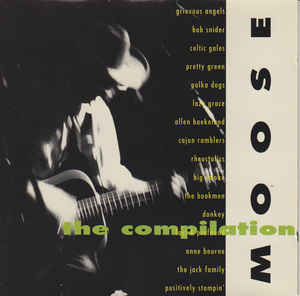
SOUNDTRACK: THE BOOKMEN-“Huggin’ at My Pillow” (Moose: The Compilation, 1991).

Back in the 1990s, it was common to buy a compilation or soundtrack or even a band’s album based on one song.  Only to then find that you didn’t really like anything else on it.

Maybe that single sounded like nothing else on the album.  Maybe the movie was almost entirely one genre, but they had that one song that you liked over the credits.  Or maybe the compilation was for something you didn’t know, but a song you really wanted was on it, too.

With streaming music that need not happen anymore.  Except in this case.

I bought this compilation, used, recently exclusively for one song, Rheostatics’ “Woodstuck.”  It’s a goofy song and this is the only place you can get the studio version.  The actual compilation was not well documented, so I didn’t know what the other bands on it might sound like.  It turns out to be a compilation for Ontario based Moose Records which specialized in Rock, Folk, World & Country.  They put out another compilation in 1992 and that’s all I can find out about them.

The Bookmen were the creation of legendary Toronto musician and independent music promoter Dave Bookman.  This is a fun bluesy stomper that sounds like a song of lost love, although the final line of the chorus might reveal the truth:

I’m huggin at my pillow but it’s just not the same
My pillow don’t know the score of the Blue Jays game.

I really enjoyed this song, so it’s no surprise to see that the rest of the band consists of Tim Mech, guitar tech for Rheostatics, Tim Vesely bassist for Rheostatics, and Dave Clark drummer for Rheostatics.  Shame I can’t find a copy of their only release Volume One: Delicatessen.

[READ: July 20, 2019] “The Love of My Life”

I have really enjoyed the more recent stories from T.C. Boyle.  I haven’t read one of his older stories in quite some time, so I don’t remember if this story is representative or not, but holy crap was this story dark.

And yet it started so sweetly.

It is the story of two high school students, Jeremy and China who are madly in love.  That spring break, they were planning on going camping–a lovely five day stretch of gorgeous weather and solitude.  The first couple of days were wonderful–they didn’t even bother putting clothes on.

They were ever so much in love. He even practiced his AP Spanish on her: Tu eres el amor de mi vida.  She tried to reply but she was taking French.

They were also excellent students–he was heading to Brown (his father’s alma mater) and she was almost but not quite the class salutatorian. (more…)

Read Full Post »

SOUNDTRACK: BOB SNIDER-“Old Nova Scotian” (Moose: The Compilation, 1991).

Back in the 1990s, it was common to buy a compilation or soundtrack or even a band’s album based on one song.  Only to then find that you didn’t really like anything else on it.

Maybe that single sounded like nothing else on the album.  Maybe the movie was almost entirely one genre, but they had that one song that you liked over the credits.  Or maybe the compilation was for something but a song you really wanted was on it, too.

With streaming music that need not happen anymore.  Except in this case.

I bought this compilation, used, recently exclusively for one song, Rheostatics’ “Woodstuck.”  It’s a goofy song and this is the only place you can get the studio version.  The actual compilation was not well documented, so I didn’t know what the other bands on it might sound like.  It turns out to be a compilation for Ontario based Moose Records which specialized in Rock, Folk, World & Country.  They put out another compilation in 1992 and that’s all I can find out about them.

This song by Bob Snider is another story song.  This one is about a Old Nova Scotian far from the ocean.  He’s a derelict dead on his feet.

This song is a slow ballad–it feels like an old Irish ballad especially with this accordion.  Although a whipping violin solo would perk the song up.

Snider has been playing music since the 1980s.  Moxy Fruvous covered his amusing song “Ash Hash,” which makes sense as it didn’t sound like one of their songs.

[READ: July 1, 2019] “Fishing with a Straight Hook”

The July/August issue of The Walrus is the Summer Reading issue. This year’s issue had two short stories, a memoir, three poems and a fifteen year reflection about a novel as special features.

Jackson talks about one summer when she went fishing on Lac Catherine, a small lake in Quebec.  She and her husband rent a chalet fora  a month each summer.

Their son’s friend Roberto, an experienced fisherman, came to visit and she hoped to learn a thing or two from him.  Roberto had many sage things to say about fishing (as fishermen are wont).  Roberto’s secret: “put the worm where the fish wants to eat and if you’re lucky you will catch a fish.” (more…)

Read Full Post »

SOUNDTRACK: JAMBINAI-Différance (2012).

I am fairly stunned that I never posted about Jambinai at the Olympics in Korea in 2018.  Their performance of “Time of Extinction” blew me away and before the song was even over I was looking them up to find out more about them.

Jambinai blend traditional Korean instruments with rock instruments.  But not in a “we rock and want to bring in a flute” way.   The three main members met at Korea’s National University of Arts while studying traditioanl Korean music.  They wanted to play traditional music in an innovative way but in a way  that was very different from K-pop.  So their band consists of
Kim Bo-mi– haegeum;
Lee Il-woo – electric guitar, piri, taepyeongso, vocals
Sim Eun-yong – geomungo.

I had to look up what some of these instruments were, and here’s what I’ve got:

Geomungo (also spelled komungo or kŏmun’go) or hyeongeum (literally “black zither”) is a traditional Korean stringed musical instrument of the zither family of instruments with both bridges and frets.   It is generally played while seated on the floor. The strings are plucked with a short bamboo stick called suldae, which is held between the index and middle fingers of the right hand, while the left-hand presses on the strings. The most typical tuning of the open strings for the traditional Korean music is D#/Eb, G#/Ab, C, A#/Bb, A#/Bb, and A#/Bb an octave lower than the central tone.

In the video from the Olympics, the band is surrounded by dozens of geomungo players.

https://www.youtube.com/watch?v=soAiXuot42U

Haegeum (Hangul: 해금) is a traditional Korean string instrument, resembling a fiddle. It has a rodlike neck, a hollow wooden soundbox, and two silk strings, and is held vertically on the knee of the performer and played with a bow. It is one of the most widely used instruments in Korean music. Its range of expression is various despite having only two strings, with sounds ranging from sorrowful and sad to humorous.

Taepyeongso (lit. “big peace wind instrument”; also called hojokhojeok 호적 號笛/胡笛, nallari, or saenap, 嗩吶) is a Korean double reed wind instrument in the shawm or oboe family, probably descended from the Persian zurna and closely related to the Chinese suona. It has a conical wooden body with a metal mouthpiece and cup-shaped metal bell. It originated during the Goryeo period (918 – 1392).   The loud and piercing sound it produces has kept it confined mostly to Korean folk music (especially “farmer’s band music”) and to marching bands, the latter performed for royalty in the genre known as daechwita. It is, however, also used sparingly in other genres, including Confucian, Buddhist and Shamanist ritual musics and neo-traditional/fusion music.

Piri is a Korean double reed instrument, used in both the folk and classical (court) music of Korea. It is made of bamboo. Its large reed and cylindrical bore gives it a sound mellower than that of many other types of oboe.

Jambinai released this album in 2012 but reissued it in 2016 when they released their second album a Hermitage.

This nine-song (mostly) instrumental post-rock album is just astounding with the sounds they produce.

1. Time Of Extinction (2:56) opens with some quick riffage on the Geomungo.  After 20 second the roaring guitars and drums crash in.  Before a minute is up, the guitar falls back and a wondrous haegeum solo takes over amid the background rumbling.  It’s followed by some staccato thumps and full-on blasts of noise.  The taepyeongso mixes with feedback to create a wall of discord before it all crashes to a close.

2. Grace Kelly (3:20) opens with some fast acoustic sounding guitars before the whole song barrels forth with crashing noises and a taepyeongso solo.  That’s all in the first minute.  After which a quiet guitar and a vocal melody takes over.  I love that the vocal is buried under some effects so you can’t even really tell what language she’s singing in.  After a minute or so of this “rest,” the song just takes off again–forcing its way to the end with vocals moans that sound a bit like Robert Plant.  The ending crashing chords are pretty spectacular.
3. Glow Upon Closed Eyes (6:26) A quieter song, it starts with fading in and out noises and what may be reversed guitar sounds.  After a minute or so the geomungo comes in with some big notes that give the noises some context.  It stays relatively quiet for 5 minutes and then the end of the song bursts firth with martial drums and big guitars.
4. Paramita Pt. 1 (4:15)  The first part opens with rumbling noises and a slow riff on the geomungo.  Nearly the whole song works at this sort of tension building exercise with a brief moment of splashing cymbals and faster notes that slow once again.
5. Paramita Pt. 2 (4:21)  Part 2 slows things down a lot–just a geomungo thump and some sporadic notes on the haegeum.  It feels menacing and suspenseful–punctuated by deep bass notes that resound and linger.   The song unexpectedly explodes about two minutes in with a wall of noise punctuated by cymbals.
6. Hand Of Redemption (4:34) is a sonic blast of hardcore.  Screamed vocals are buried amid a wall of fast thumping drums and guitars.  After two minutes the taepyeongso and piri start adding noise and the thumping grows more mechanical.  The final minute takes away the industriaial sound but leaves all the high squealing notes punctuated by walls of bass and drums.   The end of the song thumps and feedback in to the next track.
7. Empty Pupil Pt. 1 (5:10) Continues with that feedback.  The feedback goes through several iterations as quiet chords are played and then allowed to feedback some more.  The rest of the song is full of other mechanical sounds–who even knows what–that fill in to a kind of noise drone.  The song ends with quiet guitar lines (I wonder if the song endings deliberate segue or if they were just stopped at the wrong time)
8. Empty Pupil Pt. 2 (4:39)  Part 2 further explores the quiet guitar with some cool creaking sounds from the geomungo before it starts playing a riff that ends with a big crash each time.   It picks up the tempo as the haegeum is introduced along with some acoustic guitar strumming but there is no climax to this song it just ends and fades.
9. Connection (9:37)  The final song is the one epic track on the disc.  It opens with a haegeum playing a quiet two note melody before some deep slow bass notes accompany it.  There’s also I think a vocal line (it’s hard to tell).  About four minutes in the haegeum starts playing a riff that is reminiscent of Sigur Rós.  It builds in beauty an intensity until the final notes fade out.
It’s a great way to end a great album.

Stream it on their bandcamp site.

[READ: June 4, 2019] “Stonehenge”

The June 10th issue of the New Yorker features five essays by authors whom I have enjoyed.  They were gathered under the headline “Another Country.”

I enjoyed Min jin Lee’s Free Food for Millionaires quite a lot.  I had no idea that she was not born in America.  She came to New York from Seoul when she was seven, and her essay is fascinating for a couple of reasons.

First, she says that every day in the 1970s and 1980s it took her two hours to get from her home in Queens to the Bronx High School of Science.  She spent most of that commuter time reading Sinclair Lewis novels about America: Main Street, Babbitt, Dodsworth, Arrowsmith.

On weekends she worked with her family in their father’s store in Manhattan’ Koreatown.  The store was burgled several times and everyone in their family had been mugged at some point.

She notes that Sinclair Lewis wrote about white Midwesterners who struggled against materialism, corporate greed, fascism and narrow thinking.  She found it calming to read about these big ideas since her family life was so hectic.   The books also made her feel like she’d traveled even though she never did. (more…)

Read Full Post »

« Newer Posts - Older Posts »