Feeds:
Posts
Comments

Archive for the ‘Football’ Category

1963SOUNDTRACK: RESTORATIONS-Tiny Desk Concert #462 (August 14, 2015).

restor I don’t know Restorations, although I understand that they usually play pretty big loud guitar rock.   For the Tiny Desk they are stripped down (I guess) to the three guitars, but no drums or bass.  Lead singer Jon Loudon has a powerful and excellent voice.  On “Separate Songs” there are two guitars and a keyboard and wonderful harmonies.  The keyboardist sings backing vocals in the beginning of the song, so that when the lead guitarist joins in later, it’s even more impressive.

The guys are very friendly and funny.  The joke about the “desk” and about their constant tuning needs.

For “Tiny Prayers” all three play guitars and there some wonderful melodies that they play together.  The Future” is the slowest song of the three, but it contains all of the same elements–cool guitar sounds and wonderful harmonies.

The band has a great sense of melody.  And yet for all that I liked t his set, there was nothing that really stood out for me about the band.  They are simply a good rock band, and that’s not a bad thing.

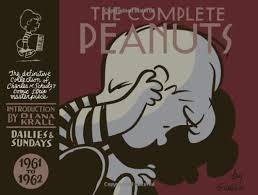
[READ: November 29, 2015] The Complete Peanuts 1963-1964

The drawing style of Peanuts that I most associate with the strip has been pretty consistent by this point.  And most of the characters look “right” (although Snoopy will continue to morph over the years).

Why does Charlie Brown keep going?  Despite all of the abuse Charlie gets, this one strip seems to sum up his strengths: “adversity is what makes you mature…the growing soul is watered best by tears of sadness.”

I feel like Schulz was either looking up facts to write about for some of this year.  Because we get things like this: Lucy: “You have to have [a note excusing you from school] otherwise the school can’t collect its state-aid money.”  Is that true or has Lucy hoodwinked Linus and me?  Later Charlie tells Lucy “when cranes and herons stand on one leg they can’t be injured by ground lightning.”  Later, Linus tells Sally that birds “have muscles in their feet which automatically contract when they fall asleep (which is how they sleep on a limb without falling off).  He then says the same principle applies with Snoopy’s ears.  Is this true?

In July 1963, there must have been an eclipse as the strip spends several days telling everyone how to safely watch it.

Linus’ blanket continues to occupy a lot of attention, with Lucy continually yelling at him about it.  His blanket hating grandma returns and even takes it away (she gives him a dollar bill which he tries to snuggle with).

Linus is full of ambition in these years.  He wants to be a rancher for several weeks in 1963.  Although, horror of horrors, he doesn’t make the honor roll in March of 1963.  But that doesn’t stop him.  And in a big surprise in 1964, he runs for school president (and has but one failing…and it’s not his blanket).

Schroeder continues to dismiss Lucy, this time even saying the chances are a googol to one (and then writing out how many zeros that is) of them getting married.  In July 1963 she complains that Beethoven never made it on any bubble gum cards.  Later when Lucy asks him why he doesn’t like her, Schroeder gives a very simple answer.  She replies, “I hate reasons.”

Rachel Carson returns in Feb 1964 with Lucy saying “we girls need our heroines.”  Of course Lucy also gets this quotable moment: “The crabby little girls of today are the crabby old women of tomorrow.”

Attacks on consumerism continue with a shoddy baseball about which Charlie says “this is what is called ‘planned obsolescence.'”

Speaking of baseball, there’s plenty of it.  I enjoyed the Sunday strip where Charlie using Snoopy to show how to break up a double play.  In 1964, Charlie suffers from Little Leaguer’s Elbow (and the team does great without him).  And when Lucy hurts her elbow (and refuses to call it Washerwoman’s elbow) she says she’ll sue Babe Ruth, Ty Cobb and Willard Mullin (Mullin was a sports cartoonist).

In August 1963, we see the first mention of Charlie Brown’s baseball hero Joe Shlabotnik (and the very distressing moment when Lucy won’t give let Charlie have his card).

I got a real kick out of Schulz returning to the McCovey joke from last year (in January!) saying “or why couldn’t McCovey have hit the ball even two feet higher?”

In 1963’s National Library week, Sally gets her library card this time and she is even more excited than Linus was.  She even has the line: “Happiness is having your own library card.”

Sally also addresses helicopter parents of 1963: “My mother is watching me out of the window.  Mothers feel secure when they see a child of theirs playing in a sandbox.  Sigh.  She’s secure and I’m bored to death.”

The little red-haired girl is obsessed over from time to time. Especially during Charlie’s lonely lunches.

Frieda has definitely dwindled by now–even if she never really did much.  She does abuse Snoopy about chasing rabbits but in one strip, we seem him playing with bunnies and four sleeping on his stomach on top of his doghouse.  This seems to set in motion Snoopy’s love of all other animals.

Later, there’s a really funny strip with Snoopy trying to fill his water bowl from a tap.  Then it rains on him.  The punchline “That’s one I’m going to have to think about for a while” is hilarious.

And…Snoopy goes to the hospital for a couple weeks! (nothing serious).  Charlie says he has a private room “he has a health insurance policy that pays forty dollars a day!”

In September of 1963, there’s a joke about ZIP Codes (Snoopy forgets his) and then shortly after a new character named 5 is introduced.  He explains, “My dad says we have so many numbers these days we’re all losing our identity.  He’s decided that everyone in our family should have a number instead of a name.”  His sisters 3 and 4 look like Peppermint Patty (who hasn’t arrived yet).  ZIP codes were introduced in 1963.

At Halloween in 1963 Linus slips about the Great Pumpkin and says “if he comes” (like in the TV show).  He’s doomed!

In February of 1964 a whole set of strips focuses on the existence of the humane society.

And in May of 1964 we get the classic bit from the movie when Charlie puts a coin in Lucy’s can and she sings “Boy what a sound.  How I love to hear that ol’ money plink!  That beautiful sound of cold hard cash!  Nickels! Nickels! Nickels!”

In June of 1964 there is a very touching Father’s Day strip.  (Although it wasn’t officially recognized until 1966 and signed into law as a official day by Nixon in 1972).

I really enjoyed the series of strips where they clean out Snoopy’s house and the dimensions (which we never see) are enormous!  There’s stairs, a pool table and all kinds of cool things.

For years now, Peanut has had strips where charters hold up signs–sometimes for Beethoven’s birthday, or national library week.  But in Sept 1964 it gets a bit more surreal with a bird holding a sign that has  ! on it.  Later another bird’s sign says ; and ?   A fight breaks out about it.  It’s very funny.

And in October 1964 Lucy pulls away the football despite given Charlie a signed document… “it was never notarized.”

And the year ends with something of cliffhanger.  Charlie has to do a report on Gulliver’s Travels over his holiday break, but he keeps putting it off… what will happen in 1965?

The foreword was written by Bill Melendez.  Melendez first met Schulz when they collaborated on an animated commercial for the Ford Falcon in 1960.  In 1963, they worked together on a documentary about Schulz using more animation.  Then in 1965 Coca Cola contacted him to see if Schulz would like to make a Christmas special.  They had 5 days to write the outline.  They used the kids from the Ford commercial as the voices. And they had six months to make the move.  It first aired on December 9, 1965.

Melendez raves about their work (rightfully) and then talks about the many other specials the made together–a Veterans’ Day one called What Have We Learned, Charlie Brown, and a show about cancer called Why Charlie Brown, Why?   In total they made fifty network specials and 4 feature films.  He talks about how great it was that they found Vince Guaraldi for the music and that they used real kids and no laugh track.  It’s hard to believe that special is so old!

Read Full Post »

rulingSOUNDTRACK: THE RED RIVER-Tiny Desk Concert #97 (December 13, 2010).

redriverThe Red River are a ten piece band (whom I have never heard of).  They have two keyboardists, a drummer, a violist, a french horn player and guitars and vocals.  But in this Tiny Desk, the band decided to remove all of their instruments, save for the guitar, and to sing four of their songs more or less a capella (such is the coolness of the Tiny Desk).

The first song “Milk n’ Honey” is completely a capella and they kind of make each other laugh at a few moments (where maybe their instruments might have covered up some unsightly notes).

“Morning Routine” begins with just guitar and duet vocals.  Again, they seem to be trying to make each other laugh when after the line “the kitten cries,” the lead singer makes some kitten noises.  The chorus of backing vocals sounds wonderful here.

For “St. Bernard’s Lily” the nine players all do body percussion to provide the beat while Bill Roberts plays guitar and sings.  The band does some great backing vocals (especially in the do do do do do doooos).  The final song “Dirty Dave” is dedicated to him.  Roberts says they miss him very much then quickly points out that he’s not dead, he just couldn’t make it on that tour.  The song has a pretty melody and when the band sings the chorus together its really beautiful.
Lyrically the songs are about the mundane, which is what makes them rather interesting. I can’t quite imagine what their full band sounds like given this stripped down version.

[READ: November 12, 2015] The Secrets to Ruling the School

I saw this book when I was in Chapters Bookstore in Toronto.  I was happy to see it again in my library, so I checked it out.

The premise of the book is familiar–getting by in Middle School–although this book takes it a few steps further.  Not just getting by in Middle School, but actually ruling it.

And the structure is cool.  You are the person who will soon rule Middle School.  And you will be tutored by Max Corrigan.  Max meets you on your first day.  He’s a clean cut kid with a binder full of information.  He is the school’s Welcoming Committee.  But as soon as you open his Official New Student packet, you see that Page 2 describes the school as The Worst Place in the Entire World.  And that Max will help you survive bullies, tests, hall passes, psycho teachers and even ditching class.

And his plan is simple–makes friends with every clique in school as quickly as possible. (more…)

Read Full Post »

1961SOUNDTRACK: NICK LOWE-Tiny Desk Concert #87 (November 1, 2010).

lowe Nick Lowe is legendary.  And yet I don’t really know that much about him.  I knew he did “Cruel to be Kind” which is very dated sounding but still great.  I didn’t know that he wrote my favorite Elvis Costello song “(What’s So Funny ‘Bout) Peace, Love, and Understanding?” (which he first recorded with his band Brinsley Schwarz).  He also produced a bunch of Costello’s albums.

This Tiny Desk is a mellow affair, with Lowe gently playing acoustic guitar and his low, smooth vocals singing interesting lyrics: “His heart’s a prune / when it once was a plum / If you know him / that’s the kind of man that I’ve become” (from “Man That I’ve Become”).

“Rome Wasn’t Built in a Day” is done in the same vein.  Cathy, mellow pop, with an almost countryish feel.

“All Men Are Liars” is a pretty typical song about lying men, until you get this fascinating lyric: “Do you remember Rick Astley?  He had a big fat it.  It was ghastly.  He said I’m never gonna give you up or let you down.  Well, I’m here to tell you that rick’s a clown.”

“House for Sale” was a then new song.  And it’s just as sharp and strign as the rest.

At the time of this recording, Lowe was 61 and he sounds great.  His voice has changed, but it hasn’t lost anything.

[READ: October 29, 2015] The Complete Peanuts 1961-1962

By this book, Peanuts had been in print for nearly 12 years.  And the core group has remained Charlie Brown, Lucy, Linus, Snoopy, Schroeder, and now Sally.  And to a smaller extent Shermie, Patty and Pig-Pen are still around.   But in 1961 he added a new character: Frieda, the girl with naturally curly hair.

One thing I hadn’t noticed so much in previous books is that he has been getting some very funny “jokey” punchlines.  Most of the Peanuts punchlines have been funny/thoughtful/amusing.  But I felt like this book had a few that were really funny.  Like Lucy saying in response to beauty being only skin deep “I have a very thick beauty.”  Or this funny groaner: Linus: “Do they always bring the cows in from the pasture at night?” Lucy: “Of course you blockhead, if they leave them out over night they get pasteurized.” I especially like that it isn’t even the final panel.  And in 1962, Charlie asks this question when he turns on the TV and sees reruns: “What would happen if comic strips had nothing but re-runs all summer?”

And of course, there’s a lot of baseball strips.  Including this one with a great set up and punchline.  Charlie is talking about the game and how “For one brief moment victory was within our grasp.”  To which Linus says, “And then the game started.” (more…)

Read Full Post »

1959SOUNDTRACK: TOM TOM CLUB-Tiny Desk Concert #82 (October 6, 2010).

tomtom Tom Tom Club were a side project of the rhythm section of the Talking Heads.  They had a hit with their song “Genius of Love” (you’d know the melody instantly).  I’ll be honest–I thought they only had one album out, but I see they had quite a few out and had recently re-formed and put out new records.

This set contains three songs.  “Wordy Rappington” which was on their debut, but which I’d never heard of.  I am shocked to see that it was a double A side with “Genius of Love.”  The song is a kind of amusing rap with a chorus of the children’s song “A Ram Sam Sam.” It is very kid friendly.

I will also be honest that I didn’t like The Tom Tom Club when they came out.  So even though I know the melody of “Genius of Love” I don’t know the song very well.  It’s kind of amusing though in that it name checks all kinds of musicians.  At one point they repeat “James Brown” over and over and then climax with “hit me!”

The music is surprisingly spare: an acoustic guitar or two, some bongos and an accordion (which plays the “Genius of Love” melody).

“Only the Strong Survive” is a cover of song by zydeco band The Franks.  Lead vocals and washboard are supplied by Mystic Bowie.

The band is having a ton of fun.  Considering Talking Heads were always kind of serious it’s nice to see Chris and Tina being silly..

[READ: September 29, 2015] The Complete Peanuts 1959-1960

This book marks more or less the ten-year anniversary of the first Peanuts strip.  Even though Patty (not Peppermint Patty) is on the cover, she gets very little time in the book.

The big news in this book is the arrival of Charlie’s little sister Sally!  In May of 1959 Charlie’s mom goes to the hospital for a few days.  And then Charlie is a proud big brother.  For a time, Snoopy is jealous and acts like a “fuzzy baby.”  However much Charlie talks about Sally, we don’t actually see her until August!  On a random Sunday Charlie is seen pushing her in her stroller (and missing out on baseball because of it).  There’s no really babyness for Sally.  She has a bottle, but while we saw a lot of baby time for Linus, there’s hardly any for Sally.  In fact, in October Snoopy gets her to dance.  And much later she gives Schroeder a hard time when he won’t play a lullaby for her.

She doesn’t really come into the picture all that much.  But by August of 1960, Sally thinks (still no speaking) that Linus is the cutest thing and has hearts floating around her when she sees him.  Charlie even has to wonder what’s going on here.  But Linus says, “I’m almost five years older than she.” (more…)

Read Full Post »

peanuts4SOUNDTRACK: BRIAN COURTNEY WILSON-Tiny Desk Concert #76 (August 25, 2010).

bcwBrian Courtney Wilson is not Brian Wilson. Rather, this Wilson sings  lovely religious songs.

This is an overtly Christian performance and as such I did not really enjoy it. Having said that, his voice is terrific and his backing vocalists are subtle and uplifting without overpowering the music.

He sings three songs: “All I Need” “Believe” and “Already Here.”  For some reason, there’s no video for “Believe” so you have to listen to the audio only track to hear it.

[READ: September 29, 2015] The Complete Peanuts 1957-1958

Some new themes emerge in this, the fourth volume of the Complete Peanuts.  Charlie seems to get branded with the “wishy-washy” curse a lot more (except when it’s raining and he’s not willing to give up his baseball game).

The angst is getting heavier now too with Charlie Brown saying “sometimes I think my soul is full of weeds).   Then in April 1958 he says “It always rains on the unloved.”   Even the normally chipper Snoopy (who at one point says “to live is to dance, to dance is to live”) gets a little mopey and introspective “when I was a puppy every day was a happy day suddenly bang, and I’m in my declining years.”

I feel like Lucy and Linus are showing up a lot more.  And Pig-Pen, really a one-joke character is appearing less but has not been forgotten.

I particularly enjoyed the concern that the earth was overpopulated (from Lucy).  And after she says “The earth can’t feed this many people” Linus replies “Why Don’t You Leave?” (more…)

Read Full Post »

academiaSOUNDTRACK: MARTIN TIELLI-“We didn’t even suspect that he was the poppy salesman.” (2001).

popptI wrote about this album once before, and while I made notes about it after listening to it again, I found out that they were pretty much exactly what I thought of the record four years ago.  So I’m going to simply repost the review here, but I’m going to add some new notes seamlessly intermingled.

Martin Tielli’s first solo disc is a proper solo release: it’s almost all him on acoustic guitar and his gorgeous alto voice.  I hadn’t listened to this disc in a while and I was delighted by how much of the disc I knew so well.

The opening track, “I’ll Never Tear Your Apart” is deceptively simple: beautiful harmonic’d guitars and his gentle voice.  There’s a great video to go with it here.  That is followed by the wonderful “My Sweet Relief” which sounds like a great Neil Young folk song: great verses an a strong chorus.  Lyrically, though, it is all Tielli.  “Double X” highlights Tielli’s beautiful acoustic guitar work.  It’s another great story song, this one about a destitute person hanging under a superstore with a K and an M.

“Voices in the Wilderness” is a simply beautiful song, a lovely guitar melody and Tielli’s high voice singing along.. I also love that the lyric  (mis)quotes Rush very nicely: “‘If you choose not to be free you still have made a choice,’ said a high and squeaky voice.”

“Farmer in the City” is the only track that Tielli didn’t write.  It’s a nearly 8-minute song by Scott Walker.  I had never listened to the original, but having now done so, I find the Walker version to be far superior.  Walker’s voice is so eccentric and wonderful.  So even though I love Martin’s voice, he just can’t compare to the original.   Also find Martin’s version to be just a little spare (the Walker version has lovely strings. Kevin Hearn plays celeste and Selina Martin plays wine glasses on the track.

It’s followed by the delightful “World in a Wall” which uses mice in the wall as a metaphor for a broken relationship (with wonderful detailed lines like: She’s like a mouse, I know she’s around It’s a gnawing sound. Leaves little brown poohs from a little pink bum.”

This is followed by “That’s How They Do It in Warsaw” which is the first really rocking song (it has bass and drums) and a voiceover in Polish by Kasia Zaton.

It’s coupled with a slightly less rocky but still loud track “How Can You Sleep?” (which makes another fun musical allusion, this time about Guided by Voices). It has a co-songwriting credit from Dave Bidini and has a kind of vocal allusion to Bob Dylan, although I doubt it is about him.

“She Said ‘We’re On Our Way Down’” is a song that I really want to enjoy more.  But It is so spare and Martin’s vocal line is so abstract, that I can never really get int it. But the guitar riff is really powerful and cool.  And yet, the song seems to eschew melody but then a gorgeous guitar or vocal line shines through and really sounds brilliant.  “From the Reel” is a beautiful, aching acoustic ballad.

The disc ends with the odd, seven minute “Wetbrain/Your War.”  The first part (wet brain) is kind of slow but it builds into a beautiful dark song about addiction.

This is a really beautiful album, although there are moments when I fell like Martin gets too delicate, it’s amazing to hear just what he can do when he’s on his own.

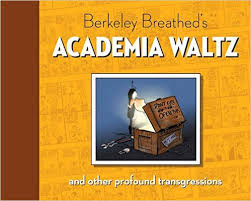
[READ: October 19, 2015] Academia Waltz

Way back a long time ago I was pretty excited to read all of the Bloom County reissue books.  Somehow I only got through Books 1 and 2, although I see now that five volumes were released in total.

Presumably at the end of that run, (which technically ended in 2011) comes this volume.  Academia Waltz is the strip that Breathed wrote back in college.  This book collects some (but apparently not all) of the strips.  It’s odd to not collect them all since there is also an art gallery with all kinds of original pieces (complete with edits and scribbled notes) that duplicate many of the earlier strips.

The first part collects pieces from Academia Waltz the 1979 collection.  The second part comes from Bowing Out, the 1980 Collection. (more…)

Read Full Post »

1955SOUNDTRACK: BUILT TO SPILL-Perfect from Now On (1997).

330px-Perfect_From_Now_OnBuilt to Spill moved to the major labels and everything changed. No that’s not true. The band (well, Doug mostly) just sounds more serious about their music. What’s impressive is that there are no obvious  singles since each song is over 5 minutes long (except for one).

This is considered a classic 90s album but fans of the band and others.  And while I like it, it’s not my favorite.  A few of the songs are a little too drifty and anticlimactic.  But at he same time there’s some really amazing stuff here.

It opens with “Randy Describing Eternity” a cool song with a great riff and an interesting lyrics.  My favorite song (most days) on this record is “I would Hurt a Fly.” It has a fairly quiet intro with more intriguing lyrics: “I can’t get that sound you make out of my head/ I can’t even figure out what’s making it.”  The song waxes and wanes and even adds some cello. And then at 4 minutes, the song shifts gears entirely, stopping to add a brand new fast section with some great guitar work and wild noisy soloing.

“Stop the Show” is another favorite.  It opens with a slow meandering guitar section and then jumps to a great, frenetic set of verses. After about 5 and a half minutes the song turns into a crazy noisy fest and then switches to an amazingly catchy guitar instrumental solo outro, which could frankly go for five more hours. “Made Up Dreams” has several different elements in it. And even though it’s only 4:52, it still packs in a lot of music.

“Velvet Waltz” is over 8 minutes long. It has slow parts, and a lengthy middle section with strings (in waltz time of course). It builds slowly adding some cool guitar sections and a great long solo at the end. “Out of Site” is one of the shorter songs on the disc.  It has an immediate, fast section that is very catchy. It then mellows out to a slow cello-filled section. “Kicked it in the Sun” is kind of trippy.  At four and a half minutes a noisy section overtakes the music, but behind the noise is a beautiful, pretty guitar/keyboard melody.  Then it shifts out of the noise into a more rocking catchy section.

The final song is the nearly 9 minute “Untrustable/Part 2.”  It begins loud with great lyrics “You can’t trust anyone because you’re untrustable.”  Like the other songs it has several parts.  Around 4 minutes it turns into another song altogether. This continues for a bit and then at 7 minutes it shifts gears entirely into a keyboard dominated romp.

There’s so many interesting melodies and changes in this album, and it clear that it was completely influential on late 90s indie rock.  But I think what’s even more impressive is that each album get a little bit better.

[READ: September 29, 2015] The Complete Peanuts 1955-1956

Moving on to volume 3 of the Complete Peanuts.  Stylistically things are advancing towards the Peanuts characters we know now.  Yet they haven’t quite gotten there.  I think the kids’ faces (not their heads, just features) are still much smaller.  And Snoopy still looks like a real dog, although his nose grows year by year.

In the beginning of the year, there’s a funny line from Lucy, attacking commericalism. Charlie is reading her a book.  He says “Once upon a time they lived happily ever after.  The end”  And Lucy says “What’s on the rest of these pages, Advertising?”  Much later there a joke in which Lucy asks Schroeder how much a musician makes, and he relies “Money?  Who cares about money?  This is art. You Blockhead.”  It is ironic of course that Schulz went on to become so staggeringly wealthy–but maybe that just shows what good art can achieve.

Another one of my favorite sophisticated jokes comes when Lucy is flying a kite.  The joke is all about perspective. It’s hilarious. (more…)

Read Full Post »

1953SOUNDTRACK:CŒUR DE PIRATE-Cœur de pirate (2008).

Coeur-de-pirate-albumCœur de Pirate is the band name of Béatrice Martin, a Québécois singer and piano prodigy.  She was 19 when she released this album (and was accepted into conservatory school in Montreal when she was nine).

Given her musical background, one might expect more elaborately created music–more chamber pop, perhaps.  But this debut album is delightfully sweet and spare indie pop.  It is primarily simple piano songs with occasional extra accompaniment.

Most of the songs are simple, with unfussy arrangements and Martin’s beautiful voice.  The songs verge from charming piano melody to simple waltz to piano instrumental and a few upbeat almost dancey songs.  There’s even a guitar based song that adds a folk feel to the album.

There are 12 songs and the album runs only to 30 minutes.  It is charming and delightful.  The only thing I didn’t like so much was when Jimmy Hunt duets with her on “Pour un infidèle.” It’s not that I disliked his voice (which I did grow to appreciate after a few listens) it’s that his voice removes you from the insular little world that Martin has created.  When I am in it I don’t want any distractions.

The album definitely has a Francophone feel to it (her songs were described as “bringing la chanson française to a whole new generation of Quebec youth”) although she does remind me a bit of Regina Spektor’s later songs, too.

She also had a fluke hit with “Ensemble” when it was used with a funny baby based YouTube video that went viral (I’ve posted that at the bottom of the page).

You can listen to the whole album below

[READ: September 17, 2015] The Complete Peanuts 1953-1954

Moving on to volume 2 of the Complete Peanuts.  As 1953 opened, the characters remained in that older style–Snoopy still looks a lot like a dog, and Charlie’s head is still much bigger (or actually I guess his face is still smaller).  By the end of the book, they have morphed a little closer to the Peanuts most of us are familiar with, but they still look “different.”

I enjoy the way the Schulz celebrates the holidays with a simple but nice sentiment (Schroeder playing his piano with the music staff reading “Happy New Year”).  Indeed, Schulz celebrates most holidays.  Valentine’s Day, Income Tax Day (!) and of course, he has lots of fun with Hallowen (no great pumpkin yet though).

This volume seems to be a lot about Lucy (which may be why she is on the cover).  In the first few strips she gets expelled from nursery school.  Later on she quits nursery school because they didn’t teach how to be a nurse.  Lucy also tends to have a regular punchline, with regard to Schroeder of “I’ll probably never get married.”  Lucy also begins in earnest her counting career–trying to count all the stars (and getting exhausted) or all the raindrops, or the amount she jumps rope.  And she is still a fussbudget, with a joke at the end of 1954 having Schroeder compose the “Fuddbudget Sonata” for her.

Linus, who is still a baby, has taken to “shooting” people with his finger  (he struggles to crawl for a ball only to have Snoopy walk up and take it away, so he looks at Snoopy and says “bang”).  He is still crawling and toddling for much of the year, although by the end he seems to be growing up.  Nevertheless, Lucy is still giving him a hard time–constantly shouting at him when he is not looking and then commenting that “he’s awfully nervous.”

There’s a lot of baseball jokes as they move into spring (how did he keep coming up with original baseball jokes after all those years?) inducing jokes about sponsorship.  And then Lucy starts taking up golf (and is very good at it).

Schroeder continues to play beautifully (and to get upset by everyone who bothers him, especially Lucy and Snoopy.  He has a crisis of conscience when he says “sometimes I thin I like Brahms even better than Beethoven.”

Schulz included some occasionally topical material.  So there’s a joke about the popularity of “Doggie in the Window”  (It went to number 1 in April of 1953 and stayed there for 8 weeks).  Snoopy has been listening to it all day.

And of course there is a ton about Snoopy too.  he still looks like a dog and still does a lot of doggie things (and Schulz is always spot on with them).  I really like the joke where Snoopy eats a moth and then coughs up the dryness.  Or when he falls asleep under a tree and wakes up covered in leaves.  There are even a few jokes in which Snoopy hates being patted on the head.  And of course, Snoopy just loves zooming around (especially through croquet hoops).  This is mostly like Snoopy giving everyone a hard time, especially Charlie Brown (with the constant refrain of “You drive me crazy”).

One thing that I like about these early strips is that even though Charlie Brown has a lot of angst, he also has a great deal of self-confidence.  Like when he is mad at Violet and the punch line is “but I know you don’t think I’m Perfect)  There’s even a funny joke (or series of jokes) about graffiti on a fence (!).  In one, it says “Charlie Brown loves all the girls” (in another it says “Charlie Brown loves Charlie Brown”).

The TV jokes continue (I especially like the one with Shermy watching and the screen clears up to say Why Aren’t You in School?).  Most of them are variations on people sitting on front of each other. and blocking the view.

In June of 1954, Schulz uses the word security to refer to Linus’ blanket (evidently coining the phrase “security blanket”), which continues in one form or another throughout the book.  Linus starts to become really smart–outwitting Charlie Brown at houses of cards and magic tricks and the wonderful punchline of him blowing up a square balloon.

The biggest change comes in July 1954 with the addition of Pig Pen or ‘Pig Pen’ as he was first called. He doesn’t do a lot but it leads to a lot of jokes about being dirty.

And in December 1954, a new short-lived character named Charlotte Braun (or Good Ol’ Charlotte Braun) enters the strip.  She has wild curly hair and talks very loudly.  She is something of a foil to Charlie, but she is never really developed.

The book has a Foreword by Walter Cronkite.  He says that he was supposed to interview Schulz, but on the day they were scheduled, he took ill.  So Cronkite never got to meet with Schulz.  This is shame although I have to say that Schulz and Cronkite were such huge figures that they certainly should have met many times over the years.

Cronkite reveals a bit more about the Schulz’ Sparky nickname–that he was given the nickname by an uncle who was referencing the horse Spark Plug in the Barney Google strip.  I like Cronkite’ summary:

Now here you have a confluence of coincidences that would never be accepted even by the producers of a Hollywood pot-boiler.  A baby nicknamed after a cartoon characters growing up to be one of the greatest and most popular cartoonist of all time!

Cronkite also praises Schulz’ economy of dialogue and illustration and likewise keeps his own foreword brief as well.

I’m really excited about continuing through the years with these books.

For ease of searching I include Coeur de Pirate, Beatrice Martin, Quebecois, francaise

And here’s that (very funny) viral video that used the Cœur de pirate song:

[youtube-https://www.youtube.com/watch?v=8vNxjwt2AqY]

Read Full Post »

1950SOUNDTRACK: FRAZEY FORD-Tiny Desk Concert #73 (August 15, 2010).

frzeyFrazey Ford used to be in the Be Good Tanyas.  Here she is touring her debut solo album Obadiah.  She is quite a character, wearing a leopard print outfit.

But her music is really complex and interesting.  On the opener, “Firecracker” she plays the guitar with unusual chord progressions but it’s her voice that is so arresting.  She use atypical phrasings and pronunciations that belie her origins (I could never guess where she was from).  Strangely, I get a kind of Cat Stevens vibe from the way she says words, but also another inexplicable emphasis: the way she pronounces exploding as explohdun.

She talks briefly about her new record while apologizing for having to tune her guitar.  “Lost Together” slower, pretty song.

“If You Gonna Go” is a breakup song which she messes up and then apologizes for, saying she’s nervous and very tired.  And she mocks herself for wearing a ridiculous cheetah outfit.  She says she bought it in London where everyone was dressed like this.  Stephen Thompson chimes in that if it was cooler they’d all be dressed like that.

She asks if they want one more and she ends with “The Gospel Song.”

It’s a really good introduction to an unusual voice.

[READ: September 10, 2015] The Complete Peanuts 1950-1952

After reading the Sunday Peanuts books, I had to go back and start the series from the beginning.  Holy cow, Peanuts started in October 1950 and ran into the 21st century!  That’ amazing.  It’s also amazing to see how different everyone looked back then.  It’s very disconcerting.  The only thing more disconcerting is to immerse yourself in the old comics, start to really appreciate them, and then see a contemporary version and wonder why he changed them so much.

When the strip first started there were just three of them: Good Ol’ Charlie Brown, Shermy and Patty (not Peppermint Patty) and they are all four years old.  Those first comics are really really different–the kids are practically stick figures.  (Although Charlie always had that little wisp of hair).  The kids all have huge heads and tiny bodies and are very minimal in their expressions.  Snoopy is there too and he looks very much like a real dog.  As it turns out I like this version of snoopy better than the current one.  He looks much more like a dog and he acts alike a dog–Schulz gets some great jokes out of doggie behavior.  Things like Snoopy hearing and smelling food and running over to beg started almost from the beginning.  As did they ways that Snoopy interacts and often drives the other characters crazy.

peaWhat’s mostly different about the early ones is that the kids are all mean to each other and CB sometimes wins in the verbal sparring.   He’s as much of a buster as the others.  It’s really fun and funny. (more…)

Read Full Post »

11SOUNDTRACK: BASIA BULAT-“Tall Tall Shadow” and “It Can’t Be You” live at Polaris Music Prize (2014).

basiaSwinging to the other side of the musical world from Tanya Tagaq, Basia Bulat also performed at the 2014 Polaris.  I like Bulat a lot, she comes across as a sweet singer (no idea if she is actually sweet).  And I love that she can make really complex songs out of such random instruments (she plays autoharp, hammered dulcimer and others).

In this performance, she is fairly traditional for “Tall Tall Shadow” on the piano (although the french horn accompaniment is a nice twist), but “It Can’t Be You” on charango really highlights just what you can do with, essentially, a souped up ukulele.

“Shadow” highlights her voice which she holds for some quite long notes.  The song is really pretty with a great chorus.  “It Can’t Be You” is just her and the charango (which looks like a ten string ukulele but is Andean in origin).  It’s quite a song–her voice and that instrument are lovely.

[READ: February 4, 2015] Grantland #11

I enjoyed this issue quite a lot, even if I didn’t know who half of the people profiled were (and won’t remember them in two days time).

I am very curious why Grantland is just so obsessed with basketball than other sports.  It’s a little crazy how one sided these books tend to be.  They obviously love all sports but the preponderance of NBA articles is really staggering.

I do wish there’d be a bit more about TV and movies (and even more about the shows that I watch), but it is a fun way to learn about shows I would never watch.  And maybe that’s why I like these books so much, it’s my chance to vicariously enjoy sports without having to care about any of it (especially since it is all a year old, I never know if anything they talk about actually came to fruition or not).

This issue covers January-March 2014 (it’s fun reading about things almost exactly a year apart–to read about Oscars and Super Bowl stuff but have it be last year’s Super Bowl (especially since it too had the Seahawks) was very trippy indeed).

(more…)

Read Full Post »

« Newer Posts - Older Posts »