Feeds:
Posts
Comments

Archive for the ‘Short Story’ Category

SOUNDTRACK: MOUNT KIMBIE-Tiny Desk Concert #121 (April 18, 2011).

After subscribing to the NPR Podcasts, I found out that every few days, a new concert gets downloaded to my folder (which is pretty cool, but which I must check on from time to time so I don’t fill my machine!).

This Tiny Desk concert came along unannounced by a band I’d never heard of.  I’m not planning to listen to every concert that comes along, but this band seemed interesting.  Mount Kimbie’s Crooks and Lovers made the NPR list of “Albums We Missed in 2010” and the song they play there “Before I Move Off” is a fun and twisted song of blips and bleeps set to a catchy beat.  About mid way, the samples (cut up and unrecognizable) come in and add a new (almost creepy) texture to this song.

This concert reveals the less “programmed” side of the band as there is an electric guitar and (evidently from the notes) a live drum.  What’s most interesting about these songs is that even after a few minutes of riff and repeat, they throw something in that changes things.  Like the vocals (!) on “Maybes” (which frankly don’t live up to the rest of the song) that begin in the last-minute of a 5 minute song.  (The opening noises are really great).

The other two tracks “Ode to Bear” and “Field” are good, interesting electronic tracks.  But after a couple of listens to the show, I was actually growing a little bored with them.  It wa s good introduction, but that’s probably as far as it will go for me and Mount Kimbie.

[READ: April 6, 2011] “Two Fables”

A fable is defined as “a short story to teach a moral lesson.”  Given this definition, I would say that these stories failed as fables. I didn’t get any kind of moral lesson from either of them.  Indeed, I have a hard time with a lot of things that claim to be modern fables if only because of the definition…a vague or missing moral seems to me that it fails as a fable. (more…)

Read Full Post »

SOUNDTRACK: MOGWAI: GovernmentCommissions: BBC Sessions 1996-2003 (2005).
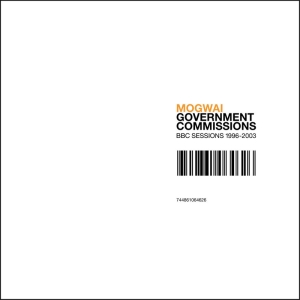
It’s unlikely that Mogwai will ever release a greatest hits (well, someone probably will, but the band themselves don’t seem likely to do so).  As such, this compilation of BBC Recordings will certainly work well as one.

As I’ve mentioned many times, the BBC recordings are universally superb.  The quality of the recordings is unmatched.  And, typically the band takes the sessions very seriously.  The major different between these sessions and the official studio release is that the band is playing these songs live.  They are mixed well and sound great but they are live, so you can catch occasional subtle differences.

Mogwai, despite their seemingly improvised sound (all those noises and such) can recreate everything they do perfectly, and their live shows are tight and deliberate (except for the occasional moments where they really let loose).

The ten songs here span their career and are not played in chronological order.  This allows all of these wonderful songs to play off the tensions of each other.  And it shows that their later songs, which are less intense than their earlier ones, are still quite awesome and in a live setting don’t really lack for intensity after all.

The highlight of this disc is the scorching eighteen minute version of “Like Herod.”  The original is intense and amazing, and this live version allows them to play with the original in small ways, including allowing the quietness to really stretch out before they blow the speakers off the wall with the noise section of the track.

Even though I’m a fan of Mogwai, I don’t hear a radical difference between these versions and the originals.  Or should I say, it’s obvious which song they are playing.  There are some obvious subtleties and differences as befitting a live album, but unlike some live discs you don’t immediately notice that this version is “live.”

And that works well for both fans of the band (because as you listen and you hear the subtleties) and for newcomers–(because you’re not listening to weird, poorly recorded versions or versions that are for fans only).  And so, you get ten great Mogwai tracks.  Just enough to make you want to get some more.

[READ: June 11, 2011] The Burned Children of America

I found this book when I was looking for other publications by Zadie Smith.  This book kept cropping up in searches, but I could never really narrow down exactly what it was.  As best as I can tell, it is a British version of a collection of American authors that was originally published in Italy (!).  Editors Marco Cassini and Martina Testa work for minimum fax, an Italian independent publisher.  In 2001, they somehow managed to collect stories from these young, fresh American authors into an Italian anthology (I can’t tell if the stories were translated into Italian or not).

Then, Hamish Hamilton (publisher of Five Dials) decided to release a British version of the book.  They got Zadie Smith to write the introduction (and apparently appended a story by Jonathan Safran Foer (which was not in the original, but which is in the Italian re-publication).  This led to the new rather unwieldy title.  It was not published in America, (all of the stories have appeared in some form–magazine or anthology–in America), but it’s cool to have them all in one place.

The title must come from the David Foster Wallace story contained within: “Incarnations of Burned Children,” which is one of his most horrific stories, but it sets a kind of tone for the work that’s included within (something which Zadie addresses in her introduction): why are these young successful American writers so sad?  So be prepared, this is not a feel good anthology (although the stories are very good).
Oh, and if you care about this kind of thing, the male to female ratio is actually quite good (for an anthology like this): 11 men and 8 women.

ZADIE SMITH-Introduction
Zadie Smith was a fan of David Foster Wallace (she wrote a  lengthy review of the ten-year anniversary of Brief Interviews with Hideous Men which is republished in her book Changing My Mind), so she is an ideal choice to introduce this book.  Especially when she provides a quote from DFW’s interview in 1995 about how living in America in the late 90s has a kind of “lostness” to it.  With this in mind, she sets out the concerns of this collection of great stories: fear of death and advertising.

Zadie gives some wonderful insight into each of these stories. The introduction was designed to be read after the book, and I’m glad I waited because while she doesn’t exactly spoil anything, she provides a wonderful perspective on each piece and also offers some ideas about the stories that I hadn’t considered.  And it’s funny, too. (more…)

Read Full Post »

SOUNDTRACK: MOGWAI-Happy Songs for Happy People (2003).

Happy Songs for Happy People follows up Rock Action with more sedate music from Mogwai.  In fact, while Rock Action was pretty mellow (with a few bursts of noise) HMFHP is even more mellow.

Although it does open with a rocking track: “Hunted By a Freak.”  “Hunted” is one of Mogwai’s best songs.  It opens the disc with a catchy riff, some cool synthesized vocals and great washes of sounds.  It’s great on record and even better live.  But starting with “Moses I Am’n’t” the album takes a decidedly more mellow approach.  “Moses” is a song of slow washes layered on each other. There’s interesting textural sounds on display, but not a lot of melody.  It leads to “Kids Will Be Skeletons,” another mellow layered song.  It has a simple melody with delicate (!) keyboard washes.

But just when you think Mogwai have gone all soft, “Killing All the Flies” adds some intense sounds to the disc. It is similarly structured to the earlier songs on the disc, although it has some rather happy-sounding guitar lines in it.  It also grows in intensity about two-thirds of the way through.

“Boring Machines Disturbs Sleep” (sic) is a short, quiet song with subdued vocals.  It’s followed by “Ratts of the Capital” the only really long song here (8 and a half minutes).  It opens in this more subdued vein (is that a glockenspiel I hear?), but by 4 and a half minutes all you hear is guitar–growing louder and louder.  There are solos buried in the noise that threaten to explode out of the speakers, but they ultimately seem to hold back a wee bit.

“Golden Porsche” mellows things out again with a very pretty, very simple song (almost 3 minutes of beautiful melody) that reminds me of the interludes in Twin Peaks.  “I Know You Are But What Am I?” opens with a tense kind of piano (with some slightly off chords).  They merge with pretty keyboard notes which counteract the somewhat sinister feel of the main riff.

The disc ends with “Stop Coming to My House” (Mogwai have always excelled at song titles).  It’s a very subdued track (quiet drums propel waves of keyboards) and as the songs continues, more and more waves layer on each other until it just all fades away.

I obviously prefer the louder, more raucous Mogwai tracks, so these two albums are not what I think of when I think Mogwai.  These two albums feel like the work of a more mature, more restrained band–as if they are deliberately trying to put constraints on their music to see what they can achieve.  But even if they are less intense, the songs are wonderfully structured and show a still show a great emotional range.

[READ: June 07, 2011] “Clever Girl”

This was a fascinating story and is yet another story by Tessa Hadley that I really enjoyed.  And it’s another story that I didn’t realize was set in England until the fourth paragraph, which opens “Mum unpacked.”

Anyhow, this story follows Stella, a young girl whose family moves to a small suburb that has recently been developed (trees were cut down and none newly planted).  Stella and her mother used to live alone together for many years, but recently Stella’s mom met Norbert.  They married and moved into this new suburban house.

The story is told in past tense about the events from Stella’s childhood.  But there are occasional moments where the narrator pops in and offers some moments of “grown up Stella” perspective–like maybe she could have been nicer to Norbert.  Grown up Stella realizes that Nortbert was really perfect for her mom (especially since she was an older woman,  with a grown daughter).  At the time, she thought that Norbert seemed okay, but the whole move has upset her sensibilities.  [I also love that Norbert is known as “Nor,” which is wonderfully contradictory.] (more…)

Read Full Post »

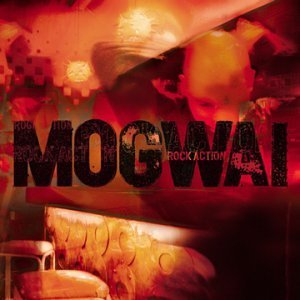
SOUNDTRACK: MOGWAI-Rock Action (2001).

After all of Mogwai’s releases over the years (and all the various compilations and imports and whatnot, it’s hard to believe that Rock Action was only their third proper full length release.

I just recently learned that the song “Dial: Revenge” has vocals by Gruff Rhys from the Super Furry Animals (the lyrics are in Welsh, apparently so that it would sound like gibberish to most of the English-speaking audience (SFA released a wonderful album sung entirely in Welsh, called Mwng).   This song is a very delicate  piece which reminds me in some ways of later Mercury Rev (Rock Action was produced by Dave Fridmann who produces Mercury Rev).  It’s got a soaring “chorus” and strings.

“Sine Wave” opens the disc with some heavily distorted noises that seem to be fighting with some echoed guitar notes.  The song feels different from other Mogwai songs but it doesn’t really sound different–it’s clearly Mogwai.  “Take Me Somewhere Nice” is perhaps the most conventional song Mogwai have done.  It has a verse/chorus structure and even has whispered vocals–that follow a melody.  The biggest surprise has to be the strings that overlay the top–they’re a bit disconcerting at first, but it quickly shows how well the band can pull this off.  It’s followed by something of a continuation of that song with the 59 second “O I Sleep,” a simple piano track with Stuart’s whispered vocals over the top.

“You Don’t Know Jesus” falls into more typical Mogwai territory.  It’s a 9-minute epic which somehow build and builds even though it feels like it’s all crescendo–until the last few moments trail off into quiet notes.

The one minute “Robot Chant” is more noise, but it leads into the surprisingly upbeat “2 Rights Make 1 Wrong.”  This is a faster track, which builds for over 9 minutes.  The middle part slows down so you can really hear the synthesized voice over the proceeding.  You can eventually hear the banjo as well.

The disc ends with the pretty ballad, “Secret Pint.”  It’s a simple piano based song (with lyrics). The recording is very clear (you can hear all of the dynamics of that opening cymbal).  While it could never be a hit, it easy certainly their most accessible track.

Rock Action is a different kind of Mogwai album: slower, more deliberate, with conventional music structures but which is in no way a commercial record.  It’s also less dramatic than albums (or EPs) past.  If you want soaring epic Mogwai, this is not your album (even the 2 nine-minute songs aren’t as dramatic as previous songs), but it’s a welcome addition to Mogwai’s repertoire.

[READ: May 27, 2011] “M&M World”

I didn’t know that there really is a M&M’s World in Times Square, but apparently there is.  And it sounds like a nightmare!

Anyhow, the story begins with Ginny agreeing to finally take her kids to M&M’s World.  Her girls are Olivia and Maggie and they have been dying to go to M&M’s World forever.  The kids march down the street, looking in all the shop windows until they finally reach the destination.

Walbert describes the store in all of its bustling glory–and given her details I’ve no doubt it’s exactly as she describes: busy, crowded, noisy, overstimulating. (more…)

Read Full Post »

SOUNDTRACK: WEEZER-Death to False Metal (2010).

This is a fascinating release.  I assumed it was a quick cash in of unreleased tracks.  And yet it doesn’t sound like a bunch of tracks from different eras thrown together.  A little digging reveals that it is sort of a collection of unreleased tracks.  The ten songs here were written over the band’s career but were either never finished or were finished but never released.  According to various places online, Rivers edited and manipulated the songs (and maybe re-recorded some?) to make them all sound current (and like they’re from the same time).  Thus he considers this to be the follow-up to Hurley.

The album is full of poppy songs (“Turning Up the Radio” has FIFTEEN people listed as composer on Allmusic–the true sign of a pop juggernaut).  There’s a couple of slightly heavier songs, “Blowin My Stack” has a big shouty chorus and “Autopilot” has a very electronic kind of sound.  But perhaps the most notable track is the cover of “Unbreak My Heart.”  That song came out in 1996, so one assumes that this version must be at least ten years old, because why would someone make a cover of an old pop hit from fourteen years ago?  It’s quite good, though, as Weezer covers tend to be.

If you like Weezer, this isn’t a throw away.  The songs are just as good as their other recent records (which means they’re not as good as their early ones, but are still poppy).  If you don’t like Weezer this will do nothing to change your mind.

Although I am amused by the album cover design that they chose for this title (which is a tribute to the band Manowar, obviously), I think a better cover would have been Weezer in loincloths.  Can you imagine Rivers Cuomo brandishing a giant sword?

[READ: May 21, 2011] “Medea”

Ludmilla Petrushevskaya had a story in The New Yorker recently.  The fact that she has one here as well can only mean she has a book coming out (although a quick look at Amazon does not indicate that she does).

The opening line says, “This is an awful story…”  And it’s true (not in the sense of being bad, but in the badness that it contains).  Petrushevskaya tends to write very dark stories (dark fairy tales is how they’re mostly categorized), and while this is not a fairy tale, it is certainly dark (and as with most of her stories, it’s quite short).

It’s a fairly simple story: the narrator hops in a cab and complains about how her seventy-three year old grandmother called for a cab to pick her up at a certain time but it never came–and never even called to say it wasn’t coming.  This meant she missed her plane, and the people waiting for her missed her and basically the whole day (and a lot of money) was lost because of a cab.

The cabbie didn’t have anything to do with that, but he tells her that it could be worse, and proceeds to launch into a story trying to outdo her story.  They jockey for position in terms of terrible stories (a woman whose baby dies on vacation–and that’s only the beginning of her problems) until finally he talks about himself. (more…)

Read Full Post »

SOUNDTRACK: MY MORNING JACKET-It Still Moves (2003).

I discovered My Morning Jacket through their awesome live album Okonokos.  Most of that album comprised songs from their previous disc, Z.  But there were a number of tracks from this record as well.  So I was thrilled to put this in for the first time and recognize a number of these epic tracks (4 songs are over 6 minutes).

It Still Moves is a soaring, gorgeous record of folk rock plus.  Some of their tracks are rooted in Americana, but they have wonderful touches of psychedelia and soaring sounds (choruses, guitars, voices).  It’s a great combination that never settles into one style of sound, and as much as it stays out of the reach of commercialism, it embraces catchiness.

And for an album that seems like it might resist the average listener, there’ some amazing stuff here.  The opening three songs are absolute stunners–catchy and interesting.  “Magheeta” is a slowish opener; “Dancefloors'” has a great riff and ends with a cool boogie of horns and pianos; and “Golden” is a shuffle song with terrific harmonies.

“Masterplan” is the first really slow song, but it has a dramatic buildup that is wonderful.  It’s followed by the first of the soaring guitar songs on the disc.  “One Big Holiday” opens with a cool tight guitar riff which turns into a soaring guitar riff of joy.  The second one is “Run Thru” which is one of my favorite songs of the past few years.  It opens with a slow soaring guitar riff that is totally catchy.  By midway it turns into a dancey discoey song for a few measures and then returns with the great riff.  It’s excellent.

“I Will Sing You Songs” is a 9 minute slow boiler of a track.  It’s very slow, almost lazily paced, but it’s never dull (credit Jim James’  amazing voice for keeping the whole proceeding interesting).  “Rollin’ Back” opens a bit like “Waiting for the Worms” from Pink Floyd the Wall (soaring oooh ooohs), but quickly settles into a slow roots song.

The end of the disc is a bit slow and meandering (the last song especially is practically a sleepytime ballad) but it works for the overall feel of the disc.  The whole enterprise is a bit long–it’s hard to listen all at one setting.  But nevertheless, it’s a great record with some amazing songs ion it.

[READ: May 9, 2011] “He Knew”

I rather enjoyed the last story by Antrim that I read, but I didn’t care for this one at all.  And that was pretty much because I didn’t care about the characters at all.

The story is about an out of work actor, Stephen (who is on antidepressants) and his very tall wife Alice (who is on Valium).  They’re sort of pathetic and it’s not even entirely clear if the like each other (or is that the anxiety speaking?).  She accuses him of wanting to sleep with every woman he talks to, and he looks longingly at most other women he sees. (more…)

Read Full Post »

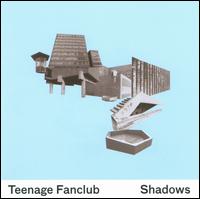
SOUNDTRACK: TEENAGE FANCLUB-Shadows (2010).

Back in the 90s, Teenage Fanclub released a few noisy, feedbacky records that were quintessential 90s alt rock.

Since then they have mellowed considerably, and this album is one of their most mellow to date. Usually for me this kind of mellowing is a sign that I’m done with a band; however, Teenage Fanclub’s songwriting gets better with every disc.  And these folky tracks are all fantastic.

What’s neat about the arrangement of the album is that each of the three members of the band writes four songs.  They are collated so that you cycle through each singer before repeating. You get maximum diversity–and it’s easy to tell which songwriter is your favorite.

The opening two songs, “Sometimes I Don’t Need to Believe in Anything” and “Baby Lee” are two wonderful upbeat pop confections.  They sound very different and yet both are infused with wonderful pop chops.

It seems that Blake is my favorite songwriter on this disc. He did “Baby Lee”, “Dark Clouds” (a pretty piano based number) and by far the prettiest song on the disc “When I Still Have Thee.”  It’s an amazingly catchy folk song that sounds timeless (and even has the great couplet: “The Rolling Stones wrote a song for me/It’s a minor song in a major key.”

That’s not to dismiss the other songwriters at all.  In fact, hearing their different takes on pop music is really pretty amazing.  It’s a shame that it takes them so long to put albums out (about 5 years these days).

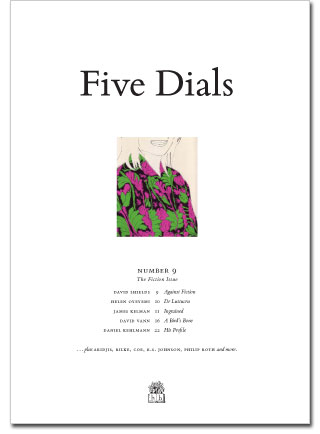
[READ: June 10, 2011] Five Dials Number 9

Five Dials Number 8, The Paris Issue, was pretty big (45 pages), but it had a lot of pictures.  Five Dials Number 9 is also pretty big (41 pages) and it’s (almost) all text.  For this is the Fiction Issue, and there are a lot of short stories in here.

CRAIG TAYLOR-A Letter from the Editor: On ‘Summer Reading’ and Fiction Issues.
Since most of what I talk about in the introduction to these posts is covered in Taylor’s Letter from the Editor, I figured I’d switch formats and start talking about his letter right away.  In this letter, Taylor talks about the serious pitfalls of  ‘Summer Reading’: We pledge to read mammoth books over the summer, but really we never finish War and Peace over the summer, do we? (except those of us who finished Infinite Summer, am I right?).  And so, this Fiction Issue was released in December (finally, a date is given to a Five Dials!).  Taylor briefly talks about all of the authors who contributed (including a pat on the back to Five Dials for securing the rights to a Philip Roth contribution in its first year of publication).  He also talks about the essay from David Shields that is decidedly anti-fiction.   And the final note is that Taylor’s own father has a piece in this issue (nepotism is alive and well!) (more…)

Read Full Post »

SOUNDTRACKDUNGEN -Skit I Allt (2010).

I’ve enjoyed every Dungen release that I’ve bought and this one is no exception.  Although I will admit that the other ones grabbed me a bit more (there are some amazing songs on earlier discs).  This one is a bit more sedate in general; perhaps this is Dungen’s ballad album.

It opens with “Vara Snabb,” an instrumental with lots of flute (!).  While  “Mid Edna Vän” is a gentle ballad (Gustav Ejstes’ voice is very nice: soft and delicate”).  “Brallor” is a duet with Anna Järvinen–her voice is haunting and beautiful.

“Soda” is another delicate ballad.  It opens with some loud drumming but quickly settles into a very gently sung song.  “Hogdalstoopen” opens with a quiet piano and slowly morphs into a noisy instrumental with an expansive, wailing guitar solo–the kind of which attracted me to Dungen in the first place.  It devolves into some chaotic noise, which is fun and works as a cathartic moment on this mstly quiet disc.

“Skit I Allt” is a pretty standard rock song (very 70s sounding).  And “Blandband” is a catchy piano number with a tone that reminds me of Peanuts, but which concludes with another trippy flute solo.  The last two songs return to the mellow quality of the earlier tracks and “Marken låg stilla” ends the disc with a super catchy chorus.

As I said, compared to their earlier discs which highlighted Ejstes’ firework-like guitar playing, this one shows the bands’ softer side.  It works as a nice companion piece (and still shows off the band’s instrumental chops).

Here’s your quick Swedish translation guide: Dungen (“the grove”), “Vara snabb” (“Being quick”) “Min enda vän” (“My only friend”) “Brallor” (“Pants”) “Skit i allt” (“Fuck it all”) “Barnen undrar” (“The children are wondering”) “Blandband” (“Mixtape”) Nästa sommar” (“Next summer”) “Marken låg stilla” (“The ground lay still”)

[READ: May 23, 2011] “What Animal Are You?”

Etgar Keret was recently in McSweeney’s 37 (I really liked his story).  This short piece is from his forthcoming book, and if they are all unusual like this I would be very excited to read it.

This story seems so much like non-fiction, that I can’t really decide what, if anything, has really happened to him already.  As the story opens, the narrator explains that he is writing for German Public Television.  Literally.  A reporter from GPT is in the room with him right now.  They are filming him for a show and need him to be “writing.”

He tries to fake it, but she says that it will look bad on TV.  So she insists that he write something for real, perhaps about her being there and how it makes him feel to be under pressure like this.  And so he begins writing.  Then his son comes home and gives him a big hug (he’s used to performing for cameras) but his wife (when she arrives) seems far more unnatural on camera–and will probably be cut.

The title comes from a phrase that his son (who is 4) says.  He sits on the stairs and asks everyone who walks by, “What kind of animal are you?”  The narrator reflects on how people respond to him: his wife, some random people who the boy encounters and, ultimately, the reporter.

The whole piece feels like several different snippets, and yet Keret ties them all together very nicely.  And it’s funny too.

It was translated by Miriam Schlesinger.

Read Full Post »

SOUNDTRACK: RICHARD THOMPSON World Cafe Live, September 5, 2005 (2005).

World Cafe love Richard Thompson.  And this set from 2005 seems to have RT playing more than they actually air.  I say that in part because I have no idea how the World Cafe shows work.  Do they just play three or four songs?  The sets where they play in the studio between interviews sure makes it seem that way.  But this set is clearly Richard being interviewed after a performance.  So who knows how many songs he played.

5 songs make this download.  Two of them come from his (then) new album Front Parlour Ballads (“Let It Blow” & “The Thames Side”).  There’s one “brand new” song, which doesn’t appear anywhere as far as I can tell called “Hots for the Smarts” which is one of RT’s great funny clever songs (the lyrics are all very smart things).

The final two songs are classics: “Hokey Pokey” (where’d he pull that one out of?) and “1952 Vincent Black Lightning” (which always sounds great).

RT has hundreds of great songs, so it’s impossible to winnow down to a great set (especially one that’s just five songs long) but this set (which is just him solo) sounds really great and is worth hearing for any RT fan.

[READ:April 8, 2011] “Tom Cruise at Lake Vostok”

This is a very short story that I feel is hindered by the title.  Sure, the title is a major grabber, but it’s also a spoiler.

The story is set at the Vostok Station in Antarctica.  Scientists are doing an amazing amount of research in all manner of departments.  The protagonist is there to study Europa, Jupiter’s sixth moon; meanwhile, a Russian scientist is there to study under the ice (she has a cryobot and all kinds of cool things that burrow through the thick layer of ice).

There are many other scientists at the Station, but since it take a full month to reach Vostok by tractor train, many of them have nothing to do but wait for their ride back.  In the meantime, there is gossip about everyone there–especially the protagonist and the Russian woman who seem so antagonistic towards each other that everyone suspects they’re having an affair.

Then she uncovers an artifact that is so amazing she has to talk to someone about it.  So she calls him on his walkie-talkie.  And this is where the spoiler happens. (more…)

Read Full Post »

SOUNDTRACK: CHARLOTTE GAINSBOURG-KEXP in studio May 11, 2010 (2010).

Charlotte Gainsbourg is a fascinating individual.  Between her acting and her singing, she’s had quite a life.  And even moreso since she had a near fatal accident.

That accident formed the nexus of her album IRM.  And this interview and performance is done in support of that disc.  IRM was made with Beck.  Beck’s not here, and the songs are more stripped down, but they sound really good in this format.

Gainsbourg sings the Beck-sung-on-IRM “Heaven Can Wait” and really makes it her own.  The other three songs here work very well in this more acoustic setting.  “Me and Jane Doe” is practically acoustic already and “Time of the Assassins” and “Trick Pony” are reworked very well.  And Charlotte is a charming interviewee as well.

It’s another excellent in-studio performance from KEXP.

[READ: March 31, 2011] “The Dead Are More Visible”

I read all of The Walrus stories when I received the magazines.  I wondered when I would completely recognize a story when re-reading them now.  Well, this was the first one that I remembered parts of vividly.  And why not–there’s a search for a missing eye on an ice hockey rink.  That’s hard to forget.  However, I didn’t remember the ending and in fact, my memory added many more details than actually occurred in the story.

The beginning of the story, which is very different from what I just described, was less memorable but perhaps more interesting.  The story opens with a woman reflecting about her graveyard shift job.  In this case the job is literally a graveyard shift, because the park she works in has a graveyard within it. However, her job is not really scary–she is there to make the ice for the upcoming skating season.  It takes several nights of very cold weather and she must go out in all her gear and fill up the rink, several tousand litres of water at a time.

While the ice settles, her time is her own–to listen to music and read. She gets a few hundred pages read a night (dream job!)  She prefers romance and horror novels.  The introduction of horror novels into the story foreshadows a bit about the scene ewith the eye later on, although for this is not a horror story. (more…)

Read Full Post »

« Newer Posts - Older Posts »