Feeds:
Posts
Comments

Archive for the ‘Short Story’ Category

SOUNDTRACK: JÓNSI-Go (2010).

Jónsi is the lead singer from Sigur Rós. This is his first solo album and, honestly it’s not radically different from Sigur Rós (were we expecting trip hop or something?).   However, within the confines of the type of music that Sigur Rós play (swirling orchestral songs), Jónsi’s solo disc is kind of different.  And the difference comes in tone.

For while Sigur Rós records are orchestral and swirly, the are also kind of dark and moody.  Jonsi’s songs are more upbeat.  They’re ethereal both in style and tone.

I’m also surprised to see just how short these songs are.  They feel like they are very long (epic in a good way) but in fact, only two songs go over 5 minutes–most are in the mid fours.

There’s no question that if you dislike Sigur Rós you will not like this record. Jónsi’s voice is the same after all–gorgeous sweeping, helium sounding and out of this world.  But if you doubted whether Jónsi could work without his mates in the band, you need not worry. This album is a beauty.

[READ: May 19, 2011] “The Trusty”

I didn’t think I would like this story.  It concerns a subject that I generally don’t have a lot of interest in: chain gangs in the south.  And yet, Rash’s writing was excellent and the story was quite compelling.

The Trusty of the title is named Sinkler.  Sinkler is a prisoner on the chain gang–he stole money from a business and got 5 years.  He has served 18 months with very good behavior and has been given the unofficial title of Trusty, which means he can do things like walk a mile up the road to the next farm house to see if their well has water for the men on the gang.

And this is what he does.  They are working on a road and have moved far enough past their current source of water that Sinkler offers to walk up to the next house to bring water back.  When he arrives, the door is answered by a young woman (between 18-22–Sinkler himself is in his 20s).  She is standoffish and unmoved by him.  She is also married–her (much older) husband is plowing the field.  She agrees to give Sinkler two buckets of water if, at the end of the day he agrees to leave one bucket there as payment.

Sinkler agrees and decides that he would like more than water from the young woman.  And over the next few weeks he returns every day and tries to win her over.  And Lucy begins to sweeten on Sinkler. (more…)

Read Full Post »

SOUNDTRACKDINOSAUR JR-Beyond (2007).

This was Dino Jr’s reunion album of the original line up.  And it sounds like the band had hardly gone away.

The opening tracks showcases the diversity of Dino Jr’s dynamic: a heavy, fast poppy number and then a “ballad” (Mascis style) and then a more heavy chugga chugga song.

By the middle of the album the band loosens up even more.  “Been There All the Time” has that kind of sloppy (but really not sloppy, they are actually very tight) sound of great Dino.  “I Got Lost” is the inevitable falsettoed Mascis track.  It’s slow and unusual for the rest of the disc, but it really showcases the band’s diversity.

The most notable things about Dino are Mascis’ voice (a kind of slacker pseudo-whine) and his wild guitar soloing.  And they are prominent here.  Mascis’ voice sounds great (of course, if you didn’t like it then, you wont like it now), and his songwriting is top notch.

I am actually more partial to the Dino Jr albums after Barlow left (blasphemy!–although even I admit the diminishing returns on the last few discs).  But on this disc, the band sounds totally revitalized and the songs are uniformly great.

Lou Barlow gets two songs.  They sound very Barlow: a bit slower but very catchy.  As I wondered about Farm, I’m not sure what would make Barlow return to Dino since the band still feels like Mascis’ band with Barlow getting a few songs.  I mean, they sound great together on the disc, but it’s clear that Mascis is the star here.  But whatever the reason, it’s a wonderful return to form and one of those rare reunions that really works.

[READ: May 18, 2011] “The Cat’s Table”

The combination of this title and the accompanying picture (a large cruise ship) was very confusing to me.  It turns out that the Cat’s Table is what a passenger on the cruise ship calls the table that they are assigned because it is as far from the Captain’s table as you can get.

The story opens in the third person as it describes a young boy (aged 11) who is seen boarding this large cruise ship which is travelling from Colombo, Ceylon to England (a 21 day journey).  The boy is traveling by himself to meet his mother.

After that brief section, the story switches to first person, from the boy’s point of view.

I was shocked to read that this eleven year old boy was dropped off on a cruise liner with no adult supervision.  But it turns out that there are several boys on board who are his age, and he even knows one from his school.  Coincidentally, his neighbor Emily, the closest thing he has to real family, is also on board. (more…)

Read Full Post »

SOUNDTRACK: MOGWAI-EP +2 (1999).

There’s a fascinating release history behind this EP (which mostly means fans wind up with three copies of “Stanley Kubrick.”  First it came out as EP with 4 tracks (which I ordered on import).  Then it was released in the US as EP+2 with two songs from the Fuck the Curfew EP (which was not released in the US) and finally in 2000 it was reissued again as EP+6 with ten songs in total (compiling 1997’s 4 Satin, 1998’s No Education = No Future (Fuck the Curfew), and 1999’s EP–I didn’t buy this version because by then I had the original imports).

“Stanley Kubrick” is a slow burner with a great repeated mournful guitar.   It’s one of their best songs. “Christmas Song” is a slow, upbeat track with a very pretty melody.  “Burn Girl Prom Queen” opens with some really quiet guitar.  After about 90 seconds, a brass band kicks in adding amazing horns over the simple guitar melody.  It’s my favorite track on the disc.  “Rage: Man” is the first song on the album where Mogawai’s noise tendencies really come to the fore.  Once again, it’s a simple slow melody (with piano).  About two minutes in, the song is bombarded with noise guitars that take over the song but don’t obscure the melody.  There’s also a noisy guitar solo played over the noise.  Soon enough all the noise ends, and the simple, harmonic’d guitar comes back and the song ends peacefully.  It’s a great example of Mogwai dynamics.

The other two tracks, “Rollerball” and “Small Children in the Background” come from the other EP as I mentioned.  It’s odd to squeeze in songs from a different release, but Mogwai don’t sound terribly different on these early EPs, so these songs work well together.

Despite their length, Mogwai EPs are pretty uniformly wonderful.

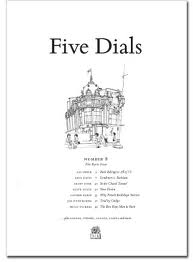
[READ: June 1, 2011] Five Dials Number 8 bis

After publishing Five Dials Number 8, they quickly rushed out this addendum to the issue, which they’ve called Five Dials 8 bis.  According to the introduction: “The definition of ‘bis’ is a passage to be repeated, so here is a small bis for our eighth issue.”

It’s only 9 pages long and really only contains one long piece.  Primarily, this is a memento of their Paris-issue release party, which they held in Paris (duh).  The opening pages includes scans of postcards (“One of our volunteers waded into conversations and asked attendees to write down their own thoughts on Paris. We’ve reprinted five of our favourites.”)  The editor’s letter, which explains all about the party and this issue, is not credited to anyone, so I can’t so who is responsible.  [This lack of proper crediting is the one major flaw with this publication–just saying illustrations by, and then not saying which is whose, or not including the date of publication is maddening].

The big article is by Guy de Maupassant (translated by Siân Miles). (more…)

Read Full Post »

SOUNDTRACK: AUDIOSLAVE-Audioslave (2002).

Despite the pedigree of this band: Rage Against the Machine + Chris Cornell, I wasn’t all that interested in the band when they came out.  I was over Rage and was bored by Cornell’s solo stuff.  But then recently, someone donated a copy of this album to th elibrary, so I thought I’d see what all of the fuss was about (nine years ago).

There are times when this album is really superb.  The Rage guys get an amazingly full sound out of their instruments (the choruses of “Show Me How to Live” are so full).  And when it works, and Cornell’s amazing voice is in full force, this seems like a genius pairing.

But there’s a lot that feels kind of clunky here (and there’s some really bad choices of guitar solo work by Tom Morello–the weird noises that compriose he solo of “What You Are”–in Rage the noises were weird but exciting and inflammatory, these are just kind of dull.  Worse yet, is the, well, stupid solo in “Like a Stone”–boring and ponderous at the same time).  Although he redeems himself somewhat with the cool solo on the otherwise dull “Intuition”.

The biggest surpise comes in “Like a Stone” which is insanely catchy and mellow–something one assumed Rage didn’t know how to do).  Lyrically the song is pretty stupid (as are most of the songs), but the combination of melody and Cornell’s great vocal lines really raise this song high–shame about the solo).  Also, a song like “Shadow of the Sun” seems to highlight Cornell’s more mellow moments (and shows that the Rage guys can actually play that slow), and they all seem to be in synch.

And there are several songs that rock really hard, sounding at times like Rage and at time like Soundgarden, but working on all cylinders together.  “Cochise” and “Set It Off” are simply great riff rock songs.

But ten or so years later, and twenty years since Badmotorfinger (my favorite Soundgarden album), it’s nice to hear Cornell rocking again.  Although man, the record is too long!

[READ: June 1, 2011] Five Dials Number 8

For Issue Number 8, Five Dials went to Paris.  And so the whole issue is given over to French concerns and ideas.  For a magazine that didn’t need a change of pace, it’s a delightful change of pace.  The feel of the magazine is different, and there’s an air of vacation about it (which is not to suggest that it is slacking off in any way), and it feels really vibrant.

I don’t know a lot about France in general.  I mean, I’ve been there, and I keep up with things, but I am not a Francophile by any means. So a lot of this stuff was simply new to me, which is always fun.  What I especially liked about the issue was that they were not afraid to show some of France’s uglier sides as well–it’s not just a tourism booster.

It even starts out differently than the other issues. (more…)

Read Full Post »

SOUNDTRACK: TRENCHMOUTH-Vs the Light of the Sun (1994).

I learned about Trenchmouth from an interview with Fred Armisen on The Sound of Young America.  He informed us that he was the drummer in Trenchmouth before he was on SNL.  And he and Jesse Thorn had an amusing discussion about how he was sure they would make it big.  I can’t recall if they played a snippet of the band or not, but it’s a pretty laughable thought that Trenchmouth might be his claim to fame.  Because they are awesome, but they are totally NOT commercial.

In fact, just a few seconds into the lead-off track “Washington! Washington!” will tell you how noncommercial they are.  (It’s a sort of fast heavy punk version of prog rock–jazzy guitars, independent bass, wonderful drumming (Armisen kicks ass) and the screamed hyperkinetic vocals of Damon Locks (he’s passionate, man).

There’s a lot of atonal work here (“Washington! Washington!” opens with drums and Lock’s ragged voice), and once the guitars kick in, it actually makes the song more confusing.  “A Prescription Written in a Different Language” opens with wavering harmonic notes before busting into a full on punk noisefest.  The album lurches around to different styles of weird noise rock (most of the songs are quite short, although “A Man without Lungs” runs over 6 minutes).

But before making it sounds like this is a mess of a record, a few listens will reveal the sanity beneath the chaos.  There are even some discernible choruses: “Here Comes the Automata”‘s “Everybody needs protection” and “Bricks Should Have Wings”‘ “Let the bricks fly” are fun to sing along to.  Similarly, the guitar work that opens “Set the Oven at 400” is rather conventional and quite pretty.

This disc is not for most people, but Trenchmouth is a cool band that has been unfairly lost to the annals of history.

[READ: April 4, 2011] “Rome, 1974”

I had received a pre-pub of Bezmozgis’ novel The Free World, but I haven’t read it yet.  I am interested in Bezmozgis’ writing and was planning to read the book.  As it turns out this “story” is really an excerpt from the novel.

The story is about the Krasnansky family, a Jewish extended family emigrating from the Soviet Union to Italy.  The opening scenes detail the physical hardship that such a move would have taken (it’s played for somewhat comic effect when the large duffel bags are thrown off the train).  There is much dissent among the family members although they sem to settle in well–except for patriarch Samuil who is disconcerted by everything and unhappy to have left the communist country he feels comfortable in. (more…)

Read Full Post »

SOUNDTRACKFLAMING LIPS-“Two Blobs Fucking” (2011).

As I understand it, the Flaming Lips will be releasing an EP a month for the next twelve months–all in an unusual manner.  The first track, “Two Blobs Fucking” comes as a 12-part free video download.  Like with their album Zaireeka (which had 4 discs that you were supposed to play simultaneously to get the full effect), this song  comes as 12 separate audio tracks.  According to the online instructions, you’re supposed to get 12 friends with iPhones to each download a section and to play them at exactly the same time.  I don’t have an iPhone (or 12 friends that I could get in the same place at the same time to listen to a song), so I did the next best thing: I used YouTube Downloader, converted the tracks to WAV and then mixed them with Audacity.

I have received many CDs over the years that have mixing technology where you can play certain tracks and not others, but it’s very rare that I play around with them.  This whole process was easy enough that I made 20 different mixes of the song.

The “full” version is a fascinating amalgam of noises with a very cool riff that opens the track.  About midway through, the whole song is taken over by noise–a distorted squealing noise–for a few seconds.  And then the song continues as it was with gentle washes of sound.

The twelve tracks include the main riff, the riff as done by “voices” (doh doh doh), there’s a few noise (guitar) tracks and some noise (animal sound) tracks.  There’s a drum and percussion track as well as the vocal track.

The lyrics are a brief story about Wayne finding a dumpster from a factory which makes and discards manikin body parts.

It’s a weird track.  It’s not their best by any means, and the lyrics are hard to hear for the most part (unless you isolate them, of course).  But having now listened to it so many different ways, I’ve rally grown fond of it.  The riff itself is as I said, simple, but very cool.

It’s a neat experiment and nice that it was free (unlike their second release–a USB drive that is buried inside a candy skull which costs $150).

[READ: May 23, 2011] “Deniers”

This is, as far as I can tell, the first short fiction piece that Lipsyte has had published (please correct if I’m wrong), aside from that really short piece in The Revolution Will be Accessorized.  I enjoyed The Ask quite a lot, and I was excited to read more from him.

This piece, as the title implies, plays around with types of denial.  But it is self-denial that they experience.  The main character is Mandy, an adult whose father, Jacob,  is still alive but who has recently been put into a nursing home.  The opening of the story is more about Jacob.  More specifically, it’s about how Jacob relates (or doesn’t) to Mandy.  Jacob is a holocaust survivor, but he has barely said one word about it (or, really, anything) to Mandy.

Through a series of flashbacks, we see Mandy’s childhood with this distant father.  We also see what happened between Jacob and his wife–a fascinating story of duplicity on almost everyone’s part (and which is wonderfully encapsulated by the picture that accompanies the story (a Shell station lit up at night with the light from the letter “S” unlit). (more…)

Read Full Post »

SOUNDTRACK: CBC Radio 3’s Sloan 20 Anniversary Podcast (2011).

2011 sees the 20th anniversary of Halifax’s Sloan.  I’ve liked Sloan since their first single, “Underwhelmed” broke through American radio (more like MTV’s 120 Minutes, I suppose) eighteen years ago.  The band’s profile faded in the US since then, but they have been producing steadily great albums over all of these years.

CDC Radio 3 has created a twenty year best of Sloan Podcast.  (And the band has all of their songs streaming online as well).

The Podcast has brief shoutouts from a bunch of fans (famous and non-) and a favorite selection from each of their nine albums (“Underwhelmed” is not included).  There were even a couple of tracks that I wasn’t familiar with (some seriously buried tracks from those early records).

Perhaps the funniest moment for me comes when the DJ admits that he didn’t know “Delivering Maybes” from Between the Bridges.  I was listening to that album just yesterday, and that’s one of my favorite tracks on the disc.  But really, they have so many great songs, it’s hard to choose.

Twenty years.  Good on ya, Sloan.  Looking forward to the new record The Double Cross.

[READ: June 2, 2011] “Noisemakers”

This story has a suprise appearance by a foley artist.  I love foley artists and am totally fascinated by them and would secretly love to be one.  So, even though the foley artist is almost drowned, I liked this story quite a bit.

It opens with Peter and his wife, Sarah, riding a boat in a lake. There’s some tension between them, but everything changes when she has to quickly turn the boat to avoid hitting something in the water.  It turns out to be a body.

The body happens to be of Lucy (the foley artist) who was Peter’s ex girlfriend.  Sarah hates Lucy (there is some background given about them and how Lucy seems to have been involved with Peter since he got married–but I feel like the given details are too vague to justify his current wife’s hatred of Lucy).  Sarah believes that Lucy being here is some kind of connection to Peter, but realilstically, they are quite far from their cabin, and she is floating in a lake…. (more…)

Read Full Post »

SOUNDTRACK: BEN FOLDS/NICK HORNBY-Lonely Avenue (2010).

As the cover of this album notes: “Ben Folds adds music and melody to Nick Hornby’s words.”  And that is true. The only surprising thing about this combination is that Folds is quite a good lyricist himself, so it’s surprising that he would sacrifice his words.  But regardless, the fit is a good one.

Sometimes it seems like Hornby is challenging Folds to come up with melodies for some of his more difficult lyrics which Folds lives up to).  But they have such similar sensibilities that (aside from occasional references to British things) the words could have come from Folds himself (although, Hornby’s a better writer, so Folds wouldn’t have written exactly the same things).

The big surprise is the diversity of musical styles on the disc.  Folds of course does play lots of different types of music on his previous discs, but I guess since the cohesion is Hornby’s words so Folds can really let loose.

The opener, “A Working Day” is a keyboard pop confection, a surprisingly 80s sounding synth song with some wry lyrics about being a writer/performer (“some guy on the net thinks I suck and he should know, he’s got his own blog”).  “Picture Window” is a beautiful downer, a string-filled song that seems like a companion to Folds’ “Brick” (“You know what hope is, hope is a bastard”).  It’s just as sad but the melody is gorgeous.

“Levi Johnson’s Blues” is a strangely topical song (in fact, it took me a minute to remember who he was when I first listened to the song.  Anyhow, it’s a silly song about what happened to the father of Sarah Palin’s grandchild.  And yet, despite the novelty of it, it’s actually a somewhat sympathetic portrait of the guy (sure he’s a redneck, but he’s just a normal guy thrust into a ridiculous spotlight–the liner notes say the chorus came from Levis (redacted) Facebook page).

“Doc Pomus” feels like a classic piano song.  While “Young Dogs: is a fast romper (with great vocals) and more keyboards.  “Practical Amanda” is a slow ballad (and Hornby says it’s not autobiographical at all).  While “Claire’s Ninth” is a story about a young girl of divorced parents who hates having two birthdays.  (With sweeping choruses!) Hornby states that this was his first accepted short story (modified for the song, of course) but the magazine that accepted it stopped publishing before his appeared.  D’oh!

“Password” is a wonderful song which only makes sense when you know the name of it (which I didn’t at first, as I usually don’t look at titles right away).  Throughout the song Ben spells words which leads to a cool conclusion–it’s wonderfully clever writing and it’s done in a fascinating R&B-lite style.

“From Above” is a jaunty rocker about people who never meet, although their paths cross quite often.  “Saskia Hamilton” is the “single” from the record.  It’s another great 80’s keyboard fueled romp.  Since I have a friend named Saskia (hi, Saskia) I’m fond of this song–her name is fun to say.  They have a bunch of fun in the recording too.

The final track, “Belinda” is designed like a classic 70s piano ballad (there’s a lengthy email printed in the notes that explains the construction of the song–reading that makes the song even more impressive).

It’s a great Ben Folds album.  It’s not as tidy as some of his other ones–but all of that experimentation leads to some new avenues of melody. It’s a risk that paid off.

[READ: May 10, 2011] Five Dials Number 7

This issue of Five Dials was primarily about Memoir.  Typically, I don’t like memoirs, but I’m finding (and this coincides with what one of the memoirs below states), that I just don’t like celebrity memoirs.  Or perhaps I just like three page accounts of an incident in someone’s life (which these are).

Each of the writers below is given an introduction in which they summarize WHY they write memoirs.  It’s interesting to see that many of them do, in fact, take other people’s feeling into consideration (not as seriously as Mark Twain who waited 100 years for the publication of his), but they try to do something or other to spare people’s feelings.  I was intrigued also that several of the writers also talk about finding themselves through writing.  One or two of them make the exercise of writing memoir sound obnoxiously solipsistic (which of course it is), but it’s nice to read ones that are interesting and not too self-centered.

CRAIG TAYLOR-A Letter from the Editor: “On Audio Detective Work and Memoir”
This letter explains the extent of the audio detective work that went into the interview (presented later) between Raymond Chandler and Ian Fleming.  Since I love playing with audio software, this was of especial interest to me.  And it made me really look forward to the interview. (more…)

Read Full Post »

SOUNDTRACK: FUJIYA AND MIYAGI-Live at the 9:30 Club, Washington, DC April 30, 2007 (2007).

I was turned onto Fujiya & Miyagi through a sampler CD from WXPN (the song “Ankle Injuries” was included).  “Ankle Injuries” has such a simple template.  It’s an electronic song, full of washes and beats–nothing too high or low–with the repeated lyrics (sort of whispered) “Fujiya, Miyagi.”  I kind of forget that there are other lyrics, since that “chorus” is repeated some seventy times during the song.  The rest of the lyrics are also whispered (but mixed loud so they are audible) and are sort of weird, rambling nonsense.

It’s slick and catchy and with the simple lyrics, it’s really easy to sing (or whisper) along.  The problem is that pretty much all of their songs (in this live NPR show, anyhow) sound like this.  That’s dismissive and not entirely true, but they all tend to follow this similar template: smooth, catchy keyboard melodies and whispered vocals.

The thing is that it works quite well, and the show is kind of fun.  And yet, it’s also rather repetitive.  This seems to be the kind of show that I need to be in the mood to enjoy.  It also makes me glad I didn’t buy the album.  I think little doses are enough for me.

This concert (available from )

[READ: April 1, 2011] “Where Are the Men”

This is  another story that, once I was about halfway through, I remembered reading the first time.  This one in particular was quite memorable because of the middle section.  But let’s go back to the beginning.

As the story opens, a woman is talking, out loud, to herself.  Her name is Eye-Dora; she’s in a dark basement and sees searchlights flooding into her room.  But she herself is dark: her skin is dark, her house is dark so she feels safe.

She is from Barbados, a single mother (her husband left many years ago and is now dead) with a son who wears a robe and now goes by a muslim name.  Eye-Dora is pissed.  She is pissed at the state of black men in Toronto.   She is pissed that a black man is going through her garbage and leaving it strewn all around.  She is pissed that a black man was killed for wandering down the street claiming to be Jesus.  She is pissed. (more…)

Read Full Post »

SOUNDTRACK: SHARON VAN ETTEN-Live at SXSW (2011).

Sharon Van Etten has a lot of sessions at NPR.  Not too many are downloadable, but this one is.  This is a fascinating set because it’s a special breakfast show for KUT. (See in the picture she’s doing Java Jive).  (She also plays a show later that night, but it’s not available here).

The set is four songs (all from Epic) on acoustic guitar.  The really different thing about this set than any of the other things I’ve heard from her is that her voice sounds really gravelly (like she just woke up–which she may have, almost all of her between song banter is about how it’s early–it’s either endearing or annoying).  Normally, Sharon has a really amazing voice–high and soaring.  This time it’s much  raspier.  But the interesting thing is that it works well.  She never misses a note and it brings an interesting growly tone to these (somewhat) angry songs.

It’s a great (although brief) set.

[READ: March 30, 2011] “Mont Royal”

This is a very brief (three column) story that reads like a stream of consciousness piece.  And that is appropriate because it not only references Ulysses, it actually quotes the end of the novel.

There are many fascinating things about this story.  First off, it is written in direct address: “When I moved to the city, ladies, …” but we never find out who the ladies are.  Second, it begins with the humorous idea that the narrator–upon moving to Montreal–believed for many years that the cross on the to of Mont Royal was a plus sign (he is an engineer). (more…)

Read Full Post »

« Newer Posts - Older Posts »