Feeds:
Posts
Comments

Archive for the ‘Sex’ Category

The edition I’m using.

SOUNDTRACK: KINCH-The Incandenza (2011).

I like this album more than I have any right to like an album that I bought purely for the name.  The album name is The Incandenza which is named after the main family in David Foster Wallace’s Infinite Jest.  The band name is Kinch which is named after what Buck Mulligan calls Stephen Dedalus in The Odyssey. That’s pretty high literary tributes.  So who cared if the music sucked.  But the thing is is that it doesn’t.  And I’ve been having a hard time writing about it because I like it so much and yet I don’t know what it is that grips me about the disc so intensely.  It’s not staggeringly original.  It’s more of an alt rock take on classic rock.  But even that doesn’t work because they use pianos prominently and the classic rock is more sound styles than sounds themselves.  Yet at the same time I hear a number of different band in the mix (and only a few of them use pianos).

“When I was Young” opens the disc with a great loud piano sound and a strong vocal line.  When the chorus comes in, the song picks up tempo and strings add intensity to what is already a catchy song.

“Evelyn” has a great stomping rock guitar sound.  At two and half minutes, it’s an amazing potential single with, again, a great chorus.  “45 Minutes” opens with screaming guitars and a great bass line that sounds like a classic song from The Jam.  “That’s Just the Mess That We’re In” features some horns that accentuate the chorus nicely.

“Once I was a Mainsail” starts like a pretty normal piano based rocker but the screaming chorus adds a great punk feel to the song.  “Tea Party Bomba” unravels its beginning into a great prog rock riff, with shades of Queen via Muse everywhere.  The same is true in “Bye Bye Bye Bye” which has a bombastic bridge (really showcasing the singer’s voice) until we get to the great shift to the quiet “I don’t think he ever knew.”  It’s a wonderful change of pace. It’s followed by the punky buzzy guitars and a simple melody of “Ocean”

“VHS” is another song that is just over 2 and a half minutes.  It begins quietly and (again) simply, this time with some gentle keyboard washes as the song build and builds adding drums and guitars.  It bleeds into “The Incandenza,” the longest song on the disc at just over 5 minutes.  It never feels like it’s 5 minutes long–another great bride with more sing along bits (and a great tempo change after the bridge) and a guitar and whistling solo make the song ever-interesting.  even if I don’t think it has anything to do with the Infinite Jest.

Kinch have a few other short albums out and I’m looking to get them as well, but in the meantime all of these great music can be streamed at their bandcamp site.

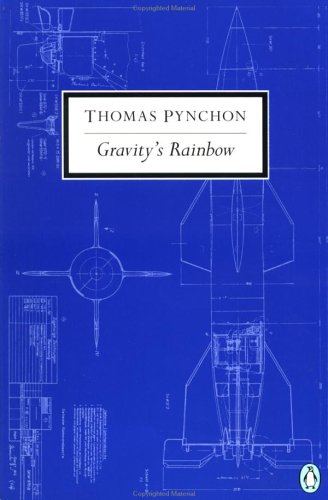
[READ: Week of February 20] Gravity’s Rainbow 1.1-1.12

This is my first time reading Gravity’s Rainbow.  And I know literally nothing about it.   I have always felt like I should read it (being a good modernist and a fan of Joyce and David Foster Wallace), but I never bothered to find out even a basic plot.  And it’s kind of fun going into this thing completely blind.  I had no idea even that it was set in England just Post WWII (1945).  So that was a surprise.  [Interestingly, having just read The Apothecary which was set in London right after WWII, it is cool to read another story set just around WWII and to hear similar things about the living conditions.]

But back to GR.  The only thing I have read before writing this post (aside from a few thoughts over at Infinite Zombies) was a comment (again, on IZ) that you will be confused while reading this book and that’s okay.  Phew.

Having said that I didn’t find it as confusing as I imagined.  (I’ve been intimidated by reading this book for fear of its difficulty).  I admit there are several scenes with pronouns that are somewhat elusive to me, and there’s a few other scenes where characters seem to be there without being fully introduced until later, but overall it’s not that bad.

The first section of the book seems like a lot of exposition–good, thorough exposition, which is also funny—but by section 1.12 we’re still meeting new characters.  It feels like serious plot things will happen later.   The book opens with a more or less famous line (Okay, I knew about that line before reading the book, but that doesn’t give any context).

And so, the screaming comes across the sky and the city is in the midst of an evacuation, but it is too late.  At least for some.  And the opening is a little confusing, as an evacuation might be.  It certainly seems like the end of everything, but then we also find out that some people are sleeping through it.  That this bomb is a localized attack.

Section 1.1 also introduces us to Lt. Capt. Geoffrey (“Pirate”) Prentice.  Pirate is just waking up when he notices that his flatmate Teddy Bloat is about to fall off of the minstrels’ gallery but Pirate manages to shove a cot in the way just as Teddy falls off the balcony.  Pirate is famous for his Banana Breakfasts (he’s the only person in England who has bananas).  And at this point the story settles down into a rather enjoyable domestic scene.  I mention in a post at Infinite Zombies that this opening scene of Pirate on the roof is reminiscent of the opening scene of Ulysses (I won’t go into that here).

The next scene is a raucous affair with a bunch of locals clamoring for their Breakfast plates.  The scene feels like a college dorm, although the participants are (I assume) older—Pirate himself is in his early 40s.

It’s time to mention Pynchon’s astonishing character names. I love them all, they are so weird and evocative without (always) being obvious.  So Teddy Bloat is a good name, but what about Coryson Throsp, the designer of their building.  And with the Breakfast comes names out of the woodwork:  Osbie Feel, Bartley Gobbitch, DeCoverley Fox, Maurice “Saxophone” Reed, Joaquin Stick.  I’m not going to go speculating about names in these posts, but I am sure going to highlight my favorites. (more…)

Read Full Post »

SOUNDTRACK: LOS CAMPESINOS!-Romance is Boring (2009).

Even though I had heard good things about Los Campesinos! before I got this album, this was the first one I bought.  I see that it gets less high marks than previous discs but I think it is fantastic.  It is frantic and catchy, it is intense and mellow, it is loud and soft and most of the time that’s in the same song.  And, as you’ll see below, lyrically I think it’s fantastic.

The disc begins slowly.  Then the vocals come in and you can tell that Gareth Campesinos!’ voice is somewhat abrasive, but well enunciated. When at the 2 minute mark the song more or less stops and turns into little twinkling bells you’re not prepared for the next bit–the guitars are noisy and the drums are loud and the lyrics are even stranger (sung in a slightly off-key style): “I’m leaving my body to science, not medical but physics.”  By the end, the song has mellowed almost completely and we have an almost a capella ending, “Would this interest you at all?”  But before you have a chance to answer that, the next song, “There are Listed Building” ratchets forth in both speakers with loud and quiet sections, group vocals and the lead singer’s more shouting style.

“Romance is Boring” has some super catchy shouted vocals as well as the first real exposure to the co-vocalist Aleksandra Campesinos!’ beautiful gentle female voice. “We’ve Got Your Back” is primarily sung by the female vocalist until the male voice come back with “and so fucking on and so fucking forth” and my favorite shouted chorus: “What would you do?  I do not know.”  “(PLAN A)” is a screaming punk blast of discord.  Until, of course, the much more palatable group sung chorus kicks in.

One of the best songs they do is “Straight in at 101” a wonderful song about breakups that is catchy and funny. It opens with, “I think we need more post-coital and less post rock.”  And then after some great alt rock, the song comes to an end with an a capella section that is quietly sung:

I phone my friends and family to gather round the television;
The talking heads count down the most heart-wrenching break ups of all time
Imagine the great sense of waste, the indignity, the embarrassment
When not a single one of that whole century was… mine

“I Warned You: Do Not Make an Enemy of Me”  has frenetic guitar and the wonderful line, “if this changed your life, did you have one before?”  And the wonderfully titled “A Heat Rash in the Shape of the Show-Me State” opens with this lyrical stanza:

She’d a bruise so black they watched it fade through the full spectrum of colours.
They kept it like a pet; a private joke they told no others.
And how the tissue repaired, and how it turned to yellow
And she found it disgusting, ’cause it didn’t match her clothing.
He said “that’s not yellow, it’s golden”.

Also lyrically interesting is “The Sea Is A Good Place To Think Of The Future,” because how can you make this couplet work in a rhythmic way.  But he does! “At fourteen her mother died in a routine operation from allergic reaction to a general anesthetic.”

There are fast songs and slow songs and pretty sections and harsh sections.  I think they meld it all together wonderfully.

[READ: February 6, 2012] “Los Gigantes”

I think I begin every T. Coraghessan Boyle story with some trepidation.  I liked Boyle because of The Road to Wellville, but I find that most of his other stories are very Southwestern, a region I really don’t know very well.  And yet for all my trepidation, I find I do enjoy his stories.

This one has a very simple premise.  All of the largest men in the area have been offered jobs by the President (I’m not sure where this is set but I assume, if it’s not entirely fictional, that it’s meant to be in Central America).  Although the men have some freedom during the day, at night they are locked into cages.  But their job is a simple one–eat, sleep and have sex with very large women.  That’s all.  It’s kind of boring, but  they are provided entertainments.  And it could certainly be worse (wait until you see what conditions the women love in!).

Discontentment begins to settle in as they realize that they are little more than stud animals (the President is breeding them for their size for a secret army in several generations).  And so one night two of los gigantes escape (it’s fairly easy, they are very strong men).  But they basically get as far as town where the pleasures of the  town’s bar keep them from returning home.  They are caught and punished, but the punishment is not that bad because the President really wants their offspring.

The men issue demands–a nicer living situation mostly–which are met, and they are contented once more. (more…)

Read Full Post »

SOUNDTRACKTV ON THE RADIO-New Health Rock (2004).

I was not aware that this EP existed (I guess technically it’s a single).  It came out after their original EP but before their first full-length.

The title track is a rocking number with all kinds of cool keyboard noises strewn about.  This is clearly early template TV on the Radio.  “The Wrong Way” will appear on Desperate Youth, Blood Thirsty Babes and it shows a new noisy sound for the band–lots of horns and a reluctance to allow silence appear, there’s sound filling up every space.  The final song, “Modern Romance” feels like a B-side.  It is kind of slow and meandering.  There are a few interesting sonic bits but mostly they are overshadowed by a kind of monotony.

Not essential listening for the TV on the Radio fan.

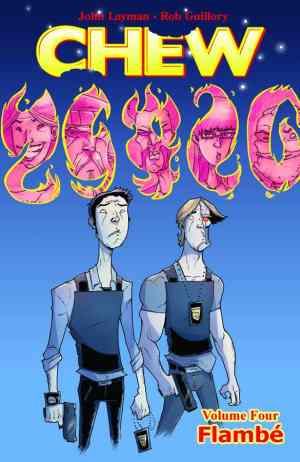
[READ: December 29, 2011] Chew: Volume Four

It was delightful to get volume four of this series so quickly after finishing volume three!

As with previous issues, this one starts out with a quirky opening.  A series of shots of a chicken restaurant (Mother Clucker’s) thirty-five years ago, then twenty-five, then fifteen and then five (nice clientele drawings over the years).  And then finally we see it today, after the ban on chicken–a wasteland.

But this story introduces an entirely new element (which goes through the arc of the book.  Lights from (presumably) an alien life form fill the skies.  They spell out words in a language that absolutely no one can understand.  And it is so vexing that money is taken away from the FDA (the people who are fighting the chicken war) and put into NASA.

This first chapter also introduces a new kind of character: a man who is voresophic–if he is eating he is unbelievably intelligent. Of course, if this was your gift, how long would you be able to stay slim?

Chapter Two jumps us right into a NASA space station.  Just as it explodes.  A quick cut to a school (where Tony Chu’s estranged daughter goes) reveals a more down to earth problem.  Since the letters have appeared in the sky people have been acting weird.  And one technologically savvy boy, who has been picked on most of his school life is looking for revenge.  But is he responsible for the space station explosion as well?

Chapter three is wonderful for a couple of reasons.  First, Chu and John Colby are getting assigned increasingly dangerous missions (because their boss wants them dead).  It culminates in a hilarious scene at the USDA (a furious female army). Chu and Colby are the last resort.  If everyone else fails, they have a fall back so dangerous that it is classified.

Chapter four is amazing for opening with a series of scenes that are gruesome and awful and, as the narrator boxes keep repeating, never actually happen.  And that is because Tony Chu has been assigned to work with his twin sister Toni Chu–NASA bigwig and (unknown to anyone else, fellow Cibopath–she doesn’t tell anyone so she’s not treated like a freak like her brother).  It’s great to see the two of them work their magic.  And while I wouldn’t want it to replace the Chu/Colby team, it would be fun to see future pairings of these two.

Chapter five (this is the first book with five chapters!) opens with a wonderfully long sequence of Agent Mason Savoy (he never went away, he’s always in the background) sampling something amazing.  And we get several wordless pages of him processing what he has just ingested.

But the more amazing thing is that suddenly the letters in the sky simply disappear.  And there seems to be a cult leader who predicted this, right down to the minute.  The cult leader ingested scads and scads of gallsaberries when she was adrift at sea and it led her to the Truth.  And she has lots of followers who are willing to drink her Kool-Aid.

The book ends with two wonderful cliffhangers.  The first one is (mild spoiler, but not really since it will be dealt with in the next book) that their actions lead Chu and Colby to get fired.  The second one is that Mason Savoy has learned a special secret about one of Tony Chu’s relatives (remember we saw them all in that cool scene from the last book?).  And he takes advantage of that knowledge.

The series isn’t over by a long shot.  Awesome.

A couple other things, first off–welcome back Poyo!  I loved the faux story they created about his background and then the negation of said story.  Also, this books reintroduces the vampires that were mentioned early in the story and then kind of hidden.  I love when stories pick up threads like this.  And a final quick nod to all of the excellent little jokes in the margins of the pictures.  I read them all and I love them…keep them up!

For ease of searching I include: flambe

Read Full Post »

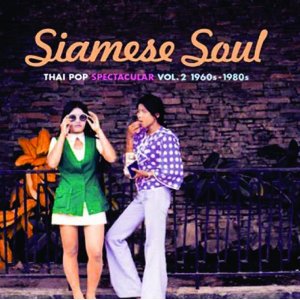
SOUNDTRACK: KWAN JAI & KWAN JIT SRIPRAJAN-“E-Saew Tam Punha Huajai” (1960s-1980s).

This song is the basis for My Morning jacket’s “Holdin’ on to Black Metal.”  It’s not the inspiration…it’s the exact song.  In fact, it could even be a cover, except with completely different lyrics.  Well, I say completely different lyrics without knowing what the original lyrics are, although it translates as “Advice Column for Love Troubles” which “Holdin’ on to Black Metal” certainly is not.

This original is a tad slower and, perhaps, a tad stiffer (which is funny that it’s on a collection called Siamese Soul).  The riff is pretty cool, and in this version they use (what I assume are) Thai flourishes the keyboards are just all over the place, bringing in a crazily noisy texture.  The vocals are all in Thai (I assume).  But what’s amazing is that the opening vocal melody is copied exactly by MMJ (and then MMJ take it in a very different direction).

After that opening riff, the similarities in vocals end, as the singer (I am so vague about this because I can’t find anything about this album anywhere) takes off on a more conventional non-Western singing style.  I prefer the MMJ version, but this is a fun little addition to Circuital.

Check it out and be surprised.

[READ: January 31, 2012] “Someone”

I normally don’t like titles like this one.  “Someone” seems to show a real dearth of imagination, and it doesn’t really inspire anyone to want to read the story.  Having said that, the title actually proves to be quite apt, albeit only after reading the whole thing.

I haven’t read any McDermott stories before, although I have heard of her, but I have no idea if this is the kind of story she normally writes.

This one is set in 1937.  Marie is 17 and has just been asked by Walter Hartnett what is wrong with her eye.  What’s wrong with her eye is that the sun makes it squint involuntarily.  Walter tells her not to do that, that it makes her whole face look funny.  This must be a charming pick up line circa 1937 because later that day Marie and Walter go on a date.

The story quickly flashes forward to the present–we see Marie examining her squint in the mirror. She also thinks back to when her daughters started dating and she warned them: (a rule that I agree with): “If he looks over your head while you’re talking, get rid of him.”  But the daughters didn’t want to hear another story about Walter Hartnett.  So we get to hear it instead.

On that first date, Walter invited Marie upstairs for a minute.  We all know what getting invited upstairs means, but did it mean that in 1937?  Well, Walter does live with his mom, so maybe not.  But his mom is not home, and there’s beer in the fridge.  And soon enough Marie is having her first kiss.  And Walter doesn’t take it slow.  He’s already moving on to second base–with kissing and biting and….  And then they hear the door open downstairs.  Marie is stunned.  (more…)

Read Full Post »

SOUNDTRACK: LE BUTCHERETTES-Tiny Desk Concert #185 (January 9, 2012).

The write up for this Tiny Desk show implies that I should know who Le Butcherettes, and leader Teri Gender Bender, are.  I don’t.  But that doesn’t matter.

In this set, it’s just Teri Gender Bender and her acoustic guitar.  And she is channeling early PJ Harvey like nobody’s business.  If you like PJ’s new album but miss the less than subtle aspects of her earlier  records (and who doesn’t, honestly), this is a very enjoyable set.  Teri is angry and it shows.  But it’s all done on an acoustic guitar, so the anger is modified by the music.  It’s a neat trick.  But it’s also a little disconcerting.  Not least because she seems so nakedly honest when she sings (when she coughs aggressively during “Henry Don’t Got No Love” it’s not entirely clear if that’s part of the song or not.  But also because Teri is not afraid to look right at the camera (or, indeed, the audience) when she sings the songs.  Teri is very pretty but there is something haunting about her, which makes these songs of loss and love all the more effective.

See for yourself here.

[READ: January 22, 2012] “Notes on The Chelsea Girls”

I’m not going to start reviewing films, or, worse yet, reviewing reviews of films.  But since I like to try to read all of the academic articles that get recommended to me, I wanted to mention this one too (I admit I will not be subjecting myself or readers to a thirty plus page article about Charles Darwin and pigeon fanciers (which seemed interesting, especially the pictures, until I saw that it was over thirty dense pages).

It’s childish to laugh that a reviewer of Warhol’s The Chelsea Girls is named Battcock, but I’m not above that sort of joke.  What is amazing, to me, is how intellectual this review is.  I’m used to reading reviews in Entertainment Weekly or even The New Yorker, which talk about the plot of the film and the quality of the direction and what not.  And The New Yorker often trashes mainstream film on highfalutin grounds.  But even that doesn’t come anywhere close to:

Warhol still questions the very nature of the medium and its relationship with the cultural matrix and the contemporary value structure–for which he clearly holds no brief.  He is determined to prove that only vital institutions can provide vital art statements; his challenges to the medium serve ultimately to assure its legitimacy.  If in his earlier movies he attempted to redefine the nature of film and to clarify its limitations, the new works may be said to check out the remaining restrictions of the art form.  These include such physical aspects as the two distinct types of images (the retinal-visual and the cerebro-visual), as well as the nature of the auditorium, projection and screen.

Battcock is kind of hash on the film–which is actually several short films–two of which are projected side by side at the same time.  He says the individual shorts, which run about 30 minutes each, are “a little bland.”  Although, as he points out above, the actual films themselves are kind of beside the point.

Indeed, he criticizes other critics for missing the “point” of these films, which is that Warhol is “stripping the cinematic medium of its pretension and decorations.”  Rather, he complains, “Nearly all the other critics writing in the popular press dwelt with the lugubrious insistence on the squalidness, sordidness, perversion, etc of the lives depicted in the film” (more…)

Read Full Post »

This is not the right cover for the issue. I couldn't find it online!

SOUNDTRACK: THE GOLDBERG SISTERS-The Goldberg Sisters (2011).

I don’t often make lists of “Best” records or anything like that.  But I’m making an exception for this.  This was easily the best album that I had low expectations for.  That sounds like half a compliment but it’s not.  I really didn’t expect much from this album when Adam Goldberg promoted it on Craig Ferguson’s show.  But when I checked out the video for “Shush” I was really impressed.  So I bought the CD.

And I have to say that it is really, really good. 

I need to get this out of the way because it will influence the whole write up otherwise.  Adam Goldberg is an actor, a very good, very funny actor.  And this is just one of his music projects.  It was not an entirely solo affair, but Goldberg plays guitar, piano, harmonium, keyboards, key sitar and melodica.  And of course, he sings as well.  I was more or less expecting an at-home-sounding demo, maybe, or some standard rock-n-roll like many other side projects.  But the album is lush and full, complete with cool psychedelic effects on certain tracks and there’s even clever wordplay. 

Goldberg has a soothing, slightly feminine singing voice (I would not have expected that from his speaking voice).  And his backing vocalists really complement him well. 

The disc opens with “The Room” a simple acoustic guitar and a very nice complementary piano (which reminds me of some of Radiohead’s acoustic moments).  The long instrumental ending is quite intense.  “Mother Please (The World Is Not Our Home)” has questionable lyrics, but a really great sound.  There’s cool spoken words deep in the mix, which bring a creepy effects to the song.  It runs very long, but there’s lots of parts and a cool coda.

“Shush” is still outstanding after all of these listens.  It has a kind of Bowie/Beatles/90’s revival of same feel.  This kind of song only works if the production is right, and Goldberg’s is perfect.  “Don’t Grow” opens with cool fiddle strings and Goldberg’s slightly sinister whispered vocals.  It’s 7 minutes long (see, psychedelic) and features a really pretty denouement with tinkling pianos and everything.

“You’re Beautiful When You Die” is a weird little interlude–muffled piano and dark, dark lyrics.  I could probably do without it, but it’s only 2 minutes so I’ll deal.  It’s made up for by “Erik Erikson” a great rocking acoustic number that reminds me of The Smashing Pumpkins (in vocal style). 

“Third Person” returns to that Beatles-y style with a folk song with full instrumentation.  And “The Difference Between” has some cool backing vocals which elevate this simple piano based song into something more.  “Skin of the Patriot” is a slow piano ballad.  It’s not my favorite song on the disc, but it leads into the wonderfully upbeat ender “The Heart Grows Fonder” (which features a surprising and surprisingly effective melodica solo).  It runs about five minutes (of an 11 minute track).  The ending 90 seconds are a goofy riff on The Beatles’ “Revolution.” 

So overall this album is really enjoyable.  There’s one or two misfires and it could use a wee bit of editing, but man, am I glad I bought this.  And I can’t wait to see what Goldberg does next.

Watch the Ferguson bit here (wait for the hilarious awkward pause at 10:30)

Find out more at his wonderfully named website: Adam Goldberg Dillettante.

[READ: January 6, 2012] “Two Midnights in a Jug”

This is the final individual story that Karen Carlson recommended to me (the rest are all in anthologies that I’ll have to check out).  She writes: “Because it’s a grim, tough read, it might take a second read to get past the oppressive weight and find the delicate art. And it doesn’t hurt to look into the background of the writer a bit; he isn’t writing about these people by accident. A little Willie Nelson might work [for the soundtrack].”

Karen’s comments sound a little defensive!  But I admit I was pretty turned off in the beginning of the story.  I’ll also admit a personal bias of mine is that I don’t really like to read stories about the rural poor or folks in the Ozarks.  I know, it’s not very nice, but it’s true. 

So, this story is set there.  And it opens with just about every stereotype I hate about the region: single wide trailer that borders a hog farm, neon orange muumuus, coon hunting and a repossessed house.  Things are even worse than my stereotypes though, because the plumbing is unconnected and their toilet sits over a bucket.  Which they cover with lime after every use and which they have to empty daily.  Good god.

Oh and the hog farm?  They had so much hog shit that they decided to burn it.  Well, the fire has been raging for a month.  And the only thing worse than the smell of hog shit is the smell of burning hog shit.  And the only thing worse than burning hog shit is having the ashes from the hog shit fall onto your property and into your trailer every day for a month. 

Oh yeah, and Cordell, the man of the trailer, accidentally shot their hound, Trixie last time he was hunting.  She’s okay but had to have a leg removed.  Jee.  Sus.

I seriously almost stopped reading. (more…)

Read Full Post »

SOUNDTRACK: SLOAN-The Double Cross (2011).

Sloan never fail to make enjoyable punky pop songs.  Surely it has something to do with having four songwriters in the band (which must minimize clunkers).  I can never decide who my favorite songwriter of the group is as they all do fairly varied work.

“Follow the Leader” is a fast rocker (with a very cool guitar solo bit and a nice acoustic break in the middle).  While “The Answer Was You” is a bouncy piano-based song that starts out fast and then settles into one of the more recognizable Sloan voices (I wish I knew who was who–even after twenty years I have never quite determined who was singing what).  This song also has a great third part, minor keys and very dramatic structure.  It’s the first of several songs that hover around the 2 minute mark, as well.

“Unkind” is a simple guitar based song and man is it catchy, with a chorus that sticks with you.  “Shadow of Love” is a great fast rocker and even at only 2 minutes long it has several great parts.  “She’s Slowing Down Again” has some great bah bahs and a strong chorus.  “Green Gardens, Cold Montreal” actually slows things down, with a gentle acoustic ballad.  But it’s followed by one of their screaming punk tracks, “It’s Plain to See,” simply put, it’s two minutes of adrenaline.

The album changes somewhat with “Your Daddy Will Do,” a catchy disco song.  Yes, disco.  How else do you explain those keyboards riffs?  And man is it catchy.  “I Gotta Know” may be the stupidest song they’ve recorded yet.  How many times is the phrase “I gotta know” repeated in 82 seconds?  Still, you can’t deny how catchy it is.  “Beverly Terrace” returns to that cool pizzicato piano that they do so well.

“Traces” is the longest song (almost 5 minutes) and is one of the longer Sloan songs in general.  It feels like  an old classic rock song for many reasons (including Doors-y keyboards), and yet it doesn’t feel retro at all.  Neat trick, that.  The disc ends with “Laying So Low,” a piano ballad with a great catchy melody.  It slows the album to a nice ending.

12 songs in 33 minutes.  Multiple genres, multiple styles, multiple singers.  All of it wonderful.  Just an other typical Sloan album. Great jobs guys, here’s to twenty more years.

One word to yeprock records, though.  If you offer “free bonus” songs for purchasing their album, I would suggest in the strongest possible terms that the four bonus songs should not be one song each from their previous records.

[READ: December 29, 2011] Chew: Volume Three

We were quite excited to get this book–we were on the Hold list forever at the library.  So I’m surprised to see it came out back in 2010!  I assumed it was much newer than that.  I guess there’s a Volume Four out already (yes it came out, and they have just published issue 22 in single issues).  Volume three covers issues 10-15.

This mini-arc, as they call it, isn’t so much of an arc as a continuation of the awesome story line.

For those in the dark, read the first two posts.  But in a nutshell, Tony Chu is a Cibopath, which means that anything he tastes he knows the entire history of, be it vegetable, meat (ew) or, since he is a cop, human (bleagh, but hey it’s a comic book, right?).  His partner, John, is part machine now, having been practically blown up and then put back together.  And, as we start Chapter One (Issue #11), Tony is out on his first date with Amelia Mintz (alright, they got together!).  Amelia Mintz is a Saboscrivner which means she can write about food so wonderfully that you can literally taste it. (more…)

Read Full Post »

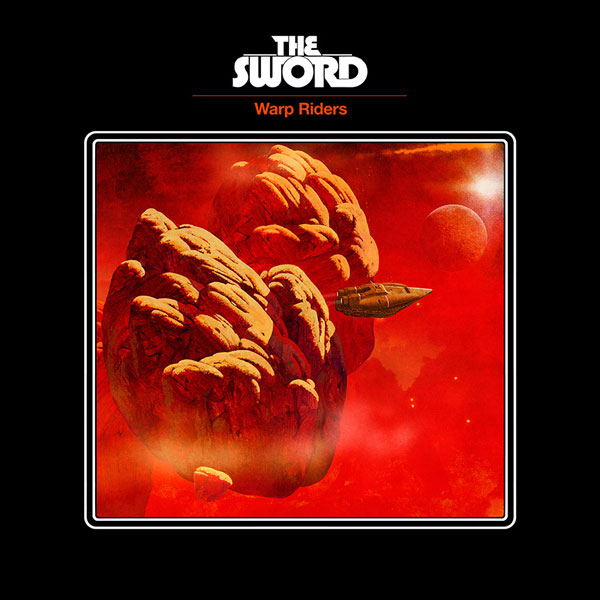
SOUNDTRACK: THE SWORD-Warp Riders (2010).

I have heard some great things about this disc from The Sword–that it was old school metal who usually sang about swords (duh) and sorcery but were warping into the future on this disc.  I put the disc on and was blown away by the opening track, the instrumental “Acheron/Unearthing The Orb.”  It sounds very 80s metal: heavy guitars, and great riffs coupled with tremendous solos.  The second song opens just as strong but then something weird happened.  I hated the lead singer’s voice (my discussion of their previous disc came to the same conclusion).  It doesn’t do ANYTHING that 80s metal should do–it’s neither growling nor yelly nor operatic.  In fact, once the vocals kick in, the song takes on a distinctly non-metal feel.  More specifically, it feels like heavy classic rock from the 70s.  The guitars are still heavy as anything, but the melody and vocals change things.

I really didn’t like the album all of a sudden, until I listened a few times and accepted that this blend actually worked.  Once I acknowledged that it wasn’t what I thought it would be, I wasn’t disappointed by it anymore, and I was able to really enjoy it.  “Tres Brujas” has a simply wonderful sing along chorus that I can’t get out of my head.  And it continues in this vein–heavy riffs (the guitars on “The Chromancer 1: Hubris” and “The Chromancer II: Nemesis” (love the names!) are really heavy) and surprisingly catchy choruses. 

The biggest surprise comes with the song “Night City” which sounds like, well, like Thin Lizzy.  The macho riffs, the swagger, the lyrics, it’s all Lynott.  And once I realized that, I really understood what The Sword was all about, and the disc has been in heavy rotation ever since.  I don’t mean to say that I had to analyze the disc to “get” it, but once it all clicked, it clicked really well.

[READ: December 13, 2011] “The Pharmacist from Jena”

This is my first story from Michael Dahlie and I have to say that I was hooked from the start. 

The story is set in 1912, when the narrator was sent from his home in Stockholm to Winslow, Indiana.  He was sent to work with his uncle as a pharmacist’s assistant. 

It’s in the second paragraph, after the exposition, that things take off: “My uncle was a passionate lover of cocaine and had situated himself in such a way that he supplied nearly all the nearby interested parties.”  He was also renowned as a great “voluptuary and eroticist.”

There is a real plot, which gets established late in the story, but in the beginning, the story is all about the narrator’s adjustment to this life.  How his aunt seemed to believe he was a girl and decorated the room accordingly.  How his uncle had a fight with a bear (long story) in that very girl-themed room (long story) and how the room was soon, no longer girl-themed.

One thing I really liked about the story was the narration.  Like: “At the time I was living in Winslow, it was fashionable for wives of wealthy men to suffer from mental disorders.”

His uncle experimented with shock therapy, but he mostly used it for erotic experimentation.  The end of the shock experiments occurred when a local husband found out what the good doctor was doing (from the burns that his wife received at the doctors hands).  (more…)

Read Full Post »

SOUNDTRACK: ULVER-A Quick Fix of Melancholy (2005).

This EP came two years after Teachings in Silence (with a movie soundtrack and “greatest hits” collection in between).  This first track, “Little Blue Bird” is a simple soundscape with echoey keyboards.  When Garm starts singing, his most emotional side comes through (even if I really can’t understand him most of the time).

“Doom Sticks” belies its name and the EP title by being somewhat upbeat.  There are kind of squeaky keyboards that pulsate through the track.  After about a minute and a half, distorted drums keep a martial beat.  But it quickly morphs into a twinkly section that makes me think of the Nutcracker or some other kind of Christmas special.

“Vowels” is similarly upbeat (the music on both of these two tracks has a vaguely Christmastime feel somewhere in there–not that anyone would think these were in any way Christmas songs, or maybe it’s because I’m listening in mid-December).  For this, we get a return of Garm’s choral voice: deep, resonant and hard to understand (although I undertsand the lyrics are from a poem by Christian Bok).   But the poem quickly makes way for some dramatic staccato strings. 

“Eitttlane” begins with some menacing keybaords and staccato notes, creating a feel of a noir movie.  But when the vocal choir comes in, it gets even more sinister.

These Ulver EPs are really true EPs–stopgap recordings for fans.  Their larger works tend to be more substantial, but these EPs allow them to play around with different styles.

[READ: December 1, 2011] “Laureate of Terror”

Two authors I admire in one article, how about that!  In this book review, Martin Amis reviews Don DeLillo’s first collection of short stories and gives a summary of DeLillo’s work.

Amis opens the article by undermining my plans for this blog.  He states point blank than when we say we love an author’s works, we “really mean…that we love about half of it.”  He gives an example of how people who love Joyce pretty much only love Ulysses, that George Eliot gave us one readable book and that “every page of Dickens contains a paragraph to warm to and a paragraph to veer back from.”  Also, Janeites will “never admit that three of the six novels are comparative weaklings (Sense and Sensibility, Mansfield Park and Persusaion).  [I still hope to read all of the books by the authors I like].

Amis says he loves DeLillo (by which he means, End Zone, Running Dog, White Noise, Libra, Mao II and the first and last section of Underworld).  And he also seems to really like The Angel Esmeralda: Nine Stories,(well, much of it anyway), DeLillo’s first (!) short story collection

His main assement is that these pieces are a vital addition to DeLillo’s corpus.  (more…)

Read Full Post »

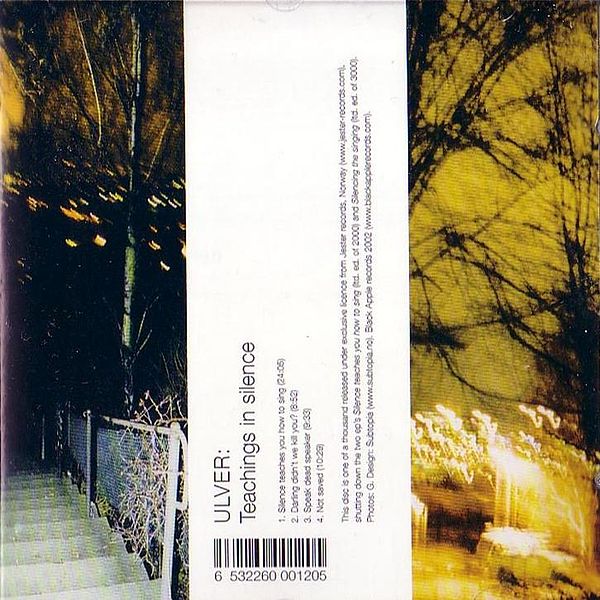
SOUNDTRACK: ULVER-Teachings In Silence (2002).

This EP is a collection of Ulver’s two previous limited edition EPs: Silence Teaches You How to Sing and Silencing the Singing.  It was originally released as a limited edition of 1000 copies, but has since been given wide release.  The two EPs that it replaced were officially retired (after print runs of 2000 and 3000 respectively).

“Silence Teaches You How to Sing” seems like perhaps Ulver has pulled a fast one.  The song starts with static…waves of static.  And you think, what, 24 minutes of THIS?  But after about four minutes, some quiet guitars layer through the static.  By 5 minutes a melody emerges, rather Twin Peaks theme-like.  Static resumes and then another wave of music bursts through and then, around 11 minutes, distant voices can be heard.  As the track nears the end you can hear a distant choir.  And by the end you’re listening so intently that you hear all kinds of things.

That was the only track on the first EP.  The second EP had three shorter tracks.  They are in a similar style to Silence, although there is more music.  “Darling Didn’t We Kill You” has a somber guitar melody and distant choral voices or a buzzing drone.

“Speak Dead Speaker” is more static (it’s easy to see why these two EPs were bundled together).  There’s more Twin Peaks style washes over the static.  I keep picturing the Pacific Northwest.  The last two minutes are a surprise cello version of the themes from the first 7 minutes.  It’s lovely and sorrowful.

The final track is a beautiful melody that repeats itself more and more quietly (with a wonderful loud funeral bell keeping time).  It repeats its cycle three times before ending.

Ulver continues to confound listeners.  Neither one of these EPs is really essential, but they are both interesting and really create a mood.

[READ: November 3, 2011] “Nilda”

This is the final uncollected story (according to Wikipedia anyhow) by Junot Díaz that I was able to access online.  There are two more stories “Invierno” (Glimmer Train 1998) and “Flaca” (Story, Autumn 1999) that I can’t seem to access online.  The rest of the listed short stories appear in Drown

This story is about longing and making the wrong choices.  Having read a bunch of Junot Díaz stories lately, this feels very much like a story he would write (I probably should have read Drown before I read these stories, but when I get to it, I’ll be able to confirm my suspicions).

In this story, Yunior, who is evidently the constant narrator in his earlier works (and in Oscar Wao) knows Nilda from school.  She was a friend of his–a kind of teasable friend–until puberty hit and her chest was to die for.  Unfortunately for Yunior, they were already friends, and she was off with other boys.

Indeed, Nilda was trouble more or less from the start–“brown trash,” he calls her.  Her mother was an alcoholic and Nilda was defiant.  She even spent time in a group home.  But she was nice and easy to talk to.  Dammit, why did she have to start dating Yunior’s brother Rafa? (more…)

Read Full Post »

« Newer Posts - Older Posts »