Feeds:
Posts
Comments

Archive for the ‘Sex’ Category

SOUNDTRACK: FOGERTY’S FACTORY – JOHN FOGERTY + FAMILY-Tiny Desk (Home) Concert #14 (April 24, 2020).

I’ve never given much thought to John Fogerty.  I like some CCR songs; dislike others.  He’s a legend for sure, but I never thought about him.  I certainly never thought about whether he had children (much less grown children).

Watching this Tiny Desk where Fogerty and his three grown kids are playing along to some utterly classic songs is pretty weird.  Imagine if your dad wrote “Centerfield”?  It’s not my favorite song.  I don’t even especially like it, but I’ve heard it a million times.

And there you on video playing guitar and bass with your dad who wrote the song.  Is that surreal and wild or is it just what dad does?

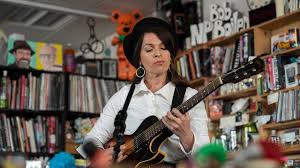
When John Fogerty breaks out his baseball bat guitar and swings into that famous guitar lick from “Centerfield” to open his Tiny Desk (home) concert, I can almost taste the Cracker Jacks. Welcome to Fogerty’s Factory, the tricked-out basement where the Fogerty Family (John, his sons Tyler (mustache) and Shane (no mustache), and his daughter Kelsy) make music in these quarantined times.

Fogerty jokes about his own tiny desk.

His desk is the road case his band Creedence Clearwater Revival used when they played Woodstock, and John shows off a guitar he played at the festival as well.

After “Centerfield” he plays

three of his CCR classics from 50 years ago (still singing in the same key), surrounded by family and sending out words of encouragement to all of us.

I have a hard time believing he wrote “Down on the Corner” if only because it seems like a song that’s been around forever (which it has).

It’s amusing hoe much he acts like a grandpa (which he just might be), when talking to us and to his daughter (who has wise words to say about missing her graduation).

I don’t really know “Long As I Can See the Light.”  Maybe I do, it sounds vaguely familiar, but all CCR songs sound vaguely the same (his voice is unmistakable–and he still sounds pretty good).  he plays organ on this song, which is a slight change of sound.

“Proud Mary” is another song that I just can’t believe he wrote. Can you imagine being the guy who wrote that song?  Again, not a song I especially like, but everyone has sung it.  Everyone knows it.  It seems like it was a blues standard or something.  But this guy wrote it.

That’s pretty wild.

[READ: April 26, 2020] “Bedtime Story”

Ezra Washington’s wife walked in on him telling a story to their younger child.  It was about the time he was rollerblading and Julia Roberts crashed into him.

At first she doesn’t realize that he is talking about Julia Roberts, she thinks he is talking about her (“That laugh you’d know anywhere”).  But none of the details sound familiar.  It’s when the child says, “She’s the one that plays the mom…with the big teeth and the long brown hair?” that she realizes it’s the Julia Roberts story.

The dad confirms and the child reiterates, “Julia Roberts went right between your legs?”

“Yes, but don’t repeat that.”

She was the biggest movie star in the world.  Back then. (more…)

Read Full Post »

SOUNDTRACK: NICK HAKIM-Tiny Desk (Home) Concert #12 (April 22, 2020).

I had a mixed reaction to Nick Hakim”s Tony Desk, although the blurb writer says he loved it.

Whenever I’m asked to name my favorite Tiny Desk concerts, Nick Hakim’s 2018 performance sits near the very top. He and his four bandmates reset the bar for intimacy at the Desk with their hushed groove.

Hakim plays three songs from his upcoming album WILL THIS MAKE ME GOOD

from the corner of his dark bedroom with a keyboard, guitar and stacks of audio components.

His vocals on all three tracks are quiet and echoing, as if he is whispering down a long hall.  In fact all of the music sounds muted and soft, with a feeling of hazy smoke floating around,.

“QADIR,” is a haunting dedication to a fallen friend.  He plays guitar–mostly slow muted echoing guitar chords.  When the song ends, he activates a mini applause effect box which is pretty funny.

He takes a few loud slurps from his drink and gives a big “ahhh,” before starting the next song. For “GODS DIRTY WORK” he switches to the keys.  His singing style is exactly the same, although the song may be a little slower.

He adds a little more fake applause and then a somewhat creepy echoing laughter as he switches the drum beat for “CRUMPY.”

Honestly, all three songs sound a lot alike and seems really slow and hazy. It’s weird how upbeat and smiling he is, in contrast to the music.  I wonder how he makes everything seem so quiet.

[READ: April 15, 2020] Nicotine

I really enjoyed Nell Zink’s two other novels, but somehow I missed this one entirely when it came out.  I couldn’t imagine what it was about with that title and boy I never expected it to go where it did.

I actually had a slightly hard time getting into the book. That may have been because it was Quarantine and it was hard to ficus or it was because the opening of the book was so puzzling.  And yet by the end I was totally hooked.  But the beginning:

A thirteen year old girl stands in a landscape made almost entirely of garbage, screaming at a common domestic sow.

Then a white man comes and takes the girl away.  Her name is Amalia. (more…)

Read Full Post »

SOUNDTRACK: LANG LANG-Tiny Desk (Home) Concert #11 (April 17, 2020).

Lang Lang is a superstar pianist whom I have never heard of.  But I agree with the blurb that it’s neat to see a fantastic pianist playing at home.  He seems relaxed and loose.  And the camera angle allows us to see his fingers (and his whole swaying body) pretty clearly.

Here’s something unique: a chance to eavesdrop on the superstar pianist Lang Lang at home.

The 37-year-old pianist, who typically plays sold-out shows to thousands, says he’s taking his recent solitary time to learn new repertoire at home in Shanghai, China. And home is where he thinks we should all be.

He opens with Chopin’s calming “Nocturne No. 20 in C-sharp minor.”  I loved watching him slowly and deliberately play that last note.  It seems like he holds his finger above it for minutes, but it fits in perfectly.

Lang Lang’s latest passion is Bach – specifically the Goldberg Variations, a 75-minute-long cycle of immense complexity grounded in the composer’s durable beauty. Lang Lang offers the “18th and 19th variations,” pieces that in turn represent the strength of logic and the joy of the dance. It’s music, Lang Lang says, that “always brings me to play in another level of artistic thinking.”

These pieces are just magical.  Even if I don;t know them well, I can tell pretty immediately that they are Bach.  Lang Lang’s fluidity is wonderful, as is the way his whole body seems to be absorbing the music as he plays.

[READ: April 11, 2020]: Carnet de Voyage

From March 5 thru May 14, 2004 Craig Thompson was on an international book tour celebrating the success of his (fantastic) book Blankets.

This journal was his visual diary (no cameras were used, only his memory) of his trip.  His editors thought it would be interesting for him to document his trip (and it is).

He flies into Paris then a 2 hour plane trip to Lyon.  He draws pictures of where he has been and the people he has met (and some of their fascinating stories).  There’s some wonderful sketches of rooftops from hotel windows.

He does interviews for radio and magazines. He laughs that one of the photos shoots was in the streets of Paris, where he is all dressed up.  But really he’s a county bumpkin from Wisconsin. The drawing of himself as a glamorous guy and his bumpkin alter ego together is pretty hilarious.

On March 15 he left for Marrakesh, Morocco and this exotic location rally sets the stage for most of his artwork and what is sort of the only “plot” in the book.

He had also just broken up with his girlfriend which weighs on his mind quite a lot on the tour. (more…)

Read Full Post »

SOUNDTRACK: JOHN PRINE TRIBUTE-Tiny Desk (Home) Concert #8 (April 11, 2019).

I feel like I have been aware of John Prine forever.  Although I also feel like I only really became aware of who he was and what he had done in the last year or so.  Or at the very least since he had surgery and his voice changed dramatically.

I knew that he was a legend in folk circles, but I had no idea how many of his songs I knew–although likely from other artists.

I was not devastated when he died because I didn’t know him enough to be devastated.  But I did feel that it was unbelievably unjust of the world to have him survive cancer only to be beaten by this virus that could have been avoided.  While there are people out there actively doing harm to others, why would a person as thoughtful as him be the victim.

Every time I saw John Prine perform, he invited friends to join him. The outpouring of love and respect has always been so profound. And so when John Prine died on April 7 from complications related to COVID-19, I knew his friends and those he touched would want to pay tribute to him. Here are five artists performing their favorite John Prine tune in their home (or bathtub) in honor of one of the greatest songwriters of any generation.

Here are the five performances:

  • Margo Price and Jeremy Ivey, “That’s the Way That the World Goes Round”
    Recorded in their bathroom, with their baby entering the scene for the final verse.
  • Courtney Marie Andrews, “Speed of the Sound of Loneliness”
    She says that Prine was the best at putting humor and sadness in one song let alone one line.  Her version of this song (that I know very well) is too slow for my taste.
  • John Paul White, “Sam Stone”
    He says he is taking this harder than he thought. This song makes him cry every time.  I knew this song from someone else singing it, although I’m not sure who.
  • Nathaniel Rateliff, “All The Best”
    I didn’t know this one, but I do like it.
  • Brandy Clark, “Speed of the Sound of Loneliness”
    It’s a shame that two people did the same song since he has 19 albums out, but this song is quite lovely.  I like Clark’s version better than Andrews’ even if they aren’t that different.

[READ: April 1, 2020] The Spirit of Science Fiction

I have read pretty much everything that has Roberto Bolaño has written which has been translated into English (many, like this book, by Natasha Wimmer).  This is one of the first novels he ever wrote and it was finally published posthumously in 2016.

It’s a very strange book with a very strange construction (a precursor to the construction of his later, larger books, for sure).

The book is told in three parts and it concerns three major characters.  The narrator, Remo, his best friend Jan Schrella and a third poet, Jóse Arco.

The book opens with Remo being interviewed by a journalist.  He has just won a literary prize.  This interview is spread out over many chapters, but it is sort of summed up by his reply:

you actually predict a bright future for art? You don’t realize that this is a trap. Who the hell do you think I am, Sid Vicious?

Remo lives with Jan, another serious poet, but one who has more or less taken to his bed–barely ever leaving the house at all.

Jan is seventeen and spends nearly all of his time reading, especially science fiction books.  He seems to want to single handedly get recognition for his country men and women.

He spends most of his time writing letters to famous science fiction authors: Alice Sheldon, James Hauer, Forrest J. Ackerman, Robert Silverberg, Fritz Leiber, Ursula K. Le Guin, (twice, first one unsent), and Dr James Tiptree, Jr.

Some of the letters are stories about his dreams, some are general notes of good will, but the overall tones is one asking them to support science fiction written by authors in Latin America.

Remo does go out though,  He goes to writing workshops.  At one of them Jóse Arco enters late.  Remo’s is instantly taken with him. As the first scene with Arco ends, Arco lays back in his chair and recites his new poem Eros and Thantaos from memory.  Arco was a daring fellow riding his (often broken down) motorcycle at 3AM.  Arco is based on Mario Santiago Papasquiaro.

Although Jan is not active, his imagination certainly is. He feels compelled to tell Remo about “Silhouette,” a science fiction short story by Gene Wolfe. (Yes, part of the book is someone describing another book ).

Meanwhile, Remo and Arco decide to investigate a publication called My Enchanted Garden which comments on the torrent of poetry magazines in Latin America.  There were 32 then it jumped to 661 and by the end of the year it was predicted there would be one thousand.

Through Arco, Remo meets young poets Angélica and Lola Torrente and their friend Laura, as well as the queen of local poets, Estrellita. Remo invites them back to his apartment.  Although Lola is the more experienced of the two, it’s Angélica who falls for Jan.  The scene where they first meet is crazy.  Jan was in bed (of course) when they came in

Jan jumped up, his skinny ass exposed and his balls dangling golden, and in two or three swift movements his back to the group, he jammed his papers under the mattress and got back into bed.

What a lovely young man, said Estrellita And his darling balls are the color of gold.

Jan laughed

It’s true, I said

That means he’s destined for greatness.  Golden balls are the mark of a young man capable of … great deeds.

They’re not exactly golden, said Jan.

Shut up.  She thinks they look golden, and so do I. That’s all that matters

And I do too, said Angélica.

It was at this party that Remo fell for Laura.  She was with Cèsar at the time, but that didn;t stop them from kissing.  But when she says they could fuck right there, he says I don’t think I could.

What do you mean, you don’t think you could?  You mean you couldn’t fuck?
Yeah, I couldn’t get it up.  I couldn’t get an erection. It’s the way I am.
You don’t get erection?
No I mean, I do, but it wouldn’t work right how.  This is a special moment for me, if that makes sense, and its erotic too, bu there’s no erection.  Look, feel.  I took her hand and put it on my crotch.
You’re right. it’s not erect, said Laura with a barely audible laugh.

He falls for her immediately though and gives her a nickname–Aztec Princess.

Later in part 2 an actual Aztec Princess–a motorcycle with that phrase stenciled on it, comes into Remo’s life.   How can he refuse to get it?  Even if he has no money, cannot drive a motorcycle and has no licence?

This barely touches half of the ideas that float through this book.  There’s a lot of information about a potato farmer; a lieutenant (Boris Lejeune) watching a recruit shoot a colonel in the chest; Father Gutierrez visiting Pierre LeClerc; and a lengthy story about a village becoming obsessed with woodwork, to the detriment of everything else.  There’s also Jan’s dream of a Russian cosmonaut, and the final chapter called “Mexican Manifesto.”

This last section is all about Remo and Laura going to baths and the strange sexual things that happen in steam.  This section was excerpted in The New Yorker in 2013(!).  That version was translated by Laura Healy.

About it I wrote:

The narrator is the man and the woman, Laura, is the more adventurous of the two.  She is the one who encourages them to go to the baths in the first place and, while he also thinks it is wonderful, it is she who wants them to explore as many different baths in the city as possible.

The first bath that they go to is a nice one, an upscale bath where the man in charge (who is pointedly referred to as an orphan) is very nice and as a result people treat him with courtesy.  There’s never any trouble at this bath.  It’s very nice, but Laura wants to explore other houses.  So they ask him for a list.  And they set out on their voyage of discovery.

It is at these less reputable baths that most of the action takes place (both in the story and out of the story).  People mingle more freely (with sexual contact common), they also share drugs and other entertainments.  The story focuses on one instance in which the entertainment was two young boys and an older man.  The man instructs the boys to begin masturbating each other.  But the boys are tired (as is the old man).  They say they haven’t slept in days.  The old man falls asleep. And with the steam, the boys begin to fall asleep as well.  The steam gets thicker and thicker and soon Laura is squatting nearer to the boys.  The narrator can’t really see what’s happening but it all seems like such a dream that he’s not even sure what to think.

I’m not really sure what this section has to do with the rest.  I’m not really sure what happens in the book at all.  The revelation of Jan’s alias is pretty fascinating though.

This is strange book to be sure and I didn’t really enjoy it that much–I just couldn’t get into it.  But it seems to forecast the kind of (much better) writing that Bolaño would eventually become known for,

I wondered how different the 2013 Healy translation was from this one.  The content is of of course, the same, but they are notably different.

Here is the last sentence first from Healy

The color of the pool’s rocks, doubtless the saddest color I saw in the course of our expeditions, comparable only to the color of some faces, workers in the hallways, whom I no longer remember, but who were certainly there.

Now from Wimmer

The color of the stones around the pool, surely the saddest color I saw in the course of our expeditions, comparable only to the color of some gazes, workers in the hallways, whom I no longer remember, but who were surely there.

If Wikipedia is to be believed, here are the remaining untranslated works

  • 1976 [Reinventing Love] 20-page booklet in México (first publication)
  • 1983[Advice from a Morrison Disciple to a Joyce Fanatic] Novel written in 1983 in collaboration with A. G. Porta
  • 2011 [Bolaño By Himself] Collection of interviews with Bolaño (1998–2003)
  • ? [Diorama] not yet published

Read Full Post »

SOUNDTRACK: SOCCER MOMMY-Tiny Desk (Home) Concert #1 (March 21, 2020).

Since the quarantine began, many many many musicians have been playing shows at home.  There are so many online home recordings that it is literally impossible to keep up with them.  I have watched a few, but not many.  I’m not sure how many of the online shows are going to be available for future watching, but at least these are saved for posterity.

The Tiny Desk is working from home for the foreseeable future. Introducing NPR Music’s Tiny Desk (Home) Concerts, bringing you performances from across the country and the world. It’s the same spirit — stripped-down sets, an intimate setting — just a different space.

On Monday March 30, Sophie Allison, aka Soccer Mommy, was to perform a long awaited Tiny Desk concert at my desk. Now the world has changed, and with the coronavirus keeping us at a distance, we’re taking a break from filming Tiny Desks at the office for a while.

Sophie wanted to share her music and her thoughts with you. So we’re kicking off our Tiny Desk (Home) Concerts series with Soccer Mommy from her home in Nashville.

Soccer Mommy was supposed to play a show in Philly on March 31. I had a choice between this show and a show from Vagabon.  I wasn’t sure which one I wanted to go to.  Well, now I get this home concert instead.

This Home Concert (as most will be) is Sophie and her acoustic guitar.  Since I don’t really know (most of) the originals, I can’t compare them.

All three songs have catchy melodies.  It’s cool watching her hands up close to see he playing modifications to the chords in “Bloodstream” so it’s not as simple a melody as it seems.

Her voice is soft and high (although a little hard to hear in this mix).

“Circle the Drain” has been getting some airplay and I rather like it.  It reminds me of a Lemonheads song in style.  This acoustic version is nice, but I prefer the studio version (that extra guitar line is a nice touch).  She says it’s about being depressed and staying inside all day.  “I’m sure some of you can relate to that right now.”

Before the final song, “Royal Screw Up” she asks if anyone can guess what tuning she is going from and into.  My guess is that she is going into standard E tuning, although I’m not sure from what.

Most of her melodies remind me of the singers I liked in the 90s, and I think with a slightly better production I would have really enjoyed this set.  I might have to check out her album a little more closely.

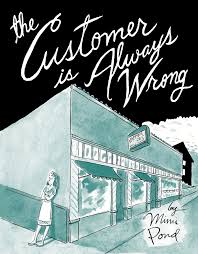
[READ: April 1, 2020] The Customer is Always Wrong

I enjoyed, Mimi Pond’s first memoir(ish) book, Over Easy, but I grew tired of it by the end.  It was an look at late 1970s San Francisco and all of the low-level drug dealers and users who worked and ate at the restaurant where Madge was a waitress.

And yet, I came away from it with enough good vibes that I was interested in reading this second volume.  And this second volume had the heart and soul that I felt the first one lacked.

The story begins with some of Mimi’s past boyfriends (good boys whom her mother loved).  Then it moved on to bad boys who treated her like crap.  Finally, she meets Bryan, a nurse who treats her kindly–and the sex is amazing.

But the shine starts to wear off and a turd is slowly revealed–the way he breaks up and gets back together (he loves the drama), the way he watches the World Series at her house even though she doesn’t care about baseball (or own a TV–he brought his own).  Oh, and the way she finds out later that he lied about nearly everything.

The drug dealer characters from the first book are still there of course.  The most prominent one is Camille, a “straight looking” and pretty young woman who has hooked up with Neville, a real dirtbag (but one who tells great stories).  She has big dreams–they will sell a ton of coke, make a ton of money and go to Paris.  Of course that never happens.

And then there’s Lazlo.  Lazlo is the real main character of the story.  Even though it is Madge’s story, it all more or less revolves around Lazlo.  Lazlo runs the diner where Madge works and he is always around–wearing his cool hat, telling great stories (he is a poet).  It’s hard to remember that he is married.  Hard for him to remember too, apparently. (more…)

Read Full Post »

SOUNDTRACK: JESCA HOOP-Tiny Desk Concert #965 (April 3, 2020).

I really liked the Tiny Desk Concert that features Sam Beam and Jesca Hoop.  So much so that I bought the CD and it made me want to see both of them live.

Jesca Hoop last appeared at the Tiny Desk as a duet with Sam Beam (Iron & Wine) in the spring of 2016. They sang songs from their collaborative record Love Letters For Fire.

This time it is just Jesca and I have realized that I liked her more as an accompanist rather than a lead singer.  Actually, that’s not exactly right.  Her voice is lovely.  I just find the songs a little meandering.

This time around, Jesca Hoop came to the Tiny Desk with just her guitars, her lovely voice, and brilliant poetic songs. She has a magical way with words, and she opened her set with “Pegasi,” a beautiful song about the wild ride that is love, from her 2017 album Memories Are Now.

“Pegasi” is nice to watch her play the fairly complex guitar melodies–she uses all of the neck.  The utterly amazing thing about “Pegasi” though comes at the end of the song when she sings an amazing note (high and long) that represents a dying star.

She wanted to sing it today so it could live on Tiny Desk.

The two songs that follow are from her latest album, Stonechild, the album that captured my heart in 2019, and the reason I reached out to invite her to perform at my desk.

“All Time Low” is a song, she says, for the “existential underdog.”  She switches guitars (to an electric) and once again, most of the melody takes place on the high notes of the guitar.  Her melodies are fascinating.  And the lyrics are interesting too:

“Michael on the outside, always looking in
A dog in the fight but his dog never wins
If he works that much harder, his ship might come in
He gives it the old heave-ho.”

After the song, she says, I’m going to tune my guitar, but I’m not going to talk so it doesn’t take as long. If you were at my show, I’d be talking the whole time and it would take a long time.

And for her final tune, she plays “Shoulder Charge.” It’s a song that features a word that Jesca stumbled upon online: “sonder,” which you won’t find in the dictionary. She tells the NPR crowd “sonder” is the realization “that every person that you come across is living a life as rich and complex as your own.” And that realization takes you out of the center of things, something that is at the heart of “Shoulder Charge” and quite a potent moment in this deeply reflective and personal Tiny Desk concert.

This word, sonder, came to my attention back in 2016 when Kishi Bashi first discovered it and named his album Sonderlust for it.

The song is like the others, slow and quite with a pretty melody that doesn’t really go anywhere.

I found that after three listens, I started to enjoy the songs more, so maybe she just writes songs that you need to hear a few times to really appreciate.

[READ: March 2020] Ducks, Newburyport

I heard about this book because the folks on the David Foster Wallace newsgroup were discussing it.  I knew nothing about it but when I read someone describe the book like this:

1 Woman’s internal monologue.  8 Sentences. 1040 pages

I was instantly intrigued.

Then my friend Daryl said that he was really enjoying it, so I knew I had to check it out.

That one line  is technically (almost) accurate but not really accurate.

The story (well, 95% of it) is told through one woman’s stream of consciousness interior monologue.  She is a mother living in Ohio.  She has four children and she is overwhelmed by them.  Actually she is overwhelmed by a lot and she can’t stop thinking about these things.

She used to teach at a small college but felt that the job was terrible and that she was not cut out for it.  So now she bakes at home and sells her goods locally.  She specializes in tarte tatin.  This is why she spends so much time with her thoughts–she works alone at home.  Her husband travels for work.  Whether she is actually making money for the family is a valid but moot question.

So for most of the book not much happens, exactly.  We just see her mind as she thinks of all the things going on around her.  I assume she’s reading the internet (news items come and go in a flash).  She is quite funny in her assessment of the world (how much she hates trump).  While I was reading this and more and more stupid things happened in the real world, I couldn’t help but imagine her reaction to them).  She’s not a total liberal (she didn’t trust Hillary), but she is no conservative either (having lived in Massachusetts and New York).  In fact, she feels she does not fit in locally at all. (more…)

Read Full Post »

SOUNDTRACK: TAIMANE-Tiny Desk Concert #956 (March 6, 2020).

This Concert opens with super fast percussive guitar. No!  Not a guitar, a six-string ukulele!

Taimane wears a crown of flowers.  There are flowers in front of the desk and in other places.  Taimane is from Oahu Hawaii so this love of colorful flowers makes a lot of sense.

So much magic unfolded in such short order. Within the first moments of Taimane’s stunning set, we hear her play fiery flamenco, a famous phrase from the opera Carmen, a touch of Bach and more than a nod to her Hawaiian homeland, all on her ukulele.

As she plays, this medley of “Carmen,” “E Ala Ē,” and “Jupiter” Ramiro Marziani adds some guitar and then Jonathan Heraux adds in percussion on the cajon.

After a brief introduction the Marziani stars playing the bass line to Carmen and she starts playing the lead on her uke.  She also plays an amazingly fast flamenco “solo” on the uke.

The playing and percussive style are not unlike Rodrigo y Gabriela.

As Taimane starts singing, violinist Melissa Baethoven adds harmony vocals and then Li’o comes out to do a Polynesian dance.

In what is a first at the Tiny Desk, a dancer named Li’o performed in a hau skirt made from dried lauhala leaves, with a lei of white conch wrapped around his neck. His Polynesian dance, along with the stick percussion, added to the beauty and the intensity.

After a brief cajon solo, Li’o returns without the skirt to show off his impressive legwork as he dances to a super fast ukulele melody.

Taimane is a an amazing ukulele player.  She began playing ukulele at age five; these days, it’s seemingly become an extension of her body.

Taimane has five albums out.  She

chose to represent the elements of the earth on her latest album, Elemental, and she brought the most feisty of those elements to the Tiny Desk: “Fire.” This music draws inspiration from Cuban traditions, with moments that are sensual as well as ecstatic.

This song is fast and fiery, including some impressively fast strumming from Taimane.  Then Ramiro takes a solo as everyone claps along.  Then after another impressive solo from Taimane, things slow down: “this is the sexy part,” she says.

The final song came as surprise because she does not play anything, she sings.  This is a lovely slow song called “Maluhia” which means peace.  It’s like a delicate cool down after the fire of the previous song.

I never knew a ukulele could sound like that.  I realize that this is a six-string and is considerably larger than a tiny four-string, but it’s still amazing to hear (and see).

[READ: March 29, 2020] “The Interpretation of Dreams”

This is a fascinating story set in 1924.  A thirty-three year old man, Gūnter Zeitz tracks down Sigmund Freud to talk to him.

Freud has a lisp and seems cranky to be interrupted by Zeitz.  But Zeitz starts flattering Freud’s ego and starts talking about dreams.  And by the end of the conversation, Gūnter says what he has wanted to: “I want to be a psychoanalyst, and I am hoping you will train me.”

Freud agrees and says the training will consist of Gūnter’s own analysis and Freud will be his analyst. (more…)

Read Full Post »

SOUNDTRACK: TERRI LYNE CARRINGTON + SOCIAL SCIENCE-Tiny Desk Concert #955 (March 4, 2020).

There is something that sets this apart from many other rap-centric performances.

Perhaps it’s because the music is complicated and fascinating–elements of jazz and prog and not just a 4/4 beat.

Perhaps it’s because on the first song “Trapped In The American Dream,” Kassa Overall on vocals doesn’t dominate the music, he is part of it.

Maybe it’s because singer Debo Ray has an utterly amazing voice, whether she is singing lead on “Waiting Game” (which sounds like it could be from a musical) or the amazing operatic backing vocals she contributes to the opening song “Trapped In The American Dream.”

It’s definitely because bandleader and drummer Terri Lyne Carrington is phenomenal:

In the jazz world, Carrington is a celebrity — a 40-year professional musician who’s won Grammy awards and performed with a seemingly infinite list of jazz dignitaries such as Wayne Shorter, Herbie Hancock and Geri Allen. An outspoken activist, teacher and mentor, she is also the founder and artistic director of the Berklee Institute of Jazz and Gender Justice, a multidisciplinary program whose motto is “Jazz Without Patriarchy.”

Her skills are really impressive and it’s fun to watch her really get into it.  There’s a moment where she is going super fast on the hi-hat and snare and it’s super cool.

“Trapped” has some interesting guitar melodies that run through the song.  When Ray sings along with them it’s quite magical.  The bass from Morgan Guerin sounds great and it’s quite a surprise when he busts out a saxophone solo.

“A Waiting Game” starts with just a piano and Ray’s voice.  There’s washes of guitar and Carrington hits her drums with her hands–flat open sounds.

The song is very pretty and ends with someone (I can’t tell who) playing bells.  As the bells ring out there’s rather a surprise as Malcolm Jamal Warner (yes) comes out to recite poetry “Bells (Ring Loudly),” in between verses from Ray.

The third tune, “Bells (Ring Loudly),” written by Parks and Carrington, features actor Malcolm Jamal Warner who also wrote the spoken word. Carrington had just seen the Philando Castile shooting and her powerful lyrics imagined what she would say to the offending police officer.

Throughout the set, pianist Aaron Parks plays some fantastic melodies and solos and guitarist Matthew Stevens seems to be perpetually filling the soundscape with little solos and accents.

Social Science [is] a collaboration with pianist Aaron Parks and guitarist Matthew Stevens (both performing here). In the works for some time, their project culminated in 2016 when the cultural divisiveness brought on by the presidential election inspired the trio to take action. “I think there’s an awakening happening in society in general,” Carrington writes on her website, “I feel a calling in my life to merge my artistry with any form of activism that I’m able to engage in.”

This performance features music from the band’s new album, Waiting Game. It’s story-filled, groove-music performed by a group of accomplished musicians who improvise, rap and sing over complex but highly crafted and accessible instrumental motifs. A perfect synthesis of jazz, indie rock and hip-hop influences, the four songs they played address important, culturally relevant protest narratives: mass incarceration, collective liberation, police brutality and Native American genocide.

The final song “Purple Mountains” features Kokayi rapping as Debo Ray sings beautifully with him.  The music in this song is outstanding–complicated and interesting (reminds me a bit of Frank Zappa, which I did not expect).

It opens with some really heavy chords from guitar and bass together while guitar play a cool atonal melody and Aaron Parks played an electric keyboard instead of piano.

The end of the song when Kokayi is rapping faster with yea yea yeas in the middle is really intense and cool.

“I hope that you can enjoy this music because it can be heavy,” drummer and bandleader Terri Lyne Carrington told the NPR crowd gathered for this Tiny Desk. “We’ve tried to figure out a way to make it feel good and still give these messages.”

“There is so much we can be angry about but you can’t really stay there,” Carrington told NPR. “Instead, you can reach somebody on a human level.”

I was totally won over by Social Science.

[READ: March 30, 2020] “Carlitos in Charge”

This story was really great and also an interesting (presumably true) look into what (might) happen at the United Nations.

This story was written in a fluid and ease to read style.  I especially enjoyed the lengthy passages of lists that he threw into the story.

Carlitos was nicknamed “Charles in Charge.”  Why? because he didn’t like standing out in an American middle school with such an ethnic name.  So he asked to be called Alex P. Keaton. But his father pronounced it like Alice, which didn’t help.  So he settled on “Charles in Charge.”

Carlitos has worked in the United Nations building for a little over a year assembling data for the Health Department.  And in that short time he has had sex with

the South Korean ambassador, the spokesman for the Swedish Mission, and Irish delegate, a Russian interpreter, an Iraqi translator, the assistant to the deputy ambassador from El Salvador, an American envoy, the chief of staff for the Ukrainian prime minister, the vice presidents of Suriname and the Gambia, a cultural attache from Poland, the special assistant to the Saudi ambassador, the nephew of the ruling party’s general secretary of Laso, a distant cousin of Castro, a film director from Mauritania, countless low-level staffers, a few guides, a half-dozen tourists and Brad.

He says that they had to leave their phones in a lock box on the second floor so cruising happened the old fashioned way.

He got the job through a college friend William Mycroft Quimby–Quim–an authentically Irish fellow living in Brooklyn. He says it was weird working for the world and not his country.  But really his jobs was “Convincing the U.S. to do no harm.”

The United States was immune to easily interpretable, commonsense data on everything–pollution, tuberculosis, birth control, breastfeeding, war, rape, white phosphorous, blue phosphorous, red phosphorous, lithium, P.T.S.D., G.M.O.s, slavery, winged migration, lions, tigers, polar bears, grizzly bears, panda bears, capital punishment, corporal punishment, spanking, poverty, drug decriminalization, incarceration, labor unions, cooperative business structures, racist mascots, climate change, Puerto Rico, Yemen, Syria, Flint, Michigan, women, children, wheelchairs, factory farms, bees, whales, sharks, daylight savings time, roman numerals, centimeters, condoms, coal, cockfighting, horse betting, dog racing, doping, wealth redistribution, mass transit, the I.M.F, CIA, I.D.F., MI5, MI6, TNT, snap bracelets, Pez dispensers, Banksy.  It didn’t matter what its was if the Human Rights Council (or Cuba) advocated one way, the U,S, Went the other.

He soon learned that people used their liaisons to influence decisions.

Do you mean blackmail?
Not blackmail, but, yes, blackmail.

Many of those dalliances resulted in changed results on important bills.

As for Brad, he met Brad at a bar.  Brad also worked at the U.N. but in a different department.  They started dating and got pretty serious. Their one rule was no talking about business.  That worked very well until something was bringing Brad down.  They tried not to talk about it but it soon became too much.

It turned out that Brad was working on a bill calling for a truth and reconciliation commission to investigate war crimes in El Salvador.  (Charles in Charge’s family is from El Salvador).

The problem was that China signaled support for it and the U.S. can’t go on record agreeing with China about a human-rights issue.  That would be a bad precedent.  Carlitos said he had been working at the U.N. long enough that this made sense.

China was supporting the resolution because El Salvador cut diplomatic ties with Taiwan. If El Salvador and Taiwan agreed with each other, that might change China’s decision.

Brad wonders of Charles in Charge cam have an impact on this momentous vote.

The way the story and the vote play out are both pretty surprising.

I enjoyed this a lot.

Read Full Post »

  SOUNDTRACK: CIMAFUNK-Tiny Desk Concert #952 (February 28, 2020).

Tiny Desk Concerts have shown me how much I enjoy Afro-Cuban music, a genre I really didn’t know much about previously.

The fact that Cimafunk incorporates elements of funk makes his even more fun.

The band plays three songs.

From the moment Cimafunk and his band start their feathery intro to “Alabao,” it’s clear that something different is about to go down. Lead vocalist Cimafunk (Erik Rodríguez) has mastered the mash-up of Cuban soneos (vocal improvisations) and deep, soul-singing over music that I swear could have been played by any of the funk bands I saw back in the ’70s.

Cimafunk has a terrific voice–deep and resonant, able to rap and scat and make interesting vocal asides.  But he also shares the lead on “Alabao” with Ilarivis Garcia “Hilaria Cacao” Despaigne  who takes a verse and then plays trombone!

The middle of the song has a great stomping section with heavy bass from Ibanez Hermida “Caramelo” Marrero  and congas from Mario Gabriel Mesa “Machete” Meriño.

You can hear the funky guitar chords from Diego “Bejuko” Barrera Hernandez as the song draws to a close.

The next song “Cocinarte” opens with that fun Afro-Cuban chord progression on the keys from Juan Marcos “Firulais” Rodríguez Faedo (which I guess is called guajira).

the very traditional guajira piano riff on “Cocinarte” transitions to a James Brown-styled funk groove so easily, it sounds like they were made from the same root.

Backing singer Miguel “Miguelo” Piquero Villavicencio plays a percussive sliding instrument and Cimafunk adds in a fast rapping section.  Everyone sings along on the fun chorus especially “Hilaria Cacao” and “Miguelo” (who makes the kissing sound later in the song).

The band breaks things down into the funkiest of bolero-swing only to have it explode into another funk romp, powered by lead singer Cimafunk’s reimagining of 1960s soul singer Otis Redding and Cuban icon Benny Moré.

The final song “Me Voy” opens with great guitar work from “Bejuko” before it turns into a party from start to finish with everyone singing, a funky bass and great drums from Raul “Dr. Zapa” Zapata Surí.

Cimafunk proves that he’s a great front man as the song nears the end and he sings really fast, ending in a big “whooo!”

It’s really fun watching “Caramelo” slide his hands up and down the neck to make grooving bass sounds and when “Miguelo” brings out the whistle, you know it’s a party.

their tune “Me Voy” raises the roof and wakes the dead, with a deep Afro-Cuban, funk-party groove. This time, they turned the Tiny Desk into the hippest Cuban dance spot on the East Coast.

I don’t know what these songs are about, but I don’t care, because they are super fun.

[READ: March 22, 2020] “Out There”

This story is about dating.

But in addition to the normal pitfalls of modern dating, Folk has incorporated blots into the mix.

The narrator says that after a bleak Thanksgiving back home in Illinois, she returned to San Francisco and downloaded Tinder, Bumble and a few other similar apps.  She says she never liked the idea of ordering up a date the way you’d order an Uber, but now the blots had really complicated things.

I thought that perhaps I was too out of touch with this story and that blots were some thing I hadn’t heard of.  But no, blots are (as far as I know) specific to this story. They are biomorphic humanoids.

Early blots were easy to identify–too handsome, tall and lean, they were like models with no sense of humor.

She met one at a party.  Her fiend had invited her to the party to beta-test the blots without her knowing about them.  Roger was “solicitous, asking about my family, my work as a teacher and my resentment toward the tech industry.  He seemed eager to charm.”  But she felt spotlighted by this attentiveness and was not charmed by him. (more…)

Read Full Post »

SOUNDTRACK: BABY ROSE-Tiny Desk Concert #944 (February 10, 2020).

I had not heard of Baby Rose, which I suppose makes sense since she put out her debut album last year.

The blurb makes it sound like she has been through a lot more than her 25 years might suggest.

But when the voice behind those words is as seasoned and vintage as Baby Rose’s, everything it utters reverberates like the gospel truth. The D.C. native — who came of age in Fayetteville, N.C. before coming into her own as an artist in Atlanta — returned to her birthplace.

She even speaks like a much older person:

“I would not be able to write with such emotion about these things without my fair share of regrets.”

It sounds like a sincere statement until you realize it’s a bit, an introduction to the song strangely spelled “Ragrets.”

But that is my favorite song here.  It’s got a great opening guitar riff from John Scherer that is duplicated on the bass (with some great high notes) by Craig Shephard.  Backing vocalist Erika JaNaé is there with her throughout–matching her with lovely backing ooohs.

Baby Rose has a voice that sounds a bit like Antony from Antony & the Johnsons–wavery and operatic.  Especially as the Concert opens with “Sold Out” which features strings from Jasminfire on viola, Yuli on violin and Noah Johnson on cello.

It’s also evident in the third song “Over.”  In the middle of the song she sings low and it sounds very Antony, although I suppose another comparison would be “the bluesy melisma of Nina Simone and the deep register of Sarah Vaughan–two of her idols.”  This song is, surprisingly, less than two minutes long.  It has a simple piano melody from Timothy Maxey.  In addition to Erika JaNaé, Jasminfire and Yuli sing backing vocals.  I like the bass slide at the end, which seems like it’s a transition to another part of the song, not the end.

The next song is “Mortal” which opens with a loud drum hit from Tauseef Anam and quiet shimmering guitars.  There’s a lot of backing singing on this song and they all sing very nicely.

As this song is ending she introduces the band and says

“This is what real love sounds like.  This is what it feels like.”

The blurb says

From any other new artist, a Tiny Desk declaration like that might sound a tad bit presumptuous if not altogether premature.

I actually thought pretentious was the word.

She asks if she can do one more (because of course an artist I’ve never heard of gets an 18 minute set).  And in introducing “All To Myself,” she says she is

Dedicating the song to herself — and “to anyone here that’s ever wanted to call or text somebody that you know you should not call or text” —  congratulating those of us who’ve refrained from squandering our emotions on the undeserved.

Her voice is really impressive on this song and I like that the blurb acknowledges that she’s not using autotune

In an era when the over-reliance on Autotune has nearly everybody in radio R&B land sounding like automatons, her unadulterated voice is almost otherworldly. It’s confounding how a vocal tone so weathered and wise emerges from her so effortlessly.

I was a bit cynical about her at first, but Baby Rose really brings the goods.

[READ: July 10, 2019] Who is Rich?

Rich Fischer is a cartoonist.  As the book opens, Rich is beginning his annual week-long teaching assignment at a New England beachside Arts Conference.  Rich was once sort of famous for his first (and only) published book and that’s why he was initially invited to instruct.  In the intervening six years, he has not really produced anything except drawings for magazines, but the head of the council still likes him, so Rich has that annual work to look forward to.

Although he doesn’t really look forward to it.  People come from all over to study all kinds of arts with esteemed faculty.  It’s a place where writers, artists and historians show off that they are really drunkards and perverts and are willing to do anything to dance naked on a beach in a drum circle.  At this point, he knows what he is and how he fits along with the rest of the teaching staff:

unknown nobodies and one-hit has-beens, midlist somebodies and legitimate stars.

His was a four day intensive workshop that cost $1500.  He details his students–a former high school art teacher (who tried to take over the class), a med student who didn’t want to start med school, a trans kid, a Vietnam War veteran, a grandmother and a teenager skulking in the back.

But he was also sick of it.  The same faces year after year.  Nadia Klein  “was widely mocked an imitated.”  Larry Burris skipped his meds one year and wore a jester’s cap to class and lit his own notes on fire.  And yet when he was asked to name another cartoonist he could vouch for to teach a second comics workshop, he didn’t answer the director, “because of the way my career had gone, I worried that I’d be hiring my replacement.”

He talks about his precocious success–at first it seems like a mistake, but you get used to it quickly. You assume it will always be there.  Until it isn’t.

(more…)

Read Full Post »

« Newer Posts - Older Posts »