Feeds:
Posts
Comments

Archive for the ‘Set in New Jersey!’ Category

[ATTENDED: February 17, 2012] Richard Thompson at the McCarter Theater

I have seen Richard Thompson live many times.  By my last count I think it must be five or six.  I’ve seen him solo and with others, I’ve seen him at Festivals and small venues.  And he never disappoints. RT makes an annual (or nearly annual) pilgrimage to Princeton’s McCarter Theater and the crowd is devout.  The last time Sarah and I saw him was on his 1,000 Years of Popular Music tour (a wonderful extravaganza) with olde instruments and two backing players.  But every show is different and you never know which incarnation  you never know which RT you’re going to get.

This tour was just RT and his guitar and our show proved to be a (mostly) request show.  Whether it was meant to be a request show is unclear (he just did three all request nights in NYC).  For tonight’s show, he definitely had songs in mind but the crowd politely asked for other songs and he accommodated (he doesn’t always).

Sarah and I laughed at the demographic of the audience (a lot of gray-haired ponytails here, Sarah noted–and that was just the men).  And yet next to us were a group of young rocker kids, so we were neither oldest, younger, coolest or squarest.  But none of that mattered because RT bridges all groups.  It was just he and his acoustic guitar, and he played slow ballads, serious rockers, funny songs and a few classics.

I didn’t know the first couple of songs (which surprised me) but it’s possible they were brand new, because why would he start what proved to be a greatest hits set with a bunch of obscure songs?  Well, he’s a conundrum.  Maybe anyone who was there can fill me in on the setlist.

After the first song the requests came.  RT explained that he had hoped to do some songs that he wanted to play and he hoped that those songs would be ones that we wanted to hear.  So obliging!  When the crowd convinced him to play Britney Spears’ “Oops I did it Again” (a song he played in his 1000 Years retrospective) we knew it was going to be a great show.

And it was.  (more…)

Read Full Post »

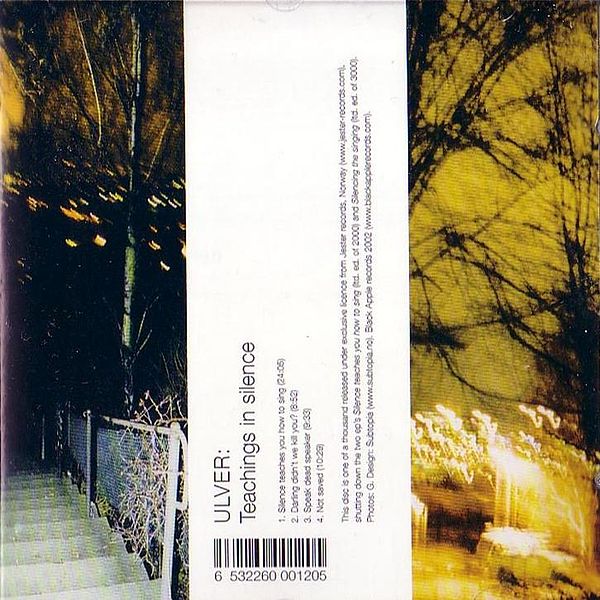
SOUNDTRACK: ULVER-Teachings In Silence (2002).

This EP is a collection of Ulver’s two previous limited edition EPs: Silence Teaches You How to Sing and Silencing the Singing.  It was originally released as a limited edition of 1000 copies, but has since been given wide release.  The two EPs that it replaced were officially retired (after print runs of 2000 and 3000 respectively).

“Silence Teaches You How to Sing” seems like perhaps Ulver has pulled a fast one.  The song starts with static…waves of static.  And you think, what, 24 minutes of THIS?  But after about four minutes, some quiet guitars layer through the static.  By 5 minutes a melody emerges, rather Twin Peaks theme-like.  Static resumes and then another wave of music bursts through and then, around 11 minutes, distant voices can be heard.  As the track nears the end you can hear a distant choir.  And by the end you’re listening so intently that you hear all kinds of things.

That was the only track on the first EP.  The second EP had three shorter tracks.  They are in a similar style to Silence, although there is more music.  “Darling Didn’t We Kill You” has a somber guitar melody and distant choral voices or a buzzing drone.

“Speak Dead Speaker” is more static (it’s easy to see why these two EPs were bundled together).  There’s more Twin Peaks style washes over the static.  I keep picturing the Pacific Northwest.  The last two minutes are a surprise cello version of the themes from the first 7 minutes.  It’s lovely and sorrowful.

The final track is a beautiful melody that repeats itself more and more quietly (with a wonderful loud funeral bell keeping time).  It repeats its cycle three times before ending.

Ulver continues to confound listeners.  Neither one of these EPs is really essential, but they are both interesting and really create a mood.

[READ: November 3, 2011] “Nilda”

This is the final uncollected story (according to Wikipedia anyhow) by Junot Díaz that I was able to access online.  There are two more stories “Invierno” (Glimmer Train 1998) and “Flaca” (Story, Autumn 1999) that I can’t seem to access online.  The rest of the listed short stories appear in Drown. 

This story is about longing and making the wrong choices.  Having read a bunch of Junot Díaz stories lately, this feels very much like a story he would write (I probably should have read Drown before I read these stories, but when I get to it, I’ll be able to confirm my suspicions).

In this story, Yunior, who is evidently the constant narrator in his earlier works (and in Oscar Wao) knows Nilda from school.  She was a friend of his–a kind of teasable friend–until puberty hit and her chest was to die for.  Unfortunately for Yunior, they were already friends, and she was off with other boys.

Indeed, Nilda was trouble more or less from the start–“brown trash,” he calls her.  Her mother was an alcoholic and Nilda was defiant.  She even spent time in a group home.  But she was nice and easy to talk to.  Dammit, why did she have to start dating Yunior’s brother Rafa? (more…)

Read Full Post »

SOUNDTRACK: ULVER-Perdition City: An Interior Soundtrack (2000).

Uver’s previous EP hinted at what would come next–electronic ambient tunes.  But it didn’t quite prepare anyone for this–a soundtrack to a film that doesn’t exist.  And yet with a title like Perdition City, you can pretty well anticipate the music that’s coming: think noir.

It is more electronica, and yet it is not just electronica.  The opening song “Lost in Moments” has a saxophone (!) solo.  And the song sounds like a perfect David Lynch/noir soundtrack to a dark and stormy night. 

What’s novel about the approach are the electronic noises and eccentric drum beats that punctuate the track.  The second track, “Porn Piece or The Scars of Cold Kisses” is broken into two parts: the first is a low, rumbling section with skittery noises and the second part has soulful singing (Garm, the only consistent member of Ulver (who goes by a different name on just about every record) has a surprising range of voices at his disposal).

“Hallways of Always,” “Tomorrow Never Knows” and “The Future Sound of Music” are sort of ambient tracks.  “Hallways” is quiet while “Future” grows in volume and chaos as the song proceeds.  “Tomorrow” is the most menacing of the three, projecting a state of noise and tension.  The interesting thing about these tracks is that although they seem like pretty conventional electronic instrumentals, they are actually fairly complicated in detail.  Some of the electronic pieces go on a bit too long, but as they are meant to be atmospheric rather than narrative, I guess that’s okay.

“We Are the Dead” bring in vocals again.  This time, it’s a spoken word narration over distorted radio voices.  And “Dead City Centers” also brings back some vocals.  Although only after about 4 minutes of noises and tension.  This time the vocals are more ominous (as the music grows more intense).

“Catalept” is the most interesting track on the disc–a remix of music from Psycho.  While the final song “Nowhere/Catastrophe” is an actual song–verses and vocals!  It’s a fairly soft song but it has moments of darkness that are quite cool. 

As a soundtrack this works wonders.  And if Ulver wanted to get into the soundtrack business, apparently their model of “making up your own soundtrack” worked.  Since this release they have recorded the soundtracks for two external films. 

As an overall release it’s a bit all over the place–jazzy sax, electronica, spoken word.  The mood is pretty consistent though, and although I don’t think I would do what the liner notes recommend: “This is music for the stations before and after sleep.  Headphones and darkness recommended,” I still enjoyed it.

[READ:  November 5, 2011] “Alma”

This is a very short story that falls pretty squarely into standard Junot Díaz territory (he says, having read like four pieces by him). 

I’m fascinated by these stories because Díaz is all about women being super hot and yet they are never objectified.  Well, in some ways they are of course–he lingers over their bodies as he describes them, but they are never just a body.  They are often smart or interesting, they are strong and powerful, and even when they are victimized (some by cheating boyfriends, others by far worse), they either fight back or get themselves to safety.  It’s nice to read about powerful women,even if the point of view is from her boyfriend.

This is the story of a young man falling hard for a hot woman (with a beautiful ass).  What fascinates me about Junot Díaz’s stories is that the women that his narrators fall for are Dominican, but they are also alternative to their culture.  So in this case, Alma is a “Sonic Youth, comic-book-reading alternatina” which makes me like her already. (more…)

Read Full Post »

SOUNDTRACK: MY MORNING JACKET-“Our World” (2011).

This song comes from the The Green Album, the grown- up-bands-cover-the-Muppets album.  I can’t remember if I knew this song to begin with or if I have just listened to this record enough that it sounds so familiar.

Although MMJ have been getting into some crazy electronic and heavy music as of late, this is a very mellow song.  It opens with a banjo!  And while more instruments come in, it stays pretty true to what you’d think the Muppets would sing.

(Aha, thanks internet.  It appeared in Emmet Otter’s Jugband Christmas).   It’s a really pretty song (Paul Williams knew his way around a ballad, huh?) and this is a very nice cover.

[READ: April 16, 2011] Babymouse: Beach Babe

This the third Babymouse book opens with Babymouse dreaming (of course).  But this time she’s dreaming of surfing!  And she can hang ten (and other surfing lingo) with the best of them.  Until a card says “Too Terrible to See.”  But when she wakes up she has wonderful news…it’s the last day of school!

We also see, to my understanding, the first real encounter with Squeak, Babymouse’s little brother.  When Babymouse runs for the bus, Squeak follows her calling out her name.  She tells him to go home and we see poor Squeak by the side of the road, looking dejected.

But we’re soon back at school, and during the film strip, Babymouse imagines she is the Little Mermaid.  But when she wakes up, the bell rings and school’s out for the summer!

When her parents tell them they’re going on vacation, she has an instant flashback to their terrible vacation last year (and the lack of “facilities” at the camp ground).  But this vacation is going to be different–they’re going to the beach!  And she is super excited…until the drive takes for-

ev-

er.

There’s even a surprising dream sequence about all the trees that she sees on the way down.

When they finally arrive, there’s all the usual beach fun and danger (sunburn!) and Babymouse gets to try her hand at surfing like in her dreams.

It was right around this time that I guessed that the beach that Matthew Holm was drawing was at the Jersey Shore.  And indeed, it is.  The end credits say that the Holms used to vacation at the Jersey Shore.

The book ends with that other classic childhood trauma–having a younger sibling and getting tired of playing with him or her on vacation.  When Babymouse complains about Squeak once too often, he takes it very personally.  And suddenly the story becomes a little frightening and quite touching.

For a snarky series, this one is surprisingly moving.  I wonder if having this book third helped establish that sensitive side of Babymouse (which seems to be missing in later books).  Good for you Babymouse!

Read Full Post »

SOUNDTRACK: COLIN STETSON-Live at All Tomorrow’s Parties, October 4, 2011 (2011).

In addition to playing SXSW, Colin Stetson also played All Tomorrow’s Parties, and NPR was there.  Unlike with SXSW, this set appears to be full length (about 50 minutes–which is a pretty amazing amount of time for him to blow that horn).  Like SXSW (and the album) Stetston starts with “Awake on Foreign Shores” and “Judges.”  What I love about this recording is that after Stetson finishes “Judges” a guy in the audience shouts (in a voice of total amazement) “That shit was off the hook!”  And he is right.  It’s not even worth me going into how amazing Steston is once again (check previous posts for  that), but man, just look at the size of that horn he’s playing (seriously, click on the link to see it bigger).

Stetson plays a few more songs from New History Warfare, Vol. 2: Judges like “The Righteous Wrath of an Honorable Man” (which is outstanding) and “A Dream of Water” (which works without Laurie Anderson, although he does say he’s sorry she’s not there).  He also introduces two news songs “Hunted 1” and “Hunted 2” which show new levels and new styles that Stetson employs.

This is a remarkable set, and Steston is clearly in his element (and the crowd is rapt).  The only problem I have is the recording level.  It must be very difficult to maintain recording levels for Stetson’s brand of noise–his louds are really loud–but you can’t hear him talk at all.  And most of the time, the introductions to his songs are worth hearing.  I’m sure if they tried to get the speaking level a little louder the music would have sacrificed though, so I think they made the right choice–I only wish there was a transcript available.

[READ: October 31, 2011] The Brief Wondrous Life of Oscar Wao

Apparently it’s pronounced, “Wow”, by the way.

Because of my new job, I don’t have a  full hour of lunch-time reading like I used to.  And so this book took considerably longer than I intended.  However, once I set aside some time to read it, I flew through the book.

I’m going to get this part out of the way because I was thinking about it throughout the book and I want to mention it without having it bog down the post.  This story reminded me a lot of Roberto Bolaño.  On the surface, sure this is because they are both writers from “Central America” (Diaz is originally from the Dominican Republic but moved to the US, while Bolaño is originally from Chile but moved to Mexico and then Spain).   But I’m not really talking about their origins so much as the style of storytelling.

Without going into a lot of Bolaño here, I’ll just say that Bolaño tends to write very detailed character studies–stories that follow one person throughout his whole life on something of a fruitless quest.  And the details of that person’s life include information about family members and distant relatives.  Further, Bolaño has written about the brutalities of both Chile and Mexico and how a person can survive in such a place.  Similarly, Díaz follows the life of Oscar and his extended family and he talks about the brutalities of the Dominican Republic.

This is in no way to suggest that there is any connection between the two writers. I mean, The Savage Detectives came out in the States in 2007 (same years as Oscar Wao) and while he certainly could have read it in Spanish, I have no evidence that he did (and as I recently found out, the first draft of the Oscar story was written in 2000).  Again, the parallels are only from my reading and have nothing to do with Díaz himself.

Okay, now that that’s out of my system…

This is the story of Oscar de Leon.  But more than that, this is the story of a fukú–a curse that befalls the de Leon family and follows them through several generations.  Oscar is the youngest member of the family and the person whom the narrator knows best.  So we see this fukú as it impacts Oscar.  And although the book is ostensibly about Oscar, it is about much more.

Oscar was born in Paterson, NJ (the town next to where I grew up!) and went to Don Bosco Tech High School (where many of my friends went).  Oscar is Dominican (his mother is from the DR, but he and his sister were born in NJ), but unlike every other Dominican male, Oscar is totally uncool, into geeky sci-fi and D&D and is clearly destined to be a virgin because he is fat with terrible hair and no social skills.

And, (no spoiler), as the title states, his life will be short. (more…)

Read Full Post »

SOUNDTRACK: locusts and an owl!

As we sat on the porch with silence all around us, we heard an owl off in the distance (I believe a barred owl).  It was pretty darn cool. (I posted a video after the break).

[WRITTEN: September 6, 2011]

I have been publishing a post a day here for something like two years.  I often have several posts scheduled for days in advance.  But the combination of a new job (with less goofing off time), a week-long vacation (with no free Wi-Fi? Come on!) and a natural disaster have left me silent for a few days.

Unlike the poor people in this photo (this is literally a half a mile from our house–the bridge is where the river normally rests).  Our house which is on top of a hill, was luckily unscathed–a little water in the basement and the loss of a twenty-five year old game of Monopoly was about the extent of our losses. 


Once we were clear, we headed down to Williamsburg, VA. 

We arrived at 10PM to find that our resort was completely powerless.  There were some areas nearby with power, but our hotel, set in the woods, was dark!  We were “luxury camping” for two nights. 

Fortunately Busch Gardens had power, so that ioccupied us for a full two days, and then soon enough everything was back to normal. 

And enjoying the vacation seemed more important than writing a few posts.  (more…)

Read Full Post »

SOUNDTRACK: PRIMUS-June 2010 Rehearsal (2010).

Just when I was convinced that Primus were a done deal, I learned that they were not only touring but had just released a free downloadable EP of their recent rehearsals.  It’s got 4 songs: two super oldies, 1 pretty oldie and one not terribly old one (these designations are in terms of albums releases, not length of time ago, as they would all be old ones by that reckoning).

The two oldies are my favorites: “Pudding Time” sounds wonderful–a few updates, and slight improv things, but basically that’s the song that introduced me to Primus.  “Harold of the Rocks” is the other one.  I love Harold, because it is such a weird, crazy song (even by Primus standards).  Lyrically, it’s about some guys who meet the fabled Harold of the Rocks.  Sometime later the narrator meets Harold again.  Harold is currently lit up like an old Christmas Tree and he tells the narrator that he doesn’t remember much about what happened that night.  And that’s pretty much it.  It even mentions Schooly D!  Great stuff.

The other two songs are “American Life” which comes from Sailing the Seas of Cheese.  It’s a deep cut as opposed to the more obvious single, “Jerry was a Race Car Driver.”  It’s nice to hear that song again, as it wasn’t very high-profile, although it is surprising to me that it’s 3 minutes longer than the original.  “Duchess and the Proverbial Mind Spread” is from The Brown Album, an album I don’t know all that well.  It’s got some good stuff in it, including a pretty good solo from Ler.

This EP features the drumming of Jay Lane, who was in Primus even before “Herb” (who I miss very much) and was in Sausage.  “Herb” by the way, was in A Perfect Circle and THE BLUE MAN GROUP!  Holy cowboys!

Primus sucks!

[READ: July 25, 2011] “Last Night”

This is an excerpt from Zone One, a book Colson Whitehead signed for me at BEA (I really must read it one of these days).

The story opens with something happening on Last Night.  It’s a little confusing, and since no context is provided, it doesn’t make all that much sense until the very end of the excerpt which (the end) blew my mind.

The story concerns Mark Spitz–not Mark Spitz the swimmer (or maybe it is Mark Spitz the swimmer–again, no context), –a teenager who goes to Atlantic City with his friend Kyle.  And for the most part, the story is pretty tame, almost dull (but Whitehead is a great writer and he invigorates what could have been a pretty typical Atlantic City gambling weekend).  The boys gamble, get comped and basically don’t leave the casino for the duration of their stay.

What I love about the story is that little things, meaningless sentences like, “They did not watch the news nor receive news from the outside” [when you are on a casino weekend with buddies you do not check the news] seem innocuous–like little details that would fill out any story.  It’s only later that… (more…)

Read Full Post »

SOUNDTRACK: PHOENIX–Wolfgang Amadeus Phoenix (2009).

It will soon be unsurprising to say that a great album has come from a French band (no offense to the French, but you never used to hear cool music coming from there).  Then we had Air and Daft Punk and now Phoenix.

The first single and leadoff track, the preposterously catchy “Lisztomania” features guitars and keyboards (just so we know they’re not another techno band).  It has a simple but infectious riff as it opens , and it never lets up in catchiness.  “1901” has a chorus that ends with some ayayayayayays that I dare you not to sing along with.

“Fences” has a pretty classic disco feel to it.  It’s followed by “Love Like a Sunset.” Part 1 is a five-minute atmospheric instrumental, and Part 2 follows along similarly.

“Lasso” follows with some more simple background keyboards topped with grinding guitars.  Like “Countdown,” it’s simple and hard not to like.  “Girlfriend” opens with great swaths of keyboards and lots of repeated words in the verses and chorus, making for yet another great single.   In fact, all of the songs are super catchy.

Despite the simplicity of the melodies, the songs are always interesting.  And that’s hard to beat.  There’s no surprise that this album was on many lists as one of the best of 2009.

[READ: October 28, 2010] “The Dungeon Master”

Reading this short story reminded me that I really want to read Lipsyte’s new book The Ask, which is supposed to be very good indeed.

The title of the story immediately made me think it would be about Dungeons & Dragons, and I was pleased to see that it was.   The story concerns a group of boys who have their own D&D club after school (as opposed to the school sanctioned D&D club).  Their game meets at the Dungeon Master’s house and there is no, repeat, no touching of the DM’s manual.

We quickly learn that the DM is a sadistic bastard.  He has killed off his younger brother’s character at least 30 times (and the brother keeps making a new character in his place: Valentine the 19th, Valentine the 20th etc).  But unlike in real D&D where you die from ogres and dragons, Valentine has died from, for instance, rectal cancer (how do you roll for that?).

There’s a lot of speculation about just how crazy their DM really is (rumors abound: he flashes some girls at the ice rink, he set his own feces on fire).  And, of course there’s talk that he spent some time in Bergen Pines.  And just where is his mother anyway? (more…)

Read Full Post »

SOUNDTRACK: THE DECEMBERISTS-Live at the Newport Folk Festival [excerpts] (downloaded from NPR) (2010).

The Decemberists played at the Newport Folk Festival this year. NPR audio has an excerpt for free listen/download on their audio site.

They say that they were not going to play the entire Hazards of Love album at this show, as had been their wont on this tour.  I’m not sure what their entire set consisted of, but the three excerpts here include: “The Crane Wife Pt 3,” “Yankee Bayonet” and a very extended “Sons and Daughters.”

It surprises me how well The Decemberists work in a live setting.  I think of their music as  complex and convoluted with strange instrumentation, and yet, perhaps because of the theatricality of it all, it all sounds great in a live setting.

I can’t really imagine them releasing a proper live album, so for those of us who don’t get to concerts much, this is the next best thing (the recording quality is excellent–I only wish it was their whole set).

[READ: October 12, 2010] “Otravida, Otravez”

Junot Díaz is the next writer in the 1999 New Yorker 20 Under 4o issue.

I didn’t like this story in the beginning because I couldn’t tell for quite some time the gender of the narrator.  Normally this doesn’t make a difference, but when the narrator climbs into bed with the man in the room, I had a hard time deciding if this was a subversive act or just a straight act of romance.  [I admit that since the author was male, I assumed the narrator was male, too].

It turns out the narrator is a woman (there is a clue when he says “Yasmin,” but in the first read I was unclear if he was saying her name or just a name in general).

In fact, to me, the entire beginning was very strangely set up and it took a few paragraphs (when she describes her job) before I felt the flow really took off.  However, once it did I found this story fascinating and convoluted in a very good and clever way. (more…)

Read Full Post »

SOUNDTRACK: PETER, BJORN & JOHN-Living Thing (2009).

After the raging (relative) success of Writer’s Block, with their crazily catchy whistling song, “Young Folks”, PB&J could have gone in any direction.

And I was quite surprised when the opening song of this follow up (actually, there’s an instrumental disc in between) opened with single note and drum sounds and virtually a capella vocals.  But unlike a typical a capella song, the thudding notes were kind of dissonant and unpleasant.  And there wasn’t much more to the song than that.

Even the second song starts out starkly.  A single piano note plays a simple riff.  The verse kicks in with some simple electronic drums (and again minimal accompaniment).  And this sparseness is the main musical theme on the disc.

And I have to say it took almost a half a dozen listen before I really enjoyed what they were doing.  They are eschewing the pop structure that won them popularity and they’re shifting their melodies to the vocal lines rather than the instruments (I guess).  It’s a risky proposition, but it pays off.

Take “Nothing to Worry About.”   It opens with what sounds like a distorted children’s choir singing the chorus at full volume.  But then it settles down into, again, a simple drum and vocals song with just a hint of instrumentation.  (Did they get all their music out on the instrumental?  I don’t know I’ve not heard it).  Even the title track is sparse guitar noises and clicked drums.  But, man, is it catchy (it reminds me in a weird way of Paul Simon).

And then, continuing my contention that the best and catchiest songs always have curses in them, “Lay It Down” with the chorus, “Hey, shut the fuck up boy, you’re starting to piss me off” will stick in your head for days.

The end of the disc (the last three songs) are considerably mellower.  They’re less catchy, but they use the starkness very well.

Initially I really didn’t like this album.  It had none of the immediacy of the previous disc.  But I found myself really enjoying it.  I wouldn’t want all of their albums to sound like this, but it was an enjoyable twist on a good formula.

[READ: October 7, 2010] Garden State

I mentioned the other day that I just found out about this book when looking up information about Rick Moody.  I was so excited to read a book set in Haledon (two towns from where I grew up) that I checked it out and begin it immediately (it’s only 200 pages, so that helped too).  But I have to say I was really disappointed with the book (even if it did win the Editor’s Book Award).

My first gripe is about the supposed setting in New Jersey.  I have no problem with fictionalizing an area.  Writers do it all the time.  But Moody fictionalizes the area in two ways to suit his thesis, and as a lover of New Jersey and a former resident of the region, I found the lack of reality to be very upsetting.

The first minor, and I have to say really weird thing is that despite the real towns included (Haledon, Paterson, Paramus) he makes up towns nearby–Fleece, Tyre– and he makes up a river–The Dern River.  He also plays around with the names of the highways that run through the state, constantly referring to the non-existent Garden State Thruway.  Now, again, there’s no problem with making things up, but nobody in the story ever goes to Fleece or Tyre, the Dern River doesn’t come into play aside from being a river that people refer to (it’s not a renamed Passaic river, because that’s included in the story, too).  So, why make up random town names?  Why say that you drive from Haledon to the edge of Paterson near Boonton, when that is not geographically correct (or relevant to the story)?  It just seems like he didn’t have access to a map. (more…)

Read Full Post »

« Newer Posts - Older Posts »