Feeds:
Posts
Comments

Archive for the ‘Sci-fi’ Category

comicSOUNDTRACK: BERNARD HERMANN-Journey to the Center of the Earth soundtrack (1959).

Herhermannmann is best known for scoring amazing pieces of music for Alfred Hitchcock and Orson Welles.  And during his prolific period with Hitchcock, he scored the 1959 version of Journey to the Center of the Earth.
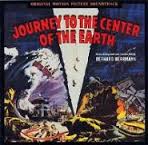
I have always admired Hermann’s scores as being very effective, although I’m not sure how enjoyable they would be to simply listen to (the opening to Psycho is pretty great as a piece of music though).

Because this is a ponderous sci-fi film that plumbs the depth of the earth, Hermann’s score is very ponderous as well, with long held very deep notes.  Although I haven’t actually seen it, so I don’t really know what is happening during the various score moments.  The opening sequence is very over the top, but it has some really great sounds in the organs (the bass notes are really ominous).

But it’s not all ponderous–there are trumpet blasts and harps.  The harp is quite a breath of fresh air and I can just imagine its revelation of something mystical.  Although the “march” is rather silly sounding and seems like something out of the Wizard of Oz (again, what could be happening in the film at this point?).  “False Arrow” is very uplifting (in a contemporary film sorta way) although with that title, I’m not too happy for them.

There are some moments like in Lost City/Atlantis where he sort of predicts prog rock.  There’s a  very cool organ sequence with single notes thrown in, that could easily come from mid period Pink Floyd.  While I wouldn’t want to listen to this soundtrack on its own for much of it, this sequence in particular could easily be played on a mix of trippy new age/prog rock music playlist.

Interestingly the soundtrack also has three songs sung by Pat Boone.  I didn’t actually listen to them so i don’t really understand how they fit in.  Especially in the soundtrack where they are interspersed with Hermann’s score.

[READ and WATCHED: mid July 2013]: Journey to the Center of the Earth

Recently re re-watched Journey to the Center of the Earth, the Brendan Frasier vehicle, with the kids.  It was a fun, kid-friendly adventure film—totally inoffensive and with a goodly amount of humor.  Aside from the gratuitous 3-D showoffiness (which just looks dumb in 2-D–can you even watch an old movie in 3-D on DVD?), the movie was enjoyable and, in its own way, faithful to the book.

I think.

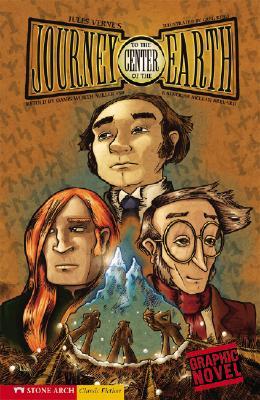
For I have never read the book.  Despite the fact that I have a category called “Hollow Earth” and had a plan to read as many hollow earth-based books as I could find and have even read a few of the more obscure ones, I have not read the famous one.  (One of these days).  But as we were watching the movie Clark said that he recognized the giant mushrooms.  I had gotten him this graphic novel a few weeks before and he read it and said it was really good.  Then he said that I should read it, too.  Not one to turn down a recommendation, I did.

Now I have to admit that I found the story a bit jumpy and disjointed.  I felt like there needed to be some transitions between scenes and more than once I turned to see if I had skipped a page.  Of course, since I don’t know the original, I don’t know if this is how the book is written (I  would doubt it), nor do I know how faithful this is to the book.  I realize that it is a major abridgment and is just meant to convey the essence of the story.  And if it makes readers want to delve into the full book, that’s pretty cool.  Of course, the story is such an integral part of historical storytelling, that just having this basis is good. (more…)


Read Full Post »

literarySOUNDTRACK: CHELSEA LIGHT MOVING-“Burroughs” (2013).

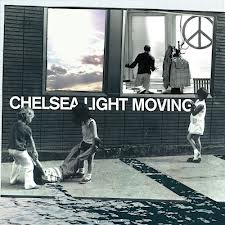
chelsea-light-moving-albumChelsea Light Moving is Thurston Moore’s new band [no comments about the state of Sonic Youth/Kim Gordon will be included in this post].  I don’t know anything about the other members of the band; I’ve not heard of any of them.  “Burroughs” is one of four new songs streaming on the Matador Records site.

The song is spot on for the noisy/sloppy style of Sonic Youth.  Fans of Sonic Youth will certainly detect some differences–the counterpoint of Lee Ranaldo is definitely absent, indeed, the entire low end sounds very different from what SY would create given this song.  But man, if you’re jonesing for some chaotic noise, this song has it in spades.

Moore is capable of creating some traditionally beautiful songs (see his Trees album), but here it’s all about discord.  The song is over six minutes long and the last 3 or so are devoted to some noisy guitars in both chords and solos.

While SY has not shied away from long songs, this song doesn’t feel like an epic–it’s not multi part or “extended” exactly.  It’s a fairly straightforward rock song with an extended solo section.  It’s really great.  I’m looking forward to the whole album (and I love the cover, too),

[READ: March 23, 2012] The Literary Conference

This has been my favorite Aira book so far.  And that’s probably because it is wonderfully over the top, mixing fantasy, sci-fi, genetics and literature.  All in 90 pages.

The story is about César Aira, translator.  He has been invited to a literary conference in Venezuela.  While there, he solves the age-old problem of The Macuto Line.  The Macuto Line is, essentially a rope which is attached to a pirate treasure.  For generations, people have tried all kinds of  things to impact this line–but it has proven to be unsolvable and indestructible.   Aira happened to be staying near the Line in a hotel.  He claims that he is no genius, but it just happens that the elements of his life have given him the exact information he needs to solve the puzzle.  And with a simple touch of the rope, the treasure is his.

But that’s just part 1 and has nothing to do with the rest of the story, really.  For despite his newfound wealth, he will still be attending the literary conference.  Primarily because he knows that Carlos Fuentes will be there (Fuentes is a real person, a Mexican author who died in 2012).  For, you see, Aira is planning to clone Fuentes in his bid to take over the world.  (In addition to being a translator, Aira is a mad scientist). (more…)

Read Full Post »

SOUNDTRACK: THE FLAMING LIPS-Dark Side of the Moon live at Hangout Music Festival, May 2012 (2012).

Recently, the Flaming Lips and friends released a version of Dark Side of the Moon that was noisy and chaotic and resembled the original in some  ways but departed from it radically in others.  When Palladia aired this concert of the band performing the album in its entirety I wasn’t sure what to expect.

I was pleasantly surprised that their rendition of the album is quite faithful to the original.  There’s plenty of Flaming Lips-isms in it, but it sounds a lot closer to the Pink Floyd version than The Flaming Lips and Stardeath and White Dwarfs with Henry Rollins and Peaches version.  And that’s a good thing.

I have to admit the audio wasn’t as clear as I would have expected (which is surprising for the Lips)–it was very hard to hear Wayne when he was talking.  That may have worked well for the singing though as he sounded almost exactly like David Gilmour on most of the songs.  The stage was also filled with people.  In addition to the four band members, there was a cast of dancers dressed like Swiss maids, there were some extra musicians  and two women.  One, dressed in a gold lame body suit (with wings) sang all of the wailing vocals on the album (and did a very good job) and the other I’m not sure what she did–neither woman was introduced during the aired set so I don’t know who they were.

Many bands throw things out into the crowd during a set, well, during “Money,” Wayne Coyne tossed out giant confetti balloons that were filled with actual money, allegedly $10,000 donated by none other than Dave Matthews.  That’s pretty intense and hopefully didn’t cause any damage.

Check Palladia for when they’re going to air it again.  I just learned that there is a You Tube video of the whole concert (more than just Dark Side of the Moon) and you can watch it here:

It’s a good fun set and shows just how much Stephen Drodz does on stage (I mean, seriously, check out the guitar he plays in “The Yeah Yeah Yeah Song”) and that Wayne’s hands must be either very cold or have no sensation.

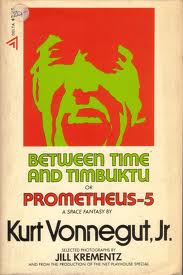
[READ: September 24, 2012] Between Time and Timbuktu

I have been reading a lot of Vonnegut lately. I had it in my head that I would just blow through all of his books.  But I admit I’m getting a little burnt out.  Deadeye Dick and Galàpagos were kind of numbing and Bluebeard which I’m working through now is fun, but a little exhausting.  There’s no reason I should be ordering new Vonnegut books to read now, but I saw that the library had a copy of Between Time and Timbuktu (which is hard to find) and since I won’t be using that library for much longer, I decided to order it.

And I’m glad I did.  Between Time and Timbuktu was a TV movie made by compiling a bunch of scenes from Vonnegut’s first few books.  The basic script was by David O’Dell and Vonnegut himself had a hand in working on it (like “grafting the head of a box turtle onto the neck of a giraffe”).  And as the story progresses you can see some of the best set pieces from his novels.

But the framing device is new.  A man, Stony Stephenson has won a jingle contest for Blast-Off Space Food.  The TV crew appear at his house (and meet his mother in a dressing gown (she’s a funny character)) to break the news.  He gets dragged away and a few months later we see the blast off of the rocket.  When he gets into space, Stony will launch into the Chrono-Synclastic Infundibulum (the Infundibulum comes from Sirens of Titan). (more…)

Read Full Post »

SOUNDTRACK: PINK FLOYD-Alan’s Psychedelic Christmas (1970).

I’ve always loved Pink Floyd’s Atom Heart Mother.  I have no recollection of how I stumbled upon this live bootleg, but when I saw that it contained one of the few live recordings of “Alan’s Psychedelic Breakfast” I had to give it a listen.

So this show is from 1970 and was recorded in Sheffield just before Christmas (Nick Mason evidently introduced the show while wearing a Santa Claus suit).  The sound quality is pretty good given that it is 40 some years old.  There’s a bunch of hiss, and the quieter talking bits are hard to understand, but the music sounds fine.

So the show opens with “Alan’s Psychedelic Breakfast” and what is so silly (and I assume funny to watch (a little less funny on bootleg) is that the band made and ate breakfast on stage.  As Collectors Music reviews writes: “This is the only known live recording of ‘Alan’s Psychedelic Breakfast’ but also hosts an amazing performance by the band which included them making morning tea on stage which is audible. Just like most of their earlier performances, the performance of “Alan’s Psychedelic Breakfast” slightly differs from the album version due to some nice jamming done by the band, especially Gilmour with his delay pedal.” As I said, some of the audio is static and hard to make out in this song–the band is conversing during their tea, but who knows what they are saying.  And who know what is o the radio.

Then the band gets down to business.  One of things I love about this period Floyd which is so different from their later work is that the played really long spacey jams often with very few lyrics.  So we get a 12-minute version of “The Embryo” (the only available studio version is a very short one on Works which is quite a shame as the song is really good).  A 14-minute workout of “Fat Old Sun” which is usually only about 5 minutes.

There’s a great version of “Careful with that Axe Eugene” and “Set the Controls for the Heart of the Sun” (15 and 12 minutes respectively).

Then in a killer version of “Saucerful of Secrets,” just as they get to the end, there’s a power failure (at least according to the song title).  The band is rocking out just hitting the climax when suddenly all you can hear are un-miked drums.  Ha. After a couple of minutes, power comes back and they pick up from just before where they left off.

Then the band launches into a full 31-minute version of “Atom Heart Mother” complete with horns and choir  of voices.  It sounds quite good (the horns seem a little sketchy but that might be expected with such staccato music).

The set ends and the band needs an encore.  Apparently they couldn’t remember anything else because they just re-do the last few minutes of “Atom Heart Mother” again.

One of the things that cracks me up about these shows in the 70s in England, is that the audience is so polite. Their applause sounds like a classical theater rather than a rock show.  And with a bootleg you know they didn’t try to make the audience sound bigger than they are.

The whole package is a fun trip.

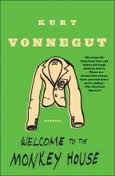
[READ: August 17, 2012] Welcome to the Monkey House

So this book is Vonnegut’s second collection of short stories.  But there’s a twist.  This collection contains all of the short stories from Canary in a Cat House except one. It also contains many of the stories he had written since then as well as stories not collected in Canary.  So you get basically 18 years worth of stories here.  And it’s interesting to see how much he has changed over those years (during which he wrote 5 novels, but not yet Slaughterhouse Five).

Since I read Canary a little while ago (see comments about the stories here), I knew that his 50’s era stories were influenced by WWII.  So it’s interesting to see how his stories from the 690s are not.  They deal more with day to day things and, of course, abstract concepts about humanity, although politics do enter the picture again once Kennedy is elected .

  • Where I Live (1964)

This was a good story to open with because it shows the then-later-period Vonnegut’s mindset and location.  This story is about Barnstable Village on Cape Cod (where I assume Vonnegut lived since there are a number of stories set on the Cape).  This is a very casually written story about an encyclopedia salesman who goes to the local library and sees that their two encyclopedias are from 1910 and 1938.  I enjoyed this line: “He said that many important things had happened since 1938, naming among others, penicillin and Hitler’s invasion of Poland.”  He is told to talk to the library directors who are at the yacht club.  I love the attitude that Vonnegut creates around the village which “has a policy of never accepting anything.  As a happy consequence, it changes about as fast as the rules of chess.” For really, this story is about the Village more than the encyclopedia salesman, and it’s an interesting look at people who move into a new place and want it to never change. (more…)

Read Full Post »

SOUNDTRACK: REGINA SPEKTOR-Soviet Kitsch (2004).

After the poppy, polished joy of Far, I went back and decided to check out the one other Regina Spektor album I knew of–Soviet Kitsch.  This album has always stuck with me as an interesting title.  I ordered it from Amazon and was bummed to get a little cardboard sleeve rather than an entire disc (her artwork is really nice).  So I was a little biased against this disc from the start.  The music also doesn’t have any of the polish and sleekness of Far.  So it took a while for me to see the beauty within.

This album is largely simple piano (with strings and other addition), but it’s a much more raw album (akin to something like Tori Amos’ Little Earthquakes).

“Ode to Divorce” is a quiet piano song with some catchy moments.  “Poor Little Rich Boy” has some interesting percussion to accompany the piano.  And in this song you know that she’s in a slightly different territory than Tori Amos, which is good–the feeling is similar but the end result is unique.  Lyrically the album explores different ideas and on this song the repeated refrain of “you’re so young you’re so god damn young” is a little unsettling.  “Carbon Monoxide” introduces a more full sound (bass and drums).  And Regina shows off yet another side of her personality–playful, flirtatious and now almost childish (“C’mon, daddy.”)

“The Flowers” introduces another new aspect to the disc–more aggressive/borderline classical piano playing (rapid, loud notes).  It suits her style quite well and this song is  a definite highlight.  The end of the song has a very Russian-style nonsense syllable sing along which is very fun.   “Us” adds strings to the song and some great sing along parts.  “Sailor Song” is a funny song from a sailors perspective with the sing-along shanty chorus “Mary Anne’s a bitch” (complete with broken glass sounds).

The next song “****” is a whispered little conversation in which a young girl asks Regina when the next song is coming.  It makes the next song, “Your Honor” even more loud.  It really stands out on this disc because it is a full on punk song with screamed vocals and band work from Kill Kenada (who I don’t know anything about).  The song is about getting in a fight to defend a woman’s honor.  The slow piano middle section features the amusing question “gargle with peroxide a steak for your eye but I’m a vegetarian so it’s a frozen pizza pie…you fight for my honor but I just don’t know why.:”

“Ghost of Corporate Future” has a kind of lullaby feel and some amusing lyrics, ” When he gets to the crowded subway platform/He takes off both of his shoes/He steps right into somebody’s fat loogie/And everyone who sees him says “ew”/Everyone who sees him says “ew”/But he doesn’t care/Cause last night he got a visit/From the ghost of corporate future/The ghost said take off both your shoes/Whatever chances you get/Especially when they’re wet.”  It’s all sung in a manic style over a quiet piano melody.

“Chemo Limo” is certainly the highlight of the disc.  It’s 6 minutes long and is quite dramatic.  The basic premise is that dying from cancer sucks, so she’s going to live instead: “I couldn’t afford chemo like I couldn’t afford a limo/And on any given day I’d rather ride a limousine.”  There are several sections in the song–allowing Regina to show off her dynamic and dramatic vocal range (serious falsettos) and very impassioned sections, “Oh my God Barbara she looks just like my mom”  She even does some (very mild) beatboxing at the end of the song.  “Somedays” is a pretty, simple ballad, with some great vocals although it kind of gets lost at the end of the disc.  Although I was not that into this record when I first got it, repeated listens revealed wonderful surprises inside.

[READ: July 15, 2012] Canary in a Cat House

This is Kurt Vonnegut’s first collection of short stories.  It is currently out of print.  That’s not a big deal because almost all of the stories were later collected in Welcome to the Monkeyhouse.  But I thought it would be fun to read them in the original book.  When it came in from the library I was surprised at how tiny it was.  But what was really surprising was how small the print and how small the margins were.  They really crammed stories into collections back then!

These stories were all written in the 1950s and what was also surprising to me was how serious and unfunny some of those first stories were.  I realize that these were some of his first works, but the Vonnegut voice is so distinctive–a misanthropy tempered by jokes and absurdity, that I was surprised that some of these stories were not only serious but seriously emotional as well.  It’s been clear from all of his stories that WWII impacted his life tremendously (as one would expect), but in these early stories he talks very deliberately about violence and the cold war and the aftermath of WWII.  It’s pretty intense.  By the end of the book the more typical Vonnegut voice surfaces–sci-fi kinds of stories with dark humor involved.  It’s quite a collection. (more…)

Read Full Post »

SOUNDTRACK: INVISIBLE GUY BLOG (2012).

Jonas from Invisible Guy contacted me about a project he’s working on.  I’m not quite the right fit for it, but I had to check out his site to see what he was all about.  As his About page explains; “This blog is generally a platform for unknown bands to get promoted and interviewed.”  That’s pretty awesome in itself.  But as I browsed the site, I saw that in his post Invisible Guy recommends: 80s Post-Punk – 1982 (Part II) he includes not only The Birthday Party but also The Virgin Prunes.  Much respect there (especially for someone who wasn’t alive when those records came out!).

But the bulk of his site is full of really obscure bands (lots of bands that I’ve never heard of).  He interviews band members (sometimes in Swedish!) and has quite an impressive list of publications that he’s worked for.

So head on over to Invsible Guy for a wonderful collection of punk and hardcore music as well as some iconic (and really obscure) new wave and post-punk tunes.  He’s also got some great stuff on death metal too.  Not bad for a site that’s only a few months old.  Invisible Guy has a lot of samples and videos as well as a bunch of streaming music from unreleased or just-released albums (like this demo from the Swedish band Regimen called Välkommen hem).

And here’s a video for the Swedish stoner metal band Skraeckoedlan.  The song is “Apple Trees” and no you can’t understsnad the words because they are in Swedish.  I love that.

It’s a great site.

[READ: June 15, 2012] “A Psychotronic Childhood”

The more I read Colson Whitehead, the more I like him, not just as a writer, but as a “person” (the person he presents to us anyhow.  Although I met him briefly at a convention and he was super friendly and very nice).  This essay shows that he and I occupied some of the same headspace when we were kids (we were born in the same year)—watching sci-fi and horror movies on Channel 7 & 11 after school and on the weekends.  Of course, I didn’t really get into horror movies until much later them him (his first time was when his parents took him to  a horror film in the theater at the age of 5).  FIVE!

These early horror movies really shaped his outlook.  He lists about 70 movies in this article, of which I have seen at least half (although more from MST3K than actually sitting through them unaccompanied) and his summaries about them (four or five parenthetical words) are apt and often hilarious:

  • Food of the Gods (giant chickens rain pecking doom on a small island)
  • Alien (an outbreak of tummy trouble among space miners)
  • Demon Seed (rom-com about a horny computer that wants to impregnate Julie Christie)
  • The Devil’s Run (A negligible and mind-numbing film, notable only for the utter ineptitude of its attempt to cash in on the brief occult-movie fad that followed Rosemary’s Baby and The Exorcist.

The Devil’s Run is the first movie he saw, back in 1975, in the theater.  He says that there was something good in it, that it really captured the element of terror when your loved one turns on you.  And he tapped into this for his novel Zone One.

Then he reflects back on 1981, when his family bought a VCR and he and his brother would head to Crazy Eddie (remember Crazy Eddie?) to rent 5 movies for the weekend (I didn’t even know they rented movies!).  The movies were inevitably 4 horror movies and one mainstream film.  And the family would gather by the TV and watch together.  How wholesome!  Except when you read what they were watching (I can’t IMAGINE my family watching these together when I was a kid–even now, Sarah hates horror films).   This is getting into the era of Friday the 13ths and Halloweens as well as classics like Terror Train, Prom Night, Slumber Party Massacre, Silent Night, Evil Night, Mother’s Day and My Bloody Valentine (“not even the holidays, hallmark or otherwise were safe”). (more…)

Read Full Post »

SOUNDTRACK: SURFER BLOOD-Tarot Classics (2012).

I really enjoyed Surfer Blood’s debut album.  This EP is a little stopgap until the next one. Although the sound is unmistakably Surfer Blood–poppy hooks and a very recognizable singing voice, the band sounds a little bit different here.  They haven’t lost any of their catchiness–there may be even more on the opener, “I’m Not Ready” (who doesn’t love when the guitar and vocals match each other?)  “Miranda” has that fun thumping chorus that is always fun to sing along to.

“Voyager Reprise” moves away from the surf-styled songs of their debut into an alt-rock of the 90s sound–when guitars were noisy (until they were quiet for a bit) and guitar solos happened between verses instead of as the third verse.  And “Drinking Problem” has a kind of early Depeche Mode (in vocals, not synths) feel–quite a departure from their debut.

In the way of EPs, the final two songs are remixes.  I’ve never been a fan or remixes and these don’t do much for me, but i do wonder if they will have any impact on their future sound.

[READ: June 14, 2012] “Olds Rocket 88, 1950”

All this time I thought there were only five of these short essays in this sci-fi issue of the New Yorker.  And yet tucked away near the back was the sixth one by William Gibson, a pioneer in science fiction.

Gibson’s recollection is of being a child and having everything seem like science fiction–something that is notably absent these days.  Like the chrome trim on his father’s Oldsmobile Rocket 88, the prevalence of spacemen and space-themed ideas everywhere.  Even the word Tomorrow was capitalized.

Then he recounts a personal incident.  He got in trouble with his parents for arguing with an Air Force man.  The man said space travel would never happen. But Gibson knew it would.  How could it not?  And science fiction shaped this worldview.  Not that he believed the stories would come true, but that his entire mindset was that in the future “things might be different…and different in literally any way you could imagine, however radical.”

What a wonderfully freeing notion.  To me, this sort of future-looking lifestyle accounted for the unprecedented achievements of post 1950 America.  Now that we no longer think of tomorrow with a capital T, we don’t seem as enchanted by the future.  Perhaps it was a naive outlook, but you need a certain degree of naiveté if you hope to do anything radically new.

Gibson ties in the sci-fi books he bought for a dollar to other fantasists: J.G. Ballard, Ursula K. Le Guin, Michael Moorcock, and how these thinkers weren’t all that far off from the likes of Kerouac and William S. Burroughs.  And he believes that without science fiction, he might not have been interested in what these other radical writers had to say.

It’s a short piece, but it really made me wish for more chrome and space-age technology in our lives–when people weren’t afraid to dram big.

Read Full Post »

SOUNDTRACK: PHISH-The Man Who Stepped Into Yesterday (1987).

This record was created by Trey Anastasio as his senior project at Goddard College.  The thesis included an essay piece and this collection of songs (recorded by Phish) relating this epic tale from the band’s fictional land of Gamehendge.  It was never officially released, but since Phish is so free with the tape trading, it is pretty widely available online (heck, even Wikipedia has a link to the Lossless SHN download of the album).

This release is legendary in the band’s history because they have played all of the songs from this album many times in their live shows (some much more than others, of course).  And while they have more or less played the Gamehendge saga a few times in concert, I’d always wondered what the original story was all about (many songs have since been added to the saga as it grew larger).

So here in all its tape-hissy glory is the original.  My first thought is that I guess it was hard to get good sound recording equipment in 1987 (or else this is a multi-generational copy—the “white cassette” from a year earlier sounds better).  And there seems to be a few flubs in the narration (which could be from copying).  I actually surprised he didn’t use a more authoritarian voice for the narration.

For fans, this is fun to hear because of that narration.  Live, the narration varies all the time, not always explaining what is going on the same way (some live narrations are far better and much more interesting).  But here you get it straight from the source.  The narration is accompanied by rather pretty instrumental music (which varies depending on who he is speaking about).  But for those of us who know all of these songs, the biggest surprise is finding out that “AC/DC Bag,” “The Sloth,” and “Possum” were part of the story (or maybe the biggest surprise is learning from the narration what the hell an AC/DC bag is (a robotic, mechanized hangman, of course).

The story is pretty interesting (Wilson and the Helping Friendly Book and all that), although by the end it loses itself a bit.  And I’m not really sure that “The Sloth” and “Possum” fit into the story at all.   But hey, he was a college senior when he wrote it, one can forgive a little sophomoric nonsense, right?

[READ: June 11, 2012] “The Republic of Empathy”

This is the first fiction I’ve read of the sci-fi issue.  I’m not sure if it’s supposed to be sci-fi, because it’s not really, at least not in terms of genre (I’d say sci-fi fans would object to the designation of sci-fi for this).  But it is futuristic and neat.  I especially enjoyed the humor and the construction of the story—Lipsyte is usually good for both of these.

It begins with William.  Williams is married to Peg.  Peg wants to have a second child as a gift for their first child (who has just grown out of the new baby smell).  William thinks this is crazy, but Peg says it’s a dealbreaker.  The next day William, who works for a flip-flop company, smokes a joint with an ex-cop friend, Gregory on the roof of their building.  On the roof across from them, they see two men fighting. And then one falls of the roof—splat.

Gregory says he’s seen this before but that William will be traumatized.  And he is in his dreams, but he’s even more traumatized when he dreams that his wife is pregnant and they already have two kids.  Oh, and that the neighbors, the Lockhorns, masturbate each other in the living room with the windows open.

Section two is from Danny’s point of view.  Danny is Gregory’s son.  Every few weeks Gregory is dating a new, younger lady.  This one is only a few years older than Danny.  It’s gross (and Danny feels like a bad YA narrator as he relates the story).  This is all before (I assume) Gregory comes out of the closet.  Because William knows that he’s gay in the above scene. (more…)

Read Full Post »

SOUNDTRACK: SQUAREPUSHER-Solo Electric Bass 1 (2009).

Yesterday I said that one Squarepusher CD was enough for me.  I did some digging and found out that he has put out a whole bunch of CDs.  And, to the surprise of me, at least, not all of them are crazy electronic music.   This CD, as the title states, is a collection of electric bass solo songs.  The songs were performed live as part of the Jazz à la Villette 2007 festival and were played on an electric six-string bass with no pedals or effects.

And that is all you get—serious solo bass songs.  The man behind Squarepusher, Tom Jenkinson, is apparently a virtuoso musician (who knew?) and these songs really show off his chops (just listen to the insanity of “Seb-1.05” (catchy title, eh?)).  He can play some impressive Spanish-sounding songs–that would probably sound better on a guitar, but sound more impressive on a bass (“Seb-1.06”).  He’s got some great slap stuff going on (“Seb-1.03”), and he really knows from melody (also “Seb-1.03”).  True, 12 all bass songs can meld into one another, but the crowd really loves it (and like a lot of things, seeing it is probably more impressive than just hearing it).

It’s not exactly “fun” listening (even if you love bass solos).  Only 850 copies of the disc were released, so it’s not like they expected a big audience for this.  But it is pretty neat to hear a) how good he is and b) that his main musical output is noisy electronic noodling.  That gives me even more respect for his electronic output.

[READ: June 5, 2012] “The Spider Women”

Margaret Atwood is another author I wish I had read more of—and I’m getting there.  I often wonder if I should just read an author start to finish and be done with him or her or if that just leads to madness.

Much like Miéville says in the previous essay, children don’t read genres, they just read what they like.  I loved Atwood’s idea that “below a certain age, [children] don’t distinguish between ‘true’ and ‘not true,’ because they see no reason why a white rabbit shouldn’t possess a pocket watch, that whales shouldn’t talk, or that sentient beings shouldn’t live on other planets and travel around in spaceships.”  After all, sometimes reality lives under the bed and has sharp claws. (more…)

Read Full Post »

SOUNDTRACK: SQUAREPUSHER-“Dark Steering” (2012).

Hot on the heels of a review of LMFAO I get to the other side of the spectrum in electronic music—Squarepusher.   There’s no big choruses, heck there’s no words, but this music shares something with LMFAO.  Well, actually it really doesn’t—except maybe keyboards.

Squarepusher play dark angular music. It’s very electronic and alien (and sounds like it may have been used in the background of Skinny Puppy songs back in the day). It’s abrasive and the sounds are otherworldly and yet in this song, there’s a melody to it.  I have but one Squarepusher CD—that’s probably enough for me.  But I am always interested to hear new music by him.  It’s impressive the way he can take a song that starts out so noisy and get it to sound like real music by the end.  It like the science fiction of music.

[READ: June 5, 2012] “Forward Thinking”

I have read only one book by China Miéville—Perdido Street Station.  I found it to be quite challenging for a bunch of reasons and figured I wouldn’t read more by him.  And yet I find that images from that book stay with me to this day (at least ten years on).  So maybe it’s time to give him another shot.  But where to start?

This entry in the New Yorker’s Sci-Fi issue is written as an “E-mail sent back in time to a young science-fiction fan.”  And I loved it.  I enjoyed how it started (with the author knowing that E-mail doesn’t exist at the time the recipient will get this—so who will it show up?)  And I loved the central question: “How did you get into this stuff?”  The sender knows that the kid will get asked this a lot, but the question should be turned around: “How did you get out of it?”  Because all kids love sci-fi concepts.  It’s just that some move away from it as they get older.

Miéville includes a few key moments in (his) sci-fi history: Page 40 of “The Tale of Mr. Jeremy Fisher” by Beatrix Potter.  What?  Indeed, for this is the first time that (you) will be ware of knowing something the protagonist doesn’t—that there’s  fish coming up to get him.

Next is Chapter 13 of Golem100 by Alfred Bester.  I have never heard of this book.  Although Miéville does warn us about it—he read it far too young and there’s some sadistic violence in it, what attracted him (and me, now) is the disrespect for text—part of the story is a musical score, another is a picture.  It sounds cool.  And of course it is long out of print. (more…)

Read Full Post »

« Newer Posts - Older Posts »