Feeds:
Posts
Comments

Archive for the ‘Religion’ Category

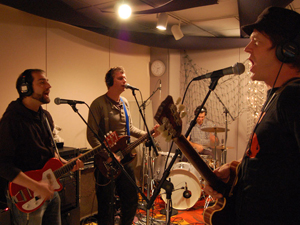
SOUNDTRACK: RA RA RIOT-Live at the Black Cat, Washington DC,  October 12, 2008 (2008).

I really like Ra Ra Riot’s album The Rhumb Line, and this concert is basically a showcase for that album.  There’ s an interview at the end of the show (all downloadable from NPR), in which the  band says that critics raved about their live show as much as their album.

I don’t really hear that the show is more energetic than the album (maybe visually they are wild), but it did sound fantastic.  It’s amazing to hear a rock band that is dominated by strings–the cello and violin are often louder than the guitar (but not in a competing/drown you out kind of way,  more of a strings do the melodies and the guitar adds bulk to the sound).

I always enjoy hearing a band that is grateful to their audience for showing up (this is most evident in young bands, who seem so much more genuine about their love of the audience) and Ra Ra Riot are certainly that .  They seem genuinely surprised at the turn out, and they play a great set accordingly.

There are two songs that aren’t on the album here “A Manner to Act” and the encore “Everest.”  They both feel like they came off the album, which bodes well for their second album, Orchard, which just came out in May.  Ra Ra Riot also do a great cover of the obscure Kate Bush song “Suspended in Gaffa.”  At the end of the show they tack on a cover of “Hounds of Love.”  Lead singer Wesley Miles has a wonderfully strong voice and he can reach some pretty high notes–not soprano or anything like that, just strong enough to be able to pull off a Kate Bush cover.

This is a great show.  And when you read about the tragedy they suffered just as they were starting to take off, their obsession with death may not be so surprising.  I’m looking forward to Orchard.

[READ: 1995 and August 18, 2011] Microserfs

After reading Life After God and thinking about Microserfs, I looked up Coupland’s bibliography and saw that indeed Microserfs came next.  And I was really excited to read it.  I have recently watched the JPod TV show and I knew that JPod was a kind of follow-up to Microserfs, so I wanted to see how much of it rang true.  And I’ve got to say that I really rather enjoyed this book.

While I was reading this, I started taking notes about what was happening in the book.  Not the plot, which is fairly straightforward, but about the zeitgeisty elements in the book.  And, since I’m a big fan of David Foster Wallace, I was also noting how many zeitgeisty things this book had in common with Infinite Jest.  I’m thinking of tying it all together in a separate post, maybe next week.  But I’ll mention a few things here.

My son also loved the cover of this book because it has a Lego dude on it and he has been really getting into Lego lately.

So Microserfs is the story of a bunch of underpaid, overworked coders who work for Microsoft.  The book is written as the journal of Daniel Underwood (Coupland still hadn’t really branched out of the first person narrative style, but the journal does allow for some interesting insights).  The story begins in Fall 1993.  I felt compelled to look up some ancient history to see what was happening in the computer world circa 1993 just for context.  In 1991, Apple released System 7.   In 1993, Windows introduced Windows NT, Intel released the first Pentium chip, Myst was released and Wired magazine launched.  In 1994, Al Gore coined the term Information Superhighway.  Yahoo is created.  The Netscape browser is introduced.  So we’re still in computer infancy here.  It’s pretty far-seeing of DC to write about this.

Daniel works at Microsoft with several friends.  Daniel is a bug tester, Michael (who has an office, not a cube) is a coder, Todd (a bodybuilder) is a bug tester.  There’s also Susan (smart and independent), Abe (secret millionaire) and Bug Barbecue (an old man–he’s like 35).  The five of them live in a house on “campus.”  There’s also Karla (a type A bossyboots who doesn’t like seeing time wasted) who works with them but lives up the street.

As the story opens, Michael has just received a flame email from Bill Gates himself and has locked himself in his office.  This leads to a very funny scene and ongoing joke in which the office mates feed slide two-dimensional food under his door and he vows to eat only things that are flat. (more…)

Read Full Post »

SOUNDTRACK: RUSH-“Garden Road” (1974).

So the bootleg that I mentioned yesterday was in fact incomplete.  On the Up the Downstair site, the track list includes “What You’re Doing” and “Garden Road.”  When I wrote to the cool host of Up the Downstair, he said that these two songs were available on You Tube and that he’d try to find them and add them to the site.

So in the meantime, I got to listen to the song on YouTube.  This is a song that the band wrote but which they never recorded (same is true for “Fancy Dancer”).  I have to imagine that they wrote these songs for their second album (along with “In the End” which they kept) around the time that Neil Peart joined the band.  Once they realized that Neil could write better lyrics, they scrapped these two heavy rockers.  Both songs have great riffs, even if lyrically they’re pretty poor.

The song rocks pretty well, although the solo seems to have been put to better use in “Working Man.”  I enjoy how the song breaks for the shouts of the Garden Road chorus (kind of like “Bad Boy”–perhaps it was a “thing” for them).  I rather like this song, and I think I like it better than a couple of the songs on Rush.

Check it out.

Maybe it’s time to release these old chestnuts for the fans?

[READ: August 10, 2011] Life After God

After the success of Shampoo Planet, Douglas Coupland wrote several short books (which were really short stories).  They were compiled in Life After God.  To me this book also stands out as another odd one from DC, because it is very tiny.  Not in length, but in height.  It’s a small book, about the size of a mass market paperback.  But it makes sense that it was made this short because it is written with lots of short paragraphs that lead to page breaks (kind of like Vonnegut).

For instance, the first story contains at most two paragraphs per “chapter” about–16 lines of text and then a page break.  At the top of each page is a drawing from DC himself which illustrates to a small degree the information on the page.  It leads to incredibly fast reading and even though the book is 360 pages, you can polish it off pretty quickly.

But what’s it about?  Well, mostly the stories seem autobiographical (even though they are classified as fiction.  And actually, I don’t know anything about DC’s personal life so I don’t know if they are based on anything real, although I do know he doesn’t have any kids, so those can’t be true at any rate).  There are eight stories.  They are all told from the first person and are more or less directed at “you.”  They all seem to deal with existential crises of some sort.  They are honest and emotional.  To my ear, sometimes they seem a little forced, maybe it’s contextual, but it’s hard to write this kind of massively introspective piece and have it sound “real.”  (But maybe I’m not very introspective about things like this myself). (more…)

Read Full Post »

SOUNDTRACK: GOGOL BORDELLO-East Infection (EP Extra) (2005).

I learned about Gogol Bordello from some live shows available on NPR.  I enjoyed their sets so much I decided to check out their albums as well.  And I love them.  The albums are full of frenetic energy (they give Sarah agita, she says).  But everything that I love about fun, spirited, gypsy music is present here.

The band is essentially a band of gypsies, headed by wonderfully-mustachioed Eugene Hutz.  And their live show (as demonstrated by the included video) is a wild circus of fun (curtains and dancers and fire buckets and bowling pins and musicians jumping out of boxes), it’s like a wild party.  The video is for “Never Young Again” which would appear in full on their next album. It’s a fun song that reverses the age-old lament of wanting to be young again.  But mostly you watch this for the live footage.

This EP is probably not the best place to start as an introduction to Gogol Bordello (but it was really cheap so I bought it first).  Although it does offer many of the different aspects of Gogol’s music.  The EP features 6 songs and the video.  The songs are intense, hyper, crazy and wonderful.  “East Infection” opens with some nonsense lyrics (“Lee lee lee lee lee, la la la la la”) and morphs into what may be more nonsense, although there’s actual lyrics here.  “Ave B.” (which is also on their following album Gypsy Punks) is a more acoustic-based song, but it still has loud parts to it.

“Mala Vida” is a cover of a song by Manu Chao.  This version is a super fast punky track sung in Spanish (despite Eugene Hutz’ origins in the Ukraine, he has lived in Brazil for years and sings many songs in Spanish).  The original is very similar in temperament, although GB version is a bit more frenetic.

“Copycat” is the odd track on the disc, it’s a kind of dub track with big fat bass and a very slinky sound.  It and “Mala” were produced by Steve Albini.

“Strange Uncles from Abroad” is to me a very typical GB song: lots of violin, lots of dah dah dahs and a great melody.  It has a total gypsy feel, and goes through some loud and quiet moments.   The final track, “Madagascar-Roumania (Tu jésty fáta)” is the longest track by far (6 minutes).  It sounds like a demo and lacks the punch of the rest of the disc, but it showcases the softer side of the band (and yes there is one).

So, maybe this EP is a good place to start after all.  It’s certainly not throwaway material.  And the EP cover alone is pretty outstanding.

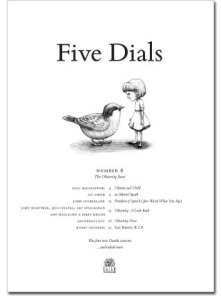
[READ: June 14, 2011] Five Dials Number 10

This is the issue of Five Dials that introduced me to the publication.  It is a special issue devoted to the memory of David Foster Wallace.  The entire issue is comprised of the eulogies given at the DFW memorial.  [The details are a little sketchy here…I’m not sure if these are all of the eulogies or just the eulogies from well known people.  I’m not even sure who would have been in the audience for this memorial.  The notes say “These tributes were given on 23 October, 2008 at the Skirball Center for the Performing Arts, New York University” and yet the Jonathan Franzen entry says “here at Pomona.”  So… details are sketchy].  Nevertheless, the tributes are heartfelt, informative and very moving.

Of course, I’m not going to ‘critique’ them, I’ll just try to summarize them.  But really, they’re all worth reading if you’re a fan. (more…)

Read Full Post »

SOUNDTRACK: TRENCHMOUTH-Vs the Light of the Sun (1994).

I learned about Trenchmouth from an interview with Fred Armisen on The Sound of Young America.  He informed us that he was the drummer in Trenchmouth before he was on SNL.  And he and Jesse Thorn had an amusing discussion about how he was sure they would make it big.  I can’t recall if they played a snippet of the band or not, but it’s a pretty laughable thought that Trenchmouth might be his claim to fame.  Because they are awesome, but they are totally NOT commercial.

In fact, just a few seconds into the lead-off track “Washington! Washington!” will tell you how noncommercial they are.  (It’s a sort of fast heavy punk version of prog rock–jazzy guitars, independent bass, wonderful drumming (Armisen kicks ass) and the screamed hyperkinetic vocals of Damon Locks (he’s passionate, man).

There’s a lot of atonal work here (“Washington! Washington!” opens with drums and Lock’s ragged voice), and once the guitars kick in, it actually makes the song more confusing.  “A Prescription Written in a Different Language” opens with wavering harmonic notes before busting into a full on punk noisefest.  The album lurches around to different styles of weird noise rock (most of the songs are quite short, although “A Man without Lungs” runs over 6 minutes).

But before making it sounds like this is a mess of a record, a few listens will reveal the sanity beneath the chaos.  There are even some discernible choruses: “Here Comes the Automata”‘s “Everybody needs protection” and “Bricks Should Have Wings”‘ “Let the bricks fly” are fun to sing along to.  Similarly, the guitar work that opens “Set the Oven at 400” is rather conventional and quite pretty.

This disc is not for most people, but Trenchmouth is a cool band that has been unfairly lost to the annals of history.

[READ: April 4, 2011] “Rome, 1974”

I had received a pre-pub of Bezmozgis’ novel The Free World, but I haven’t read it yet.  I am interested in Bezmozgis’ writing and was planning to read the book.  As it turns out this “story” is really an excerpt from the novel.

The story is about the Krasnansky family, a Jewish extended family emigrating from the Soviet Union to Italy.  The opening scenes detail the physical hardship that such a move would have taken (it’s played for somewhat comic effect when the large duffel bags are thrown off the train).  There is much dissent among the family members although they sem to settle in well–except for patriarch Samuil who is disconcerted by everything and unhappy to have left the communist country he feels comfortable in. (more…)

Read Full Post »

SOUNDTRACKFLAMING LIPS-“Two Blobs Fucking” (2011).

As I understand it, the Flaming Lips will be releasing an EP a month for the next twelve months–all in an unusual manner.  The first track, “Two Blobs Fucking” comes as a 12-part free video download.  Like with their album Zaireeka (which had 4 discs that you were supposed to play simultaneously to get the full effect), this song  comes as 12 separate audio tracks.  According to the online instructions, you’re supposed to get 12 friends with iPhones to each download a section and to play them at exactly the same time.  I don’t have an iPhone (or 12 friends that I could get in the same place at the same time to listen to a song), so I did the next best thing: I used YouTube Downloader, converted the tracks to WAV and then mixed them with Audacity.

I have received many CDs over the years that have mixing technology where you can play certain tracks and not others, but it’s very rare that I play around with them.  This whole process was easy enough that I made 20 different mixes of the song.

The “full” version is a fascinating amalgam of noises with a very cool riff that opens the track.  About midway through, the whole song is taken over by noise–a distorted squealing noise–for a few seconds.  And then the song continues as it was with gentle washes of sound.

The twelve tracks include the main riff, the riff as done by “voices” (doh doh doh), there’s a few noise (guitar) tracks and some noise (animal sound) tracks.  There’s a drum and percussion track as well as the vocal track.

The lyrics are a brief story about Wayne finding a dumpster from a factory which makes and discards manikin body parts.

It’s a weird track.  It’s not their best by any means, and the lyrics are hard to hear for the most part (unless you isolate them, of course).  But having now listened to it so many different ways, I’ve rally grown fond of it.  The riff itself is as I said, simple, but very cool.

It’s a neat experiment and nice that it was free (unlike their second release–a USB drive that is buried inside a candy skull which costs $150).

[READ: May 23, 2011] “Deniers”

This is, as far as I can tell, the first short fiction piece that Lipsyte has had published (please correct if I’m wrong), aside from that really short piece in The Revolution Will be Accessorized.  I enjoyed The Ask quite a lot, and I was excited to read more from him.

This piece, as the title implies, plays around with types of denial.  But it is self-denial that they experience.  The main character is Mandy, an adult whose father, Jacob,  is still alive but who has recently been put into a nursing home.  The opening of the story is more about Jacob.  More specifically, it’s about how Jacob relates (or doesn’t) to Mandy.  Jacob is a holocaust survivor, but he has barely said one word about it (or, really, anything) to Mandy.

Through a series of flashbacks, we see Mandy’s childhood with this distant father.  We also see what happened between Jacob and his wife–a fascinating story of duplicity on almost everyone’s part (and which is wonderfully encapsulated by the picture that accompanies the story (a Shell station lit up at night with the light from the letter “S” unlit). (more…)

Read Full Post »

SOUNDTRACK: BEN FOLDS/NICK HORNBY-Lonely Avenue (2010).

As the cover of this album notes: “Ben Folds adds music and melody to Nick Hornby’s words.”  And that is true. The only surprising thing about this combination is that Folds is quite a good lyricist himself, so it’s surprising that he would sacrifice his words.  But regardless, the fit is a good one.

Sometimes it seems like Hornby is challenging Folds to come up with melodies for some of his more difficult lyrics which Folds lives up to).  But they have such similar sensibilities that (aside from occasional references to British things) the words could have come from Folds himself (although, Hornby’s a better writer, so Folds wouldn’t have written exactly the same things).

The big surprise is the diversity of musical styles on the disc.  Folds of course does play lots of different types of music on his previous discs, but I guess since the cohesion is Hornby’s words so Folds can really let loose.

The opener, “A Working Day” is a keyboard pop confection, a surprisingly 80s sounding synth song with some wry lyrics about being a writer/performer (“some guy on the net thinks I suck and he should know, he’s got his own blog”).  “Picture Window” is a beautiful downer, a string-filled song that seems like a companion to Folds’ “Brick” (“You know what hope is, hope is a bastard”).  It’s just as sad but the melody is gorgeous.

“Levi Johnson’s Blues” is a strangely topical song (in fact, it took me a minute to remember who he was when I first listened to the song.  Anyhow, it’s a silly song about what happened to the father of Sarah Palin’s grandchild.  And yet, despite the novelty of it, it’s actually a somewhat sympathetic portrait of the guy (sure he’s a redneck, but he’s just a normal guy thrust into a ridiculous spotlight–the liner notes say the chorus came from Levis (redacted) Facebook page).

“Doc Pomus” feels like a classic piano song.  While “Young Dogs: is a fast romper (with great vocals) and more keyboards.  “Practical Amanda” is a slow ballad (and Hornby says it’s not autobiographical at all).  While “Claire’s Ninth” is a story about a young girl of divorced parents who hates having two birthdays.  (With sweeping choruses!) Hornby states that this was his first accepted short story (modified for the song, of course) but the magazine that accepted it stopped publishing before his appeared.  D’oh!

“Password” is a wonderful song which only makes sense when you know the name of it (which I didn’t at first, as I usually don’t look at titles right away).  Throughout the song Ben spells words which leads to a cool conclusion–it’s wonderfully clever writing and it’s done in a fascinating R&B-lite style.

“From Above” is a jaunty rocker about people who never meet, although their paths cross quite often.  “Saskia Hamilton” is the “single” from the record.  It’s another great 80’s keyboard fueled romp.  Since I have a friend named Saskia (hi, Saskia) I’m fond of this song–her name is fun to say.  They have a bunch of fun in the recording too.

The final track, “Belinda” is designed like a classic 70s piano ballad (there’s a lengthy email printed in the notes that explains the construction of the song–reading that makes the song even more impressive).

It’s a great Ben Folds album.  It’s not as tidy as some of his other ones–but all of that experimentation leads to some new avenues of melody. It’s a risk that paid off.

[READ: May 10, 2011] Five Dials Number 7

This issue of Five Dials was primarily about Memoir.  Typically, I don’t like memoirs, but I’m finding (and this coincides with what one of the memoirs below states), that I just don’t like celebrity memoirs.  Or perhaps I just like three page accounts of an incident in someone’s life (which these are).

Each of the writers below is given an introduction in which they summarize WHY they write memoirs.  It’s interesting to see that many of them do, in fact, take other people’s feeling into consideration (not as seriously as Mark Twain who waited 100 years for the publication of his), but they try to do something or other to spare people’s feelings.  I was intrigued also that several of the writers also talk about finding themselves through writing.  One or two of them make the exercise of writing memoir sound obnoxiously solipsistic (which of course it is), but it’s nice to read ones that are interesting and not too self-centered.

CRAIG TAYLOR-A Letter from the Editor: “On Audio Detective Work and Memoir”
This letter explains the extent of the audio detective work that went into the interview (presented later) between Raymond Chandler and Ian Fleming.  Since I love playing with audio software, this was of especial interest to me.  And it made me really look forward to the interview. (more…)

Read Full Post »

SOUNDTRACK: FIREWATER-Performance from KEXP, July 3, 2008 (2008).

I loved Firewater when their first two albums came out and I even saw them once open for Letters for Cleo (a great show by both bands).  Then I more or less lost touch with them.  And it turns out that lead Firewater dude Tod A. had been out of the country for a while.

The interview (and concert) with them details his distaste for the Bush administration and his decision to get the hell out of the country for a while.  So he spent three years traveling around India, Turkey, Pakistan and then returned with this album.  I wasn’t aware of any of that, or even that they had a new album out in 2008.

Firewater had a very cool (and reasonably original) sound when they came out back in 1996.  They had a middle eastern vibe even back then which they blended nicely with theatrical pomp and a whole lot of punk.  They threw everything together into a rollicking good time (even if the lyrics were very dark indeed).

The 2008 album The Golden Hour seems a bit more upbeat (touring the world did him good) although it hasn’t changed the overall style of the music.  This live set includes several new musicians for Firewater, and their array of skills (and instruments) is great.  But the most surprising thing to me is how friendly and jovial Tod A. is.  As I said, I knew the band as being kind of angry, so hearing him be fun (and inviting the KEXP volunteers to sing gloriously chaotic backing vocals on “Beirut”) is really cool.

In total the band does four songs: “Hey Clown,” “Electric City,” “6:45,” and “Borneo.”  I think the biggest surprise for me is how short the songs are.  Not punk short, but more like pop song length.  And super catchy as well.

It’s a welcome return to a great band.  Although I see they haven’t released anything else since 2008.

[READ: April 4, 2011] “The Principles of Exile”

This was a fascinating and very sad story which had multiple layers and went in many unexpected directions.  It was really great.

As the story opens, Manny is sent to get some “special” cheese from a shop.  The cheese is called halloumi, and the best kind is made in a bucket behind their counter.  He is sent for this cheese because his mother is making a special dinner.

The dinner is in honor of Monsieur Sarkis’s new book.  There was a fatwa leveled against Sarkis for his previous book.  And that previous book (naturally) went on to be a best seller.  Well, Manny’s father had the publishing rights to the book (normally his publishing house was on the verge of bankruptcy, so a huge best seller was a big deal for them).  They didn’t even mind the fatwa.

Until it started to affect them personally. (more…)

Read Full Post »

SOUNDTRACK: BATTLES-“Ice Cream” (2011).

My friend Lar told me about Battles way back in 2007.  I listened to the concert he sent me, and it was great. But my memory of the band was that they were really heavy (the drummer was in Helmet and Tomahawk for cripessakes).

But they’re not so much heavy as noisy and crazy.  And this track is a head-spinning amalgam of keybaords, unsettling rhythms, processed guitars and singing from Argentinean techno producer Matias Aguayo.  The lyrics sound like they are not English, but they are (with heavy effects on them).

The song is weird, indeed. But after just one listen, I was totally hooked.  It’s catchy and bouncy and very sunny and it’s a real joy to listen to.   I absolutely must go back and check out their debut Mirrored.

Listen at NPR.

[READ: April 28, 2011] Five Dials Number 6

Five Dials Number 5 was an excellent issue that I enjoyed immensely.  They followed it up with Number 6, which deals with a subject that I was very passionate about in the early 90s: censorship/obscenity.  When I was in high school and college, the PMRC was the big bogeyman for advocates of free speech (of which I am one).  I still advocate passionately for freedom of speech (now that I’m in a library, the issue can be part of my daily life), but it seems like there are so many more important issues in the world, that stickers on a record seem kind of silly.

Nevetheless, as this issue reminds us, those who control what is said control what we hear.  And that’s true for music and books, as well as our everyday news.  So, free speech should never be taken lightly.  Although this issue looks largely at obscenity in England, they also pull up some good information from Jello Biafra as well.

CRAIG TAYLOR-A Letter from the Editor: On John Mortimer and Obscenity
John Mortimer appears later in the issue. He was the lawyer who defended Lady Chatterly’s Lover against accusations of obscenity.  And Taylor points out that Mortimer’s attitude was that he “understood the silliness of censorship.”  And with that attitude, he was able to work to convince juries of that silliness.  The rest of the issue looks at important cases of censorship over the years, from The Dead Kennedys to NWA (it’s nice to be reminded about how “dangerous” they were when they came out).  He also laughs at the lame attempts at putting adult content on network TV (Fudge you!). (more…)

Read Full Post »

SOUNDTRACK: BUKE AND GASS-Tiny Desk Concert #95 (December 6, 2010).

Buke and Gass’ album Riposte made the NPR’s 50 Favorites of 2010.  I listened to a track and liked it but I wasn’t blown away by it.  Nevertheless, I wanted to check out this Tiny Desk concert because I was sure it would be interesting.  And so it is.  And it makes me like them infinitely more–enough to check out their whole album.

The initial attraction to Buke and Gass is their homemade instruments (and if you watch the video, you can kind of see how they work, except I want to know more details (there must be foot pedals of all kinds to make these exquisite sounds)).  Arone Dyer sings and plays a modified baritone ukulele (who even knew such a thing existed) and makes incredibly squalling, cool effects come from it.  Aron Sanchez plays a modified guitar/bass hybrid (there’s bass and guitar strings-the bass are filtered through one amp, while the guitar goes through another).  And someone is playing a tambourine and a bass drum (I think it’s Sanchez with his (unseen) feet).

The songs are weird but incredibly catchy.  Dyer’s voice is wonderful, and perhaps the most amazing thing is that she seems to be playing guitar harmonies to complement her voice and it makes it sound like there are two singers.  It’s also amazing how much noise they make with these two instruments.

The whole set is wonderful and if they can do this on live, I can’t wait to see what the can do with studio magic. Now, just what the hell does their name mean?

[READ: April 15, 2011] “Why I’m a Pacifist”

I enjoyed Nicholson Baker’s earlier works quit a bit, but I have missed a lot of his more recent releases.  Nevertheless, Baker is unafraid of controversy and I enjoy reading what he has to say.

In this article he defends his belief in pacifism. What’ surprising to me is that in his biographical introduction he talks  about his earlier life as a red-blooded Young Republican.  I never would have figured that Baker has such a past, but he evidently did. When he grew out of that phase, he opened himself up to the possibilities of pacifism (which his wife thoroughly supported). (more…)

Read Full Post »

[READ: September 24, 2001 & May 9, 2011] Talk of the Town

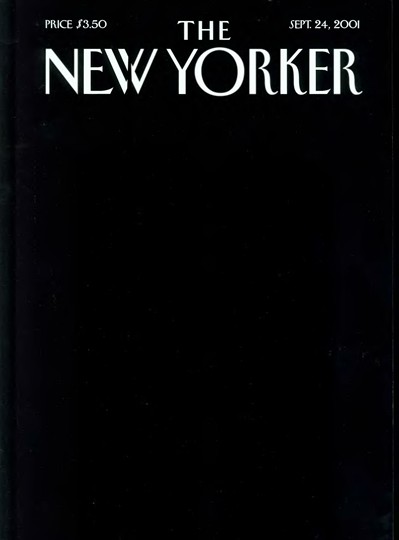
After 9/11, I read everything about the incident (like the multiple comics that came out).  About a week after 9/11 my friend Al and I went down to Hoboken and absorbed the decay (and I can’t help but wonder if that’s why I’ve developed adult asthma).  My 9/11 story is no more compelling than anyone else’s and may even be far less compelling (you can read a snippet at Al’s blog, should you care to).  Anyhow, when this issue of The New Yorker came out (with the amazing cover that you can’t really see here–the towers are in a shiny black that reflects the light), I read all of these accounts and recollections.

I came upon them again recently when I was doing a New Yorker search for Jonathan Franzen.  I recently read all of his New Yorker entries, but when I saw that he had one that was part of this 9/11 issue, I decided to put it off.  It was reasonably close to the ten-year anniversary of 9/11, and I told myself I’d wait until then to reread and see what I thought.

And then President Obama gave the order to capture and kill Osama bin Laden (hooray!) and that seemed like a far more propitious reason to go back and re-read these articles.  Now I can feel a bit lighter about the whole thing (just a bit, but a bit can be a lot).  And so, here’s a somewhat facile reaction to these reactions.

I’ll preface by saying I can’t imagine what it must have been like to write something, anything at that time.  Some people respond well to pressure and tragedy and perhaps that’s what happened here.  I can’t help but wonder how paralyzing it must have been for other writers (as it was for most people).  So that these writers had the wherewithal to write anything coherent is pretty amazing.  And the fact that the could express the range of emotions that they do is extraordinary. (more…)

Read Full Post »

« Newer Posts - Older Posts »