Feeds:
Posts
Comments

Archive for the ‘Religion’ Category

vonlastintSOUNDTRACKSURFER BLOOD-“Demon Dance” (Live at SXSW, March 27, 2013).

surfer blood

I’ve liked Surfer Blood since I first heard them.  They write catchy, mostly short, poppy songs.  And usually after a few listens, the hooks really grab you.  The strange thing about the band is that the hooks aren’t always readily apparent, which makes their songs sound kind of samey sometimes.

Of course, samey isn’t a bad thing, necessarily.  Surfer Blood is quite distinctive and I tend to enjoy everything they do.  This new song sounds like their other stuff, which is fine.  But the most distinctive thing about the band of probably their singer who sounds like a less-affected Morrissey.

Having also listened to the song from the album I can say that the singer is far harder to understand live, so maybe live is not the best way to hear a new song from them, but for an old favorite, Surfer Blood has a great energy live.

Watch the show here and hear the studio version here.

[READ: March 27, 2013] The Last Interview and Other Conversations

Melville House has published a number of these “Last Interview” books, and as a completist I feel compelled to read them.  I have read criticisms of the series primarily because what the books are are collections of interviews including the last interview that the writer gave.  They don’t have anything new or proprietary.  The last interview just happens to be the last one he gave.   So it seems a little disingenuous, but is not technically wrong.

There’s so far five books in the series, and I figured I’d read at least three (Vonnegut, David Foster Wallace and Roberto Bolaño–the other two turned out to be Jorge Luis Borges–who I would be interested in reading about and Jacques Derrida (!) who I have always loved–I guess this series was tailor made for me).

At any rate, these interviews are from various times and locations in Vonnegut’s career.  There are six in total.  I don’t know if the titles they give here were the titles in the original publications but here’s what’s inside:

  • “Kurt Vonnegut: The Art of Fiction” from The Paris Review, Spring 1977 (by David Hayman, David Michaelis, George Plimpton, Richard Rhodes)
  • “There Must be More to Love Than Death” from The Nation, August 1980 (by Robert K. Musil)
  • “The Joe & Kurt Show” from Playboy, May 1982 (by Joseph Heller and Carole Mallory)
  • “The Melancholia of Everything Completed” from Stop Smiling, August 2006 (by J.C. Gabel)
  • “God Bless You, Mr. Vonnegut” from U.S. Airways Magazine (!!!), June 2007 (by J. Rentilly)
  • “The Last Interview” from In These Times May 9, 2007 (by Heather Augustyn) (more…)

Read Full Post »

mouldbookSOUNDTRACK: BOB MOULD-Silver Age (2012).

silverage

I was a huge fan of everything Bob Mould put out.  And then he more or less gave up on music.  So I just enjoyed his past and ignored what else he did.  But then I heard great reviews of his new album Silver Age.  So great in fact, that I couldn’t help but listen to it.  And it is amazing.  It’s a major return to his punkier roots.  The guitars are loud and fast but the melodies are still present.  And what’s more important, his voice sounds great and the album is mixed really well–previous Mould records have suffered in production quality.  But this is a great great record.

“Star Machine” opens the disc with loud guitars, a simple melody and lots of attitude.  I love the repeated “Said It” that appears throughout the song.  “Silver Age” is something of a manifesto for Mould.  The guitars are harsh and jagged with lots of distortion and the lyrics tell you everything: “Never too old to contain my rage  This is how I’m gonna spend my days gonna fight gonna fuck gonna feed gonna walk away.”

“The Descent” is classic Mould–big guitars, great catchy vocals and really nice harmonies/backing vocals.  “Briefest Moment” starts with a thudding drum and a sparse fast guitar (which somehow reminds me of Cheap Trick).  The bass comes in with a galloping line rather than playing the same notes and it adds a lot of depth to the album.  “Steam of Hercules” slows things down a bit but “Fugue State” comes crashing back in with more fast thumping drums and sparse but effective guitars.

“Round the City Square” picks up the noise level and includes a wild guitar solo.  “Angels Rearrange” again sounds like classic Mould.  While “Keep Believing” has a great bridge that reminds me a lot of Hüsker Dü (yes I mentioned the band that should not be named).  “First Time Joy” ends the disc on a gentle note.  It’s a ballad (where you can really hear Mould’s voice and how clean and strong it sounds).  There’s keyboards on this song that add some nice dimension.  By the end the song gets bigger and more powerful, ending on a really strong chord.  It’s an awesome return to the rock fold for Mould and I look forward to more from him.

[READ: March 5, 2013] See a Little Light

After getting The Silver Age, I remembered that Mould had written an autobiography and that I’d heard it was quite good.  I don’t really read a lot of autobiographies, but my history with Mould is pretty deep and I was curious to see what had happened in his life to make him abandon his rock roots.  So I tracked it down.  And I really enjoyed it.

The fascinating thing is what a reasonable man Mould presents himself as.  I’m not disputing this–I don’t know really anything else about the guy–but every time someone dumps on him, he accepts partial responsibility for the problem and moves on.  If he’s really like that, that’s very cool.  But he almost seems too nice sometimes.

As I’ve said, I didn’t know much about Mould.  My friend Al got me into Hüsker Dü and I’ve been a fan ever since.  I’ve bought some of his solo records and all of his band records, but I kind of lost interest in him the last decade or so (during his experimental phase).  But I didn’t even really know why Hüsker Dü broke up.

Some interesting things about Bob: he was born numerically gifted–I really enjoyed the section about his childhood and the genius-y stuff he did.  Although he had a pretty rough childhood–his older brother died when Bob was young and so Bob was seen as a golden child (especially after something that happened to him which he didn’t learn about until much later).  And he started drinking at a very young age.

When he got to college he formed Hüsker Dü with Grant Hart (Greg Norton came a little later).  I enjoyed hearing about the early days of Hüsker Dü because I only learned of them much later.  And man were they productive!  They’d release an album and have new material ready to record before they even toured for the album that came out already.  It’s cool reading about the punk scene back in the days before the internet when bands had to rely on each other for support.  There’s also a lot of people who Bob name checks and it’s fun to hear all of the punk names again, especially the names of people who are still active.  (There’s also some bad vibes against SST, but since this is Mould, the bad vibes are pretty mild). (more…)

Read Full Post »

scarletSOUNDTRACK: ERIC CHENAUX-Guitar & Voice [CST088] (2012).

chenauxThis album is indeed just guitar & voice.  Chenaux is a performer who grows on me.  His music is incredibly slow and drawn out.  And I often find that his vocal melodies don’t always have much to do with the guitar parts he plays.  It feels like everything is improv.  And it’s unsettling at first.  As is the fact that half the songs are pretty ethereal songs with words and the other half is wild and chaotic guitar solos, in which the guitars sound like anything but guitars.

But when you actually listen to the lyrics (which aren’t always easy to follow, he sings them so languidly) they’re quite lovely.  Like, “With the clouds in the sky and the bags under my eyes I wrote your name a thousand times with an old flashlight last night.”  But the more notable thing is the guitar work.  In “Amazing Backgrounds,” he plays a simple, plucked acoustic guitar but the solo is a crazy electric guitar that is played backwards and sounds completely from outer space.  “Dull Lights (White or Grey)” is another beautiful piece with overdubbed guitars playing some great low bass sections while the other guitar plays pretty, high notes (an a cool wah wahed section too).

“Put in Music” sounds the most traditional–the vocal melody is pretty straightforward and his vocal actually has weight (it’s usually up in the ether somewhere).  And I think it works very well as a grounding for the album.  Although the guitar solo sounds like he’s playing more with the tuning pegs rather than bending the strings–it’s cool and disconcerting at the same time.  “However Wildly We Dream” is a very jazzy feeling song–upbeat finger plucking.  It’s the most conventional song and it really packs a wallop (a gentle, airy wallop but a wallop nonetheless).

The second track “Simple/Frontal” is an instrumental.  I assume it is all guitar but it sounds like slightly discordant violins playing against each other.  “Sliabh Aughty” is a nearly nine minute solo that sounds reversed and is a wild meandering piece (played over a constant drone).  It has an Irish feel, which makes sense as the Slieve Aughty (Irish: Sliabh Eachtaí) are a mountain range in the western part of Ireland.  “Le Nouveau Favori” is a short instrumental–two minutes with what sounds again like a bowed violin/drone.  And how can one not enjoy a piece called “Genitalia Domestique” another 2 minute droney instrumental. Chenaux definitely plays with sounds that don’t quite go together, often making an eerie collection of tunes.  Especially when they are compared against the pretty acoustic of the songs with words.

The final track is “Glitzing for Stephen Parkinson” and it continues with that weird bagpipe/organ drone that he pulls out of his guitar (I’d love to see him perform this stuff live–although how would he do the overdubs?)

The stuff takes a  few listens to get used to, and it’s certainly not for everyone, but the sounds he gets out of a guitar is truly amazing.

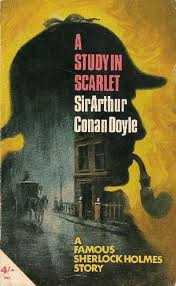
[READ: February 16, 2013] A Study in Scarlet

I mentioned recently that we have been watching a lot of Sherlock Holmes items.  So it seemed appropriate to read some of his stories as well.  I brought home a collection of the short stories not realizing that there were two novels written before the stories.  Sarah read the stories, but I held out for the debut novel.

The show Sherlock laid an amazing ground work for the books because the show (despite being set over 125 years after the books) is quite faithful to the stories.  Indeed, the way that Holmes and Watson meet is pretty much straight out of the book.  And, also indeed, the first episode took much of the story form this first book.  There were some very key changes to the story, ones that made the show very very different in the end, but the foundation is certainly there.  Interestingly, the way the murder is performed in the book (which we learn very very late in the story) proves to be the same methodology used in a different episode of Sherlock.  Two episodes from one book!

So in this book Watson opens it by giving a little backstory about himself and his quest to find cheap lodging in London (he’s back from the war in Afghanistan–a fascinating coincidence in terms of timeliness of wars) and he has blown through a lot of his stipend.  A mutual friend introduces Watson to Holmes and they agree to live together   I was a little concerned about the pace of the book at first, as it seemed like Watson was going to go into a lot about himself–but he doesn’t.  It’s a brief chapter that gets all the details out of the way.

Then we meet Holmes.  He explains his own eccentricities and how he is a consulting detective (Watson wondered why these people kept appearing and asking Hiolmes questions about who knew what).  And then finally we (the reader and Watson) are invited into a case.  A man was found murdered in a house.  There were no stab wounds, although there was blood.  The only other evidence was a word scratched in blood on the wall: Rache.

If you saw Sherlock this will sound familiar (except that the victim was a woman).  It deviates quite a bit from here (Rache is used in a very different way from the show, which I really liked), but Holmes recognizes the tobacco and is able to deduce a ton of things just from the surroundings.  He doesn’t tell the police right away, for fear that if the criminal knows the police know about him, he will flee).  And as the first half of the book draws to a close, the murderer is apprehended.

Imagine my surprise though when the next chapter opens up in the American Southwest.  All of a sudden the story has shifted utterly to a man and a girl trudging through the mountains,  lacking food and water and clearly near death   What?   (more…)

Read Full Post »

alsion1SOUNDTRACK: THE DOUBLECLICKS-Pirates!  The PPDXYAR EP (2012).

pdxyarI wanted to explore more of The Doubleclicks’ music, and their site showed off this EP.  It was made for Talk Like a Pirate Day (you’re already sold, right?) and EP is a tribute to the Portland Pirate crew of PDXYAR (whatever that is).  The first song is “The Pirates of PDXYAR highlights what I’ve come to understand is the real Doubleclicks sound: ukulele and cello.  But this one also has a host of backing vocals (make and female).  The song is all about the pirates of PDXYAR and how they came to be and how the represent Portland.

The second song “How Not to Touch a Pirate” is a simpler song which insists that, tempting as it may seem, you should NOT be touching any of the pirates (this seems like a real inside joke).  Its amusing and would probably be funnier if I knew more about PDXYAR.  And oops, this song even has an F-bomb at the end–watch out!

The final track is a remix of “The Pirates of PDXYAR, ”  And mostly it allows more funny backing vocals.  It’s a better, funnier track because of it.

I’m not sold on The Doubleclicks yet.  I like them, but I think more in small doses.

So it turns out that PDXYAR is a Portland-based pirate crew, which you can read about on their website.  The lyrics to the song seem to explain  the origins of the pirates (kickstarter).  Frankly, I don’t know why the pirates (and the Doubleclicks) haven’t appeared on Portlandia yet.

[READ: February 7, 2013] Alison Dare: Little Miss Adventures 2

Volume 2 of Alison Dare is just as fun as Volume 1.  Although I admit the first story was a little confusing (I was never really sure exactly how these books were published originally, so it wasn’t clear that the first few stories were connected.  Although in retrospect it seems obvious enough.

In the first story, “What I Did on My Summer Vacation” it’s obvious that Alison doesn’t have much in the way of the excitement that girls expect from her.  So she makes up an elaborate story which all of the girls (except her two close friends) find wonderful   In “The Unbelievable Truth” we see what really happened (and we see that Alison’s story wasn’t far off, but that details make all the difference).

In “The Perfect Gift” the Blue Scarab (aka Alison’s dad) searches for the perfect gift for his daughter.  But that proves harder than he thought, especially when she accidentally takes a precious jewel that he has recovered in a mission.  In “A Day at the Museum” the girls open something they shouldn’t and unleash a plague.  This ties to the previous story in an unexpected way.  And in “The Gift Exchange” the previous two stories come together for a satisfying conclusion. (more…)

Read Full Post »

CV1_TNY_02_04_13Schossow.inddSOUNDTRACK: GARBAGE-Bleed Like Me (2005).
Wbleedhat happens when you take something slick and shiny and remove the shine?  You get something slick and dull.  And that’s the overall feel of Garbage’s fourth album.  After the dance pop of Beautiful Garbage, Bleed Like Me was d described as a return to the rock roots of Garbage.  And it’s true that there’s a lot more guitar.  But as in the production of Beautiful, the guitars feel really anemic–again, coming from Bitch Vig who made Nirvana’s guitars roar, this is a major surprise.

Worse than the production though s the utterly generic feel of the songs and the lyrics.  Manson was most powerful when she was personal.  Even if the songs were oblique, you knew they were about something.  But these songs just feel like words, and she sings them as if they were just words.

The single was “Why Do You Love Me” and it opens with a powerful heavy metal guitar riff.  But the verses quiet down and the chorus is fast but without any oomph.  It’s quickly forgotten and even the lyrics: “Why do you love me it’s driving me crazy” don’t really make you want to learn more about it.  “Run Baby Run” had potential for a radio friendly hit but it’s also quickly forgotten.

Then there’s the songs that seem to be about something.  “Sex is Not the Enemy” seems like it could be transgressive but it’s really not–it feels like a last stand from a beaten person rather than a rocking anthem.  Musically it’s mediocre and even lyrically it’s not that shocking/surprising.

“Boys Wanna Fight” brings some of that electronic feel back and it injects some life into the disc, but again the song isn’t that inspiring.

I wonder how much I would have liked this album without the history behind it.  I know that bands need to experiment and try different things, but it felt like Garbage fell especially far from the heights that I held them.  Garbage tool a pretty lengthy hiatus after this album–Shirley went into acting (catch her on Terminator: The Sarah Connor Chronicles) and it seemed like the band was finished.

[READ: February 7, 2010] “Zusya on the Roof”

I read a story with a very similar setup recently (not implying that Krauss read it or anything).  In Russell Banks’ story “Christmas Party” a divorced man goes to his ex-wife’s new house and takes her newborn baby and…  the story ends.  [Spoiler, sort of].  This story has a similar arc.  And I guess I don’t understand this arc.  Or maybe, although I’m usually okay with endings that are vague, when you have a person with a baby, there are so many different possible endings that not leaning in one way or the other is just unfair–yes we can get clues from the story, but one never fully knows what a person’s intentions are.

This story also relies a lit on Jewish tradition.  And I find a lot of Orthodox behavior inscrutable (as Zusya seems to).  So I tend to get lost in the traditions.  Especially when, as in this story, names are used to indicate a tradition that I simply don;t know (and yes, this is my fault, not the author’s, unless she wanted to appeal to a goyish crowd).

So in this story, Zusya is about to become a grandfather.  But he falls ill just as his grandson is about to be born.  In his haze of hospital care, the grandson is born and he imagines that he gave birth to the boy–a kind of my life for his deal.  And when the grandfather recovers, he has strong emotional ties to the boy. (more…)

Read Full Post »

snuffSOUNDTRACK: SINÉAD O’CONNOR-How About I Be Me (and you be you)? (2012) .

sineadI was a huge fan of Sinéad’s first album.  And I liked her second one too (the one that made her a star).  I even followed her through a few of her later albums (while she was getting a bit more publicly odd).  But then it just got to be too much work (she released a bunch of albums which I couldn’t keep up with).

But this album promised to be a nice return to form.   And so it is–her voice sounds great and there’s many of the elements of good ol’ Sinéad here–the jangly guitars, great backing vocals and awesome mixture of gentleness and rage that really marks Sinéad’s best work.

“4th and Vine” is a boppy reggaeish song about love and marriage.  It’s nice to hear that kind of cheer from Sinéad (even if it didn’t all work out).  It’s followed by “Reason with Me” a sympathetic song from the POV of a junkie who plans to call that number one of these days.  “Old Lady” is a simply beautiful song–in which you can really hear how well Sinéad’s voice has stood up through all the troubles she’s been through.  But more than that, when the guitars kick in, you can hear that she still has the chops to write a great song.

“Take Off Your Shoes” is one of those great Sinead songs that gives you chills.  I’m not sure what she’s on about with the blood of Jesus and all, but when the song kicks in and “you’re running out of battery” wow, what a great song.  “Back Where You Belong” is one of Sinéad’s more delicate songs–a plea for peace from men on behalf of boys–the chorus is soaring and gorgeous.

“The Wolf is Getting Married” is being released as a second single this month (good for an album to have that long of a shelf life).  It starts a little slow but once the verse really starts it’s pure Sinéad–that guitar backing is just like Sinéad’s earlier hits).  And the lyrics, which are simple enough, are fun to sing with.  “Queen of Denmark” is a stunning, vulgar track that is really amazing.  It’s great to hear her when she is passionate and angry and indeed here she is–soaring voice and loud guitars and all.

“Very Far from Home” and “I Had a Baby” are sweet songs, they are enjoyable, but feel like decent end-of-disc songs, especially after the power of “Denmark.”  The final track, “V.I.P.”  ends the disc quietly, with a gently sung, almost a capella track about the true nature of very important people.  The song  ends with a whispered prayer and a chuckle.    It’s a really solid album and I’ve enjoyed listening to it many times (but I really don’t like the cover).

Perhaps, as my friend Louise has been telling me all along, I should check out those discs that I missed.

[READ: February 1, 2013] Snuff

I can’t believe I have two books in a row that deal so largely with poo!

Terry Pratchett is back with Snuff (actually, he has a book of short stories and a new novel named Dodger since Snuff came out).  Sarah gave me this for Christmas two years ago and I have just gotten around to reading it.  Which is a surprise as I love Pratchett and have read all of his books (for the most part).

This book seemed a little big.  It is 400 pages, as long as Unseen Academicals, and I was a little daunted by it.  But as soon as I read the first few pages (again, no chapters here, just section breaks), I was back in the world of Commander Vimes (or arch Duke or something) and back in Discworld.

Commadner Vimes is a wonderful character–a policeman who is street smart and very wise, even if he’s not proper smart.  He’s an excellent everyman character and the kind of person you wish was running things in your town.  Or someone else’s town.  For Vimes is off on vacation to the Shire, the childhood home of his wife Lady Sybil.  And Vimes is out of his element (which is always funny).  And he also senses that something is amiss here in the idyllic countryside.  So, despite Sybil’s gentle warnings to be on vacation and come in and be social, Vimes is on the case.

The case, as it were, is about goblins.  Goblins are a new race in Discworld.  Everyone always treated goblins like vermin–they smell bad, they steal chickens, they live underground  they are worthless.  And the goblins seem to agree (well, that’s what generations of maltreatment will do to your self-respect).  But Vimes gets mixed up in a murder–and when a goblin pleads for mercy but is killed anyway, that is murder vermin or not.  And when Vimes discovers that goblins can talk, emote and, indeed, play the harp–well that makes them a little less verminous, no?

Wait, what’s this got to do with poo?  Well, Miss Felicity Beedle, Discworld’s premier children’s author, has written a book called The World of Poo (which is actually for sale on its own too, ha) which Young Sam Vimes loves.  It is his favorite book after Beedle’s earlier book Wee.  And so Young Sam is off collecting samples of poo to dissect, and the Shire is a great place for it.  Well, when Vimes meets Beedle, he learns that in addition to being a children’s book author, Beedle has been teaching goblins how to be more…well, not human exactly, but more approachable to humans so that they may be recognized as valuable creatures. (more…)

Read Full Post »

mirkaSOUNDTRACK: MATISYAHU-“Chop ‘Em Down” (2004).

matisyaMatisyahu was something of a novelty when he appeared in 2004–a Hasid who performed dancehall reggae.  And yes, it does look very strange.  But he is quite adept at the style.  And lyrically it works really well.  Reggae is (often) a very spiritual music so Matisyahu’s own spiritualism works with the beats he lays down.  Instead of Jah, we hear about Egypt and Pharaoahs.  And the “scatting” that he does is like the scatting found in more typical reggae but it has a more Middle Eastern feel.  It’s a neat concept and well executed.

This is not a style of music that I like a lot (one song is usually enough for me), but I really like the sound he has conjured.  It’s clear that he transcends the novelty and is a genuine fan of the music.  It’s an interesting way to expand people’s horizons (on both sides).

Interestingly, in 2011, Matisyahu shaved off his beard and dropped his Orthodoxy.  He is still spiritual, but without the trappings of his faith.  Fascinating.  Here’s a before and after photo.

matismatisy

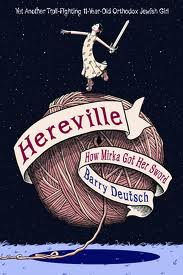
[READ: January 18, 2012] Hereville: How Mirka Got Her Sword

I enjoyed the second book in this series quite a lot.  So I found the first one to read too.  Who can pass up a book subtitled: Yet another troll-fighting 11 year-old Orthodox Jewish girl.  I had said that you didn’t need the first one to enjoy the second one.  And that’s true, although I now know that the first one would have laid down a foundation for me to enjoy the second one even more.

What is neat about this story is that there isn’t a lot of exposition up front.  We learn that Mirka is an 11-year-old Orthodox Jew living with her family (which contains many siblings).  She is a little wild and not interested in being “good.”  She’s not bad at all, just spirited–she really wants to fight a dragon.  It’s not until later in the story that we learn that she has a stepmother (unless that is obvious to Orthodox readers from the way Mirka addresses her) and that there may actually be dragons in this world.

The book presents Orthodox life and its day to day realities.  It doesn’t explain or justify the details, it just shows them (with occasional translations of Yiddish terms).  Although it must be admitted that Hereville, where the family lives, is a bit unlike other communities.  Everyone who lives there is Orthodox and non-Orthodox reading materials are not permitted.  And indeed, when a pig shows up, the children don’t know what it is. (more…)

Read Full Post »

herevilleSOUNDTRACKBRAVE COMBO/BOB DYLAN-“Must Be Santa” (1991).

bob dylanBrave Combo is a fun band that mixes more styles in one album than most bands do in their career.  While they primarily play polka, the also play everything from folk to rock to klezmer.  This song is an old song from Mitch Miller, but Brave Combo speed it up and spice it up with clarinets and fun instrumental frills.  It’s fast and furious.

And if that wasn’t strange enough, Bob Dylan covered the song–and clearly covered the Brave Combo version when he made his Christmas album in 2009.  Although Brave Combo didn’t write the song, Dylan’s cover is certainly in the polka style and he includes lyrics that Brave combo added:

Dasher, Dancer, Prancer, Vixen
Eisenhower, Kennedy, Johnson, Nixon
Dasher, Dancer, Prancer, Vixen
Carter, Reagan, Bush and Clinton.

Dylan singer faster than I’ve ever heard him.  It’s a hoot.  And the video is really funny too.

[READ: January 3, 2012] Hereville: How Mirka Met a Meteorite

I saw this book on the library shelf and the tagline (“Boldy Going Where No 11-Year-Old Orthodox Jewish Girl Has Gone Before”) made it sound like a lot of fun.  Upon reading it, I can see it’s not quite what thought it was.  It turned out to be much cooler.  This also proves to be the second book in this series, although you don’t need the first book to appreciate this one.

Mirka, an orthodox Jewish girl has been grounded (for fighting a troll with a sword.  Her stepmother, sick of her hanging around, offers to play Mirka in chess.  If Mirka wins, her punishment is over.  As with everything Mirka does, she is too brash, too hasty, which means that she will not win.  But her stepmother takes pity and allows her to go outside–if she stays out of trouble.  But because she is willful, Mirka runs right back to the troll.  The troll, angered at being defeated by such a stupid girl (his insults at her are great), creates a meteorite and sends it hurtling towards the town of Hereville.

Mirka consults with the witch who helped her defeat the troll in the first place and the witch changes the meteorite into a girl who is the exact copy of Mirka.  Although indeed, not an exact copy for Metty as she comes to be known is smarter, neater and better at basketball.  Mirka thinks it would be great to have this twin around to help with chores but Metty winds up eating all her food (they can’t both be in the same place at once) including the big feast at Shabbos and making her look bad.   (more…)

Read Full Post »

grantladn4SOUNDTRACK: PUBLIC IMAGE LTD-“Poptones” and “Careering” on American Bandstand (1980).

abThe Dick Clark article below alerted me to this bizarre gem–PiL “playing” on American Bandstand.   The article talks about John Lydon ignoring the lip synch, climbing into the audience and generally disregarding the show’s script. The video suggests something sightly less sinister (although maybe for 1980 it was outrageous–do you really cross Dick Clark?).

Dick Clark himself announces the band nicely, and then the crazy off-kilter bass and simple guitar of “Poptones” kick in.   Lydon runs into the bleachers with the kids (most of whom are dressed in New Wave finery not unlike Lydon).  They shriek with glee when he comes nearby (do any of them know who he is?  I have no idea).  When Lydon’s spoken rambling come in a little later you can’t help but wonder what the hell they are doing on AB.

Then, Lydon starts grabbing people from the audience and pushing them towards the stage–something I believe was unheard of on AB.  The fans dance around to the impossible-to-dance-to “Poptones.”  The song ends and Dick asks John if he wants the kids out there for song two.  Yes, song Two!  He does and John faux lip synchs through “Careering,” avoiding cameras at all costs and dancing with the kids–one of the most egalitarian performances I can think of from Lydon.

And listen for Dick asking Jah Wobble his name (reply THE Jah Wobble) and him saying, nice to meet you Wobble.  What a surreal moment–wonder what Dick thought of it.

Enjoy it here:


[READ: December 28, 2012] Grantland 4

Grantland continues to impress me with these books (and no, I have not yet visited the website).  My subscription ran out with this issue and I have resubscribed–although I take major issue with the $20 shipping and handling fee.  I even wrote to them to complain and they wrote back saying that the books are heavy.  Which is true, but not $5/bk heavy.  The good news is that they sent me a $10 off coupon so the shipping is only half as painful now.

This issue’s endpages were “hypothetical baseball wheel-guides created by JASON OBERG–they were pretty cool and a fun idea.  They look very retro, but use contemporary batters, pitchers and catchers.  I’d like to see them for real.

Each issue makes me like sports a little bit more, but not enough to actually watch  them.

(more…)

Read Full Post »

CV1_TNY_12_10_12Steinberg.inddSOUNDTRACKDAN DEACON-“Electronica Hanukkah” (2010).

elechanDan Deacon is rapidly becoming one of my favorite oddball musicians.  I really don’t know very much about him, but he seems willing to give away music to various projects and put them for free on soundcloud (he has a proper album out as well this year which has been well received).

“Electronica Hannukah” is a paean to consumerism–set to a noisy processed electronic beat.  The superprocessed chorus voice is, well, super processed.  Deacon’s song is snarky and funny and yet the harmonies are actually quite pretty.

I’m not sure that this is what the holiday is about.  But you can determine that for yourself.

[READ: December 19, 2012] “A Voice in the Night”

This is a multipart story told in multiple sections.  We have three story lines labeled I, II, III and each story line is broken so that the next can continue.  That may sound more confusing than it needed to be.  So let’s step back.  In story line I, we see the biblical story of Samuel, whom God called in the middle of the night.  In story line II, we see a young boy staying awake in case God calls him in the middle of the night.  In story line III we see that boy as an old man whom God has not called.

There are four breaks in the story, one for each time Samuel was called.  The first three times, Samuel assumes it is his holy master Eli who has called him.  But Eli is asleep and tells Samuel to go back to bed himself.  On the third visit Eli says that it must be the Lord calling him.  And he should answer correctly.

Unlike Samuel, the boy in the second story line is not a believer   His father does not believe and the boy does not want to stay for the religious part of Sunday school.  And yet the story of Samuel stays with him all the time and he tries desperately to stay awake in case the Lord calls.  Which he may not really want anyhow, as it means a lot of work. (more…)

Read Full Post »

« Newer Posts - Older Posts »