Feeds:
Posts
Comments

Archive for the ‘Religion’ Category

HarpersWeb-Cover-2016-01-410SOUNDTRACK: WILCO-Tiny Desk Concert #168 (October 17, 2011).

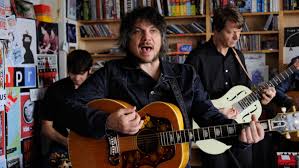
wilco2011Wilco is virtually the only band to have been asked back for a second Tiny Desk Concert.  I’ve listened to this concert a bunch of times but didn’t realize I hadn’t posted about it here.

There is a huge crowd for this show and as it starts, everyone shouts WILCO!

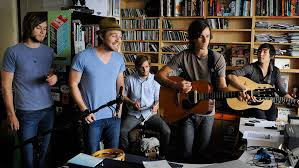
The band sounds great with all the members crowding in behind the Tiny Desk.  Tweedy plays his big acoustic guitar, Nels Cline plays all kinds of interesting sounds in the corner.  The drummer is on a small computer thing that seems to be made up of all manner of small percussive items.  There’s a bassist and keyboardist and a second guitarist all making a great sound.

“Dawned on Me” starts the set and sounds great in this setting—I love the walking bass throughout the song and of course Nels Cline plays a wonderfully insane noisy solo amid this simple and catchy folk song

Before the second song, “Whole Love” Glen’s got to get some things out of his toiletry bag.  This is another great song with Nels playing high notes to complement the rumbling bass.  No idea what the drummer is playing this time—a book?  Tweedy sings in falsetto for much of the song.

Tweedy says “this next song requires a certain amount of tuning—quiet please.”

He asks if anyone has any questions and when Bob says “I’m speechless,” someone on staff says “That’s a first,” which gets everyone laughing.  Bob asks if Jeff likes his bag of toys and Jeff says anyone who would make fun of his bag of toys is an idiot.  Sadly we never see the bag or the toys.

“Born Alone” has another great bass line that opens the song and the drummer is hitting lord only knows what.  This was the song by Wilco that made me really fall in love with the band.  Cline’s slide guitar is very cool.  But there’s something about the end of the song when the whole band plays a series of chords–the steps keep going lower and lower, and each time you think they’re going to stop, they just keep going. It’s very fun.

After that song Tweedy admits to breaking a sweat–Tiny Sweat!

The final song is “War on War.”  He says they played it about ten years ago in the city possibly for the first time.  They messed up the ending the other day, but they hope it doesn’t mess them up this time.  Cline goes berserk on his guitar.  The whole band rocks this song.  There’s some really cool harmonies on this track, too.  The keyboardist even has a little cow sound maker (that you can just barely hear, until the very end).  They get the ending right and Tweedy shouts “Nailed It!”

There is much applause as Bob asks, “Pretty good for a Saturday, huh?”  And as the applause dies down, someone yells, “Now lets trash this dump!”

It’s a great set.

[READ: March 25, 2016] “Hallelujah!”

I wanted to finish up all of the Harper’s pieces by Rivkla Galchen.  I had no idea what to expect from this piece.

It is one of those pieces in Harper’s that has images in the background–in this case musical notes and a portrait of Handel–to go with the  story.  And it is broken up into many little sections labelled 1. Sinfonia (Overture) 2. Accompagnato. 3. Air, etc up through 53 (!).

So this is obviously about Handel’s Messiah and the Hallelujah Chorus. (more…)

Read Full Post »

HarpersWeb-Cover-201603-302x410-21SOUNDTRACK: DIEGO GARCIA-Tiny Desk Concert #156 (September 12, 2011).

diegoDiego Garcia is an Argentine-American singer-songwriter.  When I saw the set up of guitar and cello I actually expected a more classical style.  But rather, Garcia is writing some beautiful, catchy songs about love and loss.

The blurb says that his album Laura is meant to be listened to as a full story, not just a few singles.  Since we only get four songs here I don’t know what part of the story we’re missing, but the songs we hear are pretty great.

“Nothing to Hide” is really quite lovely.  Diego sings and strums while Daniel on cello plays some aching notes.  Despite the aching quality the song is actually strangely upbeat sounding as well.

“You Were Never There” is interesting for where he plays the chords (way up on the neck).  And the cello plays the melody quite nicely (even taking a solo).  The song is poppy for such a dark sentiment.  The other guitarist, Zeke, plays a nylon-string acoustic guitar and adds some cool high notes (and a solo) as wonderful accents to what Garcia is playing.

“Under This Spell” begins with some minor chords and a much darker sound.  The tempo is fast again and the harmony vocals during the chorus really make it pop.

After the third song he asks if they can play a fourth song, “Would you mind?” (Who would ever say no?).

“Stay” features some really nice classical style playing from the nylon string guitar as Diego accompanies on strummed guitar and Daniel does some nice oooos as backing vocals.  I don’t really like the fluttering vocals he does in the middle of this song, though.  It might work better in studio or with a loud song, but it jut sounds weirdly affected here.  Nevertheless the way the song ends so dramatically really makes up for it.

I had never heard of him before, although apparently he was the leader of the band Elefant.  I get a sense that these songs tell a full story, and I’d like to hear the whole thing.

[READ: April 4, 2016] “Glory”

There was so much that I enjoyed about this story.  I loved that the main character Glory’s real name is Glorybetogod and how her parents (in Nigeria when she was born) believed that this would set her on the right path: to be smart, to attend church regularly and to “never stray from the Word (amen!).”  But in fact this name has given her nothing but trouble especially since they moved to the U.S.   She would always have to provide copies of her birth certificate for nearly every document and her Facebook account was constantly getting deleted because of their “real name” policy.  Her parents wanted the best for her, but it was her grandfather who was straight with them all: “That girl has something rotten in her, her chi is not well.”

And he proved to be correct as misery and failure followed her everywhere.  While some might say it was fate, a lot of it was her poor decision-making skills.  Like deciding when she was 5 to put her finger into a sleeping dog’s mouth.  And now at thirty she is disappointing everyone by working a terrible job at a call center.

And that is why that night she has written a suicide note and has a handful of sleeping pills. (more…)

Read Full Post »

[ATTENDED: April 3, 2016] David Cross

cross I have enjoyed David Cross since the old days of Mr. Show, and the as Tobias on Arrested Development and even in Alvin and the, well, actually I’m just happy for him that he got a lot of money for it.

When he released his previous stand up album, Bigger and Blackerer, Sarah and I listened to it in the car on a long trip and we had tears in our eyes from laughing so hard.

So when I heard he was touring I thought it would be fun to see him live.  And, yes, it was.

But we ran into a few bumps along the way.  We had to leave very late because our babysitter had car trouble.  She arrived just late enough that we weren’t sure if it was worth still driving the hour to Philly.  We decided if traffic was terrible we would just stop somewhere and have dinner instead.  I even called the Theatre to see if there was an opening act (nope) and if the show really started at 7:30 and not 8 (yup, he would start at exactly 7:30).  Traffic was light and the GPS said we’d get to the garage at 7:35.  I missed the turn for the alley that our garage was on, and then we got slightly lost on the walk from garage to theater and as we got there at 7:40… there were still a whole bunch of people milling about in the lobby.  And then they flashed the lights telling us to get to our seats.  We missed nothing!

And we even got to tsk at people who arrived later than us.  Cross even joked that he would wait to start his joke because “it’s not fucking distracting or anything” when people are being seated.  I was frankly shocked that people seemed to still be arriving around 8PM! (more…)

Read Full Post »

photoSOUNDTRACK: WILCO-Tiny Desk Concert #509 (February 23, 2016).

wilcoAs far as I can tell, Wilco is the first band to be invited back for a Tiny Desk Concert (there was a stated rule that no one would come back twice, with some people skirting that by coming with another band).  Laura Gibson was invited back since she was the very first attendee, but since Wilco’s newest album has been so successful, it seems somehow fitting that they get invited back.

And perhaps in honor of that, while their last performance was noisy and raucous, this one is decidedly more mellow—with all acoustic instruments.  But that doesn’t mean it’s quiet and calm either.

For the first song “The Joke Explained” from Star Wars, they used banjo, acoustic bass, hollow bodies electric guitar (w/ slide), the ever-present melodica and muted drums (w/shakers).  And it sounded great.

For the second song, the older “Misunderstood” everybody seemed to switch instruments.  Tweedy switched guitars, the acoustic bass became an acoustic guitar, the hollow body became a slide guitar.  Nels Cline’s slide guitar brings so much to the song by doing seemingly so little.  I love how this simple, sweet song has a wild middle section–a crazy breakdown with noisy cymbals and drums–drummer Glenn Kotche is fantastic–and everyone else playing some crazy high-pitched notes until it all settles back down again.

Tweedy has another guitar for the third song “I’m Always In Love” and the melodica is back.  There’s xylophone keeping the melody.  And as with all of these songs, Tweedy sounds great and the backing vocals add wonderful harmonies.  Cline plays a wonderful slide solo, too.

Before the final song and there’s another guitar change for Tweedy, and he says that after this song, “you guys need to get back to work solving this Trump problem. Figure it out! Its weird!”  They play “Shot in the Arm,” another great old song.

The band sounds excellent—a wonderfully full sound even without amplification. I am really excited to see them his summer.

There’s also a nifty video showing “Misunderstood” with two 360 degree cameras so you can see what goes on in the audience during a Tiny Desk Concert.  Check it out.

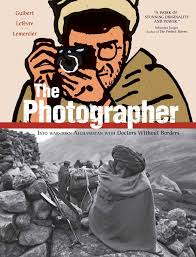
[READ: February 7, 2016] The Photographer

I loved Guibert’s book Alan’s War, in which he took the words of Alan Cope and put them to an amazing graphic novel.  Well, he is back again doing the same thing with the words of famed photograph Didier Lefèvre.

Didier Lefèvre died in 2008, but before he died he left a legacy of amazing photojournalism.  That includes this trip to Afghanistan which he took with the team from Doctors without Borders.

Alexis Siegel translated this book again, and he offers an excellent introduction which not only explains Lefèvre’s life, it also gives context for everything tat these men and women were up against in that war-torn region.

As mentioned Guibert draws out the story that Lefèvre told him.  But this book is different from Alan’s War in that it also uses the photos that Lefèvre took.  Guibert fills in the gaps where Lefèvre, didn’t or couldn’t, shoot.  And there was a lot he couldn’t shoot. (more…)

Read Full Post »

americusSOUNDTRACK: FLY PAN AM-Sédatif en fréquences et sillons EP [CST011] (2000).

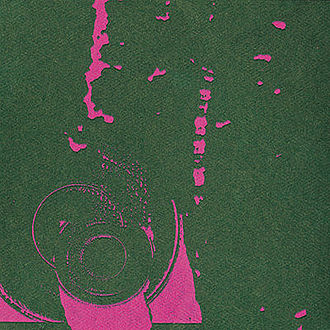
330px-SedatifsEnFrequencesCover This is an EP that works as a kind of remixes and deconstructs further the debut. There are three songs, the first is fourteen minutes, the second is 11 and the final is 4.  As the Constellation site describes the disc:

This 3-song EP of fractured, tape-infested experiments is an intransigent slab of self-referential auto-criticism. The band was sticking to its agenda of acutely self-conscious musical manipulations, re-working its own materials and assumptions to yield new compositions of uncompromising formalism. Side A is a medley of sorts, consisting of phrases and fragments reconfigured and replayed from their self-titled debut (Fly Pan Am). Various melodies are reassembled and played off of one another, creating an extended live remix with blissful passages of layered guitars, drones, sampled backing vocal lines, and the requisite incidental noise break in the middle of the piece. The result is something like a ‘Stars On 45’-style musical encapsulation of the entire debut record.

“De cercle en cercle, ressasser et se perdre dans l’illusion née de la production de distractions et multiplier la statique environnante!” (“From Circle to Circle, Rehash and Get Lost in the Illusion Born of Production and Increase the Static Distractions Surrounding!”) opens with the sounds of machinery rumbling and then slowing to a stop. The song proper opens with a rapid bass line and squalls of feedback.   Some beautiful guitars play over the noise. More guitars come in along with all kinds of crazy noises—scrapes and scratches, radios and distortion.

The propulsive music stops around 3 and half minutes in and the noise takes over. There’s loud noises and static and all kinds of things. Then the noise shifts to what sounds like someone emptying a bag of ball bearings onto a metal table.  And then maybe making microwave popcorn.  About five minutes later (seriously) a drum starts playing in the background and then a guitar line that references the debut album starts up.  It sounds a bit like the two note guitar from “Dans ses cheveux soixante circuits” with the voices from “Nice est en feu!” thrown on top.  And then at 11:20 that two note half-tone thing from “Dans ses cheveux soixante circuits” resumes, but it’s only for 20 or so seconds before different sounds come to take away the repetitiveness (although the guitars do continue that until the end of the song).  It seems like the band wanted to revisit their debut but also wanted to make sure that it was properly buried under chaos as well.

The second song “Éfférant/Afférant” (“Unrelated / Related”) (11 minutes long) is described as “somnambulist clockwork repetition.” The bass and drums are kinda funky with some simple guitar chords playing in the background. While things do change somewhat throughout song (including notes that seem inappropriate at times), the main source of change is the weird electronic sounds that play over the top. The noise starts to grow louder and louder around 9 minutes and just when it gets unbearable it fades out to the end of the song.

“Micro Sillons” (“LPs”) is only 4 minutes long and it opens with static and noises—different ones in each ear.  After about three minutes of that, the noise mutates into a kind of machine-like hum.

This is definitely a challenging listen.  There are rewards to be had, and it s amazing what good songwriters these guys are, if they’d ever let their songs stay unmolested.

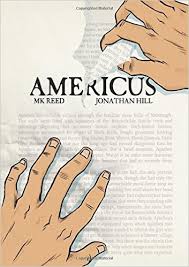
[READ: December 17, 2015] Americus

I didn’t really have any idea what this book was about–the title Americus evokes many different things.

So imagine my surprise to find out that this First Second graphic novel [go First Second!, #10yearof01] tackles the idea of banning books in schools.  It looks at religion, freedom of speech and middle school.

The story is about Neil Barton, an unpopular kid who loves fantasy and books, especially the Apathea Ravenchilde series (such a great name). Neil and his friend Danny race to library after school because the latest volume is out.  Neil is bummed that his library could only afford one copy of the book (budget cuts!) and Danny gets it first.  And as he starts reading, the artistic style switches to the Ravenchilde world (I loved that).

Then we meet Neil’s and Danny’s families.  Neil’s parents are divorced.  He lives with his mom who is harried and exhausted.  Danny’s family is an intact nuclear family, with two younger siblings.  And we learn soon enough that his mother (and father to a degree) are very Christian. (more…)

Read Full Post »

flypanam templarSOUNDTRACK: FLY PAN AM-Fly Pan Am [CST008] (1999).

In the Constellation canon, there were four originators: Godspeed You Black Emperor were orchestral, Do Make Say Think were jazzy, and A Silver Mt Zion had vocals.  But Fly Pan Am was the weirdest one—the played with noise, they broke up their songs, they deconstructed their own work and, especially novel to me, everything was in French on the discs.

Roger Tellier-Craig, the main force behind FPA was in GYBE as well.  So he knows post-rock.

Their debut album is a long affair–an hour’s worth of music (in all of 5 songs) taken from two different recording sessions.  (All translated titles are taken from Wikipedia).

“L’espace au sol est redessiné par d’immenses panneaux bleus…” (“The Floorspace Is Redesigned by Huge Blue Signs…”) is a 13 minute song.   There’s ringing noises as a simple melody is plucked out.  The full instrumentation kicks in adding a repetitive guitar line that seems to fall into the background behind the opening notes that are still playing out.  The guitar lines slowly gets longer and longer, almost like a game of Simon.  By around 6 minutes the song has built up a serious head of steam with the bass and drums moving quickly and the guitar getting really complex. By 7 minutes that pretty guitar has turned into a ringing feedback skronking solo which carries on for a minute or so before fading back. At around 9 minutes the song seems to retreat on itself again. The guitars fade away and the bass seems to get a bit louder with the guitars ringing out. The last minute or so resumes a kind of noisy static sound that tells you the song is over.  That’s a heck of an introduction.

“…Et aussi l’éclairage de plastique au centre de tout ces compartiments latéraux” (“…And Also the Lighting of Plastic in the Center of All Its Lateral Compartments”) is a 9 minute song that opens with more scorching guitars and rumbling bass.  The guitar switches back and forth between a two note melody and a chord (dissonant, of course). The other guitar then plays a different three note melody.  About 2:30 in some noisy feedback and samples start taking over the song.  All the music drops away except for the bass.  By 3:15, all the music had dropped out and its just noisy effects and feedback and then outer space sounds.  After about 4 minutes of that (yes, indeed) the bass comes back in playing a kind of discoey rhythm with the guitar supplying a dancey counterpoint which runs to the end of the song.  It’s their first song where something really catchy is utterly dismantled by noise.

“Dans ses cheveux soixante circuits” (“In Her Hair Are Sixty Circuits”) is 17 minutes long (!) and is one of the most abrasive songs I can recall. The song opens with both guitars each playing a two-note melody which rotates through a round. They sound lovely together as the bass and drums play a slow rhythm. The melody changes a few times and then by around 3 and a half minutes the main guitar line grows faster (6 notes instead of 2) and the background feels a bit more tense.   And then at 5:46, the whole song seems to get stuck on repeat. The bass plays a 2 note rhythm, the drums play the same pattern and the two guitars each play one note over and over.  And over.  Evidently it’s “a half-tone interval.”  And this goes on for 12 minutes.  TWELVE!  The only differences through this whole section come from the digitalia of guest electronic musician Alexandre St-Onge, but they are the most unobtrusive electronics I’ve ever heard and just seem to bubble and prickle gently onto the repetition.  It’s maddening and then trance-like and then maddening all over again.  How can they play the same thing for twelve minutes—and their rhythm remains perfect?

“Bibi à nice, 1921” (“Bibi Nice, 1921”) opens with noises and feedback (which is a nice break from the 12 minutes of repetitiveness. But you soon realize that that’s all you’re getting (aside from some distant rumbling noise in the background). It’s a very silent song. For four minutes (out of ten) and then the full band kicks in for a really rocking section—great guitar lines and propulsive bass and drums. But after two minutes, the sound drops out entirely—pure silence (enough to make you assume the disc froze). It slowly returns after 20 seconds–they are messing with us again.  At 7 minutes a new guitar line comes in—slow and pretty with a slow drum beat.  A solo plays over the top—it is primarily electronic, and sounds pretty cool.   The guitars start playing louder and the song feels like it’s going to build up into something huge, but it soon ends and turns into….

“Nice est en feu!” (“Nice Is on Fire!”) seems like it should be connected to the previous song, but it starts off very different with big bass notes playing a very slow riff.  The guitar starts playing a nice accompanying riff. At 3 minutes in, voices come in singing Ahhs in a nice melody. The liner notes say that Kara Lacy and Norsola Johnson do vocals on “Bibi à nice, 1921” and “Nice est en feu!” but I didn’t hear any vocals on “Bibi.”  At 4:30 the guitar line turns to something else and there’s suddenly a whole bunch of noise flooding the track—sounds of water rushing, maybe—but that goes away and a new melody (slightly dissonant) resumes.  With about a minute left the voices resume—angelic and soaring over the rumbling song.  It ends this weird disc on a very pretty note.

I love the crazy stuff that Fly Pan Am creates, even if some of it is hard to listen to.

[READ: February 23, 2016] Templar

I had actually started to read this graphic novel before Prince of Persia.  But when I saw in the introduction that Mechner talks about Prince of Persia, I decided to grab that one and read it first.  The two have nothing to do with each other, but sometimes it’s nice to get things on order.

Who doesn’t love stories about the Templar knights?  The whole premise of the National Treasure is predicated on them after all.  Not to mention, The Da Vinci Code and the book that he says far surpasses all Templar stories: Foucault’s Pendulum [RIP Umberto Eco].

So Jordan Mechner has done a lot of research (there’s a sizable bibliography at the end of the book) to create the story about a couple of Knights Templar.  He says that “much nonsense has been written about the Knights Templar over the years. I’m proud to say that this book has added to that sum.”  He explains that thousands of knights were indeed killed.  Some knights did escape, but the main plot he constructed probably never happened.   One of the histories he read said that “figures of no importance” did escape, and so that was the basis for Martin, Bernard, Isabelle and their gang–inconsequential Templars and their own story.

He also says (in the preface) that all of the movies about the Knights focus on the treasure, but the Knights’ actual story–their rise and shocking downfall– is even more interesting.  He gives a brief backstory.  Formed during the crusades, the Templars gained fame as the noblest and bravest knights in Christendom.  Their legend grew which increased their numbers.   “They were the Jedi of their time.”  They peaked in the 13th century under the protection of the Catholic Church and The Pope.  Then in October 1307 the king of France ordered the mass arrest of All Templars in his kingdom (15,000 of them).  They were brought before the Inquisition and accused of witchcraft, heresy and sodomy.  Guillaume de Nogaret the king’s chef minister staged a huge show trail.  Prisoners who denied the charges were tortured until they confessed, which made everyone who refused to confess seem like a liar. Despite knowing the truth, the Pope bowed to pressure and Templars were destroyed.  Wow. (more…)

Read Full Post »

alansSOUNDTRACK: DO MAKE SAY THINK-Do Make Say Think [CST005] (1999).

cst005web This album was self-released in 1997, but then the guys at Constellation took it and released it in a beautiful package in 1999.  And Constellation did it right: CD gatefold jacket made from 100lb. textured uncoated cardstock with foil-embossed text and window cut.  Three different two-sided duotone insert cards can be interchanged to show through the front cover window cut. Snazzy!

So this album was recorded in two different locations and it feels a bit more like  compilation of their songs than an album proper.  This doesn’t detract from the music at all, it’s just not as cohesive as their later releases.

“1978” has a raw sound.  It builds slowly, with waves of sorta static getting slowly louder for the first minute. And then the drums kick in. They sound very “live” and crisp. There’s a jazzy pattern accompanied by an unusual bass line.  At 3 minutes a big guitar riff breaks up the droning feeling as it rocks out and then disappears just as quickly.  There’s some saxophone and trippy headphone panning going on, too. This sets in motion a more funky bass line that runs like a lead instrument through the proceedings. There’s some noise bashing around at 8 minutes and a even wah wahed guitar solo at 9.  These occasional disruptions give an interesting melodic sense to this otherwise droney (in a good way) 10-minute song.

“Le’espalace”  feels a little warmer.  It opens with some analog synth trippy sounds and a pretty guitar riff. This is a lovely song that meanders around. The song gets more dense with a synth taking over the guitar line and another synth playing a contrasting melody, too.

“If I Only…”  is 7 minutes long.  It also has a rawer feel.  It’s more staccato with keyboard notes propelling the song forward. There’s a trippy middle section with a nice drum breakdown. It stops at about 5 & a half minutes and resumes with a fuller sound as it rides to the end.  “Highway 420” continues with that more raw sound.  It opens with washes of synths like Tangerine Dream or something.  There’s also a slick guitar line that begins about 3 minutes in.  It’s all rather atmospheric.

Do Make Say Think have always had a bit of jazz at their roots.  That’s evident in “Dr. Hooch” which has jazzy cymbals and slow atmospheric guitars.  About half way through, a wild synth riff comes in and takes over the song for a minute or so before returning to the atmospheric sound.

“Disco & Haze” is a warmer song that slowly builds with a spacey keyboard section.  Around 3 minutes in (of 9) a wah-wah’d guitar takes over—seemingly unrelated.   At 5 and a half minutes the song crashes into a big noisy “chorus,” probably the loudest thing on the record. There’s a noisy skronking sax solo to accompany this as well and it ends with washes of keyboards.   It really sounds like nothing else on the record.

“Onions” is only 90 seconds long.   It’s a simple keyboard riff with echo and little variation.  It’s an odd inclusion but maybe serves as a palette cleanser before the nearly 20 minute final song.  “The Fare to Get There” is warm with spacey keyboard washes and occasional woodwinds–there’s even flute at the end.  It’s 20 minutes long so just sit back and let it unfold over you.  Around 5 minutes in, eerie and spooky drums begin.  Then there’s some reverbed guitar chords and echoed notes which keep the song going.  About three-quarters of the way through, they add a simple guitar riff that continues for several minutes. With a couple of minutes left the song introduces some flutes as it mellows it way to close.

This is a pretty impressive debut.  The band knows the sound they are going for and they definitely achieve it.  Later records are more consistent (and consistently better), but this (especially the opening track) is a great place to start with this band.

[READ: February 7, 2016] Alan’s War

One of the things that First Second hoped for in their ten-year anniversary was that people might read books that they wouldn’t normally.  And boy was this ever one.  The title didn’t sound very appealing to me–I don’t really like war stories all that much.  And frankly I didn’t even know what to expect from the story, really.  Certainly not what I got!

This is the story of a man named Alan Cope.  And the origin of the story is as fascinating as the story itself (almost).  Turns out that Emmanuel Guibert met Alan Cope in the street in France.  Guibert asked the older for directions in June of 1994. Cope was 69, Gilbert was 30. They struck up a conversation.  And soon after, Cope began telling of his experiences in World War II.  What happened to him during and after the war and why this American solider now living in France.

Guibert asked if he could draw the stories that Cope was telling him and Cope said yes.  So this is a story of World War II but it is unlike any story I have ever read.  There is very little in the way of “familiar” WWII stuff in it.  Cope wasn’t in any of the major battles, he never came under heavy fire.  Rather, Cope had a fairly easy war, but he had a ton of stories that were interesting, funny, sometime unbelievable. And the number of famous people he encountered is pretty surprising.

I enjoyed this story so much.  On a side note, My father was in WWII and he also had a fairly easy war, although he was in the Pacific, he was on a small island that saw no action..  I wouldn’t say he enjoyed the war, but he came out with good experience and good friends, which is what Cope did, too.  My fathers stories were far less amazing than Cope’s, but it goes to show that everyone has interesting stories and that no amount of film or history channel commemoration will ever cover everyone’s story. (more…)

Read Full Post »

moomin5  SOUNDTRACK: JAMES VINCENT McMORROW-Tiny Desk Concert #151 (August 25, 2011).

mcmorrowI don’t know McMorrow. He is an Irish singer who plays acoustic guitar.  His singing voice switches between a kind of raspy voice and a keening falsetto.

He plays four songs and his style and voice reminds me a lot of Bon Iver.

I don’t find any of his song especially compelling. They’re all nice–the humming part of “This Old Dark Machine” is pretty memorable.  As the part in the middle where he seems to get pretty intense.

“Sparrow And The Wolf” has some nice chord changes.  I think my favorite song is “Follow You Down To The Red Oak Tree,” which opens a little differently.

I have to say it’s a little awkward watching him up close as he does some pretty unusual things with his face when he sings.

The final song, “Red Dust” really shows off his falsetto.  I found his songs to be entirely pleasant and think they would sound great in a coffeeshop on a Sunday afternoon.

[READ: February 3, 2015] Moomin Volume 5

Moomin Book 5 is composed entirely of strips written by Lars and drawn by Tove.  These are the final strips that she contributed to.  And, as such, there are only three chapters in the book.  As with the others these stories originally ran in the Evening News, London 1953-1959.

The chapters are called “Moomin Winter” “Moomin Under Sail” and “Fuddler’s Courtship”

(more…)

Read Full Post »

aug24SOUNDTRACK: IVAN & ALYOSHA-Tiny Desk concert #109 (February 7, 2011).

ivanIvan & Alyosha are a five piece (no one is named Ivan or Aloysha) consisting of Tim Wilson (lead vocals) Ryan Carbary (guitars) Pete Wilson, (Tim’s brother), Tim Kim (acoustic and electric guitars) and drummer Cole Mauro).  They play bouncy folk (I assume that their non-Tiny Desk sound is bigger than two acoustic guitars and a tambourine).

“Beautiful Lie” is the first song.  The lead singer has a gentle falsetto and the other guys add nice harmonies (especially during the oooooooohs).

As they introduce “Easy to Love” Wilson says they recorded it at 2AM in their last half hour at the studio.  And it wound up being the song people like most.  It’s easy to like, with a fun clap-along and a simple electric guitar solo.  Again, I assume the actual song is bigger than this.

“I Was Born To Love Her” is a good jam (their words).  It completes that folks sound with two guitars and lovely harmonies.  They’d be a great opener for Band of Horses.  I’d see that tour.

Incidentally, the band name comes from Fyodor Dostoevsky’s The Brothers Karamazov.

[READ: February 3, 2016] “These Short, Dark Days”

I was planning on saving this story to put it sequentially with the other New Yorker stories that I’ll be posting in the weeks to come.  But this story is set on February 3, so why not post it on that short, dark day, since it is that day, anyhow.

This story begins with a suicide.  A man sees his wife out the door, then covers the windows and door gaps, pulls the gas hose off the stove and brings it with him into the bedroom (who knew the hose would be that long).

The next section of the story jumps to much later as we see a nun, Sister St. Savior, walking down the street.  She is tired and aching from begging all day. But she smells the smell of an extinguished fire and she knows in her heart that she must go there and help.  I love that when she arrives, everyone defers to her.  One of the men even acts as if he has sent for her, when clearly she came of her own design. (more…)

Read Full Post »

moomin3  SOUNDTRACK: THE BLIND BOYS OF ALABAMA-Tiny Desk Concert #139 (July 5, 2011).

bboaI have of course heard of The Blind Boys of Alabama, but they only came on my radar maybe a decade or two ago.  And I never knew these things about them:

  • They formed under a different name in 1939.
  • The band has understandably experienced many lineup changes in the 72 years since.
  • Singer Jimmy Carter is the only participant in this lineup billed as a founding member, and even that term is up for debate.
  • They have released 60-plus albums and received a Grammy Lifetime Achievement Award
  • And that wherein these Blind Boys are young and old, blind and sighted.

There are six players for this Tiny Desk–a guitarist, a bassist and a barely visible drummer as well as three singers.

It makes me laugh that the guy on the far left sings much less than the others and seems to be less happy about being there.

They play four songs and, no surprise, they sound fantastic.  Their harmonies are outstanding and the music is quiet and subtle–a mellow accompaniment for this soulful music.

But their rendition of “Amazing Grace” is indeed amazing–they do it to the tune of “House of the Rising Sun” and it must be heard to be believed.  I happen to really like the original of “Amazing Grace” and I hate when it is done poorly.  But I love this interpretation–it’s original and still moving.

  • “Take The High Road”
  • “I Know A Place”
  • “Jesus Built A Bridge To Heaven”
  • “Amazing Grace”

[READ: January 23, 2015] Moomin Volume 4

Moomin Book 4 changes things pretty dramatically.  Because starting with this book, the stories were written by Tove’s brother Lars!

The colophon explains “[Chapters 14-17 were written by Lars [Jansson] and drawn by Tove.  Chapter 18 was to be run before Chapter 14 and be Tove’s farewell strip but she stayed on to draw 7 more chapters].”

So that means that the first four chapters in this book were written by Tove’s brother but she drew the art.  How fascinating.

This book contains the stories: “Moomin Goes Wild West,” “Snorkmaiden Goes Rococo,” “The Conscientious Moomins,” “Moomin and the Comet,” and “Moomin and the Golden Tail.”  As with the others these stories originally ran in the Evening News, London 1953-1959. (more…)

Read Full Post »

« Newer Posts - Older Posts »