Feeds:
Posts
Comments

Archive for the ‘Religion’ Category

SOUNDTRACK: JAY FARRAR-NonComm (May 17, 2019).

I didn’t like Uncle Tupelo back in the day. So when they broke up I didn’t really care.  I was supposed to care about the alt-country movement, but I didn’t. So I wasn’t interested in Sun Volt or Wilco.

Years later I have really gotten into Wilco and I feel like I’m supposed to dislike Jay Farrar because of the acrimonous split back in the day. But heck without the split, there’d be no Wilco.

I’ve never given Jay Farrar or Son Volt much thought.  So here’s my first real listen to him.

In this setting I find that he sounds a lot like John Doe, a deep soulful voice with acoustic guitar and electric accompaniment.

Jay Farrar‘s soulful folk sound graced the NPR Music stage Friday afternoon for the last day of NonCOMM. While he softly strummed his acoustic guitar, his Son Volt bandmate Mark Spencer backed him up on electric.

This set was made up of Son Volt songs.

He started with “The Reason” a thoughtful song and an indicator of what the rest of the set would sound like.  Calm music, lovely harmonies and pretty backing guitars.

Up next was “Reality Winner” which he introduced as saying “she was put in jail for sharing the truth.”  It’s a powerful song about a real incident that made news at the time but, like so many other things, it was eclipsed by the daily insanity of our government.  From The Boot:

Reality Winner, born in the South Texas town of Alice, is a veteran of the United States Air Force. On June 3, 2017, Winner was arrested after leaking a confidential document to an online news site, The Intercept.  “It’s a really unjust situation where Reality Winner leaked information for the right reason,” Farrar tells The Boot. “She proved that there was Russian interference in the 2016 [presidential] election.”

The lyrics:

What have you done, Reality Winner?
Reality Winner, what have you done?
This jail is a stone-cold answer
The biggest mistake of a Texas lifetime
In this ballad of the commander-in-chief
Is there any mercy for this standing belief?
Felt like gaslighting, not something to just accept
Proud to serve, just not this president
Those that seek the truth will find the answers

Up next was “Devil May Care”

Spencer harmonized with Farrar on a few songs; their vocals joined beautifully together for the chorus of “Devil May Care.”

There isn’t a lot of diversity in these songs.  Farrar’s voice is great but doesn’t change all that much.  They are good folk/country songs.  But I think it might be his presence that makes these song work so well:

The crowd was singing along to Farrar’s set and there was a feeling of mutual respect flowing between the performer and his audience. He has a stage presence that’s just plain cool. Not everyone can wear sunglasses inside without looking like a total jerk.

He introduced the next song saying that these songs are on the new Son Volt album of protest songs.  You may say “What is there to protest and I’d say Just about everything.”

Before singing “Union,” Farrar made a statement about there being protests about everything lately. He continued to tell this story through song while Spencer killed it on steel guitar.

This is a simple song that lays out our country’s divide and recounts Farrar’s father’s belief about the need for something to bind the country together: “He said national service/ Will keep the union together.”

“The 99” is also straightforward.  It may not be timely in the title (I don’t think people use that phrase as much anymore), but the sentiment is spot on:

Journalists in jail covering the scenes
The profit columns rise for the corporate machines
Take the stand now, protest and holler
Desecration of the land for the almighty dollar
Ninety-nine percent
Ninety-nine percent
It’s a trickle-down world
Like you’re stuck in cement

All of the songs were from the new album Union, but he ends the set with an old song.

The mood was brought back up as the set concluded with “Windfall”, a two-decade-old Son Volt song [from Trace].

It is certainly more positive, I guess from back when things were a bit better (the 90s).

[READ: June 3, 2019] “A Dream of Glorious Return”

It’s not often that people intentionally read twenty-year old news.  Maybe for historical reasons or, in my case, because you want to read a piece by a particular author.

So here is a twenty-year old essay from Salman Rushdie about the first time he returned to India after the fatwa had been put on his head twelve years earlier.

He returned to India in April 2000 (I guess the 90s weren’t great for Rushdie).

But first he talks about the many times he left India.  First when he was thirteen and went to boarding school in Rugby, England.  While he was away his father sold their family home in Bombay.  Salman was devastated and is still angry about it.  He believes he would be living there today if they still owned it. (more…)

Read Full Post »

SOUNDTRACK: MAGOS HERRERA AND BROOKLYN RIDER-Tiny Desk Concert #849 (May 15, 2019).

Brooklyn Rider was on a Tiny Desk nearly a decade ago.  My main take away was how poorly it was lit.  I enjoyed them for their multicultural take on classical music.  For this Tiny Desk, they team up with Mexican singer Magos Herrera (whom I’ve never heard of).

When the intrepid string quartet known as Brooklyn Rider first visited the Tiny Desk nine years ago, no one knew what the musicians might play. They’re as likely to trot out an Asian folk tune as they are a string quartet by Beethoven, or one of their own compositions.

For this visit though, we knew exactly what was on tap. The band, fronted by the smoky-voiced Magos Herrera and backed by percussionist Mathias Kunzli, performed three songs from the album Dreamers, a collection steeped in Latin American traditions.

The versatile Mexican singer, who has never sounded more expressive, notes that these songs emerge from struggle.

She says, “Although there is a lot of light and usually I don’t sing that early, my heart is warm and expanding.”

The first song, Gilberto Gil’s bossa nova-inspired “Eu vim da Bahia” is “a tribute to his home state. He released it in 1965 as Brazil’s military dictatorship took charge.”  I love that between the heart-felt words, there is a gorgeous instrumental passage from the quartet (Johnny Gandelsman and Colin Jacobsen: violins; Nicholas Cords: viola; Michael Nicolas: cello).

She says the songs transcend dark times with the values of their words.  Gil wrote the tune a year before the dictatorship was installed in Brazil

The atmospheric, flamenco-tinged “La Aurora de Nueva York,” composed by Vicente Amigo, has lyrics from a poem written by Federico García Lorca, the Spanish poet who wrote it while he was in residence in New York in the 1920s.  She says “A Poet in New York is my favorite book” and this poem is the most iconic poem from the book.  Her voice is smoky and impassioned.  There’s some wonderful pizzicato from the quartet.  There’s some lovely solo moments from the violins and some spectacular percussion sounds from Mathias Kunzli.

García Lorca, who fell to assassins during the Spanish Civil War in 1936.

The final track “Balderrama,” by the Argentine folk legend Gustavo Leguizamón, ruminates on a café which served as a safe haven for artists to talk about their work.

One of the members of Brooklyn Rider says that when they talked about this project, they wondered which songs to do.  Which would best represent beauty in the face of difficult circumstances–an antidote to cynicism.  What is most precious and beautiful to a culture.

This song and all of them certainly do that.

[READ: May 16, 2019] “The Presentation on Egypt”

I have enjoyed everything I’ve read by Bordas.  And I really enjoyed this one.  A story would have to be good if the apparent main character has your name and–before committing suicide–has to pull the plug on a brain-dead man with your son’s name.  [That was painful to read].

The story opens with Paul telling the wife of the brain-dead man that he is completely brain-dead.  Unlike on TV, he wasn’t going to magically snap out of it.  When the wife finally agreed to pull the plug and the main died, Paul went home, had a cigarette, and hanged himself.

Paul had a wife and a daughter (if either one had my wife or daughter’s name, I would have had to give Bordas a call).  Paul hanged himself in the laundry room, perhaps knowing that his daughter would never go in there. (more…)

Read Full Post »

SOUNDTRACK: PHOSPHORESCENT-NonCOMM 2019 (May 14, 2019).

A couple of years ago I had a pass to NonComm, but ultimately I decided not to go.  I had never been to World Cafe Live and, while it sounded like a fun time, it was just so many mid-week nights and lots of leaving early, that it sounded more exhausting than fun.

I have now been to World Cafe Live and I can imagine that the (less divaish) bands are hanging around talking to people (and radio personalities) which is probably pretty cool.

I love the idea of these sorta personal concerts, too.  But I have since come to see that they are 20-45 minutes tops.  Hardly worth driving 90 minutes (one-way) for.

But since the shows are streaming you can watch them live.  Or you can listen to the recorded version online.

I’ve been aware of Phosphorescent for a number of years but I seem to have him/them confused with another band (Telekinesis–a one word band name that is actually just one person, who also put out a new album this year).  Phosphorescent is the project of Matthew Houck and in this performance it’s just him on the acoustic guitar.  I’m not sure what he normally plays live, but during this set he said, “this is the first time I’ve played an acoustic guitar for a concert in 20 years, probably.  It feels pretty weird up here at the moment.”

Recently, Phosphorescent has had a big single on WXPN called “New Birth in New England” which I love.

He opened with “C’est La Vie No. 2” off his latest album C’est La Vie.  His delicate strumming paired perfectly with his lyrics, which I especially liked;

C’est La Vie they say but i don’t know what it means
I say love’s easy if you let it be

“My Beautiful Boy” has a wonderful guitar melody (clearly it is about his becoming a father).  Even though his lyrics are thoughtful and somewhat serious, he was a charming frontman, staying “this song is about rocks.  It’s called ‘These Rocks.'”

He told us “New Birth in New England” doesn’t go on an acoustic guitar by itself.  But it will tonight.   It sounds wonderful in this stripped down version, although I prefer the recorded version.

The last song of the set was “Song For Zula,” a track from Phosphorescent’s 2013 album Muchacho.  I didn’t realize this was his song which I really liked back when it came out.  It’s really beautiful and, once again I like the way he plays with existing lyrics to make them his own.

and it showcased the strength of his vocals as he belted it out for the crowd before making his way off stage. The hearty applause was fitting for the wholesomely low-key set. Give C’est La Vie a listen now and check out Phosphorescent on tour this summer.

Some say love is a burning thing
That it makes a fiery ring
Oh but I know love as a fading thing
Just as fickle as a feather in a stream
See, honey, I saw love,
You see it came to me.

Now if I can keep his name straight, I’ll have to listen to him a bit more.

[READ: May 3, 2019] “Upholsetry”

The July/August issue of The Walrus is the Summer Reading issue.  This year’s issue had three short stories and three poems as special features.

I loved this story.

I love the dysfunctional families involved in it and I love the way it is circular while still moving forward. Plus it’s darkly comic.

The narrator, Iris, says that when she told her mother (whom she calls Judy, never mom) that she was going marry Thom, Judy didn’t hesitate to say that he was a car crash waiting to happen.  Judy is a psychologist not a fortune-teller.  But her words proved to be literally true–Thom was in a car accident with Iris in the car.  Iris fractured her skull.  Somehow, Thom still wore the T-shirt he was wearing during the accident–and he assures her that the faded pink spot is not blood.

Thom is extremely smart and was rewarded out of college with many luxury job offers.  He turned them all down to teach at McGill College. The accident left Iris with some brain injury, so going back to her job wasn’t really an option.  (more…)

Read Full Post »

SOUNDTRACK: TREY ANASTASIO-One Man’s Trash (1998).

This is Trey Anastasio’s first solo album. It is a 30 minute collection of odds and ends (hence the title) and experimental pieces.  There are some kernels of real songs and some simple noise experiments (most of which are shorter).

The first three songs are kernels of songs.  “Happy Coffee Song” is a simple blues riff with a guitar solo and scatting lyrics.  “Quantegy” is three minutes long.  It’s got a bass line like Led Zeppelin’s The Lemon Song but with Trey just narrating about quantegy and materials with synths behind him.  “Mister Completely” sounds like a Phish song with intertwining lines and a catchy riff.

“A Good Stalk” is the first of the experimental noise tracks.  Feedback and backwards drum sounds make a 50 second soundscape that does indeed sound like a “A Good Stalk.”

“That Dream Machine” is a fast looping guitar pattern that sounds like it could be a King Crimson melody from the 80s.  “The Way I Feel” introduces a funky bass line (with cowbell).   “Rofa Beton” is almost three minutes of soft but fast echoing drum patterns.

“For Lew (My Bodyguard)” brings lyrics into the songs again.  This song is about two minutes long, primarily keyboard washes and synths that follow the vocal line for

‘Cause Satan is real on the fainting couch,
I can feel my curved back sink into the hot orange light;
Feels good against my arms.

Mustard walls surround me like soldiers face to face
At the Battle of Trenton.
I can feel my curved back sink into the chapel pew.
While Maurice stands guard outside, no one can defy me.
No one can get by me with Maurice standing guard outside.

‘Cause Satan is real on the fainting couch.
Satan is real inside me,
From my head down to my kidney bean.

Yup.

It’s followed by three way experimental pieces.  “At The Barbecue” is a kind of free jazz saxophone/trumpet experimental piece.  “Tree Spine” is similar to “Stalk” with pulsing deep sounds and what could be the sound of insects eating a tree.  “Here’s Mud In Your Eye” is a minute of splashing sounds–made by mouth?

“The Real Taste of Licorice” returns to proper songs with a lively three minute acoustic guitar piece.

“And Your Little Dog Too” is the longest piece at 4 minutes.  It’s echoing drums and sound effects with Trey yelling in the background.  It sounds like it is meant to be almost a savage dance.

“Jump Rope (fast version)” is thirty five seconds of meandering keyboards and what sounds like fast whipping loops (yes, like a jump rope).  “Jump Rope (slow version)” is not a slowed down version of the above.  In this one the looping sound is like a slow moving UFO.

“Kidney Bean” closes the album.  The phrase kidney bean appeared earlier (in “For Lew”).  The return is an elliptical 30 second song with the loud monotone recitation of “Now we’re talking kidney bean.”

There’s not a lot here for the casual listener.  Or even for big fans.  It’s the kind of thing that would be released for free if that was something that could have happened in 1998. I suspect people were kind of pissed to have paid money for this.

But it is kind of fun, if you like weird Phish nonsense.

[READ: May 1, 2019] “Child’s Play”

Alice Munro is a master of the short story.  This story is utterly fantastic.  They way it is written and the stunning ending are mind-blowing.

The story more or less begins with an introduction to Marlene and Charlene.  They were not twins as people might have guessed (from their names).  They were not even related.  But they were at camp together and they bonded over their similar names.  They bonded over their physical similarities and differences.  They bonded over the camp counselor they didn’t like (Arva, “she even had an unpleasant name”).

Camp was religious, but it was United Church of Canada, so there wasn’t much talk of religion, exactly.  Mostly it was talk of being nice.  But Marlene had a story of being not nice.

There was a girl in Marlene’s neighborhood named Verna.  She was described as her neighbor’s granddaughter, but there was no evidence of Verna’s mother.  Marlene had an aversion to her right from the start.  She told her mother that she hated Verna.

Her mother’s standard reaction was “The poor thing.”  Marlene’s didn’t think her mother liked Verna either rather it was  “a decision she had made to spite me, she pretended to be sorry for her”  She said “How can you blame a person for the was she was born?” (more…)

Read Full Post »

SOUNDTRACK: PUP-“Free at Last” (2019).

PUP has been on my radar for a while now–I’ve heard amazing things about their live shows, although I always seem to miss them. I was really surprised to find out that this year’s Morbid Stuff was only their 3rd album (for about 100 minutes of total music released), because they’ve been touring forever.

I was very amused to see that at the beginning of the video for this first single they wrote

Prior to its release we wanted to see if anyone would cover our song “Free at last” without hearing it first.  We posted the lyrics and a basic chord chart.  The rest was up to interpretation.

253 people tried.

The beginning of the video shows many of these interpretations (wonderful variety) before the song properly starts.

The song is a wonderful punk blast of fast chords and a big chanted chorus of “Just ’cause you’re sad again, doesn’t make you special at all.”

What I particularly like is the slow heavy metal sounding opening guitar riff (it seems like it should be a very different song from the way it starts).  I also love that Eva Hendricks from Charly Bliss gets a cameo line “Have you been drinking?” although I wish she was a little louder in the song, because it goes by so fast.

I will keep an eye out for the next time PUP comes around.  I hope to catch them.

[READ: April 20, 2019] “Dominion”

I really enjoyed this story, the way it unfolded and the way it was broken into relatively discreet sections.  I found the ending to be really unsatisfying, though.

The story opens with Michael and his wife talking to their son Paul.  Paul is 12 and wants to go hunting with his father.  Michael thinks that when he’s 14 he’ll be old enough to go on this annual trip, but that right now he’s still too young.

Paul gives the unexpected argument that in Christian Ethics class, he debated that man has dominion over the animals and that hunting them is okay.

His parents are on the fence about sending him to Catholic school–they both had horror stories about their own upbringing.

The ironic thing is that Michael himself doesn’t really like hunting.  He often walked the woods with the dog ostensibly hunting for pheasants.  But that was mostly because he liked walking in the woods and fields.  The locals though there was something suspicious about you if you didn’t have a gun in your arms doing it.  So he carried a shot gun and planned on shooting nothing.  Of course, if the dog spooked a bird he would try for it.  If he did hit it, it was just more work because he felt compelled to eat it. (more…)

Read Full Post »

SOUNDTRACK: NEGATIVLAND-Negativland (1980).

Negativland was (is?) a weird “band” who released absurdist sound collages.  Their purpose was culture jamming and they created quite a stor throughout their “career.”    The band was more or less created by David Wills (born 1954) also known as “The Weatherman”.. He was a cable repairman when he joined the group with a then-teenage Mark Hosler (1962) and Richard Lyons (1959-2016) also known as Dick Vaughn, Dick Goodbody, and Pastor Richard Seeland.

Their first record came out in 1980 and had twenty untitled tracks.  The “songs” were mostly sound effects, radio broadcasts and home recordings. There was some original guitar and drum machine, but mostly it is just collage.

About the tracks:

[SIDE 1]

1. You can hear a spoken word news announcer in the background as a guitar line comes in followed by a drum machine.  Then comes a woman (David’s mother, I believe ) reciting “This is Negativland.”

2. A ticking clock with a pretty guitar melody and then increasingly loud table saws (one in each ear)

3. A drum machine with a spoken word announcer.  This blurb comes from a fan on YouTube:

The man speaking, Mitch Werbell, worked for U.S. covert operations. At the time, (late 70s) there was a big problem with urban terrorism in Argentina. They had threatened to kidnap Coca-Cola reps in Buenos Aires. Werbell is explaining (on the ABC TV show 20/20) what he told the terrorists would happen if they tried, when he was hired to go help the executives escape the area.

4. Horns playing single notes.  It abruptly ends with ringing alarms

5. Guitars (electric and acoustic) playing and echoing.  This is the longest track at almost 5 minutes. Lots of spoken words among the trippy sounds and boopers.

6. Drum machines and noises and then after a violin line comes the most famous early phrase from NegativalndL “Seat Be Sate” (Play Black Sabbath at 78).  The “poem” is soon taken over by noise and a looped spoken word.

7. A menacing static noise and very sci-f sound effects couple with a German language instruction tape.

8. Static noises and de-tuned acoustic guitar strumming as someone sings a bit

9 A looping string of interesting sounds–booper, waves of sound and a clip o kids singing and then Don’s family speaking, all looped into a rhythm.  Finally a classroom rule about silent E

10. Drum machine with a whispered singing vocal and a catchy guitar riff with (of course) lots of distorted noises.

The lyrics:

Cara mia, why
Must we say goodbye
Each time we part
My heart wants to die
Darling, hear my prayer
Cara mia fair
Here are my arms
You alone will share

All I want is you
Forever more
To have, to hold
To love, adore
Cara mia mine
Say those words divine
I’ll be your love
Till the end of time

My cara mia
My cara mia
My cara mia

[SIDE 2]

11. French speaking and the an a loop of an older man saying “everything’s going fine, no trouble just get set and get going. Amen.

12. Warbled distorted vocals of a man and woman reciting the Hail Mary.

13. A family scene with people talking over a news broadcast (WCBS news time).  You can hear David saying “It’s not alive, Drew.”

14. Some more kids talking with all kinds of jammer sounds over them.  The final line has a woman saying “Reading the book by the seamen within would be very helpful.”

15.  Blues on an acoustic guitar (pretty well played) although by the end the solo is out of tune and crazy.

16. Boopers and outer space sounds.  Multiple radio broadcasts overlapping including one about a bedpans in hospitals.  And a joke ( I can’t guess the comedian, but he sounds a bit like Bob Goldthwait or Les Claypool, but it obviously isn’t) “I wouldn’t marry you if you were the last man on earth.”  The punchline is obscured then the laughter come in.

17. A slow drum beat and random noises on a guitar

18. A family scene David’s mother talking about the affordability of buying meat by the pound.

19. A low deep siren sound followed by this dire message from the Emergency Broadcast Network: “The office of civil defense has issued the following message “this is an attack warning” this is an attack warning.  An attack warning means an actual attack against this country has been detected.  Then there’s David inviting Everett to a barbecue that afternoon.  It’s followed by some audio from the American Airlines 191 plane crash from 1979.  This segues into a family scene where the dad is telling a joke about cannibals.  A man walked among cannibals with cases of Pepsi.  The cannibals drank the Pepsi and ate the man.  All except his thing.  When they were later asked why they didn’t eat his thing, they sang, “Things go better with Coke.”

20. The final track states, “Now hear how a real parakeet should sound.”  Then a woman says good morning and then a crazy raspy voice repeats here.  The album ends with this oscillator sound that my parents had in the 1970s–a kind of looping really fake bird chirping.  No idea why they had it.

This actual release of this record was accomapnied by all kinds of original magazine clippings and artwork. And the CD came with pins and other cool things.  It’s a weird artifact from the dawn of culture jamming.

[READ: April 20, 2019] “The Glass House”

I decided it would be interesting to go back to the year 2000 and to read all of the New Yorker stories up to the present.  I think as of now I have read through 2005.  By the time I have finished (next year, I’m sure) I’ll have 20 years of stories read.

This story is set during the Civil War.  The main character, Will, has just enlisted.  His brother, Sam, was killed at Bull Run and Will came to take his place.  His Captain was very happy to have him because Sam was a brave and well-liked man.  But Will, as he himself would admit, was neither of those things.

After Sam’s death, the Captain intended to go to Sam’s house personally to pay his regards to their family.  Had Sam’s mother seen the Captain, she would have spit on him.  But before that could happen, Will decided to enlist.  He forged his mother’s signature and didn’t tell anyone when he left. (more…)

Read Full Post »

SOUNDTRACK: MAJOR HIT-Robert De Niro at the Tony Awards Remix (2018).

Who is Major Hit?  No idea.

Is this remix very good?  Not really.  It’s only a minute or so.

Is it hilarious?  Yes.

Is it satisfying?  Hell Yes.

Will you listen to it more than once?  Probably not.

But will you feel a little bit better about your taxes after hearing this?  Well, probably not.

Actually, it might make you feel a little better.  And you probably find yourself quoting De Niro, too.


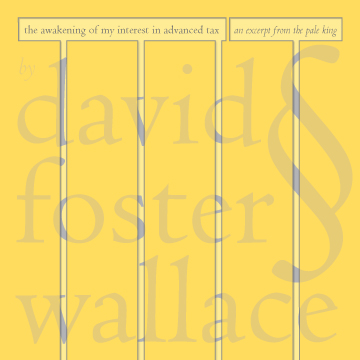
[READ: April 4, 2019] The Awakening of My Interest in Advanced Tax

Madras Press publishes limited-edition short stories and novella-length booklets and distributes the proceeds to a growing list of non-profit organizations chosen by our authors. For this particular book, proceeds to benefit Proceeds to benefit Granada House.

Originally appearing at the heart of The Pale King, David Foster Wallace’s posthumous semi-novel, this extended monologue brilliantly rambles its way around the circumstances that brought its narrator out of his ‘wastoid’ childhood and into maturity at the IRS. Along the way, he falls under the spell of a fake Jesuit, considers the true meaning of a soap opera station break, and narrowly escapes a gruesome death on the subway.

This is the final Madras Press book that I had left to read.  Since I has already read The Pale King, I was in no hurry to read this one.  But now it’s nice to say that I’ve finished all of the Madras Press books.  And that I could post this just in time for the massive Republican tax scam in which thanks to trump and his evil puppet mcconnell, my tax return dropped over $3,000.  Bastards.   May they all rot in prison.  And then hell.

Interestingly, back when I read this during Pale Summer (2014), this entire section was one week’s reading.  So my post from that week is still relevant.    It is posted almost in its entirety below:

This book is an excerpt from The Pale King.  In the book, it is almost 100 pages of one person’s testimony.  Without the novel for context, this excerpt stands on its own just fine.  It is basically an unnamed person’s introduction.  This narrator is so detail oriented that everything gets the same amount of importance–snowfall, the way to score drugs, the effects of drugs, Christian roommates, his father’s death, his mother’s lesibianism, oh and taxation.

So much of it is “irrelevant,” that I hate to get bogged down in details.  So this is a basic outline of ideas until the more “important” pieces of information surface.

For the most part, this is all inside one man’s head as he talks about his life in college, after college, and into the Service.  Mostly this is simply a wonderful character study, full of neuroses and problems that many people face at some point (to one degree or another).  The interviewee states that “A good bit of it I don’t remember… from what I understand, I’m supposed to explain how I arrived at this career.”

Initially he was something of a nihilist, whose response to everything was “whatever.”  A common name for this kind of nihilist at the time was wastoid.  He drifted in and out of several colleges over the years, taking abstract psychology classes.  He says that his drifting was typical of family dramas in the 1970s–son is feckless, mother sticks up for son, father squeezes sons shoes, etc. They lived in Chicago, his father was a cost systems supervisor for the City of Chicago. (more…)

Read Full Post »

SOUNDTRACK: NAO-Tiny Desk Concert #833 (March 18, 2019).

This was possibly my least favorite Tiny Desk Concert I have seen.  And it was endless.  It kills me when bands I like play short sets (often only three short songs) while shows like this push nearly 20 minutes.

Nao’s voice is a comic book character–underneath that comic book voice there’s a powerful voice, but it’s all wrapped up in this goofy–how can you take it seriously–nasally nonsense–and when she goes deep, it’s even more amusing.  Worse yet, her backing singers sound like bleating goats and sheep in the first two songs–single note: “baaa.”

And yet , clearly I know nothing because the blurb describes “Nao’s sophomore effort and one of 2018’s best albums.”

Just to top it off, the album is about astrology.

In astrology, your Saturn return is the time in life when Saturn goes back to the same spot it was at the time of your birth. As Nao explained during her appearance at NPR’s Tiny Desk, “It’s about leaving adolescence and going into adulthood.” This crossing of the threshold that happens around your late 20s to early 30s is the inspiration for Saturn

Maybe I would like the album more if her voice was drowned out in synths.

While Nao usually performs with synthy, electronic twinkles, her day at the Tiny Desk was stripped down by comparison. At times, her lyrics ring out with just a sparse guitar to carry them. Like a roller coaster of unexpected upheaval, Nao’s distinctive vocal range on this four-song set goes from bellowing and husky to soft and coy, often within the same verse. Be it the breezy, Brazilian funk of “If You Ever,” the hallowed harmony of “Orbit” (complete with prayer hands) or the valiant soul-searching of “Make It Out Alive,” it’s almost as if Nao duets with herself, answering her own questions, settling into her own quirks.

I listened to the show twice to see if I was wrong.  The first song is a bit catchy–I like the guitar lick from Ariel O’Neal.  In fact, focusing on her throughout the show is a highlight.

I also really like the part between the songs when she introduces the band, because she’s not singing–it’s a nice light jam.  I admit that it amuses me that she says “that’s my cousin Samson Jatto on drums–he’s not really my cousin I just wanted to say that.”

If she didn’t do the R&B warble, the opening of “Bad Blood” would be okay.  But the comical vocals just undermine anything serious.  And then the bleating starts.  I’m not sure if only Troi Lauren and Taylor Samuels are making the goat sounds, but it sounds like it’s coming from all around the room.

“Orbit is similarly okay to start with.   “Make It Out Alive” is the fastest song in the show, with some uptempo keys and bass from Joe Price and Henry Guy.

If it were one song on a mixtape, I’d skip it, but 20 minutes was a lot to take.

[READ: March 26, 2019] “Setting the World to Rights”

A powerful opening from this story: “All his life he lived on hatred.  He was a solitary man who hoarded gloom.”

And how about this: “Good people are afraid of hatred, and even tend not to believe in it.  If it appears before their eyes, they generally call it dedication or some such name.”

Those in the kibbutz believed the subject of the story (unnamed) was full of faith and dealt severely with the world–“We invested him with a halo of self-sufficient reticence.”  This halo afforded protection against gossip although the children called him ‘wicked Haman” and pointed fingers at him.

He works with machines and is efficient and hates waste. (more…)

Read Full Post »

SOUNDTRACKAMANDA PALMER-“The Ride” Tiny Desk Family Hour (March 12, 2019).

These next few shows were recorded at NPR’s SXSW Showcase.

The SXSW Music Festival is pleased to announce the first-ever Tiny Desk Family Hour showcase, an evening of music by artists who have played NPR Music’s Tiny Desk Concert, at Central Presbyterian Church on Tuesday, March 12 from 8-11pm.

This show is the most interesting visually because Palmer is sitting at her piano and the camera is at all angles–so you can see the crowd and how close they are to the performers.

The blurb is also interesting because I had no idea the performers only played for about 15 minutes.

When Amanda Palmer heard she’d have around 15 minutes for her Tiny Desk Family Hour performance, she assumed there wouldn’t be time for most of the songs on her new album, There Will Be No Intermission, a sprawling masterwork with epic tracks clocking in at 10 minutes or more. So, she showed up with just her ukulele in hand, prepared for a stripped-down, abbreviated set. But when we wheeled out a grand piano just for her – and after I gushed to the crowd about Palmer’s brilliant new opus on the nature of humanity called “The Ride” – she decided she had to play it.

Like many of the tracks on There Will Be No Intermission, “The Ride” is a deep, existential dive into fear, death, loneliness and grief, with the tiniest glimmer of hope or comfort at the end. This is Palmer’s first album in seven years and it documents all she’s been through in that time. It’s also an album she says wouldn’t have been possible if she hadn’t decided to make it on her own, with crowdfunding support from fans. “It’s a very intense record. It’s been a very intense seven years of my life since I put out my last one,” she told the crowd at Austin’s Central Presbyterian Church. And without having a label to answer to, she said she was able to “write an entire album with songs that are really long and about miscarriage and abortion and about the kind of stuff I don’t want to take up to ‘Steve’ in marketing to try to explain why this record should exist.”

It’s a powerful song–simple and mostly unchanging–where the focus is on the words.  But those few times when the vocal melody changes or she adds that circus melody it’s a jarring change from the story she’s presenting.

Though she’s played abbreviated versions of “The Ride” in past shows, this is one of her earliest performances of the full, album-length song. Two days after her Tiny Desk Family Hour set, Palmer returned to the Central Presbyterian Church for an epic, two-and-a-half hour concert with just her ukulele and piano.

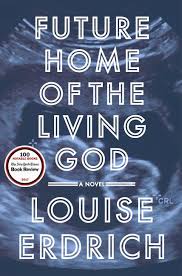
[READ: February 2019] Future Home of the Living God

I’m not sure what drew me to this book. I have read (and enjoyed) many short stories by Erdrich, so I assume her name stood out.  The title is also pretty cool.

But I really had no idea what was coming.  I also didn’t know that Erdrich is Turtle Mountain Chippewa, which obviously lends weight to her Native American depictions.

This story is about Cedar Hawk Songmaker, an adult woman who was adopted by “Minnesota liberals” as a baby.  When she went to find her Ojibwe parents, she learned that she was born Mary Potts.

The book is written as Cedar’s diary.  It begins August 7 (year unstated).  The book is set in the future.  A cataclysmic event has happened and I absolutely love that since this book is written from Cedar’s point of view, she doesn’t know what happened.  She will never learn what happened, and neither will we.  It is just understood that evolution as we know it has stopped.  People seem to be devolving. Or more specifically babies are being born in a state of devolution.  Again, no more details are given. (more…)

Read Full Post »

SOUNDTRACK: KING GIZZARD AND THE LIZARD WIZARD-Nonagon Infinity (2016).

A nonagon is a 9-sided shape.  Infinity is endless.  This album has nine songs that flow seamlessly into the next one.  Including the final song, which flows seamlessly into the first.  It’s a nine-track album designed to loop forever.  Riffs and choruses are repeated throughout (including the frenetic guitar solo riff that starts the album and is sprinkled throughout).  But even though the songs are connected and there are repeated parts no two songs sound alike–it’s not a 41 minute song by any means.

It is a pretty intense and relentless rocking good time, though, with all kinds of catchy melodies and bizarre lyrics.

This album launches with “Robot Stop,” a maniacal riff and a super fast beat .  It’s non-stop intensity of distortion, drums and vocals.  There’s distorted whoops and hollers.  There’s a distorted harmonica solo and more and more guitars.  It also introduces the repeated chorus:

Nonagon infinity opens the door
Wait for the answer to open the door
Nonagon infinity opens the door

It’s not always clear if the lyrics have meaning [Any wasp that I see / It’s a fig wasp / Pearly guillotine] but I love singing along with those that I can understand.  Or just chanting “Big Fig Wasp” when it comes around.

“Gamma Knife” encourages us to “come on through the door, see, it’s your unborn self.”   All the while, the guitars are rocking and the vocals are whooping.  Things do finally settle down near the end of the song, where everything drops out but the two guitars playing the riff.  It’s interrupted by some pretty wild drum soloing (from both drummers) before seguing into the moderately slow introduction of “People -Vultures.”  It’s slow for the first three lines before the line “What else have I got left to spew down?” prompts a breakneck resumption of the album’s pacing.

“Mr Beat” seriously slows things down for one of the catchiest songs on the record.  It’s a cool groovy chugging song with organs amid the guitars.   It has an instantly memorable melody and is easy to sing along to “Once I missed a beat – only missed a beat.”  Even the verse has a sweet sing-song melody.

Things do come to almost a complete stop as Mr Beat slows down, but before you can take a breath, “Evil Death Roll” takes off.  It is 7 minutes long, full of staccato chants during the chorus.   But midway through the song a new riff enters–a happy, almost boppy riff that reconciles itself into a version of the original main riff.  And after a few minutes of electronic manipulation, a new bridge comes around.  It’s musically unique to the album, but while that music is playing the nonagon infinity refrain returns.  And then the song returns to the main “Evil Death Roll” chorus before jumping into the staccato “Invisible Face” which shifts midsong into a gentle jazzy jam.

The ending riff segues seamlessly into the wah wah of “Wah Wah” which starts with a harmonica solo and then switches to a downbeat verse with a screaming noisy bridge of “Wah Wah Wah Wah.”   It ends with some distortion and a drum beat that sounds like a train, hence the album closer “Road Train.”

Road Train hearkens back to their more Western songs, but with all of the metal and garage trappings that are consistent on the album.  So the song about a train is rather dark:

The spawn of Satan’s back
It’s made of steel and black
It comes to bring you pain
It comes again and again
Road Train!

The song is 4 minutes but after a bout 3 minutes, it starts a new chanting of Nonagon Infinity–a new way of doing it that speeds up until the last ten seconds which return to the opening of the album.

There is so much originality in this album and so many ideas that it’s kind of a blur.  But repeated listens show just how much excellence is on display here.

[READ: February 25, 2019] Cottons Book 1

Wow, I loved this book (part 1 of a trilogy).  The story was fascinating (if a little murky in some places), but the artwork was simply tremendous.

Arnhold’s drawing style is so realistic, and the rabbits are so lovingly drawn, it’s really beautiful.  (In her bio she says she loves drawing rabbits, and volunteers at the Georgia House Rabbit Society).

This is the story of Bridgebelle and the rabbits in her warren.  They live in the Vale of Industry within the World of Lavender.  But their’s is not a happy life.  Bridgebelle is an artist and no one appreciates artists in this time of Industry.  But even worse, this is a time of fear for all of the World of Lavender.  Fear of predators, or fire and of the end of their existence.

As the story opens we see Bridgebelle and her co-worker/secret crush Glee fleeing from foxes.  The two of them hide in a stump when suddenly they see that Glee’s sister Soozie is snatched up and killed by Marrow, a ruthless fox.   It is devastating.  (The drawing is very sad, but not bloody or disgusting).

Worse yet, the murderous fox just did it to get the rabbits’ attention.  He wants control of their factory. (more…)

Read Full Post »

« Newer Posts - Older Posts »