Feeds:
Posts
Comments

Archive for the ‘Racism’ Category

SOUNDTRACK:

[READ: December 16, 2024] “Conversation Over the Holidays”

This year my wife ordered me The Short Story Advent Calendar.  This is my seventh time reading the Calendar–it’s a holiday tradition!  Here’s what H&O says about the calendar this year.

Ten years of stories! Yikes, where does the time go?
When the first Short Story Advent Calendar launched, in 2015, we frankly had no clue we’d still be sitting here today, continuing to offer up batches of tasty stories fresh from the oven. To celebrate this milestone, we’ve packed the 10th SSAC with a mix of new and familiar names—ideal company for those chilly winter nights ahead.

The author of this story was Jessica Westhead.  Each day has an online component with the author with a brief interview.   Here’s today’s

It’s December 16. Jessica Westhead, author of Avalanche, knows a good crab dip when she sees it.

(more…)

Read Full Post »

SOUNDTRACK: hiatus.

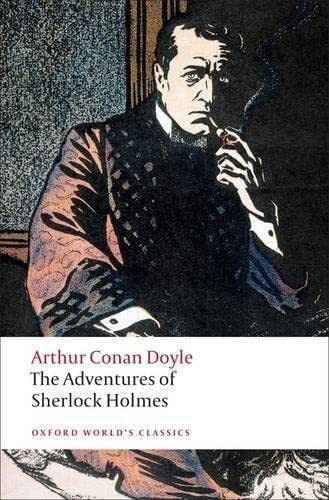
[READ: February 4, 2024] “The Five Orange Pips”

The fifth story in this collection is notable to me for the context of the mystery more than the mystery itself.

A gentleman named John Openshaw tells Holmes that his Uncle Elias has been killed.  As a young man, Elias went to Florida, joined the Confederate Army, made some money and came back to England.  John lives on his estate.

Recently Elias received a mysterious letter from India with the initials K.K.K. on it.  The only thing the letter contained was five orange seeds (pips).  Elias frekaed out and became even more reclusive.

Elias was found dead on the grounds of his house, but it was ruled a suicide.  John did not believe it was a suicide.

John’s father inherited the estate.  He soon received a similarly peculiar note with orange pips.  This note told him to leave Elias’s papers at the sundial.  But Elias had burnt the papers.  John’s father was dead soon after–this one ruled an accident.

John has now received a letter asking for the papers and that’s why he has come to Holmes.

What’s most notable about this story is that the K.K.K. (and this seems really obvious now, but who would have guessed) stands for Ku Klux Klan. The Klan was effectively defunct at the time he wrote this.  Sadly it has been revitalized since this writing and remains the scourge that it was at the time.

Obviously, Holmes didn’t go after the Klan, but it’s nice to know that the ship carrying the Klansmen was destroyed in the story.

~~~~~~~~~~~~~~~~

The four novels of the canon:

  1. A Study in Scarlet (1887)
  2. The Sign of the Four (1890)
  3. The Hound of the Baskervilles (1902)
  4. The Valley of Fear (1915)

The 56 short stories are collected in five books:

  1. The Adventures of Sherlock Holmes (1892)
  2. The Memoirs of Sherlock Holmes (1894)
  3. The Return of Sherlock Holmes (1905)
  4. His Last Bow (1917)
  5. The Case-Book of Sherlock Holmes (1927)

The Adventures of Sherlock Holmes (1892) contains 12 stories published in The Strand between July 1891 and June 1892

  1. “A Scandal in Bohemia” (June 1891)
  2. “The Red-Headed League” (August 1891)
  3. “A Case of Identity” (September 1891)
  4. “The Boscombe Valley Mystery” (October 1891)
  5. “The Five Orange Pips” (November 1891)
  6. “The Man with the Twisted Lip” (December 1891)
  7. “The Adventure of the Blue Carbuncle” (January 1892)
  8. “The Adventure of the Speckled Band” (February 1892)
  9. “The Adventure of the Engineer’s Thumb” (March 1892)
  10. “The Adventure of the Noble Bachelor” (April 1892)
  11. “The Adventure of the Beryl Coronet” (May 1892)
  12. “The Adventure of the Copper Beeches” (June 1892)

Read Full Post »

SOUNDTRACK: hiatus

[READ: July 25, 2023] Room to Swing

I receive books that are part of a series, but often I get one book and never see any other books in the series.  So this book is part of the Library of Congress Crime Classics series–reprints with wicked covers.

I’d never heard of this book even though it won the 1958 Edgar award for best novel.

Much of the reason this book is reprinted in this format is because the main character, Toussaint Moore is a Black private investigator.  Black sleuths were not common at the time, although they were not unheard of.  Indeed, white author Octavus Roy Cohen had created Florian Slappey, a caricature of a Black detective for the Saturday Evening Post.  By the 1950s, there were several Black detectives, but not many Black private detectives.

Ed Lacy (pseudonym of Leonard (Len) S Zinberg) was a white author who married a Black woman and lived in Harlem.  He created Toussaint Moore as an opportunity to capture the struggles of a Black man in the 1950s.

But the story is not a polemic about race relations.  Indeed, the mystery is pretty interesting and fun to follow.  And Touie is a charming and resourceful detective.

As the story opens, Touie is heading to Ohio from his home in New York City.  Southern Ohio is not the South (although Kentucky is only 20 miles away), but when Touie walks into a diner, they tell him he can’t eat there.  He only wanted to see a phone book and the local policeman quickly arrives to make sure that’s all he’s getting.  However, the mailman is Black and he quickly tells him what it’s safe for Touie to do.  He also has a room that Touie can stay in for a couple of days.

So why is he here?  He is here looking for clues about a murder.  However, he is also the prime suspect in the murder, so it’s possible he’s also laying low.  Although a Black man in a beautiful Jaguar (a crazy expensive import) does not lay low in Southern Ohio.

The man who was killed (in NYC) was from this small town.  And the story is that he was a heap of trouble when he was here, so maybe someone was tailing him to give him trouble in the City. (more…)

Read Full Post »

[READ: December 20, 2022] Skelton’s Guide to Suitcase Murders

I admit that I thought this book was called Skeleton’s Guide… which I thought as very funny.

But it turns out that Skelton is a barrister (and this is the second book in the Skelton series).  David Stafford is a British writer who has written largely for TV and theatre until he started writing novels.  He has written plays with Alexei Sayle (for fans of The Young Ones).

This mystery is set in 1929.  That setting allows Stafford to avoid any kind of contemporary details that might help speed the case along.  But it’s written in such a way that you’re not frustrated by it–you can simply get into the nearly 100 year old technology (and lack thereof).

In November 1929, a woman’s corpse is discovered in a suitcase.  She is identified and her husband, Doctor Ibrahim Aziz becomes the prime suspect.  They find some evidence and there is a rumor that she was cheating on him.  So clearly he is guilty.  Especially since he’s not from England–he’s Egyptian.

Arthur Skelton is a barrister.  He’s not 100% successful, but he gives his all in hopeless cases.  So he is called in to represent Aziz.

Skelton is concerned for diplomatic matters if Aziz is executed here.  He is related to a wealthy and well-connected family back in Egypt.

The story, despite dealing with a gruesome murder, has some funny moments.  Skelton’s clerk Edgar is trying to lose weight and is quite miserable. (more…)

Read Full Post »

SOUNDTRACK: hiatus

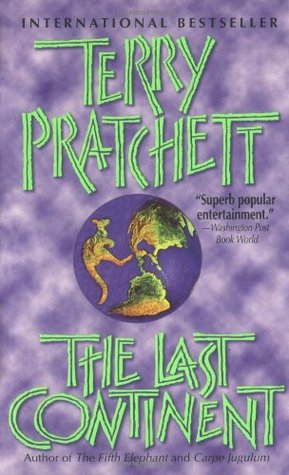
[READ: March 2022] The Last Continent

The Last Continent in Discworld is Australia. Or as Pratchett says “This is not a book about Australia. No, it’s about somewhere entirely different which just happens to be, here and there, a bit Australian.  Still… no worries, right?”

In the previous Rincewind story, he was sent to Four Ecks in exchange for a kangaroo.  He has been there for a time and has been adjusting reasonably well–only nearly everything wants to kill him.

But suddenly he meets Scrappy–a talking kangaroo.  Scrappy believes that Rincewind is a hero of sorts who is going to bring the wet (Rain) back to the continent.  Turns out that it has not rained in Four Ecks for a long time, although it is surrounded by forbidding storms that make the continent almost inaccessible from outside.

Four Ecks is also a time travel parody of sorts, because Rincewind is able to see himself (and the other wizards) in cave paintings that are thousands of years old but which just appeared in front of him.

Meanwhile, back in Ankh-Morpork, the librarian seems to be going through something.  His magical field (which tunrned him into an orangutan) seems to be failing.  He keeps turning into various shapes, and the senior wizards (Archchancellor Mustrum Ridcully, The Dean, The Bursar, The Chair of Indefinite Studies, The Lecturer in Recent Runes, The Senior Wrangler, and Ponder Stibbons) are keen on fixing him–even if that means turning him back human–which he does NOT want, Indeed, the librarian destroyed all record of his original name–which would be essential for creating a spell to revert him to his original shape.

They decide that Rincewind might know a thing or two about the librarian since he was the librarian’s assistant.  They think about dragging Rincewind back, but soon realize the danger of that (and actually stop their plans before anyone can get hurt). (more…)

Read Full Post »

SOUNDTRACK: hiatus

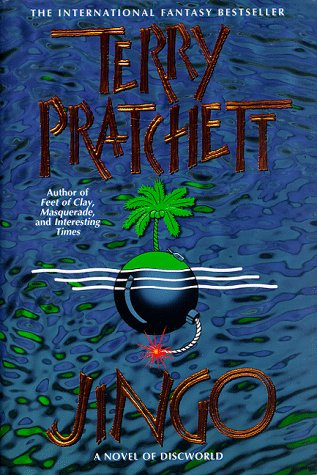
[READ: March 2022] Jingo

With a title like Jingo, you know that Terry Pratchett isn’t holding back.  And indeed, this is a story about two countries fighting each other over disputed territory–and the unenlightened attitudes that people have about “foreigners.”

What is great about Pratchett is how much he is able to get his point across without being preachy.  Some of the unenlightened characters say offensive things, but they are quickly discoruaged from such attitudes–not with bludgeoning and hysteria, but with rational comments.  It’s very well done.

But what causes this trouble?  Well, out of nowhere, an island has surfaced.  The island of Leshp was submerged forever, and suddenly, it floated to the surface amid two fishermen.  Solid Jackson of Ankh-Morpork (and his long-suffering son) and Greasy Arif from Al-Khali, the Klatchian capital.  They often fought over their prey (the Curious Squid), because they sailed the same waters that were between the two countries.

While this is going on, diplomatic business is occurring in Ankh-Morpork.  The prince of Klatch, Khufurah, is in Ankh-Morpork to receive an honorary degree (Doctorum Adamus cum Flabello Dulci) in Sweet Fanny Adams.

Hostilities between A-M and Klatch are high.

Several leaders of the city are there to complain to Lord Vetenari about Klatch.  Watch Captain Sam Vimes is there to add a level head and sarcasm.  When someone complains that Klatch wouldn’t accept ten boatloads of cabbages, Vimes says out loud to himself “everyone knows caterpillars add to the flavor” and later “Meat is at its best when it’s going green.”

And of course, the Patrician knows his way around diplomacy: “it is no longer considered…nice…to send a warship … to show Johnny Foreigner the error of his ways.”

Later, the Prince meets with Vimes and asks him about the word he’s heard shouted at him: “towelhead.” (more…)

Read Full Post »

SOUNDTRACK: hiatus

[READ: March 1, 2022] The Devil Made Me Do It

As South Africa entered the new millennium, things were progressing very slowly (and sometimes regressing).  And Zapiro was watching.

Homophobia was spreading throughout African nations.  There’s a banner that says Queens against Mugabe.  Zapiro ties it together nicely with a picture of Queen Elizabeth with a paper that says “Mugabe lambasts U.K.”

And an anti-rape ad (starring Charlize Theron) was banned because there was public outcry.  Which leads to a later strip in which children learn the rape message: it’s not bad to rape someone in your own family (A lenient sentence was given to a man who raped his daughter); rape is less offensive than an anti-rape ad that offends men; you can get away with rape if you are famous and hire a hotshot legal team.

Apartheid fallout was still happening.

There’s a an amusing picture of Apartheid Hell and the devil is showing all of the people there a video called No person shall be discriminated against on the basis of race, gender ethnic or social origin, culture, sexual orientation….”  Although clearly the powerful men aren’t all getting punished as we see Craig Williamson, a constant figure in these battles, telling the Amnesty Committee to sit, lie down and fetch his amnesty. (more…)

Read Full Post »

SOUNDTRACK: hiatus

[READ: February 20, 2022] Call Mr. Delivery

This is Zapiro’s fourth book and it’s the first time, I think, that he’s put himself into the cartoons.  And it seems like maybe the world is getting to him.

Although his first appearance is in the meta-joke:

“Only one tiny minority welcomes the formation of Louis Luyt’s new political party” : Cartoonists.

But later by March 1999 he is on a therapist’s couch.  The therapist asks “when did you first experience this feeling of uselessness.  Zapiro says “this week suddenly reality seemed weirder than anything I could come up with.” (And the world hasn’t even gotten to trump yet).

It’s the end of the Mandela era and his successors don’t seem to be shaping up very well.

Although Mandela gets one nice shoutout.  He parts the waters for the Lockerbie Breakthrough and Libya asks if anyone ever get blasé about this sort of thing.

The Truth and Reconciliation Commission’s Final Report had to have any negative mentions of F.W. DeKlerk removed.  And Desmond Tutu seems under attack from the left, right and centre (PAC, IFP, FF, ANC, NP, TRC). (more…)

Read Full Post »

SOUNDTRACK: hiatus

[READ: February 14, 2022] End of Part One

I’m not sure what the Part One is that this title refers to.  This book picks up where the last one left off and moves on into 1998.

It’s clear that Zapiro is still bitter about the Olympics, as the first cartoon is “For the first time the I.O.C. has awarded the Olympic Games to an African City” (the toon is dated 3004 A.D.

At some point it was imperative that I learn all of the political abbreviations.  And he has a good cartoon that summarizes them: (more…)

Read Full Post »

SOUNDTRACK: hiatus

[READ: February 9, 2022] The Hole Truth

Nothing can make you feel ignorant like reading a book of cartoons.

This is a collection of South Africa-based cartoons that Zapiro wrote in 1996.  Who remembers what was going on twenty-five years ago?

Well, this book has an introduction from Archbishop Desmond Tutu (who appears a few times in cartoon form).  Tutu writes that Zapiro is there to skewer hypocrisy but that he has a desire to help the country into realizing their potential–even if it means gently nudging the people he supports when they mess up.

Every country has its share of corruption.  That’s the way of power.  A book like this makes it seem like there was nothing but corruption in South African (and with apartheid, that was likely the case).  Of course, the cartoonist assumes the reader knows what’s going on, so they don’t need to explain their cartoons.  If you don’t know what’s going on, well, you may not get the joke.  And then you feel stupid. (more…)

Read Full Post »

Older Posts »