Feeds:
Posts
Comments

Archive for the ‘Poets’ Category

SOUNDTRACK: Y LA BAMBA-NONCOMM 2019 (May 14, 2019).

I have been hearing a lot about Y La Bamba lately and for some reason I didn’t realize that they sang in Spanish (which is why I thought it was an odd name for an English-speaking band).  I know WXPN has been playing some of their songs, perhaps I only heard “My Death” and “Orca” which are in English and which they did not play at NonComm.

But they do sing in Spanish and they bring a wonderfully diverse sound to these Spanish lyrics.  And they are not simply casually Spanish either, as their mission statement explains “BEING A CHICANA, MEXICAN AMERICAN HAS BEEN AND WILL CONTINUE TO BE A STRENGTHENING JOURNEY. I AM LEARNING HOW TO CELEBRATE MY BEAUTY, HISTORY, BE AND HEAL FROM WITHIN IT.”  Nor are they exclusively Spanish. “I WRITE IN SPANISH BECAUSE IT WANTS TO BE SUNG, I WRITE IN ENGLISH BECAUSE IT WANTS TO BE SAID.”

Lead singer, guitarist and songwriter Luz Elena Mendoza is the daughter of immigrants from Michoacán, and she has channeled into her music her Mexican-American heritage and her many frustrations with American culture.

And she demands the audience’s respect.  I would have found this particular set very uncomfortable as Mendoza, called out talkers in the back of the room, demanded silence and respect.  I’m all for silence and respect for bands during shows.  In fact I wish more bands would demand it, but this was really uncomfortable to listen to and I wasn’t even there.

Demanding silence form the drinkers at the bar, she said “I don’t come here to waste my time, […] you hear me?” She waited for the crowd’s attention. “You hear me? […] OK. Because that’s real. I’m not here to be cool, to give you something that you think might be cool. I’m here to give you my parents’ story.”

This is all pretty awesome, but since nearly all of the songs they sang were in Spanish, I’m not sure how much the audience really got out of what she was singing.

The blurb describes their music as a “mix of indie-punk, música mexicana and raw emotional storytelling” while Mendoza sings and raps in Spanish and English, railing against misogyny, patriarchy, and white ignorance.

Y La Bamba were at their most intense last night when Mendoza rapped in unison with keyboardist Julia Mendiolea, including on their fiery opener, “Paloma Negra”(“Black Pigeon”).

There’s some gentle echoing guitars (Ryan Oxford) and some bouncy synths underneath their very fast rapping.

As the raging “Paloma Negra” concluded, drummer Miguel Jimenez-Cruz instantly slid into a sly tresillo groove that marked the introduction to “Boca Llena,”

Later, “Bruja de Brujas” introduced all kinds of cool sounds in the bass (Zack Teran) and the percussion.  It was funky and fun.  The song ended with a

a wash of echoing cymbals and guitars that finally coalesced into the arrival of “Cuatro Crazy,”

This was the first (and only) song sung in English.  It was quiet with the two singers singing in a gentle falsetto over washes of guitar.

A blend of phasers, distortion and delay lines infused the band’s guitar and vocal sounds with an electric energy, and helped Mendiolea’s synth provide a brooding ambient backdrop for the spoken-word “Santa Sal.”  This was spoken in English, but it had some echoing and it was a little hard to follow.

It was during the introduction to “Una Letra” that Mendoza started to get angry with the crowd.

As she introduced the ballad “Una Letra,” Mendoza explained to the crowd, “It’s about domestic violence. It’s about my mom writing a letter to me, wishing […] for me to have the good things that she couldn’t have. And if those don’t want to hear this story, and you’re here to listen, then I don’t know what you’re doing here.”  Mendoza and her bandmates gently repeated, “No se sabe. No se sabe, se comprende.” — “You don’t know. You don’t know and you don’t understand.”

Again, she has every right to be annoyed that she’s telling these personal stories and people are apparently ignoring her.  But again, it’s hard to “hear the story” if you don’t understand the language.

This is when she launched into her “I don’t come here to waste my time, […] you hear me?”  tirade.  But It felt a little better when she sent her anger to someone who should know better.

“I’m very disappointed in Morrissey,” she went on to refer to a 2018 interview that Fiona Dodwell conducted with the former Smiths frontman, for which he has received intense backlash. In the interview, Morrissey aligned himself with a UK political movement known as For Britain and dismissed the many critics who have deemed the movement extremist and racist.  Morrissey performed at NonCOMM just a few hours before Y La Bamba on Tuesday night, before a crowd that presumably included some of the same listeners who attended the Y La Bamba set.  “I’ve been a huge fan of Morrissey and I just heard him talk,” Mendoza continued, “He thinks that ‘racism’ is just a childish word that we use against one another. He’s a white man with so much privilege! I am so disappointed!”

I had wondered if anyone would allude to Morrissey’s recent politics statements and thought no one had.  But Mendoza did not hold back.

I don’t know if Morrissey had anything to do with the next song but “Soñadora” shimmied ans swayed and Mendoza’s voice soared to new heights. “Corazón, corazón,” she and her bandmates chanted.

What is particularly unsettling is that on the recording, people sound respectful, but apparently she is unhappy with the crowd.

Before a gentle solo rendition of “Entre Los Dos,” she said

“I politely ask for everyone’s silence,” she said. But as the bar and the back the room remained noisy, she continued, “Because what are we doing here? … People wanna have their drinks, but I’m really asking — just giving benefit of the doubt — just everyone’s silence. To actually listen to what’s happening….  If you saw, ‘Y La Bamba is playing,’ and you saw what record I put out, and you got to read the story — you got to hear that it’s for women.” This prompted shouts of approval from several voices in the room, but Mendoza seemed intent on getting the attention of even more of the crowd. “You know? Right? Right? Isn’t that what we’re here for? … Let’s remember that, OK? Come on, we’re not children anymore. You know what I’m saying?”

She strummed her guitar softly and continued on with the song, but stopped singing again at one point to remind the room, “I’m not gonna play my song until everyone gets the point … I’m making my point, and I’m gonna make my point everywhere I go. It’s not really about like, you know, hearing me sing, it’s about listening. Like, yeah, if I get to sing, cool. But it’s about listening … and it’s really hard. Like, nobody even knows what I’m talking about back there. No one.” She then addressed those closest to the stage. “But I see you! I see those who are in the front. I see you. I hear you, with your heart.”

Of all of the comment she made, I though this was the most powerful and could be used in any context

After Mendoza completed “Entre Los Dos”, Jimenez-Cruz began a low drum roll and Oxford’s electric guitar shuddered back to life. Before the band began their final two numbers, Mendoza looked to front row of the crowd with resolve. “You guys wanna help me sing this song?”

“When I show up here, it starts right here.  When I ask for silence I really wanna be taken seriously.  When I am out there walking out on the street, I am not going to count on it. “

That’s pretty powerful and reasonable thing to say.  But she seems so pissed when she says it that it’ hard to know how to respond to her request that everyone sing a long to a pretty melody of “dadada da da da”  “Riosueltos” is a great rocking rap-filled song.  It was my favorite of the set, with its cool bass and guitar.

The set ends with “De Lejos”an upbeat dancey number with some great wild guitar work.

Before this show I was curious about Y La Bamba, but I can tell they are not a band I need to see live–I wonder if she’ll demand the same respect at XPNFest, when people are not there just to see them.

[READ: May 3, 2019] “Green Ash Tree”

The July/August issue of The Walrus is the Summer Reading issue.  This year’s issue had three short stories and three poems as special features.

I don’t normally write about poems.  Certainly not ones that appear in magazines (this blog would be all poetry if  did that).  But for a summer reading issue that features three poets, since I wrote about the other two, I figured I should include this one as well.

Of the three, I feel like I “got” this one the least.

A tree never dies
except in our neighborhood.  Green ash,
stripped in old age, all branches
cleanly lopped by saws: a torso standing

Upon being aware of this poor specimen (more…)

Read Full Post »

SOUNDTRACK: TACOCAT-NONCOMM 2019 (May 14, 2019).

Tacocat are from Seattle and they are very happy to be here.

It sounds like that was another set that would have been a lot of fun to see:

An indie-punk four-piece from Seattle [singer Emily Nokes, drummer Lelah Maupin, bassist Bree McKenna and guitarist Eric Randall] walked onto World Cafe Live’s upstairs stage glowing—literally. Covered head-to-toe in bright colors and sparkles. The band brought an unwavering burst of energy to the first night of NonCOMM, performing a handful of songs from each of their three albums.

Tacocat wasted no time getting started as they jumped right into “Hologram” from their latest album This Mess Is a Place. Lead singer Emily Nokes started dancing with a tambourine in her hand and didn’t quit until the set was complete (minus breaks between songs to sip some tea—we hope she’s feeling okay).

“Hologram” puts a slight political spin (I assume) on their poppy punk songs.  Indeed, their identity seems to be one of snark and surf-pop, but with thoughtful questions underneath

Not so long ago, I used to feel like
I was too sensitive to be alive
But maybe now it’s the opposite
Too much to say
So I don’t say anything
Is numb even a feeling?
I just wonder how anyone falls for this anymore

“Bridge to Hawaii” is about seasonal depression–wouldn’t it be nice to build a bridge from rainy Seattle to beautiful Hawaii so that you could just walk there?  While “New World” wonders what it would be like to build a new world–like in sci-fi movies.

New world, new planet
No ugly buildings in my eyes
No paperwork, no jerks, no parking tickets
No beak to feed, no nine-to-five

“The Joke of Life” is about “when when things are too hard to make fun of anymore because they’re already making fun of themselves.”   Randall chimed in, “the death of satire.”  The song contains the chorus: “The jokes is that the joke is already a joke.”  This one features backup vocals from Randall and McKenna which perfectly complement Nokes’s raspy lead vocal.

At the end of the song drummer Lelah Maupin [who was sporting a checkered onesie and a toothy smile throughout all 7 songs the band played] said, “my whole life as a drummer has been building up to playing that song.”

“Grains of Salt” changes their sound a bit with some synthy solos.  It’s more poppy than punky but doesn’t feel too far away from their sound.

Randall says that they needed t pick a single for their album and “Crystal Ball” just didn’t make the cut.  “But we love it.  We love all our children equally.”

The final song, “I Hate the Weekend” is which is dedicated to everyone who ever worked in the service industry…  like you.  Let’s all be nice.  Let’s all tip well.  Let’s not throw up in the sink.”  It’s a ripping fast song with this nice section

Homogenized and oh so bleak
Got a hall pass from your job
Just to act like a fucking slob

before the chippy clap-along chorus.

I missed Tacocat when they came around, but I hope they open for someone I see real soon.  Stream this show on the media player.

[READ: May 3, 2019] “Fake News”

The July/August issue of The Walrus is the Summer Reading issue.  This year’s issue had three short stories and three poems as special features.

I don’t normally write about poems.  Certainly not ones that appear in magazines (this blog would be all poetry if  did that).  But for a summer reading issue that features three poets, I thought I’d make an exception.

Especially for this one, which is subtitled “An American bodyguard forsees his death.”

How’s this for an opening line

Do I love my country less  than I pledged,
since I haven’t yet brought the tent top down
on this circus?  Head clown, I and the men

code call him, in small font, or else imPOTUS–

But if some fanatic
does attempt to off him (snipe him, stab him,

body bomb him), my Navy SEAL-trained nerves
will trigger a textbook-expert tackle–

block bullets with my skull, spine, sacrum

I have often wondered if we would ever see a day when a bodyguard would turn on him–for love of country since he is wrecking our so badly.  I assume not.  I can’t imagine what would have to happen to a person’s mind to act that way.

Read Full Post »

SOUNDTRACK: MORRISSEY-NonCOMM 2019 (May 14, 2019).

Morrissey was (to me) quite a surprise performer at NonComm.  It seems way too “exposed” for him.  When I mentioned divas not mingling with fans, it was Morrissey I had in mind.  I don’t know if he mingled anywhere at NonComm, but, speaking of divas, he does not have a live stream available.

I had the radio on when he performed and heard a bit of his set.  I was impressed with his voice.  It doesn’t sound like it used to in his heyday, but it still sounds strong.  He seems to have modified the songs to allow his somewhat deeper, gravellier voice to work well with them.

I was supposed to see Morrissey last time he came to Philly.  I even had a ticket. But better than a Morrissey show, I got a Morrissey excuse–the show was cancelled.  On the night of the show!  So I don’t feel the need to see him now.  I wonder if he’ll actually make it to his show this summer.

Since I can’t re-listen to his NonComm set, I’ll have to rely on the (lengthy) blurb that The Key has written.

Morrissey was as cynical, self-obsessed and self-assured as ever at NonCOMM on Tuesday night. “I have to warn you before I begin,” he offered slyly as he took center stage. “I have never in my life been this close to another human being. So If I don’t do something illegal, I will do something extremely… enjoyable.”

The World Cafe crowd responded with a roar, and the band burst into a rowdy rendition of “Alma Matters” from Morrissey’s 1997 album Maladjusted. His croon was grave and full-throated, and the band matched his machismo with pounding drums and several wailing guitar solos early in the set. Morrissey strutted across the stage, full of pomp and in his element; he danced with his microphone stand, clapped along to the band, and took every opportunity to denounce his critics, including in song. “So, the choice I have made may seem strange to you. But who asked you anyway? It’s my life to wreck, my own way,” began his opening number. The Manchester native dressed himself in all black, with a t-shirt proclaiming “MEAT IS MURDER” (also the name of a 1985 LP by his former band, The Smiths) and dressed his band in blood-red tees that threatened “BE KIND TO SEALS OR I’LL CULL YOU.” (These shirts are also available on Morrissey’s website.)

But for all his sarcasm, egotism and brash political inclinations, the Philadelphia crowd still hoped to show Morrissey plenty of genuine affection. Dozens of fans standing in the front row reached out to hold his hand each time he stepped downstage; one of his most ardent fans attempted to climb onstage before being shoved back down by a security officer, and another fan got so far as to step onto center stage and lock Morrissey in an embrace before security managed to pull them away from the singer.

Did this really happen?  Is there footage?  He didn’t cancel the rest of the set?

The crowd enjoyed a set spanning Morrissey’s career, including “I’m Throwing My Arms Around Paris” from 2009’s Years of Refusal, the Pretenders cover “Back on the Chain Gang” from 2017’s Low in High School, and the Jobriath cover “Morning Starship” from his upcoming album California Son.

Recently, as Morrissey has begun making public appearances to promote California Son, journalists and fellow musicians have criticized him for his outspoken support of For Britain, a UK political party that many have deemed extremist and racist. On Monday night, Morrissey appeared on The Tonight Show Starring Jimmy Fallon to perform “Morning Starship,” and he wore a lapel pin featuring For Britain’s trident logo. On Monday night at NonCOMM, he wore no pin and made no mention of the controversy, although he seemed bent on repelling all those who might judge him (as usual).

I was very curious if anyone would say anything about him or to him about what he;’s been saying lately, but apparently not.  Left-wing Morrissey fans (like me) are able to turn compartmentalize.

In between two songs, he gave the crowd a snarky smile and chuckled, “As I thank you now, I have many critics. I have many critics. As you know, I have many critics,” he repeated, before concluding, “They’re all idiots!” With that, he exploded into his most contemptuous number of the night, “If You Don’t Like Me, Don’t Look At Me.”  “See if I care! See if I care! See if I care!” he taunted in each verse. Growling lead guitar propelled this song toward its climactic finish, which was marked by Morrissey’s send-off, “Don’t get your knickers in a twist!” (These lyrics do not appear in the recorded version from 2009.)

Morrissey also performed one Smiths track — “That Joke Isn’t Funny Anymore” from Meat is Murder — before finishing with “The Bullfighter Dies” and the menacing “Jack the Ripper.” During the closer, white strobe lights struck him as his deep laugh echoed through the hall. Then, while the clanging guitars faded and the stage smoke dissolved, he smugly proclaimed, “I love you. Goodnight.” He tore his shirt in two, ripped it off and tossed it into the crowd, then departed.

Wait, he tore his shirt off?  For real?

I need more pictures to see what really happened.  And I’d like to hear “That Joke Isn’t Funny Anymore” to see if he or Johnny Marr now sings songs from The Smiths better.

[READ: May 3, 2019] “Extinction Sonnets”

I don’t normally write about poems.  Certainly not ones that appear in magazines (this blog would be all poetry if  did that).  But for a summer reading issue that features three poets, I thought I’d make an exception.

Especially for this one.

And it seems quite apt for Morrissey.

This depressing series of five poems is five sonnets written to extinct species.

The Monteverde Toad (Costa Rica)

This one offers some modicum of hope:

like fallen stars How lost the scientists
wondering where you went and why. Perhaps mist

there’s still hope that one day you’ll be found
like buried treasure: patient, underground.

The Baiji Dolphin (China)

[once] esteemed as a goddess: one glimpse then gone–

this time you’re drowned for real, will not return
no matter how much incense people burn.

The Black-Faced Honeycreeper (Hawaii)

The Honeycreeper is not yet extinct but is very close. Hence

rarest bird in the world

hidden on remote Haleakala

They say that you are “unusually quiet.”
Well, lonely as you are, why would you sing?
You pretty thing, pretty thing, pretty thing.

The River Otter (Japan)

Once abundant at as reeds in the waters
where you swam and played and raised your young for years,
you’ve disappeared victim of casual slaughter
because humans must wear fur.  Profiteers…

The Pyrenean Ibex (France and Spain)

extinction’s a mystery
we’ll never understand.  But full of guilt
or full of pride, we tried to fix history
by cloning you.  No luck.

The end of this poem summarizes the whole series and summarizes humanity, too.

The things we killed
can never be restored, we know that now.
What we don’t know is who dies next, and how.

Read Full Post »

SOUNDTRACK: TORO Y MOI-Tiny Desk Concert #845 (April 29, 2019).

I have been hearing about Toro Y Moi for quite some time and yet I never got a sense what he (they) were like.  I also always assumed it was a duo (which apparently it is not).

Chaz Bear, who performs as Toro y Moi, is going to do what he feels. In preparation for his Tiny Desk concert, we were given two possible sound scenarios: aim to recreate the heavily electronic and lustrous aura that birthed his latest LP, Outer Peace or strip away the bells and whistles for an acoustic performance. The game-time decision was the latter and fans were treated to brand new iterations of these songs.

I had assumed that the music was dancey, so this acoustic rendition was a surprise.  Reading that blurb makes more sense.

Toro y Moi’s discography conveys that same unpredictability and showcases his affinity for a wide span of genres. While largely known as an early pioneer of chillwave, Outer Peace is anything but. It’s hard-hitting, funky and directly to the point, as is this Tiny Desk concert.

It’s true.  “Laws of the Universe” is as funky as anything (that bass!–Patrick Jeffords) with the stabs of piano (Tony Ferraro) really bring the melody home.  The drums (Andy Woodward) snap and pop and bring the song to life.  And I love the nod to LCD Soundsystem: “James Murphy is playing in My house.” (we should have all replied “my house”).

Stripping down such heavily produced songs could risk revealing weaknesses. In this case, the rhythms move just the same. Removing the Auto-Tune, synths and effects make way for some insightful songwriting that’s often hard to hear in the recorded version.

Like in “New House” which is “about wanting that gold.”  It comes across as such a simple song with simple but relatable lyrics.

I want a brand new house
Something I can not buy, something I can afford
I ain’t even make it off the jetway now
Phone’s been on blast like all day (Ring)
Why you gotta do this? Try to test me now
Right when I touchdown got anxiety (Fuck)
Follow signs out of the terminal now
JFK is a different animal now
Damn baggage claim is like a warzone now
Glad I packed light clothes, I’m on my own

He has a simple, quite vocal delivery here in this mellow song.

“Freelance” returns that funk in the bass with more nice piano punctuation of melody.  I love this verse:

No more shoes and socks, I only rock sandals
I can’t tell if I’m hip or getting old
I can’t hear you, maybe you could change your tone

For the final song they brought out a special guest (who I didn’t know).

With shaker in tow, Bear sat front and center at a stool to deliver four of my favorites from Outer Peace, including “Ordinary Pleasure,” with bongo assistance from Foots of Foot and Coles.

There is definitely a sameness to the set (are they all in the same chord?)  His quiet delivery and the spare piano are all there.  But each song has a moment that lets it stand out.

Like the funky bass and the insanely catchy chorus of “Ordinary Pleasure.”  The bass and ooohs have a very disco feel to it as you dance along to “Maximize all the pleasure, even with all this weather, nothing can make it better, maximize all the pleasure.”

I have since listened to all four songs and I found the Tiny Desk versions to be more enjoyable each time–except for “Ordinary Pleasure” because the disco is ramped up on the album and it’s impossible not to shake to it.

[READ: April 29, 2019] “Poetry”

There is so much going on in this story, that it’s amazing it keeps its coherence.

James and Celeste are on vacation near a volcano.  Possible rain suggested that Celeste would not enjoy the hike but, “so, frankly, did Celeste’s dislike of hikes.”  But the volcano was there and so they had to climb it.  Celeste could sit out out, of course, but “there was the looming question of marriage and children, after all and of the deeper compatibility of our interests.”

She had once told an acquaintance that he needed harrowing ordeals to prove he’s not on the road to death.

The hike was tough–straight up, it felt–and it did rain.  He hoped they would both hold on to the idea that suffering underwrote a deeper pleasure.  He promised it would be over soon and they would enjoy the taste of prune de Cythère.  (Even though neither one knew what it actually was). (more…)

Read Full Post »

SOUNDTRACK: CAROLINA EYCK AND CLARICE JENSEN-Tiny Desk Concert #816 (January 11, 2019).

There have been a lot of bands I have first heard of on Tiny Desk and whom I hope to see live one day.  Carolina Eyck and Clarice Jensen are two women I would love to see live–together or separately.

The concert opens with a looping voice (Carolina’s) and what appears to be her using a theremin to play looped samples.  And then soon enough, she starts showing off how awesome she is at the futuristic 100-year-old instrument.

Carolina Eyck is the first to bring a theremin to the Tiny Desk. The early electronic instrument with the slithery sound was invented almost 100 years ago by Leon Theremin, a Soviet scientist with a penchant for espionage. It looks like a simple black metal box with a couple of protruding antennae, but to play the theremin like Eyck does, with her lyrical phrasing and precisely “fingered” articulation, takes a special kind of virtuosity.

After playing a remarkably sophisticated melody on the theremin (with suitable trippy effects here and there), for about three minutes, she explains how the instrument works.  She even shows a very precise scale.

The position of the hands influences electromagnetic fields to produce pitch and volume. Recognized as one of today’s preeminent theremin specialists, Eyck writes her own compositions, such as the pulsating “Delphic” which opens the set, and she’s got big shot composers writing theremin concertos for her.

Up next is Clarice Jensen with “her wonderful cello.”

Joining Eyck for this two-musician-in-one Tiny Desk is cellist Clarice Jensen. When she’s not making gorgeous, drone-infused albums like last year’s For This From That Will be Filled, Jensen directs one of today’s leading new music outfits, ACME, the American Contemporary Music Ensemble.

Jensen doesn’t explain what’s going on, but she makes some amazing sounds out of that instrument–she’s clearly got pedals and she modifies and loops the sounds she’s making.

“Three Leos,” composed by Jensen, offers her masterful art of looping the cello into symphonic layers of swirling, submerged choirs with a wistful tune soaring above.

Vak Eyck comes back for the final song, a wonderfully odd duet of cello and theremin.

The two musicians close with “Frequencies,” a piece jointly composed specifically for this Tiny Desk performance. Amid roiling figures in cello and melodies hovering in the theremin, listen closely for a wink at the NPR Morning Edition theme music.

Van Eyck make soaring sounds, while Jensen scratches and squeals the cello.  Within a minute Jensen is playing beautiful cello and Van Eyck is flicking melodies out of thin air.

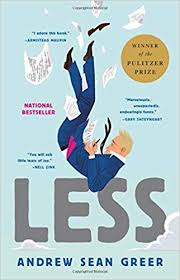
[READ: June 24, 2017] Less

It wasn’t until several chapters into this book that I realized I had read an excerpt from it (and that’s probably why I grabbed it in the first place).  I also had no idea it won the Pulitzer (PULL-It-ser, not PEW-lit-ser) until when I looked for some details about it just now.

It opens with a narrator talking about Arthur Less.  He describes him somewhat unflatteringly but more in a realistic-he’s-turning-fifty way, than a displeased way.

And soon the humor kicks in.

The driver who arrives to take Less to an interview assumes he is a woman because she found his previous novel’s female protagonist so compelling and persuasive that she was sure the book was written by a woman (and there was no author photo).  So she has been calling out for “Miss Arthur,” which he has ignored because he is not a woman.  This makes him late and, strangely, apologetic.

He is in New York to interview a famous author H. H. H. Mandern who has, at the last moment, come down with food poisoning.

It takes only ten pages to get the main plot out of the way:

Less is a failed novelist about to turn fifty. A wedding invitation arrived in the mail: his boyfriend of the past nine years is about to be married to someone else. He can’t say yes–it would be too awkward–and he can’t say no–it would look like defeat. The solution might just be on his desk –a series of invitations to half-baked literary events around the world.  Can he simply get out of town, and go around the world, as a way to avoid looking foolish? (more…)

Read Full Post »

SOUNDTRACK: KASVOT VÄXT-“Say It To Me S.A.N.T.O.S.” (1981/2018).

Back in 1994, Phish started covering a classic album for its Halloween costume. In 2015 they covered the Disney album: Chilling, Thrilling Sounds Of The Haunted House, which pretty much meant all bets were off.  So in 2018, they decided to cover an obscure Scandinavian prog rock band called Kasvot Växt and their sole album, í rokk.  This proved to be a big joke–they were a nonexistent band.  They had so much fun creating this band, that they even enlisted others to expand the joke.  This included impressively thorough reviews from WFMU and from AllMusic.

The joke is even in the name: when translated together Kasvot Växt and í rokk means “Faceplant into rock.”.

Here’s some more details they came up with:

The Scandinavian prog rock band purportedly consists of Jules Haugen of Norway, Cleif Jårvinen of Finland, and Horst and Georg Guomundurson of Iceland.  The album’s label, Elektrisk Tung, supposedly went out of business shortly after the LP’s release and little information about the record appears on the internet. Bassist Mike Gordon made a tape copy of í rokk in the mid-’80s and Phish would play it “over and over in the tour van in the early ’90s.” In the Playbill, guitarist Trey Anastasio insisted, “Every time the Halloween discussion comes up, we talk about Kasvot Växt. We honestly were worried we wouldn’t have the chops to pull it off or do justice to the sound, but when it came down to it, we just couldn’t resist any longer.”

The decision to go with an obscure album few have heard or even heard of appealed to the members of Phish. “We’ve paid tribute to so many legendary bands over the years, it felt right this time to do something that’s iconic to us but that most people won’t have heard of,” Gordon said as per the Phishbill. “And with these translations we’re really performing songs that have never been sung in English before.” Keyboardist Page McConnell added, “I love the mystery surrounding this whole thing. If those guys ever hear we did this I hope they’re excited because we absolutely intend it as a loving tribute.” As for what Phish fans can expect? “A weird, funky Norweigan dance album! Get out there and put your down on it!” exclaimed drummer Jon Fishman.

While the listings for the 10 tracks on the original í rokk were in a Scandinavian language, the titles appear in English in the Playbill. Phish called upon a Nordic linguist to translate the lyrics to English for tonight’s performance.

These songs do not really sound like a Norwegian prog rock band.  They do sound an awful lot like Phish (although with a more synthy vibe overall. The band has this part of their live show streaming on Spotify under the Kasvot Växt name.  And I’m ending the year by talking about each song.

This is probably the most memorable of all of the songs on the disc.  The keyboards are funky, the bass is funky and the wa- wah is funky.  The verse is a nice, slow slinky build up to the big chorus which is dumb and easy to remember, and–more to the point–really fun to sing along (hi-ho-hi-ho-hi-ho).

The post chorus of “This is what space smells like (you will always remember where you were)” is more or less screamed and makes it pretty unforgettable.  What does S.A.N.T.O.S. stand for?

Well, most of the time Tom Marshall writes the songs with Trey, but according to a Live for Live Music report:

Trey and Tom have been best friends and songwriting partners since elementary school, but Tom explains that he had absolutely nothing to do with Phish’s mastermind curveball they threw for Halloween, and remained in the dark, just as Phish’s entire fanbase did. Trey remains extremely tight-lipped following Phish’s debatably greatest prank ever, but according to Tom Marshall, the one thing Trey divulged is what the acronym S.A.N.T.O.S. stands for. Whether we believe it or not, Trey evidently told Tom that S.A.N.T.O.S., from Phish’s new tune “Say It To Me S.A.N.T.O.S.”, stands for “Subterranean. Arctic. Neuro. Technology. Orientation. Station.”

Whatever it stands for, it’s great.

[READ: December 7, 2018] “I Flirted with the Women”

This is an excerpt from a book whose subtitle is A Life and Work in Conversation with the Life and Work of Etheridge Knight.  I don’t know what that means and that makes this excerpt which is largely about Mary Karr even more puzzling.  (After re-reading I see now that it is Hayes interviewing Mary Karr about Etheridge.)

It begins with someone saying

One day Mary Karr sort of appeared along my path like a brush fire.  She’s incendiary, combustible, she’s a walking flame.  She’ll light up the whole house or she’ll burn that motherfucker down.  Recently when I told her I described her that way to people, she paused and said, “I don’t know if that’s a compliment or a complaint.”  I meant it the way she heard it.

I myself only really know about Mary Karr because of her association with David Foster Wallace.  I don’t think I’ve ever read her. (more…)

Read Full Post »

SOUNDTRACK: HALF WAIF-Tiny Desk Concert #803 (November 9, 2018).

Nandi Rose Plunkett is a member of Pinegrove. She released albums as Half Waif, and when Pinegrove retreated for a time, she toured as Half Waif.  I wanted to see her but didn’t have the opportunity.

I was under the impression that her shows were very spare and I wasn’t sure if I would enjoy a full live set by her.  This five piece version (see more below) has a wonderful full sound though and these songs sound terrific.

The band [is] more often a trio, with Nandi singing her songs and playing keyboards, Zack Levine on drums and Adan Carlo bass synth and guitar.

But for this show she has a five piece band, which she has a great introduction for:

Midway through Half Waif’s Tiny Desk, singer Nandi Rose Plunkett stops to let us all know that this particular Half Waif show is extra special. “So today we’re actually ‘Full Waif,’ because I am joined by my dear friends,” she says. “These are all musicians who have played with the band Half Waif over the past five years, but we’ve never all played together until now! So thanks for the opportunity to get ‘Full Waif’ together.”

The other two guys are Zubin Hensler keys and Robin electronic drums.

It’s clear that she doesn’t need all five of them–the music isn’t all that complicated but it ensures a really full sound.  What’s most notable is the two drummers–each doing his own thing but combining into a wonderful rhythm session.

The session opens with “Lavender Burning.”  It sounds like she is playing a harmonium, but I don’t think she is.  The layers of synth are added to by Adan and Zubin.  It’s not until about half way into the song that the drums come in and it adds a lot of texture to an already wonderful song.

“Lavender Burning,” with its opening line, “Staring out into the shifting darkness / Tryin’ to give a name to the place where my heart is,” reinforces my love for their peaceful, almost backwoods calm.

The more I listen to the song the more powerful it becomes.  And Nandi’s voice is just lovely.

“Silt” opens with electronic drums and Nandi’s simple synth washes.  I love the thoughtful and clear lyrics

Nobody deserves me.  I get lonely. I get angry.
My love is like an island.  You can’t find it if you’re not trying
And if you want my love I will guide you. I will be your anchor.  If I only have a minute to myself. T hen i would let you in without poison.  I would eat my anger if you only gave me what I wanted.

Adan offers some nice backing vocals and Nandi does double duty on synth and piano.  There’s so many interesting sounds I’m not sure who is doing what (like that synth solo at the end).

The final song is “Salt Candy” which is the a more acoustic track–Nandi on piano only to start.  Adan is making the tiniest sounds on guitar and the drumming is spare and minimal.

When they closed with “Salt Candy,” the line “I wanted to be carried in my mother’s arms / I wanted to be buried in my mother’s arms,” in this setting and with the spare punctuation of electronic drums and textures, sitting alongside Nandi’s voice, was particularly chilling.

It’s a beautiful set and makes me like them a lot more.  I’ll definitely have to see them when they tour again.

[READ: January 7, 2017] “Pardon Edward Snowden”

Many people feel that stories about writers are not very interesting.  I disagree typically, but that’s probably because I aspire[d] to write something someday.

This story is about a poet and I really liked it a lot.  I enjoyed the political and the literary nature of the story.

Mark McCain received an email sent to many American poets inviting him to sign a “poetition” requesting that president Obama pardon Edward Snowden.

The request also took the form of a poem and the narrator talks about some of the rhymes: “pardon and rose garden.”  “nation and Eden” “Putin and boot in.”

Mark forwarded the email to his friend, the poet E.W. West.  They were enraged by the “poetition.” (more…)

Read Full Post »

SOUNDTRACK: DAWN-Tiny Desk Concert #774 (August 10, 2018).

I had no idea who DAWN (all caps, please) was.  According to the blurb

Dawn Richard–who went by D∆WN for a while, and now just prefers DAWN–Dawn Richard has a breathless enthusiasm for shape-shifting pop music.  Her discography is a bedazzled collage of heart-bursting rave and extraterrestrial dance-pop — but for her Tiny Desk, the L.A.-based singer and producer strips three songs to just the essentials, illuminating the impeccable songwriting behind the wild combination of sounds.

I love the verses of “Waves,” about female empowerment.  The blurb says she transforms “the trap-laced anthem for “underpaid, underappreciated, undervalued and undermined” women into a classic girl group song, flanked by two harmonizing vocalists” (Kene Alexander and Chaynler Stewart).  The music is just not my thing at all.

I love this:

“If you feelin’ stress up in yo chest / Cause they forgot that you the best / Wave ya money,”

But really “wave ya money, wave, wave ya money?”

“Waves” is followed by two songs. Both “Vines (Interlude)” and a funky revitalization of “Lazarus,” speak to Richard’s mission to expand our preconceptions about who gets to make what kind of music.

I like the way “Vines (Interlude)” starts a capella.  But I don’t like the R&B vocalizing throughout.  The electronic percussion is pretty fun though–William DeLelles is working really hard to get those little dinky sounds–he’s also playing the “synth” with his drumsticks.

DAWN explains that she was on a huge label and is now totally indie–no label, no promoter, no nothing.  She says

“I find it interesting when you’re a brown or black girl and you try to do something beyond R&B and hip-hop, it’s not always cool,” Richard says before performing “Lazarus.” “They don’t get it. They think you’re trying too hard. They don’t know where to place you. I wrote this record because sometimes you’re misunderstood. You know exactly who you are, but everyone else can’t quite figure you out. I wrote this record for that person.”

It’s interesting that she jokes, “You’re a folk singer and they label you as alternative R&B.” This song is not alternative or folkie at all, although it does have some cool sounding electronics to start.  But once that guitar (Ben Epand) comes in, you know its back to pop.  I do enjoy when she gets some attitude: “you all could snap a little bit–you aren’t too cute to snap.”

So I won’t be listening to DAWN, but I hope others do.

[READ: February 9, 2018] “From the Desk of Daniel Varsky”

This story started out as one thing–a break up of a long-term relationship.  And turned into something else–the story of a poet who was captured in Chile.

As the story opens, we see that the narrator is thinking about the winter of 1972 when R had just left her.   He had vague reasons but said something about a secret self, that she didn’t buy.

Things got worse but then were okay.  The hardest part was when they lowered his grand piano out the window–it was his last possession and was so large it was like he hadn’t left:  “I would sometimes pat it as I passed, in just the same way that I hadn’t patted R.  The only difference is that R always did, eventually, speak.”

After a few day, she had a phone call from a friend, Paul.  He told her about a crazy dream involving César Vallejo (she and Paul were both poets and they bonded in class over the poets whom others hated).  In the dream, Vallejo had put a mud mustache on Paul’s upper lip. (more…)

Read Full Post »

McSweeney’s 49: Cover Stories: Contemporary writers reimagining classic tales (2017)

SOUNDTRACKBIG K.R.I.T.-Tiny Desk Concert #714 (March 5, 2018).

A while back I downloaded one of Big K.R.I.T.’s mixtapes and rather liked it.  Since then he seems to have become pretty huge and I feel like he has really expanded on his style.

K.R.I.T. sings/raps three songs from his new album.

4eva Is a Mighty Long Time, a double album in which he covers everything from blessings to depression while plumbing the carnal and spiritual depths of his own duality. All three songs performed here come from side two, titled after his birth name Justin Scott.

The first song “Mixed Messages” is really thoughtful.  He sings and raps

I gotta whole lotta mixed messages / in my songs am I wrong / to feel this way
I got me a lover but I still wanna cheat / I wanna be saved but its fuck the police
i never really liked the fake shit / but I’m attracted to the fake ass and fake tits
i really wanna sing but id better rap

K.R.I.T.’s backing band, which includes Burniss Travis II on bass and Justin Tyson on drums, also features on keys Bryan Michael Cox — the hitmaking producer and songwriter behind a slew of Billboard chart-toppers. Together, the trio delivers stripped-down versions of the latest thought-provoking material in Big K.R.I.T.’s catalog.

Introducing the second song, “Keep The Devil Off” he says his grandmother introduced him to gospel.  She brought him to church and “she would wake me up when i fell asleep saying wake up you gotta hear this.”  He sings beautifully.  And then the rapped verses are really well structured.

And when he stops to pay homage to his church-going grandmother before performing “Keep The Devil Off,” it’s clear that everything she instilled in him is keeping him alive, too.

Definitely in these times we need to keep the negativity away–keep the devil off.

His grandmother was clearly very important to him.

Big K.R.I.T. has kept her spirit alive through his music since his breakout mixtape, K.R.I.T. Wuz Here, which he released in 2010, the same year she died.  So it only makes sense that he would bring her with him for his Tiny Desk concert.

Halfway through his three-song set at NPR Music headquarters, K.R.I.T. stops to pull out an old-school tape recorder — the same one his grandmother would use to record him singing and reciting poetry as a child. “I have to feel like my grandmother was my first mix engineer,” he says before pressing play to reveal him and his brother as kids singing a duet of R&B crooner Donell Jones’ 1999 slow burner, “Where I Wanna Be.”

He plays the tape and cracks up listening to it.  He gets the audience to sing the refrain with his younger sell.  And then his grandmother introduces he and his brother as an R&B singer, “but I’m sticking with the rap thing.”

It’s a sublime interlude — one that resonated so strongly with K.R.I.T. that he had to start his last song, “Bury Me In Gold,” over to catch the proper beat. “I’m super emotional from this, too,” he says, laughing in a moment so genuine it was only right to leave it unedited.

He says “Bury Me in Gold” is not about gold really, it’s about having something so that in the event he gets to heaven he’ll give everything away.

He tells us to remember that peace of mind and your soul are more important than gold.

I’ve always enjoyed thought provoking rap and K.R.I.T.’s lyrics combined with his voice really work wonders.

[READ: May 29, 2017] McSweeney’s 49

It has been a long time (three years or so) since the previous McSweeney’s volume.  During that silence, the publishing house went non-profit and that seems to have taken up a lot of their resources.  They even address this a bit in the interdiction to this book.

But regardless of the reasons why, it is great to have them back.

As the subtitle says, this is a book of “cover stories.” What that means is a little vague–the contemporary writers model their story after a classic story.  I try to compare it to music covers, although in music covers the music and words are typically the same with some kind of variations.  Typically, the words are the same but the music is different.  I liked to flip this idea on its head for describing these stories in that the words are different by the music is the same.

Since I don’t know most of the original stories here I don’t know how similar these are to the originals–same character names?  Same ideas?  Same plot?  I don’t know.  And perhaps it would affect the way I read these stories if I was familiar with theory original pieces.  But without knowing them, these just turned out to be good stories from good writers.

Interspersed between the stories were poems and, in a wonderful commentary on our current shitty president and the cowardly house of representatives who on the day I finished this voted to strip 24 million people of health care, are comparisons of classic historical figures’ speeches with the petty garbled tweets of out current crap in chief.  Can we impeach this motherfucker already?  And send the whole lot of them to jail, please.  #ITMFA

As many McSweeney’s do, this one opens with letters.  And of course they aren’t really letters at all, even if they are addressed to McSweeney’s.  Many deal with cover songs, but a few are much more serious, political and right on.

WAJAHAT ALI writes from Camp FDR in Washington DC where he and his fellow prisoners were finally able to cobble together WiFi.  Ali explains that the Executive Order was inevitable the ban, the vetting, the registry were all just prelude. The need to protect against terrorism outweighs the individual rights and the rights of American Muslims…read the Supreme Court decision.

NICK JAINA writes about the Sept 23, 1970 episode of The Johnny Cash Show in which Ray Charles appears and plays “Walk the Line” and then “Ring of Fire.”  The letter states that the creator of “Ring of Fire” is actually mis-attributed.  The story is that June Carter wrote it after seeing a page in her uncle’s book of Elizabethan poetry.  But Johnny first wife claims that Johnny wrote it while drunk about a certain female body part: “all those years of her claiming she wrote it and she probably never knew what the song was really about.”  Then it reverts back to Ray Charles’ performance with an unseen band playing behind him–especially a great baseline–and as the song ends he lets out one last shudder and cackle like he just invented the orgasm.  “Johnny returns to the stage looking like a man who just watched someone have sex with his wife but was so in awe of how good he was at it that he could only thank him.”

ROBIN TERRELL talks about trumpmania in the Czech Republic from the perspective of a black woman, lesbian, child of civil rights activists, mother of a black man living in Prague.  The look in the eyes of people after the election: The U.S. is going to fuck us over again.  It stunned Europeans that the U.S. could generate someone fouler than Europe’s own crop of white male extremists.  She is now a refugee from her own country.  #RESIST #ITMFA

KIMBERLY HARRINGTON says she always believed that even in the darkest times humor has its place.  But lately she’s been bursting into tears rather than cracking a smile.  She hopes she can find things to laugh at–even death in these horrible times.

MARY MILLER says that for the longest time she thought her uncles wrote “Stagger Lee.”  Her uncles were musicians who wrote songs but also threw some covers into their shows.  She believed that “Stagger Lee” was one of theirs. She realizes that they are not famous and that no one will remember them–but she promises them that she will remember them.

RICK MOODY writes at length about Elektra’s 1990 tribute album Rubaiyat: Elektra’s 40th Anniversary.  I remember it coming out and I remember not getting it because it was too expensive. But Moody talks about what a great conceit this collection was to have contemporary artists cover classic songs.  He also talks about how the tribute album was quite popular in the 1990s (was it ever).  Some thought: He loves Bjork, but he thinks of the Sugarcubes as a cheeseball imitation of the B-52s (and that their “Motorcycle Mama” is pretty bad.  He mentions a few great tracks, like Kronos Quartet covering “Marquee Moon,” Metallica doing “Stone Cold Crazy,” and even a Howard Jones cover of “Road to Cairo” by the cult hero David Ackles.   But he says fully half of the collection is bad, some of it even awful–not worth its list price at the time but it has a great number of masterpieces on it.

Will Buttler (from Arcade Fire) wishes to make some amusing corrections: some errors during concerts, and apologizing for singing “I’m So Bored” with the USA because he is not.

ARIEL S. WINTER-This is an interesting philosophical question wondering whether or not Marty McFly actually created “Johnny B. Goode.”  How could he cover it before Chuck Berry had released the original.  As a child this blew her mind.  This facile beginning then goes on to say that before recorded music the notion of a cover didn’t really exist.  And indeed in the 1950s people recorded songs without concern for copyright.  It’s also true that when Chuck Berry plays Johnny B. Goode live, it’s not considered a cover of his original.  She concludes by that the Back to the Future is probably the first time she ever heard Johnny B. Goode.  So Marty McFly’s is the original to her (as it is to all the kids at the dance).  So in addition to a song having an original for the performer there is also an original for the listener.  Anyone who has loved a song for years before finding out that it’s a cover has had that experience.

INTRODUCTION BY THE EDITORS

This introduction talks about how the first time they did a “cover story” was in 1999 in issue 4.  Rick Moody covered Sherwood Anderson’s “The Egg.”  They had been planning to do an entire issue of covers as far back as two years ago and then things happened in the McSweeney’s universe to delay it.  And now : this issue is being born in a moment of racial, social and economic reckoning and imminent fascism…into a country that looks much different from the one in which it began, fronted now by a mean and disingenuous imitation of a president.   As such: Tucked between these thirteen beautiful renditions of thirteen classic stories are instances when a cover is not an homage but rather a perversion of its predecessor”  And by that they offer examples of eloquent speeches by former leaders and then tweets from our pervert in chief.

GARY BURDEN-excerpt from Nobody Knows (an autobiography)

Gary Burden created the cover images for this issue.  I had no idea who he was, but this autobiography tells me just how interesting a fellow he was.  He has been responsible for some of the most iconic album covers of the last 60 years!

These excerpt shows his origin story–he was 8 on December 7, 1941 and he has had vivid memories of WWII.  When he was 16 he joined the Marines.  But he was restless, got involved in bad things, was dishonorably discharged and got mixed up with even worse people (he says he can’t believe the things he did back then).  In 1964 he met “Mama” Cass Elliot. They spent a lot of time together and this opened him up to meeting all kinds of people: David Crosby, Stephen Stills, Graham Nash.  Eventually he met and hung out with Jim Morrison and designed Morrison Hotel (a fascinating story that).  In one of the nicer things I’ve heard someone say he says that Jim was a real poet, someone who was unafraid of delving deeply into life irrespective of the personal cost.  Then he met Neil Young. He says that Buffalo Springfield has been his favorite band and then one day Neil came to Mama Cass’ house in his 1948 Buick Hearse.  He was also hanging around when CSN decided to become CSN&Y and then he and Neil became friends. and Neil sold him his house in Topanga.  Eventually he made the cover art for After the Gold Rush (and he gives a little story about the old lady there on the cover).  I’m kind of curious to read this whole book now, especially if it includes album covers.

EMILY RABOTEAU-“The Babysitter” after “Some Women” by Alice Munro
This is the story of a babysitter for Mrs Fagan.  She is a young girl and her employer is very rich and locally famous.  And quite eccentric (she went to East Africa and allegedly witness the Ark of the Covenant and then wrote a controversial book about it).  But in their town she was known as the white lady with black kids (Maya 3, Eddie 10 months old).  The story reflects back on the babysitter as child (she is now the same age as Mrs Fagan was when the babysitting began.  The babysitter’s mother is kind of jerk and is very sarcastic about this babysitting arrangement.  She is also a very strict Jehovah’s Witness, so when the narrator gets her first period rather than tell her mom, she just takes products from Mrs Fagan.  As the story opens Mrs Fagan’s son has just arrived and that changes the dynamic in the house.  How will Mrs Fagan take it when the narrator accidentally sets fire to the kitchen? I really enjoyed the way the end of the story plays on the notions of memories and the impact people have on others.

MEGAN MAYHEW BERGMAN-“The Lottery, Redux” after “The Lottery” by Shirley Jackson
“The Lottery” seems like a pretty easy story to cover–I think everyone knows everything about it and it has been covered in things like The Hunger Games in their own ways.  I don’t know if this story references the original (with the redux),  for this story the people of the island of Timothy were exiled from America fifty years earlier for crimes against the environment.  They were gathering on July 27th, the day of the lottery.  And indeed the lottery is a death sentence, although it’s not entirely clear why.  Interestingly, the story is more about the girl chosen and what her life up to that point has been like.

ANTHONY MARRA-“The Tell-Tale Heart” after “The Tell Tale Heart” by Edgar Allan Poe
This story doesn’t diverge all that much from the original except for the wonderful modern twist on the beating heart.  It’s hard to say more without giving things away but I loved the modernization.

JESS WALTER-“Falling Faintly” after “The Dead” by James Joyce
I didn’t know all that many stories before hand, but I knew this one very well and this is wonderful homage.  It is not in any way rewriting the story–it’s a very different story, but it alludes to the Joyce story and directly mentions it and it is quite clear where the connection between them is.
Michael is a writer.  He is married with kids but has moved temporarily out to New York to write for this new police procedural.  The show is doing well and the female star is quite beautiful.  They bond over cigarettes–she is foreign and smokes like a European, he recently started again.  As stories like this tend to go, Micheal gets the wrong idea about this young, hot actress.  And given that she is not American she misunderstands the subtleties of his behavior (which isn’t very subtle admittedly).  But he wants her to know that his story is a tribute to Joyce’s “The Dead.”  When he talks about the dead she thinks he means real dead people and is pretty freaked out.  This leads to a restraining order and a police intervention–not how he thought his life in New York would go.  What doe sit have to do with “The Dead”?  Well they are standing smoking in the snow as it gently floats to the ground falling through the universe, faintly falling.

LAUREN GROFF-“Once” after “Wants” by Grace Paley
I loved the way this story started.  I saw my enemy at the beach.  With that as a groundwork we slowly learn just how this woman has an enemy (it’s an old boyfriend’s mother) and how they have grudgingly begun to respect each other decades after the two broke up. I really enjoyed this short piece.

ROXANE GAY-“Men on Bikes” after “Rape Fantasies” by Margaret Atwood
I can’t imagine what the original of this story is.  The actual story of this is pretty peculiar itself.  Basically, the men in town have all started riding bicycles everywhere.  It started when one of them was arrested for drunk driving.  He didn’t lose his license but his wife took it away from him.  He dug out a bike and began riding it.  She thought he looked ridiculous, but when another man had his license taken away, they began riding together.  It was quite a sight, although I’m not sure what the point of it was.

NAMWALI SERPELL-“Company” after “Company” by Samuel Beckett
I like Beckett, and I know that he can be confusing.  I don’t know what “Company” is about so I have no idea how it relates to it, but man I did not get this at all.

It was confusing and really long.  It is broken into many small sections which might be connected.  The first is about the brightening which happened although many people missed it. Then we learn about the ship which is electro epidermal, which is cool but not really explained  and then the story turns into a quest for melanin and just when you think it’s a sci-fi story, it becomes a story about race.  There is a pale man tied to a tree hitting a sack (pound pound).  There’s a lot of vomit.  If the white man inseminates even one person, finding pure stem cells is impossible.  Dark skin marked you as  lucky when the darkening came.  But then she says the mission is over.  There’s more vomiting.  A fellow is supposed to be invisible in the village but Pound sees him.  There’s more vomit, a section titled rape, where Pound rapes Lila every once in a while and then who the hell knows what happens at he end.

KIESE LAYMON-“And So On” after “Hills Like White Elephants” by Ernest Hemingway
Weeks ago 64 black folks changed the world.  You are the 11th.  Aside from the direct address to the reader the story is pretty straightforward and interesting.  Chanda Stewart was 8th, the narrators research assistant was 9th and Doug E., Chandra’s boyfriend was 1st.  They are at a fancy restaurant, Chandra, the narrator and you.  She swears that Doug is a porn star, but the narrator argues that having 1089 twitter followers and awkward consensual sex with a few white women filmed on an iPhone 2 in his fake Timberlands, blue knee brace and yellow wrist bands makes you a porn participant, not a star.  The story comes down to which side the narrator is going to choose.   sides or run for our lives.  Because while they were talking, Doug E. and about sixty young black kids were marching down the street.  To the school.  They each had an ax and a shovel.

MEG WOLITZER-“If You’re Happy and You Know It” after “A Perfect Day for Bananafish” By J.D. Salinger
I haven’t read this Salinger story in a long time, so I don’t really know how it connects to this, but I really enjoyed it.  I enjoyed the way that it was written which was a little confusing but in an intriguing way.  Set in a hotel on Miami there is the young woman in 609 who arrived with her new husband.  She’d sent him off to the beach.  We see her telling her parents that he is taking it easy, but they want to know if he is taking the Klonopin.  Later that night in the lobby, a four year old girl, Chloe, is in the lobby of that hotel watching a man play piano.  The man is a guest also and he is playing and really getting into it.  Another boy asks if he can play This Old Man and the player jokes about the boy calling him old.  But Chloe asks if he can play “If You’re Happy and You Know It.”  He says he might be happy but he may not know it. She is puzzled by that.  He says she is breaking his heart.  We soon realize that the pianist is the Klonopin man, and while things don’t get dark exactly, they certainly get strange.  And Chole’s parents have foisted her off on a poor babysitter the whole time.  This was one of my favorites in the book.

T.C. BOYLE-“The Argentine Ant” after “The Argentine Ant” by Italo Calvino
I can’t imagine what the original story is like, but this one from Boyle was really icky and really fantastic.  Its’ a fairly simple premise–a family moves to a rental property in Argentina, only to find that it is swarming with ants.  The ants are everywhere–even crawling all over their baby.  They run to the next door neighbor’s house only to see that they know about the ants and might have a secret weapon.  But mostly they just seem to be putting their furniture in jugs of water–presumably as a deterrent.  There is also an Ant Man who might be fighting the ants or who might actually be bringing more.  What is great about the way Boyle writes this is that the guy renting the house is working on an academic theorem that his wife thinks is rather frivolous.  And that tension underpins everything.

ALICE SOLA KIM-“One Hour, Every Seven Years” after “All Summer in a Day” by Ray Bradbury
Again I don’t know the original, but this story was great, and also weird. The weird part is that the story seems to start over multiple times. And that’s because there is a kind of time travel component to it.  The title refers to how often the sun comes out on Venus.  There is a girl, the main character, named Nargit. She was born on Earth and so she saw the sun.  The other kids are pretty angry at her for it (as if it’s her fault).  They are abusive to her, and the time travelling is the girl’s attempt to protect her younger self.  Many things go wrong but they bring about different results.

CHRIS ABANI-“Sleepy” after “Sleepy” by Anton Chekhov
This story was pretty horrific.  Kemi, a sixteen year old black girl who is now an orphan is working for a white family.  The family has two little children, one of whom is a baby.   The family is horrible to Kemi.  Pretty unrelentingly horrible.  Kemi is tired and never gets a break and the baby cries all the time.  She can’t soothe the baby and the family blames her for her failures.  Her exhaustion builds and builds until you pretty much know the ending several pages before it happens.

TOM DRURY-“The Yellow Wallpaper” after “The Yellow Wallpaper” by Charlotte Perkins Gilman
I know the original story although not super well.  But this version feels almost exactly the same. I honestly can’t tell what the difference is (without having re-read the original again to compare).   Jane and John are renting a place on an island for the summer.  John thinks Jane is not strong and keeps her hidden away in a room with yellow wallpaper.  He more or less runs everything in her life until she starts seeing people through the wallpaper.  You know things can’t go well from there.

POETRY:

REBECCA LINDENBERG-“Having a Coke with You” after “Having a Coke with You” by Frank O’Hara

MATTHEW ZAPRUDER-“Poem for Keats” after “Ode to a Nightingale” by John Keats

STEPHEN BURT-“A Nickel on Top of a Penny” after “Piedra Negra Sobre Una Piedra Blanca” by César Vallejo

BRIAN TURNER-“The Metaphor Program” after “The Red Wheelbarrow” by William Carlos Williams

STEPHEN BURT-“Roofers” after “The Armadillo” by Elizabeth Bishop

MATTHEW ZAPRUDER-“Poem on the Occasion of a Weekly Staff Meeting” [the first two lines are taken from “A Poem on the Occasion of the Consecration of Sandford and Shippon Churches” by Rev. F. Wilson Kittermaster, 1855]

STEPHEN BURT-“Suspense” after “To Brooklyn Bridge” by Hart Crane

KEVIN MOFFETT-“Second Wonder”-a monologue that will air on The Organist.
I found this puzzling at best.

PATTY YUMI COTTRELL-excerpt from Sorry to Disrupt the Peace
I read this book not too long ago.
This except was about two young children who invented a game called “Confession” in which the boy confesses his real or imagined sins to his sister.

~~~~~

The comparison quotes are called Great Speeches from History vs. the Tweets of Donald J. Trump:  I can’t bring myself to write any of the jerks tweets.

Mahatma Gandhi from the “Quit India” speech, 1942 vs. a Feb 4 2017 tweet

Abraham Lincoln’s “The Gettysburg Address” 1863 vs. a Feb 18 217 tweet (about fake news)

Martin Luther King Jr from “Letter from Birmingham Jail” vs. Feb 21 2017 (crowds planted by liberal activists)

Frederick Douglass from “The Hypocrisy of American Slavery” 1852 vs. Feb 6 2017 (negative polls are fake news).

Franklin D. Roosevelt, inauguration speech 1933 vs. Jan 22, 2017 (including all my enemies)


The bad thing about this issue is that the last four or five stories were all real downers, making it a pretty tough slog.  But I loved the idea, and I liked that they found the time and space to point out how stupid trump sounds and looks and is.

For ease of searching, I include: Cesar Vallejo

Read Full Post »

SOUNDTRACK: JAMILA WOODS-Tiny Desk Concert #699 (January 29, 2018).

Jamila Woods is the Associate Artistic Director of Young Chicago Authors, the non-profit organization behind the Louder Than a Bomb youth poetry slam festival.  She also did guest vocals on a slew of albums recently.

Last year she released her debut album HEAVN.  But there is so much more

Singer, songwriter, poet, educator and community organizer Jamila Woods is also a freedom fighter: a voice that celebrates black ancestry, black feminism and black identity. “Look at what they did to my sisters last century, last week,” goes a line from “Blk Girl Soldier,” her powerful opening number at the Tiny Desk.

A cool bass line from Erik Hunter opens “Blk Girl Soldier.”  I don’t love the music that much (too jazz lite for me) but the lyrics are outstanding

We go missing by the hundreds…
The camera loves us, Oscar doesn’t…
They want us in the kitchen
Kill our sons with lynchings
We get loud about it
Oh now we’re the bitches

Woods’ delivery is fantastic and the backing vocals (and keys) from Aminata Burton add a nice touch.  Throughout this song and the others the drums are great–different sounds and rhythms from Ralph Schaefer.

Woods followed “Blk Girl Soldier” with “Giovanni,” another anthem of black female pride, inspired by the Nikki Giovanni poem “Ego Tripping.” The original text includes no punctuation, not a single comma or period, and reveals a liberated prosody that is also illustrated in the song. Listen how her lyricism interplays with the rhythm section’s syncopated groove to create a captivating state of emotional buoyancy.

I love the stops and starts and the groovy bass and soaring guitars from Justin Canavan.  But once again, I’m more enamored of her lyrics

Little Bitty you wanna call me
100 motherfuckers can’t tell me
How I’m supposed to look when I’m angry
How I’m supposed to shriek when you’re around me

“Holy” opens with just keys and a punctuating drum beat.  This song is a slower one and it is all about self-empowerment.

Of particular note is her recurring theme of self-love, as heard in “Holy,” the last song in this set: “Woke up this morning with my mind set on loving me.” (What a refreshing affirmation to hear “loving me,” instead of the predictable “loving you.”)

I don’t like R&B, but I could see this album transcending that for me.

[READ: November 12, 2017] The Resurrection of Joan Ashby

I received an email from A.M. Homes touting this book (obviously, I wasn’t the only one).  It was quite an encouraging email so I decided to give this fascinating book a try.  Boy, did I love it.

The book opens with a clip from the Fall issue of Literature Magazine.   It is a story about Joan Ashby, wondering where she has been all of these years.  The article says that they have been allowed to look at her childhood notebooks.

At thirteen she wrote nine precepts she was determined to follow in order to become a writer

  1. Do not waste time
  2. Ignore Eleanor when she tells me I need friends
  3. Read great literature every day
  4. Write every day
  5. Rewrite every day
  6. Avoid crushes and love
  7. Do not entertain any offer of marriage
  8. Never ever have children
  9. Never allow anyone to get in my way

Eight years later she burst onto the scene with her first collection of short stories about incest, murder, insanity, suicide, abandonment and the theft of lives called Other Small Spaces.  Four years later in 1989 her second book Fictional Family Life was a collection of superbly interlocked stories.

She was considered brutal and unsparing and wrote very powerfully.

During all of this time, her parents were irrelevant–they didn’t seem to think much about her when she was young and when she became successful she had little to do with them.

The “magazine” prints excerpts from these stories and here is where Wolas really shines.  She creates story fragments that really show off what a great writer Ashby (and of course, by extension, Wolas) is.

These are followed by an interview and her last public sighting–a reading of her work.  It was at this reading that her first shock was revealed–she had gotten married.  And when she toured for the second book, the women who revered her were outraged by this betrayal.

The opening section is “continued after the break” which is basically the rest of the book. (more…)

Read Full Post »

« Newer Posts - Older Posts »