Feeds:
Posts
Comments

Archive for the ‘Poetry’ Category

SOUNDTRACK: MEREBA-Tiny Desk Concert #916 (November 27, 2019).

Who the heck is Mereba?

Very few artists get to return to the Tiny Desk, and fewer still return twice in the same year. But after contributing background vocals behind the desk for Dreamville artist Bas in early 2019, we invited Mereba back for a solo set that puts her eclectic, major-label debut The Jungle Is The Only Way Out into sharp focus.

As with many singers I’ve never heard of, I’m not sure if these songs sound like this on the record or if they are more dancey.  I do quite like the simple, organic sounds that accompany these songs.

The stripped-down soundscape Mereba achieves live with her four-piece band is equally dreamlike here, drawing from influences as wide-ranging as the many places she’s called home (Alabama, Philly, North Carolina, Atlanta, Ethiopia). As she pulls from genres as seemingly disparate as folk, rap and spoken word, her set reflects the years she spent perfecting her craft on live stages in Atlanta cafes and clubs, where she attracted the attention of the indie creative collective Spillage Village  before joining them in 2014.

She sings three songs and recites a poem (all on the album).

When “Black Truck” started I thought she sounded exactly like Alanis Morissette.  The way she says “and I said world would you please have some mercy on me” sounds very uncannily like her.  The song is a quiet, mellow piece that starts with a simple bass line (including some harmonics) from Chris James and guitar washes that turn into a nice picked melody from Sam Hoffman.  After a minute or so, Aisha Gaillard plays a simple drum beat and the song kicks into higher gear.

Through all of this, the backing vocals from Olivia Walker were just beautiful.  The end of the song turns into a kind of rap as the guitar and bass fade out.  I say kind of a rap because Mereba is also a poet and she has more of a poet’s delivery than a rapper’s delivery.

For “Stay Tru” the guys switch instruments and the bass takes on a slightly more lead role.  But this song is also very mellow.  Mereba’s vocals sound a bit more Jamaican in his song.  Midway through, James switches to violin and Mereba plays keys which adds a whole new texture.  I didn’t like this song as much because the chorus is kinda lame with a lot of repeating of “cut the bullshit, this time” sung in a sweet voice.  It also seems to drag on for a really long time (although it is very pretty).

“Dodging The Devil” is a poem she wrote when things just didn’t seem to be going right.  After a couple of verses, a quiet guitar line fills in the background.

On the last song, “Kinfolk,” Mereba plays the main guitar line while Sam plays single soaring notes.  The song kicks into gear with a simple guitar riff and some prominent bass.

I really enjoyed this set.  I thought the music was beautifully restrained and her voice distinct enough in each song to show such a range of sounds.  It’s always nice to be surprised by a new musician.

[READ: November 15, 2019] Cursed

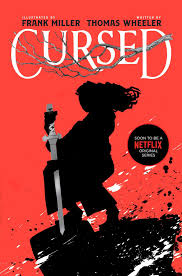
I saw this book in the new YA section at the library.  I was attracted by the cover and fascinated by the “soon to be a Netflix Original Series” sticker.

I have known of Frank Miller for years.  I’m sure I’ve read graphic novels by him, although I don’t know if I’ve read Sin City (maybe a long time ago?).  Mostly he drew superhero comics which is not my thing.  Turns out I really don’t like his artistic style in this book (at least for the way he draws the heroine–I rather like the way the bad guys are drawn).  If the series was in any way designed to look like the art in the book I don’t think I’d watch it.

But the story itself is petty darn good.  It took me a while to read it for some reason. I guess maybe the opening was a little slow because there’s so much going on it takes awhile to really get settled in this universe.

But the description of the story is pretty intriguing: Whosoever wields the sword of power shall be the one true king.  But what if the sword has chosen a queen?

For this is a story of Arthurian legend with many many twists.  My knowledge of Arthurian legend is surprisingly minimal.  I love the story and I know the main participants, but there is a lot of information in here that I didn’t know about–or even how much Wheeler is making up. (more…)

Read Full Post »

SOUNDTRACK: FRENCH, FRITH, KAISER, THOMPSON-“Bird in God’s Garden/Lost and Found” (1987).

The words are a poem by Rumi.   It is a slow droney song that is primarily drums from John French.  Thompson sings in his quieter style.

There are several different versions of this song. There’s an earlier unreleased version with Richard & Linda Thompson that is much quieter.  I especially like this version because after every other verse they brighten things up with a dramatic five note string riff (or maybe it’s Kaiser on the sanshin) that seems to come out of nowhere.

They spice up the middle of the song with a rollicking traditional Irish sounding fiddle melody from Fred Frith’s “Lost and Found.”  (Frith plays violin).  It adds a bit of zing to an otherwise dirgey song.

After about three minutes of the slow thumping there’s a wonderfully rocking instrumental section complete with fiddles and bass playing some wild melodies.

It was recorded on the album Live, Love, Larf and Loaf and also appears on Thompson’s collection Watching the Dark (1993).

[READ: September 1, 2019] “Nell Zink’s Satire Raises the Stakes”

I have really enjoyed the Nell Zink books that I’ve read. I’ve even read an excerpt from Doxology, the book that’s reviewed in this essay.

What I like about this essay though is the summations of her writing and her earlier books.

Schwartz says that Zink looks at life from the fringes.  She then summarizes her three impossible to summarize books in simple and amusing fashion: (more…)

Read Full Post »

SOUNDTRACK: THE ANGELUS-“The Young Birds” (2019).

Every once in a while I like to check in with Viking’s Choice on NPR’s All Songs Considered.  Lars Gottrich specializes in all of the obscure music that you won’t hear on radio.  For this month, he did a special focus on Patient Sounds. a small label based out of Illinois.

[UPDATE: At the end of 2019, Patient Sounds closed shop. I’m not sure if any of these songs are available outside of Bandcamp].

Lars had this to say about the label

Matthew Sage, who runs the label, knows that dynamic drone, jittery footwork, oddball drone-folk, hypnagogic guitar music and cosmic Americana can exist in the same space.

The second song of the week is by The Angelus.  Lars describes the song:

Redemption often comes at the hands of something bigger than yourself, but as The Angelus’ soul-rattling doom-gaze reminds us, the love of young children will make you humble.

This song starts with crashing heavy chords–cymbals and loud guitars.  But then it settles down to a groovy death riff.  The surprise to me was when the singer began singing.  He has a soft melodic voice which totally changes this from a heavy dark song into a kind of melodic slow heavy song.  The chorus is surprisingly heavy and even ends on a kind of positive mood.

[READ: September 1, 2019] “Class Picture”

This story surprised me because it started

Robert Frost made his visit in November of 1960, just a week after the general election.  It tells you something about our school that the prospect of his arrival cooked up more interest than the contest between Nixon and Kennedy.

If Nixon had been at their school, they would have glued his shoes to the floor.

This is quite a lengthy story and there are a lot of components.  Wolff fleshes out this school very well.  So well, in fact, that I could see this being developed into a novel [It is actually an excerpt from a novel]. Although for the purposes of this story, the plot is dealt with fully.

It also makes me wonder if such a school could actually exist.  Certainly not in 2020, but even in 1960?  Because this school exhibited pride in being a literary institution. Glamorous writers visited three times a year and the English masters carried themselves as if they were intimates of Hemingway.  The teachers of other subjects (math, science) seemed to float around the fringe of the English masters’ circle.

The tradition at the school was that one boy would be chosen to meet the famous author who was coming next.  This year it is Robert Frost.  Each boy would submit an entry (in the case of Frost it would be poetry).  The author himself would select the winner.  And these meetings were a big deal to everyone on campus.

The narrator is very excited but he knows that his poems are subpar–he writes fiction.  He was on the school’s literary magazine board so he was familiar with the other great writers in his class.  There were three.

George Kellogg was a proficient writer of poetry, although the narrator found the boring.

Bill White was the narrator’s roommate.  He’d written most of a novel already and his poems were impressive.

Jeff Purcell was the third.  He was also on the literary magazine and was quick to dismiss others.  Could that translate to his own writing?

The one detour from the poetry angle is about smoking.  The school forbade smoking but a lot of boys did anyway.  The narrator said he loved smoking.  He smoked in storage closets and freezers, steam tunnels and bathrooms.  He even went out for cross-country so he could smoke while running in the woods.

If you were caught smoking you were expelled.  It happened every once in awhile.  A person was sent home just before the Frost Poem deadline.  This made the narrator quit smoking on campus.

The narrator wrote a poem for the occasion but he didn’t think it was good enough.  So he decided to submit an older one on the off chance that Frost liked it.

I won’t spoil the winner, but Frost did come to the school and he read some of his poems aloud.  During the Q&A that followed a master asked a question.  Interestingly he misstated the title of the poem.  He called it “Stopping in Woods” which Frost corrected instantly to “Stopping by Woods on a  Snowy Evening”  The master continued the question asking about iambic lines  Frost says “Good for you, they must be teaching you boys something here.”

The boys all laughed and Frost seemed pleased–had he made a mistake about the master or had he known all along?  The boys were surprised to learn later that Frost was quite funny.

The end of the story shows the winner of the contest questioning the value of his poem.  He felt that Frost mis-read it and that perhaps he won for the wrong reasons.  Should he blow off Robert Frost?  Is he crazy?

I really enjoyed this piece and found myself thoroughly engaged.  If this is part of a novel, I would be very curious to read it.  Turns out it is an excerpt from the novel Old School.

Read Full Post »

SOUNDTRACK: LAZY GRACE-“You Don’t Know How Much” (Moose: The Compilation, 1991).

Back in the 1990s, it was common to buy a compilation or soundtrack or even a band’s album based on one song.  Only to then find that you didn’t really like anything else on it.

Maybe that single sounded like nothing else on the album.  Maybe the movie was almost entirely one genre, but they had that one song that you liked over the credits.  Or maybe the compilation was for something but a song you really wanted was on it, too.

With streaming music that need not happen anymore.  Except in this case.

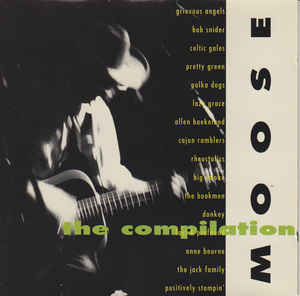
I bought this compilation, used, recently exclusively for one song, Rheostatics’ “Woodstuck.”  It’s a goofy song and this is the only place you can get the studio version.  The actual compilation was not well documented, so I didn’t know what the other bands on it might sound like.  It turns out to be a compilation for Ontario based Moose Records which specialized in Rock, Folk, World & Country.  They put out another compilation in 1992 and that’s all I can find out about them.

Here’s another traditional song performed very slowly.  This feels like a blues song only played with a more country style with violin as the lead instrument.  The two women singing have good harmonies, but it feels so downcast that I don’t want to listen to it again.

[READ: July 1, 2019] “Poem #8–Beetle”

The July/August issue of The Walrus is the Summer Reading issue. This year’s issue had two short stories, a memoir, three poems and a fifteen year reflection about a novel as special features.

I assume this poem is part of a series, although I don’t know for certain

This is a poem about nature.

It is set at a lake in the woods of the eastern slope of the Rockies. (more…)

Read Full Post »

SOUNDTRACK: POLKA DOGS-“Slag Heap Love” (Moose: The Compilation, 1991).

Back in the 1990s, it was common to buy a compilation or soundtrack or even a band’s album based on one song.  Only to then find that you didn’t really like anything else on it.

Maybe that single sounded like nothing else on the album.  Maybe the movie was almost entirely one genre, but they had that one song that you liked over the credits.  Or maybe the compilation was for something but a song you really wanted was on it, too.

With streaming music that need not happen anymore.  Except in this case.

I bought this compilation, used, recently exclusively for one song, Rheostatics’ “Woodstuck.”  It’s a goofy song and this is the only place you can get the studio version.  The actual compilation was not well documented, so I didn’t know what the other bands on it might sound like.  It turns out to be a compilation for Ontario based Moose Records which specialized in Rock, Folk, World & Country.  They put out another compilation in 1992 and that’s all I can find out about them.

Polka Dogs sounded promising–I imagined a rocking polkafied band.  “Slag Heap Love” sounded like it would be a gritty rocking song.

So imagine my disappointment when the song is propelled by a tinny banjo and the accordions are only used as accompaniment, not for wild soloing.  Even the tuba is slow and ponderous and not used as a fun bass instrument.  Top this off with the vocals which are almost comically crooned and this song proved to not be anything I wanted at all.

About half way through (the song is five minutes long) the song goes to double time, which makes it more interesting. But the vocal style remains the same and nobody does anything more interesting than playing the same stuff in double time.

It doesn’t even really sound like a polka until the last forty seconds when the song picks up into triple time, but by then the song is pretty much over (especially since the lyrics don’t really change for the whole five minuets.  “Slag Heap Love” is pretty unexciting.

[READ: July 1, 2019] “Falling, without You”

The July/August issue of The Walrus is the Summer Reading issue. This year’s issue had two short stories, a memoir, three poems and a fifteen year reflection about a novel as special features.

This is simple poem of loss–of a person falling apart.

I rather liked how visceral this poem was, with each stanza being more explicit as she fears she might fly apart. (more…)

Read Full Post »

SOUNDTRACK: CELTIC GALES-“Sittin’ on Top of the World” (Moose: The Compilation, 1991).

Back in the 1990s, it was common to buy a compilation or soundtrack or even a band’s album based on one song.  Only to then find that you didn’t really like anything else on it.

Maybe that single sounded like nothing else on the album.  Maybe the movie was almost entirely one genre, but they had that one song that you liked over the credits.  Or maybe the compilation was for something but a song you really wanted was on it, too.

With streaming music that need not happen anymore.  Except in this case.

I bought this compilation, used, recently exclusively for one song, Rheostatics’ “Woodstuck.”  It’s a goofy song and this is the only place you can get the studio version.  The actual compilation was not well documented, so I didn’t know what the other bands on it might sound like.  It turns out to be a compilation for Ontario based Moose Records which specialized in Rock, Folk, World & Country.  They put out another compilation in 1992 and that’s all I can find out about them.

Celtic Gales was, apparently, a trio of Audrey, Linda and Wanda Vanderstoop.  I can’t find anything else about them.

This is a traditional song with some nice guitar work from Scott Rogers.  I rather enjoyed the introductory guitar playing and rather hoped it would be an instrumental.  Their vocals (even if the three part harmonies are lovely) are a little too country for my liking.  There’s the addition of a kona as an instrument on this song but I can’t tell what it is doing

[READ: July 1, 2019] “Clotho, Lachesis, Atropos”

The July/August issue of The Walrus is the Summer Reading issue. This year’s issue had two short stories, a memoir, three poems and a fifteen year reflection about a novel as special features.

This poem addresses several images. The first is Max Liebermann’s “The Flax Barn at Laren.”

He described it very powerfully.

He then mentions a photo of Walter Benjamin: (more…)

Read Full Post »

SOUNDTRACK: UMM KULTHUM (أم كلثوم‎‎)-“It is Too Late” (Fit al-ma’ ad) (1967).

I picked this song because it is mentioned in the story.

I don’t really understand the song and I didn’t really understand the story, so I guess it all fits.

Umm Kulthum was an Egyptian singer, songwriter, and film actress active from the 1920s to the 1970s. She was given the honorific title Kawkab al-Sharq (كوكب الشرق, “Star of the East”).

The version of the song that I found is 27 minutes long with three sections.  I can’t find anything useful in the way of translation (even of the title) which means “It’s too late” or “The rendez-vous is over.”

There are several parts to this song, although it is so traditional it is hard for me to determine them.  I also have a hard time understanding why her voice is so remarkable as she doesn’t really “do” very much.  She seems to have a limited range although with a lot of stamina.

Perhaps there is a different standard of excellence in Egyptian music.  Although I do understand how in the story she hears the song in the cab and calls him and he seems to take a Panadol then lays down and relaxes before turning on the radio and the song is still on.

[READ: June 1, 2019] “The Tortoise and the Hedgehog”

This is an excerpt from Sweileh’s novel Remorse Test.

It was translated from the Arabic by Jonathan Wright.  The original won an award for literature in 2017.

I include this last part because I found this story really hard to follow and even harder to enjoy.

It is written from the narrator to “you” and wonders what “remorse” is. (more…)

Read Full Post »

SOUNDTRACK: PITCH BLACK PROCESS feat. HAYKO CEPKIN-“Zahid Bizi Tan Eyleme” (2019).

Pitch Black Process is a Turkish heavy metal band.   All of the members played in a band called Affliction in the 90s and 2000s.  As PBP they have released an EP and two albums and have a new EP on the way from which this song comes.  And I found it because of the Hayko Cepkin connection.  Interestingly, some of the songs on their albums are in English, but this song is in Turkish.

Metal Shock Finland says of the song

In “Zahid Bizi Tan Eyleme”, Pitch Black Process interpret a poem from the 16th century, of which melody is anonymous. With this significant work by “Muhyî”, their aim is to contribute to bring the culture of this land to the world scene, via building a bridge between east and west. It is a modern but also a folkloric song which blends traditional and authentic instruments with rock/metal elements; it is emotional, touching and sombre, but at the same time it’s moving, encourages individuality and gives a sense of fight and battle.

This song opens with traditional instrument–drums, flute and oud (I believe).

After 45 second the band kicks in with heavy guitars sludging through a traditional-sounding melody.    I really love the way the heavy guitars produce the djent sound along with traditional riffs.  Midway though an instrumental break highlights the zurna, I believe.

The end of the song features Cepkin and PBP singer Emrah Demirel singing in harmony over a quiet musical interlude that builds to a crushing end.  It’s a short song but it’s a terrific mix of the traditional and the modern.

The video is pretty outstanding.

[READ: June 4, 2019] “Hard Seat”

The June 10th issue of the New Yorker features five essays by authors whom I have enjoyed.  They were gathered under the headline “Another Country.”

Jennifer Egan is the only writer born in America writing in this series of essays and her perspective is as an America in another country.

In 1986 she turned twenty-four while travelling with a friend in China.  Her friend wasn’t quite as excited by this journey as the night before in Hong Kong rats had gnawed through her satchel at the youth hostel.

But they took a ferry to China (Guangzhou), a city full of tea shops and sunny gardens.  They stayed in a dormitory style hotel designed for travelers. (“this was practically a job description for most of our bunkmates, who’d been travelling in Asia for months.”  She felt silly around them–she was a grad student studying in England.  Hong King was still under British rule at the time and felt barely exotic). (more…)

Read Full Post »

SOUNDTRACK: Y LA BAMBA-NONCOMM 2019 (May 14, 2019).

I have been hearing a lot about Y La Bamba lately and for some reason I didn’t realize that they sang in Spanish (which is why I thought it was an odd name for an English-speaking band).  I know WXPN has been playing some of their songs, perhaps I only heard “My Death” and “Orca” which are in English and which they did not play at NonComm.

But they do sing in Spanish and they bring a wonderfully diverse sound to these Spanish lyrics.  And they are not simply casually Spanish either, as their mission statement explains “BEING A CHICANA, MEXICAN AMERICAN HAS BEEN AND WILL CONTINUE TO BE A STRENGTHENING JOURNEY. I AM LEARNING HOW TO CELEBRATE MY BEAUTY, HISTORY, BE AND HEAL FROM WITHIN IT.”  Nor are they exclusively Spanish. “I WRITE IN SPANISH BECAUSE IT WANTS TO BE SUNG, I WRITE IN ENGLISH BECAUSE IT WANTS TO BE SAID.”

Lead singer, guitarist and songwriter Luz Elena Mendoza is the daughter of immigrants from Michoacán, and she has channeled into her music her Mexican-American heritage and her many frustrations with American culture.

And she demands the audience’s respect.  I would have found this particular set very uncomfortable as Mendoza, called out talkers in the back of the room, demanded silence and respect.  I’m all for silence and respect for bands during shows.  In fact I wish more bands would demand it, but this was really uncomfortable to listen to and I wasn’t even there.

Demanding silence form the drinkers at the bar, she said “I don’t come here to waste my time, […] you hear me?” She waited for the crowd’s attention. “You hear me? […] OK. Because that’s real. I’m not here to be cool, to give you something that you think might be cool. I’m here to give you my parents’ story.”

This is all pretty awesome, but since nearly all of the songs they sang were in Spanish, I’m not sure how much the audience really got out of what she was singing.

The blurb describes their music as a “mix of indie-punk, música mexicana and raw emotional storytelling” while Mendoza sings and raps in Spanish and English, railing against misogyny, patriarchy, and white ignorance.

Y La Bamba were at their most intense last night when Mendoza rapped in unison with keyboardist Julia Mendiolea, including on their fiery opener, “Paloma Negra”(“Black Pigeon”).

There’s some gentle echoing guitars (Ryan Oxford) and some bouncy synths underneath their very fast rapping.

As the raging “Paloma Negra” concluded, drummer Miguel Jimenez-Cruz instantly slid into a sly tresillo groove that marked the introduction to “Boca Llena,”

Later, “Bruja de Brujas” introduced all kinds of cool sounds in the bass (Zack Teran) and the percussion.  It was funky and fun.  The song ended with a

a wash of echoing cymbals and guitars that finally coalesced into the arrival of “Cuatro Crazy,”

This was the first (and only) song sung in English.  It was quiet with the two singers singing in a gentle falsetto over washes of guitar.

A blend of phasers, distortion and delay lines infused the band’s guitar and vocal sounds with an electric energy, and helped Mendiolea’s synth provide a brooding ambient backdrop for the spoken-word “Santa Sal.”  This was spoken in English, but it had some echoing and it was a little hard to follow.

It was during the introduction to “Una Letra” that Mendoza started to get angry with the crowd.

As she introduced the ballad “Una Letra,” Mendoza explained to the crowd, “It’s about domestic violence. It’s about my mom writing a letter to me, wishing […] for me to have the good things that she couldn’t have. And if those don’t want to hear this story, and you’re here to listen, then I don’t know what you’re doing here.”  Mendoza and her bandmates gently repeated, “No se sabe. No se sabe, se comprende.” — “You don’t know. You don’t know and you don’t understand.”

Again, she has every right to be annoyed that she’s telling these personal stories and people are apparently ignoring her.  But again, it’s hard to “hear the story” if you don’t understand the language.

This is when she launched into her “I don’t come here to waste my time, […] you hear me?”  tirade.  But It felt a little better when she sent her anger to someone who should know better.

“I’m very disappointed in Morrissey,” she went on to refer to a 2018 interview that Fiona Dodwell conducted with the former Smiths frontman, for which he has received intense backlash. In the interview, Morrissey aligned himself with a UK political movement known as For Britain and dismissed the many critics who have deemed the movement extremist and racist.  Morrissey performed at NonCOMM just a few hours before Y La Bamba on Tuesday night, before a crowd that presumably included some of the same listeners who attended the Y La Bamba set.  “I’ve been a huge fan of Morrissey and I just heard him talk,” Mendoza continued, “He thinks that ‘racism’ is just a childish word that we use against one another. He’s a white man with so much privilege! I am so disappointed!”

I had wondered if anyone would allude to Morrissey’s recent politics statements and thought no one had.  But Mendoza did not hold back.

I don’t know if Morrissey had anything to do with the next song but “Soñadora” shimmied ans swayed and Mendoza’s voice soared to new heights. “Corazón, corazón,” she and her bandmates chanted.

What is particularly unsettling is that on the recording, people sound respectful, but apparently she is unhappy with the crowd.

Before a gentle solo rendition of “Entre Los Dos,” she said

“I politely ask for everyone’s silence,” she said. But as the bar and the back the room remained noisy, she continued, “Because what are we doing here? … People wanna have their drinks, but I’m really asking — just giving benefit of the doubt — just everyone’s silence. To actually listen to what’s happening….  If you saw, ‘Y La Bamba is playing,’ and you saw what record I put out, and you got to read the story — you got to hear that it’s for women.” This prompted shouts of approval from several voices in the room, but Mendoza seemed intent on getting the attention of even more of the crowd. “You know? Right? Right? Isn’t that what we’re here for? … Let’s remember that, OK? Come on, we’re not children anymore. You know what I’m saying?”

She strummed her guitar softly and continued on with the song, but stopped singing again at one point to remind the room, “I’m not gonna play my song until everyone gets the point … I’m making my point, and I’m gonna make my point everywhere I go. It’s not really about like, you know, hearing me sing, it’s about listening. Like, yeah, if I get to sing, cool. But it’s about listening … and it’s really hard. Like, nobody even knows what I’m talking about back there. No one.” She then addressed those closest to the stage. “But I see you! I see those who are in the front. I see you. I hear you, with your heart.”

Of all of the comment she made, I though this was the most powerful and could be used in any context

After Mendoza completed “Entre Los Dos”, Jimenez-Cruz began a low drum roll and Oxford’s electric guitar shuddered back to life. Before the band began their final two numbers, Mendoza looked to front row of the crowd with resolve. “You guys wanna help me sing this song?”

“When I show up here, it starts right here.  When I ask for silence I really wanna be taken seriously.  When I am out there walking out on the street, I am not going to count on it. “

That’s pretty powerful and reasonable thing to say.  But she seems so pissed when she says it that it’ hard to know how to respond to her request that everyone sing a long to a pretty melody of “dadada da da da”  “Riosueltos” is a great rocking rap-filled song.  It was my favorite of the set, with its cool bass and guitar.

The set ends with “De Lejos”an upbeat dancey number with some great wild guitar work.

Before this show I was curious about Y La Bamba, but I can tell they are not a band I need to see live–I wonder if she’ll demand the same respect at XPNFest, when people are not there just to see them.

[READ: May 3, 2019] “Green Ash Tree”

The July/August issue of The Walrus is the Summer Reading issue.  This year’s issue had three short stories and three poems as special features.

I don’t normally write about poems.  Certainly not ones that appear in magazines (this blog would be all poetry if  did that).  But for a summer reading issue that features three poets, since I wrote about the other two, I figured I should include this one as well.

Of the three, I feel like I “got” this one the least.

A tree never dies
except in our neighborhood.  Green ash,
stripped in old age, all branches
cleanly lopped by saws: a torso standing

Upon being aware of this poor specimen (more…)

Read Full Post »
SOUNDTRACK: TACOCAT-NONCOMM 2019 (May 14, 2019).

Tacocat are from Seattle and they are very happy to be here.

It sounds like that was another set that would have been a lot of fun to see:

An indie-punk four-piece from Seattle [singer Emily Nokes, drummer Lelah Maupin, bassist Bree McKenna and guitarist Eric Randall] walked onto World Cafe Live’s upstairs stage glowing—literally. Covered head-to-toe in bright colors and sparkles. The band brought an unwavering burst of energy to the first night of NonCOMM, performing a handful of songs from each of their three albums.

Tacocat wasted no time getting started as they jumped right into “Hologram” from their latest album This Mess Is a Place. Lead singer Emily Nokes started dancing with a tambourine in her hand and didn’t quit until the set was complete (minus breaks between songs to sip some tea—we hope she’s feeling okay).

“Hologram” puts a slight political spin (I assume) on their poppy punk songs.  Indeed, their identity seems to be one of snark and surf-pop, but with thoughtful questions underneath

Not so long ago, I used to feel like
I was too sensitive to be alive
But maybe now it’s the opposite
Too much to say
So I don’t say anything
Is numb even a feeling?
I just wonder how anyone falls for this anymore

“Bridge to Hawaii” is about seasonal depression–wouldn’t it be nice to build a bridge from rainy Seattle to beautiful Hawaii so that you could just walk there?  While “New World” wonders what it would be like to build a new world–like in sci-fi movies.

New world, new planet
No ugly buildings in my eyes
No paperwork, no jerks, no parking tickets
No beak to feed, no nine-to-five

“The Joke of Life” is about “when when things are too hard to make fun of anymore because they’re already making fun of themselves.”   Randall chimed in, “the death of satire.”  The song contains the chorus: “The jokes is that the joke is already a joke.”  This one features backup vocals from Randall and McKenna which perfectly complement Nokes’s raspy lead vocal.

At the end of the song drummer Lelah Maupin [who was sporting a checkered onesie and a toothy smile throughout all 7 songs the band played] said, “my whole life as a drummer has been building up to playing that song.”

“Grains of Salt” changes their sound a bit with some synthy solos.  It’s more poppy than punky but doesn’t feel too far away from their sound.

Randall says that they needed t pick a single for their album and “Crystal Ball” just didn’t make the cut.  “But we love it.  We love all our children equally.”

The final song, “I Hate the Weekend” is which is dedicated to everyone who ever worked in the service industry…  like you.  Let’s all be nice.  Let’s all tip well.  Let’s not throw up in the sink.”  It’s a ripping fast song with this nice section

Homogenized and oh so bleak
Got a hall pass from your job
Just to act like a fucking slob

before the chippy clap-along chorus.

I missed Tacocat when they came around, but I hope they open for someone I see real soon.  Stream this show on the media player.

[READ: May 3, 2019] “Fake News”

The July/August issue of The Walrus is the Summer Reading issue.  This year’s issue had three short stories and three poems as special features.

I don’t normally write about poems.  Certainly not ones that appear in magazines (this blog would be all poetry if  did that).  But for a summer reading issue that features three poets, I thought I’d make an exception.

Especially for this one, which is subtitled “An American bodyguard forsees his death.”

How’s this for an opening line

Do I love my country less  than I pledged,
since I haven’t yet brought the tent top down
on this circus?  Head clown, I and the men

code call him, in small font, or else imPOTUS–

But if some fanatic
does attempt to off him (snipe him, stab him,

body bomb him), my Navy SEAL-trained nerves
will trigger a textbook-expert tackle–

block bullets with my skull, spine, sacrum

I have often wondered if we would ever see a day when a bodyguard would turn on him–for love of country since he is wrecking our so badly.  I assume not.  I can’t imagine what would have to happen to a person’s mind to act that way.

Read Full Post »

« Newer Posts - Older Posts »