Feeds:
Posts
Comments

Archive for the ‘Play (Drama)’ Category

SOUNDTRACK: WOLF PARADE-Expo 86 (2010).
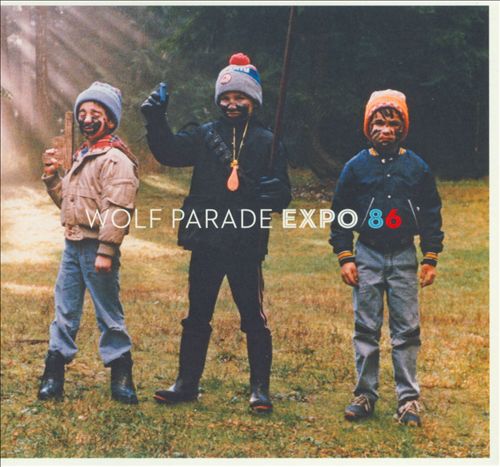
Wolf Parade is a strange band, no doubt. Both singers can craft super catchy songs, but they like to layer them with odd sounds and lots of song parts making the songs more challenging (and better in the long run).

“Cloud Shadow on the Mountain” starts the disc off with drums and an eccentric voice.  And the lyrics? “I was asleep in a hammock/I was dreaming that I was a web/I was a dream-catcher hanging in the window of a minivan/Parked by the water’s edge./I’d say that I was all alone.”

The song has some loud guitars, some great guitars riffs and (the most notable feature on the album) retro sounding keyboards.  On this song the keys play an alternate melody that compliments the song very well.  There’s some heavy rocking sections and a slowed down drums and vocals section.  It’s fairly exhausting how much is in this one song.  By the end, he’s repeating “you will never be born as a scorpion.”

“Palm Road” is a more straightforward and catchy song, although it’s certainly offbeat.  “What Did My Lover Say” opens with a cool guitar riff an counterpointed keyboards.  As with most of the songs on this record headphones or at least good stereo speakers really make a difference.  The rest of the album is hard to speak of in different terms because each song is unusual with angular guitars and interesting vocals.  The keyboards also provide unsettling atmospherics.   None of the songs are easy to sing along to, until one day the shifts in melody and phrasing sink in and it all sounds wonderful.

What I find notable about these songs is that they are all long (most are around 5 minutes) and they feel long–not in a dragging out way (although maybe “In the Direction of the Moon” drags) but in a–so much has been going on, this song must be really long kind of way.

Some other highlights include “Ghost Pressure” with its great keyboard riff (that feels not unlike The Cars).  Speaking of The Cars, the keyboards on “Oh You, Old Thing” have the great spacey Cars sound from the 80s.  “Pobody’s Nerfect” melds the catchiness that the guys are capable of with just the right mix of unexpectedness.  And the closing song “Cave-O-Sapien” seems to combine all of the best qualities of the above songs in to one–a great riff, catchy “oh oh ohs,” and bizarre lyrics, “I had a dream of a gorilla.”

This album is definitely not for everyone, but multiple listen reap big rewards.

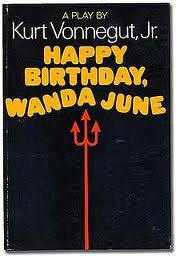
[READ: July 8, 2012] Happy Birthday, Wanda June

I have been chugging along nicely through Kurt Vonnegut’s oeuvre.  My plan was to read all of his novels and then read his short stories.  And then maybe read his plays (I wasn’t sure about that last bit).  But as I mentioned yesterday, reading a simple play can be a delight (and can be a very quick read, too).

Vonnegut opens the book with a prologue about how and when he wrote the book.  It was originally a play called Penelope, and he thought it was terrible.  Fifteen years later he kept the basic idea and rewrote it as Happy Birthday, Wanda June.  And the idea is straight out of Homer.  In the Odyssey, Penelope is Ulysses’ long-suffering wife.  When Ulysses came home from his travels some twenty years later, he was feted as a hero and the world (well, his world) rejoiced (except for Penelope’s suitors, of course).

So in this play, Harold Ryan is a loud, manly hunter and soldier, ready and happy to kill anything in his way.  He has been on an expedition for eight years–his plane went down and he  is presumed dead–even Mutual of Omaha thinks so.  His wife, Penelope Ryan believes him to be dead and has been entertaining two suitors–Dr Norbert Woodly, a pacifistic doctor and Herb Shuttle, a vacuum cleaner salesman.  The only person who doesn’t presume him dead is their son Paul Ryan, who bristles not only at the thought of his father being dead, but even more so at these wimpy suitors.  Although Paul is too young to ever have rally known his father (he’s 12), he keeps hopes alive that his father will return one day.

What I like about the play is that it maintains Vonnegut’s voice right from the start.  It opens with a speech from Penelope:

My name is Penelope Ryan.  This is a simple-minded play about men who enjoy killing–and those who don’t. (more…)

Read Full Post »

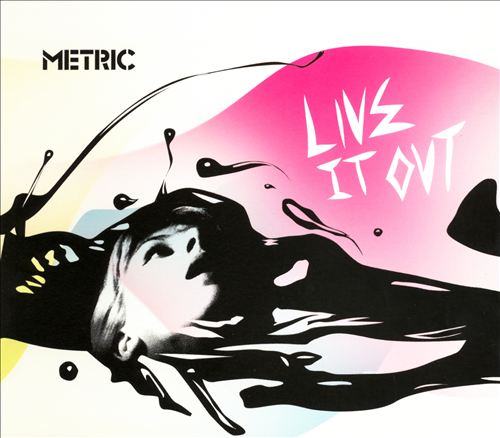
SOUNDTRACK: METRIC-Live It Out (2005).

I enjoyed Metric’s Fantasies album so much that I bought their previous album (an album that I had written down as worth checking out about 5 years ago).  At first I was a little disappointed–the album doesn’t have the glow (or perhaps sheen or polish) of Fantasies.  Normally I prefer raw to polished, but it’s surprising to go the other way sometimes.  And after a couple more listens I really started to appreciate this album’s rawness.

The guitars are loud and pushy.  There are keyboards that dominate some songs, but they never make the songs poppy.  And Emily Haines’ voice sounds great.  The opener “Empty” has a lot of quiet sections, but the guitars really just burst forth.  It’s 6 minutes long but that’s mostly through a long intro and outro.  The rest of the songs stick firmly in the 3-4 minute range.  “Glass Ceiling” has a cool stuttering riff and a kind of awkward bridge–these first two songs kind of resist admittance (the piano/guitar solo is certainly a weird combination–which I like now of course).  “Handshakes” shows their more commercial side–a slick kind of guitar riff with Haines’ more aggressive vocals.  True the siren sound may turn off some, but it’s certainly a signature.  “Too Little Too Late” is a slow sultry number, but even more sultry is the sleazy-feeling (no doubt because of the keyboards) “Poster of a Girl.”  In addition to a cool spoken word section in French (the whole song is bilingual), we get the English lines “Coming in your pants/For the off chance/With a…poster of a girl.”

“Monster Hospital” is a fun punk blast that is still a live favorite for the band.  “Patriarch on a Vespa” has another rough riff with some cool bass.  It also features some disconcerting singing (ahahs that sound more than a little spooky).  “The Police and the Private” is one of the cool songs with easily singable but easily confusable lyrics.  While “Ending Start” has some great guitar riffs near the end.   “Live It Out” ends the disc with a staccato punk number.  It’s a perfect summation of Metric before they got more commercial.  And it’s a great addition for fans of the band.

[READ: July 8, 2012] The Big Meal

This play came as a supplement with Lucky Peach issue #4.

I have often maintained that it is much better to see a play than to read one.  Not a daring opinion, by any stretch. I have taken that to something of an extreme however, which means that I pretty much never read plays.  This has severely limited by Shakespeare intact, naturally.  It also means that a lot of great works are lost to me.

I’m using that information by way of introduction, not because I think this play compares to Shakespeare, but because this is one of a few plays that I have read recently that I’ve really enjoyed.  So I’m retracting some of my earlier thoughts about reading plays.  True, some plays with multiple characters can be confusing to keep straight (since defining characteristics are not given).  But in shorter plays or plays with not too many characters, it’s not so hard to read them.  And in fact, it can be a quick and enjoyable read.

Although this play complicates things immensely because of its (very cool) setup.  The setup is described in the introduction to the play: “The actors play multiple generations of one family…as they glide through time.  As the characters age, their “essences” pass from younger to older actors.”  So, the story takes places over a few generations of time.  There are eight actors.  Each actor plays multiple roles.  These roles correspond to the characters at certain ages.  So, for example, the youngest actor plays Character A as a child; the adolescent actor plays Character A as an older child; the middle-aged actor plays Character A as a middle-aged person, etc.   So that’s a little confusing (although I’ll bet it makes sense seeing it live).  What I like though is that this “gimmick” is not so much a gimmick at all, but a real indication of how we turn into our parents and an indication of how quickly time passes in this play. (more…)

Read Full Post »

SOUNDTRACK: SIX ORGANS OF ADMITTANCE-“Even If You Knew” (2012).

Lars from NPR’s All Things Considered picked this as his summer music preview song.  I don’t know a thing about Six Organs of Admittance, but their discussion of this song makes it seem like this is atypical for the band (which has a massive output).  Evidently they’re usually more droney sounding. But man, this song is pummeling and wonderful.

It’s seven minutes long and opens with a simple, plodding heavy bass riff.  The vocals are kind of whispered and strained.  But then comes the guitar solo–a raging piece of distortion that complements the bass.  And that’s just the first three minutes.

The second half of the song features a quieter section–the bass is quieter, while the guitar noodles around and the vocals play over the rhythm.  The song slowly builds again, and by the last minute or so there’s another fierce guitar solo. Until the song is exhausted by the final distorted notes.

This is some beautiful noise.  And, no I have no idea what the band’s name means.

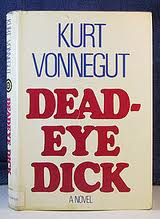
[READ: June 27, 2012] Deadeye Dick

Deadeye Dick is the last Vonnegut book that I was completely unfamiliar with.  I had no idea what it would be about.  So I didn’t realize until very late in the book, and then I looked online and confirmed that this book is set in the same location as Breakfast of Champions, Midland City, Ohio.  Indeed, some of the same characters appear in this book as appeared in that book.  But more about that later.

Vonnegut is not known for his happy books.  Misanthropy is pretty rampant in his pages.  But this book is one of his bleakest books yet.  The story concerns the Waltz family–Rudy (the protagonist) and his brother Felix are the only children of Otto and Emma Waltz.  Pretty early in the story we learn that Rudy is a double murderer.  Yipes!

As with most Vonnegut stories, this one is told in a convoluted and non-linear fashion.  He foreshadows (and really just casually mentions) a lot of crazy things that are going to happen in the book.  Like the fact that Midland City is going to be devastated by a neutron bomb.  In fact, his preface (like with many of his prefaces) tells us a lot about what’s in the book and who the characters are based on and the fact that there is a neutron bomb (but the reality of a neutron bomb is different from what he says).  There is something about knowing this information ahead of time that impacts the way you read the story.  Whether you think maybe he’s not telling the truth about what will happen (can the narrator really be a double murderer?) or maybe somehow the foreshadowing makes it even worse when it actually happens–the revelations are perhaps more deliberate.  But the style–a recursive style in which he says what happens and then he goes back and fills in the details, makes the events that much more powerful.

The funny thing about this story is that a lot happens to the characters in the beginning of the story and then not too much happens to them after that.  But that early stuff is pretty exciting and it has an impact all the way through. (more…)

Read Full Post »

SOUNDTRACK: SUFJAN STEVENS-The Age of Adz (2010).

Sufjan Stevens has released a bunch of albums of beautiful orchestral rock.  It is multi-layered and complex with classical elements and all kinds of cool instruments.

And this album starts out with a beautiful acoustic guitar melody and Sufjan’s delicate vocals.  Although it is a far more stripped down song than usual, “Futile Devices” seems like it is heading in the standard direction.  But anyone who heard Sufjan’s Christmas album number VIII knows that he has been having some fun with electronics.  And they show up with a vengeance on track two, “Too Much.”

All of the multilayered noise that was once orchestral and (some might say) precious has been replaced by a cacophony of gorgeous electronic noises.  The beginning of the song reminds me of the sounds in Skinny Puppy’s “Stairs and Flowers” (how many Sufjan Stevens reviews mention Skinny Puppy?).  The song is nothing like Skinny Puppy once the vocals kick in–it’s catchy and delicate–but those electronics underpin the whole thing, bringing his pastoralia into the twenty-first century.  When I first reviewed this song I didn’t like it but once you get absorbed by Sufjan’s world, it’s an enticing place to be,

“Age of Adz” takes this electronic nonsense even further with an 8 minute brew of strange sounds and choral voices.  But he always manages to throw in some catchy parts, no matter how strange the song gets.

For me one of the highlights of the disc is “I Walked” it features one of my favorite Sufjan things–falsetto vocals in a beautiful but unexpected melody.  And this song has them in spades.  “Now That I’m Older” has a very disconcerting sound–his voice is slowly warbled and mournful.  It’s a beautiful melody that is alienating at the same time.

“Get Real Get Right” returns to his earlier style somewhat (there’s more layers of music, although the electronica is still in place).   “Vesuvius” is a beautiful song and “All for Myself” is another of those great falsetto tracks that I like so much.

“I Want to Be Well” eventually turns into a manic electronic workout in which he repeats the chorus “I’m not fucking around.”

But nothing compares  to “Impossible Soul” a twenty-five minute (!) multi-part suite of electronic chaos.  It’s a fantastic song complete with autotune (used to very cool effect), repeated swelling choruses (it’s like a Polyphonic Spree tribute), electronic freakouts, and acoustic comedowns.  All in a positive, happy message.  I can’t stop listening to it.  “It’s not so impossible!”

Sufjan continues to impress me.

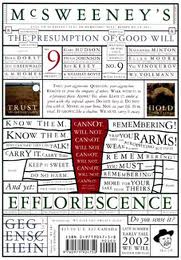
[READ: November 10, 2011] McSweeney’s #9

After the excesses of McSweeney’s #8, I was excited to get to the brevity (and urgency) of McSweeney’s #9.  This one is a paperback and looks like the first couple of issues.  The cover is mostly text with a hodgepodge of phrases and pleas.  You get things like: Thankful, Emboldened, The (Hot-Blooded/Life-Saving) Presumption of (Perpetual/Irrational (or More Likely, Irreducibly Rational) Good Will, Efflorescence, Our motto this time: We Give You Sweaty Hugs,” Alternative motto: ” We Are Out Looking,” GEGENSCHEIN (no more), and the promise: “We will Do Four This Year.”

This is the kind of issue that makes me love McSweeney’s.  There are some wonderful short stories, there are some nice essays and there are some dark moments all centered vaguely and tangentially around a theme.  There are some great authors here, too.

The back cover image is called Garden Variety by Scott Greene and it’s a fantastic painting.  You can see it here (navigate through the 2000-2004 paintings, but I have to say I really like the style of all of his work.

There are no letters and no nonsense in this issue.  So let’s get to it. (more…)

Read Full Post »

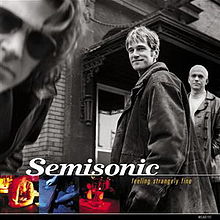
SOUNDTRACK: SEMISONIC-Feeling Strangely Fine (1998).

In my mind, Feeling Strangely Fine is the pinnacle of Semisonic’s pop greatness.  I mean, it’s got “Closing Time” on it.  And while I am now pretty tired of the song (can it really be 13 years old?), when it came out it was pretty awesome.  And so I tend to think of The Great Divide as being in the shadow of this record.  But in retrospect, I think I have to favor Divide over Fine.  This album has a bit too much polish, a bit too much smoothness for my liking.  And while there are some great songs on it, I’m not entirely sure it matches up to The Great Divide.

“Singing in My Sleep” is a supremely catchy song–a simple riff, mellow verses and an urgent chorus.  It should have been huge too.   And “Never You Mind” has that Semisonic quality in spades–simple accents that make a song catchy (a little guitar riff) and really catchy choruses.  Plus lyrically, it’s rather clever.  “Secret Smile” is one of their few ballads that I really like.  I guess they have just mastered pop hooks for this record.

But to me the rest of the record pales a bit compared  to The Great Divide.  “DND” is a similar slow song although it’s a bit slinkier.  And there’s some very mild funk on “Completely Pleased” which is a welcome return to the rockier songs but which doesn’t quite reach the heights that they have hit before.

“California” is a fun track.  It could use a bit of oomph but it shows off some fun noises at the end.  And the last two tracks just kind of fade the disc out.

Nothing on the album is really bad.  And indeed, in the right frame of mind these songs are all really enjoyable, but i think after comparing them to some of the earlier tracks and even the earlier tracks on this record overall this one comes up a bit short.

[READ: November 6, 2011] “Exorcism”

This is a Eugene O’Neill play that was believed to be lost forever.  He staged the play in 1920 but after a brief run, he destroyed every copy, possibly to assuage his dying father.  But this copy was recently found amongst a friend’s papers.

So that’s pretty exciting that a new Eugene O’Neill one-act play is now available.  I believe the whole thing is printed here–it’s so hard to tell with the New Yorker.  But they also say that Yale University Press will be publishing the play in the spring.  If the whole thing fits onto 7 New Yorker pages, how are  they going to publish it as a book?  Well, that’s Yale’s problem.

I don’t know that I have read many, if any, O’Neill plays.  I’ve never really taken any drama classes, although I know about O’Neill’s mastery of drama.

So this is probably as good a place to start as any.

This is the classic “nothing happens” kind of story which proves to be a powerfully emotional story (especially as it resonates so closely to his own life). (more…)

Read Full Post »

SOUNDTRACK: EXPLOSIONS IN THE SKY-Take Care, Take Care, Take Care (2011).

I found out about Explosions in the Sky because of the events of 9/11.  Back when everyone was looking for albums to point fingers at in some kind of hysteria (that’s also how I found out about I am the World Trade Center who are not as exciting as Explosions…).

EITS make beautiful epic instrumental music (as well as the soundtrack for Friday Night Lights).  They play music in a similar vein to Mogwai, but they take their epic instrumentals in a different direction.  And this album is perhaps their most commercial to date (as commercial as you can be when you write 10 minute instrumentals).  And while “commercial” is not usually an adjective that I give as praise, for this album it is indeed.

Take Care, Take Care Take Care is a terrific album.  It ‘s not as visceral as past releases; rather, it seems like a more experienced band playing with their sound and tweaking it in subtle ways to make it less obviously dramatic but somehow more powerful.

On “Last Known Surroundings,” there are soaring guitars that give way to simple, pretty guitar riffs.  Martial drums propel the songs forward, even if they lead to unexpected places.  It’s soundtrack music that’s not background music.

Perhaps the biggest difference with this album and previous ones is that this album doesn’t quite live up to the band’s name.  There’s no major explosive crescendos.  There are noisy bits but they’re not climactic per se.   “Human Qualities” slows to a quiet drum beat and while you’d expect to come out of that with a cacophonous explosion, it doesn’t.  The explosion does come later, but only after it has worked up to it again.

“Trembling Hands” features “voices.”  Or maybe just one voice.  It’s on a loop that becomes more of a sound than a voice.  The song is only 3 minutes long, but it’s an intense 3 minutes–more great drum work on this one.

“Be Comfortable, Creature” has a beautiful delicate guitar opening that drifts into a kind of solo.  After 3 minutes it settles into the main riff, a winding guitar line that send you on a journey.  “Postcard from 1952” is a great song. It begins as quiet intertwining guitars and slowly builds and builds into a gorgeous rocking conclusion.  7 minutes of steady growth with a nice epilogue at the end.

The final song, “Let Me Back In” also has kind of spooky voices that appears throughout the song (distorted and repeated).  But you know this song is a winner from the get go (even if the opening chord structure is a bit like Duran Duran’s “Come Undone.”)  It’s a slow builder, a cool, moody ten minute piece.  When you get to the beautiful descending guitar riff that shoots out after about 2 minutes, it’s an ecstatic moment–air guitars are mandatory.

And let’s talk packaging.  The album comes in a gate-fold type of cardboard.  If you open it up all the way it can be folded into a little house (with windows and a door and a chimney).  That’s pretty cool, guys.

If I have one compliant about the album it’s that the quiets are really quiet and he louds are really loud.  That makes this a very difficult album to listen to say, at work, or basically anywhere where other people will be blown away by your speakers.  The middle of “Human Qualities” for instance, is really quiet, you feel like you need to turn it up to hear the drum beat–there’s too much volume fiddling (listening in the car by yourself negates any reason for this complaint, of course).

Keep it up, guys.

More “controversy” from the band

[READ: September 10, 2011] New Yorker essays

Ten years ago, The New Yorker published several short essays by famous and (to me anyway) not so famous writers.  They were all written directly in the aftermath of the attacks and they were moving and powerful.  I was going to wait until today to re-read them and post about them, but for various reasons, I decided to do it on May 12.

Now, ten years later, The New Yorker has published several more essays by famous and (to me anyway) not so famous writers.  I note that none of the authors are the same (that might have been interesting) although Zadie Smith does quote from John Updike’s piece of ten years ago.

The strange thing to me about these pieces is that ten years seems to have hindered the writers’ ability to focus on the incident and to talk about What It Means.  In this collection of essays, we have a few that talk about an individual and how his life has changed since 9/11.  These are pretty powerful, although it’s odd that they would talk about another person and not themselves. We have a couple of essays that talk about the writer him or herself, but these seem kind of unfocused.  And then we have ones that talk about the state oft he world; honestly, what can you say about that.

It’s possible that I’m jaded or in a bad mood and that’s why I didn’t appreciate these essays.  Or perhaps I’m just facing the futility of things.

This is not to say that I think that writing about 9/11 is easy (you’ll notice I’m not doing it).  Indeed, I think talking about it in any kind of meaningful, non-strident, non-cliched way is nigh impossible.

But these writers do give it a try.  And I am grateful for that. (more…)

Read Full Post »

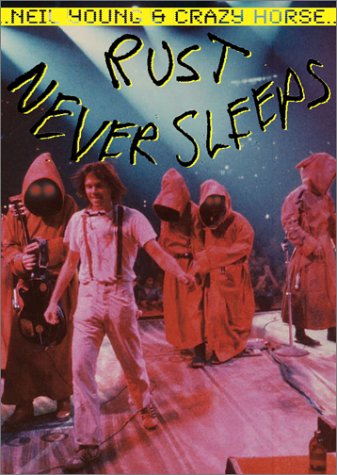
SOUNDTRACK: NEIL YOUNG AND CRAZY HORSE-Rust Never Sleeps (DVD) (1979).

Back in 1979, Neil Young had a huge hit on his hands with “Hey Hey My My” and the album Rust Never Sleeps.  This is a film of that concert (in the Cow Palace, San Francisco).

The set sounds great and the selection of songs is top notch.  On a technical note, some of the darks don’t hold up well and get terribly pixellated, but what do you expect from (what I assume is a) cheapie film from the 70s.

The weird thing about the film (and the concert as well) is the “extras” that he built into the show.  I’m curious what the audiences thought back then, because now, it’s kind of funny, but also more than a little weird.  Throughout the set he has his roadies (who he calls “road eyes”) “setting up” the stage.  The roadies are wearing robes and look an awful lot like the Jawas from Star Wars (which had just come out, so I assume they are meant to look like them).  The stage is a backdrop of oversized amplifiers and the road eyes are scrambling around carrying an oversized microphone and harmonica and other silly things.  The road eyes are having a great time dropping the mic (they even hit Neil in the head with it accidentally).   Another road eye comes out with an oversized tuning fork while the band is tuning.

There’s also some guys in lab coats and another professorial-looking guy who makes an announcement that everyone should put on their rust-o-vision glasses to see the band rust on stage (no idea what happened/how this worked/if there were even glasses, but during the song, they shine a rust colored light on the band).

These moments in the movie are weird.  They certainly break up the flow of the show.  But at the same time, at most concerts, the roadies setting up the show is dull or put behind a curtain so you don’t have to see it.  I think it was cool of Neil to give the audience something to watch during the transition stages (even of they do go on for a while). During all of the roadeye moments, he plays snippets of audio from Woodstock–we hear Hendrix’ “Star Spangled Banner”–and The Beatles (!) (Did they have to pay rights for things like that in 1979?).  We also hear a lot of the announcements from Woodstock (brown acid, no rain! no rain!–strangely, it appears that he has set up the stage to actually rain on the audience.  It’s not filmed very closely so it’s a little unclear, but it does appear that water is actually coming from the ceiling.

As for the arc of the movie (because it is a movie after all), the fist part of the show stars with Neil solo–he wakes up in a sleeping bag and wanders around in overalls singing and playing.   I gather there are wireless microphones attached to his harmonica (!)–I didn’t know they had wireless mics back in 1979).  After he plays a few songs, the roadeyes set up and Crazy Horse comes out (including what to me is an iconic outfit–Frank “Poncho” Sampedro in his Canadiens jersey (#19, Larry Robinson)).

The band bashes through a number of great songs and they all sound great (there’s a few flubbed notes so you know it’s all live but the harmonies are spot on).  It’s odd to me that the band leaves briefly and Neil does one or two more solo songs (none on piano though) before the band comes back again.

The major weird thing about the set is Neil’s almost total lack of interaction with the crowd.  At the end of the show he even seems a bit angry (although he does have a naturally scowly expression), so he doesn’t engage much with anyone.  This seems especially weird given the lightheartedness of the stage show (they lower an organ from the rafters and it has wings on it).  But then again, not everyone has to be nice, right?

The DVD is comprised mostly of songs that appear on the Young’s Live Rust album (confusingly, not the Rust Never Sleeps album) although the album has recordings from different shows.

It’s a strange artifact, definitely an item of the late 70s.  It doesn’t hold up especially well, but you can always fast forward over the slow bits.

[READ: April 11, 2011] “Big Ticket”

The Walrus has published two Two Act plays over its existence.  This is the second one.  Act one appeared in the magazine but you have to go online to see the end.  Unlike with the previous play, both Acts One and Two are online.

Act One of the play is terribly exciting. It starts out in a weird way with a woman looking to pay a man to abduct and terrify her husband.  The man (a garage mechanic) shows her the “cage” that he’s going to lock her husband in.  And then things start to get all Penthouse-y.  The woman (Annie) starts asking the mechanic (Dave) if he’s ever done anything, you know, naughty, in the cage (she’s obviously an unhappy wife).  Dave does the metaphorical look around the room and then climbs in the cage with her. (more…)

Read Full Post »

SOUNDTRACK: The Best of Sessions at West 54th, Volume 1 (DVD) (1997).

Back in the 1990s, PBS ran one of their TV series devoted to contemporary music, Sessions at West 54th.  It was primarily, but not exclusively adult alternative music, with a mixture of jazz and country thrown in as well.  I never watched the show when it was on, but I was intrigued by this DVD because it has a number of artists that I liked quite a bit then. I haven’t watched it in ages, and when I watched it recently I was interested to see that I liked some other artists better than the ones I bought the disc for in the first place.

There was a recent radio show on All Songs Considered called Splitsville: Breaking Up with Your Favorite Band.   This is something that I think about from time to time–bands that I loved and no longer do.  Or bands that I loved and then stopped and maybe now love again.  This show dealt with that very issue.  Most amusingly, Robin Hilton, one of the cohosts had this wonderful quote that applies to me (and this DVD) almost directly.

It’s Not You, It’s Me (Bands We Grew Apart From): “I (dug) out my old CD books and dusted them off. And this recurring theme that came back at me, just haunting, I realized it was the whole Lilith Fair crowd. It was so painful. I had Shawn Colvin, Jewel, Sarah McLachlan, Indigo Girls, Paula Cole, Beth Orton. I just listened to that music non-stop. And now, maybe I’m not the sensitive, new-age guy that I used to be.” — Robin Hilton

So, what happened, Robin? The same thing happened to me.  I still love the concept of Lilith, but I really just don’t care about the music anymore.  And much of this DVD caters to the Lilith crowd. But it doesn’t start that way.  It opens with

WYNTON MARSALIS-“Back to Basics” A fantastic jazz number.  Wynton plays some wonderful stuff (I particularly like the “laughing” horns).  It’s a really rousing opener.

SUZANNE VEGA-“Caramel”  Vega is not a Lilith Fair person to me because I learned of her long before then.  This is not my favorite song of hers

RICHARD THOMPSON-“I Feel So Good” It’s funny to me that when I bought this I didn’t know who Richard Thompson was.  It’s always great to hear him rock out like this.

SHAWN COLVIN-“Diamond in the Rough” I like Shawn Colvin, although not as much as most of the other Lilith Fairers.  This is one of her songs that I don’t know very well

ANI DIFRANCO-“32 Flavors” I loved Ani and her self publishing empire.  And her songs were good too.  I saw her in concert once or twice and she totally rocked the house.  Then sometime in the early 2000s she went in a new direction and I completely lost touch with her and pretty much stopped listening to her.  It was nice to hear this song again, although it’s a bit slower than the way I know it.

NIL LARA-“How Was I To Know”  I didn’t know who he was then, I’m still not sure who he is or if he’s still around.  This is a pretty serviceable folk rock song

RICKIE LEE JONES-“Road Kill” I did not care for this song at all.

DANIEL LANOIS-“Orange Kay” this was a wild guitar solo and effects song.  It was really quite different from anything else here.

EMMYLOU HARRIS-“Wrecking Ball” This song had cool harmonies although I’m not a fan of Emmylou in general.

BEN FOLDS FIVE-“Smoke” I love Ben Folds, and this song is wonderful (seeing him play the “strings” of the piano is very cool.  And my god he’s so YOUNG!

KEB’ MO-“Just Like You”  I like Keb’ Mo’ quite a bit and this is a good song by him.

SINÉAD O’CONNOR-“The Last Day of Our Acquaintance”  Sinéad was another of those ladies who I loved before Lilith.  I fact The Lion and The Cobra was one of my favorite albums.  Then she got super political (and put out more amazing music) and then she got really weird.  And I stopped listening.  She’s an odd duck in this show as well (this was in her speaking only in falsetto phase, which is pretty odd.  And she has a little grunted /spoken bit in the middle of the song which is pretty odd too).  But for all of that, man is this song awesome. I haven’t listened to it in a long time, and holy cow I forgot how impactful it is. And live, with the electric guitars and the backing vocalists, it is really amazing.  A definite highlight of the disc.

YO-YO MA “Libertango”  Yo-Yo Ma is pretty awesome.  I wouldn’t listen to a lot of his stuff (I like classical, but in small doses) but man, he rocks the cello.  This is a great piece.

PATTI SMITH “People Have the Power” Patti Smith is a legend.  An icon.  Her early music is amazing.  So why do I hate this song so much?  The sentiment is wonderful, but gah, what a dreadful song.

JANE SIBERRY-“Love is Everything” I really like Jane Siberry.  She’s a strange lady with a quirky but wonderful voice.  This is a beautiful song, but a little slow (I find it works well amidst her other songs, but it’s a bit stodgy on its own).

It’s a fun collection of mellow songs (what I think of as the old PBS/NPR audience, since now they have shows that are much louder).  And it’ always fun to see artists perform in an intimate venue.

[READ: April 12, 2011] “Shock Jock”

This is the first play that The Walrus has published.  It is not so much in Acts as it is in Ten Scenes.  Scenes 1-3 are printed in the magazine, while Scenes 4-10 are only available online.  (Sadly 1-3 are not included online).

This is the story of a political shock jock, a Canadian version of Rush Limbaugh (these were the days before Glenn Beck).  The opening scene shows him railing against everything and nothing.  He proves to be very popular with his fans but when they call him up to tell him that, he abuses them too (but they don’t seem to mind–or to notice).  It seems like a pretty straightforward parody of a radio blowhard.

But the next scene shows him at home, where he is not so much meek as completely incapable of making a decision.  His wife seems like something of a harpy, but it’s clear that she has put up with this ineffectual man for nine years and has just had it with his inability to even communicate.  These two scenes play off each other as somewhat obvious counterpoint and yet, they are strangely compelling enough to keep you reading.  And it’s worthwhile to do so. (more…)

Read Full Post »

SOUNDTRACK: BATTLES-“Ice Cream” (2011).

My friend Lar told me about Battles way back in 2007.  I listened to the concert he sent me, and it was great. But my memory of the band was that they were really heavy (the drummer was in Helmet and Tomahawk for cripessakes).

But they’re not so much heavy as noisy and crazy.  And this track is a head-spinning amalgam of keybaords, unsettling rhythms, processed guitars and singing from Argentinean techno producer Matias Aguayo.  The lyrics sound like they are not English, but they are (with heavy effects on them).

The song is weird, indeed. But after just one listen, I was totally hooked.  It’s catchy and bouncy and very sunny and it’s a real joy to listen to.   I absolutely must go back and check out their debut Mirrored.

Listen at NPR.

[READ: April 28, 2011] Five Dials Number 6

Five Dials Number 5 was an excellent issue that I enjoyed immensely.  They followed it up with Number 6, which deals with a subject that I was very passionate about in the early 90s: censorship/obscenity.  When I was in high school and college, the PMRC was the big bogeyman for advocates of free speech (of which I am one).  I still advocate passionately for freedom of speech (now that I’m in a library, the issue can be part of my daily life), but it seems like there are so many more important issues in the world, that stickers on a record seem kind of silly.

Nevetheless, as this issue reminds us, those who control what is said control what we hear.  And that’s true for music and books, as well as our everyday news.  So, free speech should never be taken lightly.  Although this issue looks largely at obscenity in England, they also pull up some good information from Jello Biafra as well.

CRAIG TAYLOR-A Letter from the Editor: On John Mortimer and Obscenity
John Mortimer appears later in the issue. He was the lawyer who defended Lady Chatterly’s Lover against accusations of obscenity.  And Taylor points out that Mortimer’s attitude was that he “understood the silliness of censorship.”  And with that attitude, he was able to work to convince juries of that silliness.  The rest of the issue looks at important cases of censorship over the years, from The Dead Kennedys to NWA (it’s nice to be reminded about how “dangerous” they were when they came out).  He also laughs at the lame attempts at putting adult content on network TV (Fudge you!). (more…)

Read Full Post »

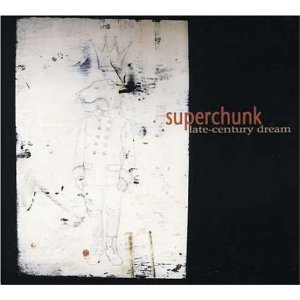
SOUNDTRACK: SUPERCHUNK-Late Century Dream (2001).

A Superchunk song that opens with keyboards, “Late-Century Dream” is one of the most mellow singles that they’ve recorded (even more mellow than some of the acoustic songs they’ve done).

It’s followed by “The Length of Las Ramblas” an even more mellow track.  This one is also full of keyboards (sort of tinny, high pitched keyboards) and acoustic guitars.

Rocking guitars return on “Becoming a Speck” which reminds me of “1,000 Pounds.”  It’s a fast-paced, punchy song with a guitar solo that sounds like it might collapse on itself any minute.

“Florida’s on Fire” is an acoustic rendition of the song from Here’s to Shutting Up. Initially, when Superchunk was a punky bratty band, these acoustic numbers were kind of a novelty.  Now they showcase the extent of musicianship that the band possesses, and this one is no exception.

It’s a good EP, and the last one that I bought prior to their return this year.  They have a couple other ones that I’m going to try to track down.  But in the meantime, it’s all Majesty Shredding.

[READ: October 10, 2010] “An Actor Prepares”

Donald Antrim is the next writer in the 1999 New Yorker 20 Under 40 issue.

This story is a funny look at college theater.  The subject is not terribly new, and yet there are so many wonderful details and the theater teacher is so over the top that this story was completely enjoyable.

The narrator is Reginald Barry, Dean of Student Life and Wm. T. Barry Professor of Speech and Drama at Barry College (ha!) and this semester his students will be performing A Midsummer Night’s Dream.   I had to look up some of the quotes in the story to make sure they were actually from the play (I didn’t know the line “Use me but as your spaniel, spurn me, strike me” was in Shakespeare), but they are, and Antrim takes lines like this and runs with them.

Barry has wonderful plans for this production which he envisions outside on the grounds of the campus, with a culminating orgy occurring just as the fireflies come out. (more…)

Read Full Post »

« Newer Posts - Older Posts »