I learned about The Blow from NPR Music. The lads played a new song by them, but this song, which is also available on NPR, is from 2006. I don’t know anything else about The Blow. But I do know that “Parentheses” is a delightful little pop confection (with enough elements of weirdness that explain why it was never a hit).
“Parentheses” immediately sounds like something I’ve heard before. That chorus is just so perfect—“when you’re holding me, we make a pair of parentheses” that I can’t believe no one has thought of it before. Of course, the bit in the verses about the deli aisle is certainly unexpected.
I normally don’t like the bap bap // bap drum beat, but it’s perfect here. The stripped down nature of the music (simple chords on a few different keyboard sounds) accompanies this perfectly. It’s sung with Khaela Maricich’s sweet and almost fragile (but not) voice.
It is so catchy I have now listened to it three times in a row. And that little guitar tail at the end is very inviting as well. I can’t believe this song wasn’t huge.
[READ: September 26, 2013] Desolate Heaven
I read this play because of my friend Ailish—I’ve never seen anyone with a name almost like hers—Ailís—before. And, given the Irish name it is no surprise that the story is set in Ireland. But rather than Dublin, it is set on a desolate beach. We see two young girls: Orlaith (13) and Sive (12) messing about. They are acting like adults—complaining about the beach and “the kids” and how everything is awful. Despite some tensions, the girls bond over their difficult lives. Each lives with a single parent and in each case, the parent is an invalid. Each girl has to do everything for her parent in addition to going to school. And in the next few scenes we see just how desperate their situations are: Sive’s mother has broken her pelvis (and has been unable to move for two years) and Orlaith’s father didn’t get up at all today because he didn’t feel he was able to.
In the next scene, we see the girls acting out a plan—to meet at the beach with as much money as they can grab. And just like that, they are off on a road trip. (more…)
SOUNDTRACK: FORGET ALL THAT AND JUST WAIL: New Music That Orbits Around Jazz (compilation The Believer July/August 2013).
This compilation came as a digital download with The Believer’s 2013 Music Issue (you need to get a physical copy of the issue to get the download code). Ross Simonini, the compiler, explains that he used to like jazz, but that he really doesn’t anymore. And he finds himself attracted to these pieces that hover around jazz but which really aren’t jazz. You can read Simonini’s thoughtful comments about all of these tracks here). I enjoyed this compilation quite a lot and am considering getting a few of these discs, or at least investigating them further. And that’s want you want from a compilation.
COLIN STETSON-“The Righteous Wrath if an Honorable Man”
Any compilation that opens with Colin Stetson is okay with me. This track was my introduction to the man last year and I still love it, in all of its insanity.
KARRIEM RIGGINS-“Double Trouble” is only 2 minutes long. It’s got flutes and vibraphones and is super cool and retro sounding. I really like it, although this track ends abruptly and I can’t decide if the actual song does or if it was cut short for the disc.
THUNDERCAT-“For Love I Came” has some echoey keyboards and some great bass lines and cool/cheesy keyboard lines (it all sounds so gloriously 70s). When the vocals come in, the whole track feels like Yes if Yes were inspired by jazz instead of classical (and had no drums—until about 2 minutes when the drums kick in and the song takes off and bass solo makes it very Yes-like).
THE BEN MONDER TRIO-“Red Shifts” is a classic style jazz guitar workout—the echoed effect is very jazzy. And yet there is something very angular about the playing that keeps it from sounding smooth. It’s a great track (which once again seems to get cut off very abruptly).
DAWN OF MIDI-“Ymir” is another trio—piano bass and drums. The piano is muted (the pianist puts his hand on the strings) which makes it sound like another percussive instrument while it is also creating the melody. It’s very cool. And I like the way over the 8 or so minutes the melody changes slightly, giving it a new sound almost accidentally.
GLOWS IN THE DARK-“Up and Down” starts as a fast but quiet guitar piece with some cool subtle horns over the top. It features a rap by Count Bass D which i do not care for (The “I’m pissed/L.L. Cool J” verse is really awkward). This is the first track on the disc that i really don’t like, which is a shame because the music is really cool.
STEVE RAEGELE-“Traingle (Daedalus)” is a weird, cool experimental sounding track. Sounds are overlaid on each other with a lot of echoing that gives it a very dense structure. Whether or not this is jazz is hard to say but it’s very intriguing.
MARY HALVORSON QUINTET-“Sea Cut Like Snow (No. 26)” Halvorson is a guitarist and this live track features some of the most traditional jazz on the compilation. The song has cool melodies and some nice improvsiing (on various instruments). It runs a little long though (I wish this had been truncated rather than the earlier ones) but it’s enjoyable.
FLYING LOTUS-“German Haircut” this is an electronically manipulated pastiche of songs with a sax solos placed over the top. It’s an interesting concoction.
CHRIS CORSANO-“Famously Short Arms” This is one of the most amazing drum videos I’ve ever seen–it is so creative and original. As an audio track it is basically a drum solo, but watching him and what he does on the drums is really mind expanding.
MATANA ROBERTS-“lulla/bye” I have this track as well (two tracks from Constellation here). It’s full of saxophones and longing in the singing. It’s hard to define but it’s very evocative.
MICROKINGDOM-“Peppermint Crab” This is a weird and wild piece. It opens with some manipulated and spacey vibes and electronics and then gets assaulted by a wild and screaming sax solo that would make John Zorn proud.
DIAMOND TERRIFIER-“Kill the Self That Wants to Kill Yourself” This song opens with some simple keyboard chords and some odd unsettling sounds thrown over them (waves of static and squeaking saxophone). Then comes some wild soloing.
This is a solid compilation of jazz-like music. It veers into more extreme forms of jazz and will certainly alienate some listeners, but it’s an introduction to what else is out there on the fringes.
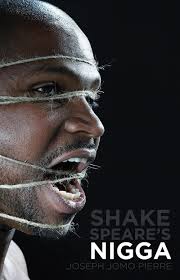
[READ: August 8, 2013] Shakespeare’s Nigga
The artistic director of the Obsidian Theatre Company (which put on this play) explains in the intro that with a title like that, you’re going to get attention. In fact he initially said that they couldn’t use that title, because it was too much. But they changed their mind because it really was…right.
This story looks at the two most prominent black men in Shakespeare: Othello (the Moorish general who is ruled by violent emotion) and Aaron (a Moorish slave who is basically pure evil—in Titus Andronicus). As the artistic development coordinator of the Obsidian Theater says, Shakespeare is the authority on writing characters, thus these two men have become entwined in Black masculinity. Which is a shame because “Moor” could basically be anyone who did not live in Europe and because Shakespeare likely didn’t know any black people (except as slaves). It’s not really a good sample.
Playwright Joseph Jomo Pierre doesn’t seek to rectify this or upend this or decry Shakespeare. What he does is much more subtle and much more powerful.
There are five characters in the play: Othello, Aaron, Tyrus (an older black male), Shakespeare and Judith (Shakespeare’s daughter). Shakespeare and Othello are comrades (I won’t say friends, but it seems like Shakespeare relies on Othello for protection and advice). Meanwhile, Aaron has tried to escape from his slavery and is currently chained up and beaten (usually by Othello). (more…)
Horrible Histories is a British children’s show. They tell you histories of people and things in fun ways. Like this. (It sounds awesome).
This biography of Charles Dickens (which lyrically is amusing as well as informative) is done in the style of The Smiths. The music is very clearly The Smiths and of course the singer hits all of the Morrisseyisms that he can. In addition to some actual Smiths lines (Dickens take a bow, heaven knows I’m miserable now), the song more or less mashes up “Heaven Know I’m Miserable Now” and “This Charming Man.”
It’s very funny and catchy as well. Check out the joy:
[READ: June 30, 2013] A Taste of Honey
I discovered this play because it was mentioned in a documentary about The Smiths, It was one of Morrissey’s favorite movies; he quoted a line from it in “Reel Around the Fountain” (I dreamt about you last night and fell out of bed twice”) and the song “This Night Has Opened My Eyes” is basically a summary of the play (with lines from it).
It’s a fairly modern story for 1959 England (Delaney was 18 when she wrote it), but it seems like rather a downer to be a favorite film/play.
It is the story of Jo, a young girl who is stuck in the dreaded life of living poor in Manchester (The river the color of lead). She has no father around and her mother, Helen, (described as as a semi-whore (!), is quite unpleasant). Indeed, the opening scene of the play is the two of them bickering in a hole in the wall flat that feels dirty just by reading it.
Eventually a man comes along who promises to take Helen away from all of this. He may be her pimp (specifics are not really given in the story and I wondered if they would be more obvious if it was 1959 (or in the movie). But it’s clear that he has money and seems to be willing to bring Helen home. At the same time, he is terribly mean to Jo–treating her worse than her mother does. By the end of the scene, he takes Helen away, leaving Jo on her own. (more…)
I won free tickets to this show in Murray Dodge Hall, and olde theater in the heart of the Princeton University campus. Sarah and I were delighted to discover that the theater held only 190 people and that our seats were in the fifth row!
This is student theater, but, as I said to Sarah, these are seriously good acting students (better than most of the students that I went to school with, anyhow).
She Loves Me is a musical based on the drama Parfumerie by Hungarian playwright Miklos Laszlo. Before being adapted in 1963 as She Loves Me, (Music by Jerry Bock, Lyrics by Sheldon Harnick, Book by Joe Masteroff) it was previously adapted as the 1940 film The Shop Around the Corner and the 1949 musical In the Good Old Summertime. It was also revisited in 1998 as You’ve Got Mail.
If you’ve seen any of these adaptations, yo know the story. And if you haven’t, it is this: two shop workers who dislike each other are secretly each others’ pen pals. In this version, they each write to a lonely hearts column, and plan to meet for the first time very soon. It’s a simple enough story. But what sold me in this version was the music—which was simple and catchy and very very funny. (more…)
SOUNDTRACK: DEPECHE MODE-“Fly on the Windscreen” (1986).
Every time I use the phrase ‘death is everywhere” (which I don’t do often, but which I do do below) I think of this song.
I forgot how synthy this song sounds when it opens–two different very synthy sounds. After the vocals (which feature Dave Gahan’s voice at its strongest) the guitars come in and the song sounds a bit more complex.
It’s funny how the song which starts with the dark verses and “death is everywhere” can have the cool and rather sweet bridge of “Come here, touch me, kiss me, touch me, now.” (Gahan’s o’s are so wide when he sings, it’s great).
This song really marks the transition of Depeche Mode from synth pop to darker more angsty music. Indeed, all of Black Celebration, with its noisy percussions and unusual instrumentation and of course, Martin Gore’s dark lyrics, shows a band transitioning to new levels of greatness.
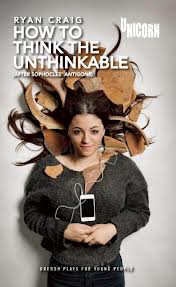
[READ: May 30, 2013] How to Think the Unthinkable
This play was created and produced for the Fringe Festival. I tend to think of the Fringe Festival as, you know, stuff on the Fringe, so I imagined that this play that was “After Sophocle’s Antigone” would be a modern and possibly weird update of the story. And it starts off that way with a guard coming back with three clothespins. He explains that he always draws the short straw and he was the one sent off to get clothespins to block the noses of the other guards. You see, they have been sitting watch over this body for a few days and he is starting to smell pretty bad.
But when the guard, Tom, arrives, he discovers that the other two guards (Roy and Bo) have fallen asleep and the body is gone. Tom freaks out, he tells them (and us) that the body (of Polynices) cannot possibly be given a proper burial. Polynices was a traitor to King Creon and his punishment is to be left to rot outside of the city walls. How could they have let someone take and bury his body? They were tired. See, it’s funny.
Indeed, the other guards have no answer and are more or less comic relief. Until Haemon shows up. Haemon is Creon’s son. He is super annoyed because he was the one who vouched for Tom and the others. Now he looks bad and Creon will be pissed.
Cut to Creon ensuring the City Elder that he plays no favorites and if even his son is found guilty of a crime—like burying Polynices–well, the full force of punishment will come onto him as well. Like any Greek tragedy, you can see the set up. (more…)
SOUNDTRACK: BOBTOWN-“Don’t Fear the Reaper” (2012).
I heard this song on the radio today. When it started I didn’t think much of it–a nice acoustic guitar which… suddenly sounded familiar. And then, no doubt, it was “Don’t Fear the Reaper.” With banjo! A good song can be played in any genre, and while I never would have guessed that this song would work in this genre, man, Bobtown knock it out of the park.
Bobtown has five members–two men, on bass and banjo, and three women who sing in gorgeous harmony. And if you know “Don’t Fear the Reaper” you know that there are various vocal parts, which these woman tackle beautifully. Their version gave me chills.
Now, befitting a bluegrass band, they did not play the super fast part (in fact they ignored that entire section of the song–the didn’t use cowbell either). I was initially a little disappointed because I wanted to hear what they would do with it. But it was truer to their version to leave it out and by removing it, they made the song a little different–more sombre, less wild. And it was really good.
This version below is not the studio version, it was recorded in a stairwell. But the band sounds great in this unlikely location.
[READ:April 7, 2013] Seminar
I grabbed this book at work (just like Cousin K). This book was also short, which was a plus since I knew nothing about it. It was also a play and it listed the cast from the opening on Broadway. And I was rather surprised. Hamish Linklater (the brother on New Adventures of Old Christine), Jerry O’Connell and..Alan Rickman! I hadn’t heard of either of the women (Lily Rave–she’s been in nothing I’ve seen and Hetienne Park–her first role).
The story is a one act play about four college-aged writing students taking a seminar with a former great writer and current old man.
The four students are Douglas, a cocky writer who has connections and talent and who has been published in Tin House and is soon to be published in The New Yorker. Martin, a shy writer who is rather insecure, although he proves to be very talented. Kate is a girl who Martin knew from high school. She has been writing the same story for six years and is outraged at the way her fellow students and their teacher behave. And Izzy (who I thought was a man for a few pages) is a sexually adventurous woman who seems to be willing to do anything to succeed. (more…)
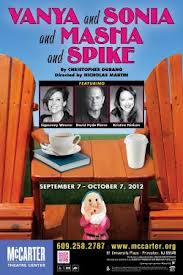
[ATTENDED: October 3, 2012] Vanya and Sonia and Masha and Spike
Berlind Theater is on the back side of the McCarter Theater on Princeton University’s campus. I’ve seen a number of shows at McCarter, but none at Berlind. Berlind proved to be an even smaller and more intimate venue than the gorgeous McCarter.
What better place to see Sigourney Weaver and David Hyde Pierce in starring roles? Especially when I managed to get $20 seats that were in row K. That’s right, Row K, as in 11 rows from the stage. All for $20 and free parking…suck it, Broadway!
Sorry, that was very unclassy. Let me start again.
Christopher Durang wrote the play Vanya and Sonia and Masha and Spike as a kind of loving nod to Chekov’s Uncle Vanya. The booklet that came with the play is very funny in which Durang interviews himself and gets most of the details wrong (he keeps calling it a parody of Uncle Vanya, which he explicitly states it is not).
The play is set in Bucks County, PA (just a hop skip and a jump from Princeton). David Hyde Pierce played Vanya, an older man who lives with his sister Sonia. Sonia, who is played by Kristine Nielsen, was adopted as a little girl. Their parents loved Chekov and named them after the characters in Uncle Vanya. And when thy became infirm, Vanya and Sonia stayed in their childhood home to take care of their ailing parents. Now Vanya and Sonia are much older, unemployed and curmudgeonly. She and Vanya have a hostile, co-dependent relationship. (more…)
SOUNDTRACK: …AND YOU WILL KNOW US BY THE TRAIL OF DEAD-Live on KEXP, March 12, 2009 (2009).
Back in 2009, …And You Will Know Us by the Trail of Dead had been hit by a truck. Really. Evidently no one was hurt too bad, but they did have to cancel a show in Salt Lake City.
Nevertheless, they managed to get to KEXP to play a four song set from their latest album The Century of Self. The opener “The Giant’s Causeway” is full of bombast and noise and has a surprisingly catchy melody in the middle. It merges into “The Far Pavillion” (just like on the album) which sounds like pretty typical Trail of Dead–rocking and yet melodic, with some good screaming parts.
“Luna Park” is something of a surprise to me as it’s a piano-based ballad (which I suppose Trail of Dead plays, but which I don’t associate with them). “Bells of Creation” also opens with a piano, but it quickly grows very loud. It’s a cool song with lots of depth.
I had actually stopped listening to Trail of Dead after Worlds Apart (and album I liked, but I guess the band fell off my radar) so it’s nice to hear they’ve still got it. At least as of three years ago.
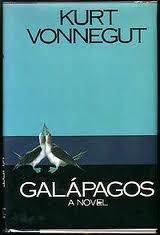
[READ: September 17, 2012] Galápagos
Each of these 1980’s era Vonnegut books gets darker than the last. In this one the entire human race is wiped out (except for a few people who spawn what eventually becomes of the human race in a million years). For indeed, this book is set one million years in the future and it is written by a person who was there, one million years in the past when the human race destroyed itself. It’s not till very late in the book that we learn who the narrator is and, hilariously, what his relationship is to the Vonnegut canon.
In typically Vonnegut fashion, the story is told in that spiral style in which he tells you a bit of something and then circles back to it again later and comes back again later until finally 200 or so pages into the book you get all the details of what is happening. Interspersed with the respawning f the human race (and flippers) is the story of the Adam and Eve and Eve and Eve and Eve and Eve who created the human race–how they got to be together, what their lives were like before and what contribution they made to humanity, such as it is now.
In another bizarre and fascinating twist, every character who is going to die in the near future gets a star next to his name so that the reader knows that that person is going to die. We get a lot of things like ★Andrew MacIntosh for many pages until the character finally dies. And pretty much everybody does die. Well, obviously if it is set a million years in the future, but aside from that part, only a few of the characters survive.
So here’s how these few people managed to create a new human race in the Galápagos Islands. (more…)
SOUNDTRACK: OF MONSTERS AND MEN-Live from Iceland Airwaves (2011).
This brief set was recorded at KEX hostel in Reykjavik, Iceland (how on earth KEXP in Seattle was there I don’t know). This set was performed before the release of their debut EP, although “Dirty Paws” which they play was not on that EP. “Little Talks” their (reasonably) huge hit them was on the EP and is on their full length album–it’s a great duet (and reminds me a bit of Stars).
There’s an amusing fail in the horn solo on “Lake House,” which is kind of surprising, but not terribly tragic or anything. The band sounds great, especially in front of a home country crowd (I love hearing them say “Takk” at the end of the songs). There’s five songs in all, and by the final one, they feel sound like they’re really enjoying themselves.
[READ: September 1, 2012] Wampeters, Foma & Granfaloons
This collection contains essays reviews and speeches. So it’s non-fiction. Except that, ever the contrarian, Vonnegut includes one fiction piece–a short play. The title of this book comes from three words from his novel Cat’s Cradle: “a wampeter is an object around which the lives of many otherwise unrelated people may revolve. The Holy Grail would be a case in point. Foma are harmless untruths, intended to comfort simple souls. An example: ‘Prosperity is just around the corner.’ A granfallooon is a proud and meaningless association of human beings.”
That all comes from the preface. The preface also says that there are people who have collected everything he has ever written (even stuff he has forgotten about) but he will not let most of that see the light of day. Here he has whittled down the least embarrassing stuff for publication. He also explains that at some point (supported by reading this) he decided to stop giving speeches; to stop “talking” and to concentrate on writing. So he did.
The final straw for this was a comment from the President of the American Academy of Arts and Letters. Vonnegut had prepared a speech. The president reread it and hated it, but the president told Vonnegut that nobody would actually listen to the words: “People are seldom interested in the actual content of a speech. They simply want to learn from your tone and gestures and expressions whether or not you are an honest man.”
While Vonnegut’s essays are powerful and effective, it’s the Preface that really tells it straightg.”Not nearly as many Biafrans were butchered by the Nigerians at the end of the war as I had thought would be. At a minimum those damaged children at the exact middle of the universe will be more honorable than Richard M Nixon. [Nixon] is the first president to hate the American people and all they stand for.”
Gore Vidal died last night at age 86 because of complications from pneumonia.
When I was younger, back in college, I loved Gore Vidal. I read almost all of his essays and I tried to read most of his novels (I didn’t succeed–he has published some 50 books). His book United States: Essays 1952–1992 is one of the best collection of political essays I have read.
People who know Vidal at all know him for different reasons. Some know him as a writer of historical novels known as the Narratives of Empire: Burr (covering 1775-1805 and 1833-1836), Lincoln (1861-1865) 1876 (1875-1877), Empire (1898-1907), Hollywood (1917-1923), WashingtonD.C. (1937-1952) and The Golden Age (1939-1954).
Others know him for his outspoken pro-homosexuality stance. His third novel 1948’s The City and the Pillar caused quite the controversy for presenting sympathetic gay characters. He also wrote Myra Breckenridge about a transsexual character. His published quote from about sexuality (from 1969) is:
We are all bisexual to begin with. That is a fact of our condition. And we are all responsive to sexual stimuli from our own as well as from the opposite sex. Certain societies at certain times, usually in the interest of maintaining the baby supply, have discouraged homosexuality. Other societies, particularly militaristic ones, have exalted it. But regardless of tribal taboos, homosexuality is a constant fact of the human condition and it is not a sickness, not a sin, not a crime … despite the best efforts of our puritan tribe to make it all three. Homosexuality is as natural as heterosexuality. Notice I use the word ‘natural,’ not normal.” (more…)
 SOUNDTRACK: THE BLOW-“Parentheses” (2006).
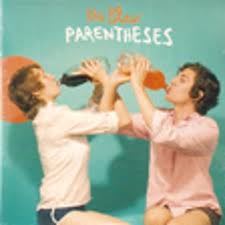 I learned about The Blow from NPR Music. The lads played a new song by them, but this song, which is also available on NPR, is from 2006. I don’t know anything else about The Blow. But I do know that “Parentheses” is a delightful little pop confection (with enough elements of weirdness that explain why it was never a hit).









 I Just Read About That...