Feeds:
Posts
Comments

Archive for the ‘NPR/PRI/PBS’ Category

SOUNDTRACK: BOMBINO-Tiny Desk Concert #301 (September 7, 2013).

So who or what is Bombino you, like me, are probably asking.  Well:

Omara “Bombino” Moctar is a Tuareg guitarist, born in Niger.  There’s something alluring and charming about Bombino, whose childlike face belies his fierce, hypnotic guitar playing. The familiarity in his music stems from the blues, a common thread between American music and Africa for obvious reasons. Bombino grew up on the music of Jimi Hendrix, whose sound keeps getting sent back and forth from America to Africa and back again.

Bombino plays three songs.  They’re all pretty lengthy with a lot of guitar playing.  But none are instrumental.  However, I certainly have no idea what he’s singing.  In addition to Bombino, there; a rhythm guitarist, a bassist and two drummers–one playing a djembe I believe and one playing that drum that you thump with your fist–I can’t find the name of it.

  • “Tamiditine” has a Western sounding melody
  • “Her Tenere” opens with a lengthy guitar solo–and o course his guitar has that distinctive tinny guitar sound  This one is really catchy.  I assume he is singing real words, but it just sounds like “deh deh deh.”
  • “Imuhar” feels a bit more Nigerian, than Western–it’s interesting to hear the distinction in scales there.  Overall this has a long jamming quality to it.

Before listening to the Tiny Desk Concerts, I’d never listened to music like this and I’m grateful for the exposure to it.

[READ: January 24, 2017 ] Snow White

Matt Phelan continues to make great graphic novels.  This one is an adaptation of Snow White.  I assumed it would be a fairly straightforward telling of the fairy tale, but Phelan changes the setting of the story and makes the whole thing far more “real,” which is a neat trick.

Phelan has moved the setting of the story from the forest to the glamour of 1920s Manhattan.  It is just before the Depression and the city is hopping!  Bright lights, (for a black and white book anyway), dancing and money everywhere.

And amid this, a young girl is born.  Samantha White is a few years old in 1918.  As she runs through central park her mother calls to her: Samantha…Snow!  The girl responds to this name, but as she turns around, her mother cough up blood into a handkerchief (virtually the only color in the book). (more…)

Read Full Post »

SOUNDTRACK: SHOVELS AND ROPE-Tiny Desk Concert #304 (September 16, 2013).

This Tiny Desk Concert starts with the most fun opening of any—the duo of Shovels & Rope brought their dog along, and as they are warming up, the dog roams around, getting pet by people and sneaking treats.

As the blurb notes:

But once Cary Ann Hearst and Michael Trent showed up, the office quickly lost sight of the approaching performance, as the murmurs began: “There’s a dog in the office there’s a dog in the office there’s a dog in the office!” You could practically see our coworkers’ brains short out from a combination of cognitive dissonance and canine adoration.

I’ve enjoyed Shovels and Rope’s punky folky country music, But I didn’t know much about them:

As endearing as our new friend was, Shovels & Rope soon won back the crowd’s attention [with] the husband-and-wife duo’s mix of rowdy folk-rock and rootsy balladeering. After opening with the plaintive ballad “Carnival,” the South Carolina duo ripped through one of its signature rockers — “Birmingham,” during which the pair held eye contact sweetly while singing in unison — before closing with “Bad Luck,” a clattering gem for which the two swap instruments (he on guitar, she on drums). The song, originally from a Michael Trent solo album, most recently appeared on a deluxe version of Shovels & Rope’s 2012 debut, the winning and appropriately titled O’ Be Joyful.

The band’s music is definitely steeped in country and yet there’s something about it that I like—they have country spirit without all the twang—or perhaps it’s just the gorgeous harmonies that elevate it above pedestrian country fare.

“Carnival” is a slow, sweet song.  She plays guitars, he plays keys and he gets a harmonica solo.  For “Birmingham,” he jumps up and switches to drums. And it’s amazing how much power that simple drum beat puts into these songs.  This is a hootin’, hollerin’, country stompin’ song.  There’s a punky element to it- sort of an X vibe (although I think its more like The Knitters than X) with their voices mingling.

As that song ends, they switch places–he takes guitar she takes the drums.  Before starting, he asks, “Where’d our dog go?  Anyone got a line on a hound dog?”  She jokes, “If your ham sandwich is half eaten?”  Then corrects: “He won’t half eat it, he’ll get it all.”

The final song “Bad Luck” is a big stompin’ fun song. There’s simple loud punky drums and she hollers the vocals for extra fun

The dog even gets an on-screen handshake at the end (and then the duo shake each others’ hands, too).

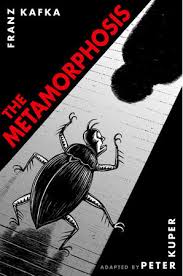
[READ: July 30, 2016] The Metamorphosis

I’ve been enjoying the art of Peter Kuper lately.  So I found a few of his older books, like this adaptation of The Metamorphosis, which is pretty great.

I don’t know if this is meant to be a complete telling of the story.  I’ve read it a few times, but I don’t know all of the details.

I liked that he clearly doesn’t include all of the dialogue or text–it’s not a comprehensive version of the story.  Rather, he uses a the art to move the story along.

The cockroach is drawn in Kuper’s very blocky, very robotic style–it’s cool and creepy.  But not bug-creepy just inhuman-creepy.

As the book opens, he flashes back to his life and job as a traveling salesman .  He hates the work–it is exhausting–and if his parents didn’t need the money he would have quit a long time ago.

But while he’s thinking all this he realized that he is late for work.  He tries to get up and that’s when the limitations of being a cockroach really hit him.

His supervisor comes to tell him that he is fired because of poor performance and when his family sees him, they are disgusted by him.

Only his sister Grete treats him kindly–bringing him scraps of foot (real food at first and then rotting food, since he is a bug). We learn that in the family only Grete and Gregor are close–their father is distant and cold.  The father is really annoyed at Gregor the bug still being in the house–how do they even know he is that creature or if he is even still “in” there.  He throws an apple at Gregor and it gets embedded in his back (ew).

Without Gregor’s income the family must take in lodgers, who are bossy and inconsiderate  Gregor wants them out but when they see him, they freak out and storm out without paying.

Can a story like this find any happiness at the end?  Well, sort of, in a very unexpected place.

Even though this is primarily a visual work, it really conveys the horrors of the original in a very clever way.

Read Full Post »

SOUNDTRACK: HEM-Tiny Desk Concert #306 (September 28, 2013).

Hem is one of All Songs Considered‘s earliest discoveries. Back in 2002, we received a beautiful and unique album called Rabbit Songs. It was a homey, fireside kind of record, with a sound that could be called country or Americana, and the arrangements by Dan Messé made it feel quaint and warm. To top it off, there was singer Sally Ellyson, an untrained natural talent with an effortless yet breathtaking voice. Hem has gone on to make five more albums since Rabbit Songs; their latest, Departure and Farewell, finds the group still writing songs that feel as if they’ve always been there.

Bob is quite right about the feel of this band, the drums are actually foot stomping and piano tapping, and that makes the band sound like they are siting around cozy room with friends.   And then there’s her voice.  There’s nothing specific about it that stands out, and yet it really does.  Her voice feels incredibly warm and welcoming, making you want to stop and listen.  And perhaps it’s something about the recording which makes everything feel soft (but not muddy) and warm.

And even in the songs themselves, it feels like friends hanging out.  During “Walking Past The Graveyard, Not Breathing” they say “go George” as the intro to the bass solo and then “go Heather” for the violin solo.   “Tourniquet” has some great lyrics, between the alliteration at the beginning and the great metaphor of the song, I was so taken with the lyrics that I didn’t even realize how pretty the melody was:

Brooklyn, I’m broken — I’m breaking apart
Oh Brooklyn, your bridges are bound up in light —
Every artery’s clogged as you pull the belt tight —
And this tourniquet turns even tighter until
Traffic comes to a standstill

When the song suddenly takes off near the end (but only briefly) it really elevates the song which was already delightful.  Introducing the final song, “Seven Angels” she says they are excited to be there, playing in this format.  She says the song can be seen as a lullaby–she likes to sing it for her sister.  She says she doesn’t write the songs but she can pretend this one is hers.

It’s hard to imagine this band playing a venue much larger than this one–they seems right at home in a small space.

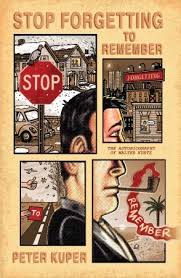
[READ: July 31, 2016] Stop Forgetting to Remember

This is a fascinating story about the comics artist Walter Kurtz.  I know very little about Peter Kuper, but I gather that this is sort of his life but written as an autobiography of somebody else.  (For instance, Kurtz was born on the same day as Kuper).

The back cover blurb also states how daring it was for Kurtz to write all of this –showing the embarrassing details, etc.: “My spouse would have killed me!”

This book is a collection of “stories” (not sure if they were ever published separately) that are joined by the narrative thread of Kurtz telling us about his life.  And the “occasion” for this reflection is the pending birth of his first child.  He is freaking out a bit–when he was young he never wanted kids, and then maybe he was cool with it, but recently he’s become terrified again.  He’s particularly afraid because he’s engaged with the world and he sees that as each month goes by, things get worse: AIDS, global warming, overpopulation, famine, wars (and that’s just 1996). (more…)

Read Full Post »


SOUNDTRACK
: BATHS-Tiny Desk Concert 300 (September 4, 2013).

I was unfamiliar with Baths and I am impressed by their busy-ness in this set.  There are only two guys playing, both play with various computer gadgets and then switch to keyboards and guitars.  They layer more and more music on this fairly dancey and very electronic sound.

Baths, a.k.a. Will Wiesenfeld, plays mysterious and textured electronic music. When Wiesenfeld came to the Tiny Desk, I expected contemplative tones and a laid-back performance; he does, after all, call his project Baths. But what sets him apart from the vast majority of like-minded performers is that his music doesn’t get buried behind the buttons or lost in a hypnotic glaze.

Wiesenfeld is an extrovert live, and at the Tiny Desk, he sounds vibrant and compelling as he performs songs from this year’s Obsidian. His partner Morgan Greenwood, an accomplished music-maker in his own right, keeps the music dense but frees up Wiesenfeld to sing with few distractions; there’s a mind-meld between the two that’s undeniable. They’re not accustomed to playing in the light of day, but they enchant in this perfect introduction to their work.

Wisenfeld’s vocals are a lot of wordless sounds (ba ba ba, na na na) that get looped and mixed around.  He sings in a rather high register, especially when making the looped sounds.

“Miasma Sky” builds with layers upon layers of sounds and vocals.  The sounds are manipulated in great ways with those little knobs and sliders. And just as you think it’s going to end with a series of delicate synth and guitar notes, he begins looping them which create the building blocks for the rest of the song.   It’s primarily keyboards and glitchy drums until the end.

“Phaedra” begins with some heavy drums and them playing around with all their gadgets.  This is a fast, pumping, dancing song.  Greenwood sings backing vocals in an equally high register.

“Ocean Death” has deep thumping drums and an opening with lots of na na nas and la la las in a textually rich soundscape.  It all fades down o just drums before building back up again.

[READ: July 9, 2016] Ruins

Seven years ago I read a book called Diario de Oaxaca, a sketchbook by Peter Kuper that I really enjoyed.  When I grabbed this book of the shelf the other day I didn’t realize it was the same guy.  But I can see that that sketchbook informed this excellent graphic novel.

The Diario covered his two-year stay in Oaxaca where he drew a lot, studied insects (and saw the monarch butterflies) and experienced both chaos and contentment.

This fictionalized account of the story places two characters into a situation that sounds similar to what he experienced, but with enough difference to keep it purely fictional. (more…)

Read Full Post »

SOUNDTRACK: STEVE GUNN-Tiny Desk Concert #299 (August 31, 2013).

Steve Gunn is a fascinating guitar player:

his work mostly stems from a bushy, overgrown definition of what we often call “Americana,” with a healthy understanding of the La Monte Young drone.

Grateful Dead and J.J. Cale certainly reside in the rubber-band bounce of “Old Strange,” a song that keeps the groove mellow, but will suddenly pop with water-drop elasticity. “The Lurker” comes from a much longer solo guitar version that originally sounded like one of Roy Harper’s acoustic epics, but with Gunn’s trio, it becomes a back-porch barn-burner.

For this concert, Gunn and his band play two 9-minutes songs.  They center around his guitar work which yes, has a drone, but the main focus are the Americana riffs that he plays with precision.

“Old Strange” opens with a lengthy guitar passage that shifts after 2 and a half minutes to a slow folky kind of style.  The song seems like it will be an instrumental but 3 and a half minutes in he begins singing. His voice is deep and he sings a kind of narrative story.  It’s quite mesmerizing.   “The Lurker” is a slower, more mellow jam.

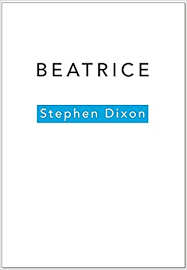
[READ: September 3, 2016]: Beatrice

I have read a couple of books from Dixon through McSweeney’s.  I didn’t know much about him then and I still don’t, but I recalled liking his stuff pretty well.  And this book was short so I thought I’d give it a look.

This book is told in a fascinating style–a kind of stream of consciousness in the mind of the main character, but through really close third person.

The book details the encounter of the main character Professor Philip Seidel (there’s a joke about this name, as Seidel means mug) and a woman named Beatrice.  Beatrice was a student of his some 25 years earlier.  She has stopped at his house to deliver some food in condolence for the recent passing of his wife.  She knows about this because she is now a professor where he taught her, although he had retired a few years back.

She brought some food and also wanted to tell him that he was her favorite teacher back then.  She had studied German and wasn’t allowed to take fiction courses until she completed her requirements.  She loved his teaching method and loved how encouraging he had always been.  She has clearly been keeping tabs on him–she has read some interviews he gave–and she definitely knows a lot about his life.

When she leaves he briefly wonders if maybe she’s interested in him now that the are older.  But he puts that out of his mind. (more…)

Read Full Post »

SOUNDTRACK: ALPINE-Tiny Desk Concert #295 (August 12, 2013).

I was unfamiliar with Alpine before this show, so the blurb helpfully notes:

The Australian sextet crafts busily impeccable pop music with a danceable sway, prominent synths and the charming shared lead vocals of Phoebe Baker and Lou James. That’s a lot of ingredients to strip down to a semi-acoustic set in the NPR Music offices; there’s virtually no margin for error.  Thankfully, the two women at the band’s heart possess gorgeously interlocking, harmony-intensive voices that require no sweeteners.

Each of the women is fascinating in her own way.  I can’t not mention that Lou James, the dark-haired singer’s outfit is light blue two piece with the top and bottom attached by crossing strands of fabric (so technically it’s a one piece).  While the blonde-haired singer, Phoebe Baker is wearing a flowery dress over a long-sleeved shirt.  Her hair looks like if she unclipped it, it would be a huge nimbus around her head.  But appearances aside, their voices work perfectly together.  They do a lot of singing one note in a pretty staccato fashion (almost like horns).  Their voices meld beautifully, whether singing in harmony or chorus.

I love the little fiddly, interesting guitar chords of the first song, “Gasoline.”  The song doesn’t deviate that much from the beginning—it’s bouncy and catchy–because all of the focus is on the two singers.  It’s really a fun song that I can’t stop listening to.

the second song, “Villages,” opens with a gentle acoustic guitar.  It’s interesting that Baker’s voice is noticeably accented in this song.  Like when she sings “Why don’t you come,” or in the really groovy middle part when James is singing, “I can’t believe I’ve seen this love,” Baker sings “Ah Oh” but you can actually hear her accent in these single notes.

They mention that they were walking around D.C. but it was way too hot.  They saw the White House and the Lincoln memorial.  The guitarist went to the Air and Space Museum (but he’s English) and the drummer is jealous.

I really like the way the third song, “Hands” opens with the vocals singing in an enchanting staccato, “It’s okay to feel the rain on my hand my love.”  And again once the verses start the vocals are very Björk-like

The final song, “Softsides,” is one they’ve never done acoustically before.  It’s also the first time their drummer has played keyboards live.  Once again the vocals are fascinating and really engaging, with each singer doing little pieces of the delicate vocal line.

[READ: July 19, 2016] Dan vs. Nature

I judged this book by its cover and title and deemed it worthy of a read.

I loved the idea of “vs. nature” and didn’t really have any sense of what the book would be a bout but the blurb “an outrageously funny and wicked raunchy romp in the woods” sounded promising.

So I was very surprised that the book began with Dan getting beaten up by jocks (the scene was funny if not a little violent) and then going home to have dinner with his mom and the man he is meeting for the first time–who his mom says just asked her to marry him.

The reason he is getting beaten up by jocks is because of his best friend Charlie.  They have been friends forever and Charlie is super smart.  He’s also a major germaphobe and has been reading everything science-related since he was little.  Charlie is also the school photographer and when he tries to get the jocks to pose for a picture he calls them uriniferous homunculi. They don’t know what that means, but Charlie explains it to them.  So Charlie and Dan both get beat up for it. The gym teacher hears the ruckus and comes out and tells them to save their fighting for the wrestling meet.  Ugh. (more…)

Read Full Post »

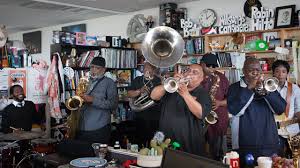
 SOUNDTRACK: DIRTY DOZEN BRASS BAND-Tiny Desk Concert #601 (February 28, 2017).

I have, of course, heard of the Dirty Dozen Brass Band. I’ve probably even heard them on a record or two that I own.  But I don’t really know much about them (in this Concert there are only 7 of them, I don’t know if they ever actually have a dozen members).

But nevermind, because man, do they swing.  And they swing with a big chunk of funk.

“Use Your Brain” is catchy as anything–with a great funk sound.   I love that the bass is all done by the sousaphone (Kirk Joseph).  I love the squeaky trumpet solo that gets played at the end of the song by Gregory Davis.  And I love everything in between.  A cool thing is that there is a guitar (played by Takeshi Shimmura) in the song which you can barely hear except during the moment when the horns are quiet and then you hear it do a great little funky chord riff.  It’s not prominent, but it is essential.

“Best of All” has a very different style (an almost Latin feel)–with Efrem Towns the “vocalist” doing r-r-r-r-r-r-r-r- vocal rolls.  I’m intrigued that for most of these songs the saxophone Kevin Harris (tenor sax) and Roger Lewis (baritone sax) play the main riff most of the time and the trumpets are often silent (until they totally take the song higher).  Like the great high note in the middle of the song.  The guitar is playing lots of little riffs that you can hear every one in a while–rounding out the song very nicely.  And the sousaphone makes some great rumbling sounds.  This song has a drum solo and I love that the drummer (Julian Addison)is placed up at the front of the band so you can really see him–his playing is fluid and that solo is funky and not showoffy.

“Tomorrow” has a funky bass–all coming from the sousaphone–and a real ska feel (especially as the guys sing the chorus “Tomorrow yeah yeah yeah yeah”).  There’s a great rollicking solo from the baritone sax.  Whenever Towns sings, he’s barely audible over the music of the horns–which is fine because hearing his voice is fun even if you can’t really hear what he’s saying.

For the final song, “My Feet Can’t Fail Me Now” Davis says:

This is the song where you all participate –you all been a little bit stiff, not moving.  (someone says , well it is NPR).  For this song we want you to participle. Don’t just stand there and clap like that, you know… move. Put your back into it.  Put your wiggle in the wiggle.  Drop it like it’s hot.  All that stuff you do behind closed doors do it now–well not all you do.

The song is super fun and dancey with a big chorus chant of “feet can’t fail me now, feet can’t fail me now.”  There’s some great horn and a cool wah wah guitar throughout the song.

The Dirty Dozen Brass Band show just how much diversity you can get with “just a brass band.”  This was a super fun concert.

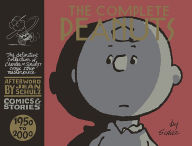
[READ: February 13, 2017] The Complete Peanuts Comics and Stories

This is the final book in the Complete Peanuts series from Fantagraphics.  It took 13 years–2 books a year–and here is the odds and ends collection to tie the series up.

There is an introduction by the editors of the series who explain just what this volume is:  The content has to be Peanuts, drawn by Schulz himself, and (when possible) with verification from Schulz’s widow, Jean.  Material that had not been seen before or was not in print in the twenty-first century got preferential treatment (no Happiness is a Warm Puppy, which is frequently reprinted).  So you’ll see dozens of strips not seen in any book and ones not printed in more than half a century. Six complete books are here– four story books, two volumes on life’s lessons.  Seven comic book stories, lots of single panel gags and lot of ads!

Then there is a Designer’s Note by Seth.  Seth has been behind all of these books (imagine dedicating 13 years of your life to something like this).  He says that he wanted these books to look and feel dignified and maybe even a bit sad.  He also wished to pay a personal tribute to Charles Schulz in his design.

He says that it was Schulz who first set him on the cartooning path.  He was the first artist Seth ever noticed: “Who is this magical person who signs his name in the last box of Peanuts?”  He never met the man and he’s not sorry about that–he has all he needs from the work itself.  He wants to think of this compete set as a monument to Schulz. (more…)

Read Full Post »

 SOUNDTRACK: MIRAMAR-Tiny Desk Concert #594 (January 27, 2017).

Miramar is from Richmond Virginia, but they play beautiful bolero music.

When the members of Richmond, Virginia’s Miramar first heard the music of Puerto Rican composer Sylvia Rexach, they were intrigued that she wasn’t as well-known as other popular bolero writers. So they came up with an album’s worth of her songs to cover, and have been wowing audiences across the country with their exquisite renditions of her songs.

When they pulled into NPR to play behind Bob Boilen’s desk, Miramar’s members made time stop with a performance that swept us off our feet, ably backed by friends of theirs from Richmond who played gorgeous string arrangements behind the band. So turn the lights down low, clear out the living-room carpet and find your dance partner for this one.

What is it about bolero music?

Some say you have to have loved and lost to appreciate the beauty of the bolero. Since its inception in Cuba in the early 20th century, the music has been designed for thoughtful and emotional consideration of the joys and pains that come with loving someone so intensely, it becomes like a religion to adore that special someone (an actual bolero lyric).

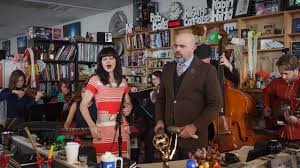
They play four songs: “Sin Ti” (without You) opens with some great Spanish guitar and shakers (which sound like water).  The song slowly builds and then the two singers come in.  Rei Alvaresz and Laura Ann Singh sing beautifully together.

The rest of the band includes: Marlysse Simmons Argandoña (piano, organ); Hector Barez (percussion); James Farmer (bass) and Sebastian Cruz (guitar).

“Estatua” (Statue) is faster and more upbeat.  The large string section is put to full use here. (With strings provided by Ellen Riccio (violin); Treesa Gild (violin); Kimberly Ryan (viola) and Schuyler Slack (cello)).  I love when she is singing “te creo” and he is singing low vocals underneath her.  The strings add wonderful drama to this mournful yet beautiful song.

“Urgancia” (Urgency) has some very cool organ sounds—very retro 60s swinging (almost soap opera)–sound.  But in addition there’s beautiful guitar and their great vocals as well.   The first three songs were all originals

“Tus Pasos”  (Your Footsteps) is by Sylvia Rexach–the inspiration for everything they’ve done.  It is a sweet, romantic, old-fashioned sounding love song.

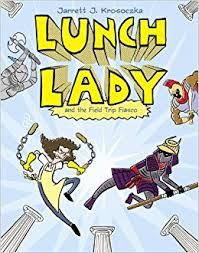
[READ: July 6, 2016] Lunch Lady and the Field Trip Fiasco

I’ve been really enjoying the way the events of the previous books lead to the follow-up.  So you actually should read these in order, which is more fun anyway.

Our opener shows masked men robbing a grocery store–Lunch Lady is able to stop them with fizzy soda.

But the plot of this book is the field trip that was foreshadowed in the previous one.  The Breakfast Bunch is excited to go, except that Hector forgot to get his permission slip signed.  So Dee (who is increasingly more sarcastic as the books go on) forges the signature–who will know?

Lunch Lady and Betty are bored because everyone is going to the field trip–there’s no lunch today.  But when Mrs Palonski learns that her chaperone can’t come she reluctantly agrees to let Lunch Lady come along.  (Betty tells her to go and have fun even though she sighs when she’s left all alone).  Of course Mrs Paloski is worried that Lunch Lady never stops talking (which proves to be an ironic worry). (more…)

Read Full Post »

SOUNDTRACK: BADBADNOTGOOD-Tiny Desk Concert #593 (January 23, 2017).

I’m amused at how kinda dorky all of these guys look–except for the drummer who looks “cool.”  Why is that amusing?  Because of this blurb:

BADBADNOTGOOD made a name for itself by reworking songs from the likes of Nas and Ol’ Dirty Bastard, eventually catching the attention of Odd Future leader Tyler, the Creator. The masses took notice in 2015 when the group produced an entire LP for Ghostface Killah, Sour Soul. BADBADNOTGOOD has been called a hip-hop ensemble, but its foundation is clearly jazz, which provides a gateway to countless genres. On IV, the group allows that gateway to widen, adding soul and funk to the repertoire.

And they are all only in their 20s!

They play three songs from IV.  This first “And That, Too.” is a very jazzy song.  I love the complex piano melody that’s getting thrown around–syncopation and almost chaos, but always staying true to the great rhythm laid down by the bass and gentle drums.  I also happen to love the flute solo that rides over the top of everything–it provides a great 19070s jazz vibe.  The flute switch es to alt sax, and instrument that I think is kinda cheesy–I’d have rather it stayed with flute.  But his solo is pretty great–meandering and intense.

Introducing “In Your Eyes” the drummer says that he was fortunate enough to go to high school with a sax player who he didn’t know would have a voice that would blow him away … “later in my life” (ha).  Charlotte Day Wilson’s voice is deep and sultry although I don’t particularly like it–it feels too forced or something?  But she does sound much older than she looks.  Which is shame because I think the music of the song is pretty great.  The flutist has switched to guitar for this song (that’s a talented dude).

Before introducing the final song the drummer says “My 2017 is feeling pretty good so let’s keep it going.”  The fact that this was recorded sometime around the inauguration trump feels incredibly tone deaf.  But whatever.  “Cashmere” (“which only slightly veered from the studio version”) is a ten-minute song that opens with a very cool high bass note section and lots of piano.  The guitarist switches to yet another sax (four instruments in three songs).   The middle of the song is just the bass notes and a  lengthy piano solo.  i also like how the song seems to be over but that bass line picks up one more time.

I was surprisingly delighted with this Tony Desk Concert.

[READ: July 4, 2016] Lunch Lady and the Bake Sale Bandit

As Book 5 opens, Lunch Lady foils some safe robbers (in a very funny way).  I really enjoy how every book starts out with an intro comic showing off Lunch Lady’s mad skills.

Then it switches over to a school bus.  The Breakfast Bunch is trying to get on board–they don’t usually ride the bus–but the driver, Brenda, is pretty awful. To them and to everyone.  She drives like a maniac and yells at everyone.  She’s nice to the principal bit once he tells her his news, she can’t even pretend to be nice to him.

The news is that there is going to be a bake sale.  And if it goes well, the students will get a field trip and… Brenda will be the bus driver!

Gah! “How she despises children.” (more…)

Read Full Post »

SOUNDTRACK: DEREK GRIPPER-Tiny Desk Concert #587 (December 16, 2016).

There are so many amazing musicians in the world that it’s impossible to have heard of all of them.  So it’s no surprise I haven’t heard of Derek Gripper, but at the same time, he is so mesmerizing I’m surprised that I haven’t heard of him before.

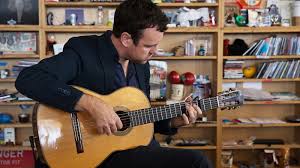
The 38-year-old started on violin at age 6, then wound up with one of the few classical-guitar professors in his native South Africa. But touring the world playing the music of the great dead white men was not all that appealing (though Gripper still loves to play Bach). Then he heard a record by the Malian kora player Toumani Diabate. He decided that that’s what he wanted to do: not play the kora itself, but play kora music on the guitar.

Of course, the kora has 21 strings, each tuned to a fixed note. The nylon-stringed guitar Gripper plays has six. But by using unusual tunings and fretting the strings up and down the neck with his left hand, he can pretty much hit all of the kora’s notes.

The remarkable thing is, he figured all of this out — and recorded two acclaimed albums — just by listening to CDs and checking out music online. Gripper painstakingly transcribed what he heard onto a kind of notation called tablature — similar to the music written for the Renaissance vihuela, which was also an inspiration. Earlier this year, Gripper finally made it to Mali, where his efforts received the blessing of Toumani Diabate himself; the two even jammed together.

That’s an amazing story but it’s nothing compared to the quality of his music.  It really does sound like he’s playing, if not the kora exactly, then certainly an instrument with more than 6 strings.

He plays four songs, three are traditional pieces which he has arranged for guitar and the fourth is an original piece.

Hearing the opening notes of “Tuth Jara” (Trad. Arr. Derek Gripper) and you know that you’re not listening to a typical guitar–the trills and runs sound so West African.   And once you get past the mesmerizing nature of his fingers. The melody is really pretty too.

“Joni” is an original piece about a love affair with a singer–the way he tells the story is delightful.  I love that part of the song is him actually down tuning one of the strings for a bit and then tuning it back up (all while playing everything else).  I also really like that he makes relatively quiet humming/singing noises while he’s playing.

He says he was inspired by Diabate who turned the kora into a solo instrument–which is much easier than traveling with a  band.  And then he illustrates how he plays kora music on his guitar–a bassline, the accompaniment and the melody–all on the guitar all by himself.  That’s his introduction to “Jarabi” (Trad. Arr. Derek Gripper).  And during the incredible playing out comes a beautiful, catchy and fun melody line.  All too soon, it’s over.

But since he has some time, they encourage him to play one more–“they’d be happier!” if he did.  So he ends with “Duga” (Trad. Arr. Derek Gripper) which he describes as a conversation between ngoni and kora.  The kora wins because he knows more about kora.   And like so many of his pieces, it is over way too soon.

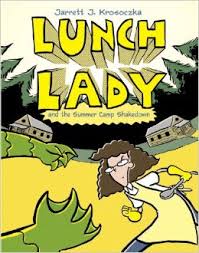
[READ: June 13, 2016] Lunch Lady and the Summer Camp Shakedown

As Book 4 opens, Lunch Lady is seen in a two-page spread wielding her fish-stick-nunchucks.

Then we see that everyone is heading off to summer camp.   The kids have been looking forward to summer camp since they were little and they are finally old enough. Sadly Milmoe the bully will be there too.

And, unbeknownst to Lunch Lady and Betty, they are working at the same camps as the kids.  Lunch Lady has worked there before and she knows everyone, she gives us the lowdown on the counselors like Scotty who has always been the most popular and Ben, the new guy, who is pretty foxy himself.

The counselors are super excited when the kids show up, although Dee is a little blasé about it.  And then they run into Lunch Lady. (more…)

Read Full Post »

« Newer Posts - Older Posts »