Feeds:
Posts
Comments

Archive for the ‘Field Recordings’ Category

SOUNDTRACK: APANHADOR SÓ-“Prédio” (Field Recordings, May 13, 2015).

Apanhador Só  is from Brazil.  At the beginning of the video you see the guys in the band gathering…junk.   Childen’s toys boxes of refuse and homemade instruments.

The video starts and the singer explains that Prédio means building.  He says the song is about a different vision of life, a different perspective.  As it pans back we see that the only conventional instruments are a floor tom and a guitar.  And all kinds of weird other things.

In this video, shot during SXSW in Austin (2015), its members coax rhythms and beats from a trunkload of found items, including a children’s bicycle and other playthings. The resulting performance of “Prédio” is the stuff of hip-swaying joy.

The song starts with one of them tapping a bicycle bell.  Soon he starts keeping time by spinning the wheel and clacking the spokes.  Then he switches to a jug of some kind that changes the sound as he uncovers the opening.

There’s even a kazoo solo.

Near the end of the song, there’s wonderful breakdown where you can see then hitting and kicking everything at their feet-all kinds of junk that makes a cool cacophony.  The song is really catchy and lovely, although I admit I was more focused on what they were playing more than what they were playing.  (The items rather than the melody).

[READ: January 4, 2017] “Invasion of the Martians”

This was the funniest , most enjoyable thing I’ve ever read by Robert Coover.  Probably because it is so base and straightforward, it transcended some of his usual stylistic things.

A Senator from Texas is in bed with two women–the Secretary of the Interior (whom he calls the Secretary of the Posterior) and his intern–when he gets the news that Martians have landed in his home state.

He greets them warmly with Southern hospitality, but they don’t seem to speak any civilized languages.  They also don’t have any papers.  As the Senator was explaining this to them, they shot him. (more…)

Read Full Post »

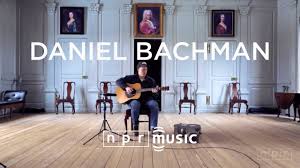
 SOUNDTRACK: DANIEL BACHMAN-“Song for the Setting Sun II” (Field Recordings, May 21, 2015).

Daniel Bachman plays a gorgeous six string acoustic guitar.  He plays wonderful instrumentals full of melody and feeling which tell a story in their own way.

Bachman grew up around the Rappahannock River in Fredericksburg. It’s a quiet town in Northern Virginia that still has a pharmacy with cheap sandwiches and milkshakes.

The 25-year-old has been at the solo-guitar game since he was a teenager.  That’s why it felt right to bring Bachman back to the area that inspired River, a record surrounded by history, but guided by hands and a heart that know its bends and bumps.

In early March, we met Bachman in Fredericksburg to drive an hour east to Stratford Hall, home to four generations of the Lee family, which includes two signers of the Declaration of Independence; it’s also the birthplace of Robert E. Lee. Bachman knows it well, not only because his dad works there, but also because he can’t help but bury himself in history books about the region.   Bachman plays a version of “Song For The Setting Sun II” in what was the performance space at Stratford Hall. The song leaps boldly around the sunlit, symmetrical room, bouncing off walls decorated with paintings of buxom women and men in powdered wigs.

It’s a gorgeous piece with ringing strings that sounds massive in this Great Hall.  In the second half, he strikes a low E and it sounds like a cannon.  And when you hear that melody amid all of the ringing notes, it’s just sublime.

[READ: January 29, 2015] “F.A.Q.s”

Phoebe is in her mid 20s.  She returns from college withdrawn and single. Her parents are delighted that she is single, but not happy that she is so withdrawn.

Phoebe is also pretty unhappy with the changes that have occurred since she was at school.

A new coffeemaker was where the compost bucket had been.  The chicken coop lay empty (they had reverted so quickly to supermarket eggs).  An exercise machine was in her old room–however after several minutes of exercise Melanie usually ended up lying on Phoebe’s bed.  Her mom tells her that she bought rice milk and oat cakes   Later on she even tries to make her parents granola (her father was supposed to watch his cholesterol but didn’t and her mother nibbled Icelandic chocolate),

One of the few things that remained was Grandma Jeanne’s violin on the top shelf of her closet.  It was unmentioned. (more…)

Read Full Post »

july 28SOUNDTRACKJazz Lives At Duke Ellington’s Resting Place (Field Recordings July 2, 2015).

Playing jazz at a cemetery during the day seems like an odd decision.  But it’s all part of the one-day Make Music New York festival (MMNY) which celebrates music and community.  It happens every June 21 with more than 1200 outdoor concerts across the five boroughs running from morning till night.

For the 2015 edition, the festival’s organizers invited musicians to six different burial grounds across the city to riff on the idea of “exquisite corpse,” a surrealist parlor game popularized by artists and poets in the 1920s. In the game, someone writes a phrase (or draws part of a figure or scene), folds that part of the page over, and then passes it to the next player, who then does the same. The game ends when everyone has had a turn. That game is a natural bridge to the art of improvisation, and to jazz.

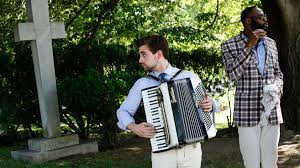
Woodlawn Cemetery is a mecca for the jazz world — it’s the final resting ground of royalty like Duke Ellington, Miles Davis and many others, including Ornette Coleman now as well. So as a tribute to their musical forerunners, the group — singers Michael Mwenso and Vuyo Sotashe, trumpeters Alphonso Horne and Bruce Harris, saxophonist Tivon Pennicott, pianist Chris Pattishall, bassist Russell Hall, drummer Evan Sherman and tap dancer Michela Marino Lerman — took as their point of departure W.C. Handy’s 1914 tune “St. Louis Blues,” a tune essential to jazz’s DNA. But they made it their own via surprising and turns that saunter through many textures, colors and rhythms.

The song begins with vocals from “St. Louise Blues” from Vuyo Sotashe and accordion from Chris Pattishall.  After a verse, Michael Mwenso (whose voice sounds very different) takes over.  The accordion drops out and it’s just voice and bass.

They pass the baton along to the horns, two trumpets, one with a mute in, the other using the mute  and a saxophone play a lively instrumental break.  This is followed by the percussion.  Evan Sherman and Michaela Marino have a percussive call and response.  I could have watched that part for a lot longer.

When that’s over the whole group joins together to end the song.

[READ: September 10, 2018] “Audition”

The first line of this story reads, “The first time I smoked crack cocaine was the spring I worked construction for my father on his new subdivision in Moonlight Heights.”

A first implies a second (especially with crack).

The story is about a 19-year-old college dropout. He went to school to study theater but “unmatriculated” and has been working for his father’s construction firm.  His father came from nothing and build up this firm which is presently creating a development.  His father is not too happy about him wanting to be an actor and as such is paying him the same as everyone else (which isn’t much).

He still acts–in community theater, but usually to 15 people at a time.

No one knew that he was the owners son and he liked it that way–he was using this time to study the laborers to learns their mannerisms–he was acting in his job, too,   New workers came through all the time (the pay was lousy after all).

The crack came from a coworker Duncan Dioguardi who was not acting.  He was a laborer living in his mother’s basement and longing to party.

The narrator knew “party” meant get high. When Duncan’s car died and the narrator drove Duncan home (an hour out of his way), Duncan invited him to party. The narrator was intimidated, then intrigued so he did.  And that was the first time he smoked crack.

He marveled how the lump of crack looked like some drywall that could easily be swept away.  Duncan showed him how to smoke it.  It tasted like nothing.  It smelled like nothing.  It was ant climatic except for his new-found fondness for Duncan whom he now considers a good friend.

That following spring he received a call from his old acting teacher to audition for a role  It was a stage show. The character would be on stage for all three acts but would not speak a word.  The narrator didn’t know if this was a step forward or backward.  The audition went well and he was sure he would get the gig.

Duncan’s car broke down again and the narrator told him all about the potential role.  But the narrator was more excited about the option of partying some more.

The story ends soon after this, which is a little disappointing as it is told from many years later and we never learn how he turned out.  But i did like the details of the past like “wiring th ehouse for internet, whatever that was.”

For ease of searching, I include: Said Sayrafiezadeh

Read Full Post »


SOUNDTRACK: THE DJANGO FESTIVAL ALL-STARS-“Them There Eyes” (Field Recordings, October 23, 2014).

This Field Recording was done under what looks like an old bridge outside of the Newport Jazz Festival.

Every year for the last decade and a half, select groups of hot swing musicians have come from Europe to tour the U.S. The exact lineups change, but they all feature masters of the “gypsy jazz” — or jazz manouche — style pioneered by guitarist Django Reinhardt. In fact, they’re billed under the banner of New York’s Django Reinhardt Festival.

After the last set of the Festival, done by the All-Stars, they asked the band, who had little time to spare, to play one last song.  Soon fingers were flying [The Fastest Fingers At The Festival, For Django Reinhardt]  The video there doesn’t work, but you can watch it on YouTube.

They chose the standard “Them There Eyes,” and to paraphrase its lyrics: They sparkled, they bubbled, and they got up to a whole lot of trouble.

Samson Schmitt, plays an amazing lead guitar–his soloing is blinding. The rhythm guitar from DouDou Cuillerier keeps up a great shuffle and Brian Torff on bass keeps the pace as everyone else gets a chance to solo wildly.

First up is Ludovic Beier, accordion and as a bystander observed: “He has the fastest fingers I’ve ever seen.”  And he does, it’s amazing.  His solo is followed by Pierre Blanchard, violin.  And Peter hits notes that seem like they might not actually exist on the violin.

There’s no vocals in the version which is just as well. No one would be able to keep up.

[READ: January 28, 2018] “Little Deaths”

Félix Fénéon was born in 1861.  In 1906 he wrote 1,220 brief items under the rubric “News in Three Lives” for the Paris newspaper Le Matin.  They were collected in a book and translated by Luc Sante

Seeing that these were written over time makes a lot more sense than having them all printed in a book–I mean, 1,220 deaths would be a lot to do all at once.  It’s still hard to believe that these would be printed in a newspaper at all.

Some examples in their entirety: (more…)

Read Full Post »

SOUNDTRACK: MAC DEMARCO-“No Other Heart” (Field Recordings, August 10, 2015).

Mac Demarco is pretty famous now and seems to be pretty much everywhere.  And yet I actually don;t think I’d ever heard him before this recording.

I’m not even sure if it is in any way representative of his music.  But I love that you can hear the waves lapping.

For this song, Demarco says he bought a boat for his birthday.  It’s a small rowboat, which he rowed out into a bay in Queens “Take A Sunset Cruise With Mac DeMarco”) and began playing his song on a little keyboard. The music has an intentional weird vibrato on it but the recording sound is quite magnificent.

For the charismatic 26-year-old songwriter who grew up in the landlocked plains of Canada, the water still holds an exotic appeal. Plus, the area’s laid-back feel is a perfect match for his laconic delivery and perpetually chill personality.

He sounds a little goofy singing it–presumably intentionally–given the other clips of him goofing off on his boat.

DeMarco moved to this house [by the bay in Far Rockaway, Queens] last fall, after touring behind last year’s excellent Salad Days — just in time for the long, bleak East Coast winter — with the intention of playing his instruments loud and writing new music in isolation [the wistful, melodic mini-album Another One].  A shaggy and surfy collection of love songs, it’s suited for a lazy summer backyard barbecue or taking your second-hand rowboat out for a dusk cruise.

As the show ends, he goofs around singing “Don’t Rock the Boat” as the camerawoman walks up to him in waist deep water.

Behind him, sun-dappled waves are chopped up by freighter boats and the occasional jet ski passing by. Across the water sits JFK airport, with its distant engine hum of planes taking off and landing at a steady, rhythmic clip. The crisp, salty sea breeze mingles with wafts of stagnant water, decaying debris and dead horseshoe crabs that wash ashore.

[READ: June 2, 2018] Cleopatra in Space Book Four

T. brought this book home and I couldn’t believe that book four was out already (had it really been a year?).

This book opens with a reflection on the previous book and Octavian yelling at his soldier cat for not killing the girl.  He is provided with a bounty hunter–a dog-headed man who will stop at nothing to make sure that the Golden Lion is destroyed.

Octavian is shocked.   If they possessed the Golden Lion, they could firmly defeat P.Y.R.A.M.I.D.

Back at P.Y.R.A.M.I.D. at Yasiro Academy, we see Cleo doing battle against a whole bunch of robots in a simulator  Akira comes to take her to class but before they can go they are summoned before he Council.  When they arrive in front of the cat Council, Akira’s parents are there (they call her KiKi much to her annoyance).  They are happy to see her and very happy to meet Cleopatra for they have been studying her life and the prophecy for years. (more…)

Read Full Post »

SOUNDTRACK: THE McCRARY SISTERS AND THE FAIRFIELD FOUR-“Rock My Soul” (Field Recordings, September 20, 2015).

Hearing these eight voices intertwine so beautifully is wonderful (I especially love the bass voice).  Knowing how the voices are connected is pretty cool, too.

The original Fairfield Four was founded nearly 95 years ago in Nashville, and has remained relevant into the present day; many current listeners know the group from its appearance in the Coen Brothers’ 2000 film O, Brother, Where Art Thou? The McCrary Sisters are the daughters of the now-deceased longtime Fairfield Four lead voice, Samuel McCrary; together, they’ve made a major impact as that rare thing in a mostly masculine preserve, a female gospel quartet. To hear these voices perform “Rock My Soul” together is to feel the power of living history and the timelessness of family connection.

“Rock My Soul,” powered by their persistent clapping is just wonderful.  Their voices sound amazing, their harmonies are wonderful. It’s a joyful three minutes.

[READ: August 29, 2018] “The Wind Cave”

This is a somber story from Murakami.

It concerns a boy and the death of his younger sister when she was 12.  She was born with a malfunctioning heart valve and although she was never robust, it was still a surprise that she died so young.

His parents told him to watch over her, to look after her because she was so delicate.  The fact hat he couldn’t save her from death (no one could) has hung over him.

He hated seeing her in the coffin and he grew claustrophobic even thinking about her in that tiny box.  The symptoms didn’t start right away but occurred after he had been locked in a box truck.  He was working a part time job and was accidentally locked into the back of the truck when people wanted to leave early.  (Frankly I would think that might trigger claustrophobia more than anything having to do with his sister).

But now he can no longer ride in elevators or watch movies about submarines. (more…)

Read Full Post »

SOUNDTRACK: JESSE BOYKINS III-“4 U 2 B Free” (Field Recordings, October 8, 2014).
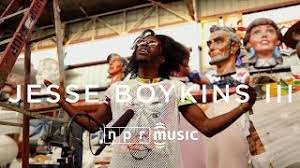
This Field Recording [Jesse Boykins III Breaks It Down] starts with a lot of ambient noise–a giant overhead fan–which I thought might be an interesting component to the song.  But once Boykins starts singing, it’s just his voice. And that’s all–it’s a lovely a capella performance.

The day after playing a set at the Superdome during the Essence Music Festival this summer, eclectic R&B singer Jesse Boykins III wandered into Mardi Gras World — an expansive, airy warehouse packed wall to wall with floats used in New Orleans’ infamous parades. The floats are built from the ground up in-house, so Boykins found himself surrounded by unfinished works and spare parts.

It’s creepy and unsettling to see these giant heads–eyeballs at eyeball height, but just a head–staring at you.  It’s also surreal with the various colors and shapes and the head of Abraham Lincoln looking on as Jesse sings.

He sang one of the most emotional tracks from his latest album a cappella. While singing “4 U 2 B Free,” Boykins pulled back the layers of his own creation, matching his performance to the exposed, oddly vulnerable characters surrounding him.

But Boykins’ performance is really powerful especially at the end as his wonderful high notes as if no no one is watching.

[READ: October 4, 2017] “Enter the Ford: Lost Chapters from A Death in the Family”

I knew nothing about this book, so I had to look it up.

The first chapter sees a young by, Rufus, waking up wearily with his dad.  The boy is very excited and the father seems pretty delighted to be awake with his son so early.  They try their best not to wake the baby girl or the mom.  Of course the mom wakes up and asks for the dad to do some things before he leaves.  The dad makes breakfast–with stern admonitions to the boy not get burnt by the coffee pot, bacon or stove–and then he helps the boy with the difficult buttons.

We don’t know too much about the dad yet, but this exchange is interesting:

“You’re getting pretty good, buttoning yourself.” he said.  Rufus said nothing.
His father thought damn fool thing to tell a child; dumb as a fish.

In the second chapter they head out to Chilhowee Park and the entire chapter is given over to the most exquisite descriptions of this amusement park through the eyes of Rufus.  Everything is amazing and wonderful and the language is of a person taking everything in–from the color of the lake to the swans on the water to the roller coaster and the fairy’s wheel.

And then came the merry-go-round.  We learn how first Rufus rode only on the bench.  And then was allowed to ride the horses that did not go up and down.  And then on the up and down horses only if his dad was holding on.  And finally, today, to ride the up and down one by himself.  The amount of detail about the merry-go round is wonderful.

The only thing more wonderful than the merry-go-round was the little train.  We hear his father’s kind words about how amazing the train is.

Then things go sour a little because there’s also the arcades–where adults play games of chance.  There’s games that one never won–like the seventeen jewel watch.  But the worst was a place where there was “a darky with his head through a hole.”  And the people were meant to, as the carny said, “hit the nigger in the head and you get a cigar.”

Rufus’ mom hated this game.  And Jay wasn’t too keen on it either.  The one time they were there, Jay conceded that the man’s got to make money some way.  Jay tried to ease his wife’s concerns by showing her that the ball wasn’t that hard.  He lifted it up but she refused to even touch it.  The carny got mad at him for touching the ball. And Jay got huffy back.  She calmed him and he walked away.

But on this visit, he did not back down. the carny did. And that made Jay’s day even better.

Chapter 3

This chapter opens with Jay and his wife, Laura, talking about something extravagant.  She wants it, he doesn’t seem to want it and he seems to twist her words against her.

It comes out that he wants to get a car so that they can visit the in-laws once in a while.  She is nervous that cars are dangerous.  He admits they are but sometimes living in a house is dangerous.  But he says that having a wife and kids means he will be even more careful than everyone else out there who has nothing to be careful about.

She agrees to the car.  But in the middle of the night she has a premonition of something bad happening to the family in the car.  He says that they won’t get one.  Then later she gets over the premonition and agrees that they should go ahead and get one.

Chapter Four.

And then daddy drove home in a gas buggy–a new ford  Rufus is thrilled.  Laura can’t believe he drove it there all by himself.  And the neighbors all come out to gawk.

“Course they got an awful name for breaking down… But where Ford’s ahead, he supplies you the parts.”

They go for a before-dinner ride.  Jay drives very well and everyone is enjoying themselves.  Laura is nervous and says so, but he is careful and considerate of them.  He pulls over when another car comes by and he is very cautious around a horse and buggy–the horse is not spooked at all.  But their joy ridge is somewhat ruined by a speed demon who comes buzzing by them scaring them all half to death.

As the excerpt ends, Jay and Rufus take the car out for a spin and Jay really lets the speed fly.  They almost have an accident but Jay is able to handle it and he confides in the boy that they must never tell their mom that they went fast.  He agrees.

I don’t actually know much else about this story.  Between the title and what kind of tension a scene like this builds I expected something bad to happen.  It never did (hooray), but i assume it does),

The writing in this story was exceptional.

Read Full Post »

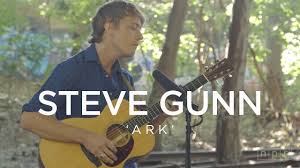
SOUNDTRACK: STEVE GUNN-Plays Between the Ties of an Abandoned Railroad (Field Recordings, October 12, 2016).

I don’t know Steve Gunn and I am surprised to see that he has released fourteen albums and has worked with Kurt Vile.

For this Field Recording, Gunn headed out to the woods to play three beautiful songs.

 In Forest Park, Queens, N.Y., an old relic suits Gunn’s sound. The Long Island Railroad’s Rockaway Beach Branch used to run through the park. It’s been abandoned for over a half-century, and trees have grown between the ties, skewing the rails and jarring the lines. Late this past summer, Gunn stood on the tracks of this worn American symbol and sang three songs off his latest album — songs about meandering, home and the crooked paths that take us wherever we’re meant to be.

Once again I am really impressed by the quality of the sound.  His guitar is absolutely clear and his voice is perfectly mic’d, but you can also hear ambient sounds–birds and such–making this recording unique.

Gunn has a pretty picking style (using thumb and fingers independently to get strums and picked notes simultaneously).  This enables him to keep the song moving forward while he plays the pretty guitar melodies.

“Full Moon Tide” has a great melody and a delightful chorus.

He walks further into the woods to play “Night Wander.”  It has a kind of circular feel in which the chorus feels like a part of the verse.  I’d say that Gunn’s voice is nothing special, but I like the deeper resonances he gets on this song.

For the final song, “Ark” he walks further down the tracks to a bridge.  Whether it is having the surface above him or just the style of his playing, this song feels warmer, and quite different from the others.

It’s a great introduction to this excellent guitarist.

[READ: January 9, 2017] “The Apartment”

This story is a fascinating look at a woman convincing herself that something must be true.

The apartment across from hers has been vacant for sometime–since the woman living there died.  But recently there was movement inside.  The person’s last name was Jahani.

Louise knew a man named Jahani when she was studying at Stockholm University.  Arman Jahani was the second man she’d slept with (her husband Martin was the first).  Martin, did not know about Arman.

While she is having lunch (sushi) with her adult son Jonas, she intersperses his conversation with memories of Arman.  The two most resonating thoughts are that he died in the early nineties and was survived by a son and a daughter.  Or so she believed.

She tells Jonas that the vacant apartment has been filled.  Jonas hasn’t lived at home for quite some time.  He wasn’t there when the woman died.  “You can;t imagine the smell” she tells him.  It was actually her husband who discovered her and was shocked that no one has mentioned the smell. (more…)

Read Full Post »

SOUNDTRACK: LAWRENCE BROWNLEE AND JASON MORAN-“There’s A Man Going ‘Round Taking Names” (Field Recordings, February 17, 2016). 

I know of Brownlee from a Tiny Desk Concert.  But this is a whole other order of magnitude.  He and pianist Jason Moran are playing a spiritual about death in an active crypt.

Brownlee’s voice is powerful and soaring, but full of anguish.  And Moran’s piano is so intense, especially at the end.  He plays the melody but he allows for a lot of overtones and echo to nearly overpower the music.

At the very end, he plays some high notes by literally chopping at the keys like a karate chop–powerful, sharp and dissonant.

Here’s the blurb for more context:

Opera singer Lawrence Brownlee is known for portraying kings and princes. But lately he’s been thinking about real people: Trayvon Martin, Michael Brown and Freddie Gray, to name a few.

He’s been thinking about the Black Lives Matter movement and an old spiritual called “There’s a Man Going ‘Round Taking Names.” Decades ago, singers like Paul Robeson and Lead Belly recorded it. Brownlee, with jazz pianist Jason Moran, revives the old song to tell a new story for the 21st century.

“Jason and I chose this song because we felt it accurately captures a growing sentiment that’s in society today,” Brownlee says. “So many senseless deaths of young African-American men.”

A crypt, they thought, would be an appropriate setting to perform their version of the song. So we took our cameras and microphones — and a lovely piano — deep into the active crypt below the historic Church of the Intercession in Harlem. The 1915 structure at 155th Street and Broadway is a New York City landmark and a dramatic setting for occasional concerts, including a December 2015 recital by Brownlee.

“I know that the ashes of the parishioners of this church are here in this crypt,” Brownlee explains. “You can feel the weight of death, you can feel the sting. It adequately captures the atmosphere, the somber mood that we are trying to capture with this song.”

In this arrangement, an already solemn song becomes even more dark and agitated.

“What [Jason] has done with the piano part has made it build, and you feel the unrest, the turmoil, the tension that is underneath,” Brownlee says. “This is something that is painful and difficult to deal with.”

Woah.

[READ: January 31, 2018] “Self-Portrait with Beach”

This is the story of an older couple who have been together for a while.

They go to the beach, she removes her top and asks “Is the body the house for the soul or are body and soul and one and inseparable.?”  He looks at her and says, “Your body is my soul.”

She laughs that his soul is bound for decay but he continues, ‘Nothing of you will decay as long as I am alive.”

Out of nowhere a man in white comes and offers his homemade beverages.  He says they have unique powers. (more…)

Read Full Post »

SOUNDTRACK: DUA LIPA-“Thinking ‘Bout You” (Field Recordings, August 31, 2016). 

The title “Field Recordings” seems to be a catchall for videos that they’re not really sure what to do with.  This video clip is from a show called Noteworthy (which ran all of ten episodes from July 2016-September 2016).

Dua does sing from the balcony [Watch Dua Lipa Perform ‘Thinking Bout You’ On A Balcony In New York City] and the sound is pretty great (I like that you can hear sirens at one point).   But the video is apparently clips from the documentary because there’s scenes of her walking around the city.

A day after performing “Hotter Than Hell” on The Tonight Show, rising pop star Dua Lipa performed another one of her songs, “Thinking Bout You,” for a much smaller audience: our Noteworthy video crew. Enjoy this extra from our Noteworthy documentary on Dua Lipa and be sure to watch the entire documentary here.

I can’t imagine why this particular singer whom I have never heard of in any other place has a documentary made about her.

Her voice is fine, a rough edged pop singer. And the song is pleasant enough.

[READ: January 31, 2018] “The Revisionist”

This is an excerpt from Mellis’ novel The Revisionist. And boy what a gloomy depressing book this sounds like.

The narrator’s last assignment was to conduct surveillance of the weather and report that everything was fine.  She was set up outside of the city in a lighthouse. She was tempted to take her own observations, so she did.

Now how about this for a paragraph

I saw a family driving to the country on vacation. Behind them, a bomb went off. Through my headphones, I noted the rushing sound of radiation cruising low across the land. The father, who was driving, saw the mushroom cloud in his rearview mirror. The others didn’t turn around, so they never noticed.

What? (more…)

Read Full Post »

« Newer Posts - Older Posts »