Feeds:
Posts
Comments

Archive for the ‘Nostalgia’ Category

6616 SOUNDTRACK: GLEN HANSARD-Tiny Desk Concert #225  (June 17, 2012).

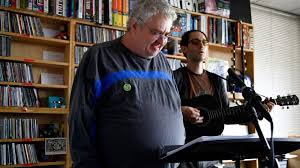
glenWhat can I say about Glen Hansard that I haven’t said already—he’s a powerful singer and a great storyteller.  This is his second appearance on Tiny Desk (although his first solo) and his fourth or fifth concert on NPR.

With The Swell Season, they played for 34 minutes (a Tiny Desk Record).  And this Concert is no shortie either at nearly 22 minutes.

He’s playing songs from his solo album (on that same beat up guitar).   Although he is distinctly himself, without the band(s), he sounds a bit like Cat Stevens and sometimes like Van Morrison (and he looks like Gordon Lightfoot).

He sings rather quietly and then impressively loudly–powerful and passionate.  He is clearly into what he does.

“Love Don’t Leave Me Waiting” is rocking folk song (he throws a coda of RESPECT at the end) in which he really belts out a few parts.  He’s got a delightful “La la la” middle section, and the overall melody is great.

“Bird of Sorrow” is  much more mellow song.  It builds through some verses and allows him to belt out a few lines near the end.

“Come Way to the Water” has him on a 4 string tenor guitar.  Although it is quite clearly a Glen Hansard song, the guitar is much more timid sounding compared to his voice.  And it really does give the song a very different (darker) feeling.  In fact when it’s over, he says, “that was kind of depressing wasn’t it?”

“Lucia” is a “song he hasn’t finished yet” but he’s going to play it because “it’s a little bit happier.”  Although the lyrics are “Lucia, you’re letting me down again / Lucia, your heart’s not in it babe…. And if your heart’s not in it, then your heart’s not in it, babe.”  Not exactly a happy song.  But very pretty.

“The Song of Good Hope” is slower with no big powerful singing, but it’s really heartfelt and intense.

And as always, he is unfailingly polite and thanks everyone for listening.

My friend Jonathan says that he will always try to see Hansard live, and it seems like I should be doing the same next time he comes around.

[READ: January 12, 2017] “At Home in the Past”

The June 6 & 13, 2016 issue of the New Yorker was the Fiction Issue.  It also contained five one page reflections about “Childhood Reading.” 

As soon as I started reading this, I knew that Sarah would want to read it as well.  For although I have not, Sarah has read The Secret Garden, which is what Tessa Hadley is writing about here.

Tessa says that she didn’t own many books as a child–mostly she borrowed from the library.  But the ones she did own she read over and over and “some of them soaked in deep under my skin, composing my private mythology and shaping my mind.”

She says she had a Puffin paperback of Frances Hodgson Burnett’s The Secret Garden.  The cover picture of a dark-haired girl in a white coat standing among thorny bare rose bushes looks just like Mary Lennox is described in the book.

Although it was published in 1911, she felt no separation from the Edwardians.  She felt at home in the past and often preferred it to modernity, which seemed somehow inferior. (more…)

Read Full Post »

6616 SOUNDTRACK: PATRICK WATSON-Tiny Desk Concert #221  (May 31, 2012).

pat-watsPatrick Watson is a Montreal-based singer songwriter with whom I was unfamiliar.  But he has received many accolades, including being nominated for the Polaris prize many times (and winning once).  It turns out that Bob Boilen also really likes him a lot. And I can see why.

Watson and his band make sounds that are quite unexpected (but are still melodic and pretty).  The first song “Adventures In Your Own Backyard” itself is amazing the way it unfolds.  The first sounds we hear are the drummer using a violin bow on Boilen’s Emmy statue (which I’m sure Bob was genuinely delighted by).  There’s two acoustic guitars and the violinist’s beautiful ooohs.  About one minute in, there’s a big drum sound as the drummer starts playing snare and bass.  And then the acoustic guitar is is put through some kind of filter to give it a very electric sound.  Once you get used to the acoustic guitar sounding electric and the electric guitar sounding acoustic, the violin comes in (sounding like a violin).  And then there’s backing vocals oohing until Watson comes back with more vocals, but this time through a microphone that is hugely distorted and mechanical-sounding (he and the violinist shared oohing duties and their voices get processed together).  All of this sounds like chaos and yet the melody is catchy and constant (and yes, the song ends with the drummer bowing that Emmy one more time).

Watson explains that for “Words In The Fire” the band was “nine hours north of nowhere” north of Quebec with these kids who invited them to a campfire party.  They had nowhere else to be so they went.   The kids requested a Bob Marley song, but they didn’t know any.  So they wrote this song.  For the start, it’s just Watson singing with the acoustic guitar.  Midway through the song, the percussionist plays a saw, giving it an eerie quality.  Despite the craziness of the first song, this song is delicate and pretty and Watson’s voice is high and sweet as well.

“Into Giants” opens with some lovely guitar intros and lots of harmonies.  This song is especially fun to watch because the five of them are all squeezed in behind the desk and seem more crammed than before.  Watson even has to move out of the way to let the violinist take her solo.  The whole band sings in a big folksy chorus “started as lovers don’t know where it’s gonna end” with appropriately big bass drum sounds.  The song seems like it’s going to end with Watson’s oooohing, but with a minute left, the song picks up again, with Watson playing a cool riff on the keyboard.  He even gets out that distorted mic again to build the song back up.

I love watching a Tiny Desk by someone I don’t know and immediately falling for a band.

[READ: January 12, 2017] “The Book”

The June 6 & 13, 2016 issue of the New Yorker was the Fiction Issue.  It also contained five one page reflections about “Childhood Reading.” 

Matar’s story is quite different from the others.  He says that his earliest memory of books is being read to, not actually reading.  Many of the classics were read to him: One Thousand and One Nights, and the Arabic literary renaissance of the twentieth century.   But there were hardly any books for children in the house.

He says that during his life he has had a passionate affair with books in English and Arabic.  And he makes this wonderfully succinct comment about youthful reading: some books were “undeserving of my youthful fervor, a few … I encountered at the wrong moment, [but there were] plenty of others that still light up rooms inside me.”

But, for him the book that affected him the most if one that he hasn’t read.  He doesn’t even know the title or author. (more…)

Read Full Post »

6616 SOUNDTRACK: DANIEL JOHNSTON-Tiny Desk Concert #224 (June 11, 2012).

danDaniel Johnston makes me uncomfortable.  I find his music to be simple and his voice isn’t very good.  And yet he is beloved by so many other people.  The fact that he is schizophrenic makes me worried that there’s some kind of exploitation going on.  But who knows.  He has had rather a lot of (relative) success.

The blurb tells us

Johnston has been diagnosed with bipolar disorder and schizophrenia, and he’s been institutionalized, but these days he travels and performs. It’s amazing to see and hear a spark of candor in what he does, all while he’s shaking like a scared child. There’s an odd sort of curiosity to watching Johnston perform, but it’s easy to root for him: He’s endearing and sloppy and unmistakably talented.

He and his guitarist Friend McFriendstein (actually Shai Halperin who plays under the name Sweet Lights) play four songs.

“Mean Girls Give Pleasure” is a pretty funny fast romp.  “Sense of Humor” is a slower song.

Between songs, they show off Johnston’s book Space Ducks.  There’s an iPad app and video game which is “Much beter than checking out Starbucks on yelp.”

“American Dream” is a clever song that’s full of monsters as metaphors.  “True Love Will Find You In The End” is a pretty, uplifting song.

His songs are short and unadorned, and surprisingly catchy.  But I don’t think I’d ever listen to him intentionally.

[READ: January 12, 2017] “Uninhabited”

The June 6 & 13, 2016 issue of the New Yorker was the Fiction Issue.  It also contained five one page reflections about “Childhood Reading.” 

Young says that when he was in fifth grade he read Robinson Crusoe (not the abridged version) in one weekend.  But he wasn’t showing off.  He saw an image or cartoon of the book and picked it for a book report not realizing how massive the actual book was.  He delayed until Friday for a report due Monday and thus had to cram in an entire novel.  He did the same thing with Gulliver’s Travels, “Who knew Gulliver met more than just Lilliputians?”

But he says that these masterpieces didn’t seem that different from non-fictional travelogues like Thirty Seconds Over Tokyo, the gory account of the U.S. bombing of Japan.

Crusoe is apt because he says he felt shipwrecked when they moved from New York to Topeka, Kansas.  (more…)

Read Full Post »

6616 SOUNDTRACK: YANN TIERSEN-Tiny Desk Concert #219 (May 21, 2012).

yannYann Tiersen scored the soundtrack to Amélie.  But he also writes and sings lovely chamber-pop music.

The first song “The Gutter”  opens with Tiersen playing a swirling violin melody accompanied by an acoustic guitar, a ukulele and keys.  Tiersen doesn’t sing, but the lead singer’s voice is yearning and delightfully accented as well.  (No names are given for the rest of the band).  I liked the way the song built in intensity even while his voice retained that quiet style of singing.

For the second song, “Monuments” everyone switches around.  Tiersen plays a lead 12 string acoustic guitar, the ukulele player is on keys and all four sing harmony lead.  You can tell that Tiersen is not American because of the way the word “Monuments” is sung “all monYOUments…” which adds an exotic flavor to the song.  The delicate keyboard sounds float nicely over the acoustic guitars.

They stay with this lineup for “Tribulations.”  The singer from the first song and the acoustic guitarist sing lead.  And everyone else joins on harmony.  “The Trial” opens with the four singing a beautiful “ooh” in harmony.  Then the other three sing a complex backing vocal while Tiersen sings lead.

There’s some really lovely melodies in this concert.

[READ: January 12, 2017] “Where is Luckily”

The June 6 & 13, 2016 issue of the New Yorker was the Fiction Issue.  It also contained five one page reflections about “Childhood Reading.” 

Having a child is like rereading your own childhood.

Galchen has a young daughter and that daughter has a some favorite stories.  One is a Moomin (which I love), another is a Piggy & Gerald.  Galchen says that if you read children’s book enough times, “they start to seem like Shakespeare.”

But she says that her daughter doesn’t read in a linear fashion.  “What happens next” doesn’t seem to cross her mind.  She reads them more like eternal landscapes: “In that sense, nothing is happening, and she reads for that nothing.” (more…)

Read Full Post »

6616 SOUNDTRACK: CHUCK BROWN-Tiny Desk Concert #217 (May 16, 2012).

chuckI’m puzzled by a few things with this Tiny Desk Concert.  The first is a note that This story originally ran on Sept. 28, 2010.  The second is the note that Chuck Brown, the Godfather of Go-Go music, died Wednesday. In 2010, he brought his full band to the NPR Music office — and put on a party like no one else.

That isn’t confusing in itself, but I have to wonder why it took them two years to air this concert, which is quite a fun rave up.  Are there other shows they didn’t air?

Okay, so I had no idea who Chuck Brown was.  And the blurb anticipated that

The name Chuck Brown might not mean a whole lot to people outside the Washington, D.C., area. … In D.C., Brown is widely known, even revered, as the Godfather of Go-Go, a title he’s held since the late ’70s. Though he started out as a jazz guitarist, Brown invented go-go, a style that incorporates funk, jazz, R&B, hip-hop and dancehall, and has mostly stuck with it ever since.

So, Go-Go, huh?  I never heard of that either.

No one in D.C. can really explain why go-go hasn’t traveled beyond the city’s environs — we love it here, it’s all over our commercial R&B and hip-hop radio stations and, at least when I was in high school, a go-go in a school’s gym was the most packed party of the weekend. Chuck Brown is a local hero. A few days after he played our offices, Brown and his whole band played at the Redskins’ stadium for the halftime show.  So to have Brown play a corner of our office — not a 90,000-capacity football stadium — was like a dream come true for a lot of NPR staffers. Sweat started pouring immediately, between the 11 musicians (that’s congas and a stripped-down kit; saxophone, trumpet and trombone; two backup singers and a rapper) and all the go-go-heads in our building.

Brown played four songs for about 25 minutes.

Go-go is mostly about the groove, though, and Chuck Brown just settles in and leans back. He showed up looking like a million bucks in a vest, Dior shades and his signature hat, and then he did what he does best — get the crowd on his side and hand its members something to dance to.

Go-go is based on a syncopated beat and the use of congas in addition to drums.  So “Senorita” is like a combination of reggae salsa and 50s singing (I can’t help but think he sounds like Frank Zappa when Zappa does his rather funny voice).  The song is slow but smoldering and fun to sing along to.  There’s a Santana guitar vibe too.

“Chuck Baby” is the hip hop element of his music.  His rapper is not very inspiring though.  She seems a little stiff.  And the song is a little flat when he’s doing the call and response–he sounds cool and seductive and they sound more bored than “naughty.”

Before the third song everyone starts chanting “wind me up chuck!” which he lets everyone know www.windmeupchuck.com is his website. “Wind Me Up!” / “Bustin’ Loose” starts with lots of call and response.  “Bustin’ Loose,” is a funky song with very James Brown accents and everyone singing the refrain: “Gimmethebridgenow, gimmethebridgenow.”  The song has been a hit in D.C. since 1979.  The backing vocalist on this song feels a bit looser (apparent as she sings “I feel like bustin’ loose).

The crowd was yelling out requests, too: “Chuck Baby” and “Run Joe,” a go-go cover of the Louis Jordan song.  “Run Joe” / “It Don’t Mean A Thing.”  “Run Joe” has a Jamaican flair “Policeman is on the premises.  What is he doin’ here?”  His guitar playing is really inspired throughout the set, but especially at the end of this song.   He does a lot of playing the same melody as he sings.  The song segues into a version of “It Don’t Mean a Thing” in which he slips in “It don’t mean a thing if it ain’t got that go-go swing.”

This set was really a party.  And Brown was just full of energy.

[READ: January 12, 2017] “Surrendering”

The June 6 & 13, 2016 issue of the New Yorker was the Fiction Issue.  It also contained five one page reflections about “Childhood Reading.” 

This reflection beings with Vuong explaining that his family moved to the U.S. from Vietnam when he was two.  He was an ESL student from a family of illiterate rice farmers who saw reading as snobby.

When he entered kindergarten, he found himself immersed in a new language.  He quickly became fluent in speech but not in the written word.  In fourth grade his class was given an assignment to write a poem in honor of National Poetry Month.  Normally his poor writing skills would mean that he was excused from such assignments.  He would spend time copying sentences out of books in the classroom.  But this time he decided to be ambitious and write a poem. (more…)

Read Full Post »

 doubledownSOUNDTRACK: JAKE SCHEPPS’ EXPEDITION QUARTET-Tiny Desk Concert #187 (January 19, 2012).

jakeJake Schepps’ Expedition Quartet is a somewhat unusual string quartet in that the instruments are violin and upright bass (normal) but also guitar and banjo.  And so the songs have a classical feel–melodies repeated in a fugue style, but with the prominence of the banjo, it feels more like a folk song.  The violin takes on a kind of fiddle sound.  And that’s interesting enough, but it’s the story of the music that they are playing which makes it even more fascinating:

About 100 years ago, Béla Bartók was traipsing through his native Hungary (Romania and Slovakia, too) with a bulky Edison phonograph, documenting folk songs and dances. There’s a priceless photo of the young composer, his contraption perched on an outside windowsill with a woman singing into the horn while anxious villagers stare at the camera. By 1918, Bartók had amassed almost 9,000 folk tunes. He made transcriptions of some; others he arranged for piano, while elements of still others found their way into his orchestra pieces and chamber music.

This was the country music of Eastern Europe, and its off-kilter rhythms and pungent melodies continue to captivate music lovers and musicians like Colorado-based banjo player Jake Schepps, who has recorded an entire album of Bartok’s folk-inspired music.

For this concert, with fellow members of Expedition Quartet — violinist Enion Pelta-Tiller, guitarist Grant Gordy and bass player Ian Hutchison, they played a Bartók hoe-down of sorts.

They play three pieces:

“Romanian Folk Dances: ‘Stick Game'”  Bartók (arr. Flinner).  This is a quieter piece with moments of bounce.  Indeed, Schepps doesn’t feel like the leader of this group because everyone shares the spotlight.  The guitar takes a lengthy solo–its got a very jazzy feel (which is a little weird on an acoustic guitar).  The violin takes a pizzicato solo, which is neat.  When Schepps finally does do a solo it’s not a showoffy banjo solo, it just fits in well with what everyone else is playing.

“For Children (Hungarian Folk Tunes): ‘Stars, Stars Brightly Shine'” Bartók (arr. Schepps).  This is a slower tune and it is much shorter as well—it doesn’t really lend itself to soloing.  Although the violin takes on the lead melody and it sounds mournful and beautiful.

“Mikrokosmos No. 78 / ‘Cousin Sally Brown'” Bartók / traditional (arr. Schepps).  Before this track, when someone tells Schepps that No 78 is his favorite of the Mikrokosmos, he says that he prefers 79.  The bassist says that 79 has gotten too commercial.  The end of the song has a tag of “Cousin Sally” a rollicking traditional dance number.  The four seems to play somewhat at odds with each other briefly and when they all rejoin for the end—it’s pretty great.

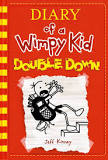
[READ: December 27, 2016] Diary of a Wimpy Kid: Double Down

I keep expecting the quality of the jokes in the Wimpy Kid books to decline.  But rather, this book was not only hilarious, but it worked really well as a book, too.

What I mean is that, I know that the Wimpy Kid series is online and that Kinney does a new story every day (or at least he did , I don’t know if he still does).  These books had always been taken from the online site (and I assume they still are).  But somehow, this book has jokes that circle back to jokes earlier in the book.  There’s at least a half a dozen callbacks which makes this book more than just a collection of diary entries…it’s a perfectly contained unit with a satisfying ending.

(more…)

Read Full Post »

dasha SOUNDTRACK: SACKVILLE-The Principles of Science [CST007] (1999). 

sackvilleFor Sackville’s only release for Constellation Records, they created a short disc of great folk with a hint of art rock

“Gold Dust” is a catchy uptempo folk song with some nice violin melodies as accents.  It’s a catchy number with Levine’s vocals sounding once again kind of like the guy from Social Distortion singing a mellow folk song.  The chorus has nice backing vocals added.  “Water” is a mellow song with, again, a beautiful guitar and violin melody.  The vocals have a great distinctive melody over the top.

“Blue Lips” has a kind of saloon sounding quality in its piano and a super catchy violin riff that runs through the song (and informs the vocal line).  I really like the lyrics on this one: “If memory serves me well…I may forget your name but not your face…unusual face.”  This song is only 3 minutes and it is over way too quickly.  “Four Alarm Fire” is a slow, evolving song coming in at nearly 7 minutes.  It opens with some quietly played guitar and a bass line that seems to be quiet but soon plays and interesting line that propels the song (albeit slowly).

The title song picks up the pace with a pretty guitar and piano melody.  The catchiness of the chorus “this light will disappear like breath on a mirror” is a great ending to this quiet disc.

Their final album of odds and ends, Natural Life, is available to stream on bandcamp.

[READ: June 20, 2016] A Year Without Mom

This book is a graphic novel (mostly) about a year without mom.  This is actually a memoir from Tolstikova about the year in her life when her mother left Moscow to study in America.  Dasha was 12 years old in 1983 and her mom was an advertiser in Russia.  But she didn’t like the kind of advertising she did.  She had applied to a Masters program in America and was accepted.  And soon enough she packed up and shipped out.

Dasha was to stay in Moscow with her grandparents.

In August she and her grandparents went to the country for a writers retreat.  Other kids would be there, too.  Her grandparents encouraged her to play with them but Petya, the leader is an anchor on a children’s TV show and his mother is a famous actress herself–it’s an intimidating scene. (more…)

Read Full Post »

harpaugSOUNDTRACK: LAND OF KUSH-The Big Mango [CST097] (2013).

mangoOsama Shalibi is how Sam Shaibi is credited on this album.  He is the composer and creator of The Big Mango, although he does not appear on it.

Some background that may or may not be useful.  This comes from Popmatters:

“Big Mango” is the nickname for Cairo and The Big Mango is a love letter from composer Osama (Sam) Shalabi to his new home, Cairo, and all of its tumults and contradictions…. Reveling in free-jazz noise, rock rhythms, and the radical propulsion that Shalabi encountered on trips to Dakar, Senegal, the album weaves the divine spirit unleashed through fury and joy and dance into an utterly fascinating whole…  This pinging between controlled pandemonium and something beautiful, strident, transcendent, is not accidental. Shalabi is tackling the nature of change and the place of women in Arab culture on Big Mango, and by so clearly blurring the strange and the celebratory, he suggests that even sweeping, radical change need not be a revolution, but perhaps a way of life, movement as vital force in the universe.

With an introduction like that it’s hard not to want to love this record.  But a with everything Shalibi does, he is always trying to push boundaries and attitudes.  And so, this album has some songs that are really fun ad/or pretty and some songs that feel like (but apparently are not) wild improvisations that test the limit of your patience for experimentation.

As I mentioned, Shalibi doesn’t play on this –I would have loved to hear his oud, but instead we hear all kinds of interesting Western and Eastern instruments: setar (is a Persian version of the sitar), flutes, saxophones, piano, balafon (a wooden xylophone), hand drums: riqq (a type of tambourine), darbuka (goblet drum), and tablas (like bongos) and of course, guitars and bass.

“Faint Praise” opens the disc with 3 and a half minutes of Middle Eastern music quietly played with a rather free form vocal over the top.  The vocals are a series of wails and cries (and almost animalistic yips).  It sounds like an orchestra warming up, and indeed, the Constellation blurb says:

These opening six minutes are an inimitable destabilizing strategy of Shalabi’s – his lysergic take on an orchestra ‘warming up’ – that serves to introduce most of the instrumental voices and the montage of genres that will form the rest of the work

It comes abruptly to a halt with “Second Skin,”  a much more formal piano piece—structured notes that end after a few minutes only to be joined by a saxophone solo that turns noisy and skronking and nearly earsplitting.

After some dramatic keyboard sounds, “The Pit (Part 1)” becomes the first song with vocals (and the first song that is really catchy).  It begins with a jolly sax line which is accompanied by another sax and a flute before the whole band kicks in with a refreshingly catchy melody.  For all that Shalibi likes exploration, he has a real gift for melody as well.  The lovely lead vocals on this track are by Ariel Engle.  It’s very catchy, with a somewhat middle eastern setar riff and those voices.  When the song stops and it’s just voices, it’s really beautiful.  The song is 7 minutes long and I love the way the last 30 seconds shift gears entirely to a more dramatic, slower section.  This section is so great, I wish it lasted longer.

“The Pit (Part 2)” is only two minutes long.  It’s a quiet coda of piano and flute.  After about a minute, a low saxophone melody kicks in, it is slowly joined by other instruments and Engle’s voice.  Unfortunately I can’t really tell what she’s singing, but it sounds very nice.

“Sharm El Bango” is a jazzy song with hand drums and all kinds of space age samples spinning around the song.  I really like when the flute melody takes over and the song become quite trippy.

“Mobil Ni” is the second song with vocals.  It begins with some strings instruments and hand drums over a slow bass line.  Then Katie  Moore;s voice come s in with a gentle lovely vibrato.  Her voice is a little smoother than Engle’s.  The song ends with a mellow section.  And then there’s a trumpet blast that signals the beginning of “St. Stefano.”  The trumpet gives way to brief explorations off free-jazz type before turning giving way to a bowed section with resonating bass notes.

“Drift Beguine” returns to catchy territory with a full Middle Eastern musical phrase and Elizabeth Anka Vajagic’s lovely voice raging from high to scratchy and breathy.  Around 4 minutes when the pace picks up, it’s really quite fun.

The final track is the only one that really rocks.  “The Big Mango” has a big catchy guitar riff and hand drums filled in by Molly Sweeney’s rock vocals.  The song ends the disc as a kind of fun celebration.

As with most of Shalibi’s releases, it’s not for everyone.  But there’s a lot of great stuff hear, if you’re willing to experiment.

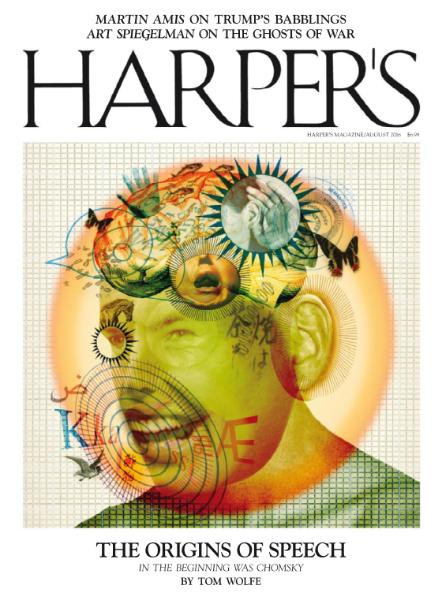
[READ: August 25, 2016] “Don the Realtor”

I hate to contribute anymore attention to Trump.  But it’s hard to pass up a chance to read Martin Amis, especially when he eviscerate his targets so eloquently.  Hopefully Trump’s voice will soon disappear from the airways and we can go back to forgetting about him.

Ostensibly this is a review of “two books by Donald Trump,” The Art of the Deal (1987) and Crippled America (2015).

Amis begins, as he usually does, by getting to the point: “Not many facets of the Trump apparition have so far gone unexamined, but I can think of a significant loose end.  I mean his sanity: What is the prognosis for his mental healthy given the challenges that lie ahead?”

Some basic questions come up about Trump: “Is his lying merely compulsive, or is he an outright mythomaniac, constitutionally unable to distinguish non-truth from truth.  Amis adds that “Politifact has ascertained that Donald’s mendacity rate is just over 90 percent, so the man who is forever saying he ‘tells it lie it is’ turns out to be nearly always telling it like it isn’t.”

But the Trump lying machine has grown from the rubble of the G.O.P. which “has more or less adopted the quasi slogan ‘there is no downside to lying.'” (more…)

Read Full Post »

[LISTENED TO: August 2016] Neil Armstrong Is My Uncle & Other Lies Muscle Man McGinty Told Me

neilThe title of this book sounded weird and fun. So I grabbed it from the audio book collection at the library and we listened to it on the way home from vacation.

Set in Long Island (narrator Emily Bauer does some great Long Island accents for the adults (and a few kids) in the story), this is the story of a young girl, Tamara Ann Simpson (Tammy) growing up on Ramble Street in 1969 just a few weeks from the Moon Landing!

But that’s miles away.  Because it is summertime and all she can think about is kickball.  Well kickball and her friend Kebsie who took off all of a sudden one day without even saying goodbye.

Kebsie was Tammy’s best friend.  She lived in a foster home on Ramble Street.  They did everything together and even had a secret “arooo” signal.  They were BFs and even bought necklaces to prove it.  Kebsie was a straight shooter and took no crap from anyone.  And then one day, she was gone.  As we understand it, her mother returned and took Kebsie away to secret place because there was some kind of abuse in he family and they needed to be removed from everyone they knew. (more…)

Read Full Post »

guibertSOUNDTRACK: JACKSON BROWNE-Tiny Desk Concert #394 (October 6, 2014).

jbI don’t really think much of Jackson Browne.  He’s always been a staple of classic rock radio, but I never especially sought him out. His voice is unique and recognizable although if pressed I can’t think of the names of any of his songs (but I’d know them immediately if I heard them).

Bob Boilen talked with Browne in his book and that’s where I learned that Browne dated Nico from The Velvet Underground fame and even wrote songs for her.  I also learned that he is quite the activist.  And that he plays a lot in California with various performers (the blurb says “he’s largely free of obligations”–that’s a nice phrasing).

He plays three songs here.  I assume they’re all new as I don’t recognize them.  And they all sound very much like Jackson Browne.  He voice is largely the same although it does crack and break a few times (could that be the setting or the time of day or does he just accept that he’s getting older?).

It’s also interesting that Browne plays the rhythm guitar for most of the songs–allowing Val McCallum to play the lead guitar and Greg Leisz to play “all manner of stringed things” (including the slide guitar solos).

The three songs are “Call It A Loan,” “The Barricades Of Heaven” and “Long Way Around.”  I’m surprised at just how long these three songs are (the whole set comes in around 20 minutes).

Before “Long Way Around” (which is quite political), he says that they’re “Lucky to play for such an informed group.”  Bob says they stopped the news–there’s no news being made–so that Browne could play.

Some of the lines in “Long Way Around” are: “It’s hard to say which did more ill, Citizen United or the gulf oil spill” and “It’s never been that hard to buy a gun, now they’ll sell a Glock 19 to just about anyone.”

The songs are nicely accentuated by the backing vocals of Jeff Young who also plays keyboards for them but which they couldn’t bring.

This is a delightful, mellow (and thoughtful) set of music (with a huge crowd watching).  And there’s a funny moment at the end where someone triggers a James Brown doll and Browne does a pretty good “hit me!”

[READ: March 2, 2016] How the World Was

I was intrigued to read this book by Emmanuel Guibert because I’ve really enjoyed his work lately.  But how was I to know that How the World Was is a prequel of sorts to Alan’s War?  It was also translated by Kathryn Pulver.

This book is a”loving, immersive portrait of Alan Cope.”  Cope was born in 1925 when California was still the frontier and life was simpler and harsher.  And Guibert felt that it was a gift for Cope “in the last moments of his life” (unlike in Alan’s War there’s no word on whether Cope saw this book).

So this book is indeed all about Cope’s childhood.  And while he did have some pretty interesting things happen to him, his childhood was in no way extraordinary.   This is just a simple portrait of growing up in Californians in the 1920 s and 1930s as seen from one man’s eyes. (more…)

Read Full Post »

« Newer Posts - Older Posts »