Feeds:
Posts
Comments

Archive for the ‘Non-fiction’ Category

SOUNDTRACK: MATT ULERY’S LOOM-Tiny Desk Concert #312 (October 19, 2013).

When a jazz band (or really any band) is named after a person, it’s always fun to try to guess who that person is in the band.  The first song “Coriander”  starts out with some trumpet notes and a kind of intro melody that’s played by both the sax and the trumpet.  And then about a minute and a half in, the keyboards take over, with a great cool 70s jazz/funk sound (the keys sound is my favorite part of this band).  And then of course behind all of this is the constancy of the drummer and the upright bass.  So, which one is Ulery?

I never would have guessed that he’s he bassist.  For his job in this band is basically to hold everything together.  The horns are doing their own thing, the drummer is doing all kinds of cool syncopated jazz beats. And the keys are just soloing like mad.  I don’t know if it’s because the bass isn’t very loud in the mix (it’s really isn’t), but his presence is almost not really there.  At the 4 minute mark of “Coriander,” the whole band drops away and the keys pick up a cool riff and then the horns chime in and eventually the bass comes back in.  I think he’s just not loud enough because watching him, it sure looks like he’s doing a lot more than what I hear.  And yet he’s never flashy.  As I say, he’s the ground, not the star.

When he speaks he’s rather quiet as well.  He says he loves NPR and gives a shout-out to his local Chicago station WBEZ.

Then they launch into the second song “My Favorite Stranger”  in which the keyboardist has now switched to accordion (a pretty pearly white and red affair).  I really like when the bass clarinet takes over the melody for a bit.  The accordion acts like drone with the trumpet taking most of the leads (although I love when the bass clarinet gets to run those same leads as well).

And for some background on Ulery:

The Chicago bassist Matt Ulery writes beautiful music in an unpretentious way. It’s intricate stuff, with interlocking parts and segmented structures. It often borrows from Eastern European scales, orchestral tone colors, folky textures. (On his backpack, he sports a SXSW patch from when he toured with a rock band called In Tall Buildings.) But it doesn’t sound like calculus class, as in some other ambitious works of modern jazz. It never seems to stray too far away from pretty melody over undulating rhythms, and that deceptive simplicity sets it apart.

Last year Ulery put out a grand two-disc set of music you might call “chamber jazz.” By A Little Light had strings, orchestral horns and singers — the whole nine yards. But he has also long done lavish on a smaller scale with a band called Loom. A rejiggered quintet lineup (note: Matt Ulery, bass; Marquis Hill, trumpet; Geof Bradfield, bass clarinet; Rob Clearfield, keyboards/accordion; Jon Dietemyer, drums) produced this year’s Wake An Echo, which the band brought to our office during a brief summer tour.

[READ: December 14, 2014] Tetris

I really enjoyed Box Brown’s take on Andre the Giant.  I really wasn’t sure what a book about Tetris could contain.  I mean, I love the game, but what’s there to say about it?  Well, it turns out, quite a lot–250 pages worth, in fact.

Beyond the game itself, Brown talks a bit about the history of video game development, including a bit of the history of Nintendo. But then he gets into what happened when people started to get addicted to those little falling blocks.  Who knew that Tetris had such a convoluted history?

The book starts off (in Brown’s wonderfully simple drawing style) with a picture of Alexey Pajitnov, the creator of Tetris and his friend Vladimir Pokhilo.  Alexey says he has been thinking about the pentomino puzzle. (more…)

Read Full Post »

manner SOUNDTRACK: BEN GIBBARD-Tiny Desk Concert #251 (November 19, 2012).

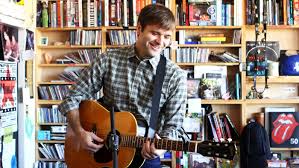
benBen Gibbard is the voice of Death Cab for Cutie.  His voice is instantly recognizable and his melodies are surprisingly catchy.

This Tiny Desk Concert (they say it’s number 250, but I count 251) is just him and his acoustic guitar.  I didn’t know he did solo work, but apparently he does (in addition to being in The Postal Service and All-Time Quarterback).

Gibbard just released a solo album, Former Lives, which he’s said is a repository for material that didn’t work as Death Cab for Cutie songs; from that record, only “Teardrop Windows” pops up in his Tiny Desk Concert. For the rest, he draws from Death Cab’s most recent album (“St. Peter’s Cathedral,” from Codes and Keys) and, of all places, last year’s Arthur soundtrack (“When the Sun Goes Down on Your Street”).

As mentioned he plays three songs and his voice is so warm and familiar I felt like I knew these songs even if I didn’t.

I knew “St. Peter’s Cathedral.” It is a lovely song with very little in the way of chord changes.  But the melody is gentle and pretty.  And the song appears to be entirely about this church.  Which is interesting because the second song is also about a building in Seattle.  “Teardrop Windows” is a surprisingly sad song about an inanimate object.  It’s written from the building’s point of view as he mourns that no one uses him anymore.  And such beautiful lyrics too:

Once built in boast as the tallest on the coast he was once the city’s only toast / In old postcards was positioned as the star, he was looked up to with fond regard / But in 1962 the Needle made its big debut and everybody forgot what it outgrew

The final song “When the Sun Goes Down on Your Street” was indeed for the Russel Brand movie Arthur.  Somehow I can’t picture those two together.  It’s a lovely song, too.

I prefer Gibbard’s more upbeat and fleshed out music, but it’s great to hear him stripped down as well.

[READ: January 2017] “My Writing Education: A Time Line,” “The Bravery of E.L. Doctorow,” “Remembering Updike,” and “Offloading for Mrs. Schwartz” 

I had been planning to have my entire month of February dedicated to children’s books.  I have a whole bunch that I read last year and never had an opportunity to post them.  So I thought why not make February all about children’s books.  But there is just too much bullshit going on in our country right now–so much hatred and ugliness–that I felt like I had to get this post full of good vibes out there before I fall completely into bad feelings myself. It;s important to show that adults can be kind and loving, despite what our leaders demonstrate.  Fortunately most children’s books are all about that too, so the them holds for February.

George Saunders is a wonderful writer, but he is also a very kind human being.  Despite his oftentimes funny, sarcastic humor, he is a great humanitarian and is always very generous with praise where it is warranted.

The other day I mentioned an interview with Saunders at the New York Times.  Amid a lot of talk with and about Saunders, there is this gem:

Junot Díaz described the Saunders’s effect to me this way: “There’s no one who has a better eye for the absurd and dehumanizing parameters of our current culture of capital. But then the other side is how the cool rigor of his fiction is counterbalanced by this enormous compassion. Just how capacious his moral vision is sometimes gets lost, because few people cut as hard or deep as Saunders does.”

These first three pieces are all examples of his love and respect for other writers–both for their skill and for their generosity.

“My Writing Education: A Time Line”

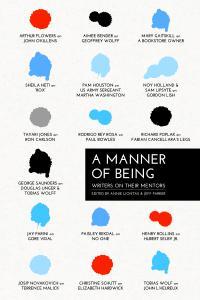
“My Writing Education” comes from a book called A Manner of Being: Writers on Their Mentors.  Saunders’ mentor was Tobias Wolff.  And for this essay, his admiration takes the form of a diary.  (more…)

Read Full Post »

talkingSOUNDTRACK: HOSPITALITY-Tiny Desk Concert #212 (April 30, 2012).

hospitalHospitality are a four piece band from New York.  They play fairly quiet, kind of delicate music.  Most of the songs have a delicately picked out guitar line on the electric guitar and strummed chords on the acoustic.  Amber Papini is the lead singer and rhythm guitarist.

“Sleepover” the first song, starts out even more quietly, with Papini picking out notes on the acoustic guitar while singing in what is practically a whisper.   There’s an interesting part in the middle where both guitars are picking out melodies and its the bass that is playing the most prominent line of the melody.

“The Birthday” picks things up a bit with a relatively more intense song.  The chords are louder and Papini sings more intensely.  This song ends with a whole series of “la da de das.”  Some songs can’t pull that off, but it works perfectly with this one–especially when the bassist adds harmony vocals–it’s super catchy.

“Betty Wang” opens with just the acoustic guitar and drums as Papini sings.  She won me over immediately with the echoed and rising notes of “so shy so shy so shy.”  With the electric guitar bursts and rather loud drumming this song is practically raucous.

The band is quite but their melodies are really catchy.

[READ: December 28, 2016] Talking as Fast as I Can

I was so excited that they were making a continuation of Gilmore Girls.  And while it was no doubt hard to live up to all the expectations of all of the fans, I thought the new series was great.  It captured the old show very nicely even though everyone had moved on ten years.

I wasn’t expecting a new book from Graham, and certainly not a memoir.  But, with some down time, she was able to push this book out as well as doing everything else she’s been doing lately.

For a memoir, this book is a little skimpy (208 pages), and yet, if that’s all she had to say I’m glad it wasn’t padded out with a ton of fluff.  Plus, Graham doesn’t tell us everything about everything.  She talks about her childhood, about acting, about being single and about Parenthood and Gilmore Girls.  It’s all done in what has become Graham’s trademark style (although since we are reading it and not hearing her, the pace is probably much slower). (more…)

Read Full Post »

6916SOUNDTRACK: MARGARET GLASPY-Tiny Desk Concert #560 (August 22, 2016).

margaretI really love Glaspy’s 2016 album Emotions & Math.  Her lyrics are sharp, her voice is unusual and mesmerizing and her guitar licks are simple but just chock full of hooks.  What’s not to like?

This Tiny Desk sees her playing songs from that album. Her band is just a bassist, a drummer and her on guitar and voice.

“Emotions & Math” starts off quietly with just bass and drums while she sings in that unique way of hers.  Then the guitar comes in–it’s nothing fancy, but it plays off the bass notes in a very cool way.  And it’s super catchy too.

“Love Like This” opens with a cool bass and drums rhythm–bouncy and tribal.  And when her guitar comes in, it’s with a ripping couple of chords before disappearing again.  Once again, the bass is rumbling along with her chords accenting in a neat way.

“You and I” bounces along with some low chords and bass and Glaspy’s most growly vocals. This song features the first “solo” which is really just the notes of the chords played, but it really stands out among the deep notes.  And once again, the whole business is really catchy.

“Somebody to Anybody” is just her singing and playing guitar.  Although it feels a little quiet without the rhythm section, she fills in more guitar parts on this song and it feels quite full.  And the chorus is, that word again, very catchy.

It was this Tiny Desk that sold me on getting her album, and I’m glad I did.

[READ: March 17, 2016] “The Running Novelist”

This essay appeared in the Summer Fiction issue of the New Yorker.  Since I really like Murakami, and hope to read more of him one of the days, I’m going to include this essay because it is as surprising as some of his fiction.

This is the story of how he became a runner and how he became a novelist.

He had been the owner of a small jazz club (which I feel he has written about in one of his stories).  It stayed open late and was a novelty in Tokyo at the time.  He had a niche audience and while many people didn’t like the place, he had a steady clientele.

His friends said it would never work, but he didn’t listen and he became quietly successful.  He was there in the morning and worked late at night.  And once he made a profit he hired people to help him out. (more…)

Read Full Post »

slowreadSOUNDTRACK: DIRTY THREE-Tiny Desk Concert #245 (October 15, 2012).
dirty-3For a Murakami collection I should really have picked a jazz Tiny Desk Concert.  But none jumped out at my on my list.  So I decided to do something that might be jazzy in spirit, even if it is nothing like jazz at all.

Dirty Three are a three-piece band which consists of violinist Warren Ellis (who works closely with Nick Cave), drummer Jim White (who I had the pleasure of seeing live with Xylouris White), and guitarist Mick Turner (who has released a string of gorgeous instrumental solo albums and worked a lot with Will Oldham).

I’ve liked Dirty Three for years, although I kind of lost touch with them back around 2000.  So it was fun to see that they are still working.  (They’ve released all of 3 albums since 2000).

Jim White plays an eccentric but very cool style of drum–it always feels improvised and random, and maybe it is, but it’s never “wrong.”  Turner is the only one who is keeping the song, shall we say, “stable.”  He’s got the rhythm and melody both with his strumming.  And Ellis is all over the place with melody lines and bowing.

For this Tiny Desk, they play three songs.  Their music is ostensibly instrumental although Warren Ellis is not above shouting and yelling and keening when appropriate.

The first two songs are from their 2012 album and the last one is from Ocean Songs.

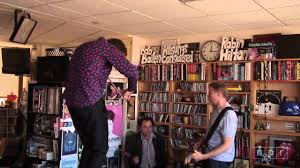
“Rain Song” opens with Ellis strumming the violin while Turner plays slightly different chords.  Then Ellis takes off on a series of spiralling violin rolls.  As always, White is back there waving his arms around with the loosest grip on drumsticks I’ve ever seen.  He plays brushes on this song but the drums are far from quiet.  Meanwhile Ellis is soloing away, yelling where appropriate and doing high kicks when White hits the cymbals.   As the song comes to an end, White is going nuts on the drums and Ellis takes off his jacket (revealing a wonderful purple shirt) .  He starts screaming wildly as he physically gets into his violin playing.

“The Pier” is about realizing that it’s the rest of the world that is driving you crazy.  It’s about “trying to undermine Facebook and realize a new way of communicating with people beyond the internet.”  It’ about… are you ready Mick?  Okay.  “The Pier” is a slower song with some plucked violin.  Ellis climbs up on the desk and dances around as he plays.  This one feels a but more controlled but in no way staid.

For “Last Horse in the Sand,” white switches to mallets and adds a tambourine to his cymbal.  It’s really interesting to watch White play around with things–moving his gear around as he plays.  He switches sticks and seems to be not even paying attention, but without ever really losing momentum or timing.  For this song, Ellis and Turner are the mellow ones while White is just all over the place with his amazing drumming.

I haven’t said anything about Turner because he is really the grounding of the band, while the other two are taking flights of fancy.

This is a wild and untamed set and it’s a lot of fun.  It’s also amusing to watch the audience witnessing this seeming chaos.

[READ: December 16, 2016] Slow Reader Vol. 1

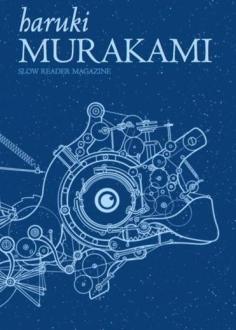
Madras Press had released 16 small books, which I enjoyed reading quite a lot.  I have posted about some and will post about more in the new year.  But word is that they have given up on the small books and have switched their attention to a new magazine/journal called Slow Reader.  The first issue came out this month and it collects stories, essays, poems, illustrations, and other things that center around novelist Haruki Murakami.

Support this small press!  You can order this issue directly (and name your price, although I think the asking price is $6).

From an article elsewhere I’ve learned that future issues will cluster around M.F.K. Fisher, Kazuo Ishiguro, and Patricia Highsmith.

This issue contains essays, fiction and illustrations, some dating back as far as 2000.

CHIP KIDD-cover illustration (wind-up bird)
Chip Kidd is awesome

GRANT SNIDER-Murakami Bingo Board
This bingo is hilariously apt–covering most of the bases of Murakami’s writing: cats, jazz, running, and even a Chip Kidd cover.

JESSE BALL-Sheep Man
A line drawing of a sheep standing upright with the caption “The sheep man’s peculiar tail was never visible to me.”

HARRIET LEE-MERRION-Diner illustration
A nice line drawing of a corner diner

KAREN MURPHY-Sputnik and two moon illustrations
Two simple drawings of Sputnik and two moons.

BEIDI GUO-Hard Boiled Wonderland and the End of the World map
A cool map of the locations of the novel.

DINA AVILA–Murakami Tasting Menu at Nodoguro in Portland, OR
I don’t really get if the menu items are related to the stories but it’s a neat idea that there are foods named after his works. But why are so many called IQ84?

EUGENIA BURCHI–IQ84 menus
A drawing of foods with what I think are character names (I haven’t read the novel yet).

FABIO VALESINI-train illustrations taken from the book trailer for Colorless Tsukuru Tazaki and His Years of Pilgrimage
No idea what the original context is, but it’s a neat, clean drawing of a train station.

JEFFREY BROWN-“In Conversation” What Jeffrey Brown Thinks About
The first piece is an amusing cartoon in which Brown scores a job at an indie bookstore by mentioning Murakami.  The little blurb says that it is an only slightly exaggerated account. There’s also a later picture by Brown of Murakami’s face posted on a bulletin board (with a lost cat flier), that’s really great.

DANIEL HANDLER-“I Love Murakami”
Handler begins his piece by apologizing to dozens of authors before saying that Murakami is our greatest living practitioner of fiction.  He mentions a few books but heaps a ton of praise on Wind Up Bird Chronicles and mentions his excitement at  finally getting Norwegian Wood in English (it had been untranslated for many years).  He wrote this essay in 2000.

YOKO OGAWA-“On Murakami’s “The Last Lawn of the Afternoon” [Translated from the Japanese by Stephen Snyder]
Ogawa writes about a house in her neighborhood which has a lawn that she finds unsettling–it’s perfectly manicured and a pale, cool shade of green.  She is reminded of the Murakami story in which a boy mows a woman’s lawn and she asks him an unexpected question.  Ogawa imagines a woman in that home asking the same kinds of questions.

ETGAR KERET-“What Do We Have in Our Pockets?”
This was inspired by Murakami’s story “On Seeing the 100% Perfect Girl One Beautiful April Morning.”  This story is about a man whose pockets are always bulging with unusual items.  People often say to him, “What the fuck do you have in your pockets?”  And his answer is that he carries things that he imagines the perfect woman needing–a stamp or a toothpick.  It is a wonderfully charming story.

RIVKA GALCHEN-“The Monkey Did It”
Of all of the items in this collection, this is  the only piece I’d read before.  I remembered parts of it (particularly the excerpts from “A Shinagawa Monkey,” and her talking about Colorless Tsukuru Tazaki.  I also recalled her saying that she liked his short stories better than his novels, but that she was perhaps wrong in thinking that.  The one thing I didn’t pick up on last time was that in the beginning of the essay she writes about Toricelli’s Trumpet or Gabriel’s Horn–an item with finite volume but infinite surface area.  She says this perfect describes Murakami’s work.  And I love that she ties it to translator Philip Gabriel who is a gentle and modest translator–perfect for the watery novel.

TESS GALLAGHER-“Murakami and Carver Meet at Sky House”
Before he had written any substantial works, Murakami translated Raymond Carver’s works into Japanese.  Ray was excited and bemused that Haruki and his wife Yoko would travel from Japan to meet with him.  This essay tells us that the following poem came about as Ray tried to imagine how his poems could possibly be appreciated in Japan.  Murakami told him how both the Japanese and American people of the 1980s were experiencing humiliation at being unable to make a decent living.  Gallagher says that if they were to meet today Ray would be awkward about Haruki’s stature.  But he would have loved knowing that Murakami had translated everything he had written.

RAYMOND CARVER-“The Projectile”
This poem is wonderful. It begins with Carver speaking about his meeting with Murakami and then flashing back to when he was 16 and was hit with an ice ball.  It was thrown from someone in the street through a small crack in the window of the car he was riding in–a chance in a million.

RICHARD POWERS-“The Global Distributed Self-Mirroring Subterranean Neurological Soul-Sharing Picture Show”
This is the most abstract and “intellectual” of the essays here.  It speaks of a team of neuroscientists discovering a lucky accident–that neurons in the brain fire when someone else makes a motion that we recognize.  Similarly, in Murakami–representation is the beginning of reality.  He speaks of the parallel narratives in Hard Boiled Wonderland.  He wonders at the universality of dreams and ideas in Murakami.  “But if his own stories are steeped in the endless weirdness hiding just inside everyday life, how then to account for Murakami’s astonishing popularity throughout the world?”

MARY MORRIS-“The Interpreter”
I loved this story.  An American business woman is giving a series of lectures in Japan.  She is assigned a translator who goes with her nearly everywhere.  She is a little annoyed that he is always there, but he is very respectful of her and only speaks when spoken to.  She assumes he is translating her speeches correctly, but during one, the audience laughs where there was nothing funny.  She doesn’t want to disrespect him, but she can’t imagine what he said to them.  In the next one, they are practically doubled over with laughter at what he says.  Finally she has to confront him about it.  He reveals astonishing insights into her personal life.  And the next day he is called away–just as she has begun to feel close to him.

In the author’s note, she says that the she was at an writer’s meeting in Princeton (where she teaches) and Murakami was there eating with them. He was by himself, and she talked to him because she was a fan of his work.  She relates a story of holding up a sign for him when he ran the New York City Marathon.  She says that the part about the translator and his family (which I didn’t mention) is from an actual translator she met in Japan.

AIMEE BENDER-“Spelunking with Murakami”
Bender speaks of trusting Murakami.  She says when the cat started speaking in one of his books, she began to mistrust him.  Nevertheless, she says, she loves a lot of writers but only trusts a few of them.  She’s not trusting Murakami’s honesty or his ability to make her smarter.  Rather, she trusts him like a man with a torch in a cave–someone who is willing to explore–and to be in front leading the way.

SUMANTH PRABHAKER-Editor’s Note
Prabhaker would like to ask the world’s philosophers why some things seem to happen to us in a random fashion.

Read Full Post »

coralSOUNDTRACK: SACKVILLE-These Last Songs (1997).

lastsiongs Sackville released two full length albums.  This was the first. They’d added a second guitar which gave their songs a bit more texture.  But they still had a kind of gritty folk music sound.  I saw the term “urban country” used to describe them, which is strangely apt.

“Sydney Mines” is a slow folk song with a quiet slow guitar motif.  I love the descriptive lyrics: “In the dead of winter in Sydney Mines they take their cars out on the ice.” The song is accented by a slow, scratchy violin that comes in after the first verse.  But the chorus gets rocking and kind of fun/sloppy with the drums really taking over.  The vocals don’t really change the laconic style but they do get noticeably louder.  “Clothesline” retains that slowness although the verses have a bit more sing-song quality.  And once again the chorus bursts into life with a raw violin and loud drums.

The excellent guitar riff that opens “Good Citizen” is quite a change—the song picks up speed (and the vocals sound very different–clipped and quick).  It’s a great alt folk song.  The chorus is lurching and interesting as well.  “Upstate” has an early 1990s guitar line and pounding chords at the end of each verse.  The juxtaposition of his voice with this electric song works nicely.  “Tie Back Yr Hair” returns to the slow style of the earlier songs although this melody is mostly led by the violin.  “Lines and Barriers” is a slow ballad, mostly guitar—it reminds me of Syd Barrett.

“The Frame-Up’ has more loud drums and quiet creaking violins.  Nearly four minutes in, the violin takes over with a staccato refrain that gets the song sounding more intense.  “Bender” adds a pleasant surprise with guest vocalist Genevieve Heistek taking lead vocals.  The music is much the same but her voice changes the overall style of the music quite a bit.  The addition of fuzzy static at the end adds an alt-rock touch.  “Invisible Ink” has the prettiest violin melody yet, an unscratchy ascending melody that complements the slow guitars.  And just as it seems to be another slow ballad, the 3rd minute ramps up the electric guitar and the song soars for about 20 seconds before returning to that main melody.

“Her Ghost Will One Day Rise Again” has the most country feel of the album—the violin is much more fiddle than violin and the simple melody is very catchy, but in a drunken hillbilly kind of way rather than a country song proper (which means a I like it better).  On “Border Towns” he sounds the most like the lead singer from Social Distortion.  This is a lurching kinda punk y song, although it’s the chorus that really has that Social D feel—a slow catchy chorus in which his delivery is uncanny.  “Pioneers” ends the disc with a downbeat song with really catchy lyrics: “It’s hard to be a pioneer” in the keening voice of the 12-year-old protagonist.

Given the popularity of alt-country, Sackville was sadly ignored.

[READ: June 10, 2016] Coral Reefs

Wicks created the Human Body Theater graphic novel (also from First Second), which I absolutely loved.  This book is part of First Second’s new Science Comics series, in which they take a good hard look at scientific things and present a ton of information in a fun cartoony format–easily digestible chunks with awesome pictures that convey a lot of information.

I loved the dinosaurs one for just how much new information I’d learned from it.

This book has a really inspirational forward about scuba diving which I thought was by wicks (and I wondered how she was so scholarly AND an artist), but it was actually by Randi Rotjan from the New England Aquarium (and is still inspirational).

I didn’t know a ton about coral reefs going into this book and man, is it full of information about them: how they grow and form (yes, they are animals), who lives among them and what we can do to protect them. (more…)

Read Full Post »

mikesplace SOUNDTRACK: MONIKA-Tiny Desk Concert #529 (May 6, 2016).

monikaMonika is a superstar in her native Greece (her full name is Monika Christodoulou).  She is a charming woman with a big voice and a bigger stage presence.  She incorporates theatrical notions in her performance too (the fact that she has a shirt that looks like a mime’s kind of encourages that idea): “throwing” stars, flying, sleeping.

It is hard to believe that the blurb says used to sing sad songs, as she is so fun and bouncy.  But there’s this biographical note:

her recent transition from singer of sad songs to purveyor of upbeat jubilance came after she nearly lost her life in a boat fire; she had to swim eight hours in the dark to safety without food or drinkable water. These days, it’s all about a great band grooving, her joyful voice, and that infectious smile.

Wow.

She sings four songs.  The first, “Yes I Do,” opens with what I assume is a lyric about the then current moment: “24th of March has arrived and I think it’s Thursday?  Washington is beautiful out there but we don’t really care.”  It has a kind of circus opera feel.  And Monika’s voice is a marvel–powerful and beautiful with a good range.

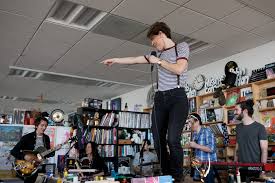
monika2For the second song, “Shake Your Hands” she asks if everyone is ready to dance a little.  She climbs up on the desk and as she sings the slow opening, when she gets to the “I love you” moment, she sings without the mike and is as loud as when she uses it.  Once the song kicks in, it has a big disco beat: wah wah’d guitars and a funky bass line.  She encourages everyone to sing along: “Even if you don’t understand, just repeat, okay.”  The song ends with a very fun extended ending of staccato chords.

“Hand in Hand” has a kind of gospel quality (a big group sing along of the opening lines), although it is a brief, transitional song before “Secret in the Dark” begins.  She straps on a guitar for this final song which has a discoey riff and a fuzzy keyboard sound.  It’s really fun.

I’d never heard of Monika, but she seems like the kind of pop/dance star that would be really fun to see live.

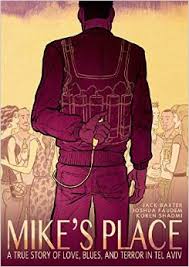
[READ: April 1, 2016] Mike’s Place

Somehow I missed that word in the subtitle: True.  I didn’t realize that this was a true story until the very end.  The story was really good before I knew that and it makes it even more amazing after I found the truth.

In Tel Aviv, Israel, John Baxter (Jack), a filmmaker has come to cover a story.  He goes into a local bar called Mike’s Place for a meal.  He is greeted warmly and is told that there is live music every night of the week.  They proudly state that Mike’s is a place where people of all stripes comes to congregate and do anything but talk about politics.

It turns out that there are already people making a documentary about the subject who John came to cover (Marwan Barghouti) so Jack  decides to give up. (more…)

Read Full Post »

« Newer Posts