Feeds:
Posts
Comments

Archive for the ‘Newspapers’ Category

SOUNDTRACK: JONATHAN FRANZEN-Commencement Speech (audio) (2011).

You can hear the entire speech from the Kenyon College site.

[READ: May 28, 2011] Commencement Speech

On May 21, Jonathan Franzen gave a commencement speech to the students of Kenyon College.  When I think about my commencement speech (from Judy Woodruff of CNN), all I can remember is that I had never heard of her (and when I typed her name just now I got it almost entirely incorrect–the only thing right was the “wood” part).  I don’t recall a single thing that she said.  [It’s also fascinating that I can’t find any record of this speech anywhere online–what a different world it was twenty years ago].  I rather expect that most people feel this way about commencement speakers.  I have to wonder, if Jonathan Franzen had spoken at my college, would I have cared?  Is there even a chance that I would have read any of his novels (had they been published of course) when I was in college?  Would I be treating this any differently than my whatever speech in 1991?

But I like Jonathan Franzen and I wanted to read what he had to say. 

His speech is about love.  Love is kind of an odd topic for a commencement speech, isn’t it?   I mean, aren’t they supposed to talk about the Future and Jobs or something?  Or maybe even sunscreen?  But really, what is more useful for a 21-year-old to think about than Love.  Franzen hits the nail right on the head about Love, how it is a dangerous, risky proposition to put yourself out there, to take off your veneer and reveal all of your flaws–and hope someone will love you.  Not new or novel, but still true.

The way that Franzen gets into this subject is through technology.  It seems weird and artificial at first, but it’s a wonderful way to get into a young audience’s state of mind.  They were probably all looking at their iPhones while he was extolling the virtues of his new Blackberry (the old person’s phone, right?).  And when he segues into Facebook (who even knows if he has an account–but he seems to be well-versed with it, so maybe he does) you can imagine students raising their head in familiarity (maybe even updating their status) and wondering (as he puts it) if this 51-year-old guy is going to dis Facebook. (more…)

Read Full Post »

[WATCHED: August 22, 2011] “The Calamity Song”

I woke yesterday to the news that one of my favorite bands had made a music video which was a tribute to one of my favorite books, Infinite Jest. Colin Meloy was a reader during the Infinite Summer project (one of the more high profile readers, although he didn’t really contribute beyond the first week).  When I saw him at BEA, I asked him if he finished the book and he said that indeed he had. Weill according to this story from The New York Times, Colin liked the book so much that he wanted to use one of the great scenes from the book as the basis of a music video.  And since The Calamity Song has the line “In the Year of the Chewable Ambien Tab” which is an allusion to Infinite Jest‘s Subsidized Time, well why not use that as the song.

The video was directed by Michael Schur (a huge Infinite Jest fan) who is a major figure behind Parks and Recreation. The video is a bare-bones retelling of the Eschaton sequence from the novel. For those who have not gotten to that scene yet, Eschaton is a game of global annihilation played on a tennis court. There are strategic places you are supposed to hit from across the court (so it’s a physical game, not just an academic one) with your 5 megaton tennis balls.   The scene is challenging to read because there’s so much going on, but the video does a very good job of giving you the essence.

Sure, diehards will have lots to quibble about (it’s raining, not snowing; Ann Kittenplan (the girl who gets hit with the ball) is totally hot–not so much in the book; and the scene doesn’t end with someone’s head crashing through a computer monitor).  Most of the quibbles are addressed in the Times article but some are easily answered anyhow–it was filmed in two days, it’s a flat screen monitor (you can’t put your head through that), and why not have a hot Ann Kittenplan, it’s a music video, right?   (more…)

Read Full Post »

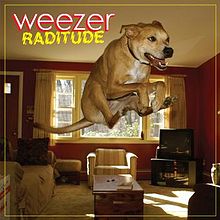
SOUNDTRACK: WEEZER-Raditude (2009).

I didn’t buy this Weezer album when it came out because I had heard really bad things about it (like the “guests”), but when I saw it cheap I decided to check it out.  This has to be the most polarizing Weezer album of them all.  I listened to it twice yesterday.  The first time I thought I had been too harsh on it.  The second time I thought it was godawful.  It’s amazing what a couple of hours can do.

It opens with a wonderful bit of poppy wordplay ala Cheap Trick: “(If You’re Wondering If I Want You To) I Want You To.”  It’s catchy as anything and is a wonderful start to the album, even if it is probably their poppiest song ever.  From there though, the album really degenerates.  And mostly it’s because it’s so dumb.  I mean the album title should tell you what you’re in for, but who would have expected the moronic sub-pop-metal of “The Girl Got Hot” or even the reprehensible lyrics of “I’m Your Daddy” “You are my baby tonight And I’m your daddy.”  It’s just creepy.  Or gah, a song about the mall?  “In the Mall.”  It’s not even worth mocking.  And really, try to picture Rivers Cuomo in a mall.  Any mall.

But nothing could prepare anyone for “Can’t Stop Partying.”  Unlike Andrew WK’s ouvre, which is so sincere about partying that you can’t take it seriously, this song really seems to be about the guys partying.  It’s laughable.  The anemic rap but Li’l Wayne certainly doesn’t help.

Even the collaboration with Indian musicians on “Love is the Answer” (yes, seriously) doesn’t really work.  It feels like they wrote the song and then said, “Hey let’s throw some sitar on it.”  It’s not enough to be exciting but too much to ignore.

This is not to say that these songs aren’t catchy.  I mean, geez, I still have “Can’t Stop Partying” in my head while I’m listening to something else.   Rivers knows how to write a pop trifle.  And the more he writes songs like this, it makes me thing that Pinkerton was the fluke.  Which is fine. The music world needs poppy songs, right?

[READ: early August 2011] various nonfictions

I thought about doing individual posts for all of Arthur Bradford’s non-fiction that’s available on his website (that’s right,  yet another author that I have read short uncollected pieces by without having read any of his bigger works–I’m looking at you Wells Tower).  Bradford has links to all of his nonfiction ( I assume) on his website.  There are 12 links in total.  One is to his blog (which I’m not reviewing).  The rest are for articles covering a pretty broad array of topics from a pretty broad variety of sources.  (more…)

Read Full Post »

SOUNDTRACK: JOSH CATERER-“Ask” (2011).

Josh Caterer is the main guy behind The Smoking Popes, whose first album, Born to Quit, Morrissey has said was his favorite –and which is also not only no longer in print, it’s not available on Spotify! (the first album that I have looked for which was not available).

Anyhow, this cover comes from The Onion’s A.V. Club’s Undercover series.  (The current series offers a list of 25 songs from which the bands can choose to cover–but each time a song is chosen, it is removed from the list.  Soon, bands will cover songs they may not even like!)

Anyhow again, this cover is delightful.  I was going  to say that “Ask” is one of my favorite Smiths songs, but I think they’re all my favorite songs.  Nevertheless, this one is pretty high on my list.  And this version is, indeed delightful.  Caterer is accompanied by a guitar, a violin and a viola.  The strings cover most of those catchy melodies, while the guitars keep the song propulsive (you don’t even miss a rhythm section).  Caterer’s voice, while not as distinctive as Morrissey’s is perfect for the song.

Overall, an excellent cover.  Watch it here.

[READ: July 20, 2011] “Archeology”

This was the first of five “Starting Out” pieces in the New Yorker’s fiction issue.  The Starting Out pieces are one page (or less) and are a look into the author’s childhood/adolescence.

Egan, who wrote  A Visit from The Goon Squad, talks about what she wanted to be as a child.  First, she wanted to be a surgeon.  She saw blood and that was the end of that.  Then she thought that maybe she could be an archaeologist.  She desperately wanted to become one, even sending her resume (which was: high school and a desire to dig) to every place she could think of (only one even bothered to write back). (more…)

Read Full Post »

SOUNDTRACK: RAFTER: “No Fucking Around” (2010).

This song made one of The Onion’s AV Club voter’s Top Ten lists this year. The  description was interesting enough that I had to go check it out.

Rafter is on Asthmatic Kitty, home of Sufjan Stevens, so I assumed the disc would be intriguing, if nothing else.  The song starts out with an overly autotuned (practically mechanical) voice repeating the title.  From there the song slows down with some interesting lyrics.   As the reviewer said, it strips dance music to its barest essentials.  This trend seems to be kind of popular lately, and I’ve noticed that when it works, the rests are very catchy, (when it doesn’t it’s boring as all get out).

Now, I first listened to the song with the video (see below) which I love.  So I’m not entirely sure how much of my enjoyment of the song is predicated on the video.

However, I’ve now listened to it several times and my enjoyment grows with each listen.

Although I am always more interested in indie rock than dance and pop, occasional a pop song or a dance song will grab me and make me listen. LCD Soundsystem has had that effect, as has Daft Punk.  I’m not sure if this whole album is as interesting, but I certainly enjoy this song.

Shame that I’ll probably never hear it without going to YouTube.

[READ: January 11, 2011] “The Years of My Birth”

This story impressed me both for its unexpected emotional pull and its twist (in a sense) ending.

When the story opens, we learn of the narrator’s birth: she was an undetected twin who was, for lack of a better term, squished by her brother.  When she came out, the doctor said she would likely have birth defects; her mother, when asked if they should try to save the baby, shouted “No!”

But the nurse had already ensured the baby’s survival.  The baby was disfigured, with a misshapen head and twisted legs, but she appeared mentally normal.  And yet, since her mother had already rejected her, (and times were different then), the nurse, a Native American woman, took the baby home and raised her as part  of their family.  She even nursed the baby since she was already nursing a young girl at home.

The Native American family tended to her, working on re-shaping her head (with massages) and mending her legs (with stretching), and she found herself thriving (reasonably).  Her adoptive family was very supportive and although her closest-in-age sister once said she’s never get in trouble because she was white, she formed a very tight bond with all of her adoptive siblings. Her brother even nicknamed her Tuffy because he knew she’d get a nickname eventually and he wanted to give it to her.

Tuffy lives a quiet, modest life, never making to many attachments, for fear of getting hurt.  Nevertheless, she always felt a kind of ghostly presence in her life.  She knew it was her twin, although she didn’t know where her brother was physically, what he looked like, or even what his name was.   But their bond, or whatever it was, was always there.

And then one day out of the blue, she get as a call from her “mother.”  She wants to connect.  So Tuffy meets her for dinner and the truth comes out (just like a recent plot of 30 Rock): her twin needs a kidney.  And your heart goes out to her.  For so many reasons.

The last section of the story, though, reveals the depth of the character that Erdrich has created in Tuffy.  Because even though she knows that this family has done nothing for her, she has this connection to her twin.  Her family discourages her from contact with her “mother,” but Tuffy feels drawn to help.  Even though she knows she owes them literally nothing, she starts to think that maybe she got the better deal in life.

And then we find out why he needs the kidney, and our feelings gets even more complicated.  And when she finally meets her twin, things go in another direction altogether.

I was really surprised at how complex this short (4 page) story was.  I was riveted, and as I mentioned, emotionally torn.  It’s a great piece.

Read Full Post »

SOUNDTRACK: A CAMP-Studio Sessions on WFUV [available on NPR] (2009).

I rather enjoyed A Camp’s latest album Colonia.  I discovered this session while browsing through NPR’s archives.  There’s a pretty lengthy (and amusing) interview with the band and then they play three acoustic songs: “Love Has Left the Room,” “Stronger Than Jesus” and “I Signed the Line.”

Nina’s voice sounds fantstic, and in such a simple acoustic session it’s her voice that really sells the music.  But this is another instance where an acoustic, stripped down session reveals the strength of the songs themselves.  The album has a lot of production, but when it’s just bare bones guitar and bass, the melodies still hold up.  And again, Nina’s voice just soars through these meloides.  Anyone who got sick of The Cardigans needs to hear what Nina Persson can do in other settings.

Check it out here.

[READ: October 29, 2010] “The Comfort Zone”

The subtitle gives the foundation of the article: Franzen loved Peanuts when he was growing up.  This article was timed to coincide with the release of the awesome Fantagraphics collection of original Peanuts cartoons. I’ve only read the first of these Peanuts books, but it was really eye-opening and quite fascinating to see that such odd thoughts were published on a daily basis on the comic section!  And, I hate to sound curmudgeonly (that’s Charlie Brown’s job) but Franzen is right, the original Peanuts cartoons are far more existentially dark and satisfying than the fluffy Snoopy & Woodstock cartoons of the late 70s and 80s.

Anyhow, Franzen loved these early comics (and he makes a wonderful comment about spending a lot of time (probably age-inappropriate time) with talking animals: Snoopy, Narnia, A.A. Milne).   But as with all of these longer Franzen articles, it’s about much more than just Charlie Brown.   One night when he was a young boy, his older brother Tom had a huge fight with their parents and stormed out.   Franzen sets this up in the context of generation gap that was sweeping through the country in the late 60s/early 70s.

And it’s this unsettledness that also explains the popularity of the Peanuts cartoons. Despite all of the differences between generations, everyone agreed that they loved Peanuts (except for Franzen’s parents, evidently–his dad never read the funnies, and his mom only liked a strip called The Girls, which sounds like a prototype of Cathy).

The other angle that this article takes is about losers.  Charlie Brown was a loser, there’s no doubt.  But Franzen himself was a winner.  He was the king of spelling bees in his school. (This relates to Charlie Brown misspelling “maze” as MAYS, a perfect misspell for a sports fan).  And when a new kid comes to challenge him he steps up his game…and makes the kid cry.

This, of course, leads to guilt. Charlie Brown one said, “Everything I do makes me feel guilty.” And now Franzen feels guilty about the boy in his class, and about being mean to a frog as a kid and about the wash cloths at the bottom of the closet which don’t get used enough (Sarah and I have jokey guilt about that too) and even about the stuffed animals who don’t get cuddled enough. (more…)

Read Full Post »

[VIEWED: August 5, 2010] America in Color 1939-1943

The Denver Post recently published 70 color photographs from the Depression.   You can see them all here.  The photographs are part of the Library of Congress’ collection of photos.  The Library of Congress’ collection houses 1,600 color and over 160,000 black and white photos from this period in American history.  It is a bit more for scholars, as you can’t just browse the pictures like in the Denver Post site, but for completeness, you really must check out the LOC prints.  They’re available here.

But back to the Denver Post.  The Post’s collection of 70s prints come from the Library of Congress’ 2006 Exhibit Bound for Glory: America in Color.  These Post’s pictures are very large and very clear (they are reproduced from slides).  And they are all downloadable.

They include photos from New Mexico, Connecticut, Maine, Massachusetts, Georgia, Oklahoma, Arizona, Colorado, Idaho, California, Texas, Nebraska, Ohio, Montana, South Carolina, Tennessee, Mississippi, Louisiana, Washington D.C., Illinois, Iowa, Virginia, Kansas, Kentucky and Michigan.

And, they show the amazingly diverse makeup of the country.  From a peach farmer to a railway worker.  From kids fishing, to kids playing in the snow.  From women at a fair, to women welding.  From men on horseback to men in front of bomber.  Not to mention, the creation of the Shasta Dam!  (It’s amazing — #28)

The thing that amazes me most about these pictures is that although some things have changed quite dramatically in sixty years, other things haven’t.  Kids still fish, stores still sell fruits and veggies, and people still love pictures of scenery and interesting faces.

You can obviously tell that these pictures are old.  Even the ones without people just look old, why is that?–see #2 in particular for one that looks old even though nothing in the picture is dated.  Or picture #11: the women’s faces simply look like the were photographed 60 years ago.  Or this one, which I’m including.  There’s nothing particularly dated about the picture, and yet you can tell this didn’t just happen in 2010.

(more…)

Read Full Post »

SOUNDTRACK: BILLY BRAGG-Talking to the Taxman About Poetry (1986).
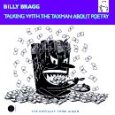
I’ve liked Billy for ages now.  I’ve seen him live a few times, and I’ve always loved that his accent is so prominent when he sings.  Over the years he has become somewhat less overtly political, but he is still a man of issues and causes.

This is Billy Bragg’s second full length.  He was still primarily a man with a voice and a guitar at this stage.  His melodies are strong, and since there’s no other instrumentation, all that’s left to talk about is the lyrics.

“Greetings to the New Brunette” is an adorable love song, followed closely by the anti-marriage “The Marriage”: “If I share my bed with you Must I also share my life Love is just a moment of giving And marriage is when we admit our parents were right.” (which doesn’t quite jibe with Sophia, but it’s close.

But really what you come to Billy Bragg for is the politics.  LIke in “Ideology”:  The voices of the people Are falling on deaf ears Our politicians all become careerists They must declare their interests  But not their company cars  Is there more to a seat in parliament  Then sitting on your arse.”

He also covers a public domain song which I wondered how well it would fit here.  “There is Power in a Union” seems like it’s saying the right thing, but some of the characters here would disagree about the end: There is power in a factory, power in the land Power in the hands of a worker But it all amounts to nothing if together we don’t stand There is power in a Union.”

This album also features the great track, “Help Save the Youth of America.”

Over the years Billy would expand his sound (he even worked with Wilco on two discs), but he always sings for the people.

[READ: Week of July 2, 2010] Letters of Insurgents [Fourth Letters]

As I’ve been going along in the story, I began to wonder if the two letter writers were going to be rehashing the same arguments in each letter.  I had confidence in Perlman that the story would be interesting (it sure had been so far), but I couldn’t imagine how he would keep it original, especially since Yarostan was in jail for so long–he has no information except secondhand.

This week’s reading gave two examples of how he’d do it:  Jasna comes to visit Yarostan and she updates everyone about what had happened to all of their fellow workers, and Sophia reveals a horrible situation in which she hits rock bottom–a real physical bottom, not a philosophical one. (more…)

Read Full Post »

SOUNDTRACK: ROB SZABO-“If I Could Do It All Again” (2003).
Rob Szabo is a singer-songwriter.  And this song is a pretty traditional singer-songwriter song.  It’s got some humor, it’s got some cliches.  In some ways he reminds me of Jill Sobule (lyrically, not vocally, obviously) or maybe Loudon Wainwright III.

Szabo has a number of albums out already.  I listened to a few others songs on his radio station and I enjoyed them.  He strikes me as the kind of musician that the more you listen, and the more carefully you listen, the more rewarding his music is.

I wasn’t all that impressed by “If I Could Do It All Again,” but the other tracks were certainly good.  And I could easily enjoy listening to his stuff when the mood was right.

[READ: June 15, 2010] “Stet”

This was probably my favorite story of the bunch.  It’s funny, it’s dark and its very Canadian.  I suppose that if you want to write a “Canadian story” it’s easy to set it where he does (so you can mention a LOT of Canadiana) but this story works beyond the surface.

And the surface is that this story is set in a Canadian newspaper.  Mansour, Fabien and Matt are trying to meet a deadline.  They bemoan their late hours, their hard work, their horrible bosses and the inevitable decline of newspapers. (more…)

Read Full Post »

SOUNDTRACK: VAMPIRE WEEKEND-Contra (2010).

I absolutely loved Vampire Weekend’s debut album (and still do).  It was my favorite record of last summer and always makes me think of summer fun and hijinx.  Critics trotted out the “world/ethno/Paul Simon” vibe when discussing the album.  But I really didn’t hear it.  I mean, yes  I suppose it was there but the album felt more like a punky ska album of fun.

On this, their follow up, it’s as if they took all those critics to heart and decided to make the album that everyone was describing. This disc emphasizes all of the ethnic music sounds,  and downplays the guitars and more rock elements.  I was a little disappointed by this on the first listen or two.  However, subsequent listens showed me that the songwriting was still there and it was just as strong.

There’s still lots of rocking elements, it’s just that they are hidden under the other divergent influences.  But for the most part, the album is still bouncey and full of fun summer tunes.  There are three songs that slow down the pace, “Taxi Cab” and “Diplomat’s Son” (at 6 minutes, it’s a little long).  And the final song “I Think Ur a Contra” is a bit too divorced of beats (it works as an end to the disc, but I’d never listen to it on purpose).

The rest of the disc however, is very enjoyable, and I find that the 7 other songs work just as well as anything off the debut. “Horchata” is a delightfully fun world music treat (I hear Paul Simon, yes, although come on, Graceland came out 24 years ago!).  “White Sky” has delightfully catchy falsetto screams.  “Holiday” is practically classic ska and “Cousins” has a delightfully tricky guitar riff.

This feels like a band who has matured and experimented and yet not lost track of who they are.  I’m really looking forward to their next release.

[READ: Week of April 12, 2010]  2666 [pg 702-765]

Last week I concluded that

It almost seems as though Bolaño is saying that even Nazi Germany is better than Santa Teresa.

Oh how wrong I was.  Despite the fact that I found the bulk of this section enjoyable and fascinating (twisted and dark certainly, but fascinating nonetheless), the ending killed me.  The opening’s entire writers among writers, within writers, with communist party members and secret diaries was completely captivating.  And then it is all shattered by the reality of WWII. (more…)

Read Full Post »

« Newer Posts - Older Posts »