Feeds:
Posts
Comments

Archive for the ‘Nature’ Category

SOUNDTRACK: Big 4 Thrash Tour (2010).

During my recent trip down metal memory lane, I learned that the Big 4 Thrash bands may be touring together.  The Big 4 would be: Metallica, Anthrax, Megadeth and Slayer.

When I was a young metal dude, these were definitely my big 4.  I own the first 5 or so albums by all of these bands.  Megadeth was the first to fall out of favor (around 1990), then Anthrax (around 1993), then Slayer (around 1994) (although they came back nicely in the last few years) and the Metallica (around 1997 although really they’ve drifted the furthest from the thrash world, and probably I should’ve stopped sooner).

I haven’t really listened to any of these guys’ newer releases (although I did get Slayer’s 2001 release, God Hates Us All–and I wanted to add this wonderful quote from Araya, who sings of ever so much death and destruction: “when you see someone and if you’re a human being you respect them and treat them as human beings”), so I can’t say that I’m the target audience for this tour.  However, I am delighted that these 4 bands, whose music I loved while growing up, are still together and still touring.

I wonder what the audience make up for this show is?  Is it old fogeys like me (who are still younger than the band members, at least) who would have wet themselves for this tour back in 1989, or is it a new generation of thrash kids who would mosh the crap out of me?

Either way, I won’t be going to this concert (in Poland or in Greece for that matter) but nor will I be going should it come to a theater near me.  But I’ll be delighted to hear how it goes.

[READ: March 29, 2010] “Bystanders”

I was prepared not to like this story (actually an excerpt from a novel).  It is set on a mountainside on the border of China and Tibet.  And it was about mountain climbing, a subject about which I care very little.  And as it started  feared it was going to be another story about battling with the elements on top of a mountain, blah blah.

But rather, the story went in a different direction entirely.  While the young protagonist is watching the sun set on the mountains she hears gun shots.  Ad i the distance, she sees a man fall.  The guides come over to offer her a hand but she refuses.  They force her down behind the rocks as they call for her father.  Then she flashes back to another time when her father selflessly came to someone’s rescue.

There were many cool ideas in this story.  I loved the idea that she was sitting in two countries at the same time.  I loved even more the later idea that the glacier has moved the border between the to countries and that soldiers had to remeasure and replace the flag.  But really, it was the final line, “that by making his care, his very life and limb, equally available to all, he deprived [his family] of an exclusivity they had a right to expect” that was incredibly moving.

I don’t know that I’ll track down the novel Every Lost Country, but I did enjoy this excerpt quite a lot.

Read Full Post »

SOUNDTRACK: RUSH-A Farewell to Kings (1977).

Although I recently said that Caress of Steel is one of my favorite Rush albums, I’m really torn between a number of their albums from the 1970s.  I’ve loved A Farewell to Kings since the time I got it: it’s over the top, and it showcases all of the band’s strengths.

The opener “A Farewell to Kings” features a wonderful classical guitar intro that morphs into a heavy rocking masterpiece.  There’s time changes galore and it’s all over in just about 5 minutes.

It’s followed by “Xanadu,” one of Rush’s all time great epics.  Tubular bells, cool guitar effects, Rush’s first great use of keyboards-as-effects, even a cowbell solo all open this song with sufficient grandeur for what’s to come.  A slow vocal intro leads to a super fast exploration of Coleridge’s “Kubla Khan.”  Whenever people wondered why Neil’s drumset was so big or why Alex (and Geddy) had doublenecked guitars, they needed only listen to this to be amazed that three men could play it all.  11 minutes long and not a wasted second.

One of Rush’s biggest hits and perennial favorite “Closer to the Heart” comes next and it still sounds pretty fresh all these years later.  “Cinderella Man” is an overlooked track on this disc, but it showcases Rush’s drift away from the individualism vs state of 2112, and move toward the individualism of doing what’s right for all: “he held up his riches to challenge the hungry.”  It also features a blistering solo from Alex.  “Madrigal” is a very short acoustic song, quite a departure for the time but a nice delicate track before….

“Cygnus X-1.”  The other epic on this disc.  And right from the start you know you’re in new territory here.  A fully distorted voice, bells echoing like they are floating at sea (or in outer space), all kinds of build-up lead to a noisy bass line coming from far away in the depths of space.  And after 2 and a half minutes of build up, the whole band kicks in with this off kilter heavy rocker.  It’s basically the story of a space ship flying into a black hole. It also features some of Geddy’s most screechy vocals.  I wish I could remember the exact quote, but my friend Joe’s bandmate had a wonderfully derogatory description of the end of this song.

But aside from the end, the main body is great.  From the 5 minute mark, the song is a catchy, driving song as the Rocinante flies through the galaxy.  From the 7 minute mark, the song is seemingly caught in the black hole, as the song drifts about, compressing the song into a manic session of fast fast fast riffs and Geddy’s tortured screams.  It’s pretty intense, and guaranteed to alienate as many people as it wins.

The album features so much experimentation, and it’s wonderful to see a band with so much creative energy release a disc with so many fantastic moments.  Very few records take risks like this anymore.

[READ: March 21, 2010] The Color of Heaven

This final book of the Kim Dog Hwa’s trilogy is a wonderful conclusion to this sweet story.  If you’ve read my previous two posts about these books, you know that this is the story of, Ehwa, a young woman as she matures in rural Korea several generations ago.  By this third book, she has turned 17 and has met the love of her life.  Sadly for her, Duksam has had to leave suddenly.  At the end of book two, he set sail in part because he was fleeing an angry mob, but also in an attempt to make money as a fisherman so that he can save up for his beloved Ehwa. (more…)

Read Full Post »

SOUNDTRACK: BLUE OYSTER CULT-Club Ninja (1986).

My roommate Glen is the only person that I know who not only owned this record but also played it a lot.  No doubt it was his relentless playing of this disc that now leads me to think of it rather fondly, even if it is pretty poorly regarded as far as BOC discs go.

It has a very poppy/80’s metal feel to it, there’s no denying.  Some of the songs are beautiful keyboard-rich tracks (“Perfect Water” which is close to cheesey but I don’t think ever crosses the line), some of them are pummeling 80s metal with chanted choruses “Make Rock Not War” (boom), and “Beat ‘Em Up” (which is as delightfully silly as it sounds).

It also featured a song that could have been a hit called “Dancing in the Ruins.”  The less bombastic metal songs are also quite catchy, like “Shadow Warrior.”  And the final song, “Madness to the Method” reminds me of one of their 70s songs, “The Marshall Plan” as it’s complete with spoken word sections and seems to be about rocking out.

I suppose compared to their 70s heyday, this falls a little short, but as an 80s metal album it’s quite solid.

[READ: March 12, 2010] The Color of Water

This is the second part of Kim Dong Hwa’s trilogy of the maturation of Ehwa (a character loosely based on his mother).  It is beautiful, engaging and very very real.

Ehwa is growing up in rural Korea. Her father died many years ago, so it is just her and her mother living together.  Her mother owns the local tavern, and for much of the day Ehwa is free to roam around and learn things from her friends.

This second part of the trilogy focuses on Ehwa’s budding sexual maturity.  She learns  more and more about what her mother and the “picture man” are feeling when he arrives at their house.  She learns, through her friend Bongsoon, what it feels like to experience individual pleasure.  She also learns what it feels like to fall heavily for someone when she meets the handsome and strong Duksam. (more…)

Read Full Post »

SOUNDTRACK: BLUE ÖYSTER CULT-compilations and live releases (1978-2010).

For a band that had basically two hits (“Don’t Fear the Reaper” and “Burnin’ for You”) and maybe a half a dozen other songs that people might have heard of, BOC has an astonishing number of “greatest hits” collections.

Starting in 1987 we got Career of Evil: The Metal Years (1987), Don’t Fear the Reaper (1989), On Flame with Rock n’ Roll (1990), Cult Classic (which is actually the band re-recording their old tracks (!)) (1994), and the two cd collection Workshop of the Telescopes (1995).  There’s even Singles Collection, (2005) which is a collection of their European singles & Bsides.

This doesn’t include any of the “budget price” collections: E.T.I. Revisited, Tattoo Vampire, Super Hits, Then and Now, The Essential, Are You Ready To Rock?, Shooting Shark, Best of, and the 2010 release: Playlist: The Very Best of).

The lesson is that you evidently won’t lose money making a BOC collection.

I don’t know that any of these collections are any better than the others.

The 2 CD one is for completists, but for the most part you’re going to get the same basic tracks on all of them.

And, although none of them have “Monsters” for the average person looking for some BOC, any disc is a good one.

Regardless of the number of hits they had, BOC was tremendous live.  And, as a result, there have also been a ton of live records released.  Initially the band (like Rush) released a live album after every three studio albums. On Your Feet or On Your Knees (1975) Some Enchanted Evening (1978) and Extraterrestrial Live (1982) were the “real releases.”

Then, in 1994 we got Live 1976 as both CD and DVD (which spares us nothing, including Eric Bloom’s lengthy harangue about the unfairness of…the speed limit).  It’s the most raw and unpolished on live sets.  2002 saw the release of A Long Day’s Night, a recording of a 2002 concert (also on DVD) which had Eric Bloom, Buck Dharma an Allan Lanier reunited.

They also have a number of might-be real live releases (fans debate the legitimacy of many of these).  Picking a concert disc is tough if only because it depends on the era you like.  ETLive is regarded as the best “real” live disc, although the reissued double disc set of Some Enchanted Evening is hard to pass up.  Likewise, the 2002 recording is a good overview of their career, and includes some of their more recent work.

If you consider live albums best of’s (which many people do) I think it’s far to say that BOC has more best of’s than original discs.  Fascinating.  Many BOC fans believe that if they buy all the best of discs, it will convince Columbia to finally reissue the rest of the original discs (and there are a number of worthy contenders!) in deluxe packages.  I don’t know if it will work, but I applaud the effort.

[READ: October 2009-February 2010] State By State

This is a big book. And, since it’s a collection essays, it’s not really the kind of big book that you read straight through.  It’s a perfect dip in book.  And that’s why it took me so long to get through.

I would love to spend a huge amount of time devoting a post to each essay in the book.  But, well, there’s 51 (including D.C.) and quite a few of them I read so long ago I couldn’t say anything meaningful about.  But I will summarize or at least give a sentence about each essay, because they’re all so different.

I’ll also say that I read the Introduction and Preface last (which may have been a mistake, but whatever).  The Preface reveals that what I took to be a flaw in the book was actually intentional.  But let me back up and set up the book better.

The catalyst for the book is the WPA American Guide Series and sort of Steinbeck’s Travels with Charley.  The WPA Guides were written in the 1930s as part of the Works Progress Administration.  48 guide books were written, one for each state.  Some famous writers wrote the books, but they were ultimately edited (and many say watered down) by a committee.  I haven’t read any of them, but am quite interested in them (and am looking to get the New Jersey one).  Each guide was multiple hundreds of pages (the New Jersey one is over 800).

State By State is written in the spirit of that series, except the whole book is 500 pages (which is about 10 pages per state, give or take).  And, once again, famous writers were asked to contribute (no committee edited this book, though).  I’ve included the entire list of authors at the end of the post, for quick access.

So I started the book with New Jersey, of course.  I didn’t realize who Anthony Bourdain was until I looked him up in the contributor’s list (I’m sure he is thrilled to hear that).  And his contribution was simultaneously exciting and disappointing,.  Exciting because he and I had quite similar upbringings: he grew up in North Jersey (although in the wealitheir county next to mine) and had similar (although, again, more wealthy) experiences. The disappointing thing for me was that Bourdain fled the state  for New York City (and, as I now know, untold wealth and fame (except by me))  I felt that his fleeing the state, while something many people aspire to, is not really representative of the residents of the state as a whole.

And that dissatisfaction is what I thought of as the flaw of the book (until I read the Preface).  In the Preface, Matt Weiland explains that they asked all different authors to write about states.  They asked some natives, they asked some moved-ins, they asked some temporary residents and they asked a couple of people to go to a state for the first time.  In reality, this decision makes for a very diverse and highly entertaining reading.  In my idealized world, I feel like it’s disingenuous to have people who just stop in to give their impression of an area.  But hey, that’s not the kind of book they wanted to compile, and I did enjoy what they gave us, so idealism be damned.

For most of the book, whenever I read an essay by someone who wasn’t a native or a resident of a state, I assumed that there weren’t any famous writers from that state.  I’ve no idea if that played into anything or not.  From what I gather, they had a list of authors, and a list of states (I was delighted to read that three people wanted to write about New Jersey-if the other two writers ever decided to put 1,000 words  to paper, I’d love to read them (hey editors, how about State by State Bonus Features online, including any extra essays that people may have wanted to write).

From New Jersey, I proceeded alphabetically.  And, I have to say that I’m a little glad I did.  I say this because the first few states in the book come across as rather negative and kind of unpleasant.  Alabama (written by George Packer) comes across as downtrodden, like a place you’d really have to love to live there.  Even Alaska, which ended up being a very cool story, felt like a veil of oppression resided over the state (or at  least the part of the state that Paul Greenberg wrote bout.)  But what I liked about this essay and the book in general was that the authors often focused on unexpected or little known aspects of each state.  So the Alaska essay focused on Native fisherman and the salmon industry.  Obviously it doesn’t do justice to the rest of that enormous state,  but that’s not what the book is about.

The book is meant to be a personal account of the author’s experiences in the state. (more…)

Read Full Post »
SOUNDTRACK: COLIN MELOY-Sings Sam Cooke (2008).

I ordered this CD from the Decemberists website.  (Sadly Colin singing Morrissey is no longer available).   This is, as the title states, Colin Meloy singing Sam Cooke songs.

I don’t know much about Sam Cooke (although I knew a few tunes from this disc).  And, in my head, Sam Cooke doesn’t have a “catalog” of songs, like, say, Morrissey does. So, this came across as a disc of standards.  And as such it’s very good.

If you like Meloy, you’ll like this.  If you don’t, this isn’t going to covert you.  It’s basically just him and his acoustic guitar (and an occasional backing vocal) singing these songs.

I have always liked “Cupid” so it’s nice to have a rendition of it.  As for “Summertime,” I’m not sure why that’s considered a Sam Cooke song since it comes from Porgy and Bess.  I didn’t know the other three songs, but they’re all quite good, uptempo jazzy numbers.

This EP makes me want to investigate a Sam Cooke Greatest Hits, to see what I’ve been missing.  And maybe that was Meloy’s point all along.

[READ: January-February 2010] Shite’s Unoriginal Miscellany

I had ordered a couple of Schott’s Almanacs from the UK, because I thought it would be fun to see what was different about them from the U.S. versions (quite a lot actually).  And while browsing for them, I found this parody of the series.  So, for a few dollars used, I ordered it too.

Now any book that bills itself as “extensively researched, eccentrically compiled and irresponsibly written” pretty much lets you know what you’re getting.   And it does conclude its summary by saying, “more than 250 pieces of useless, misleading and possibly dangerous information.”  So, what might you expect?

This is a very strange parody of the series because it does three things at the same time:  1) It provides actual lists of actual things (which are, indeed, useless and silly).  2) It provides nonsensical/hypothetical questions (more on that shortly).  And 3) It has stuff that is clearly made up and intended to be funny (but often isn’t) (more…)

Read Full Post »

SOUNDTRACK: LES CLAYPOOL-Of Fungi and Foe (2009).

Claypool was asked to score a video game called The Spore Wars and, at around the same time, to score a movie called Pig Hunt.  According to the liner notes of the disc, he used the templates that he made for the scores and fleshed them out to make this album.

This was the first Claypool solo album I’d bought in several years (since 2002’s Purple Onion).  I’d heard “Mushroom Men” on the radio and really liked it, so I decided to get the disc.  And I have to say overall I’m a little disappointed.

Now, I’ve been a Primus fan for years (I even saw them right after Suck on This) so I know what I’m getting with Les.  And yet, maybe I don’t anymore.  The disc is very percussion heavy, with lots of rather long songs.  And although I love long songs, I love long songs that aren’t the same thing for 6 or so minutes.  I also rather miss Claypool’s voice.  He doesn’t sing a lot of these songs in his typical falsetto.  There’s a lot of very deep voiced, rather processed sounding voices here (it works great on the muh muh muh muhshroom men, but not so great elsewhere).  Because when you combine that with the bass and percussion, it’ really hard to hear what he’s on about (and Claypool lyrics are half the fun).

Plus, we know that with Primus’ own brand of weirdness, a little goes a long way.  So, hearing the same bizarro riff for 4 minutes can be trying.

Despite the criticisms, the disc is good in small doses.  The first 4 tracks are all really solid.  But that 5th track, “What would George Martin Do?” just sucks all the life out of the disc.  The same goofy riff for 6 minutes with completely unintelligible lyrics.  Ouch.   But “You Can’t Tell Errol Anything” picks up the pace somewhat with a wonderful Tom Waits-ian soundtrack.  The addition of Eugene Hutz on insane wailing vocals brings a wonderful new level of dementia to the disc.

Throughout the disc there some amazing bass riffs (of course) and some really cool effects thrown onto the bass (and other instruments).  But the overall feel of the disc is just too samey.  I think the music would probably work really well as soundtrack music, but it lacks a little something by itself.

I’m not suggesting that Claypool needs to be more poppy, because that’s hardly it (although he does have an amazing gift for clever hooks), but it’s possible that he needs an editor.  Was that the role Ler played in Primus?  Who will ever know?

[READ: February 5, 2010] Diario de Oaxaca

Wa-HA-Ca (that’s how you pronounce Oaxaca (the first question I had)).

I ordered this book for our Spanish collection without really knowing what it was about.  When it arrived I had a hard time deciding where to catalog it…is it a graphic novel?  a biography?  It’s bilingual so does it even go in the Spanish collection, which has much less circulation than our English collection?  As I flipped though the book, it looked really cool, so I decided to just read it and figure it out for myself.

Peter Kuper is, among other things, the drawer of Mad Magazine’s Spy vs Spy since about 1997.  Sometime in 2006, Kuper decided to go on sabbatical from the politics of George W. Bush.  He and his family packed up and moved to Oaxaca, Mexico for two years.  While he was there, the city experienced a semi-annual teacher’s strike.  However, this particular strike turned bloody when the President of Oaxaca turned his soldiers against the strikers. (more…)

Read Full Post »

SOUNDTRACKDOWN AT THE SEA HOTEL (2007).

This has rapidly become one of my favorite CDs for our kids.  It’s a collection of lullabies written by some great artists with performances by: Guy Davis, Lucy Kaplansky, John Gorka, Eliza Gilkyson, The Wailin’ Jennys and Lynn Miles.  They play either solo or in groups to create a wonderful collection of tracks which maintains an overall cohesive sound.

It’s nice to have a collection that, although it contains many different singers, retains a similar style, a style that feels like a group of folk singers playing together just to get you to relax.

The songwriters include: Greg Brown, Tom Waits, Bruce Cockburn, Gord Downie, Neil Young, Carole King, Steve Earle and more.  It’s a magical collection of songs. Perfect for any bedtime routine.  The only problem with it is that my daughter usually falls asleep before we get to the end, so I don’t know the last five or six tracks all that well (but I know the first batch from start to finish).

I also recently learned that you can get a very cool edition of this CD in a book format. It is an illustrated edition of the title song and it comes complete with the full CD attached in the back. The book is quite beautiful (and I wish I had gotten that version instead of just the CD).

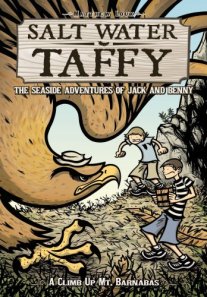
[READ: January 26, 2010] Salt Water Taffy 2

This fantastic kids graphic novel series just gets better and better.  I enjoyed this story so much that I decided to read it to my 4 year old son.  I removed a few paragraphs and edited for length but he really enjoyed the story…leading him down a garden path to comic book enjoyment.

This book continues the story of 8 year old Jack and 11 year old Benny on their family summer vacation in the seemingly dull seaside town of Chowder Bay.   The first volume laid out enough backstory for you to know that the town is boring as all get out for the kids, with no TV even!  But the locals have plenty of adventure for the kids to get up to.

As this book opens, the family is on a nature hike.  The boys are collecting feathers to compete with Fisherman Angus’ fantastic collection of a feather from every (species of) bird on the island.  But they are easily distracted from this quest when their dad reveals that Angus isn’t the only one on the island with good stories.  For indeed, he himself once climbed to the top of Mt Barnabus (the tallest mountain around) where he fought Barnabus, the giant eagle, for the hat that he is wearing at this very moment.

The boys are awed by this and now hold thie rdad in slightly higher esteem.

Later, when the kids are playing (and one of them is wearing that very same hat), Barnabus the giant eagle swoops down and take the hat right of his head.  He proceeds to fly up to his cave on th etop of the mountain.

The rest of the book covers the boys’ decision to climb that mountain by themselves and rescue that hat.  They encounter many many dangers on the way (I edited down the wolf section a wee bit)but what they find at the top of th emounatin is by turns frightening and hilarious.  (I especially enjoyed the cameo of the little lobsters from Book1).

The resolution to the story is great, the drawings are great, and the entire sprit of the book if one of advneture and fun.  It’s a real treat to read, and I’m delighted that there;s a 3rd book already available.

The first story laid out all of the details of where and who they are.  However,

Read Full Post »

SOUNDTRACK: DINOSAUR JR.-Farm (2009).

I’ve been a fan of Dino Jr since my friend Al introduced me to Green Mind (I had missed the “classic” line up but caught this newer incarnation).  And I loved it.  I have enjoyed just about everything that J. Mascis has put out (although yes, there have been a few duds).

I missed the first reunion album (and will likely get it one of these days) but I had heard a few tracks from this disc on a pitchfork TV segment on IFC (if you can track down the show, it’s great).  This one featured two Dino Jr tracks recorded live (?) in what looks like an attic.  It sounds great and sounds very close to the record, but I hadn’t had the record yet so I don’t know if it was just a video or a new recording).

On the disc, the band sounds fantastic.  The thing I loved about Dino in the post-Barlow/Murph stage was J Mascis’ amazing guitar work that morphed with his almost-beyond-slacker singing.  He sings like such an under-achiever that it was amazing his guitar solos were so blistering.

What has changed on the new disc is that his vocals are a little less lazy/whiny sounding, he seems to be actually singing!  And his guitar work sounds even better.  The strangest thing is that even when he pulls off a hugely long guitar solo like on the nearly 9 minute “I Don’t Wanna Go There” he never sounds like a show off.  The songs aren’t there to highlight the solos, rather, the solo sounds like an integral part of the song.

And this disc offers all of the things that the band is good at: lengthy guitar solo tracks like I mentioned and rocking fuzzed out guitar jams.  And despite all of Dino’s noisy guitars and squalling solos they also wrote some amazingly catchy pop songs.  And that’s true here, too (“Over It” and “I Want You to Know”).

I have been a little confused as to what inspired the band to reunite.  I mean, Lou Barlow had a very successful thing with Sebadoh and Folk Implosion (scoring a huge hit with “Natural One”).  And on this record, he only contributes two songs.  So, it can’t be any kind of ego thing.  I assume they just enjoyed playing together again.

But Barlow’s contributions add a lot to the record.  A sense of depth in the verses and, of course, the utterly different sound than what Masics brings on his vocal tracks.

The disc came with a bonus disc of 4 songs: 2 covers and 2 Mascis solo pieces.  They’re not essential, but they do show a lighthearted side of the band.

[READ: January 25, 2010] “Safari”

I wasn’t initially that interested in this piece.  I’m not big on the whole safari thing, but I thought I’d give it a try.  And I’m really glad I did.  This story went in so many different directions, and covered so much ground, that it was practically a novel condensed into seven pages.

The story starts with Lou’s children.  Lou and his children (and his nanny/student protegé/lover) are on a safari in Africa.  Over the course of the story we learn that there are several other people on the safari with them (a rock star and his band, some older ladies who are birdwatching, Albert, the driver and, my favorite, Dean–a young actor who states the obvious).  But we begin just with this family. (more…)

Read Full Post »

SOUNDTRACK: NO FORCEFIELD-Lee’s Oriental Massage 415-626-1837 (2000).

I was terribly disappointed with the second No Forcefield album (so why did I get this one?  Because I got them both used at the same time for $1 each).  And I can’t help but think Id have been so much more disappointed in it had I listened to this one first.

This first record is really quite good.  I still have no idea why Ler from Primus is in the band or what he does on this disc (and he’s the reason I learned about the band to begin with), but this disc sounds like a proper album and not just a bunch of undercooked ideas.

This disc is primarily a collection of electronic/scratching tracks.  The beginning of the disk has more scratch-heavy pieces (provided by DJ Disk), and as the disc moves along we get slightly longer more instrumental-only dancey tracks.  But they’re not really dance tracks either, they’re heavy electronic tracks in the vein of say Prodigy (with no lyrics).  They’re quite inventive and they rock pretty hard.

But it must be said, it sounds nothing like Primus.  There’s virtually no bass, and no guitars and no vocals.  I assume that Brain does all of the electronics and drums, and then there’s a few extra folks helping out.  There’s some definitely worthwhile tracks on here (and the samples are all fun…Mister Roger’s Neighborhood music, for example).

This isn’t a genre I know very well, so I don’t know how it compares globally to others. But I do know bad techno music and this isn’t it.

Not bad for $1.  And, no I never called the phone number.

[READ: January 26, 2010] “Fjord of Killary”

This is a quick, dark story.  It concerns a poet, named Caoimhin, who moves from the city to the West Coast of Ireland.  Specifically, he goes there to buy a hotel.  The hotel has been extant since the 1600’s and was even written about by Thackeray.  Since he is having massive writer’s block, he assumed that this little community on a fjord will give him lots to write about.

But instead, he finds himself very busy tending to the locals (the hotel bar is the real draw) and largely uninspired to write anything.

The actual plot of the story concerns a terrible storm.  The raging ocean that is right below the hotel is rising and rising.  Caoimhin is rather nervous, but the patrons, all old residents of the area, tell him not to worry.  Well, actually they ignore him, (despite all of his lame attempts at conversation making) but the effect is the same.

It’s only when the water actually comes up the porch and under the doors that the people start to really get nervous. (more…)

Read Full Post »

SOUNDTRACK: RHEOSTATICS-Static Box (complete) (2008).

I’ve decided not to review all of the volumes of this fabulous free box set.  Rather, since I have now finished it, I’ll sum up and say that it is a fantastic collection from start to finish.

The final disc has a series of great cover tunes.  And of course, there’s the final songs from the final Massey Hall show which are quite emotional, even all these years later.

There’s one or two songs that I probably would have left off for sound quality reasons (although usually they’re pretty interesting/essential for what they are).  There’s one 8 minute song, “Monkeys Will Come” that has quite poor sound quality.  However, it is a recording of the song that the Canadian government asked them to record for Canada Day in 2000.  And I assume there are no better recordings of it, so it’s nice to have.

The best part of this collection is that it allowed me to see which concerts were worth downloading in their entirety (the site has a ton of concerts for downloading…a ton!).  It also got me to track down the two Violet Archers CDs, which I’m quite excited to be getting soon.

And, while I’m in a Rheos mood.  Martin Tielli’s final CDs in his subscription collection just made their way to my house and they are weird and wonderful.  And, I just learned that Dave Bidini put out a solo record a few months back, so that’s worth tracking down too.  Go Rheos!  You are all very star.

[READ: January 12, 2010] Generation A

I was quite excited when this book finally came out.  I had been dipping into the Douglas Coupland back catalog (including watching JPod the TVseries), so this book is a treat.

Strangely, when I started reading the book I realized I had no idea what it was about.  At all.  So, the first thing to note is that it is not in any way a sequel to Generation X.  None of the characters are the same, the setting is not the same, there’s no connection whatsoever (or if there is I didn’t see it).  The premise of the title comes from a Kurt Vonnegut address.  It is quoted on the book jacket and in the book itself, so I won’t quote it here, but the gist is that young people were dismissed unfairly when labelled “Generation X,” so they should insist that they be called “Generation A,” the beginning of the alphabet, and the start of it all.

But when the book starts, it’s hard to understand what that has to do with anything.  Because, as we learn right away, the book is all about bees (which explains the yellow and black cover design). (more…)

Read Full Post »

« Newer Posts - Older Posts »