Feeds:
Posts
Comments

Archive for the ‘Deep Purple’ Category

tpk3SOUNDTRACK: OBETROL-“The Sound Machine” and “Chopped an Dropped”(2011).

obetrrolObetrol is a band that I can find out very little about. They seem to have 5 songs out and each one is quite different. My favorite is “The Sound Machine” which has a lush sound with twinkly guitars and a wispy female vocalist singing over the top of it.  It has a very trippy slow motion quality to it.  The singer sings a bit like a delicate Kim Gordon (in that shes not always exactly on key).

It’s hard to get more out of this song since it’s only 2:25, but I think it would make a cool intro to any record.

“Chopped and Dropped” on the other hand opens with buzzy guitars (and a “Kick Out the Jams” sample).  The vocals are sung (screamed) by a man. It is a fast-moving tinny punk song with trippy female echoed vocals in the background.

Hard to pin them down, but you can check them out here.

[READ: July 28, 2014] Pale Summer Week 3 (§22)

This week’s read is only one section because it is almost 100 pages of one person’s testimony.  Presumably, this is also part of the testimony on videotape which was broken down into smaller sections.  But there is no “context” for this section;  no ID number.  Although it does address very similar issues and questions.  I was on the fence about how much to include here.  So much of it is “irrelevant,” that I hate to get bogged down in details.  So I think it will be a basic outline of ideas until the more “important” pieces of information surface.

§22

For the most part, this is all inside one man’s head as he talks about his life in college, after college, and into the Service.  In terms of advancing the “plot,” there’s not much (until the end).  Mostly this is simply a wonderful character study, full of neuroses and problems that many people face at some point (to one degree or another).  We don’t know who this author is (very minor spoiler: we will learn who it is in §24 [highlight to read]).

The interviewee states that “A good bit of it I don’t remember… from what I understand, I’m supposed to explain how I arrived at this career.”

Initially he was something of a nihilist, whose response to everything was “whatever.”  A common name for this kind of nihilist at the time was wastoid.  He drifted in and out of several colleges over the years, taking abstract psychology classes.  He says that his drifting was typical of family dramas in the 1970s–son is feckless, mother sticks up for son, father squeezes sons shoes, etc. They lived in Chicago, his father was a cost systems supervisor for the City of Chicago. (more…)

Read Full Post »

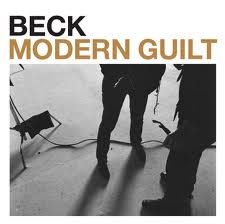
shoppingSOUNDTRACK: BECK-Modern Guilt (2008).

modern guil;As I mentioned, I missed Modern Guilt when it came out.  I guess I had burnt out on Beck after The Information.  But man, I have recently gotten into it big time.  It may be my favorite Beck album of all.  It is brief and simple but with enough going on to keep iot more than just interesting.  The feel is consistently retro by Beck but Danger Mouse throws in enough modern elements to keep it totally fresh (at least six years after the fact).

“Orphans” opens with a hyper drum beat and keyboards, but once the chords and Beck’s vocals come in it has a very sixties folk/psychedelic vibe.  But those drums keep coming it, making it sound very modern.  This has one of the catchiest verses that Beck has sung in addition to a great unexpectedly poppy bridge.  The song is unmistakably Beck, but the flourishes are very Danger Mouse.  “Gamma Ray” opens with a surf rock sound and backwards backing vocals.  It sounds very “future”, but future from the 60s.  This song ends abruptly just under 3 minutes, it’s especially abrupt after the length of some of his more recent albums.  “Chemtrails” opens like mid 70s Pink Floyd–synths and falsetto vocals.  But when the drums come crashing in it totally changes the song to a more modern sound–and yet that bass is still very Pink Floyd.  “Modern Guilt” has a very simple beat and seems like a simple catchy song.  Then the keyboards come along top and it feels kind of spacey.  Then the second guitar riff comes in underneath the song and it’s grounded again.  There’s so much going on in this little poppy gem.

“Youthless” is another straight ahead simple rocker, this one has disco synth lines over the top.  It reminds me of “Cellphone’s Dead” from The Information (I keep waiting to hear “One by One, gonna knock you out”).  It’s the only song on here that reminds me of another of his songs. “Walls” has a cool vocal melody that plays off of the music very well.  It also ends abruptly–a very cool two and a half-minute song.  “Replica” has very contemporary chaotic drumming that pins this floating song.  “Soul of a Man” makes me think of Deep Purple’s “Hush” for some reason.  But I love the way the guitars and noises just seems to come and go leaving the classic rock rhythm pulsing underneath it all.  “Profanity Prayers” has a very punk feel–buzzy guitars and a fast beat, and yet it’s also smoothed over somewhat with an interesting backing vocal line.  “Volcano” is a slow song that anchors the album nicely.  It runs a little long, but this brief album earns a longer coda like that.

I just can’t stop playing this.

[READ: April 2, 2014] “Shopping in Jail”

Just when I thought I had caught up with everything that Douglas Coupland had published, I came across this book, a collection of his recent essays.  I enjoy the very unartistic cover that Sternberg Press has put on this.  It looks extremely slapdash–look at the size of the print and that the contents are on the inside front cover.  But the essays contained within are pure Coupland and are really enjoyable.

I have read a number of his older essays in recent years.  And here’s the thing: reading old Coupland essays just makes you think, ho hum, he knew some things.  But you don’t really think that he was on the forefront of whatever he was thinking.  So to read these essays almost concurrently is really fascinating.

His thoughts are science fiction, but just on the cusp of being very possible, even probable.  He also looks at things in ways that the average person does not–he notices that on 9/11 people didn’t have picture phones–imagine how more highly documented it would have been.  These essays are largely about technology, but they’re also about the maturation and development of people and how they relate to things.  Coupland can often seem very ponderous, and yet with these essays he seems prescient without actually trying to predict anything.  I enjoyed this collection very much. (more…)

Read Full Post »

booger1SOUNDTRACK: “WEIRD AL” YANKOVIC in 3-D (1984).

in3dAfter Al’s debut he came roaring back the next year with In 3-D a disc which opens with his first Michael Jackson parody “Eat It.”  The song was leaps and bounds above anything on the debut (even if there are still hand farts in it).  The song actually sounds like the original (if a little less “full” and a little goofier and on the whoo hoos).  But the solo by Rick Derringer rocks and the whole song works very well.  The rest of the album is a solid mix of originals and parodies

I didn’t really understand that “Midnight Star” was meant to parody the Weekly World News and such (I didn’t really know those papers at the time) but I thought the headlines were funny.  And yes its a lot of fun to sing a long to.  It’s always funny when Al parodies a song that is already rather stupid (My Sharona, or in this case Safety Dance), and “The Brady Bunch” opens with a general overview of stupid TV shows and then morphs into the The Bunch’s theme song to the music of “Safety Dance.”  “Gonna Buy Me  A Condo” is a reggae song which I never really got the joke of as a kid.  I mean, I knew it was reggae but I didn’t know enough about reggae to know that this song is kinda funny, about selling out for the mainstream life.  It’s not genius or anything but it’s kinda funny–in fact I think it’s funnier now than I ever did as a kid.

“Jeopardy” works perfectly as a parody.  It retains all of the weird sounds and “drama” of the original and yet it works entirely unto itself.  It’s definitely an early highlight.  This disc also introduces what would be come a staple on all his later albums:  “Polkas on 45” where he mashes together a string of songs into a polka beat.  They are always fun and clever.  This one is a mix of new wave and classic rock bands Devo, Deep Purple,  Berlin, The Beatles,  The Doors,  Iron Butterfly, Jimi Hendrix, Talking Heads, Foreigner, The Police,  The Clash,  The Rolling Stones,  and The Who.

“Mr Popeil” is another one that I didn’t full get until later (why did i like Al if I didn’t get any of the jokes?).  Ron Popeil is the king of the As Seen on TV  product (as listed in the song).  The thing that I really didn’t get was that this is was a parody of the B-52s–one of the first parodies he’d done that’s a parody of band but not really a song.  This is not a parody of Rock Lobster exactly, but it sounds quite a lot like it–and that’s a neat trick.

“King of Suede” is a parody of The Police–I never really liked it even though it does work as a parody–perhaps the original isn’t a very string song.    “That Boy Could Dance” is instantly forgettable, so much so that I had forgotten all about it.  “Theme from Rocky XIII” is a pretty funny parody of “The Eye of the Tiger.”  But it doesn’t prepare you for the genius that is “Nature Trail to Hell.”  An epic song about horror movies with the great line “if you lie the 6 o clock news you’ll love Nature Trail to Hell (in 3D).”  It’s over the top and very silly–the music escalates  with screams and strings and several different sections (although the solo section is a little anemic).  I can’t imagine what he would do with it today if he rerecorded it.

So In 3-D was a big jump in quality for “Weird Al” and was actually a pretty big hit (charting at #17).

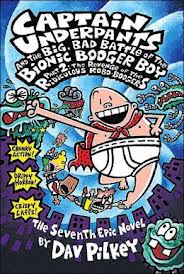
[READ: February 22, 2013] Captain Underpants and the Big Bad Battle of the Bionic Booger Boy Part 2

Since it is 2013 and not 2003, I don’t have to wait several months for Part 2.  Huzzah!

The opening comic in this book not only gives all of the Captain Underpants background that it usually does, it also includes what happened in Part 1.  At the end of the book, the robotic booger monsters (Carl, Trixie and Frankenbooger) were on the attack.  They destroyed the Combine-O-Tron 2000 so it would not reverse the effects of the machine on Captain and Melvin.  But Sulu the hamster rescued them by hurling the boogers into space (with his mouth, ew).

The boys want to get things back to normal.  But Professor Krupp (who is in Melvin’s body) is going about his business getting everyone in trouble.  Except that since he looks like Melvin people are getting angry at him rather than listening to him.  This book features a wonderful letter swap from “Check out our school’s big internet website at http://www.jhes.com” to “We shake our big butts when we swim in the toilet.”

The boys give up on trying to fix the Combine-O-Tron and decide to use the Purple Potty Time Machine that is in the library and go back in time.  There’s a great sequence in which the librarian has banned every book but one and I love the posters that are up encouraging the banning of books–it’s another awesome dig at those who censor.  And the librarian is named Miss Singerbrains. (more…)

Read Full Post »

[WATCHED October-November 2012] Metal Evolution

metal evolutionVH1 aired this series last year and I was intrigued by it but figured I had no time to watch an 11 hour series on the history of heavy metal.  Of course, this being VH1, they have since re-aired the series on an almost continual loop.  So, if you’re interested, you can always catch it.

This series was created by Sam Dunn, the documentary filmmaker who made the movie Metal: A Headbanger’s Journey.  I had heard good things about the movie, but never saw it.  After watching the series, I’m definitely interested in the movie.  Dunn is a keener–A Canadian heavy metal fan who is really into his subject.  He knows his stuff and he knows what he likes (heavy metal) and what he doesn’t like (glam metal, nu metal).

The sheer number of people he interviews is impressive (as are the number of locations he travels to).  Part of me says “wow, I can’t believe he was able to interview X,” and then I remember, “X is really old and is nowhere near the level of fame that he once had.”  Given that, the few hold-outs seem surprising–did they not want to have anything to do with VH1?  Are they embarrassed at how uncool they are now?  Just watch the show guys, you can’t be as low as some.

The only mild criticism I have is that the show relies a lot on the same talking heads over and over.  Scott Ian from Anthrax, whom I love, is in every episode.  Indeed, he may be a paid VH1 spokesman at this point.  There are a few other dudes who show up a little more than they warrant, but hey, you use what you got, right?

What is impressive is the volume of music he includes with the show.  I assume that he couldn’t  get the rights to any studio recordings because every clip is live.  This is good for fans in that we get to see some cool unfamiliar live footage, but some of it is current live footage which often doesn’t compare to the heyday.  Having said that, there’s a lot of live footage from the early 80s–of bands that I never saw live anywhere.  And that’s pretty awesome.

With an 11-part documentary there’s the possibility of exhaustion and overkill, but Dunn is an excellent craftsman  he jumps around from old to new, talks about how the history impacts the current and, because of his own interests, he makes it personal rather than just informative. (more…)

Read Full Post »

SOUNDTRACK: THE FLAMING LIPS-“Smoke on the Water” (2012).

There’s a new Deep Purple tribute album coming out shortly (is this the year of tributes?  what’s going on?).  Anyway, the lineup isn’t all that inspired, but I was curious to see what the Flaming Lips would do with that song

As with their recent reinterpretation of Dark Side of the Moon, this cover is respectful and utterly disrespectful.  Musically the song is pretty accurate. Well, the notes are the same.  But the style is very different, kind of wahwahed delicate chords–no heavy bass or anything.  But it’s the vocals that are the contentious point–he recites the entire song (which kind of works because it is a story) in a stilted, faux British accent.

The second verse has a very computerized voice singing an autotuned melody along with the recitation–sort of a harmony but not.  This voice continues through to the chorus (which the main vocals also simply recite).

I appreciate the Flaming Lips’ approaches to popular songs, but this version renders a big loud song kind of anemic.  Which is so weird because the last few Lips albums were so loud and bass-heavy.  I listened twice, I probably don’t need to listen again.

So, this is yet another tribute I won’t be buying.

[READ: August 22, 2012] Don’t Get Too Comfortable

I’m already making good on my promise to read more David Rakoff.  Indeed, as soon as I heard that he died, I put this book on hold at the library.  The strange thing about this book is that I feel like I read parts of it already.  I don’t feel like I read the whole book because some things were unfamiliar to me, and yet there was a strange feeling of déjà vu throughout the book.  But I looked in the front of the book to see where these essays had appeared and I don’t read any of the magazines where they initially showed up.  And while I like This American Life, I don’t really listen to it very often.  So either I read this book seven years ago or these pieces are inspirations for other pieces I have read (which is possible–two or three articles in here reminded me of things that A.J .Jacobs has since done).

So this collection of essays takes place during the early 2000s, George W. Bush’s first term (not the happiest time to be a gay Canadian living in New York).  But in addition to the first essay which is all about his quest for citizenship, it seems that Rakoff was now gainfully employed as a freelance writer.  Most of these essays seem to have been requested for magazines–like they sought him out to write them.  So his fame was clearly growing.  And, again, like A.J. Jacobs, he seems to have been picked as a guinea pig for certain pieces.   I don’t really know if this is a “genre” per se, I mean lots of un-knowledgeable people have gone into new experiences to write about them (insert inevitable David Foster Wallace reference here–but of course he wasn’t the first either).  But Rakoff’s subjects in the last couple essays seem to be closer to what Wikipedia calls Jacob’s “stunt” journalism. (more…)

Read Full Post »

« Newer Posts