Feeds:
Posts
Comments

Archive for the ‘Museums’ Category

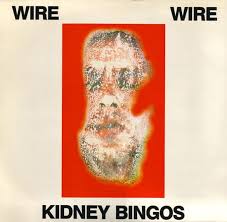
SOUNDTRACK: WIRE-Kidney Bingos (1988).

Wire’s first three albums are punk and post-pink classics.  So classic that a Britpop band ripped off one of their songs to make an even bigger hit.  (I rather like Elastica too).

After their hiatus in the early 1980s, they returned with a new sound.  Like King Crimson only with fewer notes.

Their second post-hiatus album A Bell is a Cup even had a single, “Kidney Bingos.”

This song is remarkably far from their early punk sound. It’s almost as if on their first albums, their guitars only had the low strings,  And on this one, they only have the high strings.

The guitars on this song are gentle and jangly.  The bass is pretty similar–nice and deep with a great resonance, although the tempo is much slower and more chill.

The chorus is a really catchy bit if pop fun, even if for 30 years I had no idea that he was saying

Money spines paper lung kidney bingos organ fun

which makes as much sense as what I thought he was saying.

The end of the song throws in some synths and a wordless singalong that shows a real depth to Newman’s voice.

[READ: June 29, 2019] “Pastoralia”

I was sure I had read this story before.  But it turns out I’ve had his collection Pastoralia on my “too read” list but had never actually read it.  In the collection, this story is almost 70 pages.  It’s pretty long in the New Yorker, but i do have to wonder if it is an excerpt as there’s so much that is unexplained.

This story is set in what I think of as the Saunders future.  There’s no ProperName objects as there usually are.  But this future has a lot of the mildly dystopian qualities that Saunders tends to put in his stories

This one includes an exhibit where humans act out historical scenarios in a museum of sorts (the details are never given).

The narrator’s name is never given.  Over the course of a few pages we determine that he is a caveman in an exhibit.  Every day he is supposed to “eat grubs,” “see” a herd of animals and not speak English.  He has a “wife,” Janet.  She is not his real wife, he has a real wife and children.  In fact he doesn’t especially like Janet. She tends to speak English a lot and disregards most other work protocols.

In many respects it doesn’t matter because hardly anyone comes into the museum.  But they are doing a job and they do have supervisors.

When the light dims as if it were night time they each go to their separate personal quarters where they have such modern amenities as a fax machine (this was written in 2000 so that’s not a goof, I don’t think).  (more…)

Read Full Post »

SOUNDTRACK: DAVID BYRNE AND BRIAN ENO-My LIfe in the Bush of Ghosts [Remix website] (1981, 2006).

I’m stealing the bulk of these comments from a Pitchfork review of the album reissue because I have never actually listened to this album which I’ve known about for decades.

When Eno and Byrne released My Life in 1981 it seemed like a quirky side project.  But now, Nonesuch has repackaged it as a near-masterpiece, a milestone of sampled music, and a peace summit in the continual West-meets-rest struggle. So we’re supposed to see Bush of Ghosts as a tick on the timeline of important transgressive records.  Nonesuch made an interesting move that could help Bush of Ghosts make history all over again: they launched a “remix” website, at www.bush-of-ghosts.com, where any of us can download multitracked versions of two songs, load them up in the editor of our choice, and under a Creative Commons license, do whatever we want with them.

The only thing is, at the time this review was written, the site was not up yet.  And as I write this in 2019, there’s nothing on the site except for a post from 2014 about Virgin Media and Sky TV.  Alas.

[READ: May 1, 2019] “The Ecstasy of Influence”

Back in the day I was a vocal proponent of free speech.  It was my Cause and I was very Concerned about it.

It’s now some thirty years later and I don’t really have a Cause anymore.  It’s not that I care less about free speech, but I do care less about the Idea of free speech.

Had I read this article in the 1990s, I would have framed it.  Right now I’m just very glad that people are still keeping the torch alive.

Lethem begins this essay about plagiarism by discussing a novel in which a travelling salesman is blown away by the beauty of a preteen girl named Lolita  That story, Lolita, was written in 1916 by Heinz von Lichberg.  Lichberg later became a journalist for the Nazis and his fiction faded into history.  But Vladimir Nabokov lived in Berlin until 1937.  Was this unconscious borrowing or was it “higher cribbing.”

The original is evidently not very good and none of the admirable parts of Nabokov’s story are present in the original.

Or Bob Dylan.  He appropriated lines in many of his songs.  He borrowed liberally from films, paintings and books.  Perhaps that is why Dylan has never refused a request for a sample. (more…)

Read Full Post »

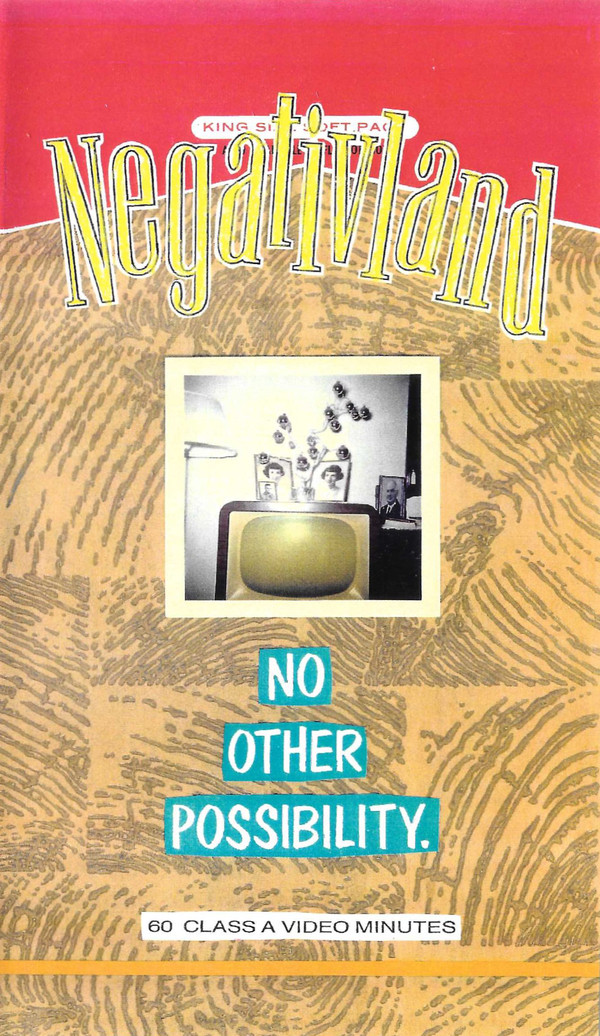
SOUNDTRACK: NEGATIVLAND-No Other Possibility (1989).

In the year that Helter Stupid came out, Negativland released this one hour video.  It is a visual approximation of a Negativland album.  Lots of cuts, lots of snippets of ads and songs and news broadcasts.  It’s mostly nonsense with some reality and some things that may or may not be reality.  Who knows?

It opens with a critical diatribe that scrolls over a test pattern.  The diatribe by Crosley Bendix criticizes everything that is (correctly) poor about the video and making up other things–the death of a stuntman.

After the opening credits, the video opens with David Willis’ mother watching TV.  On the screen is a clip from Dick Vaughn and his Jack-O-Lantern (more below).  Then she asks David for her cigarettes and the song from A Big Ten 8 Place is acted out hilariously.

After some clips from video games and a commercial for Marlboro, there’s a video for “Nesbitt’s Lime Soda Song.”  When the bee comes into the song, it turns into clips of David filming his family talking about bees and more (like his grandma looking in the fridge for potato chips which makes David laugh).

Change channels until The Dick Vaughn Show comes on and he brings out David Willis to light up a Jack-O-Lantern with 700 volts.

After a commercial from ZOTOS and Nation Hairdressers and Cosmetologists Association that tells women they have to look their best in order to get a job.  “Appearance and good grooming are essential.”

Then it’s time for Trick or Treat with David Willis who is dressed as E.T.

He talks about Halloween safety with 5 hand drawn posters.

  1. no fresh fruit–nails razors
  2. looks for holes or tears in wrappers–inject chemicals
  3. avoid homemade treats
  4. avoid weird, strange-looking people.
  5. if you bob for apples make sure your partners are not sick

Then some explosions with cars flipping.  A small video slowly evolves revealing a live performance of David singing the “Very Stupid” song from 10-8.   It is noisier and rocks pretty hard while David yells the lyrics: “1, 2, stupid ; 3, 4 dumb.”  The version slowly comes into focus as David roams the audience.  he even adds new lyrics: “1,2 urinate ; 3, 4 defecate ; 5, 6 fornicate ; 7, 8  seat be sate!”

After a text: “Earlier that same evening,” a car drives into the building under a scroll from Dick Goodbody raving about this beauty, “her name is Monarch Mercury Monarch.”

Followed by a commercial for the Monarch.

Then there’s a video clip of the fire in the Negativland recording building (which I think is true?).  They interview Mark Hosler who grabbed master tapes and studio equipment.  He tours the burned out building.

Then there’s interstitial questions of what people think about TV.

  • An old man complaining about sex on TV.
  • Teenage girls saying they like soap operas because of the sex.
  • A guy saying TV would be improved if they quit showing so many commercials.

Up next is Crosley Bendix (“Director, Stylistic Premonitions” played by Don Joyce) of the Universal Media Netweb has an insane piece about numerology, at the end of which he cries, “Thanks a million!

  • MTV has fine guys on it

Then comes Negativland “Fire Song” with Mark singing in the burnt house.

A series of ads for canned foods: tomatoes, grapes, yams, dog food over a muzak version of “Age of Aquarius.”

Then comes the religion portion of the show.  Another diatribe by Crosley Bendix complains of people always searching for more intense entertainment.  Since Jesus’s time.  In fact, The Last Supper is the crucial link-up of food and show business.

Then comes more live scenes of some crazy music and kids walking around in costumes who start shouting about ice cream and other food.

  • I don’t watch religious TV because I have a personal relationship with Jesus Christ.

Clips of preachers and then Pastor Dick comes out,

He tells some dad jokes like asking for coffee without cream and the waitress saying “you’ll have to have coffee without milk because we are out of cream.”

He brings out a racist ventriloquist dummy Enrico Gomez.  Then has everyone sing along with the Christian Youth Fellowship song from the album How Do You Spell Joy?

He has a Stop sign and asks everyone to clap along. Stop! [clap clap] And let me tell you what the Lord has done do me.  When he turns around the sign is a hand written note “fuck you pastor dick.”

Then comes the 5 eyewitness news team featuring Hal Eisner, with the video of the audio used in side one of the album Helter Stupid.  Don Joyce is interviewed.

As the video ends, there’s one more guy that they interview.  He says

TV is gonna make me famous one day.  When the interviewer asks how, the guy says

“you gotta know how to exploit the media.”

Was he a plant?  Who knows.  There is no other possibility, godammit.

Watch the whole video here.

[READ: April 25, 2019] “Attention Geniuses: Cash Only”

Woody Allen doesn’t seem to write much for the New Yorker these days.  I’ve found over the years that I rather like some of his New Yorker jokes and then others are just ho-hum.  Of all of the short “funny” pieces in the New Yorker, Woody tends to be able to pull off three pages better than others.

Although this one drags and often come across as an excuse to throw out pretentious references.

And yet he’s got some great turns of phrase:

Jogging along Fifth Avenue last summer as part of a fitness program designed to reduce my life expectancy to that of a nineteenth century coal miner

(more…)

Read Full Post »

SOUNDTRACKRHEOSTATICS-Molson Centre Montreal, QC (December 9, 1996).

This is the 21st night of the 24 date Canadian Tour opening for The Tragically Hip on their Trouble At The Henhouse Tour. According to this host of the RheostaticsLive site: This in my opinion is the best show of the tour.

This show opens with the recording of the French language hockey game.  This time you can clearly hear him shouting Esposito!  After the recording fades,

It opens in a very amusing way.  I imagine that Dave and Martin are lying on the stage, because Dave asks, “Martin can you sleep?  I should have been asleep hours ago.”
Martin: “No, I can’t sleep.  I was up all night listening to the Local Rabbits.  Those riffs will keep anybody awake.”
[Tim starts playing the bass].
Dave “I had this weird dream we were playing in a giant rock stadium, opening for Ringo’s All Stars.  It felt really weird.  And everyone was speaking a different language.”
Martin: “Ringo’s really giving it this tour.”
Dave: “I’m just gonna get out of bed and see what Tim and Don are doing.”

They launch into “Fat.”  I really like the nice little bass tag Tim adds to the end while Martin sings “Bye Bye.”

“Aliens” is a nice surprise–I feel they just don’t play it all that much.  The feedbacking guitar segues nicely into a rocking “All the Same Eyes.”

It’s followed by a fun and bouncy “Michael Jackson.”  At the end, Martin says, “It feels good to be alive.”  Tim deadpans, “sometimes.”

Thanks to CSRG & CHUM FM and C5 for coming down and talking to us today.  This is a song [“Bad Time to Be Poor”] that’s getting played on the radio in all the finer dentist offices in the land.

Some cool sounds from Martin open up “California Dreamline.”  The ending part totally rocks until the denouement where it sounds like someone rocks so hard they may have de-tuned their guitar.

They wish Happy birthday to Gary Stokes, the finest soundman in the land.  Which leads to a lovely “Claire” that segues into a quiet intro for “Horses.”  It builds slowly and powerfully.   Lots of repeated lyrics in the middle–threaten to chop, chop.  These signs will wilt–they’re just paper ink and paper.

While martin ends with some wailing horse noises, Dave sings the first two lines of “Another Brick in the Wall” to end the show.

[READ: April 9, 2019] “Both Sides Now”

This is an excerpt from Gainza’s novel Optic Nerve which was translated by Thomas Bunstead.

It’s a little hard to guess what the whole novel is about since the excerpt worked so well by itself.

The narrator notes that one day you develop a fear of flying.

Before you turned twenty-five, flying seemed natural, but now it seems insane.  Nevertheless, you are supposed to fly to an art convention in Geneva. (more…)

Read Full Post »

SOUNDTRACKALFREDO-RODRÍGUEZ-Tiny Desk Concert #796 (October 18, 2018).

As this Tiny Desk Concert started,  I was sure the main musician was the bassist.  Given his fascinating outfit and his amazing bass playing, I was sure it was all about him.  I was still more impressed with the bass even after learning that:

Cuban pianist Alfredo Rodríguez gave our office audience a very quick lesson on why pianists from that island nation are so impressive: they treat the piano as the percussion instrument it is. Rodríguez immediately let fly with an intense flurry of notes that were as melodic as they were rhythmic.

But really, once Rodríguez starts playing you can tell that he is the composer and creator, even if guitarist/ bassist Munir Hossn is the exciting splash on the music.  I didn’t mention that Hossn also plays guitar.  It’s on a stand which he walks over to play in between amazing bass runs.

“Dawn” opens with some singing and a very simple rocking kind of feel.  Then Hossn plays some wonderful guitar soloing notes while Rodríguez plays his complicated main lines.  Meanwhile, Hossn has switched back to bass and is playing some amazing jazzy lines–fast, furious and at times really high notes.  It’s pretty cool.

There’s a lengthy guitar solo (with Rodríguez clapping) before the main song resumes with two very distinctive styles of music.

The mash up of European lyricism and Afro-Cuban percussion is at the heart of the Cuban piano tradition and it is very present in the first song. It wasn’t long before Rodríguez dug deep into rapid-fire syncopation along with drummer Michael Olivera.

Listen to the expansive and lyrical exploration of the second song in this Tiny Desk set, “Bloom.”

It opens with a lovely piano melody twinkling along the keys.  But it’s that great low-end and the simple drums (check out Olivera’s jacket) that takes it beyond “European lyricism.”  There’s some wonderful interplay between the musicians and some great effects from Hossn on bass (how does he get those super high notes?).

The final song is called “Yemaya.”  It opens quietly with Rodríguez singing before turning into a frenetic piano melody with Hossn’s intricate guitar pyrotechnics.  The song is eight minutes long and features many components including a lengthy, beautiful (and impressive), piano-only section.  But I still love watching Hossn (as he hat falls off) the most.

West Africa-based Yoruba spiritual tradition, commonly known as Santeria, infuses so much of Cuban daily life in music and Rodríguez closes with his take on the music dedicated to the Orisha Yemaya, the goddess of the ocean and all waters. The song’s melody is a derivation of the song associated to Yemaya and the Tiny Desk trio explores the rhythms of the melody, up to and including the sing-along at the end.

Every exposure to Cuban music presents an opportunity to walk alongside historical music figures and Santeria spirits alike.

Especially when it ends with an engaging sing along like this one does.

Actually they seem to be having so much fun that they refuse to end the set by playing one more wild coda to top everything off.

[READ: November 28, 2018] “Children are Bored on Sunday”

The December 3, 2018 issue of the New Yorker was an archival issue, meaning that every story was taken from an earlier issue.  The range is something like 1975-2006, which is odd since the New Yorker dates back so much longer.  Although the fiction pieces are at least from the 1940s and 1950s.

This story was written in 1948 and it is certainly of a certain time and place–specifically The Metropolitan Museum of Art in 1948.

Emma is a young, single woman browsing the art gallery.  She is excited to see a Botticelli, but as she nears the room, Alfred Eisenburg is standing there right in front of “The Three Miracles of Zenobius.”  She liked Alfred and even flirted with him at a party “in some other year.”

At most other times she would have been pleased to see him, but she turned quickly back the way she had come. (more…)

Read Full Post »

SOUNDTRACK: GIL SHAHAM-“Partitat No. 2 “Gavotte en Rondeau” by J.S. Bach” (Field Recordings, January 12, 2012).

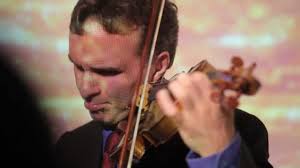
This was the very first Field Recording posted on the NPR site back in 2012 [Gil Shaham: A Violinist’s Day At The Museum].

Shaham plays Bach in the Hirshiorn Museum.

As Gil Shaham wandered through the back offices of the Hirshhorn Museum and Sculpture Garden in Washington, D.C., he said he felt “like Ben Stiller in Night at the Museum.” For this impromptu Bach mini-recital, the violin superstar momentarily became part of the art, bathed in the modish lighting and projections of a multimedia installation during the performance.

He is introduced with the rather amusing:  “A world famous, world renowned violinist who, by the way, starts every morning with a bowlful of Cap’n Crunch.  He told me that.”

I love that this first Field Recording was, like many of NPR’s best things, a spontaneous idea:

A crowd packed the exhibit room to watch as Shaham launched into Bach’s third partita. After the performance, the violinist greeted fans in the museum, many of whom were headed to his concert at the Kennedy Center that night. He seemed surprised and delighted that the guerrilla concert, announced only on local classical station WETA and Twitter that day, drew so many people willing to hear Bach in the afternoon.

[READ: January 22, 2017] “Are We Not Men”

Boyle’s stories aren’t usually as fanciful as this.  But I loved it just as much as many of his other more down to earth stories.  I particularly enjoyed that it was set in the future, although there was no real statement of that until late in the story.  There were hints, which seem obvious in retrospect, but which at first just seemed like hyperbolic or metaphorical.

Like “the dog was the color of a maraschino cherry” or that the lawn incorporated “a gene from a species of algae that allowed it to glow under the porch light at night.”

The story opens with the cherry-colored dog killing an animal in the narrator  Roy’s front yard (on that grass).  He wanted to chase the dog away because it might ruin his grass.  Then he noticed that what the dog had killed was his neighbor Alison’s pig.  She loved that pig and anthropomorphized it.  To try to salvage the pig, he ran up to the dog waving his arms.  It immediately latched onto his forearm instead.

As Roy fights with the dog, the dog’s owner, well, the daughter of the owner, came running across the street.  She looked like a teenager but was actually 11 or 12.  When the girl says, “You hit my dog,” he replies that she bit him.  The girl says Ruby would never do that–she’s just playing.

Amid this horrorshow of blood and violence and death, and a sprinkling of genetic splicing, Boyle throws in a very funny experiment gone wrong.  Crowparrots were a modified bird which blended crows with the invasive parrot population.  It believed that the experiment would turn the parrots into carrion eaters.  But instead it made their calls loud and more frequent.  And they mimicked, so they “were everywhere, cursing fluidly, (“Bad bird! Fuck, fuck, fuck!“).” (more…)

Read Full Post »

SOUNDTRACK: DANIEL HOPE-three pieces (Field Recordings, August 21, 2013).

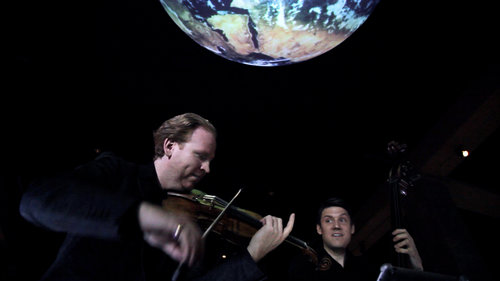
The only thing I like more than a Field Recording set outside, is one set in an unlikely building, like the way this Field Recording [Daniel Hope’s Earth And Sky Expedition] is set in the American Museum of Natural History.

When Daniel Hope was a boy, the only thing he loved as much as his violin was his telescope. Gazing into the night sky, he pondered the vastness of space. Now a grown man, Hope still has a penchant for wonder and discovery — especially when it comes to music.

In his latest album, Spheres, Hope returns to the spirit of those early astronomical adventures. His idea, he says, is “to bring together music and time, including works by composers from different centuries who might perhaps not always be found in the same galaxy.” The unifying factor is the big question: Is there anything out there?

What better place to play with that ancient query than the Rose Center for Earth and Space at New York’s American Museum of Natural History. We invited Hope and jazz bassist-composer Ben Allison into the “performance crater” in the Hall of Planet Earth.

As if the Hall isn’t interactive enough — with its glowing orbs and 4.3 billion-year-old zircon crystal — we wrangled afternoon museum-goers to participate in our own Earth and sky expedition. Equipped with small flashlights, they became the twinkling stars surrounding Hope and Allison in the darkened room.

The music seems to live and breathe in the space, as each of the three pieces (spanning four centuries) reverberates a unique voice. “Imitation of the Bells,” with its rippling arpeggios and tolling bass line, comes from the long forgotten Johann Paul von Westhoff, a German violin master who crisscrossed Europe a generation before J.S. Bach. In “Berlin by Overnight,” from contemporary Max Richter, Hope’s violin asteroids whiz past while Allison’s bass propels through outer space. And finally, the otherworldly beauty that is Bach’s “Air on a G String” floats in a safe, gentle stasis.

It’s neat watching the little kids swing their flashlights around while the older kids watch on, bored, from the balcony during “Imitation of the Bells.”  Hope’s violin is flying in a flurry of activity while the bass keeps things grounded.

I’m not sure that I have heard many violin pieces performed with a bass accompaniment.  The bass doesn’t add a lit of melody to the violin work, but it adds a very cool feeling of grounding and rhythm especially in “Berlin by Overnight.”  The piece feels very contemporary with a cool, fast, Glassian kind of repetitiveness.  And the bass adds occasional notes (that feel like rock bass notes, he plucks so hard) to keep the pace going.

The bass is much more pronounced on the familiar J.S. Bach: Air on a G String.  I feel an imperceptible sitting up straight once the first notes ring out of the violin.  But I keep coming back to the bass.  The violin melody is so pretty and so familiar that it’s interesting to listen to the way the bass plays off those notes.

[READ: February 9, 2018] “The Botch”

I have not enjoyed Means’ stories in the past.  They’re usually pretty violent and just not my thing.

This one was a bit more enjoyable until the end.  The only problem with it per se was that it was about a bank robbery and I feel like there’s not much you can say about a bank robbery that hasn’t been said in films and stories already.

But there’s some interesting tweaks.  It is set around the Great Depression–tommy guns and wise guys.  And the mastermind behind the scheme has thought out everything ahead of time.  There is a repeated refrain of “the idea is” which I kind of liked.  Although for some reason it bugged me when it was switched to just “idea being,” which I know is how it would be said, but it bristled. (more…)

Read Full Post »

SOUNDTRACK: GREGORY PORTER-“Be Good (Lion’s Song)” (Field Recordings, May 14, 2013).

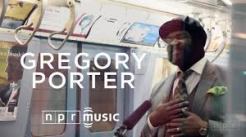
The still from this Field Recording [Gregory Porter: A Lion In The Subway] certainly led me to think that Porter would be singing on an actual moving train car (the ambient noise would be IMPOSSIBLE to filter out).

Of course, it wasn’t the most practical (or legal–bands and other musical acts need to audition to even set up underground. And those are just the “official” performers) thing to actually get Gregory Porter to perform on an operational MTA train. So we asked him if he’d perform for us at the New York Transit Museum in downtown Brooklyn, a collection of vintage memorabilia and reconditioned cars housed in a former subway station. All the better: Porter has a way with vintage suits, and there was a fortunate coincidence about the way it all felt right among the period-specific ads which flanked him. Accompanied by pianist Chip Crawford — who perfectly punches and beds the gaps here — Porter sang his original “Be Good (Lion’s Song),” a parable of unrequited affection.

The only thing I know about Gregory Porter comes from his Tiny Desk Concert.  I marveled that he wore a hat with ear flaps the whole time.  Well, he does the same thing during this song.

Gregory Porter has the frame of a football linebacker — maybe because he once was one, for a Division I college — and the rich, booming voice you might expect from a guy with such lungs. It cuts through a crowd with its strength, in the manner of an old-school soul singer; it demands attention with its sensitivity. If Porter weren’t winning over the international jazz club and festival circuit, he’d rise above the din wherever he went.

This is a sweet, quiet song, befitting him and the location.  The lyrics are a clever metaphor about lions and love.

[READ: October 22, 2017] “Scared of the City”

This is an essay about being white in New York City.

Franzen says that in 1981 he and his girlfriend were finishing college and decided to spend a summer in New York City– a three-month lease on the apartment of a Columbia student on the comer of 110th and Amsterdam.  It had two small bedrooms and was irremediable filthy.

The city seemed starkly black and white “when a young Harlem humorist on the uptown 3 train performed the ‘magic’ act of making every white passenger disappear at Ninety-Sixth street, I felt tried and found guilty of my whiteness.”

A friend of theirs was mugged at Grant’s Tomb (where he shouldn’t have been) and now Franzen was morbidly afraid of being shot.  The impression of menace was compounded by the heavy light-blocking security gates on the windows and the police lock on the door.

Franzen made some money when his brother Tom came into the city to do some work for hot shot photographer Gregory Heisler at Broadway and Houston.  Franzen was a gopher and made trips around the Bowery and Canal Street but he knew not to go to Alphabet City. (more…)

Read Full Post »

SOUNDTRACKRHEOSTATICS-The Horseshoe Tavern, Toronto (May 25, 2017).

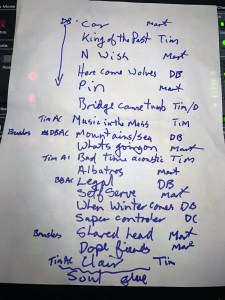
Second of four shows at The Horseshoe Tavern dubbed Spring Nationals. First Time played live for the new songs Rear View (Tim), Here Come The Wolves (Dave B), AC/DC On My Radio (Dave B/Dave C).
Lineup is:
Dave Bidini / Dave Clark / Hugh Marsh / Ford Pier / Martin Tielli / Tim Vesely

The show starts with a kind of quiet, hushed version of “Stolen Car” with cheers for Hugh’s violin solo at the end of the song. And then Martin introduces “Ford Kristofferson on the keyboards” (Man I wish I could see what Ford looks like).

Someone shouts “Rheos rule” and Clark comments, “if we did, there’d be world peace.”

They play a wonderful combination of “King Of The Past” (Clark: King of the Pasta) and “Northern Wish.”

The crowd whoops and Dave says that that is the appropriate sound for the new song.  Clark: “It’s called “Confused Wolf.”  The song is really called “Here Come The Wolves” and it’s a powerful song with great toms and violins.

This one [“P.I.N.”] is called “Snakes on a Plane.”

Clark says “Big thanks to Dani Nash and her rocking band.  She also drums for the Samantha Martin Band.  She is a wicked drummer and a knockout visual artist, too.

[We’re skipping a song on the setlist, shhh–they were going to play “Bridge Comes Tumbling Down”].  They “bridge” to “Music Is The Message” and as Tim says, “we played a bunch of new songs last night and playing them again tonight and they’re completely different.  It’s awesome.”

Dave B: We’ll try to play this next song (Dave’s “Mountains And The Sea”) well for once.

Clark says “That is the first chord of Dust in the Wind, right?  It was a hit for them, why not us?”

There was a lengthy solo from Hugh including a funny bit where he holds off on playing notes busting all the anticipation.

Martin comments: “I’ll call you David from now on.”
DB: “Are you mad at me?”
MT: “No it’s jut you insist on that….  Don’t Davids bug you?  Or Mikes who insist on being called Michael.”
DB: “I’d like to send that out to Michael Philip Wojewoda who is here tonight.”
MT: “I’ve always hated that about Michael Phillip.”
Tim: The only thing worse that David is “Daveed”
Clark: “And yet David Durango is one of the nicest guys going.” (I can’t figure out who they are talking about).
MT: He’s the only guy who almost drummed for Nick Buzz.  A Band with a “no drummer” policy.”
DS: “No drummer policy? Where do I sign up?”

Tim will surprise us with an instrument change…
Someone in the audience: “Polka the shit out of us, Tim!”
DB: “There’s heavy male patter presence, which must be offset at some time.”

Tim is on “the gentleman’s instrument” for “What’s Going On Around Here?”  It sounds great to hear again, although Tim says, “that accordion was exhaling musty basement smell in my face. It’s been down there a long time.”

Up next is a duet with Hugh and Tim (on acoustic) doing “Bad Time To Be Poor” it’s very cool to hear it this way.

Dave announced the last new song of the night.  “I know you want to hear new songs but you get worried, I hope they play the one I like.  But you’re such an elastic forgiving crowd, you’ll let us do anything.”
Tim: ” Wednesday’s crowd were a bunch of assholes.”
(Someone in audience: “I’m never coming back.”)
Tim: “This is the best crowd ever.”
Martin: “Maybe the penultimate.  There was one other that was better.  They were so good.  I loved them.  I dream about them.”

Tim tells a story about opening for The Hip and getting ambivalent and odd crowds.  We expected that.  There was no abuse.

But Dave B says they played in Quebec in purple and orange jackets and people laughed… they got it!  We should be bigger in Quebec.

Martin says in New Brunswick somebody threw something at us.  Martin says he picked it up and whipped it right back at them.
But Dave says at another show, something hit Martin and he got pissed, but it was a T-shirt that said “We love you Rheostatics.”

Tim: “The moral of the story… Fucking Rheostatics fans.”

They play a wonderful “The Albatross” which is really gelling live and then a solid “Legal Age Life At Variety Store” (with an introduction to Tim Mech).  Dave shouted that he end, the Eagleson ripped off Bobby Orr line and Tim shouted “can’t you ever get over that?” During “Self Serve Gas Station” Martin sings “What went wrong with Ford?”

After some banter they’re on to “Shaved Head” which sounds great even though Martin misses a lyric.  It doesn’t throw him, although he does apologize later.

The pretty ending gets cut off but only by a little I’d guess. And they go for an encore.

After the break Dave Clark comes out to sing an a capella version of “Johnny’s Got A Problem” by D.I.   The crowd is really into it and sings along.

As soon as Martin starts playing the crazy guitar intro to “When Winter Comes” someone in the crowd goes crazy “Oh my God!  Oh my God!”  It sounds great to hear again as well.

They end the night with a song “co-written by Paul Quarrington.  Go to a library and take out one of his books.”  A lovely version of “Claire.”

It seems like maybe there might be more, but that’s where the recording ends.  The new songs have been getting better and better, and the band is having a lot of fun up there.  Dave Clark is even being a bit more silly, but nothing like he was back in the old days.

[READ: May 18, 2018] “Candidate”

This is a story of a man who works for a presidential candidate.

It is told in first person in the present and in flashbacks.

The flashbacks talk about how he and his best friend Spencer were marginal kids in school.  Spencer in particular was a somewhat shunned individual–he could have been in the Trench Coat Mafia.  But while the narrator and Spencer shared the same views and ideas, the narrator passed more easily with the other kids. (more…)

Read Full Post »

SOUNDTRACKRHEOSTATICS-The Horseshoe Tavern, Toronto (May 24, 2017).

After decades of live Rheostatics shows, this one finally catches up to just one year ago today.  Which means that after this four-night run, the only unmentioned shows from Rheostatics Live are ones from this past December.

I really wanted to get to these shows in person, but four nights in May in Toronto is not easy for me to swing.

First of four shows at The Horseshoe Tavern dubbed Spring Nationals. Dave Bidini, Dave Clark, Martin Tielli, Tim Vesely, featuring Hugh Marsh on Violin and Ford Pier on Vocals and Keyboards. In addition to the newer songs that they played in the Winter, they debuted three new songs: Rear View (Tim), Here Come The Wolves (Dave B), AC/DC On My Radio (Dave B/Dave C).

This show is “only” 2 hours long, which is something of a surprise, but maybe not for a Wednesday night.  The sound quality is great and there is a ton of hilarious banter.

“Saskatchewan” takes a while to start but it’s worth the wait as Martin and everyone else sound terrific.  Interestingly, the music sounds somewhat different with the keys and violin.  Not radically different, but noticeable.

Martin says, “That was called ‘Saskatchewan’ we wrote it in the 1940s.”

Next up is Dave Clark’s newish song “Super Controller.”  There’s a long fiddle intro before the big “bah bah bah bah dah dah dah dah.”  It segues right into “Soul Glue” where everyone does their parts wonderfully–especially the vocals.

The Daves offer a “big shout out to Friendly Rich” for opening the show and congratulations to Rich for some awesome music games for people to play.  He’s loving and kind and he’ll hug you….  but only if you ask him to.

Dave: “Great to see you all on Wednesday night–the first of 4 shows.  We’ve got opening night jitters.  Not really, we’re mailing it in.”
Martin:  “I’ve got the jitters.”
Martin to Dave: “You’re the most nervous driver I know.  No, your driving makes the most people nervous, but you are the opposite of the uptight driver.  You dance with the car.”
Dave: “Hugh and Martin don’t drive.  They’re both totally way too smart to drive.”
Martin: “We care too much about the planet.”

Pointing to the keyboards: Dave: “That’s Ford Pier.  We can’t decide if he looks like Kris Kristofferson, Kenny Loggins and… who’s the third person?”
Dave C: “I said he looks like Ronnie King from the Stampeders.”
Ford: “Who said Michael Phillip?  That’s who I was going for.”

Next up is “P.I.N.” which sounds very pretty with the violin.

Then there’ a pretty, mournful, almost Slavic violin and guitar opening to a mellow song played for the first time, Dave B’s: “Here Come The Wolves” (7:11).  Once the thundering drums kick in it’s got a kind of Jethro Tull quality.  It’s long and compartmentalized and ends with chants and tom toms.

Once it ends, Dave says, “New songs are scary, which is a good thing.”
Audience Member: (It was great)
Dave B: “Oh geez… that’s not what I was fishing for, but thank you.”
Dave C: “I liked it because I noticed Tim is howling.”
Tim: “I’d like to say that old songs are terrifying too.”
Dave B: “When you’re on the accordion.”
Dave C: “I only recently learned the next song “Sickening Song” is about sex.
Martin: “With the lowering of sexual drive comes the perception of subtlety.”

There’s a whole bit about sex and cum and ever so much more. It’s quite funny.

Then Martin gets on a long rant about the movie Urgh: A Music War.  He speaks of it lovingly as a good cross-section, of good and bad bands from the era.  Bands were very diverse.  There was no one style.  The music was free.  I love that.  So does my brother, John.

Dave Clark: “As Annie Hall would say, ‘Well, La di dah.'”
DB: “I’m going to turn off the Martinator.”‘
Tim: “I liked stage-fright Martin a lot better.” [much laughter on that].

Martin can take the joke and informs us that “Tim’s gonna accompany me on the gentleman’s instrument” (the accordion) for “Sickening Song.”  It’s great to hear this older, more unusual song.

Fave mentions that they have the new “Brave New Waves”–the first ever band on the show back in 1988 and “we sound very energetic and enthusiastic and it’s  got Dave Clark rapping on it.  It’s worth the $75.  No it’s not $75.”

Next up is Tim’s new song, “Music Is The Message.”  This is a really enjoyable version of this song, the other instruments come to the fore and Hugh Marsh’s violin is wonderful.  It’s followed by a brand new Tim song (first time plated) “Rear View” (4:16).  This one is a bit more upbeat and folkie-sounding.  Martin even acknowledges: I like that one, Tim.”
Tim: “That was a first for that one live.”

[Dave puts down the guitar and sings into jut the mic]: “It’s about to become a Corky and the Juice Pigs gig, you realize.”

He continues: “There will be no spoken word tonight sir, we will express our thoughts in melody and song.  When you go hand-held, the stand is your friend.  This is a song about coming to a new land.  “Mountains And The Sea” is a pretty song although it might be too much for Dave to sing by himself–there’s some notes that he strains with. I could see it more for Tim or Martin.  But the melody is nice and the middle improv violin section is quite cool.

Martin is back for “California Dreamline” and he sounds great.  And then comes “Claire.”  For the first time in a long time, there’s no acoustic opening, it just starts and rocks on.”

Dave starts to talk about the Rock and Roll Journey Train that their management dreamed up.  Take you up north on our journey train.
Clark: Loving, touching, hugging, squeezing.
Martin’s reaction is great: “What?  What are you talking…?”

Dave: We’re about 4 an a half songs from the end.  Did you randomly say nine more?  Then we will break for…
Tim: “A day.”

Tim: “Be excited for the next song its like 5 in one.”
Dave: “It’s a value added composition…”
Tim: “A Groupon song.”

And then there’s this amusing discourse:

This next song features Hugh Marsh on the violin.  It doesn’t, but still it seemed like a good time to mention it.

Dave Clark: The Satchel Page of the violin… Hugh Marsh.
Dave B: “He’s got a few years before he can we can all him that, Dave.”
DC: “Ok, The Ellen Page of the violin!
Martin: “The Ayn Rand of the violin!”
Ford: “That sounds like a shitty thing to be.”
DB: “Ford Pier, the Geraldine Page of the keyboard.”
Ford: “That’s equally shitty.”
DB: “Tim Vesley, The Stephen Page of the bass, see its just getting lower and lower isn’t it.”
Martin [clearly not getting the “page” part of the joke] “Dave Bidini, the Daryl Hannah of the rhythm guitar.”
[pause]
Martin: “I’m waiting, I want one.”
DC: “The Suzanne Somers of the guitar.”

Then they discuss how much good Suzanne Somers has done for people.

Dave B asks Dave C: “Remember The Alan Hamel Show Dave?  Wasting away, thinking about ending it all?”
Martin doesn’t know it.
DB: “It’s peak Canadian afternoon television.”

Then Dave asks for a gin and tonic.

Martin explains that “The Albatross” is based on a poem by Baudelaire and then mentions a song by The Godfathers with the lyric, “I don’t read Baudelaire.”

Then there’s a discussion about The Beachcombers and the Bigfoot double episode–all shows about Bigfoot have to be double length.  Martin says “a presented theory is that Bigfoot ritually bury their dead in Alaskan glaciers.”

Dave B: “I’m not getting my G&T am I?  That was ten minutes of patter….”

It’s the most fun version of “The Albatross” yet.

It’s followed by “A song about hockey and sex and being gay…yeah. you;ll see.”  Its a fun version of “Queer” with lots of backing vocals and the keyboards (or violin) doing all kinds of crazy sound effects.  The song builds up into Dave B’s new song (first time played) ” AC/DC On My Radio” (4:03) which is a much more rocking but still simple song.  Clark sings the middle verse.

After an encore, Dave sings “My First Rock Concert.”  He mentions Meatloaf and says “he just wont go away…”    Tim asks, “Did you see anybody else?  Frank Sinatra?”  Dave: “Sinatra wasn’t that big in the new wave scene.”

Martin plays a lovely version of “Stolen Car” which segues into a blistering “RDA” which they have to stop because it’s only a warm up.  Then they do it again, even better.

Dave says good night, but they play the conclusion of ‘Queer’ as Dave Clark introduces everyone in a real DJ voice.  Martin launches into the “Green Sprouts Theme” although with no fast part before it segues back into “Queer” to end the night.

The band sounds fantastic and rejuvenated.  I really must try to get to see them next time they play The Horseshoe.

[READ: May 18, 2018] “Artifacts”

Geoffrey works at a history museum in the Yukon.  There was a room dedicated to the gold rush of 1989 with rusty pans and pickaxes. But more interesting to him was the prehistory room next door: Beringia, it was called, that place where the ice wasn’t.

The room held replicas of giant sloth, giant short faced-bear and a mammoth.  Animals that were familiar, yet not.

Geoffrey was dating a woman, Ida, who had moved to the Yukon because she was “into ice ages.”  She had heard of Beringia even though he, who had studied anthropology. had not.  She was somewhat cold and inflexible like a museum exhibit.

The crux of this story involves a meeting between scientists, environmentalists and Janice, Geoffrey’s boss.  She is determined not to cave to the environmentalists who want an exhibit to address glob.  Janice may have believed in global warming but “what belongs in my museum is another matter altogether.” (more…)

Read Full Post »
« Newer Posts - Older Posts »